• Skip to main content
  • Skip to footer
  • Home

The May 13 Group

the next day for evaluation

  • Get Involved
  • Our Work
  • About Us
You are here: Home / Archives for allblogs / engagewithdata

engagewithdata

Apr 08 2021

ESSA Level 4: Getting your foot in the door

In my last post, I talked about how the recent American Rescue Plan Act will bring an influx of funds specifically for out-of-school time (OST) — after-school and summer — programs, as well as for community schools and wraparound services. 

This is a huge win for those working tirelessly in family engagement and OST!

I also mentioned that to be on the safe side, it’s a good idea to start building your evidence base now, in case these funds are earmarked for evidence-based programs under the Every Student Succeeds Act (ESSA). 

Now that you’re all familiar with the four evidence levels, let’s dig into the most accessible one: Level 4. 

So many grass roots, small, community-based organizations are at a disadvantage with ESSA’s evidence requirement. Here’s why: 1) evaluation services can get expensive, and 2) they often require technical know-how or an outside consultant to do them well. 

Program staff are great at working with kids, families, and schools. That’s why they do this work! They didn’t sign up to be evaluators, so I get why the thought of doing an evaluation can send some program staff running for the hills. 

But let’s take a deep breath.

Here’s the great news about Level 4: if you know that your organization is planning to evaluate your family engagement or after-school services but hasn’t done so yet, you can demonstrate that there is a great likelihood that your services are impactful and still get access to those Title I and other federal funds. 

That’s it – demonstrating a likelihood! It’s a great way to get your foot in the door with districts while working towards the bigger goal of becoming evidence-based. 

So you may be saying – Amanda, that sounds great, but how do I show that my services are likely to have a positive impact on kids and families? 

Here’s what you need to apply for ESSA Level 4 approval: 

1) A logic model for your organization

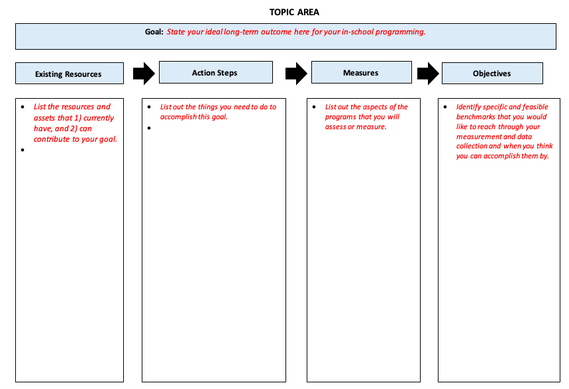
Essentially, logic models are a depiction of what you put into your program (resources, activities), what you hope to get out of it (short- and long-term outcomes), and how you’ll know you’re on track to do that (measures, benchmarks).

​Check out my post about the ins and outs of logic models here. 

2) Citations demonstrating the impact of similar programs

We can use online tools like Google Scholar to find existing evaluations and research studies that show that similar programs serving similar groups of kids or families had a positive impact.

​So, if you’re a program in a major urban center and you find a study demonstrating the effectiveness of a small, rural initiative, it’s probably best to keep looking. We want to compare apples to apples here.

You’ll also have to make sure that the studies you find meet the ESSA standards described in my last post. 

3) A plan for your future evaluation

All you need to do is put together a plan for how you are going to measure your program’s impact in the future. You’ll have to share who you’ll study, what you’ll look at, and when you’ll conduct this research. 

You may need to chat with an evaluator for this one. Don’t worry though – evaluations don’t have to be a multi-year, super expensive endeavor!

I hope you noticed that none of those three requirements needed any program data!

​So if you’re started to track your family engagement or student data, Level 4 gives you time to get your systems up and running, while still giving you access to the funds you need and the students and families you want to work with!

If you want to know how to DIY the ESSA Level 4 process, sign up below for Evidence for Engagement, the free mini course from Tamara Hamai and me!

​With weekly videos and worksheets, it will walk you through how to get your application ready for your local school district and get your foot in the door. 
Written by cplysy · Categorized: engagewithdata

Mar 25 2021

Funding is Coming: Get Your Evidence Ready!

Here’s a sentence we don’t often get to say in education: the motherlode of funding is coming our way!

The recently-passed American Rescue Plan Act has set aside … brace yourself … over $2 BILLION for out-of-school time (OST) — after-school and summer — programs!
​
Not to mention, there is funding for community schools and all the wraparound services that so rarely get enough attention or funding but are absolutely critical for bolstering families in underserved communities. 

This is a game changer for kids, families, schools, and OST/community school providers. 

But we can’t rest on our laurels and wait for the money to rain down on us. (Wouldn’t that be nice?) It’s time to be proactive! 

I’ve had a lot of conversations with OST folks recently about the Every Student Succeeds Act (ESSA)’s evidence requirements. 

Basically, if a school or district is going to purchase a program or services with federal funds (ie. Title I), they need to make sure that there is some evidence to show that what they’re purchasing is effective. 

Makes sense, right?

Unfortunately, that’s not as easy or straightforward as it sounds.

Many small, community-based, minority-owned organizations don’t have the capacity or funds to hire an evaluator. For me, this is a serious equity issue. 

But for no money, there is a way to get your foot in the door.

To be deemed evidence-based, a program needs to meet one of the following levels:


Level 1: Strong Evidence
  • Experimental study (randomized control trial)
  • Minimum of 350 participants

This means that you have two comparable groups of kids and randomly assign which group gets the program or intervention.

​Then you compare the two and see if there are statistically significant differences that you can attribute to the program.

This is super difficult and expensive to accomplish in education! Not a lot of programs are at Level 1, especially in the family engagement world.

Vertical Divider
Level 2: Moderate Evidence
  • Quasi- experimental study
  • Minimum of 350 participants

You still have two comparable groups, and one group is getting the program or intervention, but there was no random assignment, so there may be bias.

​You still compare see if there are significant differences between them, but you can’t say that the program or intervention​ caused those differences. 

This is a little easier to accomplish but still requires a lot of resources! 


Level 3: Promising Evidence
  • Correlational study
  • No minimum number of participants

​ 
Here you are compare the outcomes of two groups of kids with some fancy statistical measures to try to account for any possible bias. 

You are still looking for significant differences, but at Level 3, we can only say that there is a relationship between the intervention and those outcomes. 

This is where a lot of our family engagement and OST programs will eventually land. While not as rigorous as the first two levels, this is a much more feasible study design.

Vertical Divider
Level 4: Demonstrates a Rationale
  • Logic model of your program
  • Citations of studies of similar programs that have had an impact
  • Plan for evaluating your program

For level 4, you present a collection of supporting evidence that shows that it’s likely that your program has an impact on the kids and families you serve and also that you’re planning to study it. 

This is where we can get our foot in the door! Level 4 says that you have reason to believe your program makes an impact and gives you time to study it, while opening you up for most federal funding opportunities.


For most programs, Level 4 is a natural place to start. With a little bit of guidance and planning, you can be on your way to accessing Title funds!

Now, the American Rescue Plan Act does not seem to specify that spending is limited to evidence-based programs … but why hurt your chances of getting access to this lifeline?

Now is the time to position your program for maximum benefit from this upcoming funding opportunity. 

If you want to get more information about Level 4 and becoming evidence-based, sign up for the FREE mini-course that Tamara Hamai and I developed. Each week you’ll get emails with videos and graphic organizers to help you get ready to become an evidence-based organization!

Written by cplysy · Categorized: engagewithdata

Mar 09 2021

Education’s lessons learned from a year at home

Education’s lessons learned from a year at home

It’s hard to believe that a year ago this week, my husband and I returned from a trip to visit my family and went into lockdown for the first time.

At that time, the thought of staying at home for even two weeks straight sent my anxious brain into overdrive.

Now, it’s been a year since we’ve been in a restaurant, a year since I’ve been to the gym, and a year since I’ve seen most of my friends. Somehow, we’ve made it through this year of change, fear, and loss.

On a more positive note, it’s also been a year full of learning and growing as people and as educators. 

In reflecting on this past year, here are the biggest takeaways that (I hope!) the education world has realized:

1. Families are critically important partners in the work of educating children. 

In a recent teacher focus group, the challenges of connecting with families this year were their biggest concern.

No longer can we pretend that families and schools exist in separate planes. 

Educators have seen just how important family engagement is for getting their own work done.

​Teachers (and other critical school staff!) and families MUST be equal partners in the sometimes herculean task of educating children, especially those who come to school with a variety of needs and challenges.

2. Teachers and families both need to be commended for how well they adapted to educating children at home. 

I am constantly in awe of teachers this year — teaching is the hardest thing I’ve ever done, and I cannot imagine having to change basically every skill and strategy you’ve honed throughout your career in a flash. Their work was more challenging than ever during the pandemic, and in many cases, they put their health on the line to do the best they could for their kids.

Now, my dog is the only kid I’ve had to contend with this year (although he does make working from home challenging at times!). So I have great admiration for parents who have found ways to adapt their schedules, learn how to teach their children, and maintain positive, loving relationships in an unimaginable situation.

From the surveys and focus groups I’ve done over the past year, it’s been clear how hard this has been for educators families, and both groups deserve our respect and gratitude now more than ever.

via GIPHY

3. We can no longer rely on our memory or conversations with peers to know who we’re reaching and who we’re not. 

I’m sure you anticipated this lesson … but we MUST use data to drive our supports for children and families! Without kids and families in school buildings every day, a different approach was critical to figure out who was getting what they needed … and who had barriers that the school should help families overcome.

I’ve gotten to work with a number of different schools, districts, and organizations on their use of data this year, so imagine my PURE JOY to hear that a staff member at one of these schools said that with the use of the data tracker we developed, “We are no longer guessing.” 

That’s just it! We don’t have to guess.

We can use simple, low- or no-cost strategies (Don’t forget to download my free guide here!) to make sure we know EXACTLY what’s happening with each of our kids.

No one’s falling through the cracks on our watch.

By engaging families as equal partners, respecting the hard work that both educators and families contribute to the education of their kids, and by easily tracking how our families are engaging (sometimes more importantly, how we’re trying to engage with them), we open up a new world of home-school collaboration and possibilities for success. 

In the coming months, as we start to transition back to some semblance of normal life, I hope that we don’t regress and forget all that we’ve learned this year.

I’m excited to find new ways to support educators and families in their journey towards more equitable, data-informed partnership.

I have a few things up my sleeve for 2021, so stay tuned!

Let’s see how we can all continue to grow and learn together in this next phase of the year.

Archives


Select Month May 2021 April 2021 March 2021 February 2021 January 2021 December 2020 November 2020 October 2020 September 2020 August 2020 July 2020 June 2020 May 2020 April 2020 March 2020 February 2020 January 2020 December 2019 November 2019 October 2019

Tags

Attendance
Barriers to Success
Community Schools
Current Events
Data Tracking
Education
ESSA
Evaluation
Family Engagement
Inequality
Microsoft Excel
Professional Learning
Reflections
Surveys
Tools and Resources
Updates

Written by cplysy · Categorized: engagewithdata

Mar 09 2021

Education’s lessons learned from a year at home

It’s hard to believe that a year ago this week, my husband and I returned from a trip to visit my family and went into lockdown for the first time. 

At that time, the thought of staying at home for even two weeks straight sent my anxious brain into overdrive. 

Now, it’s been a year since we’ve been in a restaurant, a year since I’ve been to the gym, and a year since I’ve seen most of my friends. Somehow, we’ve made it through this year of change, fear, and in loss.

On a more positive note, it’s also been a year full of learning and growing as people and as educators. 

In reflecting on this past year, here are the biggest takeaways that (I hope!) the education world has realized:

1. Families are critically important partners in the work of educating children. 

In a recent teacher focus group, the challenges of connecting with families this year were their biggest concern.

No longer can we pretend that families and schools exist in separate planes.  

Educators have seen just how important family engagement is for getting their own work done. 

​Teachers (and other critical school staff!) and families MUST be equal partners in sometimes herculean task of educating children, especially those who come to school with a variety of needs and challenges.

2. Teachers and families both need to be commended for how well they adapted to educating children at home. 

I am constantly in awe of teachers this year — teaching is the hardest thing I’ve ever done, and I cannot imagine having to change basically every skill and strategy you’ve honed throughout your career in a flash. Their work was more challenging than ever during the pandemic, and in many cases, they put their health on the line to do the best they could for their kids. 

Now, my dog is the only kid I’ve had to contend with this year (although he does make working from home challenging at times!). So I have great admiration for parents who have found ways to adapt their schedules, learn how to teach their children, and maintain positive, loving relationships in an unimaginable situation.

From the surveys and focus groups I’ve done over the past year, it’s been clear how hard this has been for educators families, and both groups deserve our respect and gratitude now more than ever.

via GIPHY

3. We can no longer rely on our memory or conversations with peers to know who we’re reaching and who we’re not. 

I’m sure you anticipated this lesson … but we MUST use data to drive our supports for children and families! Without kids and families in school buildings every day, a different approach was critical to figure out who was getting what they needed … and who had barriers that the school should help families overcome. 

I’ve gotten to work with a number of different schools, districts, and organizations on their use of data this year, so imagine my PURE JOY to hear that a staff member at one of these schools said that with the use of the data tracker we developed, “We are no longer guessing.” 

That’s just it! We don’t have to guess.

We can use simple, low- or no-cost strategies (Don’t forget to download my free guide here!) to make sure we know EXACTLY what’s happening with each of our kids.

No one’s falling through the cracks on our watch. 

By engaging families as equal partners, respecting the hard work that both educators and families contribute to the education of their kids, and by easily tracking how our families are engaging (sometimes more importantly, how we’re trying to engage with them), we open up a new world of home-school collaboration and possibilities for success. 

In the coming months, as we start to transition back to some semblance of normal life, I hope that we don’t regress and forget all that we’ve learned this year. 

I’m excited to find new ways to support educators and families in their journey towards more equitable, data-informed partnership. 

I have a few things up my sleeve for 2021, so stay tuned!

Let’s see how we can all continue to grow and learn together in this next phase of the year.

Written by cplysy · Categorized: engagewithdata

Feb 23 2021

Your data tracking cheat sheet

In my last post, I talked about how logic models — although they can be a chore — can actually be a great visual roadmap of your program’s components, benchmarks, and goals. 

Working collaboratively to develop a logic model can be a unifying experience for teams, a way to get everyone on the same page about the work. 

But what keeps your finished logic model from disappearing into the dark void of your computer’s file system, never to be found or opened again?

If you’ve been reading my blog for awhile, you may know where I’m going… 

You can use your logic model to help design your team’s data tracking system! 
​
Although people design them differently, logic models always have a column for either the measures that you’ll use to assess progress (as I have in my template below) or the immediate outputs that would occur as a result of your activities.

Picture

If you’re measuring your family engagement efforts, some examples could include: 

  • Number of families attending school events
  • Number of home visits conducted
  • Percent of children whose families have engaged with the school in some way throughout the year
  • Number of parent/family leaders 

Your logic model is basically a cheat sheet to the data points you’ll want to track for your program!

​So if you follow the steps in my free guide to tracking your engagement data, you’ll see that you’ve already answered some of the questions in Step 1 — why you’re tracking the data. 

I don’t know about you, but I think that identifying the purpose behind each part of our work is often the hardest. But since you’ve already connected your measures to your short- and long-term goals, you’re ahead of the game!

With your logic model in hand, you’ll be ready to tackle the rest of the questions with ease and start tracking. 

If you haven’t gotten your hands on my free guide, use the form below to get your copy!

Written by cplysy · Categorized: engagewithdata

  • « Go to Previous Page
  • Go to page 1
  • Go to page 2
  • Go to page 3
  • Go to page 4
  • Go to page 5
  • Go to page 6
  • Interim pages omitted …
  • Go to page 11
  • Go to Next Page »

Footer

Follow our Work

The easiest way to stay connected to our work is to join our newsletter. You’ll get updates on projects, learn about new events, and hear stories from those evaluators whom the field continues to actively exclude and erase.

Get Updates

Want to take further action or join a pod? Click here to learn more.

Copyright © 2026 · The May 13 Group · Log in

en English
af Afrikaanssq Shqipam አማርኛar العربيةhy Հայերենaz Azərbaycan dilieu Euskarabe Беларуская моваbn বাংলাbs Bosanskibg Българскиca Catalàceb Cebuanony Chichewazh-CN 简体中文zh-TW 繁體中文co Corsuhr Hrvatskics Čeština‎da Dansknl Nederlandsen Englisheo Esperantoet Eestitl Filipinofi Suomifr Françaisfy Fryskgl Galegoka ქართულიde Deutschel Ελληνικάgu ગુજરાતીht Kreyol ayisyenha Harshen Hausahaw Ōlelo Hawaiʻiiw עִבְרִיתhi हिन्दीhmn Hmonghu Magyaris Íslenskaig Igboid Bahasa Indonesiaga Gaeilgeit Italianoja 日本語jw Basa Jawakn ಕನ್ನಡkk Қазақ тіліkm ភាសាខ្មែរko 한국어ku كوردی‎ky Кыргызчаlo ພາສາລາວla Latinlv Latviešu valodalt Lietuvių kalbalb Lëtzebuergeschmk Македонски јазикmg Malagasyms Bahasa Melayuml മലയാളംmt Maltesemi Te Reo Māorimr मराठीmn Монголmy ဗမာစာne नेपालीno Norsk bokmålps پښتوfa فارسیpl Polskipt Portuguêspa ਪੰਜਾਬੀro Românăru Русскийsm Samoangd Gàidhligsr Српски језикst Sesothosn Shonasd سنڌيsi සිංහලsk Slovenčinasl Slovenščinaso Afsoomaalies Españolsu Basa Sundasw Kiswahilisv Svenskatg Тоҷикӣta தமிழ்te తెలుగుth ไทยtr Türkçeuk Українськаur اردوuz O‘zbekchavi Tiếng Việtcy Cymraegxh isiXhosayi יידישyo Yorùbázu Zulu