• Skip to main content
  • Skip to footer
  • Home

The May 13 Group

the next day for evaluation

  • Get Involved
  • Our Work
  • About Us
You are here: Home / Archives for allblogs / engagewithdata

engagewithdata

May 19 2021

Use Your Data to Celebrate Families

Use your data to celebrate families

Educators: you’ve made it! It’s finally the end of the school year. 

And what a school year it was. 

I’m sure that there are all kinds of celebrations happening as this confusing, exhausting, stressful, and probably scary year comes to a close.

But if you’ve been tracking your student and family engagement data this year, there can be even more celebrations in store as you wrap up SY 2020-2021.

I often talk about using your data to identify needs, uncover gaps in services, and understand exactly who you are reaching and how. 

However, there are lots of other things you can do with all of the rich data you’ve collected, especially now that you have a year’s worth of information. 

One of the benefits of tracking your data is that you also can quickly identify your engagement all-stars and recognize their amazing efforts!

Here are a few examples: 


  • Think of the parents and family members who come to EVERYTHING you’ve planned.

    You know exactly who I’m talking about, right? They’re your biggest supporters!

    Of course, if you have a family engagement data tracker, sorting by the highest total engagements is a great way to identify this list too.

    The end of the year is a great time to show these families that you see them and appreciate how much effort they’ve put into supporting their kids and the school.

    If you have the funds for gift cards or other small gift, that’s great! If not, even printing out a certificate for them or mentioning them in your end-of-year school newsletter shows them how much you care.


  • If your teachers and staff are also tracking their engagement efforts, you can celebrate them too.

    I’ve helped some of my clients build shared tracking sheets for their whole school to document how they’re engaging families.

    With some quick sorting and filtering of their spreadsheet, they can see which teachers have gone above and beyond their minimum monthly outreach.

    These staff members should be celebrated too!

    Not only do they deserve a shout-out in a staff meeting or an award at your end-of-year staff party, but they should also be lifted up as leaders who can inspire and guide other staff who may struggle with engagement.


  • Don’t forget to recognize improvements!

    Those of you on attendance teams know that there is a lot of debate about only recognizing perfect attendance because it’s not always a realistic goal for all of our students and families.

    With family engagement too, we know that not all parents or family members can attend every event, answer every phone call, or work with their kids at home each night.

    That’s why it’s super important to recognize those who have improved over the course of the year.

    In your spreadsheets, you can quickly add columns to add up the number of engagements for each quarter. You can also add one at the end that finds the difference between those quarterly totals.

    Sort by that column to see which families or staff have the greatest positive difference from Quarter 1 to Quarter 4, and give them a shout-out, gift, or certificate, too!

Let’s be honest – celebrating kids, families, and staff is the fun part of the job! 

With a simple data tracking sheet, we’re able to maximize our impact on the tough stuff but also spend even more time on the fun parts. 

End your year on a high note by sharing all of the amazing growth your staff and families have demonstrated (and that you now have the evidence to prove!). 
Written by cplysy · Categorized: engagewithdata

May 14 2021

More ways to meet Engage with Data

More ways to meet Engage with Data

In case you missed last week’s announcement, my company, Structured Solutions Educational Consulting, has a new name!

I am so proud to have Engage with Data out in the world, and I appreciate all of the kind and supportive feedback I’ve received over the past week. 

I’ve had some awesome opportunities recently to share my work, so I wanted to share them with you!

Here are a few other ways you can get to know the new brand:

ClassTag White Paper Cover

ClassTag, a free communications app for schools and families, invited me to co-write a white paper about using Title I funds to support family engagement. 

The white paper launched this week! Click the button to get your copy.


Download the White Paper here

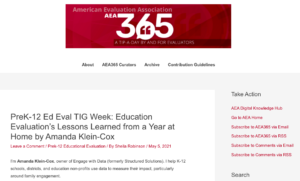
Read last week’s post on the American Evaluation Association’s AEA365 blog about what (I think) the world of educational evaluation has learned from the pandemic. 


Read the blog here

Screenshot of AEA365 blog post

Of course, you can also continue to check the website for updates, follow Engage with Data or me on LinkedIn or Twitter, and sign up for the email list below!

Written by cplysy · Categorized: engagewithdata

May 04 2021

Meet Engage with Data!

Meet Engage with Data!

Let me be real for a second: when I started Structured Solutions five and a half years ago, I was definitely building the plane as I flew it.

So when I had to choose a name, I came up with one that I thought sounded catchy (read: it used alliteration) and conveyed a message about how I operated.

As the years went on, I became increasingly unhappy with my business name. It just didn’t feel like me. 

So today, I am THRILLED to announce that my business has a new name: Engage with Data!

Engage with Data Logo

To me, this name represents two of my core beliefs:

1) That it’s critical for educators to use their data to guide their family engagement efforts; and 

2) That we should all get our hands dirty and really dig in to our data. 

The heart of my company hasn’t changed – the work is still the same, and so is my mission – to help educational organizations use the data they have to tell the story of the impact they’re having on children and families. 

Here’s what has changed:

I have worked hard to make my new brand a lot more fun and authentic to who I am and how I operate. 

I would love for you to explore (and share!) the new website: www.engagewithdata.com.

I hope that as you do, you’ll see a lot more of me shining through.

To those who have been helping me rebrand and get ready for today, I am truly grateful. 

To those who read my blogs and support my work, THANK YOU! Engage with Data would be nothing without you.

I am so excited to see what this new chapter in my business brings. 

Written by cplysy · Categorized: engagewithdata

Apr 20 2021

“Whose Evidence Is It?”

“Whose Evidence is It?”

I’ve been talking a lot about evidence lately, but I feel I’ve been missing a crucial piece.

As a reminder, the Every Student Succeeds Act (ESSA), our country’s primary federal education legislation, requires that programs and interventions purchased with federal education dollars must have be evidenced-based.

Most people know these federal dollars better as “Title I,” or the provision of the Act that allocates funds for schools and districts with large percentages of students from low-income families, although there are other funding streams as well.

Title I has always been a great way for small, community-based, and/or minority-owned organizations to work with schools in service of students and families who can benefit most from their support.

And now, those who have not been formally evaluated cannot qualify for these funds. 

Not only is that a hit to their financial lifeline, but it both reduces their access to the kids and families they serve and their ability to effectively serve them. 

That’s why I love working with small organizations who are new to evaluation work – to help them use data to tell their story and show why they qualify for the use of those funds. I’ve always seen it as an equity strategy.

In the fall, I was captivated by the keynote speaker at the Crane Center’s 2020 Symposium on Children, Dr. Iheoma Iruka. Here’s what Dr. Iruka said that stopped me in my tracks: “Whose evidence is it?”

She talked about the long history of maltreatment and discrimination in the collection of evidence, especially in medicine, and particularly for marginalized and minoritized communities.

Often, the organizations that could (and still can) afford the time, resources, and expertise to conduct rigorous evaluations did not represent or look out for the best interests of the people they were studying — and many did the exact opposite.

It made me realize that “evidence-based” can be a loaded term — one that brings up a lot of pain and distrust for many groups of people. 

Yet this term is here to stay for now, as most federal agencies have some requirement that their funds get spent on activities and interventions that can demonstrate their impact.

Now, this awful history is not my area of expertise, but it is one that I am trying to learn more about, for my own professional and personal growth.

However, here’s what I can say: we don’t have to rely on the research and evidence that exists in the world.

By developing our own base of evidence, we can ensure that all students and families are treated well and represented fairly and equitably in evaluations and program delivery.

And that starts with organizations doing the good work with kids and families ensuring that they, too, have a spot on those lists of evidence-based interventions. 

I know that’s easier said than done.

But don’t worry – it doesn’t have to be! I’ve got two great (read: FREE) opportunities for your organization to begin its evidence-based journey!

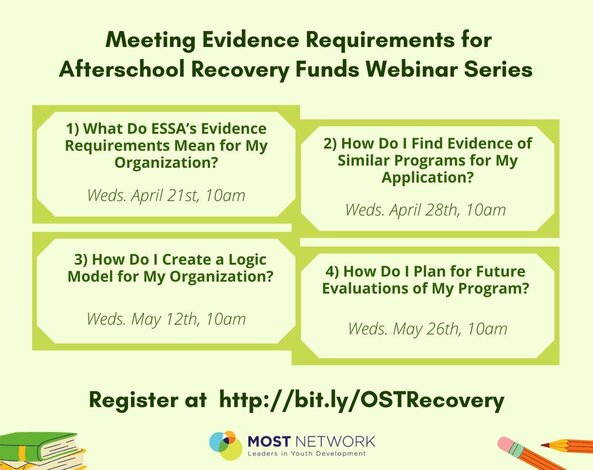
Starting tomorrow – and continuing through May, I’ll be hosting a workshop series on this exact topic, sponsored by the Maryland Out of School Time (MOST) Network! The first session — an ESSA overview — is tomorrow (4/21) at 10 AM EST.  See the image below for the full schedule. ​

Picture

And of course, you can always sign up for our free email mini-series, Evidence for Engagement, which will walk you through how to become a Level-4 approved vendor.

Archives


Select Month May 2021 April 2021 March 2021 February 2021 January 2021 December 2020 November 2020 October 2020 September 2020 August 2020 July 2020 June 2020 May 2020 April 2020 March 2020 February 2020 January 2020 December 2019 November 2019 October 2019

Tags

Attendance
Barriers to Success
Community Schools
Current Events
Data Tracking
Education
ESSA
Evaluation
Family Engagement
Inequality
Microsoft Excel
Professional Learning
Reflections
Surveys
Tools and Resources
Updates

Written by cplysy · Categorized: engagewithdata

Apr 20 2021

“Whose Evidence Is it?”

I’ve been talking a lot about evidence lately, but I feel I’ve been missing a crucial piece. 

As a reminder, the Every Student Succeeds Act (ESSA), our country’s primary federal education legislation, requires that programs and interventions purchased with federal education dollars must have be evidenced-based.

Most people know these federal dollars better as “Title I,” or the provision of the Act that allocates funds for schools and districts with large percentages of students from low-income families, although there are other funding streams as well.

Title I has always been a great way for small, community-based, and/or minority-owned organizations to work with schools in service of students and families who can benefit most from their support.

And now, those who have not been formally evaluated cannot qualify for these funds. 

Not only is that a hit to their financial lifeline, but it both reduces their access to the kids and families they serve and their ability to effectively serve them. 

That’s why I love working with small organizations who are new to evaluation work – to help them use data to tell their story and show why they qualify for the use of those funds. I’ve always seen it as an equity strategy. 

In the fall, I was captivated by the keynote speaker at the Crane Center’s 2020 Symposium on Children, Dr. Iheoma Iruka. Here’s what Dr. Iruka said that stopped me in my tracks: “Whose evidence is it?”

She talked about the long history of maltreatment and discrimination in the collection of evidence, especially in medicine, and particularly for marginalized and minoritized communities. 

Often, the organizations that could (and still can) afford the time, resources, and expertise to conduct rigorous evaluations did not represent or look out for the best interests of the people they were studying — and many did the exact opposite. 

It made me realize that “evidence-based” can be a loaded term — one that brings up a lot of pain and distrust for many groups of people. 

Yet this term is here to stay for now, as most federal agencies have some requirement that their funds get spent on activities and interventions that can demonstrate their impact.

Now, this awful history is not my area of expertise, but it is one that I am trying to learn more about, for my own professional and personal growth. 

However, here’s what I can say: we don’t have to rely on the research and evidence that exists in the world.

By developing our own base of evidence, we can ensure that all students and families are treated well and represented fairly and equitably in evaluations and program delivery.

And that starts with organizations doing the good work with kids and families ensuring that they, too, have a spot on those lists of evidence-based interventions. 

I know that’s easier said than done. 

But don’t worry – it doesn’t have to be! I’ve got two great (read: FREE) opportunities for your organization to begin its evidence-based journey! 

Starting tomorrow – and continuing through May, I’ll be hosting a workshop series on this exact topic, sponsored by the Maryland Out of School Time (MOST) Network! The first session — an ESSA overview — is tomorrow (4/21) at 10 AM EST.  See the image below for the full schedule. ​

Picture

And of course, you can always sign up for our free email mini-series, Evidence for Engagement, which will walk you through how to become a Level-4 approved vendor. 

Written by cplysy · Categorized: engagewithdata

  • « Go to Previous Page
  • Go to page 1
  • Go to page 2
  • Go to page 3
  • Go to page 4
  • Go to page 5
  • Interim pages omitted …
  • Go to page 11
  • Go to Next Page »

Footer

Follow our Work

The easiest way to stay connected to our work is to join our newsletter. You’ll get updates on projects, learn about new events, and hear stories from those evaluators whom the field continues to actively exclude and erase.

Get Updates

Want to take further action or join a pod? Click here to learn more.

Copyright © 2026 · The May 13 Group · Log in

en English
af Afrikaanssq Shqipam አማርኛar العربيةhy Հայերենaz Azərbaycan dilieu Euskarabe Беларуская моваbn বাংলাbs Bosanskibg Българскиca Catalàceb Cebuanony Chichewazh-CN 简体中文zh-TW 繁體中文co Corsuhr Hrvatskics Čeština‎da Dansknl Nederlandsen Englisheo Esperantoet Eestitl Filipinofi Suomifr Françaisfy Fryskgl Galegoka ქართულიde Deutschel Ελληνικάgu ગુજરાતીht Kreyol ayisyenha Harshen Hausahaw Ōlelo Hawaiʻiiw עִבְרִיתhi हिन्दीhmn Hmonghu Magyaris Íslenskaig Igboid Bahasa Indonesiaga Gaeilgeit Italianoja 日本語jw Basa Jawakn ಕನ್ನಡkk Қазақ тіліkm ភាសាខ្មែរko 한국어ku كوردی‎ky Кыргызчаlo ພາສາລາວla Latinlv Latviešu valodalt Lietuvių kalbalb Lëtzebuergeschmk Македонски јазикmg Malagasyms Bahasa Melayuml മലയാളംmt Maltesemi Te Reo Māorimr मराठीmn Монголmy ဗမာစာne नेपालीno Norsk bokmålps پښتوfa فارسیpl Polskipt Portuguêspa ਪੰਜਾਬੀro Românăru Русскийsm Samoangd Gàidhligsr Српски језикst Sesothosn Shonasd سنڌيsi සිංහලsk Slovenčinasl Slovenščinaso Afsoomaalies Españolsu Basa Sundasw Kiswahilisv Svenskatg Тоҷикӣta தமிழ்te తెలుగుth ไทยtr Türkçeuk Українськаur اردوuz O‘zbekchavi Tiếng Việtcy Cymraegxh isiXhosayi יידישyo Yorùbázu Zulu