• Skip to main content
  • Skip to footer
  • Home

The May 13 Group

the next day for evaluation

  • Get Involved
  • Our Work
  • About Us
You are here: Home / Archives for allblogs / evalacademy

evalacademy

Jul 14 2021

What to Put in Your Evaluation Contract


Congratulations, evaluator, you’ve landed a client! Or maybe your organization has selected an evaluator to complete an exciting project. Either way, your next step is a contract for evaluation services. 

It’s always safest to have a contract in place before any work starts. As the contractor, it helps ensure that you will be compensated for your time and efforts, and as the commissioner, the contract helps you protect your information and confirm the services and deliverables you expect.

Agreeing on contract terms can be complicated. For more complex evaluation projects, you may want to consider two separate contracts: one for evaluation planning, and a subsequent contract outlining the scope of data collection, analysis, and reporting.

Contracts may be drafted by either the evaluation commissioner or the evaluator/firm hired. Smaller organizations may be relieved to have the evaluation firm initiate the contract, while larger organizations may have internal procurement processes that must be followed. 

Monochrome Mountain Landscape Photo Travel Postcard.png

Below are some components you should include, or at least consider, in your evaluation contract.

Please don’t mistake this article for sound legal advice, though! If you have the resources, it’s best to have a lawyer review your contract template or individual contracts.


1. Names

Well, this one is probably obvious. But be sure to include each entity’s legal name, and possibly their “operating as” name if applicable.

2. Term

Define the dates the contract begins and ends. An end date may be difficult to assign for complex projects. It may be prudent to make the contract end date a few weeks later than you currently expect to hand over the final deliverable.

It can also be helpful to include a statement indicating that the contract term will be revisited at a certain date (perhaps one month or two weeks before the end date) and possibly extended. Many events beyond your control may change the timeline, so giving yourself some additional time in the contract may save some paperwork.

3. Compensation

Set out how payment is determined, whether by an hourly rate or a cost per deliverable. Indicate when invoices will be delivered (Monthly? Quarterly? Upon completion of certain deliverables?) and to whom.

You can also describe what needs to be included on those invoices; some clients prefer something akin to a timesheet, while others may be satisfied with a list of activities or products delivered. Compensation details are sometimes included as a separate schedule to follow the main body of the contract.

4. Expenses

Clarify who is responsible for any expenses such as travel, focus group incentives or printing, and whether expenses should be approved in advance.

5. Deliverables or Services Provided

The details of deliverables or scope of services are sometimes included in a schedule appended to the main contract. This section requires both parties to assess their level of comfort with ambiguity. Do you want to be very specific, outlining each step of the process and the details of the deliverables, or more general? Using general language introduces more room for interpretation – and therefore more risk – while very specific language may limit the ability to adapt to emergent situations or needs.

Some contracts may detail the headings or sections required in a final report, while others may simply state that a final report is required. Think carefully about whether any raw data files are to be provided as deliverables; clients sometimes want this information, but your professional ethics as an evaluator may prevent you from providing this kind of deliverable.

6. Acceptance/Approval of Deliverables

Who determines when something is done? It can be very helpful to clarify this responsibility upfront. Is a formal signoff required, or is verbal confirmation acceptable?

You may also want to clarify the process for reviewing document drafts; for example, a request to incorporate potentially conflicting feedback from eight separate committee members means something very different to the evaluator’s time than addressing feedback collated by the contract manager.

7. Termination

All contracts should have some sort of exit clause. Not all projects run smoothly, so it’s best to have guidance for how either party can end the contract. Define how much notice must be given, and how the evaluator will be compensated for work completed.

Termination clauses often list several different scenarios that are grounds for termination, such as contractor bankruptcy, non-compliance with contract terms, refusal to perform services, or even contractor death.

8. Non-competition and Non-Solicitation

The evaluator will be in a position of confidence, accessing information that is not publicly available and potentially sensitive. This clause can define the contractor’s obligation to refrain from using the organization’s confidential information to further their own business interests.

9. Confidentiality

Be sure to outline the evaluator’s responsibility to keep the organization’s information confidential and secure. This clause may reference a separate confidentiality agreement or constitute an agreement to protect confidentiality on its own.

10. Intellectual Property/Ownership

The evaluator will likely be producing data collection tools and knowledge products as part of the contract – who owns these materials? Who can use them, and under what circumstances? Survey tools, for example, may be developed exclusively for this contract – do they belong to the evaluator or the organization that hired them?

In this section, you can also indicate how evaluation reports should be referenced, or whether the evaluator can share reports with potential new clients as work samples.

11. Dispute Resolution

Describe the process to be followed in case of any disputes. Will a third party be engaged to remediate? Or are there existing internal processes to be followed? In our experience, formal disputes are rare, but this clause will provide guidance should any arise.

12. Assignment and Subcontracting

Assignability clauses outline whether and when a contract can be assigned to another entity. If the evaluator determines they are unable to undertake the work as described, can they hire another firm or individual to complete it? Many evaluation contracts are non-assignable – after all, the organization has selected the evaluator they thought best for the job. Based on past experiences, they may be wary of a “bait and switch” situation.

Subcontracting a portion of the work (for example, transcription, data entry, or data collection at a remote site) may be perfectly reasonable – just be sure to clarify when subcontracting arrangements may be made, and whether the evaluation commissioner has a role in approving the firm or individual being subcontracted.  

13. Other Legal Bits

Most contracts will have several other clauses that are relatively immaterial to the evaluation work, but important for legality. These include standard clauses on interpretation, “entire agreement,” enurement, unenforceable terms, and limitation of liability. For these sections, be sure to have your lawyer provide or review some text. 

14. Signatures

The final piece! Provide space for each party to sign, along with their name, role, and date. 

15. Final Copies

In our experience, most contracts are signed digitally rather than on paper. But if your contract requires physical copies, clarify which party will hold the original, or whether two original copies must be signed and held by each part.

PRO TIP: If you don’t already have a relationship with a lawyer, ask your business-minded friends for a recommendation, or try a service such as Upwork or UpCounsel  to find short-term support.


To learn more about applying evaluation in practice, check out more of our articles, or connect with us over on Twitter (@EvalAcademy) or LinkedIn.


Sign up for our newsletter

We’ll let you know about our new content, and curate the best new evaluation resources from around the web!


We respect your privacy.

Thank you!



Written by cplysy · Categorized: evalacademy

Jun 24 2021

Evaluation Roundup – June 2021

Welcome to our monthly roundup of new and noteworthy evaluation news and resources – here is the latest.

Have something you’d like to see here? Tweet us @EvalAcademy!

New and Noteworthy — Reads

How Funders Seek and Use Knowledge to Influence Philanthropic Practice

A new study, commissioned by the William and Flora Hewlett Foundation and conducted by Engage R+D in partnership with Equal Measure, recently released a report that examined how funders find and use knowledge to influence their philanthropic practice. Diversity, equity, and inclusion (DEI) emerged as the leading topic of interest for funders. The study found that the specific information related to DEI ranged depending on funders’ DEI journey. However, some funders emphasized the necessity of community voice and lived experience to inform DEI efforts.

Values, Voice, and an Equitable Vision of Validity

If you are interested in reading more about voice, this essay by Jara Dean Coffey (Director of the Equitable Evaluation Initiative) is a must-read. In this essay, Coffey eloquently articulates why it is time to “elevate and integrate voice as an essential element of validity” in our research and evaluations. She discusses how white and western concepts of validity have dominated and how diversity and lived experience are not recognized as valid but added context to the analysis.

UNDP Evaluation Guidelines

The UNDP recently updated its Evaluation Guidelines. The Evaluation Guidelines give renewed emphasis to the importance of planning for evaluations and provide greater detail on expected roles and responsibilities for evaluation. The updated guidelines include seven sections, covering Evaluation Function, Decentralized Evaluation in UNDP, Evaluation Planning, Evaluation Implementation, Evaluation Roles and Responsibilities in Decentralized Evaluations, Quality Assessment, and a FAQ section.

Fashion for Good: Evaluation Report

Are you interested in seeing how others are conducting evaluations and how they are sharing back their results? Take a look at this evaluation from the Laudes Foundation that used a rubrics-enhanced evaluation framework.

New and Noteworthy — Events

Gender-Transformative Program Design and Evaluation 

Organized by: EnCompass LLC

Dates: July 12 – 19

Instructor: Tessier Catsambas

Measurement Evaluation and Learning (MEL)

Organized by: Clear Horizon Academy

Starting Date: July 30, 2021 (15 Week Online Course)

CDC Applied Research and Evaluation Fellowship

Organized by: Centers for Disease Control and Prevention (CDC)

Application Deadline: August 18, 2021

Written by cplysy · Categorized: evalacademy

Jun 08 2021

Project Management for Evaluation


Sometimes managing evaluations can feel like herding cats. Despite your best efforts at nailing down methods, timelines, and other evaluation requirements, plans tend to change, especially if you aren’t paying attention.  

Evaluators work in multiple environments and just like there’s no one-size-fits-all evaluation plan, I’ve found there’s no one-size-fits-all project management solution for managing evaluations.

Based on my experiences and as a self-proclaimed process geek, I’ve accumulated my top project management tools and strategies to help keep your evaluation projects on track and ensure they meet your stakeholder’s needs.  

pexels-fauxels-3183186.jpg

First, there are project management tools – systems and processes that you can use to keep your evaluations on time and on budget.

Using our evaluation plan template helps you plan your evaluation and is the first set of tools you can use to determine what needs to get done when.

But managing the execution of that plan is where project management tools come in handy.

Traditional Project Management Strategies

If your evaluation work involves: 

  • A single evaluation project, 

  • Firm deadlines, 

  • Dedicated project staff, 

  • Internal control of data (i.e., collected, collated, accessed, analyzed by your team) 

you can draw from more traditional project management strategies, where specific tasks are assigned to specific people with estimated amounts of time to complete them. Tasks are linked together depending on the order in which they must be completed and generally the evaluation is executed in a linear fashion.

Examples of these more ‘traditional’ tools include: 

  • Project timelines or Gantt charts 

  • Programs like MS project or Forecast that are designed based on assigning tasks with set timelines to specific people  

  • Progress and status updates

Agile Project Management Strategies

Once you begin adding more complexity, like: 

  • Multiple evaluation projects, 

  • Estimated or loose deadlines, 

  • Shared project resourcing, 

  • External control of some data (i.e., evaluation partners are collecting or analyzing data) 

traditional tools tend to stop working as well. In my experience, items can easily be forgotten or get off track once the evaluation(s) you manage have these additional elements of complexity. A Gantt chart works well to estimate work, but if deadlines are continually changing, you will need to continually update the chart and add additional tools to your arsenal. 

Some of these additional tools can be gleaned from less traditional or ‘agile’ project management strategies (https://www.apm.org.uk/resources/find-a-resource/agile-project-management/). Agile project management was created for managing projects in software development, where management must be adaptive, not anticipatory. Agile projects work in cycles to maintain flexibility and to respond to constantly changing demands. Examples of these tools include: 

  • KanBan boards; where tasks are moved between three lanes: To Do, Doing, Done 

  • Programs like Asana or Trello that are designed around creating a list of tasks, then assigning people and updating progress on an ongoing basis 

  • Simple tracking documents such as calendars or spreadsheets to keep track of items 

  • Frequent meetings (some methods advocate for daily!) to divide up work and assess project risks 

In one sense, these less traditional methods seem more rudimentary; they’re based on the idea of keeping a rolling list of tasks and deadlines, rather than outlining all of the plans and steps at the start.


At Three Hive, we work on multiple evaluation projects, some with firm deadlines, some without; we share staff between evaluations based on availability and expertise; and very often we rely on our clients for some or most of the data we use in the evaluation.

Essentially, traditional project management tools and software do not meet our needs. What I’ve learned from working in this environment a set of principles and strategies that help me to help me juggle competing tasks and demands.

1. Be utilization-focused

We have utilization-focused evaluation and I advocate for taking a utilization-focused project management approach. That is, be adaptable and focus on managing the work in a way that makes sense for you, your team, and the evaluation(s) at hand. Don’t get hung up on adhering to certain processes and tools if they aren’t meeting your needs. If Gantt charts don’t make sense for managing an evaluation, ditch them!

2. Communication is key

Communicate clearly with both your client and your team. Start communicating early and be consistent. Give people the information they need to help make decisions and be upfront about your constraints. Notify team members and clients ahead of time if you are going to need something from them; assume your project is not at the forefront of their minds and that they will need to be reminded about tasks and deadlines. Manage expectations by being proactive and highlight the risks, benefits, and consequences of action or inaction.

3. Don’t live and die by the plan

Managing evaluation projects requires responding to change. Being overly rigid in your process, methods, and timelines will lead to you being out of touch with what you are evaluating. Build in space for review and course correction. Unless fidelity to the original evaluation plan is an important measure of success, focus on delivering a quality product and setting up your team for success.

4. Redundancy is kind of good

Having redundancy in your project management tools is probably going to happen when you are managing complex projects. I would argue that redundancy in methods is actually a good thing – it serves as a double-check for your project management constraints and assumptions. The key is to find the balance between too much and too little redundancy.

5. Use your data

Well, first off, collect it, then use it! Look at past budgets and timelines to help you gain a better understanding of how long certain evaluative activities take. At Three Hive, we use Harvest to track our work and monitor budgets. Use that information to constantly improve your project management skills. Ask yourself and your team what could be improved and what worked well after each stage of the evaluation.


For my own use, I use high-level planning tools such as Gantt charts combined with short-term to-do lists and calendar reminders.

Our Three Hive team meets weekly to discuss what is on our plate for the week and our team has an excel spreadsheet outlining upcoming projects and tasks which will require support from various team members. These methods allow for flexible scheduling and prioritization among the team.

I’m sure by the time you, the reader, are reading this article, part of this system will have changed or evolved.

Be sure to check out our evaluation plan template to get you started in the right direction! 

Download our Evaluation Plan Template


To learn more about applying evaluation in practice, check out more of our articles, or connect with us over on Twitter (@EvalAcademy) or LinkedIn.


Sign up for our newsletter

We’ll let you know about our new content, and curate the best new evaluation resources from around the web!


We respect your privacy.

Thank you!


Written by cplysy · Categorized: evalacademy

Jun 07 2021

Evaluation Roundup – May 2021

Welcome to our monthly roundup of new and noteworthy evaluation news and resources – here is the latest.

Have something you’d like to see here? Tweet us @EvalAcademy!

New and Noteworthy — Reads

How Far Dare an Evaluator Go Toward Saving the World?

The American Journal of Evaluation recently published an article by Michael Quinn Patton (MQP) that outlines value statements from a diverse group of 40 evaluators working in philanthropic foundations. These value statements are an update to Robert Stake’s 2004 publication “How Far Dare an Evaluator Go Toward Saving the World?” The article includes a list of what evaluators care about and emphasize in their practice. MQP also includes his additions to the list, along with the facilitation steps and a process for illuminating evaluators’ values.

Checking our bias in “unbiased” research instruments: applying a diversity, equity and inclusion lens to instrument design

This recent blog post by Evidence for Action discusses how Diversity Equity and Inclusion (DEI) principles and practices can be applied in the design or evaluation of research instruments, such as survey questionnaires, cognitive or psychosocial assessments, tests, or checklists. This post also offers a supplemental methods note where the authors offer a snapshot of the instrument design process.

Creating Effectiveness Principles for Principles-Focused Developmental Evaluation in Health-Care Initiatives

The Canadian Journal of Program Evaluation’s spring issue contains an article that dives into the practical application of principle-focused developmental evaluation. The article focuses on three evaluations conducted in British Columbia and highlights lessons learned through the process of creating effectiveness principles.

New and Noteworthy — Tools

Useful Questions for Analysis and Reporting Challenges and Changes  

Evaluation Support Scotland recently shared a two-page document that lists key questions you can ask as you analyze your evaluation data and get ready to report on challenges and changes.

New and Noteworthy — Events

gLOCAL Evaluation Week 

Organized by: Global Evaluation Initiative

Dates: May 31 – June 4 

Building Forward Better: Towards Renewed Global Evaluation Agenda 

Organized by: Global Evaluation Agenda

Date: June 1; 5:30 PM (Rome) 

GEI – Evaluation Can Spark Change & Better Decision Making! 

Organized by: Global Evaluation Initiative

Dates: June 9 & 10; 10:00AM (EDT) 

Engaging Your Collaborators with Data Parties 

Organized by: Community Solutions Planning & Evaluation

Date: June 17; 9:30AM – 12:00PM (PT) 

Cost: $100.00 (USD) 

Using Data Analysis & Visualization to Drive Social Impact 

Organized by: Clear Horizon Academy

Dates: June 24 

Duration: 6 weeks 

Cost: $1200.00 (AUD)

Written by cplysy · Categorized: evalacademy

Jun 07 2021

What to Include in your Evaluation RFP


In an evaluation consultant’s ideal world, potential clients would show up in our inboxes and ask us to be their evaluators because they’ve heard about how great we are or have worked with us before.

But in the real world, organizations must follow procurement policies or are seeking the best expertise or best value for money they can find, so they issue a public Request for Proposals. 

Evaluation consultants and firms who respond to RFPs know that some are good, and some are …not good.

A good RFP will yield good proposals. Unclear RFPs with overly burdensome submission requirements may drive away highly qualified firms or consultants, and what submissions do come may miss your intended mark.

If you’re creating an evaluation RFP, include these elements to get better submissions.


1. Information about your initiative

  • Background: Tell proponents what your program does, when it started, who you serve, and where. 

  • Existing evaluation documents: Share whether you already have a logic model or theory of change, an evaluation plan, or organizational policies about evaluation. You can share these documents with your RFP, you can make them available upon request only, or just let proponents know that they exist. 

  • Available data: If you already have some data from registration or intake, or you’ve done some surveys, tell your proponents about that data. Knowing if you’ve already been tracking outcomes, for example, will help your proponent to design their approach. It’s helpful to share any details about the quantity and quality of the data, and the file format.

2. About the evaluation

  • Evaluation purpose and questions: Tell proponents why you want to evaluate. Are you still planning your program, and want the evaluation to help develop it? Do you want to make decisions in the future? To learn as you go and inform program development? To meet your funder’s requirements? To share learnings broadly? If you have some evaluation questions in mind, describe them. 

  • Project scope: Describe what you want to evaluate. Is it your whole program? A specific component? How many sites? How many clients/participants/patients?

  • Timelines: Timelines should include when the work should start, when it should end, and any other important dates or seasons that matter. Think about when you need a report, or whether summer vacations or grant submission timelines might play a role in the project.

  • Deliverables: You may not know all the details at this point, but share your thoughts on what you want the proponent to produce. A written report is a common deliverable, but there may be other information products needed along the way, such as interim reports, data summaries or progress updates, or you might want to produce a journal article or white paper.

  • Budget: Let’s be clear: you need to include a budget in your RFP, whether that’s a ceiling or a range. If you only have $15,000 to spend, a submission for $275,000 isn’t going to help. “But won’t everyone aim for that top dollar amount? How do we get the best value for our money?” You can still score on pricing and value for money, but if proponents know how much available, they will design a much more feasible proposal. If you don’t know how much you should allocate, you may want to have a quick chat with an evaluator or a colleague to get some general estimates. Remember, deciding whether to write a proposal is a business decision for evaluation firms and consultants—they don’t want to waste their time or yours. 

  • Methods: You might not need to list your methods, but if you MUST do a Social Return on Investment, or if you strongly prefer NOT to run focus groups, put that in your RFP. Consider leaving the decisions about specific methods to the planning process, after you’ve hired your fantastic evaluator. 

To see how evaluators scope out a project, see our Program Evaluation Scoping Guide.

3. About who you seek

  • Evaluator/firm requirements: Share what you’re looking for in your successful proponent. Does your firm need to be local? Are you looking for a team or an individual? Do they need to have any specific credentials? How much, and what kind of experience do they need? While some content experience is helpful, it’s not always necessary; evaluation is a discipline with tools and approaches that can be applied to a wide variety of content areas. 

  • Insurance requirements: Evaluators should hold professional liability insurance. You can clarify what amount of insurance your evaluator should carry – some common amounts are $1 million, $2 million or more, depending on your organization and the nature of the project.  

4. The proposal

  • What to include in the proposal: Please. Please, don’t make your proponents work in templates or online forms. The proposal is a chance for you to see how your proponents write and design. Your final report probably isn’t going to be written in a clunky Word template, right? Listing some common elements that you want each proponent to speak to is helpful – content experience, methods expertise, capacity, proposed evaluation approach, project management, budget, team composition, subcontracting arrangements, references, resumes, etc. 

  • Page limits: If you are limiting pages (and we don’t think you need to – if you’re looking for a concise proposal, just say so!), consider whether what you’re asking for can actually fit in the page limit. You’re probably not printing this document anyway, so a proposal with more pages but more white space will probably be easier to read.

5. The submission process

  • Submission process: Hopefully, the days of couriering multiple copies of proposals and supporting documents are behind us. But if you require proposals to be named in a certain way, sent to a particular email address or to contain a specific subject line, list those details. Make sure the deadline for submissions is clear, including your time zone.

  • Work samples: It can be difficult for evaluation firms to submit samples of their projects because many reports are prepared in confidence and not made publicly available. If you do require sample reports to be submitted, please clarify that you will limit sharing to the review committee, and delete the files after you’ve made your decision.

6. The selection process

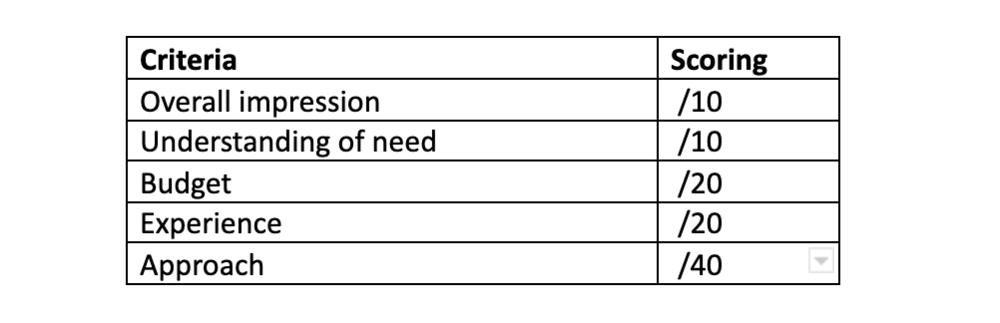
  • Proposal scoring: What will proponents be ranked on? Will a total score be calculated based on budget, approach, expertise? Your criteria might look something like this: 

Screen Shot 2021-06-07 at 7.02.11 AM.png
  • Shortlisting: Let your proponents know what happens after you score all submissions. Some organizations select their evaluation firm based on the written proposal only, while others prefer to invite a few for interviews before making their final decision.

  • Communication timelines: Share your expected timelines for communicating with proponents. If your selection process is delayed, it is courteous to send a brief update to proponents—each of whom probably really wants to work with you. 

Following these tips should help you to attract high-quality proposals. Our final suggestion is to spend some time before writing your RFP to ask yourself the following questions:

  • Who needs to know what? Who are our partners? How will they want to be involved in the evaluation? What do we expect to learn, and what do our partners need to know?

  • What really matters? Is it more important that you find the least expensive option, or is deep content experience a priority? Are you open to creative approaches, or do you have a firm methodology in mind? Do you want a very structured workplan, or are you comfortable with the ambiguity inherent in a collaborative planning process?

  • What is our budget? If you don’t have a precise budget in mind, you must have some range. Is the budget flexible? If you’re incredibly impressed with an approach, can you find extra budget to accommodate?

  • Who decides? Do you have a review committee? Are they available to meet and make decisions together? How will you reach consensus?

  • Is this RFP process genuine? If you already know who you want to hire, why not save everyone a lot of time and effort and just hire them? There are a few clues that proponents read as indicators that the winner has already been pre-determined:

    • A very short turnaround time

    • A request for very specific experience

    • Limited circulation of posting


Want to take these tips with you? Download our Evaluation RFP Checklist. 

Download our Evaluation RFP Checklist

Not sure where to post your RFP? Processes vary by region and by sector, but the Canadian Evaluation Society, American Evaluation Association, Australian Evaluation Society, European Evaluation Society, and other regional evaluation bodies offer RFP or tender hosting and distribution. 


To learn more about applying evaluation in practice, check out more of our articles, or connect with us over on Twitter (@EvalAcademy) or LinkedIn.


Sign up for our newsletter

We’ll let you know about our new content, and curate the best new evaluation resources from around the web!


We respect your privacy.

Thank you!


Written by cplysy · Categorized: evalacademy

  • « Go to Previous Page
  • Go to page 1
  • Interim pages omitted …
  • Go to page 28
  • Go to page 29
  • Go to page 30
  • Go to page 31
  • Go to page 32
  • Interim pages omitted …
  • Go to page 43
  • Go to Next Page »

Footer

Follow our Work

The easiest way to stay connected to our work is to join our newsletter. You’ll get updates on projects, learn about new events, and hear stories from those evaluators whom the field continues to actively exclude and erase.

Get Updates

Want to take further action or join a pod? Click here to learn more.

Copyright © 2026 · The May 13 Group · Log in

en English
af Afrikaanssq Shqipam አማርኛar العربيةhy Հայերենaz Azərbaycan dilieu Euskarabe Беларуская моваbn বাংলাbs Bosanskibg Българскиca Catalàceb Cebuanony Chichewazh-CN 简体中文zh-TW 繁體中文co Corsuhr Hrvatskics Čeština‎da Dansknl Nederlandsen Englisheo Esperantoet Eestitl Filipinofi Suomifr Françaisfy Fryskgl Galegoka ქართულიde Deutschel Ελληνικάgu ગુજરાતીht Kreyol ayisyenha Harshen Hausahaw Ōlelo Hawaiʻiiw עִבְרִיתhi हिन्दीhmn Hmonghu Magyaris Íslenskaig Igboid Bahasa Indonesiaga Gaeilgeit Italianoja 日本語jw Basa Jawakn ಕನ್ನಡkk Қазақ тіліkm ភាសាខ្មែរko 한국어ku كوردی‎ky Кыргызчаlo ພາສາລາວla Latinlv Latviešu valodalt Lietuvių kalbalb Lëtzebuergeschmk Македонски јазикmg Malagasyms Bahasa Melayuml മലയാളംmt Maltesemi Te Reo Māorimr मराठीmn Монголmy ဗမာစာne नेपालीno Norsk bokmålps پښتوfa فارسیpl Polskipt Portuguêspa ਪੰਜਾਬੀro Românăru Русскийsm Samoangd Gàidhligsr Српски језикst Sesothosn Shonasd سنڌيsi සිංහලsk Slovenčinasl Slovenščinaso Afsoomaalies Españolsu Basa Sundasw Kiswahilisv Svenskatg Тоҷикӣta தமிழ்te తెలుగుth ไทยtr Türkçeuk Українськаur اردوuz O‘zbekchavi Tiếng Việtcy Cymraegxh isiXhosayi יידישyo Yorùbázu Zulu