• Skip to main content
  • Skip to footer
  • Home

The May 13 Group

the next day for evaluation

  • Get Involved
  • Our Work
  • About Us
You are here: Home / Archives for allblogs / innovationnet

innovationnet

Oct 20 2020

5 Questions to Ask about 501(c)(4) Organizations in Advocacy Ecosystems

By Johanna Morariu

Advocacy ecosystems are a community of interacting individuals and organizations. They unite around a shared purpose of influencing policies and practices of institutions. A quote attributed to Helen Keller, “Alone we can do so little; together we can do so much,” aptly sums up what it takes for advocates to be successful in local, state, and national policy change campaigns.

Many different types of organizations make up these ecosystems, including policy advocacy organizations and think tanks, community organizing groups, memberships and associations, faith organizations, labor groups, and funders. For the most part, philanthropic funding and evaluation efforts have focused on the role of 501(c)(3) organizations within these ecosystems.

By Tim Mossholder @ https://unsplash.com/photos/zs-PAgqgenQ

So, why should we pay attention to 501(c)(4) organizations in advocacy ecosystems? It takes many organizations, coalitions, allies, and others to influence policy change. Rarely if ever is one organization or individual able to catalyze a policy change victory. Often, 501(c)(4) organizations are a critical part of these efforts, but less visible.

Many 501(c)(4) advocacy organizations play special roles in their advocacy ecosystems. Staff of 501(c)(4) organizations work with decision-makers behind closed doors, speak on behalf of other advocates, and negotiate policy deals. And 501(c)(4) organizations can engage in potent strategies that are off-limits to 501(c)(3) organizations. Because of this special role, it is important to better understand the role of 501(c)(4) organizations in advocacy ecosystems.

What are 501(c)(4) advocacy organizations? A 501(c)(4) organization is a social welfare organization that may pursue educational, lobbying, and some limited political activities. 501(c)4 organizations are especially important in policy change efforts as they can engage in issue-based advocacy and the political process.

What might happen if we don’t pay attention to 501(c)(4) organizations in advocacy ecosystems? While the unique role and contributions of 501(c)(4) organizations are often needed for policy change, funding for these activities can be scarce or non-existent. From an advocacy strategy perspective, if 501(c)(4) organizations are needed in an advocacy ecosystem but are not present or funded, a critical gap exists and the ecosystem may struggle to be effective. If an evaluation of the ecosystem is performed and takes the common focus on 501(c)(3) organizations, there is likely to be a critical deficiency in our understanding of the advocacy ecosystem.

I hope you agree that it is important to understand 501(c)(4) organizations within advocacy ecosystems. To help you get started, here are five questions I’ve used in my work.

1. What is the size and location of the 501(c)(4) resources in the advocacy ecosystem?

How do these resources compare to the 501(c)(3) resources in the advocacy ecosystem?

Within an advocacy ecosystem, the amount and type of resources going toward 501(c)(3) vs. 501(c)(4) organizations determines the scale and nature of an advocacy campaign. The extent to which those resources and the work they support are complementary may make an ecosystem more or less effective.

Knowledge of the location and size of 501(c)(3) and 501(c)(4) organizations in the ecosystem provides a foundation on which to build further analysis. For example, who are the influential 501(c)(4) organizations in the advocacy ecosystem and how are they regarded by influential 501(c)(3) organizations? Or how are the influential 501(c)(4) organizations regarded by organizations that have a base of directly affected people?

To dig in to this question, here are two assessment options I’ve used:

● Collect grantmaking/financial data from funders and grantees via document reviews, interviews, and other forms of data collection.

● Layer this information on organization profiles or a network map.

In my experience, this can be challenging information to collect. Advocates and their funders may be unwilling or unable to share complete funding information.

2. Who is the 501(c)(4) organization accountable to?

Does the 501(c)(4) organization have its own base of directly affected people? How does this affect their role in their advocacy ecosystem?

In my experience evaluating advocacy efforts for nearly 15 years, organizations that have a base or are more directly accountable to a constituency behave differently than other organizations. Organizations with a defined constituency, members, or other forms of a “base” may engage in policy negotiation differently. They may move slower at times, as they collect input and feedback from their base. Or they may behave differently in policy negotiations, as people in their base grapple with how their lives may change with the policy ramifications.

To dig in to this question, here are two assessment options I’ve used:

● Surveys, interviews, or desk research to identify which organizations have members and if those members are people who are directly impacted by the advocacy issue.

● Layer organization data on network maps to get a feel for which organizations are more/less accountable to a base or where their accountability lies. Take a close look at key influence and decision-making areas of the network such as relationship hubs, coalitions, and key actors.

3. What is the nature of relationships among 501(c)(3) and 501(c)(4) organizations?

As the 501(c)(4) organization can be a gatekeeper with decision-makers, do the 501(c)(3) organizations trust the 501(c)(4) organization to speak and act on their behalf?

Relationship dynamics are a key component that can help or hinder success in advocacy ecosystems. Are advocates able to work through tough decisions on strategy and resources? Do advocates trust each other and depend on each other?

To dig in to this question, here are two assessment options I’ve used:

● Interviews or surveys with advocates from across an advocacy ecosystem to gauge their relationships with each other. Depending on the situation, this could be generally about the ecosystem or specifically about relationships between specific advocates.

● Observation of campaign forums and communication.

By Photo Boards @ https://unsplash.com/photos/KZNTEn2r6tw

4. How well aligned and coordinated are the goals and strategies of 501(c)(4) and 501(c)(3) organizations?

Are the “inside” and “outside” games pointed in the same direction? Are both sufficiently resourced?

When advocates make good use of the complementary contributions of 501(c)(3) and 501(c)(4) organizations, they maximize the value of both resources. Yet in most advocacy ecosystems, 501(c)(4) resources are rare and insufficient. Aligning the contributions of 501(c)(4) organizations with those of 501(c)(3) organizations — artfully, yet lawfully — enhances the ecosystem’s influence and impact.

First, do all organizations in the ecosystem share the same north star? Or are they pointed toward different galaxies? The extent to which advocates share a north star is an important attribute of the ecosystem that may affect tactical alignment, trust and decision-making, and other dynamics.

Next, understand the relative contributions of 501(c)(3) and 501(c)(4) organizations. What are their unique contributions? Are resources focused on 501(c)(3) organizations? Expect a focus on strategies like public education and non-partisan get-out-the-vote (GOTV) drives. Are at least some resources going to 501(c)(4) organizations? You may see other strategies such as voter registration drives, voter guides, candidate endorsements, ballot measure campaigns, or significant lobbying. Once the unique contributions of 501(c)(3) and 501(c)(4) organizations are known, also explore the points of overlap, alignment, or coordination.

Ideally, the advocacy ecosystem has enough resources to deploy the strategies best fit to the need at hand. Importantly, “enough” does not mean equally split between 501(c)(3)s and 501(c)(4)s. And there may not be agreement about what is enough — in total or among 501(c)(3)s and 501(c)(4)s. At the end of the day, what matters is the strategic complementarity of 501(c)(4) and 501(c)(3) organizations, and that there are enough resources for both.

To dig in to this question, here are two assessment options I’ve used:

● Advocate interviews about their individual and collective efforts and their perspectives on how well aligned/coordinated those are.

● Bellwether interviews or other key informant interviews.

5. Who can engage in learning conversations about advocacy ecosystems that encompass 501(c)(3) and 501(c)(4) organizations?

Strategic learning helps advocates learn from their efforts to “to make their next move in a way that increases their likelihood of success” (Coffman & Beer, 2011). In the context of advocacy ecosystems where 501(c)(3) and 501(c)(4) organizations are both necessary for success it can be difficult to engage in strategic learning. Why?

501(c)(3) organizations and funders may limit their engagement with 501(c)(4) organizations short of legal boundaries, limiting the ability to learn as an integrated ecosystem. Sometimes there is a fear of being too partisan or political. Or, it could stem from uncertainty about what activities are permissible for a 501(c)(3).

With a little legwork, advocates should be able to figure out how to engage lawfully in strategic learning together. Seek the involvement of an expert about the legal parameters for learning and strategy conversations. One resource is Bolder Advocacy, which provides training, a free technical assistance hotline, and other resources for nonprofits and foundations who want to engage more actively in the policy-making process to advance their work.

By Adi Goldstein @ https://unsplash.com/photos/n2V4ZNflsHM

“Alone we can do so little; together we can do so much.”

Advocacy ecosystems are a rich mix of 501(c)(3) organizations, 501(c)(4) organizations, and their funders working together to advance policy change. To accurately evaluate the full range of strategies that make policy change possible, we must pay more attention to the unique role that 501(c)(4) organizations play in these ecosystems.

Johanna Morariu is the former Co-Director of Innovation Network. If you would like to connect about the ideas in this post, you can find her on LinkedIn or email info@innonet.org.

If you like this post and want to see more from Innovation Network, be sure to clap for this article and follow our publication.


5 Questions to Ask about 501(c)(4) Organizations in Advocacy Ecosystems was originally published in InnovationNetwork on Medium, where people are continuing the conversation by highlighting and responding to this story.


Written by cplysy · Categorized: innovationnet

Sep 17 2020

Reflections on the Intersection of Evaluation and Emergent Learning

How I applied emergent learning tools to connect evaluation, learning, and strategy

Photo by PhotoMIX Company from Pexels

All too often evaluation, learning, and strategy are disconnected. How many times have you been involved in an evaluation that’s meticulously collecting data to answer questions that may no longer be relevant to the stakeholders involved? In 2019, I had the opportunity to participate in the Emergent Learning Certification Program sponsored by Fourth Quadrant Partners. At the start of this journey I was guided by curiosity and viewed emergent learning as a chance to expand my toolbox as an evaluator — borrowing from different approaches and practices as needed. I entered the program with the following question in mind:

How can emergent learning be leveraged in my own evaluation practice to advance experimentation and ongoing learning across a diversity of stakeholders?

I was looking for a way to tighten the connection between evaluation, learning, and strategy. During the time I was enrolled in the program, I was able to apply the tools and concepts I was learning to an evaluation of a multi-site initiative designed to advance health equity through resident engagement. This work was emergent. The foundation and its partners were learning along the way and our thinking about how to define progress was also evolving as we continued to learn from the communities and their residents. In my mind, this was the perfect opening to apply the emergent learning framework and tools.

Here’s what I learned by applying emergent learning tools to my work:

Lesson 1: Applying line of sight thinking when developing or revisiting a theory of change can highlight areas of ambiguity and surface assumptions embedded in our thinking.

In emergent learning, we refer to line of sight as a way to maintain an unobstructed view from strategies to the ultimate outcomes we desire. By asking questions such as — What will this strategy make possible? Or What will it take to get there (desired outcome)? — we are making our thinking explicit and surfacing underlying assumptions about what we think is needed to reach our ultimate outcomes.

Similarly, in evaluation, we think of a theory of change as a snapshot of our best thinking at a point in time. It’s a platform to make our thinking visible and demonstrates how the strategies of an initiative or a program are connected to the desired changes we are hoping to see.

By developing a clear line of sight that illustrates how strategies are linked to desired outcomes, a group can stay focused on their collective vision for change as they continue to test and adapt their strategies over time.

In my work with the health equity evaluation, applying line of site thinking when revisiting the initiative’s theory of change, gave us the space to surface our initial assumptions and reflect on how these assumptions were changing based on what we were seeing in the communities. For more information on strengthening line of sight, check out Fourth Quadrant Partners’ Strengthening Line of Sight.

Photos by Alex Azabache and Roman Odinstov from Pexels

Lesson 2: Creating a forward-facing learning question can advance a group’s learning over time.

In emergent learning, we often create a question to help frame and focus our learning. The answer to this learning question is intended to accelerate the group’s ability to move towards their desired goal. Learning questions are typically forward facing (unlike evaluation questions which tend to be retrospective in nature) and invite the group to think together about how to tackle a specific challenge or achieve a desired outcome.

For the health equity evaluation, our forward-facing learning question was — What will it take to engage and empower residents experiencing health inequities to advance health equity in their communities? — Through the evaluation, we answered several retrospective evaluation questions designed to provide data about the various hypotheses that were being tested. The evaluation questions would evolve over time as the initiative’s strategies evolved, but all data collected through the evaluation was to inform the forward-facing learning question. Constructing a forward-facing learning question that was relevant to the group encouraged us to stay focused on our desired outcome as we explored new ideas for moving forward. For more on crafting learning questions, checkout Tanya Beer’s webinar on How to Ask Powerful Questions.

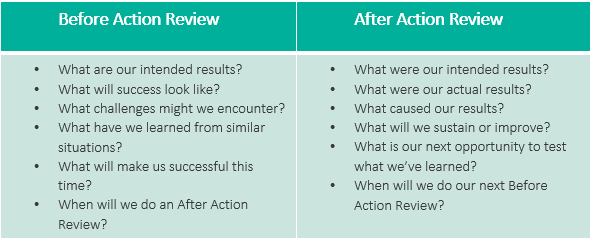
Lesson 3: Systematically applying Before and After Action Reviews can harness learning from one event to another, helping to ensure that the same mistakes don’t get repeated.

Before and After Action Reviews (BARs and AARs) offer a set of questions to help groups learn iteratively and improve results over time. For more information check out Four Quadrant Partner’s Introduction to Before and After Action Reviews (BARs and AARs).

Fourth Quadrant Partners

As part of this initiative, the funder convened community stakeholders at multiple points during the year to promote information exchange, peer learning, and networking. At the time of these convenings I was still in the process of figuring out the value of these reviews — at first glance, the questions seem almost too simple. Upon review of my own AAR notes taken after the first convening, I noticed that some of the shortcomings of the second convening could have been prevented if we had systematically conducted these reviews. Many of the ideas brought up after the first convening around — What will make us successful next time? — were not implemented. This demonstrated to me how easy it is for learnings to get lost from one event to another.

Oftentimes our best ideas flow freely after a shortcoming or failure. However, over time those lessons tend to lose salience.

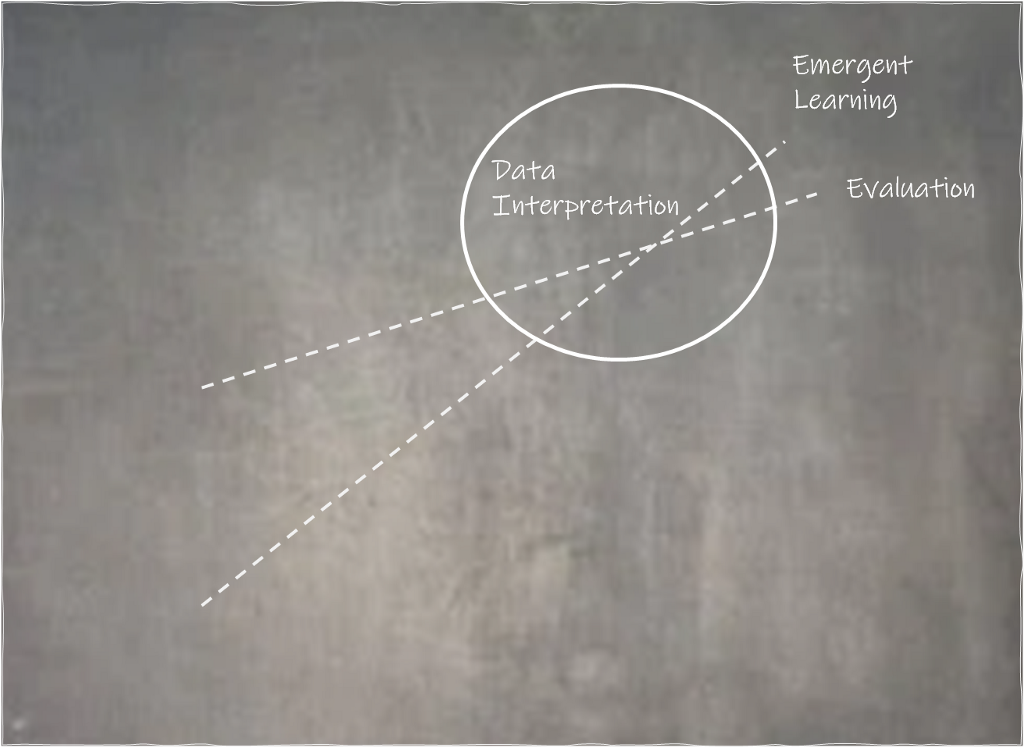
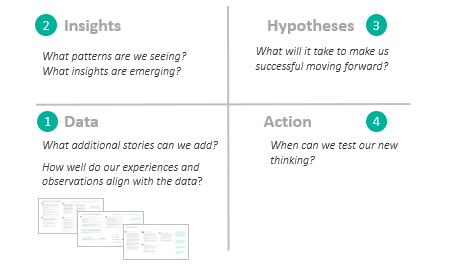
Lesson 4: Using the Emergent Learning Table as a platform for data interpretation helped move the group from data to insights to action.

The emergent learning table provides a platform to facilitate a group of stakeholders through a process designed to 1) reflect on data, 2) generate insights grounded in data, 3) establish hypotheses based on the insights that were generated, and 4) move towards action. For the health equity evaluation, I used a combination of data placemats and an emergent learning table as part of the data interpretation process with foundation staff, community coaches, and members of their technical assistance team.

This combination created a space for stakeholders to digest the data, ask questions, share experiences, recognize patterns, and generate insights for moving forward. This process facilitated the connection between evaluation and learning.

The collaborative nature of the conversation and involvement of multiple stakeholders helped increase buy-in to new ideas that were generated.

Adapted from 4QP’s Emergent Learning Framework

For me, the learning took place when I moved away from the one-off applications of the tools across disparate projects and focused on one project to cultivate learning over time.

Over the course of the year I tested and applied various aspects of emergent learning. By integrating emergent learning tools and practices throughout the health equity evaluation, I started seeing the through-line across these applications. My breakthrough moment came when I facilitated a data interpretation meeting using the emergent learning table as a platform for discussion.

Moving Forward…

How can emergent learning be leveraged in evaluation to advance experimentation and ongoing learning?

Image created by Veena Pankaj, Innovation Network

Take-Away #1: The true intersection between evaluation and emergent learning lies in the interpretation of data and its use for reflection and learning.

The emergent learning table demonstrated the power of inserting real-time, collaborative reflection into the evaluation sensemaking process. Facilitating stakeholders through the sensemaking process, creating a space for digestion, reflection, and the generation of new ideas helps connect evaluation to learning and action.

Take-Away #2: A forward-facing learning question encourages the exploration and testing of new ideas, while keeping the ultimate goal in mind.

This helps ensure that the evaluation is focusing on questions that matter and inform the collective learning of the group. All too often in multi-year evaluations, the questions that are developed at the beginning of the evaluation become outdated and irrelevant over time. When this occurs, there’s a disconnect between the data being collected and the decisions that need to be made to inform strategy.

Take-Away #3: Building in opportunities for reflection and sense-making throughout the evaluation creates a reflective practice that accelerates the learning potential of the group.

Opportunities for reflection help to create touchpoints for learning and adaptation of strategy.

Take-Away #4: Involving different stakeholders in the sensemaking process invites a diversity of perspective that can strengthen insights and lead to new ways of moving forward.

Inviting a diverse group of stakeholders to the table and valuing their experiences and perspectives helps make evaluation less transactional and paves the way for transformation.

Emergent learning tools provide avenues to gather experiences, generate insights, and formulate new ideas in a way that encourages experimentation, learning, and adaptation. It further provides a platform that inspires collaboration and a diversity of thought and perspective.

When coupled with emergent learning, evaluation has the potential to accelerate learning, magnify impact, and move us closer to our collective vision.


Reflections on the Intersection of Evaluation and Emergent Learning was originally published in InnovationNetwork on Medium, where people are continuing the conversation by highlighting and responding to this story.

Written by cplysy · Categorized: innovationnet

Apr 28 2020

18 Resources helping me in work and life with Covid-19

The resources designed to help us adapt to Covid-19 don’t match up with our lives right now. Every day, I sit down at my kitchen table — the same table where I (used to) host dinners and put together puzzles — in front of a make-shift workstation where I do my job. My living space is also my workspace. We’re managing a whole new definition of work-life balance right now and it turns out work is part of our lives.

Most of the resources I have been reading lately haven’t acknowledged this simple fact. Good-intentioned people with great ideas are writing about one or the other: adapting personally to cope with crisis and being at home or adapting our evaluation designs to keep up with a rapidly changing environment. But I — trying to do my office job from my kitchen table — need both.

Like many of you, I am struggling with the uncertainty of the pandemic, of feeling disconnected from what and who I love most in the world, and managing the implications of health risk, unemployment, and economic downturn in my work. My reading has helped me cope personally and professionally with the effects of this pandemic. And I am starting to adapt. I am seeking resilience, new ways to stay connected, and adapting my day-to-day job in the evaluation-sphere.

I’ve compiled below some of the resources I’ve found that have helped me both personally and professionally, sourced from great evaluation minds in our field, from mental health professionals, and from others whose voices have risen above the fray to provide value. Did I miss one? Please share your favorites in the comments.

Finding resilience within ourselves.

Yesterday, the first person I knew personally died from Covid-19. This once-in-a-century pandemic has created a lot of fear — for the health and stability of ourselves and our loved ones — and grief — for the loss of our lives as we knew them. And we don’t know how long this will last. I don’t think I’m alone in feeling a constant dark cloud around us and fighting through that cloud to find laughter and productivity.

Here are some resources I found helpful to connect to my own resilience:

  1. Living (and Working Virtually) in Uncertainty (Interaction Institute for Social Change, Cynthia Silva Parker): This was the first article to go around our office after the pandemic hit, and still may be my favorite. It helped me reflect on what is important right now, and how I can set a foundation in a time when I feel like the earth is moving under my feet. The ideas are grounded in relationships and collaboration — which mirror my own view for how we can get through together.
  2. Moving from Fear to Growth: Navigating Collective Trauma (Brodie Welch): This reflective article at once challenged me to think about how I am responding to Covid-19, while making me feel OK to not feel OK all the time.
  3. That Discomfort You’re Feeling Is Grief (Harvard Business Review, Scott Berinato): “If we can name it, perhaps we can manage it.” I appreciated this article because it gave permission for us to be affected by the change in our everyday lives, even if it is temporary, and even if we are healthy and seemingly fine. It goes into the different types of grief we are feeling and helped me think of new ways for managing it.
  4. The Three Equations for a Happy Life, Even During a Pandemic (The Atlantic, Arthur Brooks): As an evaluator, I especially appreciated having mathematical equations to consider when figuring out how to get out of my “Corona-funk.” In breaking down theories for what can make us happy, I can consider what ratio of ingredients will help me find resilience.

The organizations we love are also seeking that resilience inside themselves right now.

  1. Resiliency Guide (SDBJR Foundation): I just found out about SDBJR Foundation’s resources related to organizational resilience — including a breakdown of what makes for a resilient organization, a resiliency guide, and a list of resources to learn more.

Adapting our evaluation strategies and plans.

My clients have changed requirements for grantees and are funding additional measures specifically related to Covid-19. They are wondering how to measure their response. I am also working through some of our longer-standing evaluations — I am in the third year of a three-year evaluation and am striving to find relevance for today’s changed world while respecting the work and outcomes from the first two years. I’ve been seeking guidance for how to adapt my evaluation approach and be useful to those conducting important work for all of us right now.

Here are some resources I found helpful when contemplating the impact on my evaluation work:

  1. Evaluation Implications of the Coronavirus Global Health Pandemic Emergency (Michael Quinn Patton): MQP does not disappoint in his list of 15 ways evaluators should be adapting now with Covid-19. His list looks like a how-to for developmental evaluation — that’s just the reality of the world we’re in right now.
  2. The Evaluation Mindset: Evaluation in a Crisis (Chris Lysy): Our favorite evaluation cartoonist shares his rambling yet pithy thoughts on what we should be doing as evaluators right now. He captures some of the same developmental concepts of MQP with some additional refreshing reminders to breathe and fun visualizations.
  3. Deciding Well in Tumultuous Times (Ian David Moss): I thought this post got really good around “How do I deal with uncertainty” and “How do I know if I made a difference,” two questions I am grappling with right now. He provides a framework for making smart decisions and thoughtful advice to focus on process rather than impact in this moment.
  4. Spring Coffee Break Webinar Series (Public Profit): I just signed up for several of the relevant (and free!) webinars from Public Profit — including one on virtual focus groups and sustaining evaluation in the midst of disruption.

Moving to virtual meeting spaces.

In the best-timed professional development choice ever, I managed to take TOP’s virtual facilitation course right before the pandemic hit the US. It was a great course and resulted in our organization buying a license for Adobe Connect to access some of the great interactive tools available on that platform as events are cancelled and moved online. But if you’re not running highly interactive, intensive sessions with colleagues and clients — or just don’t have the funds — there are a lot of core principles and just good tips in general out there.

Here are some resources I found helpful when planning virtual meetings:

  1. A Quick Primer on Running Online Events and Meetings (Better Evaluation, Emma Smith) — This article deals with common, practical solutions to holding virtual meetings. I’m so glad she included descriptions of virtual seating charts and including a “tech helper” — tips I’ve learned along the way in isolation that Beth handily pulls together in one comprehensive how-to.
  2. How To Facilitate Effective Virtual Meetings (Beth Kanter): I especially loved the diverse virtual engagement option for collaborative and interactive meetings that Beth includes in her guide. She is the nonprofit guru, and knows that most meetings in nonprofit spaces are women-run and highly collaborative. Her meetings are the kind I want to create.
  3. Virtual Communication: Presenting with Empathy (Duarte): This is the recording of a webinar I attended that I found particularly helpful. Executive Speaker Coaches Doug and Nicole go into the specifics of practical details, like what to do with your hands on camera. Definitely worth a watch.
  4. Online Meeting Resources Toolkit for Facilitators (Crowd-sourced): This is a live google doc with facilitation resources that hundreds (it seems like??) of people have contributed to since the onset of Covid-19. I found it kind of a lot to sort through, but just that this exists and seeing all the collaboration that went into it is inspiring.

Working at home. All. The. Time.

I’ve been having some serious neck pain lately, and it’s because I don’t know how to work at home every day (That, and I may have to admit my thirty-something body isn’t what it used to be). I wasn’t as prepared as I thought I would be when we all got sent home with our laptops. I’m lucky in that I don’t also have to worry about child care, homeschooling, or taking care of an ill relative — we are all figuring out how to manage this new work-from-home life.

Here is a resource I found helpful to adjust to working at home:

  1. 26 WFH Tips While Self-Isolating During the COVID-19 Outbreak (Healthline): I liked the practicality of these tips for working at home — there’s something for everyone. I was drawn to the tips for those who don’t have an ideal WFH set-up and how to take effective breaks — but there’s also tips for people who experience anxiety and who have kids at home.

Admitting we need (to) help.

There are so many great ways to help right now that this is nowhere near comprehensive. But I can’t write a post about adapting to Covid-19 without acknowledging how deeply the pandemic is affecting the most basic needs not just of ourselves but of so many around us.

Here are resources I found particularly pithy for finding and giving support right now:

  1. FindHelp.org: This website helps you find local services to provide food assistance, help paying bills, and other free or reduced cost programs, including new programs for the COVID-19 pandemic — all based on your zip code.
  2. How to help the helpers (New York Times, Nancy Wartik): My roommate works in a hospital and I know first-hand the stress experienced at the front lines. I really valued the various and holistic options presented to support workers in this article. I know there’s a lot of attention on the other essential workers in the pandemic right now (from warehouse workers to grocery store employees to mechanics) and I think a lot of these suggestions can apply to anyone in those spaces.
  3. This is the wake up-up call for nonprofits and foundations to get political (Nonprofit AF, Vu Le) — If we really want to make a lasting difference, we need to talk about systems-change. That’s a job for politics. I love the norm-crushing language used in this post for norm-crushing times.


18 Resources helping me in work and life with Covid-19 was originally published in InnovationNetwork on Medium, where people are continuing the conversation by highlighting and responding to this story.
Written by cplysy · Categorized: innovationnet

Mar 19 2020

Learning to Support Social Movement Power

How funders and evaluators should think about learning and movement success.

Continue reading on InnovationNetwork »

Written by cplysy · Categorized: innovationnet

Aug 12 2019

Six things we’ve learned about power

And their implications for evaluation

Power is an integral aspect of social change initiatives. It can shape relationships and enable or constrain the agency and impact of social change actors. Change actors constantly contend with power as they work to advance systems and structural change. But despite its significance, power is often missing from conversations about funding and evaluating social change.

In the past year at Innovation Network, we’ve noticed an increase in the number of nonprofits and funders asking us to help them assess and learn about the power-building efforts of organizations, networks, and movements.

To that end, we’re reviewing academic and practice-based works to better understand power, how it shows up in change ecosystems, and how we can appropriately evaluate it. Here’s what we’ve learned so far.

Photo by Miguel Bruna on Unsplash

Lesson 1: Concepts of power are contested.

A constant across the literature is the lack of a common definition of power. Various pieces we’ve read describe power in turn as “sociologically amorphous,” “perpetually contested,” “polymorphous,” with a virtual “confetti of definitions and theories.”

So this wouldn’t be a real piece about power without first giving the usual disclaimer that definitions of power are contested, overwrought, and evolving.

If you’ve ever had a conversation with anyone about power, you’ve likely experienced this. I’ve personally found myself in discussions with people about power where it becomes immediately apparent that we’re talking past each other. While some people want to talk about structural types of power, others will talk about power building, and others still about power dynamics.

Implications for evaluation: If we want to assess power and power building, its critical to understand that definitions of power are numerous, and people will likely show up to the evaluation process with different understandings of power.

So how do we prioritize the varying definitions and concepts? We believe centering community and social change actors’ definitions and understandings of power will be critical. Community organizers, advocates, and movement builders have grappled with power and power building long before it became buzzy in the philanthropic and evaluation sectors. There is a lot we can learn from social change actors about power.

Lesson 2: Power is dynamic and multidimensional.

The lack of shared definition of power underscores that power is dynamic and multidimensional.

Academics and practitioners have identified countless ways that power manifests in the world. John Gaventa, an influential theorist of power, created the powercube in an effort to identify the different levels, spaces, and forms of power:

  • Levels: Refers to the different levels where power is exercised, from the individual, family, organization levels up to the local, state, national, and global levels.
  • Spaces: Refers to the spaces where power is exercised for decision-making and action. Gaventa describes spaces as being closed, invited, or claimed.
  • Forms: Refers to the different ways power shows up, including its visible, hidden, or invisible forms (more on that in Lesson 3).

Others have built on these levels, spaces, and forms to identify different expressions of power (Lesson 5) and different types of power (Lesson 6).

The levels, spaces, forms, and expressions of power are not static. These dimensions of power are interrelated and dynamic, shifting and evolving over time. Gaventa described it this way: “Each dimension of the powercube is constantly interrelating with the other, constantly changing the synergies of power. For instance, what happens at global decision-making levels can affect the spaces available for participation and engagement; which spaces are available affect the forms of power within them.”

Implications for evaluation: All systems change efforts exist in complex ecosystems of power. These ecosystems include a diverse range of social change actors, their opposition, and the decisionmakers, institutions, and systems they seek to influence. Power shapes the relationships between these actors and their ability to advance their interests. Power can take many forms and show up in countless different ways.

To address this complexity, we believe evaluating power and power building will require a developmental approach. Evaluators of power will need to be ready for shifting power dynamics and to identify and assess new forms and sources of power as they emerge.

Lesson 3: Examining power can help us understand the structural forces that enable or constrain change efforts.

Power over is the longest-standing, most recognized expression of power. This concept sees power as being fundamentally repressive and negative, all about domination and control. Some of the earliest theorists described power this way. In recent years, some theorists have started taking a more nuanced view of power over. They recognize that while power can be negative and repressive, dominant social structures and historical, social, and cultural forces can exert power in a way that is beneficial to social change efforts.

Either way, power over underscores that dominant historical and structural forces can have a powerful influence on the relationships, capacity, and impact of change efforts.

In 1974, Stephen Lukes provided one of the most oft-cited theories of power over in his book, Power: A Radical View. In this book, Lukes introduced the “three faces” of power over — visible, hidden, and invisible.

  • Visible: Visible power refers to power that is publicly visible or that takes place in formal decisionmaking spaces. Arenas for visible power include laws, legislatures, and courts.
  • Hidden: Hidden power is exercised by powerholders to maintain their power and privilege by systematically excluding people and their interests from decisionmaking tables and processes. Hidden power can manifest in how issues are framed and how institutions are structured.
  • Invisible: Invisible power shapes people’s worldviews, ideologies, and sense of agency. Powerholders may exercise invisible power by developing dominant narratives and tailoring the information available to the public to hide the existence and sources of injustice.

Lukes’s three faces of power have gotten a lot of play in social change spaces and have shown up in the work of other organizations, including Just Associates and the Grassroots Policy Project. These organizations have used the three faces of power to encourage social change organizations to take a more holistic view of the forces that facilitate or inhibit social change.

Implications for evaluation: By examining and mapping the structural forces that exercise power over a change ecosystem, we can better understand the contextual factors, systems, and structures that enable or constrain social change. This understanding makes evaluation findings more valid and useful, by deepening our understanding of which power-building approaches work under what conditions.

Lesson 4: Power building is at the heart of grassroots-led change efforts and can help us understand the progress and success of change initiatives.

Power doesn’t just lie in social structures and institutions, social change actors also have the ability to build and exercise their own power.

Gene Sharp, one of the world’s leading thinkers on nonviolent action, was a big believer in the social view of power. This idea emphasizes that the power of decisionmakers and institutions depends on the consent and cooperation of ordinary people. People can wield power by collectively giving or withdrawing their support for systems, institutions, and decisionmakers.

The idea that power lies in the hands of the public is one that is essential to grassroots-led change efforts like community organizing and social movements. Grassroots efforts flip the script on who is the powerholder, stressing that power lies not just in formal institutions and visible decisionmakers, but also in the general public.

For that reason, power building is often fundamental to the theory of change of grassroots-led change efforts. Building long-term power is often not just a means to an end but a critical end in itself.

Implications for evaluation: Power building is an important lens through which we can view the progress and success of change efforts. Assessing power building will require us to think differently about how success is defined. Contrary to what some might think, policy and systems change is not the end goal of all social change. “Winning” is also about building and maintaining long-term power in communities. How would it change our understanding and assessment of social change efforts if we saw them through a lens of power building?

Lesson 5: Power to, power with, and power within are three expressions of power building that provide us with a starter framework for assessing power.

In A New Weave of Power, People, and Politics, Lisa VeneKlasen and Valerie Miller made the case that power can be used as a positive force to advance affirmative change in society. They outlined three core expressions of power building: power to, power with, and power within.

  • Power to (power as capacity): Most of the time when people talk about power building, power to is what they’re talking about. Power to refers to your ability to exercise agency or, as Martin Luther King Jr. said, “Power, properly understood, is nothing but the ability to achieve purpose. It is the strength required to bring about social, political, and economic change.” Having power to means you have the capacity, resources, and opportunities to advance your interests.
  • Power with (power as relationships): Power with emphasizes that relationships are a significant source of power. Power with is about building collective strength across varying interests and stakeholders. Because long-term change often requires collective action, power with is a critical form of power building for social change initiatives.
  • Power within (power as individual agency): Power within is about developing a person’s individual agency, self-empowerment, and self-worth. Some social change efforts, such as community organizing, seek to build power within the individual community members and leaders they serve and organize. In transformative organizing practice, for instance, social transformation is seen as being intertwined with personal transformation; social transformation is only possible when individuals have a sense of self-worth and individual agency.

Implications for evaluation: The three expressions of power building have helped us better understand the forms of power social change actors can build. We believe they provide us with a starter framework for identifying and assessing power building in social change efforts that can be adapted to the specific interventions we are called to evaluate.

Lesson 6: Governing, people, and narrative power are three common types of power building that advance structural change.

Some social change organizations and practitioners have started to identify, define, and operationalize the types of power building that are needed to advance change. Three power-building concepts have emerged that seem to be common across different organizations and change efforts: governing/governance power, people power, and narrative power.

Governing Power/Independent Political Power: Although they have different names, governing power and independent political power (IPP) have similar definitions and elements. Both are about building power to govern based on the values and priorities of grassroots communities. Governing power is about building political infrastructure and capacity that is independent from the dominant political parties. It goes beyond policy and electoral change to advance structural change and influence narratives, norms, and values. Some select resources about governing power/IPP:

  • Demos. Independent Political Power.
  • Grassroots Policy Project. Organizing for Governing Power.
  • University of Southern California Program for Environmental and Regional Equity. Power and possibilities: A changing states approach to Arizona, Georgia, and Minnesota.

People Power: Similar to the social view of power discussed above, people power emphasizes that power comes from the engagement of ordinary people. People power is often about building power with an active, grassroots base. However, in the context of social movements especially, people power is also about building power to build, mobilize, and sustain large-scale public support. Select resources:

  • Ayni Institute. Winning with the Masses.
  • University of Southern California Program for Environmental and Regional Equity. Sustaining People Power.

Narrative Power: Narrative power is fundamentally about the power to transform and hold dominant public narratives and ideologies and to limit the influence of opposing narratives. Rashad Robinson from Color of Change sums it up nicely: “Narrative power is not merely the presence of our issues or issue frames on the front page. Rather, it is our ability to make that presence powerful — to be able to achieve presence in a way that forces change in decision-making and in the status quo.” Select resources:

  • Grassroots Policy Project. Worldview and the contest of ideas.
  • Rashad Robinson. Changing our narrative about narrative: the infrastructure required for building narrative power.

Implications for evaluation: While change initiatives do build other types of power, governing, people, and narrative power are often present in community organizing, electoral organizing, advocacy, and social movements. Given the contested nature of power concepts, we are finding that having some definition about these types of power building (and having a set of resources to draw on) provide a helpful starting place for discussions about power with funders, evaluators, and social change actors.

As more funders, organizers, and advocates start paying attention to power, it will become an increasingly important competency for evaluators who assess structural change efforts to know how power shows up in change ecosystems, how it is built, and how to appropriately measure. Over the next year, we’re building on these learnings to develop a set of resources for evaluating power building. Stay tuned!

If you like this post and want to see more from Innovation Network, be sure to clap for this article and follow our publication.


Six things we’ve learned about power was originally published in InnovationNetwork on Medium, where people are continuing the conversation by highlighting and responding to this story.
Written by cplysy · Categorized: innovationnet

  • « Go to Previous Page
  • Go to page 1
  • Interim pages omitted …
  • Go to page 3
  • Go to page 4
  • Go to page 5

Footer

Follow our Work

The easiest way to stay connected to our work is to join our newsletter. You’ll get updates on projects, learn about new events, and hear stories from those evaluators whom the field continues to actively exclude and erase.

Get Updates

Want to take further action or join a pod? Click here to learn more.

Copyright © 2026 · The May 13 Group · Log in

en English
af Afrikaanssq Shqipam አማርኛar العربيةhy Հայերենaz Azərbaycan dilieu Euskarabe Беларуская моваbn বাংলাbs Bosanskibg Българскиca Catalàceb Cebuanony Chichewazh-CN 简体中文zh-TW 繁體中文co Corsuhr Hrvatskics Čeština‎da Dansknl Nederlandsen Englisheo Esperantoet Eestitl Filipinofi Suomifr Françaisfy Fryskgl Galegoka ქართულიde Deutschel Ελληνικάgu ગુજરાતીht Kreyol ayisyenha Harshen Hausahaw Ōlelo Hawaiʻiiw עִבְרִיתhi हिन्दीhmn Hmonghu Magyaris Íslenskaig Igboid Bahasa Indonesiaga Gaeilgeit Italianoja 日本語jw Basa Jawakn ಕನ್ನಡkk Қазақ тіліkm ភាសាខ្មែរko 한국어ku كوردی‎ky Кыргызчаlo ພາສາລາວla Latinlv Latviešu valodalt Lietuvių kalbalb Lëtzebuergeschmk Македонски јазикmg Malagasyms Bahasa Melayuml മലയാളംmt Maltesemi Te Reo Māorimr मराठीmn Монголmy ဗမာစာne नेपालीno Norsk bokmålps پښتوfa فارسیpl Polskipt Portuguêspa ਪੰਜਾਬੀro Românăru Русскийsm Samoangd Gàidhligsr Српски језикst Sesothosn Shonasd سنڌيsi සිංහලsk Slovenčinasl Slovenščinaso Afsoomaalies Españolsu Basa Sundasw Kiswahilisv Svenskatg Тоҷикӣta தமிழ்te తెలుగుth ไทยtr Türkçeuk Українськаur اردوuz O‘zbekchavi Tiếng Việtcy Cymraegxh isiXhosayi יידישyo Yorùbázu Zulu