• Skip to main content
  • Skip to footer
  • Home

The May 13 Group

the next day for evaluation

  • Get Involved
  • Our Work
  • About Us
You are here: Home / Archives for allblogs / innovationnet

innovationnet

Apr 24 2023

Toward a Collective Power Framework

Written by Alissa Marchant and Cory Georgopolous
Current Knowledge on Collective Power

Advocacy evaluation is a rapidly growing field that has seen the emergence of several frameworks for building power for social change, measuring equity, coalition effectiveness, collective impact and creating communities of practice.

However, none of these pieces speak to each other or address measuring collective power specifically centered on equity. This wasn’t a total surprise: funders and evaluators have only recently begun to talk about coalitions in terms of collective power or seen as places to cultivate equity.

Because there are no existing frameworks for collective power that centers equity, we looked to the advocates who are building collective power as part of their regular practice. In the past two years, we followed two collectives who brought together traditional policy organizations with equity and grassroots organizations. They are changing the ways in which policies are created and advocated for, starting first with their internal structures. These collectives have helped us understand what it takes to center equity in groups who want to build collective power.

Learning from Two Collectives

Since 2021, Innovation Network worked with two collectives: Towards Equity in Electric Mobility (TEEM) organized by the Greenlining Institute and Forth Mobility, and Child Care Next (CC Next) organized by the Alliance for Early Success.

As their names suggest, these two groups focus on very different issue areas. TEEM was formed through recruitment and invitations, while CC NEXT had a competitive process with detailed proposals and states forming groups before they applied. But they have many similarities: TEEM and CC NEXT are both new, founded in 2021. They both have a national gathering, and state cohorts in 6 states. They both have Foundation support.

Most importantly, both are trying to build collective power rooted in equity among their members. They do this by bringing together grassroots, community representatives with expertise in centering equity and grasstops organizations with research and legislative expertise. These groups are able to learn from each other, build relationships, and take action together while centering grassroots voices in spaces that have typically been the domain of grasstops organizations.

Draft Framework for Collective Power

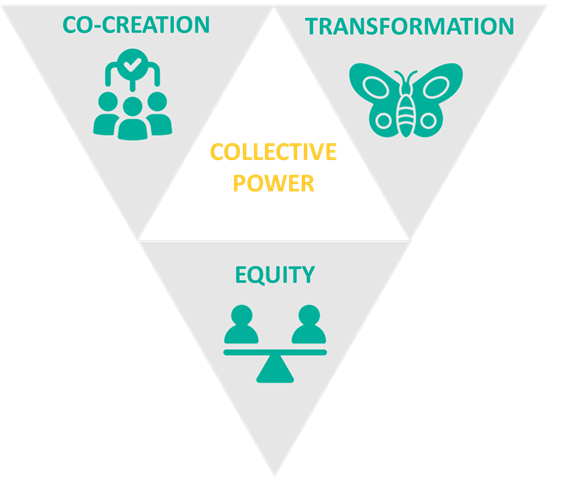
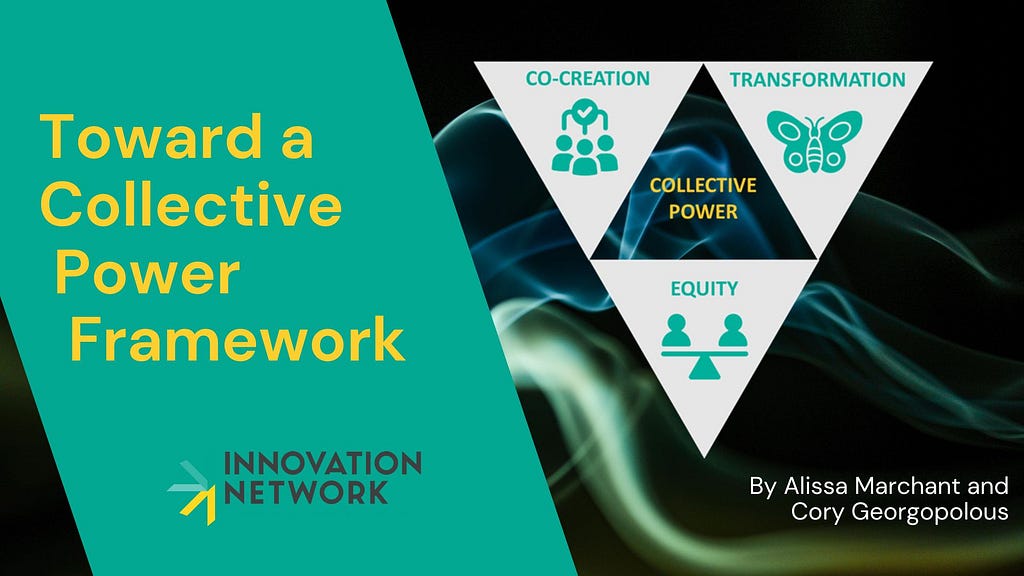
We decided to look across TEEM and CC Next to see if the beginnings of a framework could be pieced together from what we knew of these coalitions, how they operated, and how they aspired to operate. Taking into account their similarities and differences, we identified three intersecting components that make up our draft framework for collective power (Figure 1):

  1. Equity
  2. Co-creation
  3. Transformation
Collective power is shown in the center, with three pillars of a collective power framework surrounding it: co-creation, transformation, and equity

Equity

The recognition that everyone at the table holds different levels of power, and there needs to be a concerted, intentional effort to shift and build the power of members who come in with less. While all these components are important, co-creation and transformation rest upon the presence of equity in a group and would not be possible without it.

  • A commitment and vision for equity is at the heart.​
  • Members respect, appreciate, and leverage the different strengths other members bring. There’s acknowledgment that each member brings their own unique value. ​
  • The coalition openly addresses and strives to mitigate inequitable power dynamics. ​
  • Whatever the issue, those most impacted have power and weight over the coalition and its work equal to other groups or more. Within the coalition, this can mean active elevation of grassroots voices and leadership. ​
  • Participants have the resources to engage in the coalition.​

Co-creation

The space is owned, shaped, and created by members in collaboration with each other.

  • Members feel like they have a voice to share their honest opinion and that it is valued. ​
  • The coalition strives for group-based decision-making that reaches for or achieves consensus. ​
  • There’s a spirit of collaboration in how members approach realizing their shared vision rather than competition.​

Transformation

Not only are members of the group striving to affect their chosen issue (i.e., electric mobility, childcare), they are changing the way the work is done and looking at long-term social change.

  • Members are not only valued for their unique skills and the constituency they bring to the group, but for their perspective. The goals created by the group are bigger, more comprehensive, and visionary.​
  • Members can see their work and contributions make an impact. This impact could be concrete policy change but is often a transformational change in perspective as well.

These three components underpinned how the coalitions were facilitated and how members showed up in relationship with each other: not as a competition but as a place where each member has decision-making power and differences of perspective are valued rather than erased.

Continuing Refinement of the Framework

While we hope this framework is useful to other evaluators, it is still a draft with many missing parts and remaining questions, and our intention in sharing it is not to provide answers but to spark discussion. What other components are integral to collective power? How does this framework resonate with other coalitions? We hope to explore these questions — and revisit and revise the framework — as we continue to partner with these groups and others, but we also want to hear from you: what has your experience been in measuring and building collective power?

Please share your thoughts and experiences in the comments!


Toward a Collective Power Framework was originally published in InnovationNetwork on Medium, where people are continuing the conversation by highlighting and responding to this story.
Written by cplysy · Categorized: innovationnet

Nov 03 2022

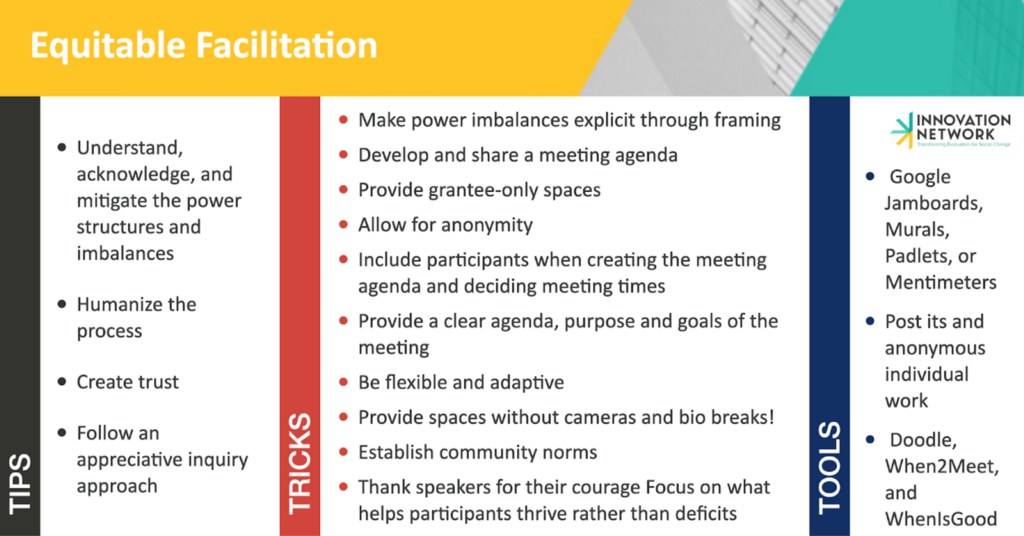
Equitable Facilitation: Tips, Tricks, and Tools

This blog post is co-authored by Anvi Mridul and Rebecca Perlmutter.

“Before we begin, I want to acknowledge the power dynamics created by virtue of me leading this meeting. I also want you to know that while I would like this to be a safe space, I recognize this is a brave space, and I deeply appreciate your courage and candidness throughout this process”. This is how one of our Co-interim Directors, Virginia Roncaglione, opened our meeting as we started our collaborative work to create more equitable decision-making structures and processes and mainstream equity across Innovation Network. Our powerful and ongoing transformation is motivated by our team’s commitment to walk the talk as practitioners and individuals. Equity is one of the core values of our organization and we make conscious efforts to incorporate it into our practice.

We believe that equity will help us move away from an evaluation approach traditionally focused on numbers and impact without providing context, accounting for less tangible outcomes and growth, and broadening our definition of what success looks like to participants and community members. Instead, equitable evaluation is designed to support learning and improvement of the projects we are evaluating. In this way, equitable evaluation can challenge power structures, encourage participant ownership, and build collective power. One of the ways to incorporate equitable evaluation is through equitable facilitation of meetings.

Equitable facilitation enables us to collect diverse and comprehensive perspectives, data, and feedback that can otherwise be silenced by the loudest or most powerful voices in the room. Equitable facilitation can also help us achieve stronger processes and projects because the perspectives that we gather affect the focus of our project and everything we do afterward. As individuals and practitioners, our team strongly believes in the importance of incorporating equity in our daily lives and work.

As we continue to explore this method, we want to share some insights–tips, tricks, and tools– we have collected along the way that have helped us facilitate with intention and equity.

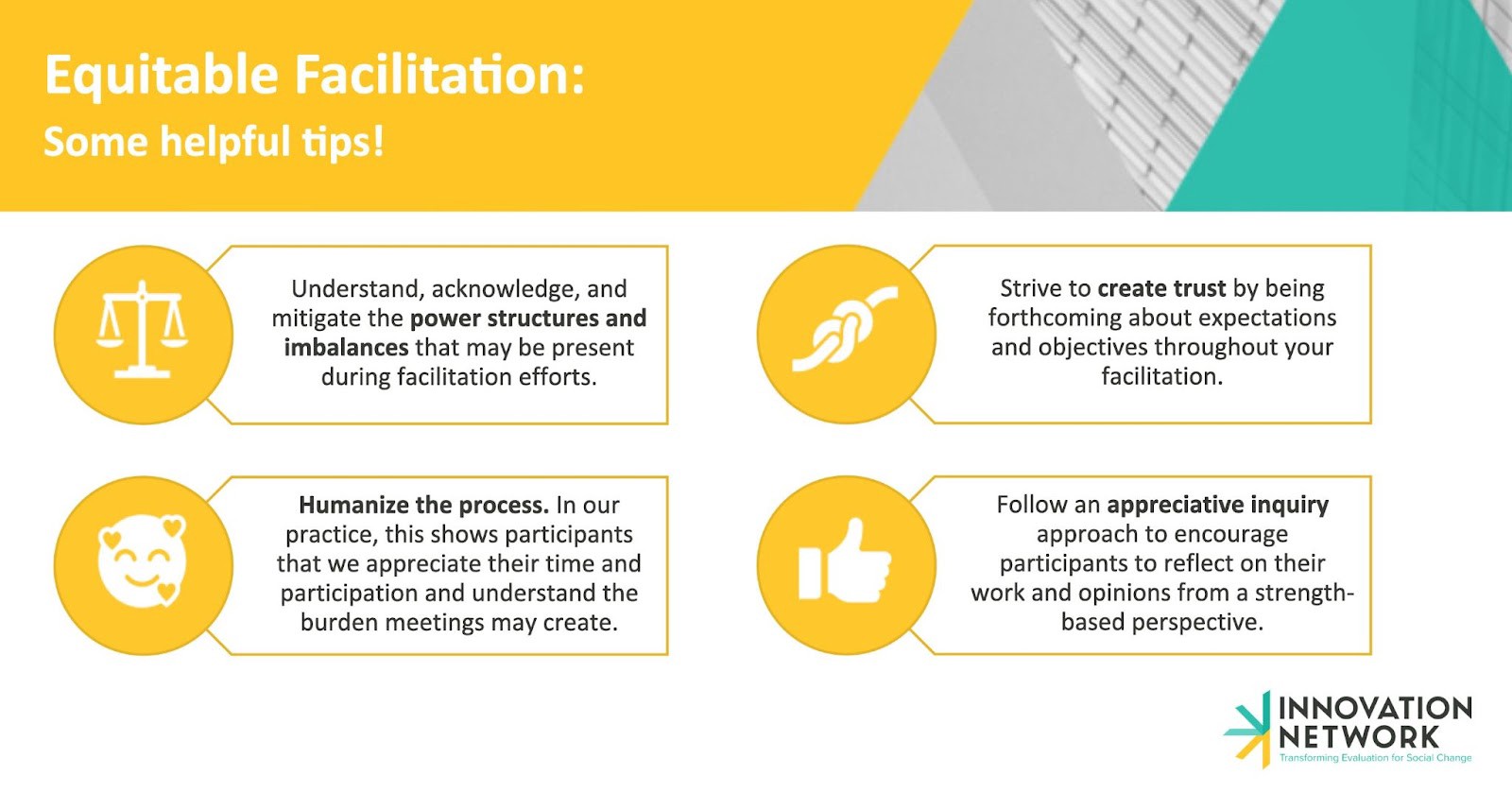
1) Understand, acknowledge, and mitigate the power structures and imbalances that may be present during facilitation efforts.

As our Co-Interim Director modeled, setting the stage can be a good way to acknowledge power structures. Explicitly recognizing the context and power imbalances that exist in the room helps address some discomfort and create a more honest and transparent space. In our experience, when those with more power, like foundations, frame the conversations to invite open feedback, it allows for more authentic engagement from the other participants.

While developing a meeting agenda, we think about who will be invited into the space, and how the power dynamics in the room may affect the contributions or answers to the questions posed. A trick we’ve often used to mitigate power dynamics is to have grantee-only spaces. Having a funder in the room when conversations about progress on outcomes or challenges are going on may limit the ability of some participants to provide their honest opinions. When this is not possible, we make conscious efforts to provide activities or spaces where those with the least power can fully engage. A tool that is particularly helpful in this effort is the breakout groups feature for online meetings. Using tools that introduce anonymity in your session can help ensure people feel safe sharing their opinions and elicit more honest feedback. In these cases, we create Google Jamboards, Murals, Padlets, or Mentimeters where we use the online equivalent of post-its, providing time for participants to answer questions and write down their thoughts without them being attached to an individual or organization. This provides opportunities for those who need time to process and takes away some of the fear of negative repercussions. In other instances, we have invited cohort members to facilitate breakout conversations with their peers, rather than an evaluator who could disrupt the dynamic and conversation.

It can be helpful to host different focus groups for different types of participants, allowing for those in different positions in an organization to freely provide opinions and feedback.

2) Humanize the process. In our practice, this shows participants that we appreciate their time and participation and understand the burden meetings may create.

Some tricks to humanize this process are to include participants in meeting agenda and timing decisions, provide a clear agenda, and provide spaces without cameras (in virtual meetings).

When we include participants in the decisions behind what topics will be included in the agenda and when meetings will take place, participants are encouraged to take ownership and participate more actively. Recognizing their agency within the process, shows how we, as evaluators, value their time and the burden our additional meeting requests may create. It can also help us create more equitable projects that challenge traditional hierarchies and value participants. While including many parties in the scheduling process can be challenging, there are some tools that help simplify the process. We’ve used Doodle, When2Meet, and WhenIsGood. While all are slightly different, these tools will help you find overlaps in the availability of participants and select the most popular time for your meeting.

Once the meeting is organized, it’s helpful to share the purpose and goals of the conversation, along with a defined agenda prior to the meeting so participants are informed and expectations are clear. Despite having a set agenda, we prepare to be flexible to accommodate additional agenda items that may come up at the beginning of each meeting, and try to recognize what parts of the conversation are inspiring more curiosity or energy, and adapt our focus to meet the needs and interests of participants.

For us, flexibility also means recognizing that while having cameras on can help us check the levels of engagement, people may have different situations that preclude them from turning on their cameras, especially at home and surrounding care responsibilities. And don’t forget to provide bio breaks, especially in sessions over an hour!

3) Strive to create trust by being forthcoming about expectations and objectives throughout your facilitation.

To establish trust, and create safer spaces, we like to start meetings by setting out community norms. These can be co-created with a quick brainstorm and carried over for future conversations. Some community norms we like include: have grace for people’s long days and other extenuating circumstances, avoid interrupting each other, it’s okay to have pauses or silences, acknowledge and respect that we come to these conversations with different experiences, and call in, rather than call out.

Another trick to create trust is to openly acknowledge and respect each individual’s situation. A way to do this is to always assume the best intentions, and hold back any judgment. When receiving comments, we also make a point to genuinely thank the speaker for their courage in speaking out and contribution to the conversation.

4) Follow an appreciative inquiry approach to encourage participants to reflect on their work and opinions from a strength-based perspective.

An appreciative approach has been particularly helpful for us in facilitating conversations, such as focus groups for data collection because participants stop thinking about what is missing and reflect on what helps them thrive. In a field overly focused on deficits, it is helpful to use this when funders are in the room and reduce pressure on grantees or evaluees. In some of our most creative data collection sessions, we have encouraged participants to respond to our questions by creating a collage of text, photos, and graphics to give them the space to visualize their responses and identify supports they need from a place of strength. This way we introduce a growth mindset, where evaluation participants can acknowledge the things they are good at, recognize where they are thriving, and help us create conditions to do forward-facing visioning.

While these are some tips, tricks and tools we use within our practice, our path to becoming more equitable facilitators is ongoing. We also recognize that there is no one size fits all approach, so it is important to understand the differences in context and how this can call for different approaches to equitable facilitation.

As we continue to learn and reflect on our path toward a more equitable evaluation practice, we recognize we do not have all the answers and are still exploring how to improve every day. We would love to hear your advice, or how you implement any of these suggestions. Please let us know the challenges you or your team face as practitioners, or other tips, tricks, and tools we may have missed!

You can also check out our August Evaluation Highlights for more helpful resources on this topic.


Equitable Facilitation: Tips, Tricks, and Tools was originally published in InnovationNetwork on Medium, where people are continuing the conversation by highlighting and responding to this story.
Written by cplysy · Categorized: innovationnet

Oct 25 2022

Insights on participant ownership in evaluation and learning

A starting list

Earlier this year we were asking the representative of a grassroots organization whether and how they would be interested in being involved in the learning and evaluation work of one of our foundation clients. They told us that what is truly real is land, water, nature, and animals, not professional titles. Their words stayed with me, reminding me how my evaluation and learning practice truly matters when it serves the communities closest to the issues and solutions that it seeks to understand, as it is these very communities who know what is “truly real” about their experiences, relationships, and lands.

In the past, this was not what I understood my practice was about, or how the field of evaluation conceived its mission. As many outstanding practitioners like Jara Dean-Coffey, Dr. Nicole Bowman, Dr. Geri L. Peak, Dr. Bagele Chilisa, and Dr. Donna M. Mertens have shown, overtly or under the cloak of pursuing the western-colonial construct of objectivity, evaluation has historically centered the learning needs and interests of those groups — usually public administrations and philanthropic funders — that held the most structural and positional power in the ecosystem of those involved in the process. I, too, for many years, understood the primary beneficiary of my work to be whoever had commissioned it. Bringing the lived experience and voices of those most impacted into learning and evaluation was a “nice to-”, as opposed to a “must-have”.

As the Equitable Evaluation Initiative has taught our field, reframing who should be the ultimate beneficiaries of our learning and evaluation work makes sense for everyone. For administrations and foundations that want to ensure the impact of their investment in non-profits, advocacy efforts, and communities, but even more so for those engaged in the evaluation, who are the very same communities and organizations that funders and their investments seek to support. An evaluation approach that defers participants’ or grantees’ learning needs and ways of knowing provides communities with the power, tools, and resources they need to self-determine, tackle both internal and external challenges, and create stronger solutions for themselves. In doing so, it also truly fulfills the ultimate scope of public or philanthropic endeavors aimed at furthering equity and social justice by effectively supporting the communities and issues they seek to elevate. Understanding and truly believing in this now, as an evaluation and learning practitioner, my purpose for practicing participant ownership in projects is also driven by a desire to advocate for power to be in the hand of communities who have the most experience and knowledge about the very issues that affect them directly.

This may sound wonderful but, in actuality, how do we do this? It is hard to make learning and evaluation valuable and engaging to communities because for so long our practice has been far removed from their ways of working, learning, and knowing, taking away from their power to create the change they envisioned. Also, while evaluators and funders are increasingly seeking to engage and center partners, grantees, and clients in their evaluation processes, there is no wholesale approach to participant ownership. The characteristics and interests of the communities we wish to defer to, the nature and quality of relationships between parties involved, and the degree to which evaluators and funders are willing to cede power are among the many factors that influence the design and implementation of projects that authentically center the communities closest to the issues of focus.

So, while it would be disingenuous to say that we are not implementing and learning at the same time, I think it is crucial that we share what we are learning about what it takes to practice participant ownership, not only to further this practice but also to seek the feedback and invite the accountability of those organizations and communities whose learning we seek to facilitate. It is this desire to be in community on this journey that leads me to share and invite your feedback on a few lessons we, at Innovation Network, have learned across the pilot projects we are working on :

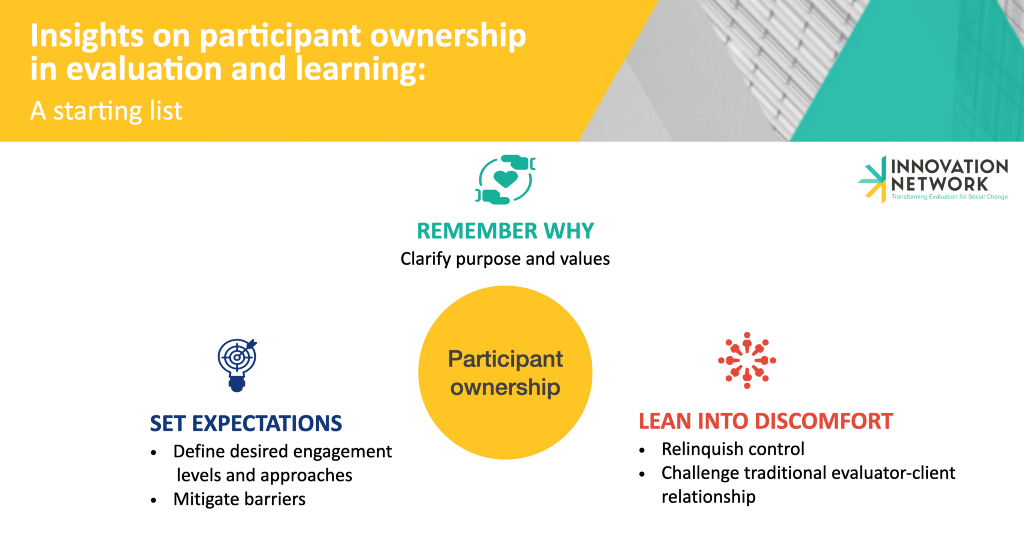
1 Participant ownership, from start to finish, necessitates that we ask and remind ourselves of why we are doing this and why this work is important. So, at the start of each project, we have a discussion among ourselves and with our clients about the purpose and values that we want to underpin it (thank you, Heather Krause and Katie Fox for teaching us the importance of doing so). We use the principles distilled in these conversations as a compass throughout a process that may often get complicated as we challenge preconceived notions of power within evaluation and learning. Further, remembering that we do this to shift power to communities to drive involvement that is meaningful to them, safeguards us from perpetuating cosmetic or performative approaches and processes.

2 Also, at the onset and throughout an engagement, it is crucial to set clear expectations for those engaged in the learning or evaluation project. Most often our client is a foundation, while the groups running the organization or implementing the program or activities that we seek to evaluate and learn from are the evaluation participants. To ensure expectations are clear and transparent from the beginning, we have an open conversation with the foundation client about the importance of participant ownership and the need to promote equity within these processes. We also establish to what extent the client is willing to engage with participants, how, and why. From the participants’ end, this also requires doing outreach to understand from them what type of engagement would be meaningful and how barriers to participation can be mitigated. To facilitate these conversations we often use Rosa Gonzales’ Spectrum of Community Engagement to Ownership, which helps to create clarity about what different levels of participant ownership entail.

3 Once expectations have been set, we make conscious efforts to create spaces conducive to participation. To foster participation we must lean into discomforts that, while difficult, often result in the most powerful insights. These include acknowledging that deferring to participants in decision-making for the project entails relinquishing control and that we are no longer the owner but rather the facilitator of the project. We are working to become comfortable with not having a concrete path laid out from the start and not being the ones setting project plans or agendas. Rather, whether it’s in a meeting or the overall design and implementation of a project, we hold containers and listen deeply, so that we can truly shape our work according to the needs and interests of participants. When needed, we also help the client buy into this by providing more education and encouraging them to be excited about the actions they are taking to promote social justice and equity in the process. Often times this process also requires some empathic negotiation skills and the willingness to enter a space of discomfort in the evaluator-client relationship, one in which we ourselves experience and are often challenged by the power dynamics.

We are, once again, conscious that we are learning and growing in our methods continuously as we strive to align our practices with our values. You can learn more about how we at Innovation Network are powered by our values, here. We know that we don’t have all the answers and what we have learned builds on the efforts of those that came before us. So please share with us, what is your team learning about what it takes to authentically foster participant ownership?


Insights on participant ownership in evaluation and learning was originally published in InnovationNetwork on Medium, where people are continuing the conversation by highlighting and responding to this story.

Written by cplysy · Categorized: innovationnet

Sep 20 2022

Mapping community organizing models: An adapted journey mapping approach

Before the pandemic, Innovation Network partnered with Community Change to document the community organizing models of the nine local grassroots organizations in their Power in Places initiative. One common feature of the organizations (nine grassroots groups across eight states) we worked with is that they were always adapting their community organizing model. Whether they came from an Alinsky tradition or designed their own approach, they were modifying and adapting to fit the needs of the current day and unique makeup of the people in their communities.

When we were asked by Community Change, a national intermediary organization for these organizations, to write down these unique approaches and adaptations, we did not anticipate how useful it would become for the organizations themselves.

Organizers appreciated time to reflect on their model. Organizers are busy strategizing, researching, knocking on doors, and building relationships. They often don’t have time to stop and reflect on why and how what they are doing is working. We heard from organizers that just the act of reflecting and articulating their organizing model was helpful.

Organizing models support peer learning. Although the groups we worked with organized in different states and contexts, they often faced similar challenges, such as organizing across difference and finding a balance between building their membership and growing leaders. When organizations read each other’s models, they were able to identify and connect with other groups addressing similar challenges and come up with fresh ideas.

Documentation helps validate community organizing approaches. Community organizing is undervalued and poorly understood. Formal documentation of the strategies and complexities embedded in community organizing can help funders and partners understand and appreciate the role of organizing in social change. Organizers can share their organizing models with staff during orientation, in proposals for grant writing, and with partners to describe their role in coalitions.

Our site visit with organizers was the one time we would be together in person to deeply understand their unique models of collective action. We wanted to find out and document exactly what their models for building the power of everyday people looked like. We have outlined our process for documenting organizing models, along with some insights, below.

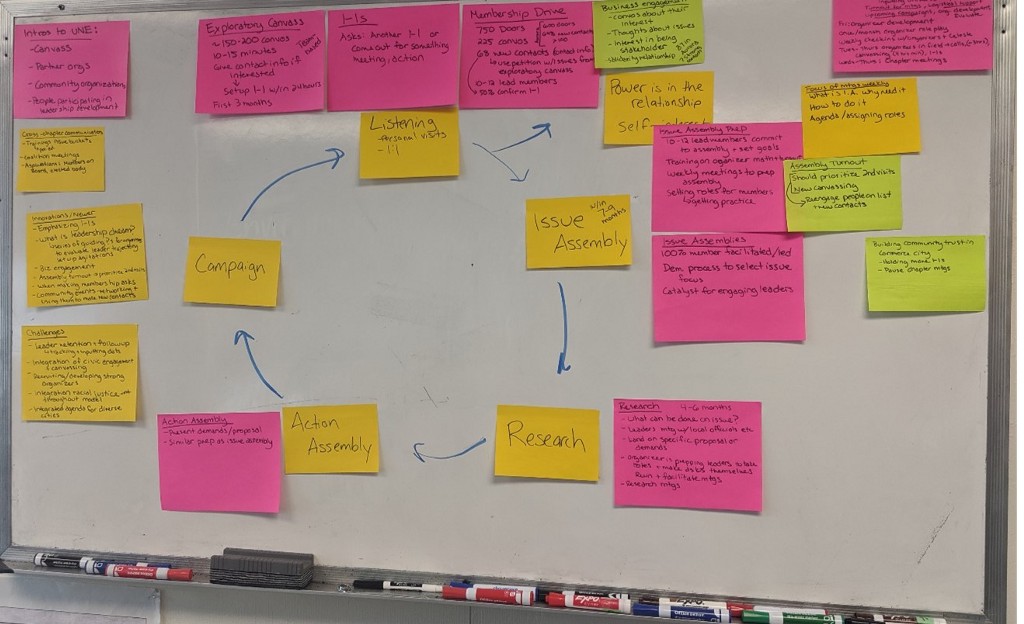
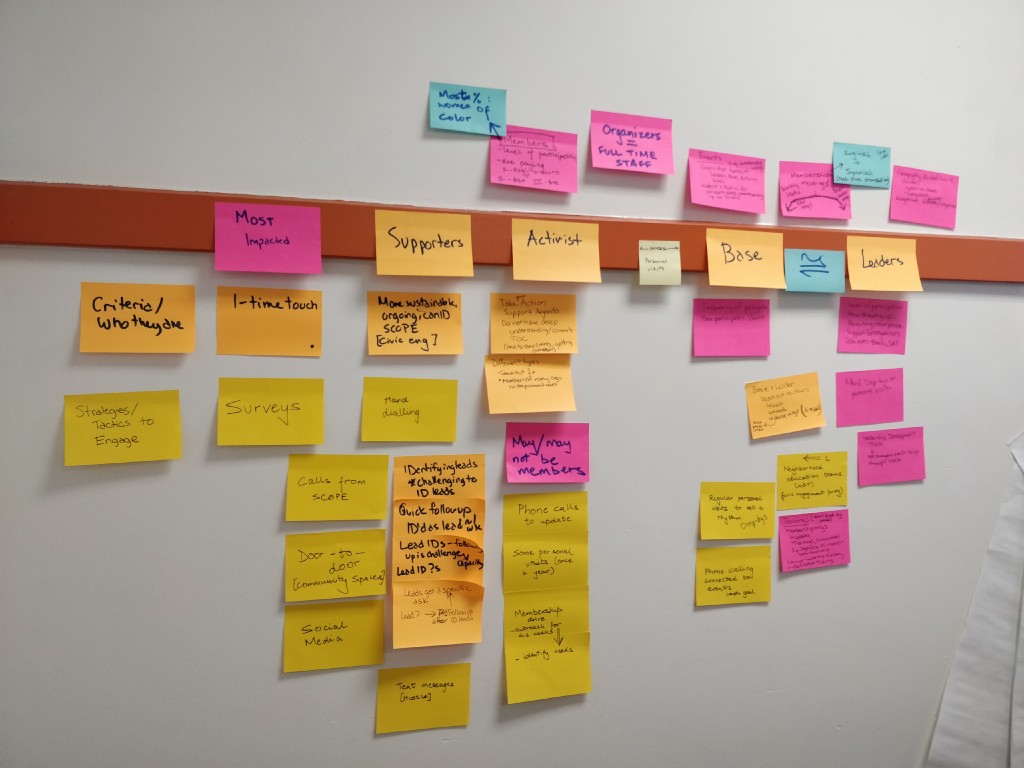
Post-its describing one organization’s model cover the wall during a site visit

Our goal was to get descriptive detailed information, to understand what a person would experience from the time an organizer knocked on their door (in one possible scenario of outreach) to the time that person becomes a member and leader of the community organization. Ultimately, we decided to use an adapted Journey Mapping approach. Journey Mapping is a process adapted from Silicon Valley for designing the user experience of people who engage with apps and websites. We used a similar process to map the experience of a person who connects with and builds their leadership through community organizing.

We found that this style of approach — using post-its and plotting them on the wall — helped us gain more clarity than a traditional interview. Organizers were able to clarify and add more detail when they saw what was written on the wall. And it helped move us along when we placed an empty post-it and asked organizers to fill it in.

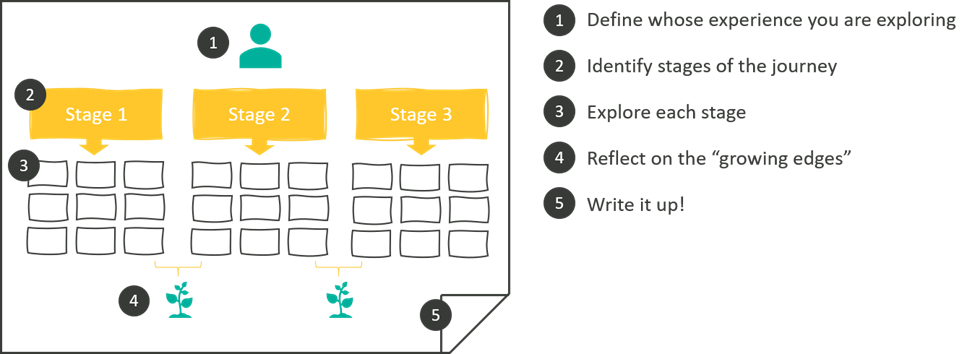
Our process included five steps:

  1. Define whose experience you are exploring
  2. Identify stages of the journey
  3. Explore each stage
  4. Reflect on the “growing edges”
  5. Write it up!

While we used this process to find a common model of community organizing, this approach could easily be used for any evaluation that seeks to capture a progressive model, e.g., increasing person or organizational capacity, member engagement, etc.

1. Define whose experience you are exploring

It’s hard to understand someone’s journey before you have a better understanding of who they are, what influences them, and the context in which they live. In our case, we were curious about the members of grassroots organizations whose journeys we mapped. Before we mapped the organizing models, we spent time learning about members and the communities they come from.

Although organizing looked different in each of the nine organizations we worked with, their members experienced similar challenges of being disproportionately impacted by racial, social, and economic inequities and injustice. Their strengths were unique: members in some states were connected to strong churches or local groups, while others have a history of civic involvement. One community organized in California had a strong grounding in the civil rights movement and has long fought against oppression. Understanding the world in which members lived helped us see how the model to organize them was constructed to respond to the needs and strengths of its members.

Questions for exploring the “who”:

Tell us about the community you organize. Who lives in the community? Who are the types of people you organize? Where do they live?

What is the demographic makeup of the community?

What challenges are they experiencing right now?

What are the strengths of this community?

Post-its describing one organization’s model cover the wall during a site visit

2. Identify stages of the journey

By identifying stages of a person’s journey you are creating a framework for the model that you will fill in later. You can start mapping stages at any point of a person’s journey. It doesn’t have to be the beginning, just a common experience of members. Start where there is energy. In our case, organizers we spoke with mentioned outreach activities to engage new members so we started there.

Write the stage on a post-it and place it on the wall or somewhere visible. You could do this virtually using tools such as Mural or Jamboard. Continue to add stages by asking what members experienced after, or leading up to, the plotted stage.

As we plotted stages, grassroots organizations described their work as linear, cyclical… even as a “tornado.” We did our best to place post-its in a way that represented the structure they described. If you’re limited by the wall space you have — don’t worry. Just get the stages down and take note of the structure discussed so you can capture it later.

For example, one organization outlined five stages of their organizing model: Listening, issue assembly, research, action assembly, and campaign.

NOTE: In a few cases, we had two parallel stages for different arms of the work. For example, one organization organized individuals as well as congregations, and had different approaches initially for getting members involved and building leadership. It was key to listen to organizers and map the process as they described it, in this case showing two parallel sequence of stages rather than one.

Questions for identifying stages:

What is a key stage or benchmark in people’s development and engagement, e.g., “first contact” with community members?

How do members go from first contact to becoming a leader? What milestones do they accomplish in between?

(If it is difficult to identify specific stages) Can you tell me the story of a specific community member that illustrates your approach to organizing? Walk us through what your organizing looked like from that person’s experience.

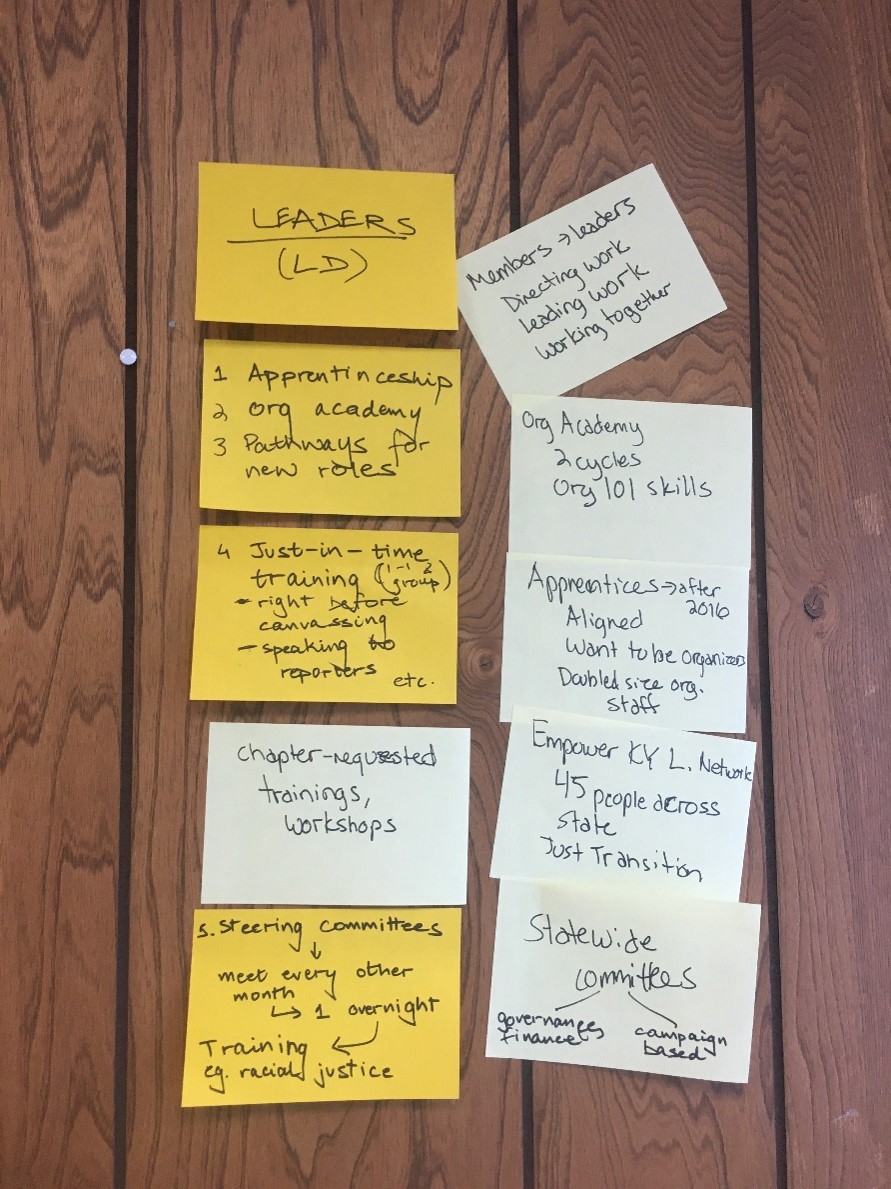
Post-its describing the detail of the leadership development aspect of one partner’s organizing model

3. Explore each stage

Take time to explore the specific strategies and tactics that organizers use to develop community members into leaders. Write these down on different color post-its and place them around the stage you are describing. This provides important details to understand what a person experiences that motivates them to continue to the next stage of the model.

Our goal was to get at a common model — not the small changes made day-to-day by unique organizers for unique members. This meant we had to stay within a specific timeframe, usually the most recent campaign conducted. We also framed the features of stages as what most members experienced. For example, if one member opted for conducting house parties as a part of their outreach but it was not a common practice, we did not include it in our model.

Questions for exploring stages:

What is the goal for this stage? What does successful engagement look like?

What does a community member’s engagement with the organization look like in this stage?

What qualities or requirements are expected of a person in this stage?

What strategies and tactics do you use for recruiting/developing members into leaders?

NOTE: Alternatively, you can dig into each stage as you identify it. We did a little of both and allowed the conversation to flow — capturing the stages, probing deeply as we went. Then we filled in the gaps once we had all the stages on post-its on the wall.

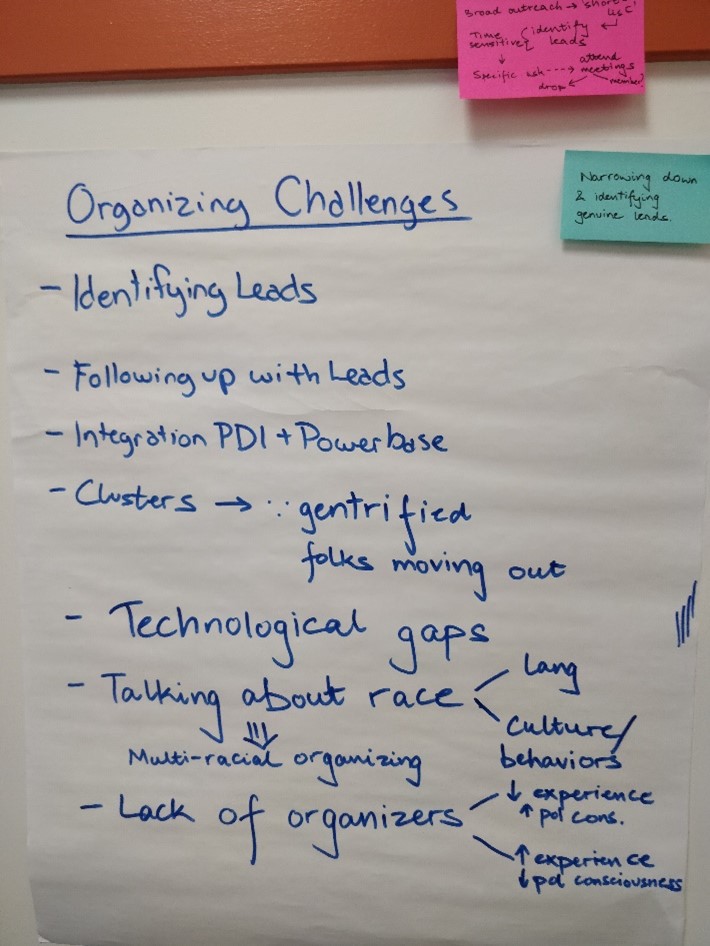
Some of the challenges, or “growing edges” identified by one partner in the process

4. Reflect on the “growing edges”

Once you have a good understanding of the major stages, strategies, and tactics, take a step back and reflect on the model overall. Often there are overarching elements that are helpful to explore, particularly what new strategies the organizations were experimenting with, and the challenges they were adapting around (the “growing edges”). These can be written on another color post-it on each side of the model.

Questions for reflecting on the model:

Which elements of your approach are newer or experimental?

What led to these adaptations (probing for challenges affecting the organizing model)?

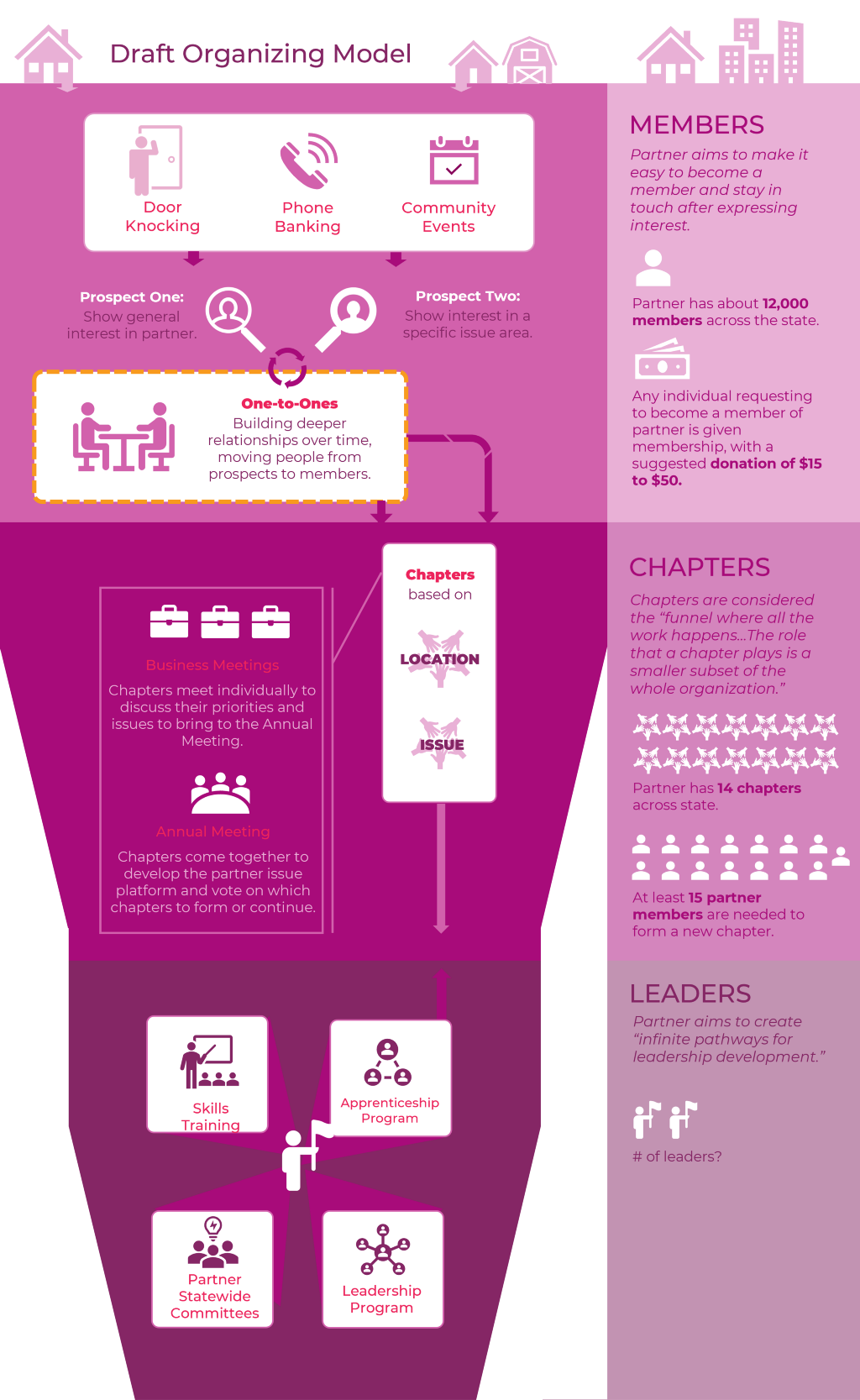
Draft organizing model, showing the trajectory from base-building, to developing chapters, to building leadership
Image of a draft organizing model for one organization built in PowerPoint. Visuals were accompanied by a more detailed narrative description.

5. Write it up!

When you have the full story, snap pictures of the post-its on the wall. Use these with notes from your conversation to create a product that describes the model you’ve captured. Models can be captured in any format! (Don’t be afraid to get creative — if a traditional report works for your audience that’s great, but consider alternative formats too, such as a cartoon strip, video, or SlideDoc.) Whatever you use, remember to describe the model using the same language (e.g., tornado!) that organizations use.

We created two products from this journey mapping exercise: a) a narrative detailing each stage and the “growing edges,” and b) a one-page visual depiction of the model to understand members’ experience at a glance. Organizers worked with us through a couple rough drafts before we came to agreement on a final version.

NOTE: We designed the narrative in Microsoft Word and the visual in PowerPoint. We knew that organizations’ models would continue to change and wanted to give them a tool that they had the power to update and use as they wished. Several organizers shared with us that they appreciated this foresight!

We shared the compilation with all nine organizations, hoping they would identify with others’ models and use them as an opportunity to connect. We created a set of guiding questions to think about as they read over each other’s models, and some questions to help them think about how they can use their own model as well, captured below.

Questions for learning from the model:

How has the model changed over time? What do these changes reflect about your approach or your community?

How can this model be used to educate new members, organizers, and funders?

What can you learn from others’ organizing models?

Have you tried participatory approaches to capture organizing or other community-based models? Please share your own ideas and experiences in the comments!

Mapping community organizing models was part of a larger evaluation that contributed to a framework for building people power. The framework and evaluation findings were published in the report, Power Building in the Community Change Power in Places Initiative: Framework & Strategies, and a New Directions Article written by my colleagues Katie Fox and Margaret Post, Evaluating Power Building.


Mapping community organizing models: An adapted journey mapping approach was originally published in InnovationNetwork on Medium, where people are continuing the conversation by highlighting and responding to this story.
Written by cplysy · Categorized: innovationnet

Sep 14 2022

Powered by our values: Equity, Curiosity, Growing Possibility, Community, and Authenticity

This blog post is part of a series of posts about Innovation Network’s transformation towards equity.

“Innovation is progress in the face of tradition” — Divad @ThereBeKulture

Over the last few years Innovation Network has undergone significant changes that sought to incorporate developments into our organizational structure that have been brewing for years. This included incorporating equity and inclusion in how we function as an organization. This collective and horizontal work encouraged us to rethink our values to more accurately reflect both the work we had been doing and the work we consciously wanted to pursue.

We led with the perspective that values are not simply statements for a website, but rather an ethos to think, work and live by. As a team, we are committed to uplifting projects aligned with our mission: to facilitate meaningful learning and evaluation with and for our partners to advance social justice through equity. Projects where we can actively and proudly embed our values which include equity, curiosity, growing possibility, community, and authenticity.

This is why our first step when reading through, considering, and submitting proposals for any project is to ask ourselves whether these align with our mission and values. Do these projects center and seek to advance social justice and equity? If so, then our work will be purposeful and we will continue by embedding equity and our values within every step of our efforts. Not because we have to, but because our values are a reflection of our team’s beliefs and principles as individuals. This is the first valuable lesson we learned through this transformation process to ensure our team embodies our organization’s mission, vision, and values.

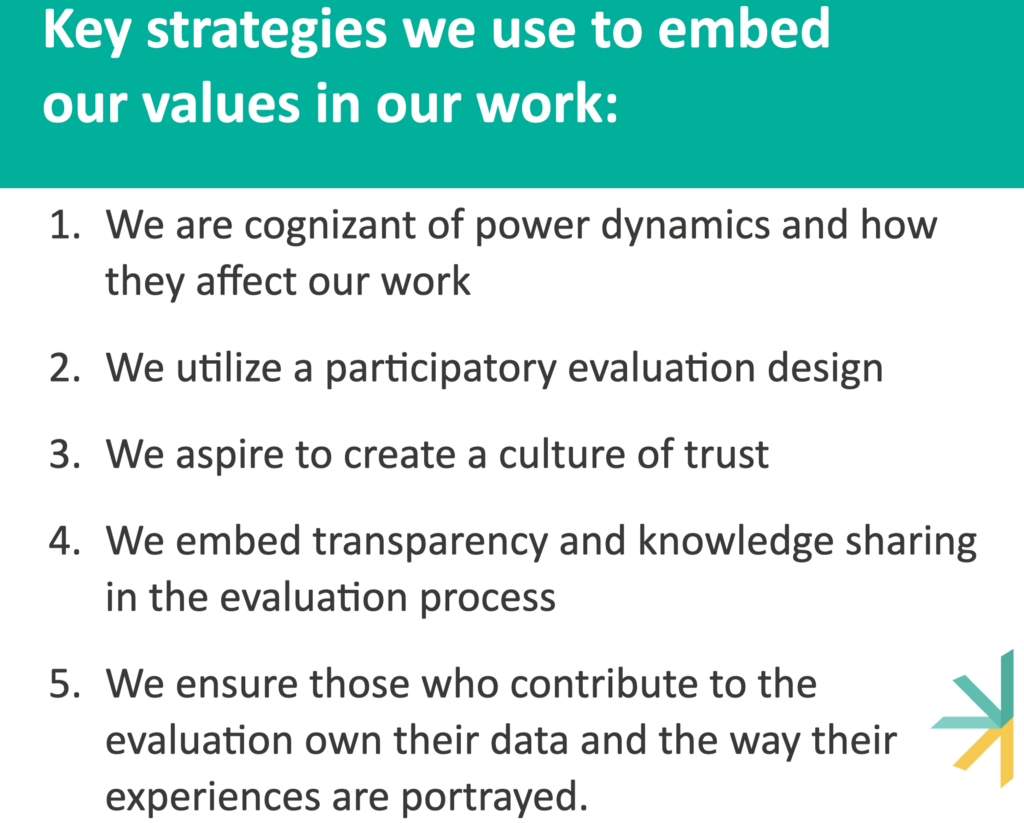
Once we have projects whose mission and objectives seek to advance social justice, our associates, project leads, and project advisors work to implement our values every step of the way. Some key strategies we use to implement these values include the following:

1 We are cognizant of power dynamics and how they affect our work. As external evaluators, navigating power dynamics is not new. However, visualizing those power dynamics and talking about them openly is a new practice that has helped us make changes in the way we do our work to alleviate common marginalization that occurs because of power dynamics. Our team thrives, through our values of equity and authenticity, when we are transparent about the power each of us holds and invite new knowledge and perspectives, no matter how uncomfortable it may be, because we know that diverse perspectives challenge our biases and enrich our projects and findings.

In practice, all our incoming team members are required to undertake the We All Count Foundations of Data Equity training; in addition to other important learning, the training provides them with the tools to create Evaluation Power Maps (check out this example by Heather Krause). For one evaluation that looked at a cross-state coalition, the Evaluation Power Map helped us start a conversation about who is involved and who gets to design the evaluation. We identified that advocates had initially been omitted, which prompted us to create an Evaluation Advisory Group that included advocates as collaborators to design mutually beneficial evaluation questions. The questions developed as a result were far different from what we had expected, centering on the desire of coalition members to explore the purpose of the coalition.

2 We utilize a participatory evaluation design. While we have always taken a collaborative approach with our clients, usually foundations and larger nonprofits, we have shifted to seek out contribution, and compensate whenever possible, the participation of actors involved in the project. This is particularly important to us because historically evaluation and learning have existed in traditionally hierarchical power structures, that not only leave behind but also overburden low-resourced organizations, particularly grantees of funders who may have hired us for an evaluation that involves their grantees. This is problematic because it is the evaluation participants who are doing the vital groundwork to further social justice and have the most experience, yet are often the least engaged in agenda creation and decision making. Our values of community and equity are our guiding lights throughout this strategy, encouraging us to include grantees in the participatory type of work we have always done with our clients

We are working with a Foundation to help them redesign their evaluation and learning objectives and practices to directly benefit their grantees We created a participatory learning agenda and included both grantees and community members throughout the project. We also created an ongoing feedback loop where evaluation participants could share thoughts and concerns about the execution and direction of the project. This was especially helpful as it allowed us to make shorter-term adjustments to the project from both the Foundation and the grantees’ perspectives. Our participatory approach allowed us to ensure the results truly reflected the concerns, desires, and needs of all parties impacted by the Foundation’s work.

3 We aspire to create a culture of trust. To ensure our partners are able to participate actively, we ensure every person is treated with respect, dignity, and empathy. Some strategies to create a culture of trust revolve around the way we listen to each other, ask for opinions and feedback, respond to comments or questions, and provide support to our partners. This effort to be both participatory and create a culture of trust is also why we prefer to call those involved in the evaluation project learning partners. It is a change that shifts our mindset to one of a horizontal and mutually beneficial relationship that recognizes partners as experts of their own experiences with both authority and agency. This strategy highlights our ongoing efforts to live by our values of growing possibility, community, and authenticity.

A clear example of this is our recognition of the evolving process of evaluation and learning during the data collection and sensemaking process of a particular project. In this stage, we found that identified interviewees had felt taken advantage of by someone involved in the initiative we were evaluating and disagreed with the framing in our draft report. We immediately took a step back with humility and empathy, providing space and time for the interviewees to share their concerns. Our team recognized the issue and gave collaborators the power to question the process. We were able to better understand their experience and rework the draft report before presenting it to their funders. This allowed us to have a much more honest and authentic final result and allowed for genuine growth.

4 We embed transparency and knowledge sharing in the evaluation process. We continuously update our partners and collaborators, sharing notes, data, insights, and learning logs. This ensures all involved in the project are on the same page, have equal access to resources, and most importantly, that we have a transparent evaluation and learning process. Ensuring everyone is able to participate actively through honest feedback contributes to an ongoing learning strategy centered around using data for action. This transparency also helps us challenge hierarchical relationships, shifting power towards grantees and community members who are encouraged to participate, co-create and learn with us, highlighting our values of curiosity, growing possibility, and authenticity.

In some of our projects, we create learning logs that capture insights and assumptions that are made accessible, updated, and re-shared to crystallize learnings from each session. Partners have access to a written record of their learning that they can access, at any time, long before any formal report is presented. Learning logs also ensure that those partners that could not join a session are included and given the opportunity to learn and contribute throughout the project.

5 We ensure those who contribute to the evaluation own their data and the way their experiences are portrayed. It is important to think about who is doing the reflection, who is missing from the table, and understand what voices and insights are important to elevate. We want to make sure the final project, and deliverable, is useful for both our client and other evaluation participants. We commonly hold sensemaking sessions to accomplish this. In a sensemaking session, we invite our partners to help us interpret the findings of the evaluation and bring in additional perspectives and insights. This process makes us check our biases, prioritize what is important, and is a facilitated space where partners translate learning into how it can be acted on to improve their work. These efforts highlight, above all, our value of equity as we strive to ensure collaborators have a say in this process, and the findings themselves.

During one sensemaking session, we took particular care to invite the people we had interviewed. The participants pressure-tested the insights we presented during the Sensemaking, weighing in and challenging those that did not align with their experience. Thanks to their active participation, we were able to integrate all perspectives in the final report and create a powerful and comprehensive strategy for the Foundation with recommendations that put forth collective goals that would not only serve the Foundation but also the field of advocacy in the state.

As a team, we have been incorporating many of these strategies for years, but only recently has a critical reflection on our work and a deep organizational transformation helped us distill our efforts into our core values of equity; curiosity; growing possibility; community; and authenticity.

We know that implementing these values with our clients is not enough; we are committed to incorporating our values internally, and today, our team is actively building a culture of trust and intentional, collective, transparent, and horizontal decision-making processes, where everyone’s opinion, independently of their level is respected and leveraged to make decisions.

While we have shared our work ethos and some of our strategies here, we have many more that we currently implement, or are experimenting with that demonstrate the positive impact of a values-based approach, and we know you do too. We encourage you to share and respond to how you incorporate your values into your work or what different strategies you implement to make evaluation and learning more equitable.

Stay tuned to our blog for more ways in which we incorporate our values into our work, reflections, and lessons learned from this transformation process.


Powered by our values:
Equity, Curiosity, Growing Possibility, Community, and Authenticity
was originally published in InnovationNetwork on Medium, where people are continuing the conversation by highlighting and responding to this story.
Written by cplysy · Categorized: innovationnet

  • « Go to Previous Page
  • Go to page 1
  • Go to page 2
  • Go to page 3
  • Go to page 4
  • Go to page 5
  • Go to Next Page »

Footer

Follow our Work

The easiest way to stay connected to our work is to join our newsletter. You’ll get updates on projects, learn about new events, and hear stories from those evaluators whom the field continues to actively exclude and erase.

Get Updates

Want to take further action or join a pod? Click here to learn more.

Copyright © 2026 · The May 13 Group · Log in

en English
af Afrikaanssq Shqipam አማርኛar العربيةhy Հայերենaz Azərbaycan dilieu Euskarabe Беларуская моваbn বাংলাbs Bosanskibg Българскиca Catalàceb Cebuanony Chichewazh-CN 简体中文zh-TW 繁體中文co Corsuhr Hrvatskics Čeština‎da Dansknl Nederlandsen Englisheo Esperantoet Eestitl Filipinofi Suomifr Françaisfy Fryskgl Galegoka ქართულიde Deutschel Ελληνικάgu ગુજરાતીht Kreyol ayisyenha Harshen Hausahaw Ōlelo Hawaiʻiiw עִבְרִיתhi हिन्दीhmn Hmonghu Magyaris Íslenskaig Igboid Bahasa Indonesiaga Gaeilgeit Italianoja 日本語jw Basa Jawakn ಕನ್ನಡkk Қазақ тіліkm ភាសាខ្មែរko 한국어ku كوردی‎ky Кыргызчаlo ພາສາລາວla Latinlv Latviešu valodalt Lietuvių kalbalb Lëtzebuergeschmk Македонски јазикmg Malagasyms Bahasa Melayuml മലയാളംmt Maltesemi Te Reo Māorimr मराठीmn Монголmy ဗမာစာne नेपालीno Norsk bokmålps پښتوfa فارسیpl Polskipt Portuguêspa ਪੰਜਾਬੀro Românăru Русскийsm Samoangd Gàidhligsr Српски језикst Sesothosn Shonasd سنڌيsi සිංහලsk Slovenčinasl Slovenščinaso Afsoomaalies Españolsu Basa Sundasw Kiswahilisv Svenskatg Тоҷикӣta தமிழ்te తెలుగుth ไทยtr Türkçeuk Українськаur اردوuz O‘zbekchavi Tiếng Việtcy Cymraegxh isiXhosayi יידישyo Yorùbázu Zulu