• Skip to main content
  • Skip to footer
  • Home

The May 13 Group

the next day for evaluation

  • Get Involved
  • Our Work
  • About Us
You are here: Home / Archives for allblogs / innovationnet

innovationnet

May 31 2022

Carrying an Equitable Innovation Network Forward

Photo by Dom J

This blog post is part of a series of posts about Innovation Network’s transformation towards equity.

The work of equity starts with our own internal work, and by now you have read about our transformation towards equity and new values that center social justice. Though many of the individuals who helped to shape our transformation have moved on to other opportunities, we are committed to carrying forward our collective lessons and vision for equity.

This work has been personal, forcing us to confront our perceptions of ourselves and the way we engage with each other. We have also seen the power of transparent decision making, trust, and a human-centered approach on our practice and our relationships to one another.

We are making structural changes to our organization that embed equity, and allow future generations of Innovation Network team members to shape it by:

  1. Participating in externally- and internally- facilitated authentic conversations, such as healing circles facilitated by Dr. Wenimo Okoya. These experiences provided a model for how we engage with each other as colleagues, and most importantly as human-beings. While relationships, including working ones, require ongoing care, healing circles resulted in a deeper sense of trust, transparency, and connection amongst our team.
  2. Intentionally shifting our culture toward distributed leadership and transparent decision-making. This framework grounds our commitment to disengaging harmful power dynamics and centers the needs of every person, regardless of experience or role, within our organization. This can be seen in our commitment to holding weekly full team decision making conversations that range from making decisions about time-tracking software to equitable salary policies.
  3. Learning about some of the deep work that is required to become activists for equity through evaluation and learning. Doing this work internally has allowed us to engage more authentically with our clients and realize what it takes to deconstruct power structures that are inherent in our projects. A future blog post will focus on how we are embedding equity in our day-to-day learning and evaluation work.

As we broaden our team, new staff are invited to join an organization where they can be themselves while taking an active role in molding the organization according to their collective beliefs; and furthering equity outside of the borders of our organization through our projects and initiatives.

We know there is much work still to do. As we look forward to the future of our organization, we are excited to experiment with ways to engage one another as contributors to a new more equitable way of working and learning. We believe that this is only possible because of those in the field who have been leading by example and sharing their experiences. We are grateful for their guidance and expertise. Following in their footsteps, we invite you to join us as collaborators and welcome your feedback as we experiment and create opportunities to learn together about how to create new equitable structures that start with us.


Carrying an Equitable Innovation Network Forward was originally published in InnovationNetwork on Medium, where people are continuing the conversation by highlighting and responding to this story.


Written by cplysy · Categorized: innovationnet

Apr 26 2022

Leading through Transformation

Photo by Chris Lawton on Unsplash

As I transition out of my role as Director of Innovation Network, I’ve been in deep reflection about how the last 20 years shaped and sharpened my own approaches to learning and evaluation, as well as those of my team and colleagues. The last few years in particular have revealed meaningful lessons about the complexities of creating institutional shifts while navigating through uncertainty and organizational change. These experiences were grounded in the lessons from our transformation toward equity. Each one reaffirmed the importance of leaning into discomfort to shift and broaden our awareness; authentically connecting with each other and those around us to build a foundation of trust; and re-imagining our future from a place of empathy and understanding.

Lean into Discomfort

Leading through this time has emphasized the importance of leaning into discomfort and vulnerability as a pathway for learning and growth. We often intellectualize the world around us to understand and draw meaning from our surroundings. When leading through transformation however, it’s important to explore how our experiences connect to our hearts, not just our minds. As a team, this meant that each one of us had to be willing to engage in deep reflection and at times, challenging conversations with ourselves and each other to interrogate assumptions and create new ways forward. For many of us this meant creating a deeper understanding of our own experiences and perspectives to expand our thinking around what’s possible. At Innovation Network this introspection allowed us to openly share, grow our understanding, and fundamentally shift the way we do things.

Make Authentic and Honest Connection a Priority

While vulnerability, empathy, and curiosity may set a foundation for organizational transformation, it is critical that we make the space and time to connect authentically, both organically and through process. This has been especially important for making sure that we stay rooted in our connection to one another’s experiences as we move through our work. In our organization, this simple but impactful act has led to greater honesty and increased capacity for resolving challenges with consideration for our individual and shared perspectives.

Collectively Re-imagine the Future

Collaboratively re-imagining with the team has been one of the most exciting and revealing parts of the transformation process for the organization and for me personally. While it is easy to fear or resist change, we instead used this time as an opportunity to courageously re-imagine the future from a place of mutual trust, empathy, and empowerment. For us, this has looked like re-imagining our organization, its renewed mission, vision, and values , as well as how we operate and the difference we hope to make. It has also reinforced the importance of community, collaboration, and co-creating with our partners in the field.

I am deeply appreciative of how this process has shaped Innovation Network and my own learning as a leader and community servant. As I part the organization, I employ each of us to continue approaching our work and each other with curiosity, empathy, and heart in our efforts to advance equity and social change.


Leading through Transformation was originally published in InnovationNetwork on Medium, where people are continuing the conversation by highlighting and responding to this story.

Written by cplysy · Categorized: innovationnet

May 11 2021

The limitations of using an advocacy frame to understand and evaluate grassroots-led change

This blog post was originally published in AEA365 during the Advocacy and Policy Change week in March 2021

Over the past year, we have all witnessed the power and promise of grassroots-led change as popular movements and organized communities have galvanized widespread support for changing institutions and systems that perpetuate anti-Black violence and racism. These mechanisms for change have a long, important history in advancing systems and structural change grounded in anti-racism, equity, and justice.

However, the evaluation field is short on scholarship, guidance, and spaces for evaluators to learn about the unique histories, cultures, and practices of grassroots-led change, including social movements and community organizing. In that absence, the evaluation field has, perhaps unknowingly, upheld advocacy and policy change evaluation as the framework for these social change mechanisms. In my short evaluation career, I have heard evaluators refer to community organizing as an “advocacy strategy” and policy change as the ultimate end goal of movement building and organizing.

When evaluators subsume community organizing and social movements under the advocacy and policy change umbrella, we obscure and devalue their unique histories, practices, and contributions. Perhaps most troubling, by centering advocacy and policy change in social justice-oriented evaluation, we are indirectly complicit in the continued underinvestment in grassroots-led change by the philanthropic sector. Mitigating these effects and evaluating grassroots-led change responsibly requires a reorientation and expansion in our understanding of the practices, strategies, and outcomes of social change work.

Lesson Learned:

Social movements and community organizing are fundamentally different mechanisms of social change from traditional advocacy — from the individuals and communities that lead them, to the underlying principles that motivate them, to the strategies they employ, to the end goals they seek. Traditionally, the advocacy sector is grounded in technocratic and meritocratic worldviews that center professionalized, “expert” advocates and policymakers as the agents of social change. In contrast, community organizing and social movements democratize social change, putting impacted communities in the driver’s seat. Community organizers and movements builders seek to not just work within existing power structures but to disrupt those structures and build the agency and capacity of communities most impacted by injustice and inequities to advance change.

Key Resources:

How Organizations Develop Activists by Hahrie Han: A thorough primer about the practices of community organizing.

The Purpose of Power by Alicia Garza: Part memoir, part handbook from one of the co-founders of Black Lives Matter that offers reflections and lessons on the unique challenges and opportunities of organizing and movement building in our current moment.

This is an Uprising by Mark and Paul Engler: A clear and compelling guide to movement building, packed with examples from movements around the world.

The American Evaluation Association is hosting APC TIG Week with our colleagues in the Advocacy and Policy Change Topical Interest Group. The contributions all this week to aea365 come from our AP TIG members. Do you have questions, concerns, kudos, or content to extend this aea365 contribution? Please add them in the comments section for this post on the aea365 webpage so that we may enrich our community of practice. Would you like to submit an aea365 Tip? Please send a note of interest to aea365@eval.org. aea365 is sponsored by the American Evaluation Association and provides a Tip-a-Day by and for evaluators. These views and opinions do not necessarily represent those of the American Evaluation Association, and/or any/all contributors to this site.

Originally published at https://aea365.org on March 7, 2021.


The limitations of using an advocacy frame to understand and evaluate grassroots-led change was originally published in InnovationNetwork on Medium, where people are continuing the conversation by highlighting and responding to this story.
Written by cplysy · Categorized: innovationnet

May 07 2021

“You only get as much justice as you have the power to compel.”

This post first appeared in the Luminaire Group monthly newsletter, Be Lumin-Us in August 2019.

Twelve years ago, when I began training as a community organizer in New England, I heard the following saying:

“You only get as much justice as you have the power to compel.”

While my community organizing career was short-lived, during those years, power was a constant reality of my day-to-day work. As I knocked on doors, recruited volunteers, and lobbied legislators, I found my conversations frequently revolving around power — who has it, who doesn’t, and how we can get more of it.

It was at that time I learned that proactively building long-term power in communities and movements is critical to achieving and maintaining structural change. It usually wasn’t enough to just pass good policy and get supportive people elected. We needed to sustain a base of power that could take us past legislative sessions and elections to ensure that policies were implemented, elected officials were held accountable, and an affirmative narrative about equity and justice was cultivated and maintained.

But as I’ve transitioned from organizer to funder to evaluator, I’ve found that in the philanthropic and evaluation sectors, power building is too often missing from discussions about structural and systemic change. As a result, there is a fundamental disconnect between our aspirations for social change and what we fund and measure.

Momentum, a social movement incubator and training organization, teaches a theory of power that helps clarify this disconnect. They explain that most of us have been taught to believe a monolithic view of power — “that power lies in the hands of the appointed few.”

It’s a view that leads people to believe they are powerless or that the path to change necessarily runs through powerful decision-makers. Traditional approaches to power mapping embrace this view of monolithic power by centering decision-makers and their interests. As a result, campaigns and movements are frequently organized around theories of change that make influencing traditional power holders their ultimate goal.

In recent years, there has been an uptick in funders who are shifting from a monolithic view of power to a social view of power that has long been embraced by grassroots organizers and movement builders. Our sector is beginning to understand that durable structural change requires building the power of communities most impacted by inequities and injustice. As a result, knowing how power shows up in change ecosystems, how it is built and wielded, and how to appropriately measure it will become an increasingly important competency for evaluators who assess structural change efforts.

Get Lit with Katie Fox: A Q&A with this month’s guest editor

This month, we chatted with Katie about what’s sparking joy for her, an idea she loves right now, and where she’s turning for inspiration.

Spoiler: This Q&A involves a cute dog photo.

READ THE BLOG →

Originally published at https://mailchi.mp.


“You only get as much justice as you have the power to compel.” was originally published in InnovationNetwork on Medium, where people are continuing the conversation by highlighting and responding to this story.
Written by cplysy · Categorized: innovationnet

Dec 01 2020

Data Placemats & Emergent Learning Tables

Data Placemats & Emergent Learning Tables: Tools to Meaningfully Engage Diverse Perspectives in Evaluation Sensemaking

Image created by Veena Pankaj, Innovation Network

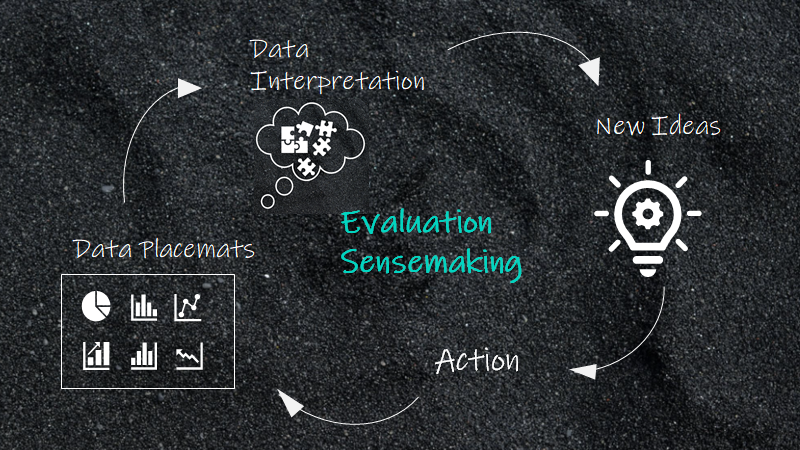
In an earlier post that highlights Reflections on the Intersection of Evaluation and Emergent Learning, I shared insights generated through my application of Emergent Learning principles and tools to my work. Through this experience I came to realize that the true intersection between evaluation and emergent learning lies in the interpretation of data and its use for reflection and learning. Data interpretation is a key part of the evaluation life cycle. It’s the space where we start to make meaning of and draw conclusions about the data collected through the evaluation. Often, this data is an accounting of the experiences and observations of community members and other stakeholders who aren’t typically involved in the sensemaking conversation.

I believe that involving different stakeholders in the interpretation process, those most connected to the programs, initiatives, and systems we are evaluating, invites a diversity of perspectives that can strengthen insights and lead to new ways of moving forward.

This post focuses on using data placemats within the context of emergent learning, as a vehicle to meaningfully involve stakeholders in the sensemaking process (to learn more about data placemats, check out this article).

The Data Interpretation Meeting

As part of the multi-site health equity initiative that Innovation Network is evaluating, our evaluation team conducted approximately 60 interviews with participating community members. As we analyzed and reflected on the data, I realized that we were only capturing a part of the story…

To truly understand and leverage the data into meaningful action, we would need to involve those that are connected to the communities and the communities themselves in the sensemaking process.

While I often involve the client and relevant stakeholders in the interpretation of data, I usually do a fair amount of data interpretation in advance and feel pressure to come up with insightful findings and recommendations of my own. For this evaluation, I scheduled a full-day, in-person data interpretation meeting with foundation staff and members of the technical assistance/coaching team.

The purpose of this meeting was to use the emergent learning table as a means to share evaluation data, create space to add additional observations and experiences, and collaboratively engage in conversation to generate meaningful insights and new ideas for moving the work forward.

Through this conversation, I wanted to gather the experiences, interpretations, and reflections of the individuals that were working closely with the communities.

The Emergent Learning Table

4QP’s Emergent Learning Platform

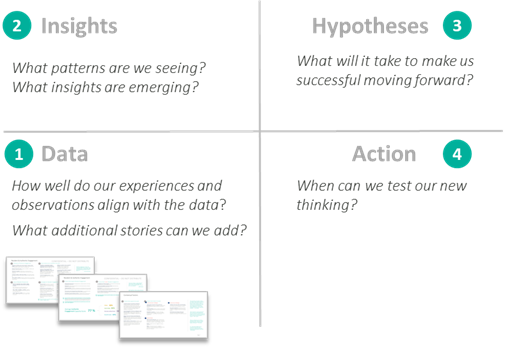
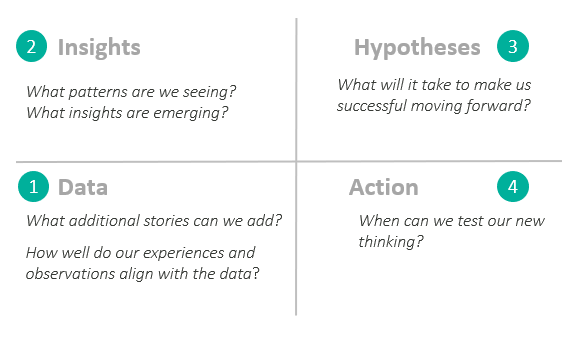
The emergent learning table helps groups articulate their best collective thinking about what it will take to be successful by providing a platform to engage stakeholders in a process designed to 1) reflect on data, 2) generate insights, 3) establish hypotheses, and 4) move towards action. Through this platform, conversation is organized into four quadrants:

  • Quadrant 1: Ground Truth/Data (discussion of experiences and stories)
  • Quadrant 2: Insights (an opportunity to collaboratively reflect on the data to highlight patterns and generate insights)
  • Quadrant 3: · Hypotheses (an opportunity to generate new ideas for moving forward)
  • Quadrant 4: Moving to action (making a plan to test new hypotheses)

For more information on emergent learning tables, checkout Fourth Quadrant’s Guide to Emergent Learning Tables.

While I was initially apprehensive about using a new approach for the interpretation process, I was also excited about the possibilities it could create. Our team had lots of data to share and we would be engaging with a group of people that were truly involved and invested in the outcomes of this initiative. What better group of people to engage in this conversation!

Through interviews and surveys, our evaluation team collected a large amount of data. The interviews in particular yielded some great qualitative data.

How could we share this information in a way that could facilitate the sense-making process so participants can readily comprehend the data and surface insights?

Data Placemats

I often use data placemats as a way to organize the evaluation data into topic areas to help meeting participants understand and make sense of data.

The visual nature of the data placemat makes it easier for participants to digest information, enabling them to more readily engage in productive conversation around the data.

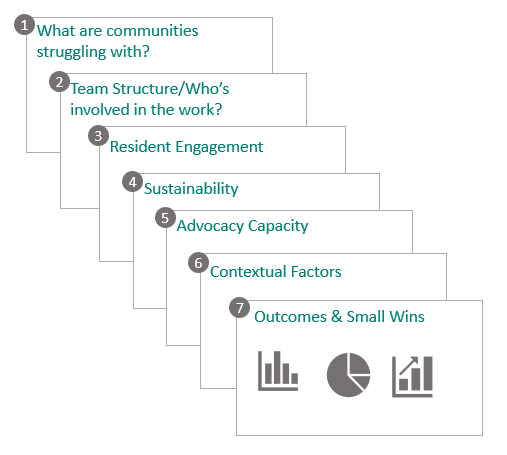
For this meeting, we used a combination of data placemats and an emergent learning table to facilitate the data interpretation meeting. We created a total of seven data placemats, each focusing on a specific thematic area that emerged from the evaluation team’s preliminary analysis:

Each placemat contained a combination of interview quotes organized around sub themes and supporting charts and graphs. The placemats were used as a vehicle to discuss data during the Quadrant 1 conversation.

Using data placemats to help participants understand and make sense of the data allowed us to facilitate a conversation that flowed from data to insights to hypotheses to action.

Adapted from 4QP’s Emergent Learning Platform

What did this make possible?

Moving to Action. Using the Emergent Learning Table as a platform for data interpretation made it possible for the group to go beyond insights to action. This is where evaluation often falls short. The collaborative nature of the conversation and involvement of multiple stakeholders helped increase buy-in to the hypotheses that were generated. This buy-in helps ensure hypotheses are followed through and tested.

Renewed sense of purpose. Going through the quadrants together gave folks in the room a renewed sense of purpose. While many of the insights generated involved issues associated with structural racism and the devastating impacts of white privilege, the group did not feel deflated. Rather, the group worked together to identify existing barriers and brainstorm new ways of moving forward. Coalescing around a common goal/framing question helped inspire a commitment to reflection and ongoing learning.

Creating space for transformation. All too often, grantees and community members experience evaluation as transactional and one-sided and are viewed primarily as subjects of data collection. For evaluation to be truly reflective of the of the experiences and learnings that are emerging from the ground, we must treat recipients of program services (e.g. grantees and community members) as learning partners not just as individuals called upon for data collection. Inviting the subjects of data collection to the sensemaking table as experts in their own lived experience along with other forms of knowledge and expertise, creates the possibility for transformation through collaborative conversation grounded in data and experience.

What did we learn?

Power of collaborative conversation. Inviting a diverse group to the table helped leverage the knowledge and experience of each person and added depth to the conversation. Each person that participated in the data interpretation meeting had their own experiences, observations, and insights to contribute. This was especially pronounced when different technical assistance providers reflected on their experiences working with their designated communities. By having multiple perspectives at the table, we could learn from each other’s experience and work together to identify emerging patterns in the data and the stories that were being shared.

Engaging a diversity of voices. The emergent learning table discussion involved foundation staff, community coaches, and technical assistance providers. The diversity of perspectives led to more meaningful conversation captured by the stories and experiences of those in the room and helped generate new hypotheses grounded in experience.

Moving forward, I would like to broaden the table by inviting community members into the sensemaking conversation to gather their perspectives on this work. By engaging a diversity of perspectives in these conversations, we will be able to leverage the experiences and knowledge of individuals across a broader cross-section of the community and work towards developing a more holistic understanding of what it takes to advance health equity in communities.

The emergent learning table demonstrated the power of incorporating real-time, collaborative reflection in the evaluation sense-making process. Data placemats offered a way to share data collected through the evaluation to help participants digest large amounts of information to meaningfully engage in collaborative sensemaking and idea generation.


Data Placemats & Emergent Learning Tables was originally published in InnovationNetwork on Medium, where people are continuing the conversation by highlighting and responding to this story.
Written by cplysy · Categorized: innovationnet

  • « Go to Previous Page
  • Go to page 1
  • Go to page 2
  • Go to page 3
  • Go to page 4
  • Go to page 5
  • Go to Next Page »

Footer

Follow our Work

The easiest way to stay connected to our work is to join our newsletter. You’ll get updates on projects, learn about new events, and hear stories from those evaluators whom the field continues to actively exclude and erase.

Get Updates

Want to take further action or join a pod? Click here to learn more.

Copyright © 2026 · The May 13 Group · Log in

en English
af Afrikaanssq Shqipam አማርኛar العربيةhy Հայերենaz Azərbaycan dilieu Euskarabe Беларуская моваbn বাংলাbs Bosanskibg Българскиca Catalàceb Cebuanony Chichewazh-CN 简体中文zh-TW 繁體中文co Corsuhr Hrvatskics Čeština‎da Dansknl Nederlandsen Englisheo Esperantoet Eestitl Filipinofi Suomifr Françaisfy Fryskgl Galegoka ქართულიde Deutschel Ελληνικάgu ગુજરાતીht Kreyol ayisyenha Harshen Hausahaw Ōlelo Hawaiʻiiw עִבְרִיתhi हिन्दीhmn Hmonghu Magyaris Íslenskaig Igboid Bahasa Indonesiaga Gaeilgeit Italianoja 日本語jw Basa Jawakn ಕನ್ನಡkk Қазақ тіліkm ភាសាខ្មែរko 한국어ku كوردی‎ky Кыргызчаlo ພາສາລາວla Latinlv Latviešu valodalt Lietuvių kalbalb Lëtzebuergeschmk Македонски јазикmg Malagasyms Bahasa Melayuml മലയാളംmt Maltesemi Te Reo Māorimr मराठीmn Монголmy ဗမာစာne नेपालीno Norsk bokmålps پښتوfa فارسیpl Polskipt Portuguêspa ਪੰਜਾਬੀro Românăru Русскийsm Samoangd Gàidhligsr Српски језикst Sesothosn Shonasd سنڌيsi සිංහලsk Slovenčinasl Slovenščinaso Afsoomaalies Españolsu Basa Sundasw Kiswahilisv Svenskatg Тоҷикӣta தமிழ்te తెలుగుth ไทยtr Türkçeuk Українськаur اردوuz O‘zbekchavi Tiếng Việtcy Cymraegxh isiXhosayi יידישyo Yorùbázu Zulu