• Skip to main content
  • Skip to footer
  • Home

The May 13 Group

the next day for evaluation

  • Get Involved
  • Our Work
  • About Us
You are here: Home / Archives for allblogs

allblogs

Feb 01 2023

Top Tips for Using a Real-Time Interpreter in Interviews and Focus Groups

This article is rated as:

I do some eval EA Traffic Light.jpg

Eval is my main role EA Traffic Light.jpg


In my role as an evaluator specializing in qualitative methods, I use interviews and focus groups A LOT. Interviews and focus groups are strategies used to gather in-depth qualitative data from stakeholders. They’re great methods for capturing perspectives and stories. For further insights on how to conduct interviews, check out this Eval Academy article.

However, interviews and focus groups also have their participation challenges. Stakeholder groups such as those who don’t have access to technology are often excluded from virtual interviews, and individuals who can’t afford travel costs or arrange childcare for example can be excluded from in-person interviews. Stakeholder groups who are unable to communicate in the interviewer’s language or would prefer to speak their own are also easily excluded from participating.

In Canada, the primary language for over 10% of the population is a language other than English or French (Statistics Canada, 2022). A real-time interpreter to translate the interview or focus group conversation can help ensure these individuals’ voices are heard within your evaluation. 

In this article, I share my top tips for running an interview or focus group using a real-time interpreter. I do this by reflecting on a recent online focus group I completed which utilized an Arabic interpreter.


How to decide when to use an interpreter

So firstly, how do you decide when to use an interpreter? Some evaluations may request it within their RFP. In others, when developing the stakeholder matrix and identifying your target groups in the planning stage, it might become apparent that some key groups cannot communicate in the evaluator’s language, or they may be more comfortable conversing in their own. To help you decide whether an interpreter is needed, you can also take a look at this article on ethical decision-making in evaluation.

Once it’s determined that a real-time interpreter is required, a good place to start in recruitment is to ask the organization or program for recommendations of anyone they have used before or of someone they think may be appropriate. In my experience, a professional translator is not always required as we recruited an individual with bi-lingual capabilities identified by the program. In that case, your local university can also be a good place to turn to for ideas and support. Qualities to look for in a real-time interpreter include:

  • A professional communicator; someone who is comfortable and thrives when speaking to new people

    • This includes fluency and experience in conversing in the evaluator’s language and the participant’s language. It is particularly useful if the interpreter has knowledge of the social and cultural background of the participants

  • A professional listener 

    • This includes attention to detail as well as the ability to engage others

It is important to consider whether the interpreter will receive payment for their services. This should be discussed with the organization or program you’re evaluating. If the interpreter is a volunteer from the organization or program, or from a local university, consider offering an incentive that aligns with incentives provided to interview or focus group participants. Check out this Eval Academy article to learn more about incentives for participation in evaluation.

When using an interpreter within an interview or focus group, I suggest 3 main steps:

  1. Preparation

  2. Data collection and real-time interpretation

  3. Debrief


Step 1: Preparation

Using an interpreter within an interview or focus group will mean the session requires more time. If an interview is expected to take 30 minutes in the evaluator’s language, I would suggest setting aside an hour using a real-time interpreter. If you planned a focus group for 90 minutes, consider scheduling 3 hours. If you planned several interviews with individuals that all require interpretation, you could consider scheduling as a focus group for efficiency. Due to the increased time needed, it’s best to keep these focus groups to a maximum of 3 to 4 people to allow for in-depth conversation and real-time interpretation.

It’s important to meet with your interpreter before jumping into data collection. Your interpreter should understand the purpose of the data collection and ideally have some knowledge of the cultural and social background of the participants. This first step is vital to ensure accurate interpretations from the qualitative data collected in the interview or focus group. This will also provide you with the opportunity to assess the interpreter’s experience with translating interviews and focus groups. In this preparation meeting, you should:

  • Provide the interpreter with an overview of the project or program you’re evaluating, why you’re evaluating, why you’re collecting data from participants, and how that data will be used

  • Share all necessary materials with the interpreter in advance (e.g., interview guide, consent form, etc.) so that they can translate it into the appropriate language

  • Run through the question guide to recap each question and the associated probes to ensure the interpreter understands the purpose and intent of the questions

  • Participants should be made aware that an interpreter will be available at the interview or focus group and they can communicate in their own language. Therefore, it is helpful to translate all pre-interview/focus group documentation such as the invitation, information sheet, and consent form, and include a brief introduction to the interpreter in your invite

  • Pre-determine how you will run the interview or focus group (see step 2). You should also make it clear to the interpreter that you would like them to translate the conversation as accurately as possible to avoid any potential judgemental language or interpretation bias. This will help to minimize misunderstandings by relaying the message in its entirety


Step 2: Data collection and real-time interpretation

Now you’ve completed the preparation, it’s time to start collecting data. When facilitating the interview or focus group, it is helpful to record the conversation so you can listen back to it later and transcribe it. Make sure you gain all the participant’s and interpreters’ approval to record the interview or focus group.

When using an interpreter in the interview or focus group, I’ve found that it’s best to break up any large portions of text into blocks of a couple of sentences, then have the interpreter translate each block. It’s important, like with all interviews or focus groups, that participants are given the opportunity to ask any questions before the interview begins. Make sure participants fully understand their rights and that participation in the discussion is voluntary.

If there are multiple participants in a focus group setting, I suggest asking each interview question to each participant and then asking the interpreter to translate their response before moving on to the next individual. This helps to ensure that the interpreter relays the participant’s response in as true a form as possible.

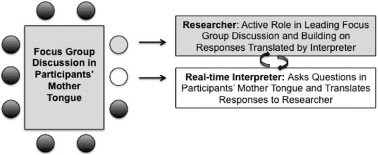
Your main job as the facilitator is to influence the direction of the focus group or interview and interpret the meaning of the participants’ responses. Therefore, while the interpreter translates the response, it is important to take notes for any probes you want to ask the individual. You can also ask the interpreter whether they themselves have any follow-up questions.  Within a focus group, it is important to allow participants to build upon each other’s answers by using probing questions such as “did you have anything to add to x participant’s answer?”. For focus groups, don’t forget to take notes on any relevant body language you view as the conversation is happening like whether there are any dominant voices for example.

The diagram below by Quintanilha et al (2015) provides a visual of the role of the facilitator (i.e., researcher) and interpreter within the focus group setting. 

Step 3: Debrief

Immediately after the interview or focus group, it is useful to hold a quick debrief with the interpreter to recap the discussion and expand on the main discussion points. This can support the validity of findings by ensuring meaning has been interpreted correctly. 

If you had permission to record the discussion, it’s important to consider the higher costs of transcribing when using a real-time interpreter. To reduce costs, I suggest listening back to the recording and only transcribing the sections translated into the facilitator’s language. To do this, you could use audio trimming software like iMovie or Audacity. Take a look at our previous article on how to transcribe interviews like a pro.

Once the audio has been transcribed, it can be useful to verify the transcript with the interpreter. I suggest sending the transcript to the interpreter and asking them to review it for accuracy and meaning. 

When analyzing and presenting your results, make sure you discuss how a real-time interpreter was used to collect and make sense of the data, as well as any possible bias or limitations as a result. This might include power imbalances through interpreter-researcher-participant dynamics or challenges encountered when the flow of the discussion is hindered using back-and-forth interpretation. 


What’s your experience of using a real-time interpreter in an interview or focus group?  Comment on this article or connect with us on LinkedIn or Twitter! 
Written by cplysy · Categorized: evalacademy

Jan 31 2023

What type of data designer are you?

Taking the next steps in your data design journey starts with knowing yourself.

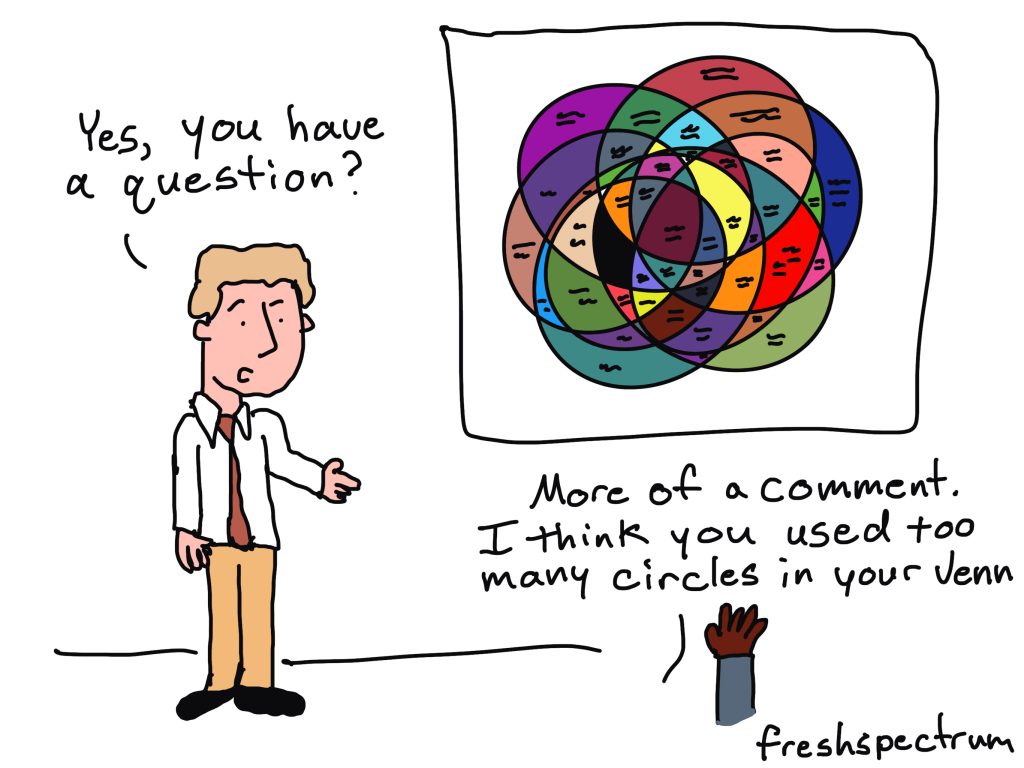
I remember when I first started getting into data visualization design. When bloggers would go to define data visualization design they would often share a type of Venn diagram. On the Venn you would usually find one of the circles focused on design, a second circle focused on data analysis, and a third focused on technology or code.

For far too long I tried to make my way to the center of that diagram. I learned a little about a lot and really started to become the cliche, “jack of all trades, master of none.”

I don’t suggest following the same path.

Picking a data design direction.

It doesn’t hurt to dabble a little in all things data design. It’s really the only way you’re going to find the path that’s right for you.

But if you truly want to develop your skillset, a little bit of focus is going to be helpful. From my experience there are generally five different pathways to take if you want to grow as a data designer. They end up being a kind of personality type.

  1. The Coder
  2. The BI Developer
  3. The Graphic Designer
  4. The Microsoft MVP
  5. The Practical Creative

For me now-a-days, I am mostly number 5 with a minor in number 3.

Which type are you?

I put together a short little quiz.

I’ll probably tweak it a bit in the future or make it a little more comprehensive. But for now it exists to give you a least a basic idea of which path you might want to follow.

At the end of the quiz I also leave with you some advice and websites to check out based on your answers. I also let you know if you should consider my information design academy, or not. Like I’ve said in the past, the academy is not for everyone.

If you do take the quiz, I would love to see what you think of your results in the comments.

Written by cplysy · Categorized: freshspectrum

Jan 30 2023

What Is Strategic Design, And Why Might I Need It

#image_title

Strategic Design is the application of design methods, principles, thinking, and approaches to an enterprise. It combines aspects of systems design, service design, and design thinking. Strategic Design focuses on aligning the organization’s resources, interests, and goals with what it does.

It ensures that your organization is fit for purpose.

Fit For Purpose

We use this expression a lot. It means ensuring two things:

  1. A clear purpose or direction.
  2. That what you do is aligned with that purpose or direction. That means having the right resources (e.g., personnel, technology, tools, location etc..) that are connected with a strategy to use those resources appropriately to accomplish goals connected to your purpose.

It sounds simple, but often we need help with both of these. Sometimes situations change, and what once made sense or worked well no longer does. Sometimes, we’ve changed, and our focus is different from what it was and our purpose.

Strategic Design involves connecting these two things and ensuring that your organization or initiative stays true to the fit and the purpose.

Designing For Purpose

Purpose is defined as:
“An anticipated outcome that is intended or guides your planned actions.”

“What something is used for”

“The quality of being determined to do or achieve something”

Each of these refers to an action-like quality. It’s tied to the things we do, the things we make, or the things we wish to be or become.

In each of these definitions, we can see where something might change. For example, our outcomes might change based on the circumstances or needs of those we serve. We might change our standards of quality or decide we want to do or be something different than we are.

Strategic Design begins by looking at these definitions and asking questions about them. It also involves considering future possibilities. Strategic Design incorporates elements of foresight into it to help us look at trends, patterns, threats and opportunities that are on the horizon or more likely to come to pass.

Designing for Fit

Liedtka & Ogilvy (Design for Growth)

We often find clients who believe that what they are doing aligns with the outcomes they seek, only to realize they need to set up differently to achieve that. It often happens with legacy programs or those operating in a highly dynamic space. Unless we constantly look at our programs and evaluate them, they may eventually lose their fit.

Strategic Design uses tools like evaluation and systems design to explore, with data, how the current or proposed offering (the ‘thing’).

Sometimes walking through a Theory of Change process can help articulate why something might work (for proposed projects)or currently works the way it does. Theory of Change is a process that helps explain why something is expected to achieve something else. It’s an excellent tool to help ensure logic, flow, and connection between your intent, your intervention (e.g., product, service, policy), and your outcomes.

Strategic Design uses all of these to make those connections and uses systems thinking to understand how your program, service, or policy fits within a situation. It allows us to design for the real world.

Doing Strategic Design

As a take-home, think of Strategic Design as involving the following steps:

  1. Figure out where ‘here’ is.
  2. Figure out what ‘there’ means and what it will take to get there.
  3. Create a support system to connect here to there consistently and effectively.

We do this by using approaches like Developmental Evaluation and Design-Driven Evaluation approaches that connect what we make with our outcomes and impact. Strategic Design without evaluation is really just strategic planning; it doesn’t ensure the fit and the purpose are retained when implemented.

Strategic Design isn’t done as a discrete part of the strategy process but is a living, breathing part of a strategy conversation.

Get talking and get designing.

If you want better conversations, better strategy, and better outcomes and don’t know where to begin (even after reading this 🙂 ), let’s talk. We can help you.

Image Credits: Photo by Andrew Neel on Unsplash

The post What Is Strategic Design, And Why Might I Need It appeared first on Cense Ltd. .

Written by cplysy · Categorized: cameronnorman

Jan 30 2023

What Is Strategic Design, And Why Might I Need It?

#image_title

Strategic Design is the application of design methods, principles, thinking, and approaches to an enterprise. It combines aspects of systems design, service design, and design thinking. Strategic Design focuses on aligning the organization’s resources, interests, and goals with what it does.

It ensures that your organization is fit for purpose.

Fit For Purpose

We use this expression a lot. It means ensuring two things:

  1. A clear purpose or direction.
  2. That what you do is aligned with that purpose or direction. That means having the right resources (e.g., personnel, technology, tools, location etc..) that are connected with a strategy to use those resources appropriately to accomplish goals connected to your purpose.

It sounds simple, but often we need help with both of these. Sometimes situations change, and what once made sense or worked well no longer does. Sometimes, we’ve changed, and our focus is different from what it was and our purpose.

Strategic Design involves connecting these two things and ensuring that your organization or initiative stays true to the fit and the purpose.

Designing For Purpose

Purpose is defined as:
“An anticipated outcome that is intended or guides your planned actions.”

“What something is used for”

“The quality of being determined to do or achieve something”

Each of these refers to an action-like quality. It’s tied to the things we do, the things we make, or the things we wish to be or become.

In each of these definitions, we can see where something might change. For example, our outcomes might change based on the circumstances or needs of those we serve. We might change our standards of quality or decide we want to do or be something different than we are.

Strategic Design begins by looking at these definitions and asking questions about them. It also involves considering future possibilities. Strategic Design incorporates elements of foresight into it to help us look at trends, patterns, threats and opportunities that are on the horizon or more likely to come to pass.

Designing for Fit

Liedtka & Ogilvy (Design for Growth)

We often find clients who believe that what they are doing aligns with the outcomes they seek, only to realize they need to set up differently to achieve that. It often happens with legacy programs or those operating in a highly dynamic space. Unless we constantly look at our programs and evaluate them, they may eventually lose their fit.

Strategic Design uses tools like evaluation and systems design to explore, with data, how the current or proposed offering (the ‘thing’).

Sometimes walking through a Theory of Change process can help articulate why something might work (for proposed projects)or currently works the way it does. Theory of Change is a process that helps explain why something is expected to achieve something else. It’s an excellent tool to help ensure logic, flow, and connection between your intent, your intervention (e.g., product, service, policy), and your outcomes.

Strategic Design uses all of these to make those connections and uses systems thinking to understand how your program, service, or policy fits within a situation. It allows us to design for the real world.

Doing Strategic Design

As a take-home, think of Strategic Design as involving the following steps:

  1. Figure out where ‘here’ is.
  2. Figure out what ‘there’ means and what it will take to get there.
  3. Create a support system to connect here to there consistently and effectively.

We do this by using approaches like Developmental Evaluation and Design-Driven Evaluation approaches that connect what we make with our outcomes and impact. Strategic Design without evaluation is really just strategic planning; it doesn’t ensure the fit and the purpose are retained when implemented.

Strategic Design isn’t done as a discrete part of the strategy process but is a living, breathing part of a strategy conversation.

Get talking and get designing.

If you want better conversations, better strategy, and better outcomes and don’t know where to begin (even after reading this 🙂 ), let’s talk. We can help you.

Image Credits: Photo by Andrew Neel on Unsplash

The post What Is Strategic Design, And Why Might I Need It? appeared first on Cense Ltd. .

Written by cplysy · Categorized: cameronnorman

Jan 30 2023

How to Influence Others with Your Data: SuperDataScience Podcast Interview

What is data storytelling?

How do we overcome common pain points in data visualization and storytelling??

What’s the most important thing to keep in mind while editing our visualizations???

I recently discussed all these, and more, on the SuperDataScience podcast with the host, Jon Krohn.

With more than 600 episodes and hundreds of thousands of downloads each month, the SuperDataScience is the #1 podcast in the data field. What an honor!

What’s Inside

  • My definition of data storytelling
  • Common pain points and how to overcome them
  • Best practices for data visualization
  • Surprising spreadsheet tricks
  • When static dashboards are more effective than interactive dashboards
  • Top tips for presenting data in a slideshow

You can listen to or watch the episode here. Or, scroll down to read the highlights.

Listen to the Podcast

You can subscribe to the SuperDataScience podcast and search for episode #637.

Or, listen online here:

Watch the Conversation

The video version of the podcast is available on YouTube here:

Read the Transcript

Prefer to read the transcript? Download it here.

This was my favorite podcast conversation so far. I hope you enjoy listening to it!

Written by cplysy · Categorized: depictdatastudio

  • « Go to Previous Page
  • Go to page 1
  • Interim pages omitted …
  • Go to page 102
  • Go to page 103
  • Go to page 104
  • Go to page 105
  • Go to page 106
  • Interim pages omitted …
  • Go to page 310
  • Go to Next Page »

Footer

Follow our Work

The easiest way to stay connected to our work is to join our newsletter. You’ll get updates on projects, learn about new events, and hear stories from those evaluators whom the field continues to actively exclude and erase.

Get Updates

Want to take further action or join a pod? Click here to learn more.

Copyright © 2026 · The May 13 Group · Log in

en English
af Afrikaanssq Shqipam አማርኛar العربيةhy Հայերենaz Azərbaycan dilieu Euskarabe Беларуская моваbn বাংলাbs Bosanskibg Българскиca Catalàceb Cebuanony Chichewazh-CN 简体中文zh-TW 繁體中文co Corsuhr Hrvatskics Čeština‎da Dansknl Nederlandsen Englisheo Esperantoet Eestitl Filipinofi Suomifr Françaisfy Fryskgl Galegoka ქართულიde Deutschel Ελληνικάgu ગુજરાતીht Kreyol ayisyenha Harshen Hausahaw Ōlelo Hawaiʻiiw עִבְרִיתhi हिन्दीhmn Hmonghu Magyaris Íslenskaig Igboid Bahasa Indonesiaga Gaeilgeit Italianoja 日本語jw Basa Jawakn ಕನ್ನಡkk Қазақ тіліkm ភាសាខ្មែរko 한국어ku كوردی‎ky Кыргызчаlo ພາສາລາວla Latinlv Latviešu valodalt Lietuvių kalbalb Lëtzebuergeschmk Македонски јазикmg Malagasyms Bahasa Melayuml മലയാളംmt Maltesemi Te Reo Māorimr मराठीmn Монголmy ဗမာစာne नेपालीno Norsk bokmålps پښتوfa فارسیpl Polskipt Portuguêspa ਪੰਜਾਬੀro Românăru Русскийsm Samoangd Gàidhligsr Српски језикst Sesothosn Shonasd سنڌيsi සිංහලsk Slovenčinasl Slovenščinaso Afsoomaalies Españolsu Basa Sundasw Kiswahilisv Svenskatg Тоҷикӣta தமிழ்te తెలుగుth ไทยtr Türkçeuk Українськаur اردوuz O‘zbekchavi Tiếng Việtcy Cymraegxh isiXhosayi יידישyo Yorùbázu Zulu