In reply to MaryQueen Ekong.
Thank you! Glad to hear it was helpful. Good luck on your reports! Reach out if I can be of assistance.
the next day for evaluation
In reply to MaryQueen Ekong.
Thank you! Glad to hear it was helpful. Good luck on your reports! Reach out if I can be of assistance.
On May 6, 2021, arts professionals from around the country convened to explore best practices for nurturing diverse talent within museums and cultural institutions. Advancing Change: The Future of Museum Leadership was a virtual summit that presented lessons learned from over 30 years of offering the Romare Bearden Graduate Museum Fellowship at the Saint Louis Art Museum (SLAM).
In 2019, RK&A conducted the first ever multi-method evaluation of the Bearden Fellowship. Results of the evaluation informed the development of a Case Study collaboratively produced by SLAM and RK&A that outlines seven key considerations for any museum interested in starting and sustaining a diversity-focused fellowship program. As part of the summit, SLAM’s Chief Diversity Officer and Fellowship Director, Renée Brummell Franklin, and I had a conversation about the Case Study. I talked generally about the importance of the seven considerations and Renée shared the ways SLAM has applied them. Here, we provide a transcript, edited for length and clarity, of one of the presentations. You can find full videos of the presentations here.
Stephanie
The first consideration [from the Case Study] is to “define fellowship goals and design fellowship structure to achieve those goals.” It’s important to carefully consider the logic behind the design and structure of the fellowship and how it will lead to the goals you intend. By structure, I mean things like the length of the fellowship, the area of focus, and whether you support one fellow or cohort. You can’t necessarily rely on previous experience running other fellowships and internships because a diversity focused fellowship will have unique goals. Renée, can you talk about the Bearden Fellowship structure and how it has changed since we did the evaluation?
Renée
Our program was set up so that we selected one fellow per year. The outgoing fellow and the incoming fellow overlap by two weeks. We find that that overlap is very important, it starts to build the network. Following the evaluation study, we have extended the program. We are going from one fellow to two fellows at a time, and from a one-year program to a two-year program [which relates to other considerations discussed below].
Stephanie
The second consideration is to “align fellowship supervision to the fellowship goals.” We found in the evaluation that the supervisory structure of a diversity-focused fellowship has enormous influence on its success. Museums need to plan carefully for what department the fellowship is situated within, who will supervise that position and also provide training for supervisors and mentors, including DEAI training. These kinds of decisions are especially important for a fellowship for people of color in a predominantly white institution. What is the supervisory structure of the Bearden fellowship and how has it changed?
Renée
The intent of the Fellowship has always been to have Fellows work throughout the Museum on a variety of projects targeted at their interest and the Museum’s needs. However, over time because the Fellows were supervised by the Director of Education and workspace was in the Education Department, the experiences became very Education focused [which was later changed to align with the program’s intentions]. Additionally, some Fellows often felt the additional burden of working only on Black initiatives [even though that was not the intention of the program]. And before I formally began to supervise and mentor Fellows as a senior staff member, Fellows often sought me out to discuss ways to navigate within the museum as a person of color.
Stephanie
Next is to “commit financial resources to the fellowship.” This may seem obvious but not too long ago, many museum internships and fellowship across the country were low or not paid. Thankfully, in the last few years there has been a shift away from no pay or low pay internships and fellowships to ones that offer a livable wage. Can you talk about financial resources for the Bearden Fellowship?
Renée
I have to say that we have been very fortunate. A significant contributing factor to the Bearden Fellowship being one of the longest-running museum fellowships has been our continuous funding. And thanks to a presentation that we made at a board meeting about the research [and evaluation], we are delighted that the Museum has received a generous gift from the Frost Family to establish a Romare Bearden Graduate Fellowship Endowment. In the future we will use the endowment’s harvest to support the Bearden Fellowship 100%. Until that happens, we will continue to support the program with our operating budget and a modest endowment established by the original funders, Daniel and Adelaide Schlafly.
Stephanie
Number four is to “seek a wide range of applicants and define qualifications broadly”. The environmental scan [one evaluation method was a scan of similar diversity fellowships] and SLAM’s experience reveal that recruiting individuals from underrepresented backgrounds can be challenging. And if you go about it in a business-as-usual way, you might not be successful. Diversity-focused fellowships require rethinking what makes a candidate eligible and where to promote opportunities so that you’re reaching your desired candidates. How does recruitment work at SLAM and what kind of changes are you making?
Renée
One of the great ways that we are able to get a broad variety of applicants is word of mouth, through the Bearden fellows themselves. But we do see the benefit of having a recruiter, an external person going out, building awareness for job opportunities. However, at the museum, we have just under 300 employees and after consideration, we do not feel that we could justify having a full-time recruiter as the study suggests [might be needed]. But, our director of HR is re-imagining the department and she is adding a new staff person, and that staff person will have, as one of their duties, the role of external relationship building and recruitment with the focus on increasing the diversity of museum staff overall.
Stephanie
Number five is to “provide opportunities for fellows to foster networks of support.” Networking both with professional networks and with peers is key to any emerging professional, but even more so for fellows of color working in predominantly white institutions. Our study found that a peer network—especially peers who are also people of color—can foster a sustaining sense of community. Fellowships that host one fellow at a time versus a cohort should consider ways to create that kind of network. Renée, what are you doing at SLAM to provide networks?
Renée
I’ll start with the good news. [As result of the evaluation] study, we are moving from one fellow at a time to two fellows, so we will have a cohort. Prior to this move, one of the ways we tried to build a network for the Bearden fellows is that one of their first annual projects is to reach out to each of the previous Bearden alums, introduce themselves and establish a relationship. We also, for the past 8 years, have had a residency program with the Bearden Foundation in New York. So that gives our fellows an additional network. From the RK&A evaluation, we [now] have local efforts underway to establish a St. Louis cohort of interns and fellows of color. And those fellows will be able to connect through the different arts organizations in St. Louis.
Stephanie
Number six is to “create an environment that embraces diversity.” Attracting and retaining professionals from historically underrepresented backgrounds depends on creating an environment where individuals feel comfortable bringing their whole self to work. Creating that environment requires a commitment to equity across the entire museum on a structural level with initiatives like organization-wide diversity plans, as well as targeted training for staff, especially those who will serve as mentors. Could you talk about this at SLAM?
Renée
Starting this year, we have put forth a new structure to continue our DEAI practice with the creation of a DEAI department, which I lead. Second, we have board support. According to a recent study, only 10% of museums’ DEAI initiatives include a board-level action plan. I am pleased to say that the St. Louis Art Museum is one of those 10%. I acknowledge that there is much work to be done, and I sincerely believe that we are moving in the right direction to create an institution that is welcoming and inclusive to everyone.
Stephanie
The last consideration is to “continuously reflect and evaluate the fellowship to improve” the fellows’ experiences. Evaluation and tracking long-term outcomes are important elements that allow you to adapt and improve over time. What is evaluation like at SLAM and for the Bearden Fellowship?
Renée
I would say that the evaluation findings are having a substantial impact on the fellowship and gathering data has become a regular part of the museum. I would say that we are not data driven, but we are data informed. And we now regularly collect data in every function of the museum. I am confident that continued formal evaluation of the Bearden Fellowship is in our future.
The post How Museums Can Nurture Diverse Talent appeared first on RK&A.
Have a question you’d like to be featured? Let me know. This month’s Ask Nicole question comes from Sylvia, a public health professional who recently stepped out into the world of full time consulting as her consulting client roster has started to skyrocket: What do you do when you find that you have too many […]
The post Ask Nicole: I Have Too Many Clients (!!!) appeared first on Nicole Clark Consulting.
Want to design reports that actually inform decisions? With software you already have??
Nobody wants to pour blood, sweat, and tears into a document that sits on a dusty shelf.
In May 2021, I co-presented with Elizabeth Grim at the Eastern Evaluation Research Society’s annual conference.
Our session was titled, “How to Design Reports that Actually Inform Decisions with Software We Already Have.”
Attendees learned about:
Today, let’s focus on one of those techniques: following the 30-3-1 approach to reporting, which is the bare minimum for designing useful reports.
I recorded a portion of our presentation for you. Here’s a 10-minute lesson about the 30-3-1 approach.
Hopefully you recognize this technique already; I’ve been speaking about it on panels for a decade. 
I’ve raised the bar over the past decade though. I used to simply encourage us to follow 30-3-1. I’ve clarified my advice to add visual appendices, too.
In the video, I show you the old way of writing reports in research and evaluation settings.
The single, 100-page technical report used to be the norm. And in some settings, it still is. (I’m thinking of the government agencies and government contractors that I work with.)
Nobody’s got time to read all 100 pages. I think we’ve known that for a while. 30-3-1 to the rescue!

Don’t want your reports to sit on a dusty shelf?
At a bare minimum, I suggest following the 30-3-1 approach, which includes:
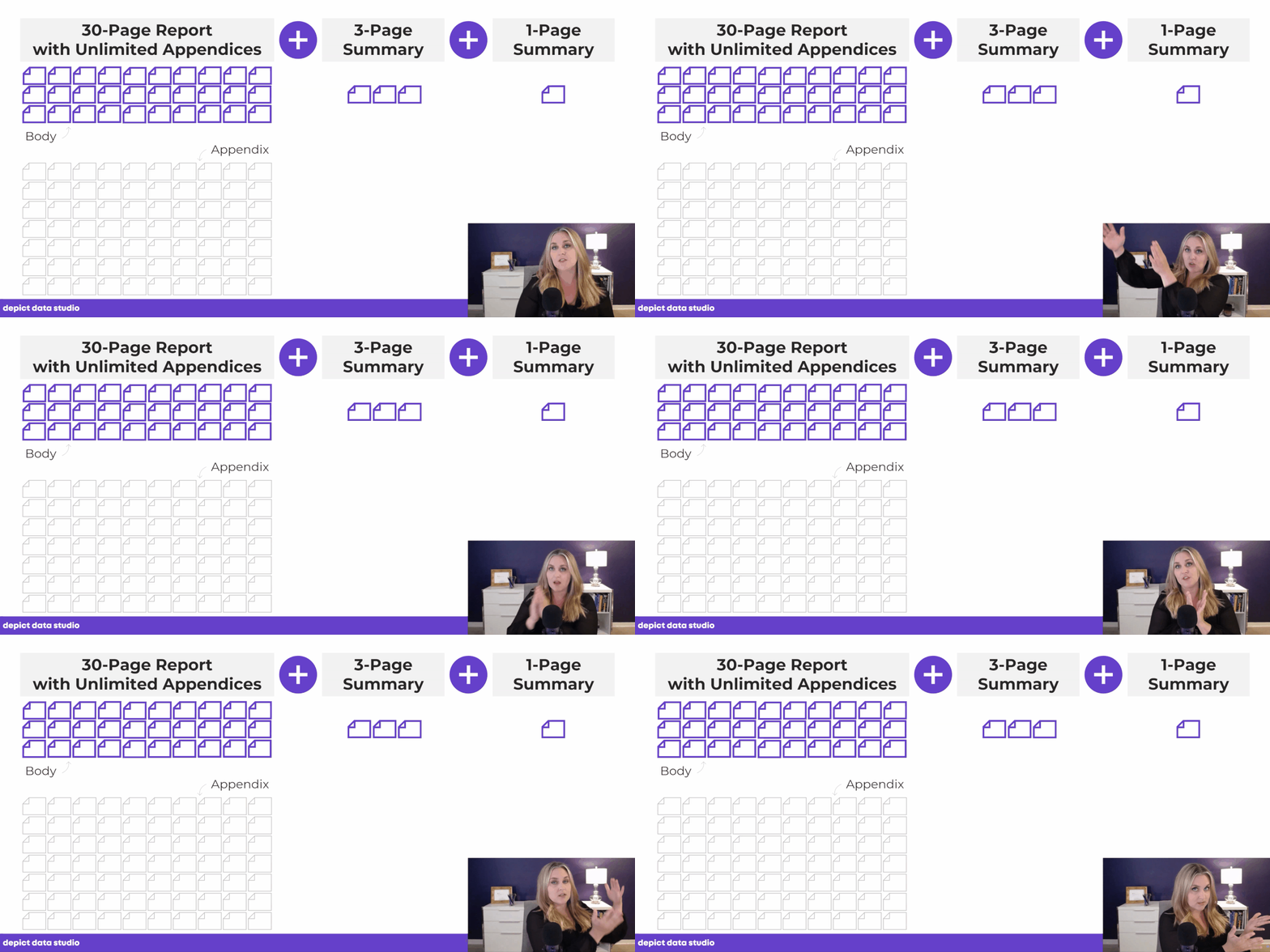
In a perfect world, with more time and a bigger budget, I’d love to see slideshows, dashboards, and infographics for every single project, too.
Reports are a good starting point.
The 30-3-1 approach with unlimited visual appendices is even better.
And adding slideshows, dashboards, and infographics is even better.
This approach is all about tailoring for our audiences. Rather than pouring everything into a single document, we design a 30-pager with one audience in mind, a 3-pager with another audience in mind, and so on.
This is the hardest step. You’ll need to get input from your boss, your report’s audience, a stakeholder group, etc.
I suggest following Marie Kondo’s advice: Focus on what you’re keeping, not on what you’re letting go of. In the video, I discuss her technique for decluttering our closets: Make a big pile of all your clothes, and then look at each item to decide what sparks joy.
We focus our mental energy on the best pieces that are worth keeping, rather than getting stressed by what we’re discarding.
We can apply the same strategy to paring down reports. Focus on the charts, pages, or chapters that are so valuable that they need to stay within the 30-page report body.
We don’t have to delete the rest of the pages. We simply move them to the back of the report, and they form the appendices.
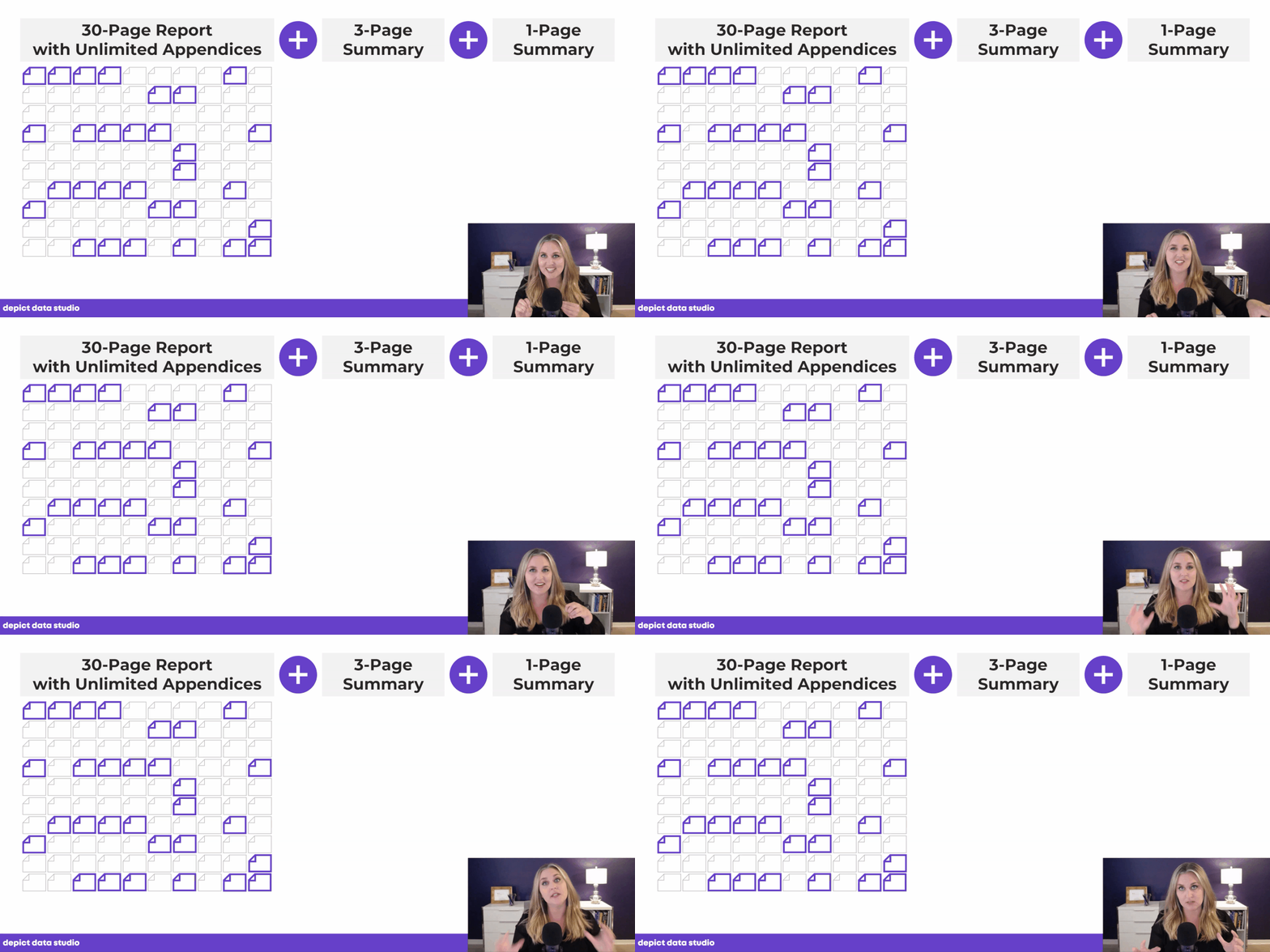
When we’re done with the 30-page report, we also need a separate 3-page report and a separate 1-page report.
Sometimes we’re tempted to count the executive summary as the 3-pager or 1-pager. That’s not enough!!! I recommend creating separate PDFs altogether.
And of course, we don’t have to follow the 30-3-1 approach exactly. We’re aiming for a full version, a mid-length version, and a short-n-sweet version. Your 3-pager might actually be 5 pages, for example. The spirit of the 30-3-1 approach is still there. I want us to avoid only writing a 100-page technical report. 20-10-2 or 30-5-2 will still help our readers tremendously.
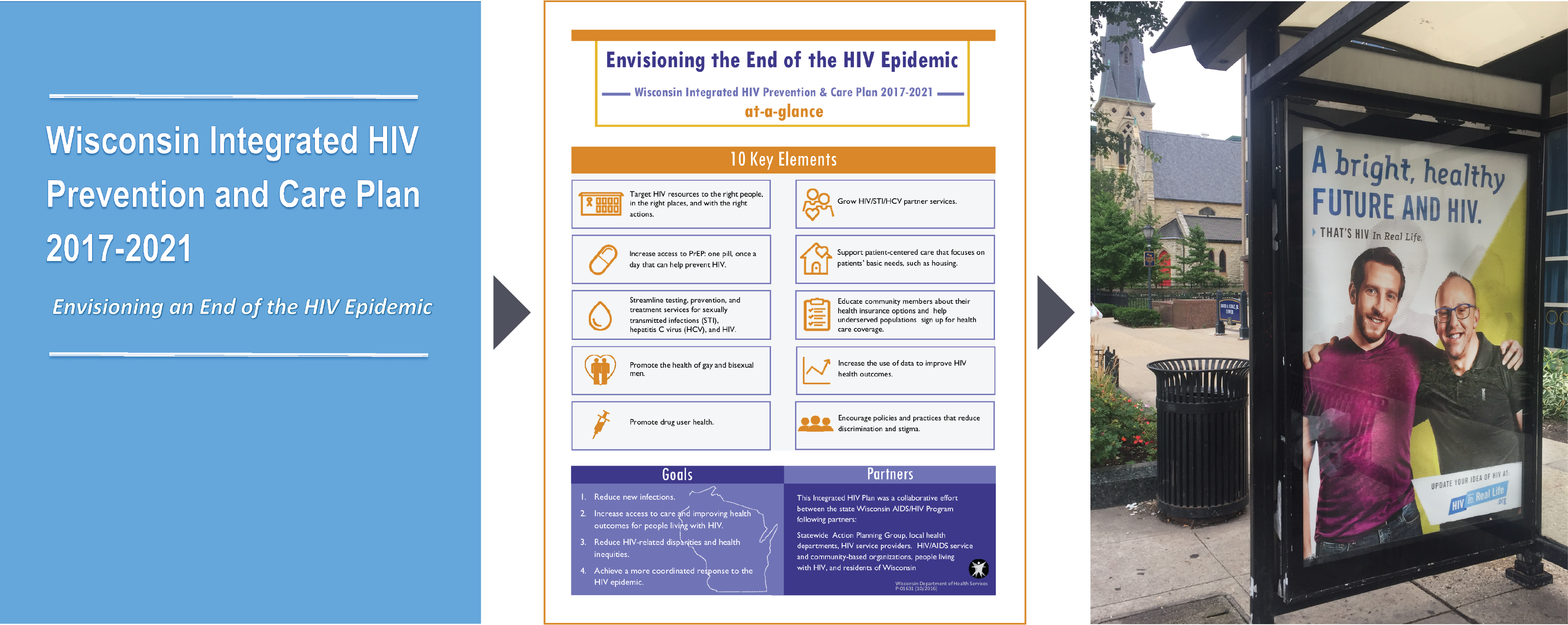
In the video, I mentioned a guest blog post from Sara DeLong about how the Wisconsin Division of Public Health applied this technique.
Her agency developed a 130-page report, a 10-page summary, and a 1-page summary. Then, they also created videos, images, and billboards (!!!) to ensure that the messages got off the dusty shelf and into the community.
In the video, I also discussed adding unlimited visual appendices to the end of our reports.
Here’s the blog post where you can learn about visual appendices and get tips for creating them yourself.
Spoiler alert: I create these tables in Excel; add Data Bars, Color Scales, and Spark Lines; and then save them as PDFs.
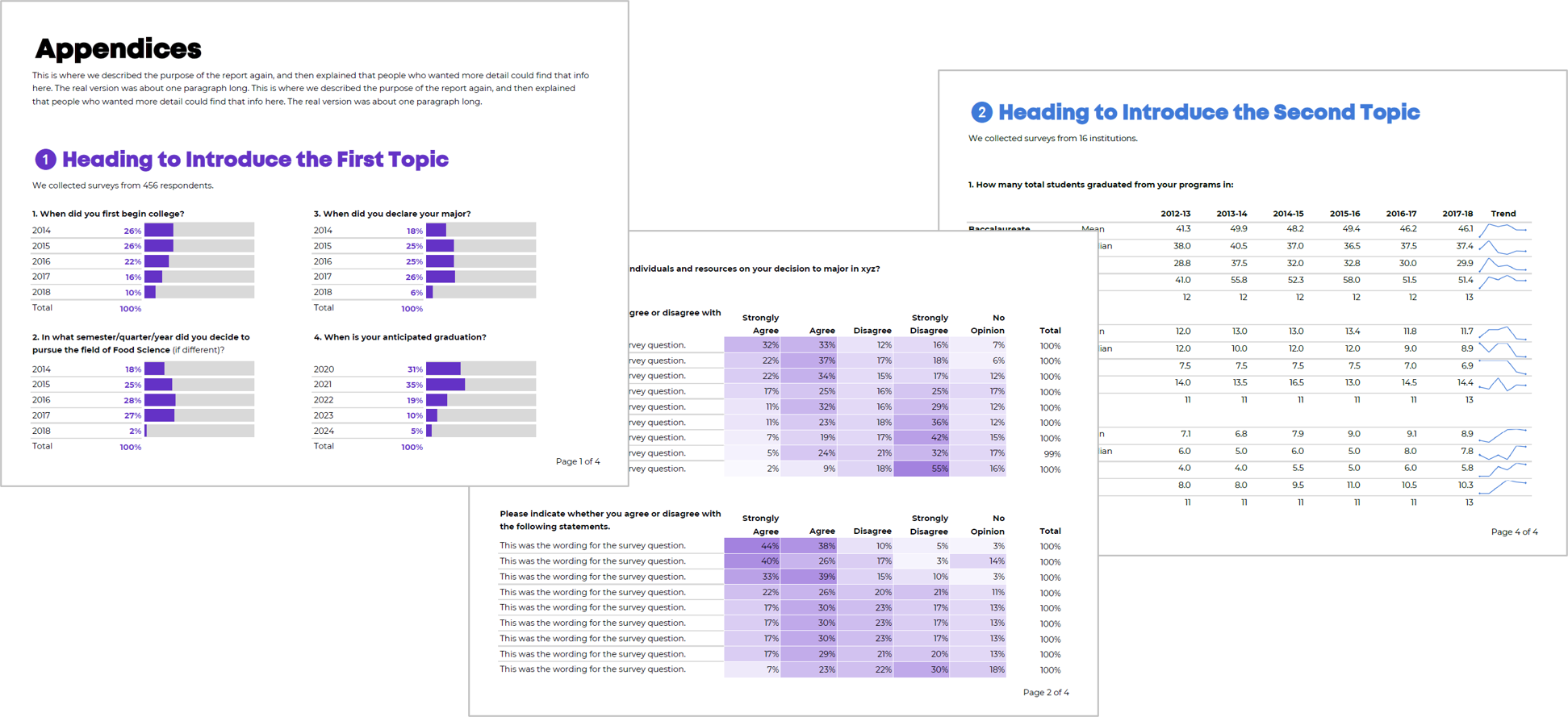
My co-presenter, Elizabeth Grim, also wrote a conference session recap.
Have you followed 30-3-1? Have you created unlimited visual appendices? Please comment below and link to your public-facing examples or describe your project. I’d love to learn from you.
In my evaluation work, I wear many hats, often balancing multiple roles each day: consultant, coach, collaborator, writer, designer, advocate. Right now the hat I am most proud of is solopreneur. In 2021, I took the leap to move to full-time solopreneurship and run my own business. This is something I had been dreaming about and planning for years. So in true evaluator fashion, I spoke to colleagues – both new and experienced – during the planning process to hear about their work in the field.
The post Shifting into Solopreneurship: Wearing the Hat of Business Owner appeared first on Elizabeth Grim.
 English
 Afrikaans
 Shqip
Shqip አማርኛ
አማርኛ العربية
 Հայերեն
 Azərbaycan dili
 Euskara
 Беларуская мова
 বাংলা
বাংলা Bosanski
 Български
 Català
 Cebuano
 Chichewa
 简体中文
简体中文 繁體中文
繁體中文 Corsu
Corsu Hrvatski
 Čeština
 Dansk
Dansk Nederlands
 Esperanto
 Eesti
Eesti Filipino
 Suomi
Suomi Français
 Frysk
Frysk Galego
 ქართული
 Deutsch
 Ελληνικά
 ગુજરાતી
 Kreyol ayisyen
 Harshen Hausa
 Ōlelo Hawaiʻi
 עִבְרִית
 हिन्दी
 Hmong
Hmong Magyar
 Íslenska
 Igbo
Igbo Bahasa Indonesia
 Gaeilge
 Italiano
 日本語
日本語 Basa Jawa
 ಕನ್ನಡ
ಕನ್ನಡ Қазақ тілі
 ភាសាខ្មែរ
 한국어
한국어 كوردی
كوردی Кыргызча
 ພາສາລາວ
 Latin
Latin Latviešu valoda
 Lietuvių kalba
 Lëtzebuergesch
 Македонски јазик
 Malagasy
 Bahasa Melayu
 മലയാളം
 Maltese
 Te Reo Māori
 मराठी
मराठी Монгол
 ဗမာစာ
ဗမာစာ नेपाली
 Norsk bokmål
 پښتو
پښتو فارسی
فارسی Polski
 Português
 ਪੰਜਾਬੀ
 Română
 Русский
 Samoan
 Gàidhlig
 Српски језик
 Sesotho
 Shona
Shona سنڌي
سنڌي සිංහල
සිංහල Slovenčina
 Slovenščina
 Afsoomaali
 Español
 Basa Sunda
 Kiswahili
 Svenska
 Тоҷикӣ
 தமிழ்
தமிழ் తెలుగు
 ไทย
ไทย Türkçe
 Українська
 اردو
اردو O‘zbekcha
 Tiếng Việt
 Cymraeg
 isiXhosa
 יידיש
יידיש Yorùbá
 Zulu
Zulu