• Skip to main content
  • Skip to footer
  • Home

The May 13 Group

the next day for evaluation

  • Get Involved
  • Our Work
  • About Us
You are here: Home / Archives for allblogs

allblogs

Jun 28 2021

Selective Justice Isn’t Just

This week’s post was written by Khalil Bitar. Khalil is an evaluator and M&E specialist who has been a leading voice in the EvalYouth global movement. He was also the founder and first president of the Palestinian Evaluation Association (launched in 2013). I invited Khalil to write a post sharing his views during the conflict and Israeli airstrikes on Gaza in May. These are Khalil’s words, I contributed the cartoons.

Something isn’t right about evaluation that doesn’t put (social) justice in the forefront. Something is also pretty wrong in my view about paying attention to justice and equity —by evaluators— only concerning particular issues and not others. Are we short in the community on both fronts? It seems so. I will explain why I think so in this blog. 

Freshspectrum cartoon by Chris Lysy
"The Israeli airstrikes have killed hundreds of Palestinians including 66 children. 
But we'll reserve judgement until we hear the other side of the story."

A little bit of context first. Recently, during the Israeli Occupation’s aggression in my country of Palestine, which resulted in the killing of over 280 people (among them 66 children), I noticed a sort of silence toward what was happening among evaluators. I took it to Twitter. I spoke directly to fellow evaluators. This is what I wrote:

This applies to “friends” and colleagues here on Twitter —really disappointed with the #EvalCommunity‘s silence, esp. those who speak ALL THE TIME about SOCIAL JUSTICE!

Selective justice isn’t justice, and selective activism isn’t activism.#Eval #EvalSoWhite #SaveSheikhJarrah pic.twitter.com/KdJyfAzSSM

— Khalil Bitar (@KhalilBitar) May 15, 2021

“...really disappointed with the #EvalCommunity’s silence, esp. those who speak ALL THE TIME about SOCIAL JUSTICE! Selective justice isn’t justice, and selective activism isn’t activism.”

I wrote that because I noticed that many colleagues and friends from the community —who are usually active in speaking up against injustice in other parts of the world— were mostly silent when it came to Palestine. Many of these colleagues are from North America and Europe, where supporting Palestine and the Palestinian cause is sensitive, often due to conflating criticizing Israel with anti-Semitism within the political circles and mass media outlets. Chris reached out to me in the midst of all of this and invited me to write a blog on Freshspectrum, which I love and often read, so I am writing this blog. 
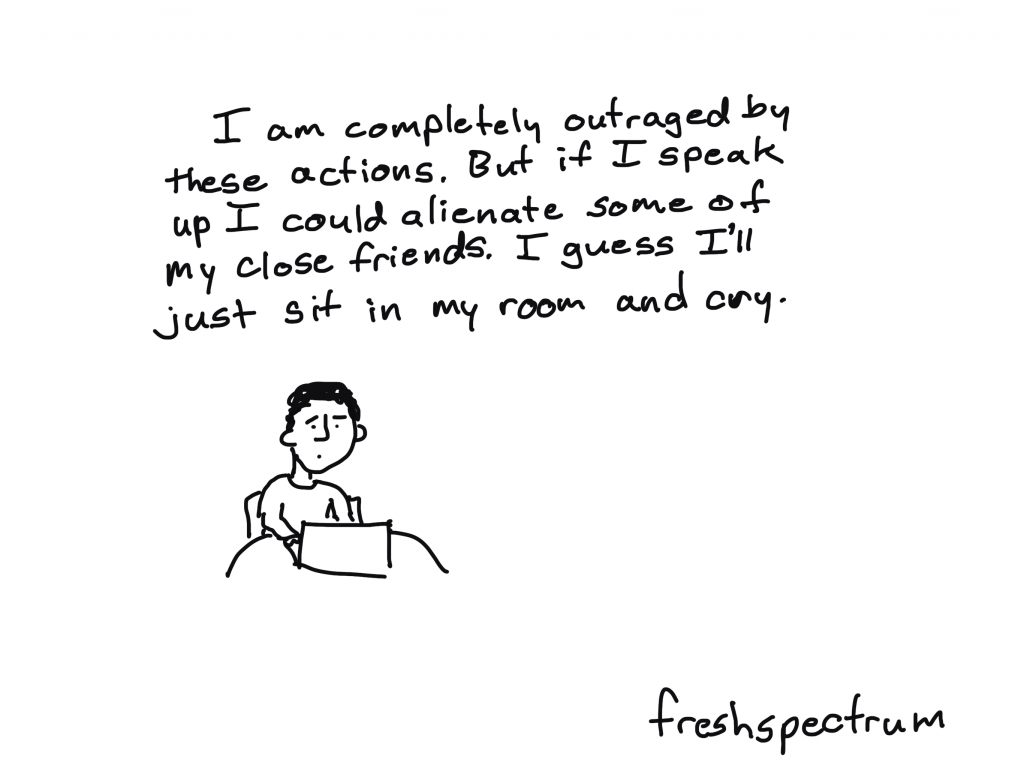
Freshspectrum cartoon by Chris Lysy
"I am completely outraged by these actions. But if I speak up I could alienate some of my close friends. I guess I'll just sit in my room and cry."

It was powerful —and important— to observe and be part of the activism by members of the international evaluation community during the Black Lives Matter (BLM) marches in the US and many other places around the world last summer after the cruel murder of George Floyd. It mattered because speaking up against injustice in all ways possible, including on social media, raises awareness about these injustices and challenges the status quo. Among many things, it showed how the evaluation community —like many other people and communities around the world— is eager to speak up against injustice and join forces with others in doing so. 

However, I noticed during the aggression on Palestine that very few colleagues in the community were speaking up against injustice in Palestine. I received some very kind private messages. But, in general, only a handful of colleagues seemed to have followed what is going on in Palestine or share about the matter on their own social media pages as they have been doing concerning the BLM movement, climate change, or indigenous people’s rights. 

This was happening while —even in the US— some progressive congresswomen and congressmen —perhaps for the first time— publicly criticized and condemned Israel’s actions in Palestine requesting to halt the US military aid to Israel; demonstrations were taking place in most big cities in the US, Canada, Europe, and other countries in most regions of the world; and social and mass media outlets were saturated with news about the bombardments, ethnic cleansing in Sheikh Jarrah, and assault on activists and journalists. But this aggression, occupation, ethnic cleansing, and apartheid (as categorized by Human Rights Watch and other human rights organizations) also happened with shameful political support and military assistance to Israel, especially from the US, Canada, and several countries in Western Europe.  

Freshspectrum cartoon by Chris Lysy
"Don't we have enough domestic issues to deal with? It's not like our tax dollars fund a large portion of Israel's defense budget. Or the planes that the Israelis are using for the missile strikes came from us. Or that the liberal representatives we voted for are still vocally supporting their actions. Or that colonial and economic decisions of the past that have privileged our super power nation continue to ripple throughout the region and the world."

I believe that evaluation colleagues in these very countries have a particular responsibility to speak up against injustice in Palestine. They should speak up against injustice in other places too, especially where their governments have been destabilizing other countries’ political, economic, and social systems —in Asia, the Middle East, Africa, Latin America, and other places. Evaluators can’t separate themselves from what is going on around the world. They have even greater responsibility and duty when their governments actively fund and defend a country colonizing other people, ethically cleansing them, and exercising apartheid, like in the case of Palestine. The US alone provides Israel with $3.8bn annually in military aid. 

Freshspectrum cartoon by Chris Lysy
"That's far too complicated an issue for me to speak up.
Is it?"

I understand that many may believe that the situation is complex and that they don’t understand it. It is not. It is an occupation, apartheid, and ethnic cleansing. One of the Occupation’s —and its enablers’— main tactics has been to make the situation seem so complex so that settler colonialism continues as it is. Others might be concerned that supporting the Palestinian people’s struggle for liberation could be seen as anti-Semitic. It is not. They can check the work of the many Jewish organizations and activists who are among the most outspoken against the Occupation and Apartheid, or the work of other Palestine activists who —in words and deeds— fight anti-Semitism hand in hand with their struggle against the Occupation. 

Freshspectrum cartoon by Chris Lysy
"I'm all for social justice. Unless an issue hits too close to home and makes me feel uncomfortable."

Others might feel the injustice in Palestine is not relevant to them or the issues on which they focus. To those colleagues, I find nothing more relevant than what Martin Luther King Jr. once said: “Injustice anywhere is a threat to justice everywhere.”

Written by cplysy · Categorized: freshspectrum

Jun 25 2021

Innovation Like An Epidemiologist

What if innovation was like epidemiology? What if we wanted to understand the source, scope, scale, and spread of an idea or product?

That’s one way that we think about the innovation process.

Innovation – like a virus — is similar to infectious disease epidemiology. Both of these areas look at the development of something, its effects, its spread, and how it scales over time. Both innovation and epidemiology require evaluation as well.

Viral Innovation

The parallels between infectious disease epidemiology and innovation are many. The first of these parallels is between a virus and an innovation.

A virus develops and mutates as it has more exposure to hosts. A virus ‘learns’ from what it does and adapts to fit a changing context. Innovation does the same thing only with an idea, product, or service. For innovators, the aim is for healthy development and the creation and distribution of the product or service. This is what research and development and marketing is all about.

Innovation and epidemiology are also both interested in the spread and scale of things. If an innovation works well in a context we might want it to spread to other contexts. Innovators often want their products to scale as far and as wide as possible. Sometimes innovations scale and sometimes they don’t.

The way we know this is through conducting detailed, systematic monitoring and evaluation.

Epidemiology, like innovation, is driven by evidence from the laboratory and the real world together.

Stages of Development

At Cense, we also look to another parallel between the two areas: research and development.

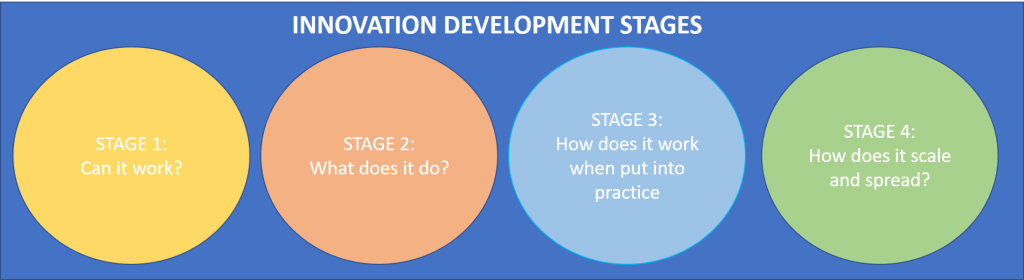
Innovation develops in four stages that are similar to phases of research trials.

The role of design and evaluation is different for each stage. At Stages 1 and 2 the emphasis is on working with innovators to align their intentions with their design to explore what it (the innovation) does and how it does it. This is where design thinking and strategy are most prominent.

At Stages 3 and 4, the aim is to build an evidence base and strategy to spread and scale the innovation. At these stages, the focus is on marketing, distribution, and amplification. Evaluation in these stages focuses on the larger impact and the means by which the innovation is implemented and adopted for use across contexts.

Like an epidemiologist, its important to collect data to support moving the innovation from each stage. It’s also important to explore what kind of effects — positive and harmful – are generated at each stage.

At Cense, we work with our clients to design the right evaluation and strategy for each stage of development. There are no ‘one-size fits all’ approaches to innovation. Much like with a virus, an innovator must know what their innovation does and what will change at each stage and scale of its development.

What is key is designing data collection and strategy that is fit for purpose.

Viruses aim to spread and survive just like innovations. By thinking like an epidemiologist you can help your innovation to survive and thrive like the best kind of virus.

Photo by Bill Oxford on Unsplash

The post Innovation Like An Epidemiologist appeared first on Cense.

Written by cplysy · Categorized: cameronnorman

Jun 25 2021

Participatory Approaches For Nonprofits

Written by cplysy · Categorized: connectingevidence

Jun 24 2021

Evaluation Roundup – June 2021

Welcome to our monthly roundup of new and noteworthy evaluation news and resources – here is the latest.

Have something you’d like to see here? Tweet us @EvalAcademy!

New and Noteworthy — Reads

How Funders Seek and Use Knowledge to Influence Philanthropic Practice

A new study, commissioned by the William and Flora Hewlett Foundation and conducted by Engage R+D in partnership with Equal Measure, recently released a report that examined how funders find and use knowledge to influence their philanthropic practice. Diversity, equity, and inclusion (DEI) emerged as the leading topic of interest for funders. The study found that the specific information related to DEI ranged depending on funders’ DEI journey. However, some funders emphasized the necessity of community voice and lived experience to inform DEI efforts.

Values, Voice, and an Equitable Vision of Validity

If you are interested in reading more about voice, this essay by Jara Dean Coffey (Director of the Equitable Evaluation Initiative) is a must-read. In this essay, Coffey eloquently articulates why it is time to “elevate and integrate voice as an essential element of validity” in our research and evaluations. She discusses how white and western concepts of validity have dominated and how diversity and lived experience are not recognized as valid but added context to the analysis.

UNDP Evaluation Guidelines

The UNDP recently updated its Evaluation Guidelines. The Evaluation Guidelines give renewed emphasis to the importance of planning for evaluations and provide greater detail on expected roles and responsibilities for evaluation. The updated guidelines include seven sections, covering Evaluation Function, Decentralized Evaluation in UNDP, Evaluation Planning, Evaluation Implementation, Evaluation Roles and Responsibilities in Decentralized Evaluations, Quality Assessment, and a FAQ section.

Fashion for Good: Evaluation Report

Are you interested in seeing how others are conducting evaluations and how they are sharing back their results? Take a look at this evaluation from the Laudes Foundation that used a rubrics-enhanced evaluation framework.

New and Noteworthy — Events

Gender-Transformative Program Design and Evaluation 

Organized by: EnCompass LLC

Dates: July 12 – 19

Instructor: Tessier Catsambas

Measurement Evaluation and Learning (MEL)

Organized by: Clear Horizon Academy

Starting Date: July 30, 2021 (15 Week Online Course)

CDC Applied Research and Evaluation Fellowship

Organized by: Centers for Disease Control and Prevention (CDC)

Application Deadline: August 18, 2021

Written by cplysy · Categorized: evalacademy

Jun 23 2021

Move like a jellyfish

I was really struggling with how to talk about my intention for 2021. The idea of saying out loud that I intended to “do less” didn’t sound right (but that’s where I started), even if the idea is that I need to do less and to be more. What I really wanted to communicate is that to have more impact, I will become more focused and intentional for the clients with which I have the capacity to engage.

Moving forward movement isn’t always… well… forward

When I am struggling with big ideas, one of my go-to tools is guided visualization. And as it happens, I had registered for an intention-setting workshop with an amazing trusted yogi who teaches Yoga Nidra. The first night, in my mediation, I immediately began to envision a jellyfish, and this incredibly powerful memory of the moon jellies at our regional aquarium. I could embody the movement of the jellyfish: the effortless, natural way that it expanded, how it seemed to move backwards just slightly and then propel itself forward as it expelled the water that it had just taken in. And I imagined the jellyfish to be graceful and easeful, but also intentional and powerful in its own way.

I imagine myself moving like a jellyfish: I am constantly learning and growing and expanding, taking in new information like water.

My photo of the jellyfish at the Monterey Bay Aquarium — swimming deeper

The crucial fourth step of the learning cycle

Shifting your frame on a situation can generate powerful momentum in problem solving. This idea of the jellyfish is something I took on in February, and since then have been tackling with clients: jettisoning what doesn’t serve you is a crucial part of growth, and frees your mind. And is deeply connected to the crucial step in our learning cycle: assess.

The pause before the surge

At times I wonder if I am slowing down or going backwards or taking on too much. And then I pull in, get focused and, for lack of a better word, expel what doesn’t serve me — and that is when I feel myself surging ahead.

And to own that I move like a jellyfish, aside from making me want to sing the Bubbly Toes song by Jack Johnson, leaves me joyous with this amazing felt-sense of this rhythm — the expansion-taking-in-moving-slightly-backwards, and the graceful, gliding surge ahead.

Written by cplysy · Categorized: betsyblock

  • « Go to Previous Page
  • Go to page 1
  • Interim pages omitted …
  • Go to page 177
  • Go to page 178
  • Go to page 179
  • Go to page 180
  • Go to page 181
  • Interim pages omitted …
  • Go to page 310
  • Go to Next Page »

Footer

Follow our Work

The easiest way to stay connected to our work is to join our newsletter. You’ll get updates on projects, learn about new events, and hear stories from those evaluators whom the field continues to actively exclude and erase.

Get Updates

Want to take further action or join a pod? Click here to learn more.

Copyright © 2026 · The May 13 Group · Log in

en English
af Afrikaanssq Shqipam አማርኛar العربيةhy Հայերենaz Azərbaycan dilieu Euskarabe Беларуская моваbn বাংলাbs Bosanskibg Българскиca Catalàceb Cebuanony Chichewazh-CN 简体中文zh-TW 繁體中文co Corsuhr Hrvatskics Čeština‎da Dansknl Nederlandsen Englisheo Esperantoet Eestitl Filipinofi Suomifr Françaisfy Fryskgl Galegoka ქართულიde Deutschel Ελληνικάgu ગુજરાતીht Kreyol ayisyenha Harshen Hausahaw Ōlelo Hawaiʻiiw עִבְרִיתhi हिन्दीhmn Hmonghu Magyaris Íslenskaig Igboid Bahasa Indonesiaga Gaeilgeit Italianoja 日本語jw Basa Jawakn ಕನ್ನಡkk Қазақ тіліkm ភាសាខ្មែរko 한국어ku كوردی‎ky Кыргызчаlo ພາສາລາວla Latinlv Latviešu valodalt Lietuvių kalbalb Lëtzebuergeschmk Македонски јазикmg Malagasyms Bahasa Melayuml മലയാളംmt Maltesemi Te Reo Māorimr मराठीmn Монголmy ဗမာစာne नेपालीno Norsk bokmålps پښتوfa فارسیpl Polskipt Portuguêspa ਪੰਜਾਬੀro Românăru Русскийsm Samoangd Gàidhligsr Српски језикst Sesothosn Shonasd سنڌيsi සිංහලsk Slovenčinasl Slovenščinaso Afsoomaalies Españolsu Basa Sundasw Kiswahilisv Svenskatg Тоҷикӣta தமிழ்te తెలుగుth ไทยtr Türkçeuk Українськаur اردوuz O‘zbekchavi Tiếng Việtcy Cymraegxh isiXhosayi יידישyo Yorùbázu Zulu