• Skip to main content
  • Skip to footer
  • Home

The May 13 Group

the next day for evaluation

  • Get Involved
  • Our Work
  • About Us
You are here: Home / Archives for allblogs

allblogs

Jul 05 2021

What is the difference between a Histogram and a Bar Graph?

If you want to be taken seriously as a data professional, there are some things that you just need to know. The difference between a Bar Chart and a Histogram is one of those things.

This post is a little cartoon illustrated explanation of the differences.

In short: the difference between a Bar Graph and a Histogram. Histograms are a bunch of bars connected to each other, visualizing a distribution of a some continuous quantitative variable. Bar graphs (or bar charts) use proportionally sized rectangles to visualize some type of categorical data.

Freshspectrum cartoon by Chris Lysy. 
"As you can see from this bar graph..."
"That's a histogram you dummy."

The purpose of a histogram (where you often see histograms).

So I started my career as a researcher, spending a lot of time looking at survey data. One of the first you do after data collection (or really during data collection), is create a report with all the response frequency tables. For the categorical data you would visualize the frequencies with a bar chart. With any quantitative data, you would visualize the frequencies with a histogram.

Histograms let you see the data distribution, and this is one of the first things most researchers will look at when analyzing quantitative data.

Calling a histogram a bar chart (or connecting your bars) is the data person equivalent of using the wrong “there.” Does it really matter that much? I don’t know…but it will draw attention in certain crowds.

Freshspectrum cartoon by Chris Lysy. 
"I only comment on posts when the author incorrectly uses "there" instead of "their" or "they're."

Some of the main differences between bar charts and histograms.

  • As already discussed, the whole continuous variable vs categorical variable thing.
  • The bars touch in histograms.
  • You can’t change the sort order with a histogram (or I guess you could, but you shouldn’t).
  • Histograms require you to bin your numerical data.
Freshspectrum cartoon by Chris Lysy.
"If charts could talk...
I met a histogram the other day. At first I thought they were bars just like us, but those guys had no conception of personal space. They also refused to change their sort order. Said it was against their "chart's purpose."

Putting your data into Bins.

Bins are the groupings you put your data into.

It’s kind of like grades in school. Is there a huge cognitive difference between kids born in June and October of the same year? Is it any different from kids born in February and June? I would think not, but at some point people needed to decide the cutoff point for a certain group of kids they wished to educate together. So they split them into bins (in this case they called them grades).

Freshspectrum cartoon by Chris Lysy.
"So to create the histogram we're going to put the quantitative data in these happy little bins."

There is no set rule saying “you must bin like THIS!!!!” So a lot of bins are based on the judgement of the data analyst.

Take age for example, it’s a continuous variable. Let’s say you have a community survey and your responses ranged from a 17 year old to a 93 year old. How would you bin it? You could use 5 year bins starting (for example 16-20, 21-25, 26-30…) or 10 year bins (11-20, 21-30, 31-40…).

Freshspectrum cartoon by Chris Lysy.
"One size fits all histogram."

Histogram and Bar Chart Resources

  • Want to create a Histogram in Excel? Here is a short guide from Excel Easy.
  • More interested in creating bar charts? I have a post on How to Create Bar Charts in Excel.
  • I also have a sister post on How to Create Bar Charts in Adobe XD.
  • Don’t like my explanation and want someone else to explain the difference between bar charts and histograms? Storytelling with Data also has a Histogram vs Bar Chart post.
  • Want a more comprehensive guide to setting bin sizes? Here is one from Statistics How To.
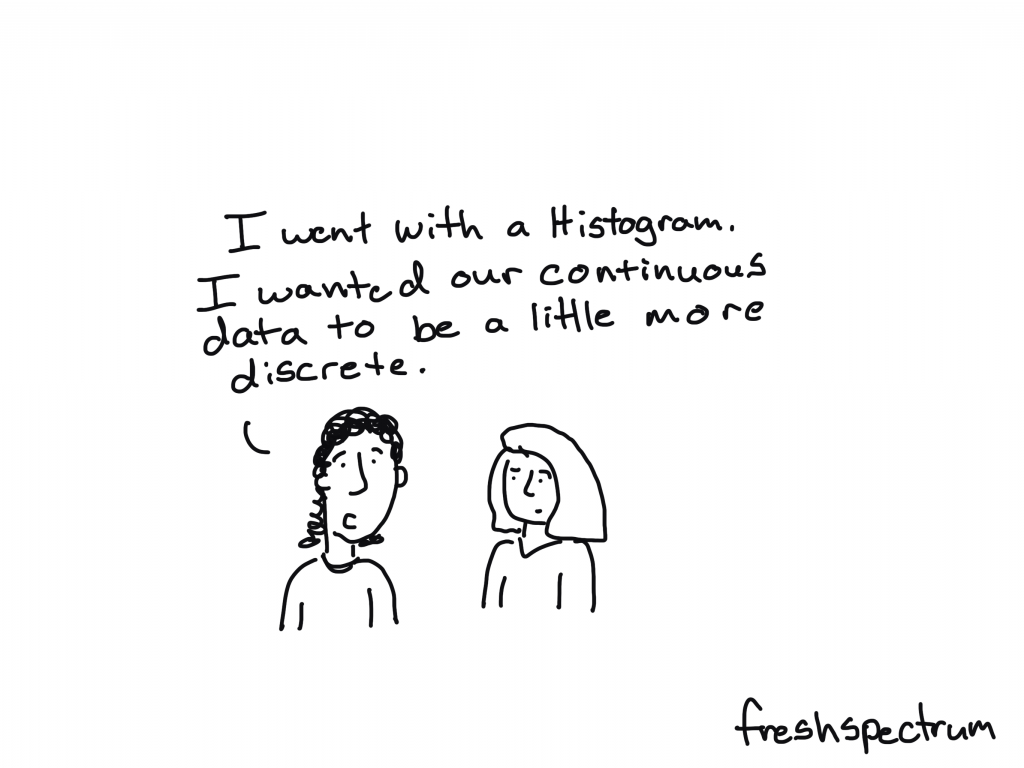
Freshspectrum cartoon by Chris Lysy.
"I went with a Histogram. I wanted our continuous data to be a little more discrete."

Written by cplysy · Categorized: freshspectrum

Jul 05 2021

Comentario en Modelo ADDIE para el diseño y ejecución de procesos de capacitación por Cesar Ahrens

lo que notamos en este curso es la diferencia luz que estamos con otros paises ,que practicamente para ellos es normal usar estas plataformas.

Me gustaMe gusta

Written by cplysy · Categorized: TripleAD

Jul 02 2021

IRB 101: What are they? Why do they exist?

Green Kermit the Frog against dark background. Kermit looks nervous and bites his nails, reflecting how the author feels about IRB.

Last week, I led an IRB 101 workshop for the Visitor Studies Association.  IRB is the acronym for Institutional Review Board.  That short three-letter acronym, IRB, can instill a lot of fear and anxiety in researchers and evaluators for multiple reasons.  For one, IRBs are an oversight organization, so non-compliance can have repercussions.  Additionally, the language used by IRBs is technical and governmental (e.g., non-compliance, human subjects research). Plus, there are so many acronyms (e.g., IRB, HHS, OHRP)!!

I have 15 years of experience using multiple IRBs with many methodologies and audiences.  Yet, I still had a lot of anxiety in leading an IRB 101 workshop. I felt like nervous, nail-biting Kermit the Frog.  I don’t feel like an IRB expert.  My hope in leading the IRB 101 workshop and writing these posts is to help others overcome their nervousness about IRBs.  Let’s start with a shared, foundational understanding of IRB.

What is an IRB?

An Institutional Review Board (IRB) is a formally designated administrative body established to protect the rights and welfare of human research subjects (research participants, in simpler terms).  IRBs do three main things:

  1. Review research and evaluation protocols involving human subjects prior to starting research and evaluation. Prior is a key word.  The review needs to take place before researchers start recruiting any research participants.
  2. Approve, disapprove, or request modifications to research and evaluation protocols. Researchers submit their protocols (and instruments, consent and assent forms, etc.) to an IRB.  The IRB reviews these materials, weighing the risks to research participants against the benefits of doing research and evaluation.  They have the authority to reject or request modifications if they decide the risks to research participants outweigh the benefits.
  3. Monitor research and evaluation activities. Once research begins, IRBs can request to review research activities. This may happen if the IRB has received complaints from research participants. They may also request to review activities if there is potential non-compliance with the approved research protocols (i.e., not following the rules).

Note that IRBs are specifically US entities.  The Office of Human Research Protections (OHRP) within the Department of Health and Human Services (HHS) oversees all IRBs.  This short video from OHRP provides a good overview about IRBs.

Why do IRBs exist?

Historically, researchers have too often mistreated research participants.  An egregious example is the Tuskegee Study of Untreated Syphilis in the Negro Male (1932-1972).  For 40 years, medical researchers studied black men in Alabama. Some had syphilis, and some did not.  The men thought researchers were providing medical treatment. However, researchers were only monitoring them to study untreated syphilis.  At the initiation of the study, treatment for syphilis did not exist.  When treatment became available, researchers withheld it from research participants.

When the public became aware of the study in the 1970s, the US government began to implement policies to protect research participants.  The National Research Act of 1974 established IRBs to oversee research with human subjects.  Then, in 1979, the The Belmont Report was published.  The report identifies three ethical principles for the protection of research subjects: respect for persons, beneficence, and justice.  Providing further guidance to IRBs was the 1991 establishment of the Common Rule.  The Common Rule takes the three principles of The Belmont Report and outlines practices researchers apply to protect research participants.  The Common Rule was revised in 2018, although the revision did not change practices drastically.

The need to protect research participants has not diminished over time.  As society changes, so does our understandings of potential risks to research participants.  For instance, physical effects on research participants were an initial risk concern (e.g., not treating syphilis).  But, the US government now acknowledges that risks to research participants also include psychological, social, economic, and legal risks.  The Protecting Human Research Participants Training identifies the Facebook Social Contagion Study of 2014 as a modern example of the mistreatment of research participants psychologically.  Researchers manipulated a random sample of Facebook users’ news feeds to show either more positive or negative posts.  They were studying the effects of these manipulations on Facebook users’ emotions.

More on IRBs

Hopefully, this post has established the unquestionable need to protect research participants and instills empathy for the process of applying to IRBs. Check back for more IRB 101 posts soon!

Have questions about IRBs? Let us know in the comments!

The post IRB 101: What are they? Why do they exist? appeared first on RK&A.

Written by cplysy · Categorized: rka

Jun 30 2021

Gen Z are Investigators: What Does This Mean for Cultural Institutions?

Summer is here, and with it, a new guest blogger series! Today we are excited to share a new post by our friend Sadiya Akasha of Sitara Systems. Sadiya is a researcher, product designer, and expert on Gen Z (people born between 1995 and 2010).  In this summer series, Sadiya will make the case for how and why engaging Gen Z is critical and share research-based insights that cultural institutions should note if they want to survive and thrive.

Her first post, below, highlights how Gen Z’s tendency to act as “investigators” affects their expectations of museums and cultural institutions.

Thank you, Sadiya, for sharing your expertise!


“Generation Z is the most tech-savvy generation” or “Generation Z spends the most time on social media.” We hear sentiments like these all the time, but what does it mean?  It means that Gen Z, born between 1995 and 2010, has greater access to information and people compared to any prior generation.  Being the most *connected* generation allows them to curate and create communities, build meaningful connections that help them define themselves, and hold perspectives that were not possible for any other generation.

Members of this generation, coming of age during a global pandemic, are currently eyeballing your cultural institution as a place to spend an afternoon engaging in active learning while socializing. How is that different from the way older generations engage with your museum or library? It turns out Gen Z has an entirely different set of expectations shaped by their unique upbringing that affects their decisions.

Growing up in an information-dense world

For starters, this generation has grown up during the Great Recession, a continuous war on terror, a global rise in authoritarianism, ideological polarization, massive racial protests, mass incarceration of children and asylum seekers, and, of course, a global pandemic. Though prior generations have struggled with some of the same (or similar) issues, none since the Silent Generation have grown up in an era with so little to buffer them from the onslaught of current events. The Silent Generation came of age in the shadow of World War II, and it left a lasting impact on their attitudes and worldview. Similarly, Gen Z has grown up in the aftermath of 9/11 and the ensuing War on Terror and that is likely to have a lasting impact. The oldest Gen Z kids would have been 6 years old on September 11, 2001. Throughout their lives, they have been immersed in media, with polarized news coverage competing for attention against the constant marketing of digital distractions. All of these information sources have their own agenda; thus this generation, composed currently of 11 to 26 year-olds, have learned to be particularly critical of any information presented to them and thoroughly scrutinize every source.

Cutting through the noise as a core competency

The unique combination of nearly infinite access to information (and a global reach) coupled with a near-constant evaluation of the motives behind consumable content has caused Gen Z to become both global and critical thinkers in a way quite beyond the norm for previous generations. 

This generation has become avid researchers, blurring the lines between work, play, hobbies, and academic pursuits. They have created online micro-communities to share the fruits of their research, deepen their understanding of particular topics, and be seen and heard by like-minded folks. Values, it turns out, are equally important to this generation as meaningful identity markers in an otherwise fluid and multicultural society. 

Ubiquitous internet access has given them a truly global reach where it would not be odd for a high schooler from Philadelphia to befriend a postal worker from a small town in Scotland if their specialized interests in sea shanties and respect for personal pronouns overlap. Where once we had to make do with AOL chat rooms populated by students in our own schools and neighborhoods, Gen Z is catapulted into depression-busting video dance challenges originating in places like Limpopo, South Africa! 

This kind of access and exposure forces them to be discerning and selectively inclusive. They can, and do, think about the values and agenda that drive online interactions. Consequently, in sharing resources, findings, and experiences with their peers, Gen Z clearly articulates their agenda and values to ease the burden on their viewers and collaborators. Furthermore, they provide sources to back up their statements. Gen Z is used to doing the work to see through marketing and propaganda. Cultural institutions will also have to engage in the work of declaring and living up to their institutional values to be able to meet this generation in good standing.

Authenticity is foundational to building trust

In my work as a Researcher, I’ve seen the value of sharing an institution’s agenda with Gen Z audiences firsthand. In interviews and test sessions I clearly state that the cultural institution I am working with is trying something new, they are doing this specifically to reach people like them, and they are looking for open feedback to better understand them and build a deeper connection. This is a simple thing to do, but it sets the tone of the interaction to one with a clearly understood values-based agenda. Seeking feedback on a new project or approach is a highly authentic opening that invites the audience in to participate. 

Most recently, I worked with a small museum that was experimenting with a new way of engaging with Gen Z audience members in their community. During the interviews, it was like seeing the lightbulb turn on when the participant would suddenly realize their feedback was of real import to the museum. They felt valued, and they said so! It was an immediate connection and the participants were all extremely excited about the project and looking forward to its launch. Of course, after building this authentic connection the next (and most important!) step is to listen deeply and reflect the research findings in your final production, whether that’s a virtual interactive, a change in exhibit layouts, or a newly commissioned work of art.

Cultural Institutions need to do the work to build trust with Gen Z.  Trust can only be earned through a clear statement of agenda, acknowledgment of when that agenda has differed in the past, transparency of the process, and actively lived values. And all this needs to be delivered with authenticity as part of an ongoing conversation with Gen Z in order to deeply engage this generation. 

What’s next?

In the next post in this series, I’ll uncover how being the most racially diverse and multicultural generation in the US affects Gen Z’s views on identity and humanity. The existence of the most multicultural and multiethnic generation to date is going to upend traditional approaches to audience research and redefine demographic collection protocols.

About the Author

A brown woman with shoulder length hair looks into the camera. She is a millennial, not Gen Z.

Sadiya Akasha is the co-founder and Director of Product Development at Sitara Systems, a design and technology laboratory that creates interactive experiences with emerging technologies. Sadiya partners with cultural institutions to help them conceptualize and deliver technology initiatives by leveraging her background in human-centered design, agile thinking, and audience research. In her free time Sadiya enjoys exploring the rugged yet delicate landscapes of the great Southwest. 

The post Gen Z are Investigators: What Does This Mean for Cultural Institutions? appeared first on RK&A.

Written by cplysy · Categorized: rka

Jun 30 2021

Summarize, visualize, Analyze

Summarize, visualize, analyze

In my last post, I asked for feedback about what you’d like to learn about in our summer of figuring out the “so what?” of our data.

To my amusement, a longtime colleague and friend replied to my LinkedIn post with the following topic: 

“How to turn raw data into meaningful information to make decisions. AKA how to think about data like Amanda does.”

So today’s post will give you a glimpse into the inner workings of my brain (just kidding, that’s kind of scary) and how I think through data once I’ve tracked it. 

There are three main steps I take when I want to figure out what’s going on in a dataset: Summarize, Visualize, and Analyze. We’re going to talk through each.

1. Summarize it

Even with a nice, clean dataset that I’ve formatted it’s still hard to tell what’s REALLY going on there.

I need to use some formulas and functions to get a sense of the big picture.

I mean, look at the screenshot below (all fake data, don’t worry!) … this is like a blank canvas. I’ve got all my data in place, but I really couldn’t tell you anything about the trends or patterns that exist for my students. 


Written by cplysy · Categorized: engagewithdata

  • « Go to Previous Page
  • Go to page 1
  • Interim pages omitted …
  • Go to page 176
  • Go to page 177
  • Go to page 178
  • Go to page 179
  • Go to page 180
  • Interim pages omitted …
  • Go to page 310
  • Go to Next Page »

Footer

Follow our Work

The easiest way to stay connected to our work is to join our newsletter. You’ll get updates on projects, learn about new events, and hear stories from those evaluators whom the field continues to actively exclude and erase.

Get Updates

Want to take further action or join a pod? Click here to learn more.

Copyright © 2026 · The May 13 Group · Log in

en English
af Afrikaanssq Shqipam አማርኛar العربيةhy Հայերենaz Azərbaycan dilieu Euskarabe Беларуская моваbn বাংলাbs Bosanskibg Българскиca Catalàceb Cebuanony Chichewazh-CN 简体中文zh-TW 繁體中文co Corsuhr Hrvatskics Čeština‎da Dansknl Nederlandsen Englisheo Esperantoet Eestitl Filipinofi Suomifr Françaisfy Fryskgl Galegoka ქართულიde Deutschel Ελληνικάgu ગુજરાતીht Kreyol ayisyenha Harshen Hausahaw Ōlelo Hawaiʻiiw עִבְרִיתhi हिन्दीhmn Hmonghu Magyaris Íslenskaig Igboid Bahasa Indonesiaga Gaeilgeit Italianoja 日本語jw Basa Jawakn ಕನ್ನಡkk Қазақ тіліkm ភាសាខ្មែរko 한국어ku كوردی‎ky Кыргызчаlo ພາສາລາວla Latinlv Latviešu valodalt Lietuvių kalbalb Lëtzebuergeschmk Македонски јазикmg Malagasyms Bahasa Melayuml മലയാളംmt Maltesemi Te Reo Māorimr मराठीmn Монголmy ဗမာစာne नेपालीno Norsk bokmålps پښتوfa فارسیpl Polskipt Portuguêspa ਪੰਜਾਬੀro Românăru Русскийsm Samoangd Gàidhligsr Српски језикst Sesothosn Shonasd سنڌيsi සිංහලsk Slovenčinasl Slovenščinaso Afsoomaalies Españolsu Basa Sundasw Kiswahilisv Svenskatg Тоҷикӣta தமிழ்te తెలుగుth ไทยtr Türkçeuk Українськаur اردوuz O‘zbekchavi Tiếng Việtcy Cymraegxh isiXhosayi יידישyo Yorùbázu Zulu