• Skip to main content
  • Skip to footer
  • Home

The May 13 Group

the next day for evaluation

  • Get Involved
  • Our Work
  • About Us
You are here: Home / Archives for allblogs

allblogs

Apr 08 2021

Ask Nicole: Being Honest about Your Capacity

Have a question you’d like to be featured? Let me know. I had a “quantity” mindset when I started out as a consultant, taking on multiple projects at once to build my portfolio. It was a lot, considering I still worked my full-time job with my employer. My thinking was that, in order to look […]

The post Ask Nicole: Being Honest about Your Capacity appeared first on Nicole Clark Consulting.

Written by cplysy · Categorized: nicoleclark

Apr 07 2021

Evaluation Question Examples


A blank page can intimidate any writer. The same goes for evaluators – that “evaluation questions” column in your evaluation plan may be daunting. Looking at examples of real-world evaluation questions just might inspire your own.  

 We’ve already covered how to write good evaluation questions. As a quick reminder, your evaluation questions should be developed collaboratively and be open-ended. You can look to strategic plans or relevant quality frameworks for thematic guidance. Most importantly, be sure to edit until you’re sure the language is just right. 

 The examples below are grouped by content area, but with slight changes, can apply to many different evaluation projects. If you’re new to evaluation, we hope these examples can help you write questions that apply to the initiative you’re evaluating. If you have some evaluation experience already, watch for an upcoming post sharing evaluation question examples at different stages of the evaluation and learning cycle. 


Youth Programming

  • What makes this program unique? 

  • Who are the program participants? 

  • To what extent are children, youth and caregivers participating in programming? 

  • To what extent is programming making a difference in the lives of children, youth and families? 

  • Which groups benefitted most from the program? 

  • To what extent do program staff hold required safety certifications? 

  • In what ways did program operations differ from the original plan? 

Healthcare Initiatives

  • In what ways did program planners consider equitable access to care? 

  • How has the program impacted pathways to and from primary care? 

  • To what extent is the organization demonstrating leadership in community health planning? 

  • To what extent do patients experience an easy referral process? 

  • How do quality of life outcomes compare to norms in the region? 

  • To what extent does the program affect mobility? 

  • How efficient is the patient flow through arrival to admission? 

  • How quickly can patients access the service? 

  • To what extent are patients receiving appropriate preventative screening? 

  • How effective are interdisciplinary teams? 

  • In what ways has the project affected patient safety? 

  • What contribution has the program made to meeting the targets for the Sustainable Development Goal “ensure healthy lives and wellbeing at all ages?” 

Environmental Initiatives

  • How has the campaign impacted local awareness of the incentive program? 

  • What impact has this process had on emissions in the northeast region? 

  • How well aligned are the program activities with the regional strategy? 

  • In what ways have residents changed their use of plastics? 

  • To what extent has recycling capacity increased? 

  • How has the program expanded access to affordable sustainable energy? 

  • How well do the program’s messages resonate with local understanding of forest use? 

  • For how long do sponsored companies maintain these new practices? 

  • Which of the three program options was the most cost-effective? 

  • To what extent did the initiative create unintended outcomes? 
    Collecting Data


Education & Training Programs

  • How well prepared were students upon program entry? 

  • To what extent did the course deliver content students expected? 

  • How successful are program graduates in achieving certification? 

  • How have trainees applied the lessons from the course? 

  • How accurate do students feel their assessments were? 

  • What factors most drove learner success? 

  • To what extent do trainees report changes in confidence? 

  • What changes in organizational performance can be attributed to the training program? 

Collective Impact

  • To what extent are partners collaborating? 

  • How engaged are local leaders in contributing to the network? 

  • How well do chosen outcomes resonate with each partner? 

  • How confident are partners that they can achieve the intended outcomes? 

  • To what extent has the collective impact been measured? 

  • How have the initiatives affected quality of life? 

  • How long do agencies’ collaborative relationships last? 

We hope these evaluation question examples have inspired some of your own. 

 Wondering how to document your evaluation questions? Download our free Evaluation Plan Template. 


To learn more about applying evaluation in practice, check out more of our articles, or connect with us over on Twitter (@EvalAcadmey) or LinkedIn.


Sign up for our newsletter

We’ll let you know about our new content, and curate the best new evaluation resources from around the web!


We respect your privacy.

Thank you!


Written by cplysy · Categorized: evalacademy

Apr 07 2021

How We Evaluated: A Virtual Health Initiative


Understanding what you need to know. Designing your approach to finding the answers. Easy enough in theory, but real-world examples can show you have to apply theory to practice. That’s why we’re sharing this series on how we evaluated. 

 In this post, I describe how Three Hive Consulting supported the evaluation of a home health monitoring project for patients with chronic conditions. 


The Project: Home Health Monitoring in Primary Care

This project rolled out in the summer of 2020, in the throes of the Covid-19 pandemic. At that time, there was enough experience of the pandemic to know that limiting in-person interactions was the key to reducing the spread. The world was working to find ways to deliver services remotely, and healthcare was no exception. 

 Patients with chronic conditions often require more frequent medical care and are at greater risk of developing severe complications or needing hospitalization with Covid-19 infection. Monitoring symptoms and delivering care virtually was an obvious need.  

 In this project, patients with chronic conditions were provided with free monitoring kits for 90 days. The kits included blood pressure cuffs, pulse oximeters, thermometers, scales, and tablets. Patients input their information into tablets loaded with a platform enabling the reporting of results to primary care nurses. Primary care nurses then checked the platform regularly for alerts for clinically significant results. They called the patients directly or consulted with family physicians when appropriate. Many concerns could be addressed by nurses over the phone, while others required the patient to attend either a virtual or in-person visit with their family physician.  

Intended Outcomes

This home health monitoring project aimed to: 

  • Improve patients’ access to care 

  • Decrease patients’ risk of exposure to Covid-19 

  • Detect worsening symptoms earlier 

  • Optimize physicians’ time 

  • Improve patients’ ability to self-manage 

  • Reduce hospital admissions and emergency department visit 

  • Maintain or improve patients’ health-related quality of life 

Developing the Evaluation Plan

This project involved many partners. Primary care in this region (central Alberta, Canada) is delivered by family physicians and supported by Primary Care Networks (PCNs). Three Central Zone PCNs received funding and in-kind resources from several partners, including Health City, Alberta Innovates, and Boehringer-Ingelheim. Each of these partners had input into the evaluation plan. 

 With limited resources available to evaluate the first phase of this potentially multi-year project, partners agreed to four focus areas: 

1. Project reach (using document review and administrative data) 

  • Did the project achieve its aim of enrolling at least 30 patients? 

  • Who are the participating patients? 

  • What challenges were encountered in patient recruitment? 

  • What was helpful or successful in patient recruitment? 

  • Was PCN and provider participation maintained through Phase 1? 

2. Provider experience (using surveys at two points in time)

  • What challenges did providers encounter in working with the HHM model? 

  • What worked well for providers? 

3. Patient experience (using surveys at program discharge) 

  • What challenges did patients encounter in working with the HHM model? 

  • What worked well for patients? 

  • What suggestions did patients have for improvement? 

4. Patient health outcomes (using the EQ-5D-5L at intake and discharge, patient surveys at discharge, and clinical data) 

  • How, if at all, did patient-reported quality of life change over the duration of the project? 

  • To what extent were clinically significant results identified through the HHM platform? 

  • How quickly were patient results reviewed? 

  • To what extent did patients utilize other health services during their participation in the project? 

We designed the evaluation plan to minimize the workload on busy providers and take advantage of information already documented for clinical care; asking nurses or physicians to track additional data elements was not feasible, particularly during the pandemic. Patient health outcome data was limited to what patients could reliably report themselves and the clinical information captured in the home health monitoring platform.  

The evaluation plan included mid-term reporting of provider experiences and final reporting of all available data. The evaluation findings would need to provide information to inform decisions about spread and scale, as well as point to a more robust evaluation approach supporting the expansion of this model of care after the initial phase.  

“It’s safe to say this is a new way of doing business,” says Central Zone PCN Committee Operations Lead Jodi Thesenvitz. “We need to see if this is going to be a legitimate model of doing work going forward.”  

Collecting Data

In a year of shifting priorities, collecting data went fairly well but did not yield the sample sizes we intended. All data collection was undertaken online to ensure safety and convenience, but we struggled with uptake.  

 Invitations and links to complete the EQ-5D-5L and patient experience survey were embedded within the home health monitoring platform, and so were seen by all participating patients. Of the 37 patients enrolled, only 11 completed the EQ-5D-5L at both intake and discharge, leaving us with results that were not entirely reliable. Similarly, only 17 completed the patient experience survey at discharge. 


Our Learnings

Low response rates are always a cue for evaluators to re-examine their recruitment processes. Upon reflection, the language we used in the home health monitoring platform to invite patients to complete both survey tools was not as compelling as it could be. In our subsequent second phase, we’ve adjusted the invite to provide more information about the importance of patient feedback and used plainer language to describe the EQ-5D-5L—it’s a very simple tool with a rather technical name. 

We’ve also increased engagement with providers, letting them know early about the role of evaluation in the project and their role in supporting that evaluation.  

The evaluation findings have been already been helpful to the project partners. “It helped validate the expansion of the initiative,” according to Health City CEO Reg Joseph. “One of our key goals is to scale the initiatives that make sense to scale, in that they drive health adoption of innovation, improve health outcomes and drive economic growth in the health sector. To do this often requires policy change that itself requires evaluation and data.” 

The findings have been helpful for PCNs and physicians considering joining the second phase of the project. The evaluation report was “used as a communication tool,” said Thesenvitz. “It was a source of evidence for those considering participation in the next wave. It legitimized and explained the effort.” 

Future Evaluation

The second phase of the project allows us to expand our evaluation approach. With a larger group of patients and access to system-level health data such as emergency department visits, hospital admissions, and physician visits, we will be able to build the body of evidence needed to make decisions not just at the operational level, but at policy and funding levels, too.  

We hope this example has helped illustrate what evaluation of a virtual health initiative, or even just program evaluation in general, looks like in practice. For another tool to apply evaluation theory to practice, see our free resource on applying the JCSEE Program Evaluation Standards in practice. 


To learn more about applying evaluation in practice, check out more of our articles, or connect with us over on Twitter (@EvalAcadmey) or LinkedIn.


Sign up for our newsletter

We’ll let you know about our new content, and curate the best new evaluation resources from around the web!


We respect your privacy.

Thank you!


Written by cplysy · Categorized: evalacademy

Apr 06 2021

La evaluación en la rendición de cuentas para resultados de planes estratégicos

Fuente

La función de evaluación puede reforzar el ciclo de gestión y planificación, mejorando la calidad del diseño y del sistema de seguimiento de los Planes Estratégicos de nuestras organizaciones.

A través de la Política de Evaluación y el Plan de Trabajo de evaluación de nuestras organizaciones se pueden fomentar las siguientes áreas de trabajo clave en la organización: (a) refuerzo del marco institucional en evaluación, (b) desarrollo de capacidades en evaluación (incluye fomento del pensamiento evaluativo y trabajo conjunto con equipos de planificación y seguimiento), (c) gestión del conocimiento y (d) la ejecución de diferentes tipos de evaluaciones. Desde estas áreas de trabajo se pueden apoyar los planes estratégicos de la organización:

1.Desarrollo y diseño del Plan Estratégico

1.1 Asegurar que existen sistemas para la incorporación en el diseño de los aprendizajes previos (desde sistemas de seguimiento, evaluaciones previas…) 

1.2 Mejorar la evaluabilidad desde el diseño: calidad del diseño, del seguimiento, del uso de la información de diseño y seguimiento, de la accesibilidad de las partes interesadas.

1.3 Apoyar a desarrollar y documentar teorías del cambio (TdC) y modelos de intervención para guiar el diseño y la implementación. TdC para asegurar que existe(n):

-estrategias/sistemas de seguimiento desde el diseño

-mecanismos de participación y triangulación adecuados (beneficiarios, personal, gobiernos locales, sociedad civil, otros pares, sector privados  etc.) en el diseño y la planificación.

-un seguimiento sistemático y regular: (1) el contexto para identificar brechas, redundancias y tendencias, (2) estructura y capacidad organizacional

2.Seguimiento (Gestión del Plan Estratégico): Asegurar o valorar si existen tiempos, mecanismos y espacios de calidad para:

Utilidad de los procesos existentes de reflexión, aprendizaje y mejora en los ciclos regulares: (a) reflexionar regularmente: lo que funciona y lo que no funciona, (b) oportunidades de mejora, (c) Incorporar los datos recopilados para adaptaciones y correcciones de rumbo en tiempo real

3.Evaluación del Plan Estratégico

3.1.Rol de apoyo o valoración (desarrollo de capacidades): Uso y utilidad en seguimiento:

Apoyo o valoración del uso práctico de teorías del cambio, tipo de análisis de contribución, indicadores, líneas de base para la toma de decisiones durante el diseño

3.2.Rol de evaluación (sumativa o formativa)

Evaluación de todo el plan estratégico (en diseño, a medio término o al final)

Evaluación de partes clave del plan estratégico ( secciones, casos de estudio…)

3.3 Evaluación durante el desarrollo del Plan Estratégico (developmental evaluation)

Written by cplysy · Categorized: TripleAD

Apr 06 2021

How to Pass the Excel Certification Exam

Want to pass the Excel certification exam?

Maybe you want proof that you can rock Excel for your resume? For your LinkedIn profile?

Do you want a confidence boost that, yes, you know Excel?

Do you want your boss to feel confidence that, yes, you know Excel?

Back in January, I’d just gotten home from my third hospital stay. Pneumonia while pregnant. 0 of 5 stars. Do not recommend.

My lungs were still on fire… but my brain was fired up and ready to go. I’d been laying in bed for weeks, and I was itching to get back to regular life.

On a whim, I registered for the Excel certification exam. I’d always been curious to see whether I could pass.

Spoiler alert: I passed!

In this blog post, I’ll share behind-the-scenes tips for registering for and pacing the MOS-200 exam.

How to Pass the Excel Certification Exam

Here are 10 steps for passing the Excel certification exam.

1. Choose the Exam You Want to Take

Head over to Microsoft’s website.

There are DOZENS of Microsoft exams available. Some focus on Word, Excel, PowerPoint, etc.

Levels

There are also different levels of exams. For example, some cover intermediate skills while others are labeled as “expert.”

I took MO-200, which is described as an intermediate-level exam.

Next, I might take the expert-level Excel exam. But, it covers formulas that I’ve never needed to use in real-life, so might not be relevant enough to be worth my time? I might also try the PowerPoint and Word exams later this year (?).

Certifications

You can also take several exams that add up to a certification. For example, if you pass the MO-100 (Word), MO-200 (Excel), MO-300 (PowerPoint) and MO-400 (Outlook), then you’ll be a certified Microsoft Office Specialist. I have zero use for Outlook skills so I doubt that I’ll bother with this particular certification.

2. See Which Skills are Covered

You can see which skills are covered. We’ll discuss these skills more in a moment.

3. Choose a Test Site

Choose a test site at https://www.certiport.com/locator.

I looked for test sites around Orlando, and when I contacted them, they said all the exams were now online (due to COVID).

4. Schedule the Exam

Schedule the exam for a particular day and time with an administrator from that test center.

Heads up: The online registration process kept glitching, so I had to call the test site over the phone.

5. Receive a Confirmation Email

Next, you’ll receive a confirmation email from the test center with your login link.

I registered over the phone and didn’t receive any confirmation emails at all, which was really stressful.

I had to follow-up with the test center twice and finally received an email confirmation at 5pm the day before my exam…

6. Create a Username and Password through Certiport

Before the exam, you’ll have to create a username and password at Certiport.com.

I was pleasantly surprised to learn that I still had a username and password from a decade ago, when I worked as a certification instructor.

I highly recommend setting up your username and password several days ahead of time in case you run into Certiport glitches.  

7. Purchase an Exam Voucher from Certiport

My MO-200 test was USD $100 as of January 2021.

You’ll also have the option to pay $120 in case you need to re-take the exam, and you can also purchase test manuals.

I didn’t purchase the $120 package to re-take the exam. Go big or go home is one of my life mottos. I know myself. If I have a safety net (the option to re-take the exam), I won’t give it my all the first time around. But, if paying $20 more for the option to re-take the exam gives you peace of mind, then go for it.

You receive two emails from Certiport:

  1. A receipt showing that you paid $100.
  2. A 16-digital voucher number. It took about 30 minutes to receive the second email with the voucher number, and I had to contact customer service to receive it. I *highly* recommend purchasing the voucher the day before in case there’s a delay.

8. Log In at Your Scheduled Exam Time

Log in at the correct day/time. Or, better yet, log in 10-20 minutes early.

My login link was in the confirmation email from the test center that I finally received the day beforehand.

A “proctor” from Pearson can see your screen. She helped me log in and start the exam.

There was also a “chat” feature available—through a “notepad,” actually—where she could help me log in.

9. Take the Exam

You’ll see two windows on your screen: a fictional Excel dataset at the top, with the instructions for the particular task underneath.

Time Limit: 50 Minutes

You’re given 50 minutes to complete the exam. I finished in 30 minutes, and spent literally half that time scribbling down notes about the registration process for this blog post.

You can probably finish even faster than me. I don’t anticipate that you’ll feel pressed for time.

Finish the 6 Projects

My test had 6 “projects.”

Each project is a fictional workbook with ~5 sheets. You’re given brief instructions for each fictional scenario, e.g., “You work for the ABC Company. You’re getting information ready for a meeting.”

Each of the ~5 sheets contains something different: an Excel Table, a chart, etc.

The data tables are relatively small, maybe 5 columns and 20 rows. You won’t see any intimidating datasets with thousands upon thousands of entries, phew!

Some of the columns were already filled in with data or formulas. Other columns were blank and you had to create new formulas to fill them in.

The topics are extremely generic and straightforward. You don’t need experience working with any of these topic areas, so don’t let the terminology intimidate you! For example, you might see questions about banking, but you don’t need to know anything at all about banking in order to understand the questions.

Finish the Tasks within Each Project

Each of the “projects” had ~7 tasks. Think of the tasks as exam questions. There were approximately 50 tasks, or questions, in total.

Skills Covered

Here are some blog posts about the skills that are covered on the exam:

  • Icon Sets (Yes, you’ll have to know how to add not-colorblind-friendly icons to your spreadsheet. Sigh.)
  • Auto-fill, adjusting column/row sizes, freezing
  • Sorting
  • Sparklines
  • If
  • Common formulas like average and sum
  • Number formatting

Skills I haven’t blogged about, but are covered extensively in my online courses:

  • Charts. On the exam, you’ll be asked to create and edit any and all aspects of charts.
  • Tables
  • Printing
  • Conditional Formatting

Skills not covered on my exam:

  • Pivot tables
  • Lookup formulas

Come Back to Tasks You Skipped

As you’re working through each task, you have three options:

  1. Mark the task as complete.
  2. Mark for review. What an excellent feature!!! This way, you don’t have to spend too much time on any particular question.You can come back and review these tasks later, time permitting. I needed to review 3 of the ~50 tasks.
  3. Leave a note for the test company (e.g., If you notice any errors in the exam). I didn’t leave any notes.

10. Receive Your Results

You can see your results immediately! I honestly expected to have to wait a while, and I was pleasantly surprised to receive instant results. So cool.

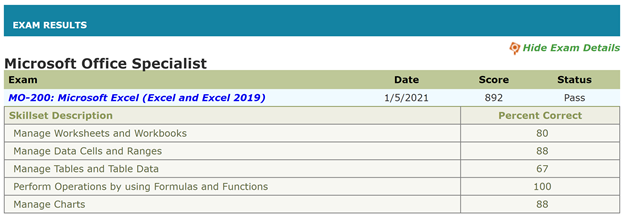
You need 700/1000 to pass. I scored 892/1000.

The scores are broken down by topic. I honestly have no idea which questions I missed; I assumed I got everything 100% correct as I was taking the exam. Apparently I don’t know much about tables, ha!

You can also login to Certiport.com and download a PDF’d certificate. The PDF is available within minutes of completing the exam.

Written by cplysy · Categorized: depictdatastudio

  • « Go to Previous Page
  • Go to page 1
  • Interim pages omitted …
  • Go to page 192
  • Go to page 193
  • Go to page 194
  • Go to page 195
  • Go to page 196
  • Interim pages omitted …
  • Go to page 310
  • Go to Next Page »

Footer

Follow our Work

The easiest way to stay connected to our work is to join our newsletter. You’ll get updates on projects, learn about new events, and hear stories from those evaluators whom the field continues to actively exclude and erase.

Get Updates

Want to take further action or join a pod? Click here to learn more.

Copyright © 2026 · The May 13 Group · Log in

en English
af Afrikaanssq Shqipam አማርኛar العربيةhy Հայերենaz Azərbaycan dilieu Euskarabe Беларуская моваbn বাংলাbs Bosanskibg Българскиca Catalàceb Cebuanony Chichewazh-CN 简体中文zh-TW 繁體中文co Corsuhr Hrvatskics Čeština‎da Dansknl Nederlandsen Englisheo Esperantoet Eestitl Filipinofi Suomifr Françaisfy Fryskgl Galegoka ქართულიde Deutschel Ελληνικάgu ગુજરાતીht Kreyol ayisyenha Harshen Hausahaw Ōlelo Hawaiʻiiw עִבְרִיתhi हिन्दीhmn Hmonghu Magyaris Íslenskaig Igboid Bahasa Indonesiaga Gaeilgeit Italianoja 日本語jw Basa Jawakn ಕನ್ನಡkk Қазақ тіліkm ភាសាខ្មែរko 한국어ku كوردی‎ky Кыргызчаlo ພາສາລາວla Latinlv Latviešu valodalt Lietuvių kalbalb Lëtzebuergeschmk Македонски јазикmg Malagasyms Bahasa Melayuml മലയാളംmt Maltesemi Te Reo Māorimr मराठीmn Монголmy ဗမာစာne नेपालीno Norsk bokmålps پښتوfa فارسیpl Polskipt Portuguêspa ਪੰਜਾਬੀro Românăru Русскийsm Samoangd Gàidhligsr Српски језикst Sesothosn Shonasd سنڌيsi සිංහලsk Slovenčinasl Slovenščinaso Afsoomaalies Españolsu Basa Sundasw Kiswahilisv Svenskatg Тоҷикӣta தமிழ்te తెలుగుth ไทยtr Türkçeuk Українськаur اردوuz O‘zbekchavi Tiếng Việtcy Cymraegxh isiXhosayi יידישyo Yorùbázu Zulu