• Skip to main content
  • Skip to footer
  • Home

The May 13 Group

the next day for evaluation

  • Get Involved
  • Our Work
  • About Us
You are here: Home / Archives for allblogs

allblogs

Apr 13 2021

How to Visualize Qualitative Data with Colored Phrases

Wondering how to visualize your qualitative data? Maybe you’ve got open-ended survey responses, focus group notes, or speech transcripts. Qualitative data visualization can bring our words and phrases to life.

My friend Jon Schwabish from PolicyViz asked me to partner on his One Chart at a Time project, in which we’re helping you get better-acquainted with common and not-so-common chart types.

I created a tutorial on using colored phrases to visualize qualitative data. In this tutorial, you’ll learn:

  • The first time I ever used colored phrases to visualize qualitative data;
  • My favorite examples of colored phrases; and
  • Practical tips for using colored phrases in your project.

Watch the Tutorial

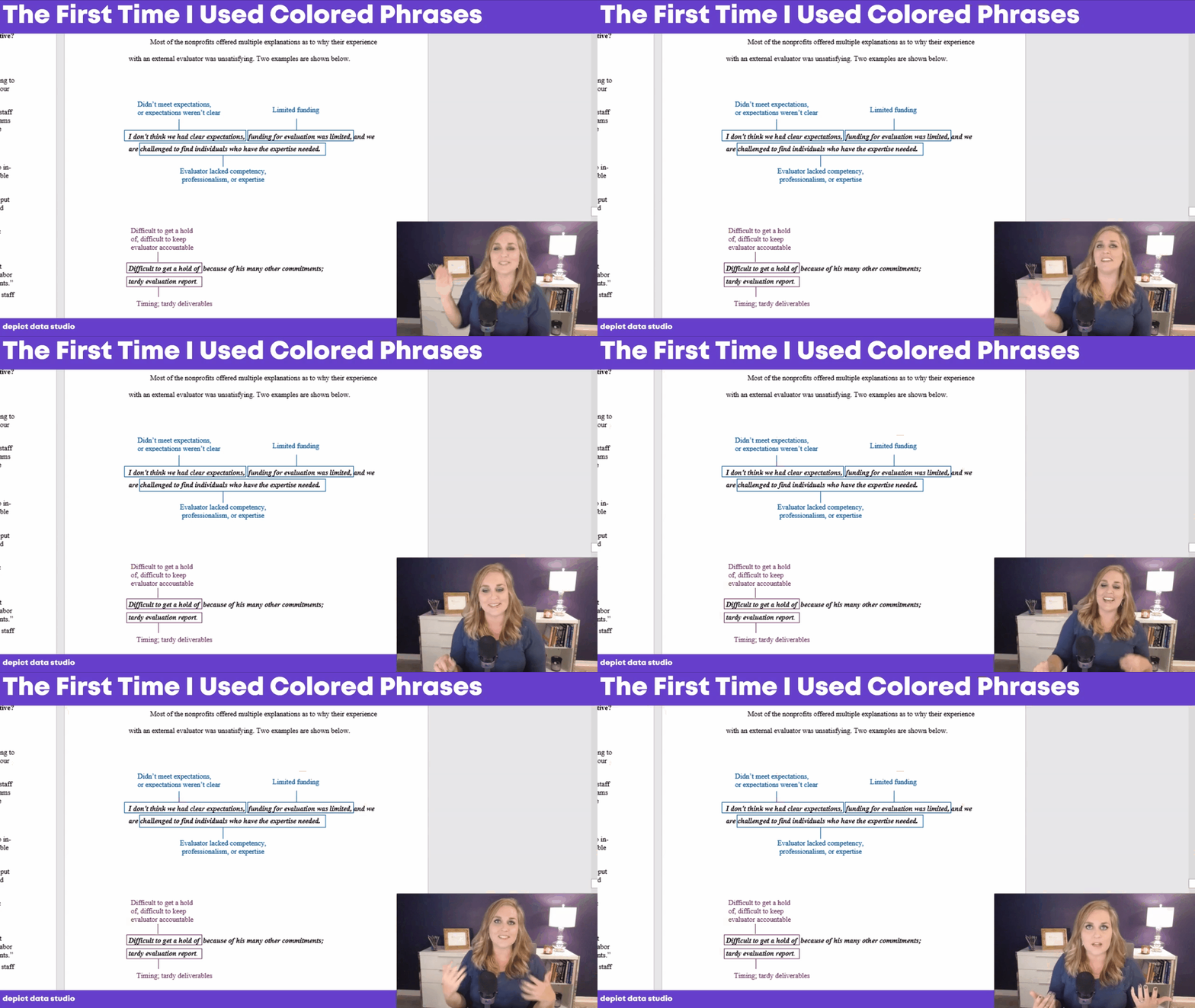
The First Time I Used Colored Phrases in Data Visualization

In the first part of the video, you’ll see the first time I used colored phrases.

I was coding open-ended survey data during my Master’s thesis, and needed to visualize different themes that I was finding in the data.

Inside good ol’ Word, I added colored rectangles around key phrases.

The outcome wasn’t perfect, but it was better than regular text.
My Favorite Examples of Colored Phrases

In the second part of the video, you’ll see my favorite examples of colored phrases:

  • ‘Stronger Together’ and ‘I Am Your Voice’—How the Nominees’ Convention Speeches Compare by the New York Times
  • Did Michael Brown Charge? Eyewitnesses Paint a Muddled Picture by the Washington Post
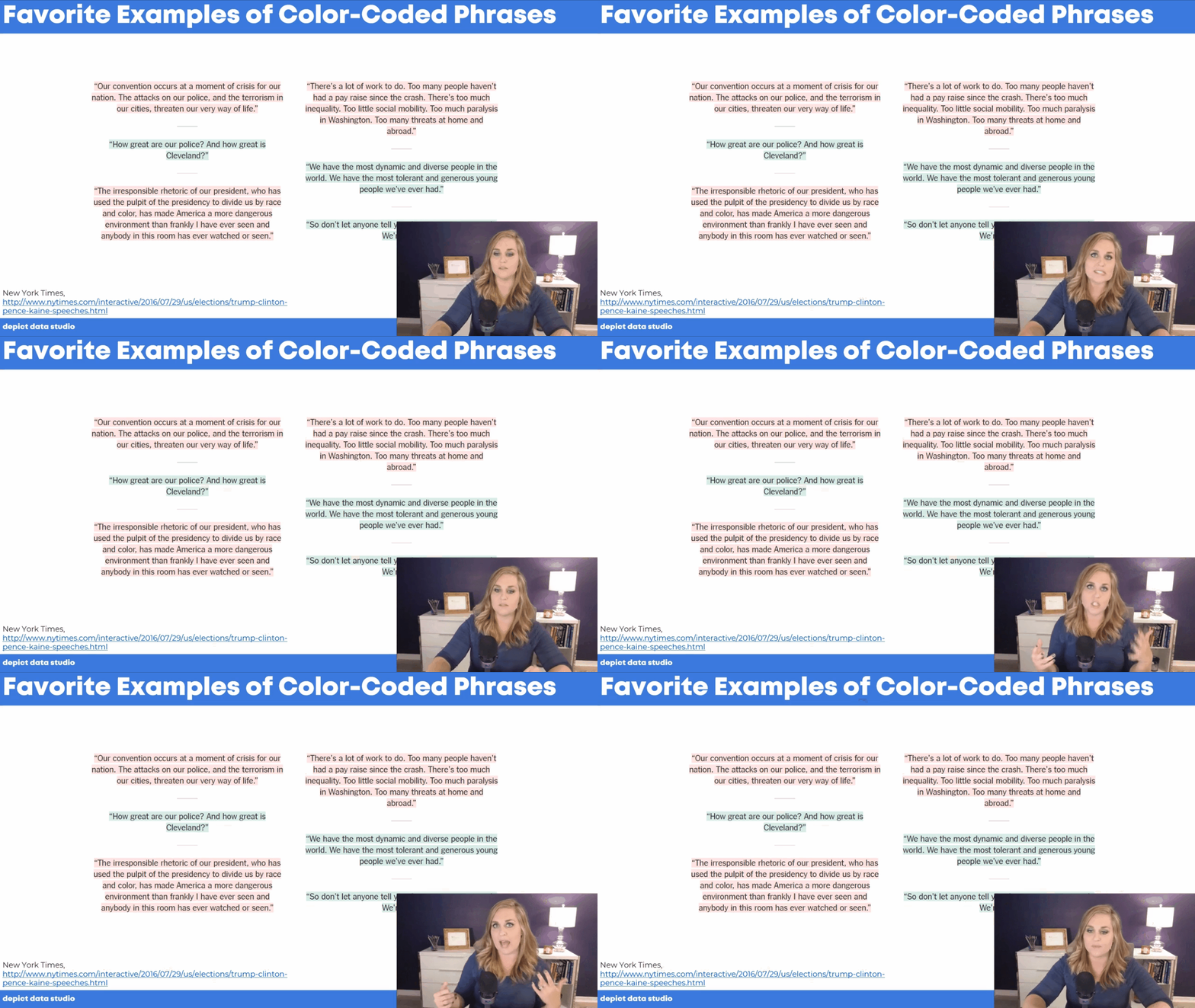
In the second part of the video, you’ll see my favorite examples of colored phrases.

Practical Tips for Using Colored Phrases

In the final section of the video, you’ll learn practical tips for using colored phrases to visualize qualitative data.

We’ll go through seven options:

  1. Regular text
  2. Bold
  3. Italic
  4. Underline
  5. Color
  6. Outline
  7. Fill

You’ll learn the pros and cons of each approach, and see why I suggest using bold, colored, or filled text instead of the other options.
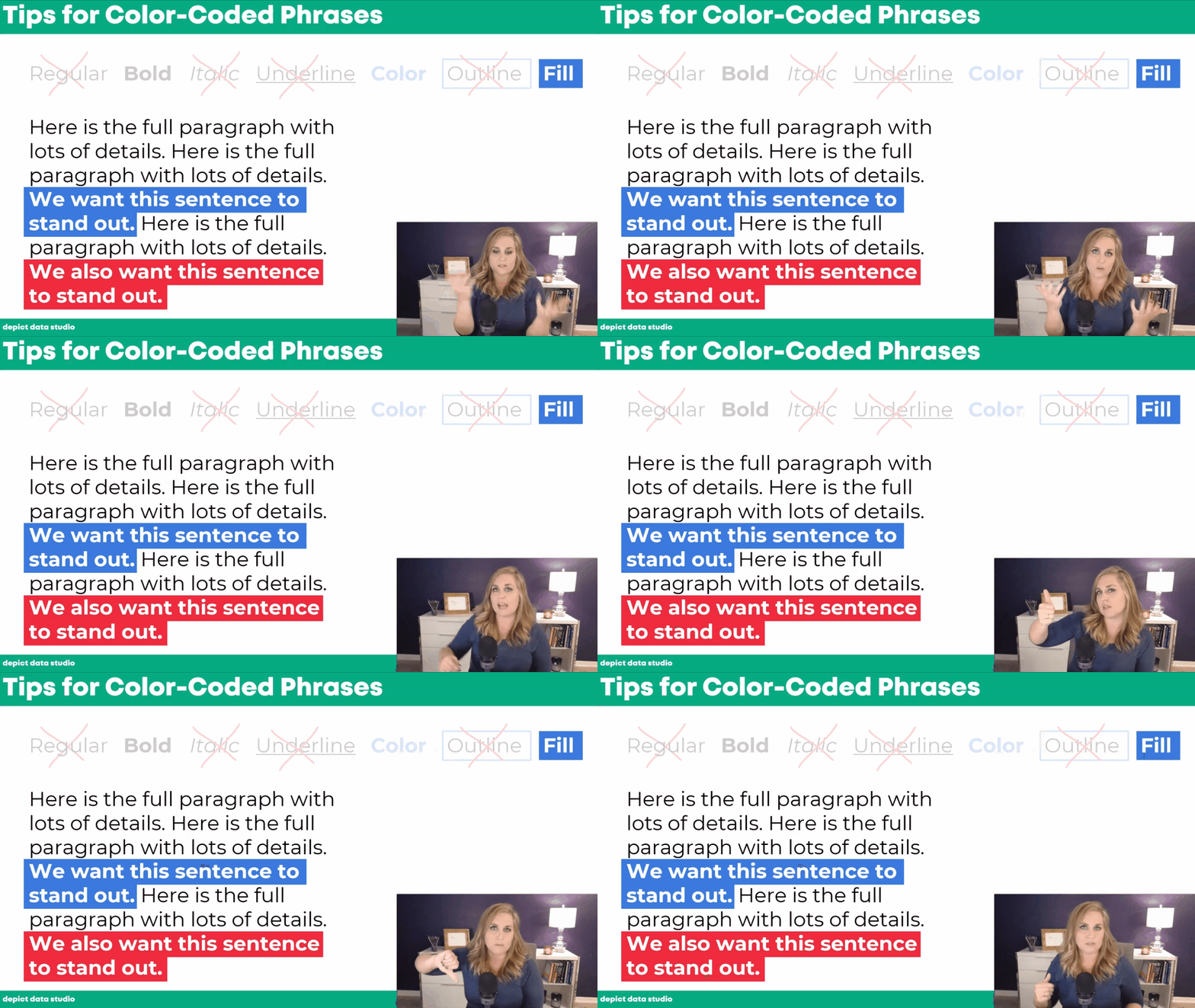
In the final section of the video, you’ll learn practical tips for using colored phrases to visualize qualitative data. You’ll learn the pros and cons of each approach, and see why I suggest using bold, colored, or filled text instead of the other options.

Your Turn

Let me know when you’ve applied colored phrases to your own project!
Written by cplysy · Categorized: depictdatastudio

Apr 13 2021

The Art of Gathering

Innovation work from identifying problems in need of solutions, generating ideas, creating things, and simply providing the inspiration and mutual support for doing the work often requires gathering.

Whether it is face-to-face, online, or some hybrid option the same general rules apply for what makes a good gathering when it comes to the up-front work.

Priya Parker has made the art of gathering a focus of her life’s mission and work and has pulled together some brilliant resources for those of us who are looking to bring people together.

These opening questions are the starting place by asking some fundamental questions about the purpose of gathering (something too often forgotten about).

Here are Priya’s recommended questions to help guide you in gathering:

  • Who is this for? What is it that this person loves to do? 
  • What are the various gifts or talents or skills of the people invited? 
  • How do you actually want to spend the time? 
  • How will you create a “moment of focus”? 
  • If this is a digital gathering, what are simple ways you can have guests bring something or wear something that connects them to the purpose, the person of honor and each other?  

Among the most valuable assets engaged in any innovation effort is time and attention and by asking these simple questions we can best use and respect both.

Written by cplysy · Categorized: cameronnorman

Apr 12 2021

Earth Day at 51: Why Museums Must Embrace the Anthropocene

Whether or not public programs are again canceled because of the COVID-19 pandemic, Earth Day each April 22 warrants the engagement of the museum sector. Emlyn Koster explains why.

“Earth Day 1970 gave a voice to an emerging public consciousness about the state of our planet — In the decades leading up to the first Earth Day, Americans were consuming vast amounts of leaded gas through massive and inefficient automobiles. Industry belched out smoke and sludge with little fear of the consequences from either the law or bad press. Air pollution was commonly accepted as the smell of prosperity. Until this point, mainstream America remained largely oblivious to environmental concerns and how a polluted environment threatens human health.”

–“The History of Earth Day,” from EARTHDAY.ORG

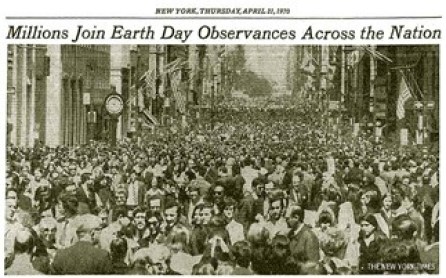
Black and white image of the New York Times issue from April 23, 1970.  The cover features an image of a huge crowd that stretches across the entire page and the headline "Millions Join Earth Day Observances Across the Nation."
Front cover of The New York Times the morning after the first Earth Day in 1970. Image via New York Times.

In 2005 the US National Academies determined that ‘climate change’ is preferable to ‘global warming’ because more than the atmosphere’s average temperature had been changing. News of governments tackling the ‘climate emergency’ is both pleasing and concerning. Pleasing that there is global communication although, as Greta Thunberg and her generation anxiously point out, today’s mitigating efforts run the perilous risk of being too little too late. In the 21st century, the world must grasp that climate and weather are interconnected with all other natural phenomena that encircle the Earth — oceans and rivers, ice sheets and glaciers, sea level, ecosystems, biodiversity, food chains, viruses, etc. — and that each has been, indeed continues to be, adversely impacted by human activities. Melting ice and rising sea level are, for example, more consequential than changing weather patterns. And while climates are being disrupted, oceans are being warmed and coral reefs are being bleached, the biosphere is being abruptly reduced by extinctions, plastic debris has become ubiquitous, and parts of the Earth’s crust have been impacted by waste disposal and hydraulic fracturing.

Society and the Anthropocene

A close-up shot of a man looking towards the camera. He is an older man, white, with gray hair and wearing glasses.
Paul Crutzen, PhD, coined the term “Anthropocene.”
Image via IASS Potsdam.

A scientific term joins mainstream conversation when it becomes helpful to communicate about a subject of rising interest and/or pressing importance. 2020 presented a compelling example: society quickly understood and used the terms pandemic and COVID-19. Although the natural history of the Earth is fascinating to many, Geologic Timescale terms have not become household words — with two exceptions. One is when Hollywood’s imagination of Jurassic Park became a blockbuster film (likely destined to remain unknown, though, is that it was field studies in the Jura Mountains along the France-Switzerland border by naturalist Alexandre Brongniart (1770-1847) that led to the term Jurassic for the period 200-146 million years ago). The second and much more consequential one is the Anthropocene (pronounced anthro-pocene like anthro-pology and of Greek origin with anthro referring to human and cene meaning a recent geological interval). For this one, we should know about Paul Crutzen (1933-2021), a Dutch meteorologist and atmospheric chemist who became a Nobel Laureate in 1995. In 2002, he contributed a seminal view to the journal Nature. Titled ‘Geology of Mankind’ it concluded: “A daunting task lies ahead for scientists and engineers to guide society towards environmentally sustainable management during the era of the Anthropocene”. Not only was it novel to imply that humanity is a geologic agent but his call to action for science and engineering to guide society was extraordinarily important.

No geologic timescale interval has previously been named in recognition of one species. This is certainly not an honor for us, Homo sapiens. Rather, it signals that humanity has, both carelessly and inadvertently, enabled a situation to rapidly develop that has imperiled all life, both human and non-human. Five years ago, science and environment journalist Andrew Revkin framed the Anthropocene as “common shorthand for this turbulent, momentous, unpredictable, hopeless, hopeful time — duration and scope unknown”. In 2017, environmental humanities scholar Christopher Schaberg wistfully asked: “Can the grand Anthropocene story, which highlights humanity as an exceptional actor in planetary morphology, help provoke a greater sense of human responsibility?”. Last year I defined the Anthropocene with a pragmatic recognition that humanity as the dominant species has extensively detached itself from the Earth System, endangering the future of both. A complicating matter is that the geological profession’s search for the best worldwide marker for the start of the Anthropocene — which currently looks likely to be the mid-20th century when atomic bomb testing left a distinctive chemical signature in lake deposits — is a different focus than the term’s relevance to the future state of the world.

Museums and the Anthropocene

Why has the museum sector hesitated to embrace this term? Is it because we must have a collection of related objects, or we lack fulsome knowledge, or we remain reticent to tackle contemporary subjects? The good news is that the tide has started to turn. Three Danish faculty have just documented 41 exhibitions since 2011 about the Anthropocene, almost 80% of which have been/are in art museums. And I have recently proposed in an upcoming Exhibition article how museums of all types have a more nimble and more immersive exhibition approach to consider.

Museums will hopefully find it feasible to emulate a reorientation described by historian David Christian: “Today’s scholarly world may be recovering the ancient balance between detailed and unifying knowledge. And doing that is increasingly urgent in a world that faces the colossal challenge of managing an entire planet, a challenge that cannot even be seen clearly through the narrow lenses of existing scholarly knowledge. The discipline-based scholarly world of the twentieth century generated much rich knowledge in so many fields that it should now be possible… to tackle the new problems of the Anthropocene with a rigor and richness, and a global scholarly reach, that was unthinkable before the twenty first century”.

To strive for unified knowledge about nature and culture, with equal respect for both, would be a profound goal of the museum sector. Biodiversity and diversity — respectively referring to the millions of animal and plant species and to just us — are each common terms yet they are unhelpfully disconnected in our conscience: it was only a geological nanosecond ago that human life evolved away from being an integral element of wildlife. Focused on the disconnects between nature and culture, the Alliance of World Scientists has nearly 26,000 signatories from almost 200 countries. Conversations about climate change in isolation oversimplify the whole Earth System scale of challenges facing us in the Anthropocene. The last annual report of Human Rights Watch highlights the link between climate change and pandemics. The choice of existential by dictionary.com as the word of the year in 2019 concluded: “It’s the threat of ceasing to exist that worries people now”. We can therefore see — surely we must see — that an ecological one-Earth perspective has become critical.


About the Author

Emlyn Koster, PhD (koster.emlyn@gmail.com) is a former CEO of Canada’s Royal Tyrrell Museum of Paleontology and Ontario Science Centre, New Jersey’s Liberty Science Center, and the NC Museum of Natural Sciences. Widely published, he has also been a board chair of the Geological Association of Canada. Currently, he is an ambassador for the International Coalition of Sites of Conscience and an adjunct professor in Marine, Earth and Atmospheric Sciences at NC State University. For Earth Day 2021, he is a panelist at a Johns Hopkins University forum titled ‘Environmentalism Today’; organized by Museum Studies, others include the lead senior scientist at the Environmental Defense Fund and project director at the Center for Scientific Evidence in Public Issues at the American Association for the Advancement of Science.

Emlyn is a guest blogger for RK&A in 2021. From his vantage point as a geoscientist, museologist, and humanist, Emlyn will explore difficult topics of our time through a monthly series of op-ed style blog posts called “Relevance Revisited,” imploring museums to be leaders in addressing these issues. Read Emlyn’s previous posts here.

The post Earth Day at 51: Why Museums Must Embrace the Anthropocene appeared first on RK&A.

Written by cplysy · Categorized: rka

Apr 08 2021

How do people read reports and just what is an F Pattern?

When I talk about report design there is always one message I make sure to deliver. People scan reports before they read reports (if they end up reading them at all).

But what does that mean really?

That’s what this post is about. We’ll walk through a couple of common reading patterns identified through eyetracking research. Then we’ll talk a little about the ramifications.

Freshspectrum cartoon by Chris Lysy. "Of course I read your report"
"(then) why the air quotes?"

What do we mean when we say people scan before they read?

Most data people write reports like they were taught to write reports in university. Sentence after sentence after sentence.

Yes, by all means, use figures. But only if they are completely relevant to your words. And if you have no figures…well, that’s okay too.

But if you ask most data people how they read reports (other people’s reports), most will admit that they certainly don’t read the report like a book. Maybe you’ll start at the beginning, but doubtful you’ll read every word. Chances are, you’ll scan and every once and awhile stop to read a sentence or two.

Eyetracking research backs this up. Especially for materials read on the web. If you want to dive deep into the subject, check out some of the work the Nielsen Norman Group has done over the years: How People Read Online: New and Old Findings.

Know that most users will read very little from a wall of text; support them by chunking your content into sections and bulleted lists, by using meaningful subheadings, and by special visual styling for keywords.

Text Scanning Patterns: Eyetracking Evidence

Freshspectrum cartoon by Chris Lysy.
According to an eyetracking study I participated in, I read with a Q-pattern.  I read all the words around the edge of a page along the margins, then a little extra in the bottom right corner.

F Pattern reports in a Z pattern world.

If you followed any of the links above, you’ll have noticed that there are several major eyetracking patterns depending on how the content is setup. I’m only going to focus on two here. The F Pattern and the Z Pattern (a.k.a. the zigzag pattern).

There is no superior pattern (these are just ways our eyes react to words and pictures on a page). But I do think that these reading patterns reflect the changing requirements we see in our own reporting worlds. In a way, we’re stuck between two mindsets.

On one side, the traditional report that is likely scanned with an F-Pattern. And on the other side, the modern visual report, that is likely scanned with an entirely different approach.

What is an F Pattern?

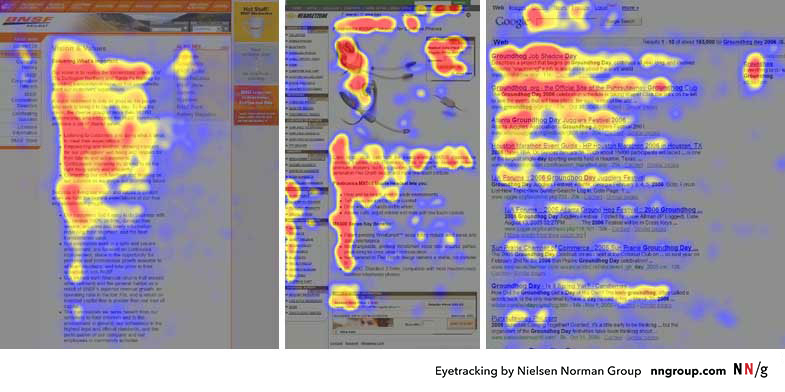
Eyetracking F-Pattern image by Nielsen Norman Group.

The F-Pattern is what happens when our eyes fall upon a big block of text.

At first we give it a shot, reading the top line (potentially the heading) and maybe a line or two following. Then our eyes drop until maybe a new paragraph, section, or sub-header. We’re a little less committed now so we might not make it all the way across the line of words. Then we drop to the bottom of the page.

In reports that are just straight narrative, with little to no section breaks, illustrations, or visual hierarchy, where our eyes stop while scanning is random and arbitrary.

Why People Scan in an F-Shaped Pattern
People scan in an F-shape when all of these 3 elements are present:

A page or a section of a page includes text that has little or no formatting for the web. For example, it has a “wall of text” but no bolding, bullets, or subheadings.
The user is trying to be most efficient on that page.
The user is not so committed or interested that he is willing to read every word.

Designing websites that mirror how our eyes work

What is a Z Pattern?

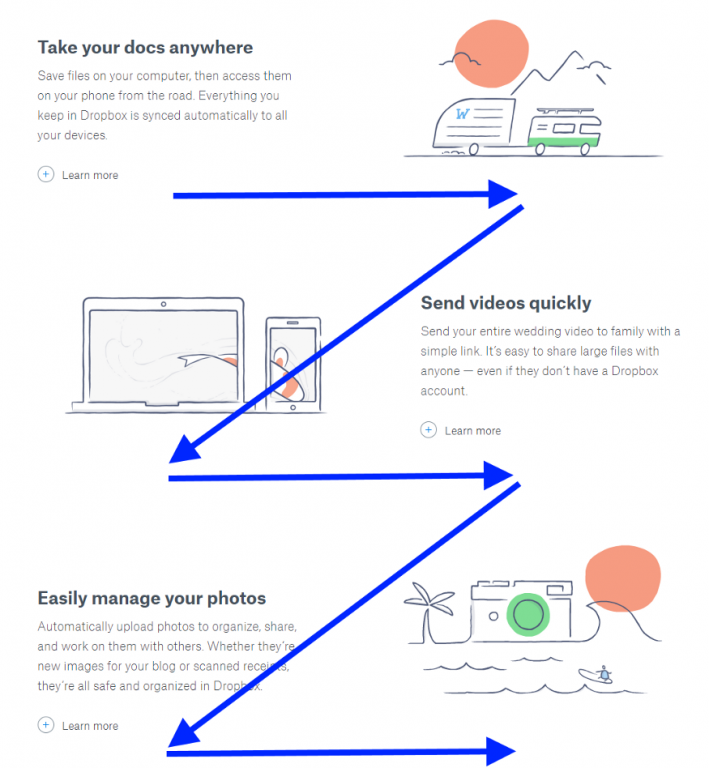
Eyetracking Z Pattern from an article on theNextWeb.

The wide screens of the web are designed differently. Unlike the paper reports of the past, not everything is left aligned. We have sidebars and illustrations that shift from one side of the screen to the other.

Well designed sites are rarely filled with big blocks of text. Instead they guide the reader through intentionally, block by block, section by section.

As our reports adapt to meet the visual needs of primarily digital audiences, we need to understand that our reader’s eyes work differently on the web.

Think of the Z-pattern as the sister to the F-pattern. Both are naturally occurring eye patterns, as validated by eyetracking studies. The difference is in the type of content the user encounters. Usually, content-rich pages will trigger the F-pattern while pages with strong primary content are more suitable for the Z-pattern…

The Z-pattern is perfect for interfaces where simplicity is a priority and the call-to-action is the main takeaway. In short, the F-pattern organizes content, the Z-pattern emphasizes calls-to-action.

Designing websites that mirror how our eyes work

Freshspectrum cartoon by Chris Lysy.
So, these are the results of our report eyetracking study. You'll notice they don't extend beyond page 3.  By that point all of our study participants had fallen asleep."

Know your report audience and sharing approach. Then design accordingly.

We’re in a period of transition.

We’re no longer governed by the spatial limitations of a typewriter. We can create reports with color and structures that don’t fit traditional molds. Yes, the structure might be different, but our reader’s eyes and reading patterns have been adjusting now for decades.

But even when we do create that long narrative report, adapt the design with respect to how people read. Use call-out boxes with larger fonts to layout the important takeaways. Use color and illustration to draw attention to the points you want to stick in your reader’s mind.

Written by cplysy · Categorized: freshspectrum

Apr 08 2021

ESSA Level 4: Getting your foot in the door

In my last post, I talked about how the recent American Rescue Plan Act will bring an influx of funds specifically for out-of-school time (OST) — after-school and summer — programs, as well as for community schools and wraparound services. 

This is a huge win for those working tirelessly in family engagement and OST!

I also mentioned that to be on the safe side, it’s a good idea to start building your evidence base now, in case these funds are earmarked for evidence-based programs under the Every Student Succeeds Act (ESSA). 

Now that you’re all familiar with the four evidence levels, let’s dig into the most accessible one: Level 4. 

So many grass roots, small, community-based organizations are at a disadvantage with ESSA’s evidence requirement. Here’s why: 1) evaluation services can get expensive, and 2) they often require technical know-how or an outside consultant to do them well. 

Program staff are great at working with kids, families, and schools. That’s why they do this work! They didn’t sign up to be evaluators, so I get why the thought of doing an evaluation can send some program staff running for the hills. 

But let’s take a deep breath.

Here’s the great news about Level 4: if you know that your organization is planning to evaluate your family engagement or after-school services but hasn’t done so yet, you can demonstrate that there is a great likelihood that your services are impactful and still get access to those Title I and other federal funds. 

That’s it – demonstrating a likelihood! It’s a great way to get your foot in the door with districts while working towards the bigger goal of becoming evidence-based. 

So you may be saying – Amanda, that sounds great, but how do I show that my services are likely to have a positive impact on kids and families? 

Here’s what you need to apply for ESSA Level 4 approval: 

1) A logic model for your organization

Essentially, logic models are a depiction of what you put into your program (resources, activities), what you hope to get out of it (short- and long-term outcomes), and how you’ll know you’re on track to do that (measures, benchmarks).

​Check out my post about the ins and outs of logic models here. 

2) Citations demonstrating the impact of similar programs

We can use online tools like Google Scholar to find existing evaluations and research studies that show that similar programs serving similar groups of kids or families had a positive impact.

​So, if you’re a program in a major urban center and you find a study demonstrating the effectiveness of a small, rural initiative, it’s probably best to keep looking. We want to compare apples to apples here.

You’ll also have to make sure that the studies you find meet the ESSA standards described in my last post. 

3) A plan for your future evaluation

All you need to do is put together a plan for how you are going to measure your program’s impact in the future. You’ll have to share who you’ll study, what you’ll look at, and when you’ll conduct this research. 

You may need to chat with an evaluator for this one. Don’t worry though – evaluations don’t have to be a multi-year, super expensive endeavor!

I hope you noticed that none of those three requirements needed any program data!

​So if you’re started to track your family engagement or student data, Level 4 gives you time to get your systems up and running, while still giving you access to the funds you need and the students and families you want to work with!

If you want to know how to DIY the ESSA Level 4 process, sign up below for Evidence for Engagement, the free mini course from Tamara Hamai and me!

​With weekly videos and worksheets, it will walk you through how to get your application ready for your local school district and get your foot in the door. 

Written by cplysy · Categorized: engagewithdata

  • « Go to Previous Page
  • Go to page 1
  • Interim pages omitted …
  • Go to page 191
  • Go to page 192
  • Go to page 193
  • Go to page 194
  • Go to page 195
  • Interim pages omitted …
  • Go to page 310
  • Go to Next Page »

Footer

Follow our Work

The easiest way to stay connected to our work is to join our newsletter. You’ll get updates on projects, learn about new events, and hear stories from those evaluators whom the field continues to actively exclude and erase.

Get Updates

Want to take further action or join a pod? Click here to learn more.

Copyright © 2026 · The May 13 Group · Log in

en English
af Afrikaanssq Shqipam አማርኛar العربيةhy Հայերենaz Azərbaycan dilieu Euskarabe Беларуская моваbn বাংলাbs Bosanskibg Българскиca Catalàceb Cebuanony Chichewazh-CN 简体中文zh-TW 繁體中文co Corsuhr Hrvatskics Čeština‎da Dansknl Nederlandsen Englisheo Esperantoet Eestitl Filipinofi Suomifr Françaisfy Fryskgl Galegoka ქართულიde Deutschel Ελληνικάgu ગુજરાતીht Kreyol ayisyenha Harshen Hausahaw Ōlelo Hawaiʻiiw עִבְרִיתhi हिन्दीhmn Hmonghu Magyaris Íslenskaig Igboid Bahasa Indonesiaga Gaeilgeit Italianoja 日本語jw Basa Jawakn ಕನ್ನಡkk Қазақ тіліkm ភាសាខ្មែរko 한국어ku كوردی‎ky Кыргызчаlo ພາສາລາວla Latinlv Latviešu valodalt Lietuvių kalbalb Lëtzebuergeschmk Македонски јазикmg Malagasyms Bahasa Melayuml മലയാളംmt Maltesemi Te Reo Māorimr मराठीmn Монголmy ဗမာစာne नेपालीno Norsk bokmålps پښتوfa فارسیpl Polskipt Portuguêspa ਪੰਜਾਬੀro Românăru Русскийsm Samoangd Gàidhligsr Српски језикst Sesothosn Shonasd سنڌيsi සිංහලsk Slovenčinasl Slovenščinaso Afsoomaalies Españolsu Basa Sundasw Kiswahilisv Svenskatg Тоҷикӣta தமிழ்te తెలుగుth ไทยtr Türkçeuk Українськаur اردوuz O‘zbekchavi Tiếng Việtcy Cymraegxh isiXhosayi יידישyo Yorùbázu Zulu