• Skip to main content
  • Skip to footer
  • Home

The May 13 Group

the next day for evaluation

  • Get Involved
  • Our Work
  • About Us
You are here: Home / Archives for allblogs

allblogs

Oct 05 2020

La evaluación busca responsabilidad

Fuente: https://revitalizationpartners.com/in-our-experience/a-culture-of-personal-accountability/

Retomando nuestro post anterior ¿Busca la evaluación culpables?, en el que indicamos que la evaluación busca reforzar la responsabilidad (rendición de cuentas) y no tanto busca culpables: en un sentido amplio ya hemos hablado de lo que se entiende por rendición de cuentas : al “conjunto de derechos y responsabilidades existentes entre los ciudadanos y las instituciones que afectan a su vida”.

La rendición de cuentas incluye tres dimensiones:

(1) Obligatoriedad: derecho a obtener una respuesta por parte de la ciudadanía y la obligación de darla por parte de las instituciones.

(2) Exigibilidad: capacidad para asegurar que una acción se lleva a cabo y sancionar si ello no ocurre.

(3) Evaluabilidad: valoración positiva o negativa de las instituciones (Newell y Bellour, 2002 y Blagescu, de Las Casas y Lloyd, 2005 en Toledano et al, 2008: 18).

Esto lleva a diferentes modelos de rendición de cuentas según su carácter:

(1) Carácter político o control al ejecutivo: combina modelos obligatorios (control parlamentario, elecciones) y voluntarios (comparecencias públicas);

(2) Carácter jurídico o legal, marcado por la obligatoriedad, exigibilidad y cumplimiento de las normas y sanciones;

(3) Carácter de gestión de recursos, marcado por la exigencia y obligatoriedad de auditoría respecto a la normal.

…pues apliquemos la rendición de cuentas por medio de la evaluación en el contexto del COVID: obligatoriedad, exigibilidad y evaluabilidad

Written by cplysy · Categorized: TripleAD

Oct 04 2020

¿Busca la evaluación culpables?Borrador automático

Fuente: http://facilitationprocess.com/the-critical-need-for-program-accountability-evaluation/

En el artículo “Evaluar ahora, y no cuando ya sea tarde“ Cristina Monge indicaba que “adolecemos de una falta de cultura de evaluación en el conjunto de las administraciones públicas y en otras organizaciones privadas que resulta todo un hándicap para la gestión”. “Probablemente porque se ve como un proceso en busca de culpables, con ánimo inquisitorial y estigmatizador; pero siendo cierto que, en algunos casos, quien lo propone puede estar buscando ese efecto, tal situación podría combatirse sistematizando la evaluación de manera que forme parte de los procesos de gestión habituales.”

En varias ocasiones en declaraciones recientes sobre la evaluación  se hace referencia a que “la evaluación no busca culpables”, sino aprendizajes. Mi experiencia me dice que si por culpables nos referimos a “responsables”, habría que matizarlo. Las instituciones no suelen tener en su deseo el aprender por aprender, ya que suelen tener siempre otras prioridades y urgencias.  Sin una rendición del cuentas hacia ese aprendizaje organizacional. la evaluación nunca será una prioridad institucional. Quizás la forma de reposicionar la importancia de la evaluación, es mejorar la rendición de cuentas de las instituciones públicas. Y esto está relacionado con lo que Cristina Mongue llama “institucionalizar la evaluación”

Lo cierto es que una parte de una evaluación puede clarificar de alguna forma (a) cómo debieron o podrían ser en diseño o en teoría y (b) cómo fueron, en la práctica, las líneas de responsabilidad durante la ejecución de una intervención y establecer conclusiones y recomendaciones al respecto…como una forma de aprender y sacar conclusiones sobre esa distribución de responsabilidades de cara a las futuras mejoras.

Por tanto la verdadera madurez para la evaluación de políticas sólo llegará (a) con esa asunción de responsabilidades y (b) con la cultura (institucional, social…) de aceptación y comprensión del fallo, del error, (a) como norma, como parte del proceso de aprendizaje y mejora, y (b) no como parte de un proceso de aniquilación partidista del contrario. Entonces (progresando hacia esa madurez) la evaluación se institucionalizará y pasará de sueño a realidad.

Written by cplysy · Categorized: TripleAD

Oct 01 2020

Evaluation Roundup – September 2020


Welcome to our September roundup of new and noteworthy evaluation news and resources – here is the latest.

Have something you’d like to see here? Tweet us @EvalAcademy or connect on LinkedIn!


Virtual conference resources


Conference season is upon us! Ordinarily most of us would be looking forward to hopping on a plane to meet up with our peers in some exotic (and sometimes not so exotic) place. Instead, we are forced to join yet one more Zoom meeting from home. Below are some resources for presenters and attendees to make virtual conference season an enjoyable one.


Amplifying your message with help from Duarte

Duarte (@duarte) is a firm of expert communicators. I took the Duarte VisualStory workshop years ago and have been singing their praises since. Not only that, I continue to use the workbook and resources that were included as part of the workshop. It may be too late to register for one of their workshops in time for your upcoming conference presentation, but they do offer individual and team trainings as well. Besides their courses and training, they have a resource section on their website where you can access a number of guides and tool to make your presentation a memorable one. My favourites are:

Slidedocs template

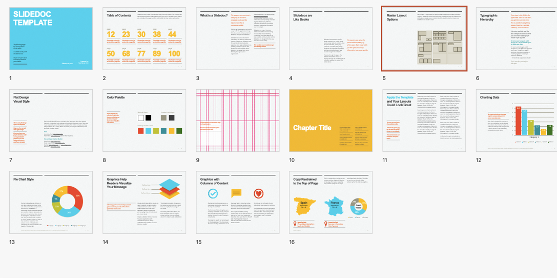
Your presentation shouldn’t be a list of narrative and text for people to look at. What goes on your slide should be a visual aide that enhances what you are speaking about. The problem is if people are interested in what you are saying then they will want a document to read and reference afterward; hence, the age-old, “can I get a copy of your slides?” If you are designing your slides correctly they should be a useless reference for people after the fact – all the meat and details should come from you and not text on a slide. To bridge this gap, Duarte suggests a Slidedoc, “a visual document intended to be read and referenced instead of projected.” The Slidedoc template can be downloaded for free – it guides you through how you can design a Slidedoc for your presentation that is visually appealing and user friendly.

Duarte’s Slidedoc template

Duarte’s Slidedoc template

Diagrammer

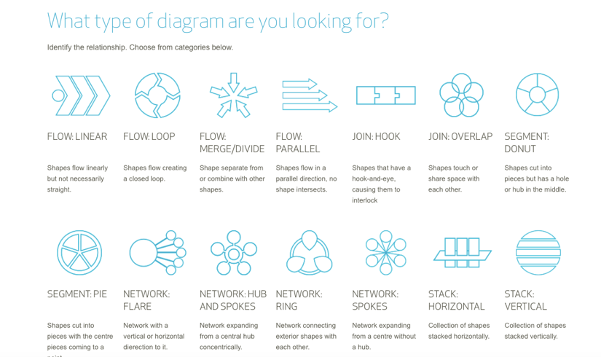
One aspect of an effective presentation is using visuals to show relationships and linkages between information. Another important aspect is having a cohesive look to each of your slides. Duarte’s Diagrammer is a visualization system that contains various diagrams to communicate relationships all with a consistent colour palette (think SmartArt on steroids.) It is free to download, and you can modify as much or as little as you want. See below for a sneak peek of some of the available designs.

Duarte’s Diagrammer

Duarte’s Diagrammer

Creating Potent Presentations

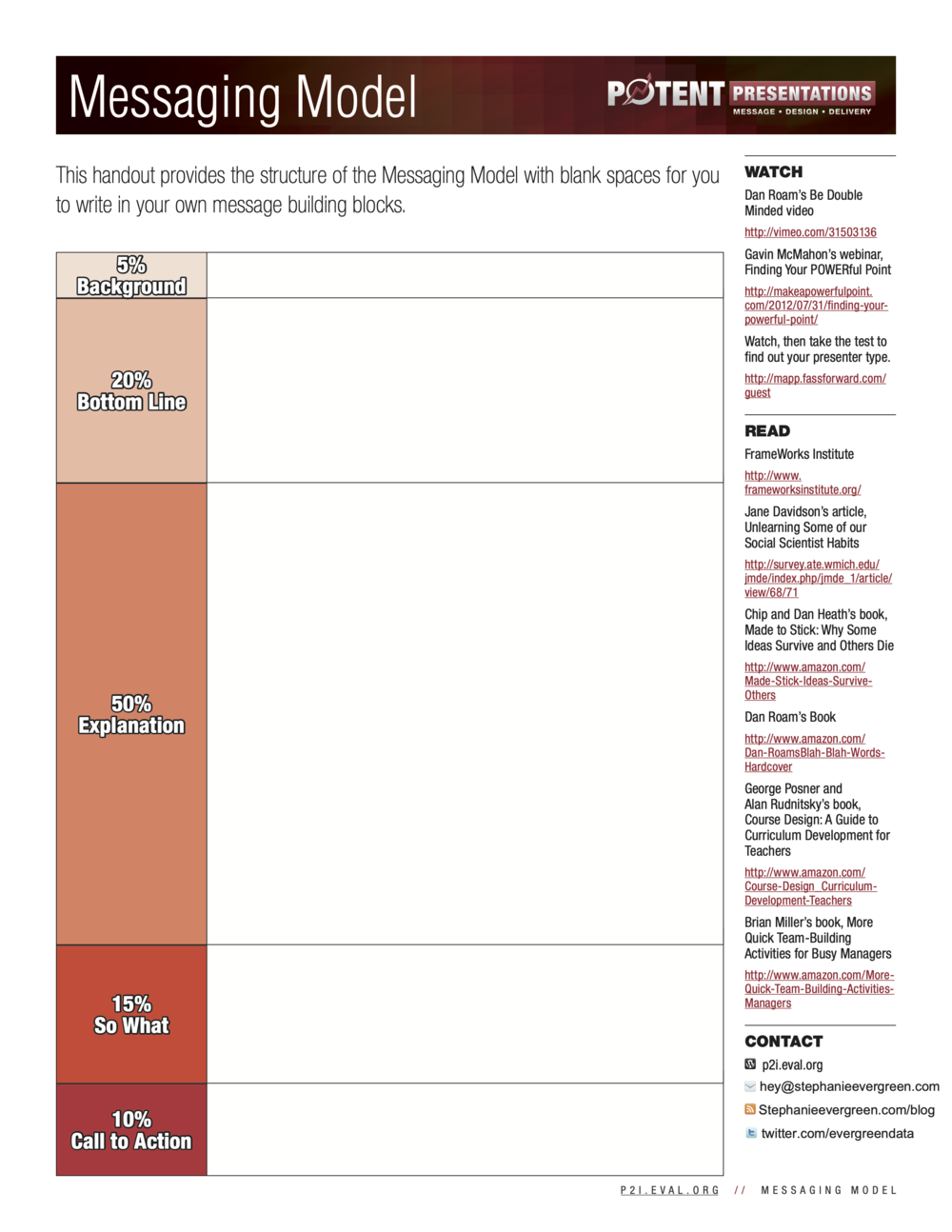
If you are an evaluator you are likely more familiar with the presentation resources the American Evaluation Association has developed under its Potent Presentations Initiative (p2i). This initiative was developed to explicitly help evaluators improve their presentation skills. The initiative has a series of free checklists and worksheets you can download, along with webinars and slides to help you craft a presentation that effectively delivers the message you are trying to get across. Sheila Robinson (@sheilabrobinson) and Stephanie Evergreen (@evergreendata) are a few who have developed resources. I find the Messaging Model Handout particularly useful when planning a presentation. Don’t be that person who spends the entire presentation talking about the background and methods and then frantically flips through the results and next steps because you ran out of time!

AEA Messaging model handout

AEA Messaging model handout

Public speaking tips for evaluators

Now that you have designed a perfectly crafted presentation and corresponding reference material, you need to actually deliver the presentation. Check out Ann Emery’s (@annkemery) recent blog with Isaac Castillo (@isaac_outcomes) where they talk about public speaking. His advice for not running out of time with your presentation: prepare half as much content as you think you need.


Facilitating a virtual workshop

What about if you’re conducting your first virtual workshop? Workshop guru Stephanie Evergreen (@evergreendata) recently posted a blog outlining five shifts workshop facilitators should consider when moving online. It covers everything from filling up dead space, adjusting slides for online audiences, break times, and the importance of interactivity. In this blog she also directs readers to Mike Morrison (@mikemorrison) who has some sage advice on conference posters.


Your poster needs to change – here’s how

Mike Morrison’s (@mikemorrison) twitter profile reads “trying to speed up science with #UXDesign.” If you look at his manifesto video he talks about how academia has an antiquated and ineffective way of sharing knowledge and proposes how this needs to change. One place to begin changing how knowledge is presented and consumed is changing those oh so horrible conference posters. Check out his entertaining video on YouTube, “How to create a better research poster in less time (including templates)”. He provides a funny overview on why they are so horrible, but more importantly walks us through how to reinvent our posters so people actually want to look at them and can take in the key learnings.


Attending a virtual conference? Make the most of it

If you are not presenting or facilitating a workshop at a virtual conference, then maybe you are attending one for the first time? If so, check out EvaluATE’s recent blog that talks about making the most of a virtual conference, but from an evaluator’s perspective. In this blog Lyssa Wilson Becho (@LyssaBecho) talks about how we can put on our evaluative thinking hat to define what it is we want to get out of the conference; from there, we can be more intentional about making those outcomes come to fruition.


New and Noteworthy — Courses, Events and Webinars


October 2020

Most Significant Change (MSC)

Sponsor: Clear Horizon Academy
Date: October 12
Venue: Online course 

Evaluation 2020

Sponsor: American Evaluation Association
Dates: October 27 – 30
Venue: Virtual Event 

Participatory Evaluation: Community-Based Assessment + Strategic Learning Practices

Sponsor: Tamarack Institute
Date: October 20
Venue: Virtual Workshop 

November 2020

Using data analysis and visualization to drive social impact

Sponsor: Clear Horizon Academy
Date: October 12
Venue: Online course


Keep the roundups coming? Sign up for our monthly roundup here:

Subscribe to Our Newsletter

Sign up with your email address to receive news and updates from Eval Academy every month.


We respect your privacy.

Thank you!


Written by cplysy · Categorized: evalacademy

Sep 30 2020

Comment on Monitoring? Evaluation? Isn’t it the same? by Thomas Winderl

In reply to peru.

Thanks, Peru – that’s nice to know. What concrete issues are you struggling with? What tool etc. could help you to find more clarity?

Written by cplysy · Categorized: thomaswinderl

Sep 30 2020

Comment on Monitoring? Evaluation? Isn’t it the same? by peru

Excellent post. I’m going through a few of these issues as well..

Written by cplysy · Categorized: thomaswinderl

  • « Go to Previous Page
  • Go to page 1
  • Interim pages omitted …
  • Go to page 232
  • Go to page 233
  • Go to page 234
  • Go to page 235
  • Go to page 236
  • Interim pages omitted …
  • Go to page 310
  • Go to Next Page »

Footer

Follow our Work

The easiest way to stay connected to our work is to join our newsletter. You’ll get updates on projects, learn about new events, and hear stories from those evaluators whom the field continues to actively exclude and erase.

Get Updates

Want to take further action or join a pod? Click here to learn more.

Copyright © 2026 · The May 13 Group · Log in

en English
af Afrikaanssq Shqipam አማርኛar العربيةhy Հայերենaz Azərbaycan dilieu Euskarabe Беларуская моваbn বাংলাbs Bosanskibg Българскиca Catalàceb Cebuanony Chichewazh-CN 简体中文zh-TW 繁體中文co Corsuhr Hrvatskics Čeština‎da Dansknl Nederlandsen Englisheo Esperantoet Eestitl Filipinofi Suomifr Françaisfy Fryskgl Galegoka ქართულიde Deutschel Ελληνικάgu ગુજરાતીht Kreyol ayisyenha Harshen Hausahaw Ōlelo Hawaiʻiiw עִבְרִיתhi हिन्दीhmn Hmonghu Magyaris Íslenskaig Igboid Bahasa Indonesiaga Gaeilgeit Italianoja 日本語jw Basa Jawakn ಕನ್ನಡkk Қазақ тіліkm ភាសាខ្មែរko 한국어ku كوردی‎ky Кыргызчаlo ພາສາລາວla Latinlv Latviešu valodalt Lietuvių kalbalb Lëtzebuergeschmk Македонски јазикmg Malagasyms Bahasa Melayuml മലയാളംmt Maltesemi Te Reo Māorimr मराठीmn Монголmy ဗမာစာne नेपालीno Norsk bokmålps پښتوfa فارسیpl Polskipt Portuguêspa ਪੰਜਾਬੀro Românăru Русскийsm Samoangd Gàidhligsr Српски језикst Sesothosn Shonasd سنڌيsi සිංහලsk Slovenčinasl Slovenščinaso Afsoomaalies Españolsu Basa Sundasw Kiswahilisv Svenskatg Тоҷикӣta தமிழ்te తెలుగుth ไทยtr Türkçeuk Українськаur اردوuz O‘zbekchavi Tiếng Việtcy Cymraegxh isiXhosayi יידישyo Yorùbázu Zulu