• Skip to main content
  • Skip to footer
  • Home

The May 13 Group

the next day for evaluation

  • Get Involved
  • Our Work
  • About Us
You are here: Home / Archives for allblogs

allblogs

Sep 22 2020

Predicting Next Year’s Top Story

Foresight can involve complex data gathering, sensemaking, and design and also be something as simple as developing the headline for next year’s news.

This simple technique can get your organization started on futures thinking and provide a way to connect the present situation with trends that you are seeing in your industry and the world to strategy and aspirations. This technique gets you to imagine the headlines of the future (what people are writing or saying about your enterprise) and walking back from that or projecting forward to fill in the steps that led you to that outcome.

Setting the Stage

This is an activity that is best done as a group anywhere from 4 to 12 people and can be done in as little as an hour, although it can be done over a longer period of time in single or multiple sessions if you wish to go deeper into the assumptions and models for the future.

It’s important to frame the exercise by choosing whether you want headlines for the organization or a specific project or product. It doesn’t matter who these imaginary headlines are to be written by (e.g., journalists, industry professionals), however, it does help to imagine what context they are to be written (e.g., news media, business press, industry news outlets, professional associations, peers). Make whatever context you pick clear even if it is in multiple contexts.

Next, set a time horizon for the headlines sometime within the next 6 to 12 months.

Lastly, this is often used to frame positive outcomes. However, after you’ve determined what success looks like it is worth considering repeating the exercise at a later date (e.g., one week later) with the converse: focusing on headlines that report failures, disasters, or problems. This can help your team see threats as well as possibilities.

The materials you will need are pieces of paper (preferably sticky notes because they are easily portable and can be re-arranged) and a whiteboard or flipchart/newsprint sheets of paper and markers for a facilitator (who can be external or a member of the team) and the team/participants.

Activity

Individually, have participants brainstorm headlines they imagine for the time horizon you have set. Give them about 5-10 minutes and ask participants to strive for volume — lots of ideas — over quality.

As a group, post together (with stickies) or share the ideas that individuals have generated. This can be done by having individuals post up their sticky notes on a wall and then later organized or by doing successive round-robin reporting where everyone presents a single idea in as many rounds as there are ideas.

We suggest having the group vote on headlines that they like, elicit the strongest reactions (positive or negative), or are the most provocative. Aim for 3-5 headlines. With these headlines explore as a group some of the assumptions that are in place for this headline to come true. The aim is to answer the question: what would have to happen for this to become a real headline?

Why?

This activity helps you set and frame a goal for your organization, project or product. It can help elicit information about what kind of aspirations, assumptions, and ideas that your team has about what you are doing. It will also allow to identify what kind of relationships, resources, or facilitators are needed to get from where you are to where you wish to go over the time horizon you’ve picked.

If you do the negative case headline, this technique can help frame what kind of necessary activities are required for success and where they can possibly go wrong. it will allow you to identify threats and risks associated with what you’re planning to help account for that in your plan.

This simple technique is powerful and can be used in a single session, with multiple units, or as part of a planning exercise and the dividends are great. It’s fun, creative, and informative.

If you want to see more about what this can do, contact us and we’ll gladly help you set up a foresight scan and strategic plan for your project or organization based on this kind of futures thinking.


Written by cplysy · Categorized: cameronnorman

Sep 22 2020

Comment on How to formulate strong outputs by Julius Awullama Abimiku

I need more of monitoring and evaluation knowledge.

Written by cplysy · Categorized: thomaswinderl

Sep 20 2020

Tips and Tricks for Great Survey Design … and a Survey for You

We have all taken TONS of surveys in our lifetime. 

We get surveys when we make an online purchase, when we speak with a customer service agent, when we want to get a  free gift card, and even when we go to the hospital. 

We’re all pros at taking surveys… and we all know when we’re taking one that’s TERRIBLY designed. 

For me, if I don’t feel like I can answer the questions, or if it gets too long or overly annoying, I’m out. 

And that organization just lost a respondent. 

I don’t want that to happen to you — because in education, surveying our stakeholders is SO important. It shows that we value our stakeholders’ opinions, feedback, and experiences. 

We can’t afford to lose respondents because of iffy survey design. 

Here are a few of my tips for upping your survey game: 

1. Ask only what’s really important. 

Make a list of what your team is wondering about or what the impact of your proposed projects/plans might be before you draft your survey questions. 

Keep it short and sweet … if it’s not related to those things, don’t include it. 

2. Reach respondents where they are. 

Think of all of your touch points with your key stakeholders. Students may be log in for online class, families may check social media for updates, and all of your stakeholders may access meal sites.

At all of these venues, you can easily ask about needs, satisfaction with the school’s efforts, or other questions you may have.

You can also get feedback through polls in Google Classroom, Zoom, via text message, or even on social media. 

3. This may seem obvious, but … make it easy for respondents to actually answer your questions. 

Keep the language clear and simple so a person of any reading level can understand it. 

Never ask about more than one topic in a single question, and try to avoid giving a neutral middle answer option when you can.

(In both of these cases, it’s very hard for you to actually learn anything from the data.)

And of course, if you work with communities who speak languages other than English, find a way to translate your survey into their language. 

Translation is a much tougher process than it should be, but it is essential for making all of your families feel valued and for hearing from your entire community, not just one subset. 

All that being said, I feel the same way about you – my colleagues, clients, and readers.

I want to know what’s important to you and what would be helpful for me to cover on the blog.

I hope that you’ve been inspired by this post and will take my brief survey below.

​I appreciate your feedback and will use it to generate future content for you!

Loading…

Written by cplysy · Categorized: engagewithdata

Sep 17 2020

Reflections on the Intersection of Evaluation and Emergent Learning

How I applied emergent learning tools to connect evaluation, learning, and strategy

Photo by PhotoMIX Company from Pexels

All too often evaluation, learning, and strategy are disconnected. How many times have you been involved in an evaluation that’s meticulously collecting data to answer questions that may no longer be relevant to the stakeholders involved? In 2019, I had the opportunity to participate in the Emergent Learning Certification Program sponsored by Fourth Quadrant Partners. At the start of this journey I was guided by curiosity and viewed emergent learning as a chance to expand my toolbox as an evaluator — borrowing from different approaches and practices as needed. I entered the program with the following question in mind:

How can emergent learning be leveraged in my own evaluation practice to advance experimentation and ongoing learning across a diversity of stakeholders?

I was looking for a way to tighten the connection between evaluation, learning, and strategy. During the time I was enrolled in the program, I was able to apply the tools and concepts I was learning to an evaluation of a multi-site initiative designed to advance health equity through resident engagement. This work was emergent. The foundation and its partners were learning along the way and our thinking about how to define progress was also evolving as we continued to learn from the communities and their residents. In my mind, this was the perfect opening to apply the emergent learning framework and tools.

Here’s what I learned by applying emergent learning tools to my work:

Lesson 1: Applying line of sight thinking when developing or revisiting a theory of change can highlight areas of ambiguity and surface assumptions embedded in our thinking.

In emergent learning, we refer to line of sight as a way to maintain an unobstructed view from strategies to the ultimate outcomes we desire. By asking questions such as — What will this strategy make possible? Or What will it take to get there (desired outcome)? — we are making our thinking explicit and surfacing underlying assumptions about what we think is needed to reach our ultimate outcomes.

Similarly, in evaluation, we think of a theory of change as a snapshot of our best thinking at a point in time. It’s a platform to make our thinking visible and demonstrates how the strategies of an initiative or a program are connected to the desired changes we are hoping to see.

By developing a clear line of sight that illustrates how strategies are linked to desired outcomes, a group can stay focused on their collective vision for change as they continue to test and adapt their strategies over time.

In my work with the health equity evaluation, applying line of site thinking when revisiting the initiative’s theory of change, gave us the space to surface our initial assumptions and reflect on how these assumptions were changing based on what we were seeing in the communities. For more information on strengthening line of sight, check out Fourth Quadrant Partners’ Strengthening Line of Sight.

Photos by Alex Azabache and Roman Odinstov from Pexels

Lesson 2: Creating a forward-facing learning question can advance a group’s learning over time.

In emergent learning, we often create a question to help frame and focus our learning. The answer to this learning question is intended to accelerate the group’s ability to move towards their desired goal. Learning questions are typically forward facing (unlike evaluation questions which tend to be retrospective in nature) and invite the group to think together about how to tackle a specific challenge or achieve a desired outcome.

For the health equity evaluation, our forward-facing learning question was — What will it take to engage and empower residents experiencing health inequities to advance health equity in their communities? — Through the evaluation, we answered several retrospective evaluation questions designed to provide data about the various hypotheses that were being tested. The evaluation questions would evolve over time as the initiative’s strategies evolved, but all data collected through the evaluation was to inform the forward-facing learning question. Constructing a forward-facing learning question that was relevant to the group encouraged us to stay focused on our desired outcome as we explored new ideas for moving forward. For more on crafting learning questions, checkout Tanya Beer’s webinar on How to Ask Powerful Questions.

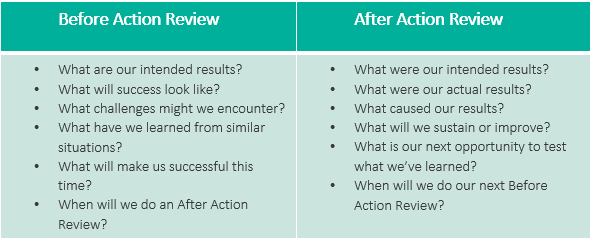
Lesson 3: Systematically applying Before and After Action Reviews can harness learning from one event to another, helping to ensure that the same mistakes don’t get repeated.

Before and After Action Reviews (BARs and AARs) offer a set of questions to help groups learn iteratively and improve results over time. For more information check out Four Quadrant Partner’s Introduction to Before and After Action Reviews (BARs and AARs).

Fourth Quadrant Partners

As part of this initiative, the funder convened community stakeholders at multiple points during the year to promote information exchange, peer learning, and networking. At the time of these convenings I was still in the process of figuring out the value of these reviews — at first glance, the questions seem almost too simple. Upon review of my own AAR notes taken after the first convening, I noticed that some of the shortcomings of the second convening could have been prevented if we had systematically conducted these reviews. Many of the ideas brought up after the first convening around — What will make us successful next time? — were not implemented. This demonstrated to me how easy it is for learnings to get lost from one event to another.

Oftentimes our best ideas flow freely after a shortcoming or failure. However, over time those lessons tend to lose salience.

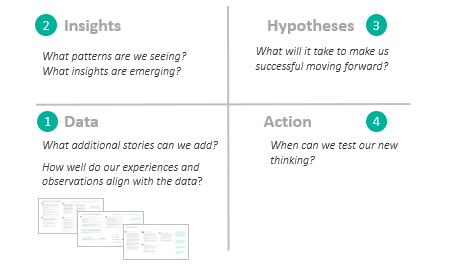
Lesson 4: Using the Emergent Learning Table as a platform for data interpretation helped move the group from data to insights to action.

The emergent learning table provides a platform to facilitate a group of stakeholders through a process designed to 1) reflect on data, 2) generate insights grounded in data, 3) establish hypotheses based on the insights that were generated, and 4) move towards action. For the health equity evaluation, I used a combination of data placemats and an emergent learning table as part of the data interpretation process with foundation staff, community coaches, and members of their technical assistance team.

This combination created a space for stakeholders to digest the data, ask questions, share experiences, recognize patterns, and generate insights for moving forward. This process facilitated the connection between evaluation and learning.

The collaborative nature of the conversation and involvement of multiple stakeholders helped increase buy-in to new ideas that were generated.

Adapted from 4QP’s Emergent Learning Framework

For me, the learning took place when I moved away from the one-off applications of the tools across disparate projects and focused on one project to cultivate learning over time.

Over the course of the year I tested and applied various aspects of emergent learning. By integrating emergent learning tools and practices throughout the health equity evaluation, I started seeing the through-line across these applications. My breakthrough moment came when I facilitated a data interpretation meeting using the emergent learning table as a platform for discussion.

Moving Forward…

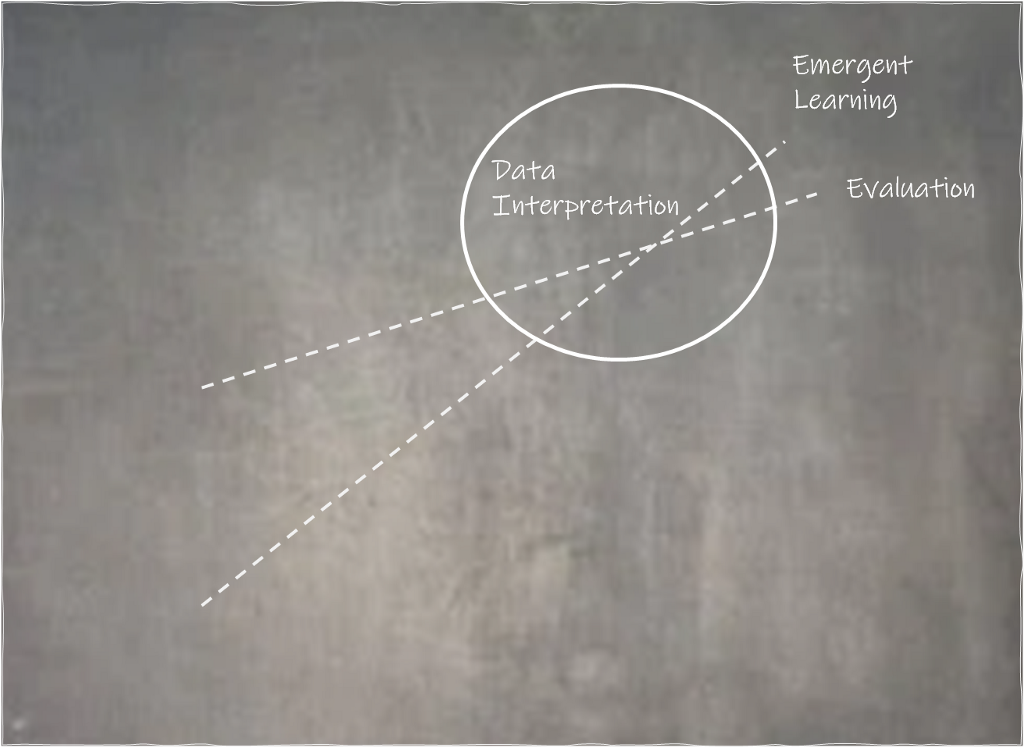
How can emergent learning be leveraged in evaluation to advance experimentation and ongoing learning?

Image created by Veena Pankaj, Innovation Network

Take-Away #1: The true intersection between evaluation and emergent learning lies in the interpretation of data and its use for reflection and learning.

The emergent learning table demonstrated the power of inserting real-time, collaborative reflection into the evaluation sensemaking process. Facilitating stakeholders through the sensemaking process, creating a space for digestion, reflection, and the generation of new ideas helps connect evaluation to learning and action.

Take-Away #2: A forward-facing learning question encourages the exploration and testing of new ideas, while keeping the ultimate goal in mind.

This helps ensure that the evaluation is focusing on questions that matter and inform the collective learning of the group. All too often in multi-year evaluations, the questions that are developed at the beginning of the evaluation become outdated and irrelevant over time. When this occurs, there’s a disconnect between the data being collected and the decisions that need to be made to inform strategy.

Take-Away #3: Building in opportunities for reflection and sense-making throughout the evaluation creates a reflective practice that accelerates the learning potential of the group.

Opportunities for reflection help to create touchpoints for learning and adaptation of strategy.

Take-Away #4: Involving different stakeholders in the sensemaking process invites a diversity of perspective that can strengthen insights and lead to new ways of moving forward.

Inviting a diverse group of stakeholders to the table and valuing their experiences and perspectives helps make evaluation less transactional and paves the way for transformation.

Emergent learning tools provide avenues to gather experiences, generate insights, and formulate new ideas in a way that encourages experimentation, learning, and adaptation. It further provides a platform that inspires collaboration and a diversity of thought and perspective.

When coupled with emergent learning, evaluation has the potential to accelerate learning, magnify impact, and move us closer to our collective vision.


Reflections on the Intersection of Evaluation and Emergent Learning was originally published in InnovationNetwork on Medium, where people are continuing the conversation by highlighting and responding to this story.

Written by cplysy · Categorized: innovationnet

Sep 17 2020

Comment on Dealing with my first journal article rejection by Rajendra

Nicely put…..
Rejection of any kind hurts a lot……
But if we take it positively, it gives us a lot of force to surge ahead….. Nothing matches that force.
Having said that, I read it somewhere, ‘Awaiting Score’, ‘Awaiting Recommendation’, ‘Awaiting final decision’ all these things have a simple meaning…….start working on your next Paper….

Written by cplysy · Categorized: danawanzer

  • « Go to Previous Page
  • Go to page 1
  • Interim pages omitted …
  • Go to page 234
  • Go to page 235
  • Go to page 236
  • Go to page 237
  • Go to page 238
  • Interim pages omitted …
  • Go to page 310
  • Go to Next Page »

Footer

Follow our Work

The easiest way to stay connected to our work is to join our newsletter. You’ll get updates on projects, learn about new events, and hear stories from those evaluators whom the field continues to actively exclude and erase.

Get Updates

Want to take further action or join a pod? Click here to learn more.

Copyright © 2026 · The May 13 Group · Log in

en English
af Afrikaanssq Shqipam አማርኛar العربيةhy Հայերենaz Azərbaycan dilieu Euskarabe Беларуская моваbn বাংলাbs Bosanskibg Българскиca Catalàceb Cebuanony Chichewazh-CN 简体中文zh-TW 繁體中文co Corsuhr Hrvatskics Čeština‎da Dansknl Nederlandsen Englisheo Esperantoet Eestitl Filipinofi Suomifr Françaisfy Fryskgl Galegoka ქართულიde Deutschel Ελληνικάgu ગુજરાતીht Kreyol ayisyenha Harshen Hausahaw Ōlelo Hawaiʻiiw עִבְרִיתhi हिन्दीhmn Hmonghu Magyaris Íslenskaig Igboid Bahasa Indonesiaga Gaeilgeit Italianoja 日本語jw Basa Jawakn ಕನ್ನಡkk Қазақ тіліkm ភាសាខ្មែរko 한국어ku كوردی‎ky Кыргызчаlo ພາສາລາວla Latinlv Latviešu valodalt Lietuvių kalbalb Lëtzebuergeschmk Македонски јазикmg Malagasyms Bahasa Melayuml മലയാളംmt Maltesemi Te Reo Māorimr मराठीmn Монголmy ဗမာစာne नेपालीno Norsk bokmålps پښتوfa فارسیpl Polskipt Portuguêspa ਪੰਜਾਬੀro Românăru Русскийsm Samoangd Gàidhligsr Српски језикst Sesothosn Shonasd سنڌيsi සිංහලsk Slovenčinasl Slovenščinaso Afsoomaalies Españolsu Basa Sundasw Kiswahilisv Svenskatg Тоҷикӣta தமிழ்te తెలుగుth ไทยtr Türkçeuk Українськаur اردوuz O‘zbekchavi Tiếng Việtcy Cymraegxh isiXhosayi יידישyo Yorùbázu Zulu