Right!
allblogs
Evaluator Competencies Series: Taking a Short Break!
It’s that busy time in the semester when the marking for the courses that I’m teaching is piling up and I am also working furiously on a couple of online courses (in addition to my day job). So I’ve decided that I’m going to take a wee break from writing my (nearly) weekly blog series on evaluator competencies until I get through this backlog of other work.
Recognizing our limitations and being about to prioritize are important competencies for an evaluator, right?
Developmental Evaluation Preparedness

Pilots have a pre-flight check before they fly a plane. A developmental evaluation journey requires the same kind of preparedness.
Developmental Evaluation (DE) is an approach to strategic learning designed for understanding and supporting innovation. This approach to data-driven learning requires a specific set-up to do well. While we need a mindset, skillset, and toolset to do DE, we also need a receptive system to make it all work.
Here are the things you can do to lay the groundwork for doing DE and making it a success. Think of this as your pre-flight checklist for a journey of learning together.
These are attributes and may be found within individuals, but it’s better if they are distributed widely across the organization.
Mindset
The most important aspect of a Developmental Evaluation is creating the right mindset. This mindset is focused on complexity, adaptation, and development (vs. improvement, linear growth). A list of statements to examine whether you have the right mindset is available on Censemaking and can provide a start.
Some other mindset questions include:
- Openness to experience. A DE will likely take a journey that can’t be fully predicted, much like a road trip. An openness to a non-linear pathway toward a preferred destination and the willingness to adapt the path and the destination based on evaluation data and evidence is key.
- Tolerance for ambiguity. Few of us enjoy uncertainty, but we all need to deal with it when working on a DE.
- Self-awareness. We often get in our own way. Understanding how we think and the biases and perspectives we hold is important to knowing when they serve us and when they are a barrier to innovation. Mindfulness is a part of this quality.
- Patience. This is a skill and mindset quality. Knowing that things will unfold at a time and pace that might change is useful — and requires patience in just knowing that.
- Evaluative thinking. This is a form of thinking that gets us connecting our activities, outcomes, and effects and asks three key questions about how we know something (and what to do about it).
Skillset
Developmental evaluation is not for the unskilled. While many of the qualities inherent in a DE are natural to people, they are not commonly practiced in organizations. DE is an approach, and while a skilled evaluator might have many methodological skills to do much of what is in a DE, without the following skills — with the evaluator, the evaluation team, the organization, or all of them — you won’t likely succeed.
- Facilitation. A DE is a collaborative endeavour. You need facilitation skills to engage the diversity of perspectives in the system and coordinate the discussion, feedback, and opportunities for everyone to engage with these perspectives.
- Sensemaking. Sensemaking is a participatory process that involves taking data that may be difficult to understand, ambiguous in its conclusions, or incomplete and helps people make sense of what it means for the organization within the present context and strategic needs. Sensemaking for DE helps guide decision-making and strategy.
- Complexity and Systems Thinking. A distinguishing feature of DE is the use of applied thinking from systems science and complexity to guide the entire process. This means creating designs and processes that are sensitive to detecting emergent properties, network effects, organizational behaviour (like self-organization), and non-linear or algorithmic change dynamics.
- Dynamism. Complexity also requires that an evaluation be designed with consideration of the dynamics of the program, actors, and system. This means adapting or developing from a moving position, not a static position. It also involves designing evaluations that take into account the growth pattern and evolution of a program that suits the system. It’s about a design for changing conditions.
- Visualization. System complexity is made more so by the inability to effectively ‘see’ the systems in our heads – there’s too much information. The ability to create system maps, visualize the dynamics and relationships within it, and facilitate discussion of those systems is critical to understanding where a program fits within it all. Visualization can be sophisticated or relatively simple in nature.
- Design. What makes DE distinct is that it is about making modifications to the program as it unfolds using evaluation data to guide the strategy. These modifications require design and the skills — like with evaluation — require designing a program while it is moving. These developmental design skills are often overlooked and bring together service design and innovation with elements of systemic design.
Toolset
The toolset is the least specific of the three ‘sets’ for DE. Almost any method can support a DE, although unlike other approaches, rarely will there be a case where a single method — interview, survey, observation — will work on its own. A multi-method or mixed-method approach to data collection is almost always necessary.
Some additional tools or methods that are not common are ones we’ve advocated for and either developed ourselves or borrowed from other contexts. Three of the most important of these are:
- The Living History Method. This meta-method brings together artifacts that inform the program’s early development and evolution. It recognizes that the present program is shaped by where it came from and that such a history can influence where things are going. Unless these conscious or unconscious patterns are recognized it is unlikely they will change. This method also helps record decisions and activities that often get missed when creating an innovation.
- Dashboards. The wealth of potential information generated from a DE and available at our fingertips can overwhelm even the most skilled evaluator. Creating dashboards using simple tools and technologies can help organize the various streams of data. It also can allow someone to gain a sense of where there may be simple patterns laying within a complex layer of data.
- Spidergrams. The spider diagram is a simple visualization tool that can work well in a DE as it helps pull various data points together in a way that allows comparison between them AND the ability to dive deep within each data stream.
Some additional perspectives on doing DE can be found in the guide (PDF) published by the McConnell Foundation by Elizabeth Dozois and colleagues.
Next time you are considering a DE, look at your present inventory of mindsets, skillsets, and toolsets to see if you have the right resources in place to do the work you need to do.
Need help? Contact us. We can help you set up a Developmental Evaluation, do one, or both. We’d love to hear from you.
Photo by Lucia Otero on Unsplash
you’re invited to ‘Developmental Evaluation: The Art of Learning’
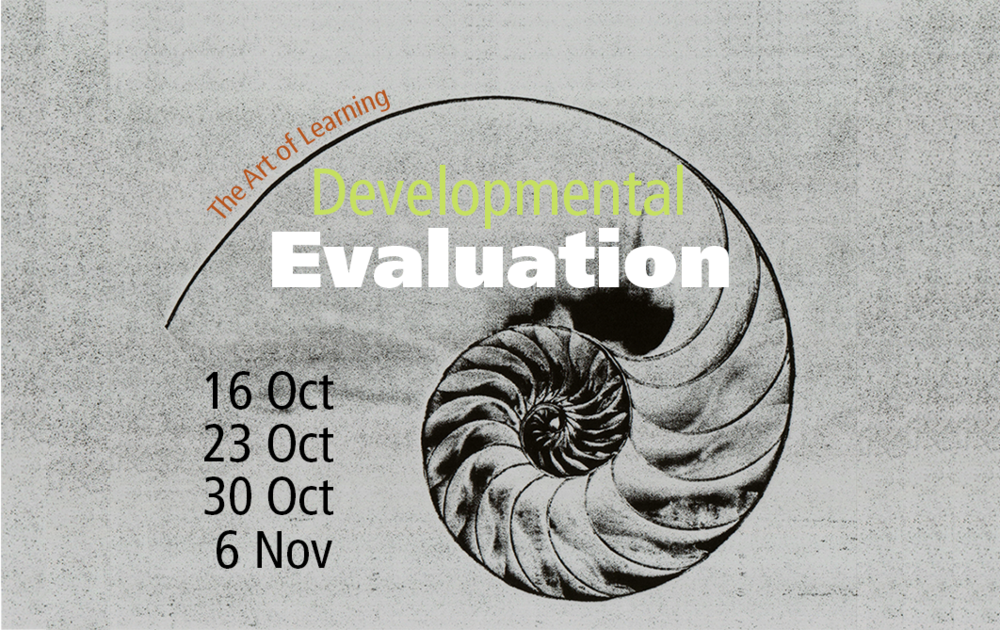
I know what you’re thinking. Do we really need yet another “The Art of”? Can’t we let this naming convention go and find something more creative for our workshop titles? I sympathize, I do, yet here we are. Because this time it’s my turn and, darn it, it’s just such a good description of what we’re up to!
Some of you may have seen me tweet a teaser about this recently, but here’s the full promotional package. From October 16th to November 6th, Rita Fierro and I will be leading an engaging online workshop on practical approaches to developmental evaluation, hosted by our lovely friends at Beehive Productions. There’s more info, including pricing and timing details, on the registration page: Developmental Evaluation: The Art of Learning
It’s a 4-week online course of four weekly 2-hour interactive sessions. We’re offering a mix of teaching, stories based on our own experiences, new tools, and small- and large-group conversations. This is not a “basics of DE” course (though we’ve got resources to help people get up to speed if they’re brand-new to it). It’s a space for those who are interested in building and expanding their own DE practice to look at what it’s like to “do” developmental evaluation, grounded in real-life stories and examples. We’re going to be talking about things like working in complexity vs. complicated realms, readiness for and navigating change at organizational and personal levels, sifting through multiple layers of learning, and building responsive learning frameworks. If you’re new to DE, it’s a chance to explore what your own practice might look like. If you’re already in the thick of doing DE, there will be conversations to deepen your thinking, other practitioners to connect with, and new tools and resources to try!
Sessions are recorded and released after each session, so if you’re interested but not available on all of the posted dates (Wednesday mornings PDT, from Oct 16 to Nov 6), you will have a way to catch up and stay involved. Please feel free to share this widely and contact me if you have any other questions about the course.
Hope to see you there!
While I’m self-promoting, here are some other cool opportunities from folks I know!
From Kim van der Woerd, Billie Joe Rogers, and Sofia Vitalis – Culturally-Responsive Evaluation workshops in Victoria (Oct 15) and Vancouver (Oct 18)
From Chris Corrigan, Caitlin Frost, Pawa Haiyupis, Kelly Foxcroft Poirier, and Amanda Fenton – The Art of Hosting Spirited Dialogue: Inviting Diverse Perspectives in Complex Times (Whitehorse, YT, Oct 29-31) and The Art of Hosting Meaningful Conversations and Participatory Leadership (Bowen Island, BC, Nov 10-14)
From Gary Hutton and Anastasia Gaisenok – Systems Thinking with Indigenous Lens, a 3-hour to full-day workshop offering (contact Anastasia at connect@anastasiaconsulting.ca for more information)
And we made a video! And I’m practicing embedding videos on my website!
Systems Diagrams Made Simple
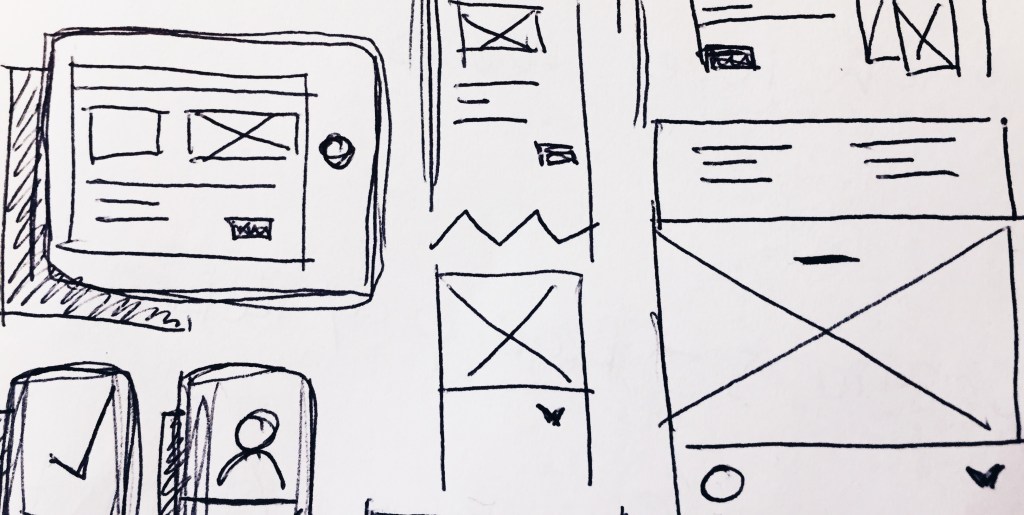
Sketch diagrams are powerful tools for visualizing complex programs and systems. This simple technique literally gets people on the same page.
Mapping out a service or product ecosystem can be a complicated endeavour. There is the entire field of systemic design that focuses on tools and strategies to engage users for starters. There are approaches like synthesis mapping and service design canvases that can help us walk through the various aspects of a system to find points of leverage, threat, and opportunity.
Nearly all of these methods and tools require user orientation and training — sometimes a little, sometimes a lot. However, in many of our engagements, particularly in healthcare, we find the time (and attention) is so limited it becomes difficult to engage participants using methods that require considerable instruction.
It’s here that we introduce a technique and tool called the system sketch map.
Sketch mapping
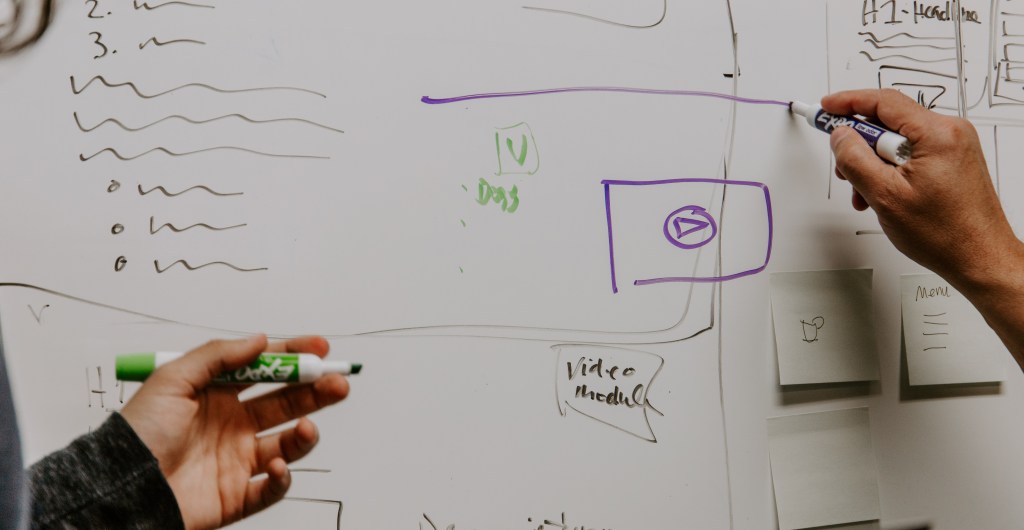
A sketch map is a multimedia system map that is created by using any form of representation such as blocks and arrows, stick figures, or elaborate illustration and can be developed at any moment. A sketch map gets participants past the challenge of having to learn a technique or representation convention and can be particularly useful for those participants who feel unskilled at drawing or visualizing their thoughts.
This works well with professionals who may find themselves uneasy about using visual media or do not consider themselves ‘creative’. (Note: Everyone can draw. It’s important to emphasize that this is not an art project).
The exercise works like this:
Begin with the instructions: Draw your system.
That’s it.
Some guidelines:
- Any visual formalism can be used. One can even combine visual approaches together.
- Emphasize the simplest media possible: Pens and paper (or crayons), sticky notes (or stickers) are among the best tools because they are flexible, colourful, and can be combined easily. These are also inexpensive and easy to obtain.
- Large format paper (e.g., newsprint) or whiteboards are best to use as a canvas to facilitate group participation
- Group participation is key
- There are no right or wrong ways to do this. Whatever participants wish to include in that system is all that matters.
- Give participants a time frame (usually 30 – 50 minutes works best) and try and ensure there are between 4 and 6 people in the group.
- Emphasize DOing over THINKing. It’s easy for groups to try and do this ‘right’ and analyze everything. The use of simple, inexpensive materials allows people to create ‘do-overs’ easily, erase material, revise and recreate things.
- Lastly, strive for ‘good enough’ and ‘coherent’ over ‘excellent’ and ‘complete’ (which are highly relative in this context).
What is interesting is that the participants define what their system is and what goes in it. In making these choices it becomes evident what they see as most essential, important, or relevant.:
A completed sketch map then allows everyone (the facilitator and participants) afterward to ‘interrogate’ the map (not the map makers) and ask questions like “does this choice of colour mean anything?“, “is the distance between these two things represent some kind of scale?“, “what might be missing from all of this?”
This interactive discussion process allows everyone to explore what gets placed at different positions, sizes, in different colours, and what gets included and left out of the map. It allows for the use of symbolism (conscious or not), metaphor, and representation without having to shape or bias the participants toward using a particular way of visualizing the system.
What it is, is what it is.
This simple technique can yield enormous insights into the assumptions, structures, relationships, actors, and core components associated with a system and do so within one or two hours and with a small budget.
For more information about sketch mapping and how it can help you with your work or just for more on innovation methods, tools, and strategies, feel free to contact us. We’d love to hear from you and can help.
Photo by Danae Paparis on Unsplash and Kaleidico on Unsplash
 English
 Afrikaans
 Shqip
Shqip አማርኛ
አማርኛ العربية
 Հայերեն
 Azərbaycan dili
 Euskara
 Беларуская мова
 বাংলা
বাংলা Bosanski
 Български
 Català
 Cebuano
 Chichewa
 简体中文
简体中文 繁體中文
繁體中文 Corsu
Corsu Hrvatski
 Čeština
 Dansk
Dansk Nederlands
 Esperanto
 Eesti
Eesti Filipino
 Suomi
Suomi Français
 Frysk
Frysk Galego
 ქართული
 Deutsch
 Ελληνικά
 ગુજરાતી
 Kreyol ayisyen
 Harshen Hausa
 Ōlelo Hawaiʻi
 עִבְרִית
 हिन्दी
 Hmong
Hmong Magyar
 Íslenska
 Igbo
Igbo Bahasa Indonesia
 Gaeilge
 Italiano
 日本語
日本語 Basa Jawa
 ಕನ್ನಡ
ಕನ್ನಡ Қазақ тілі
 ភាសាខ្មែរ
 한국어
한국어 كوردی
كوردی Кыргызча
 ພາສາລາວ
 Latin
Latin Latviešu valoda
 Lietuvių kalba
 Lëtzebuergesch
 Македонски јазик
 Malagasy
 Bahasa Melayu
 മലയാളം
 Maltese
 Te Reo Māori
 मराठी
मराठी Монгол
 ဗမာစာ
ဗမာစာ नेपाली
 Norsk bokmål
 پښتو
پښتو فارسی
فارسی Polski
 Português
 ਪੰਜਾਬੀ
 Română
 Русский
 Samoan
 Gàidhlig
 Српски језик
 Sesotho
 Shona
Shona سنڌي
سنڌي සිංහල
සිංහල Slovenčina
 Slovenščina
 Afsoomaali
 Español
 Basa Sunda
 Kiswahili
 Svenska
 Тоҷикӣ
 தமிழ்
தமிழ் తెలుగు
 ไทย
ไทย Türkçe
 Українська
 اردو
اردو O‘zbekcha
 Tiếng Việt
 Cymraeg
 isiXhosa
 יידיש
יידיש Yorùbá
 Zulu
Zulu