• Skip to main content
  • Skip to footer
  • Home

The May 13 Group

the next day for evaluation

  • Get Involved
  • Our Work
  • About Us
You are here: Home / Archives for allblogs

allblogs

Aug 24 2025

Autoayuda y Cooperación: Historias de Cambio

Todos hemos leído, escuchado o sufrido alguna de estas frases:

  • “Cambia tu vida en 7 pasos.”
  • “El secreto está en ti.”
  • “Todo problema es una oportunidad.”

Frases que funcionan igual para abrir un taller de coaching que para cerrar un power point de Naciones Unidas. Una ironía de nuestro tiempo: la autoayuda y la cooperación internacional, tan distintas en apariencia, hablan a veces el mismo idioma.

1. Autoayuda: la gran industria del yo

La autoayuda no es un género menor de librería; es un mercado global que en 2024 superaba los 48.400 millones de dólares y que apunta a los 67.000 millones en 2030 (Grand View Research, 2024). En EE. UU. ya factura más que el cine independiente: 13.400 millones de dólares anuales (Market Data Forecast, 2024).

Sus mecanismos de seducción son casi literarios:

  • Promesa universal: todo es posible, siempre que quieras lo suficiente.
  • Lenguaje imperativo: haz, cree, libérate. Una mezcla de sargento y gurú.
  • Ejemplo banal con moraleja épica: alguien dejó de morderse las uñas y descubrió el sentido de la vida.
  • Metáforas recicladas: llaves, puertas, viajes interiores.
  • Optimismo radical: si no cambiaste, es tu culpa.

Libros como Atomic Habits de James Clear (2018) muestran la fórmula en su versión más sofisticada: microcambios, ejemplos cotidianos y sensación de control inmediato. Eva Illouz (2008), en cambio, recordó que la autoayuda es también un dispositivo cultural que convierte problemas sociales en dramas psicológicos: el desempleo como “bloqueo”, la precariedad como “falta de actitud”.

Funciona porque ofrece lo que la época pide: claridad, emoción y mapas sencillos para navegar el caos.

2. Cooperación: la industria de la esperanza colectiva

La cooperación internacional no se vende en librerías, pero comparte la misma lógica narrativa. Los Objetivos de Desarrollo del Milenio (2000–2015) fueron el equivalente global a un best seller motivacional: una lista de metas claras, fáciles de recordar y cargadas de promesa.

Y lo cierto es que funcionó: la pobreza extrema cayó de 1.900 millones de personas en 1990 a 836 millones en 2015 (United Nations, 2015). Se salvaron al menos 21 millones de vidas en salud y educación (McArthur & Rasmussen, 2017).

Sus mecanismos también resultan familiares:

  • Promesas globales: “erradicar la pobreza extrema en 15 años”.
  • Lenguaje inspirador: empoderar, transformar, sembrar futuro.
  • Historias ejemplares: la niña que accede a la escuela, la aldea que abre un pozo.
  • Slogans poderosos: Make Poverty History (2005), casi tan directo como Sé la mejor versión de ti mismo.

Los éxitos son reales, pero las críticas también: promedios que ocultan desigualdades (Fehling et al., 2013), plazos optimistas difíciles de cumplir (Fukuda-Parr, 2016). Nada que un lector de autoayuda no reconozca: prometer demasiado es un riesgo compartido.

3. Dos espejos enfrentados

Al poner autoayuda y cooperación una frente a la otra, el parecido sorprende:

  • Promesa de cambio rápido. 21 días para transformar tu vida, 15 años para transformar el planeta.
  • Gramática de la simplicidad. Listas mágicas o listas de objetivos globales.
  • Historias ejemplares. El individuo que se reinventa vs. la comunidad que progresa.
  • El riesgo del desencanto. El lector frustrado que abandona los libros, el ciudadano que deja de creer en los ODS.

Pero también comparten lo mejor: cuando bajan de la promesa mágica al trabajo real, funcionan. La autoayuda, cuando se convierte en acompañamiento sostenido (Clear, 2018). La cooperación, cuando reconoce la complejidad, escucha y se adapta (Lusseau & Mancini, 2018).

4. Lecciones compartidas

  • El poder de la buena historia. Atomic Habits (Clear, 2018) o la campaña Girl Effect (2023) muestran cómo un relato individual moviliza más que cien gráficos.
  • Lenguaje claro. La autoayuda triunfa por hablar directo; la cooperación ha tenido campañas memorables cuando simplificó sin banalizar (Make Poverty History).
  • Metáforas que iluminan. Llaves, semillas, puentes: clichés, sí, pero útiles si ayudan a entender.
  • Inspiración sin milagros. Ni la vida cambia en 7 pasos ni el mundo en 15 años. Pero sí cambian, lentamente, cuando la narrativa se acompaña de prácticas y compromisos.

5. Invitación final

Autoayuda y cooperación comparten un oficio: mantener viva la esperanza. Una lo hace en el terreno íntimo, la otra en el global. Y aunque a veces prometan demasiado, ambas recuerdan que sin relatos no hay acción.

Así que, querido lector/a: no esperemos una lista de “7 claves definitivas”. Solo hay una:

👉contar con verdad y cuidado lo que sí funciona.

El resto no está en los manuales ni en los informes, sino en la manera en que elegimos narrar, compartir y sostener el cambio.

Bibliografía

  • Clear, J. (2018). Atomic habits: An easy & proven way to build good habits & break bad ones. Penguin Random House.
  • Fehling, M., Nelson, B. D., & Venkatapuram, S. (2013). Limitations of the Millennium Development Goals: A literature review. Global Public Health, 8(10), 1109–1122.
  • Fukuda-Parr, S. (2016). From the Millennium Development Goals to the Sustainable Development Goals: Shifts in purpose, concept, and politics of global goal setting for development. Gender & Development, 24(1), 43–52.
  • Girl Effect. (2023). Annual impact report. Girl Effect.
  • Grand View Research. (2024). Personal development market size & forecast to 2030.
  • Illouz, E. (2008). Saving the modern soul: Therapy, emotions, and the culture of self-help. University of California Press.
  • Lusseau, D., & Mancini, F. (2018). The sustainome of global goal interactions varies by country income and is disproportionately influenced by inequalities. PLOS ONE, 13(7), e0202108.
  • Market Data Forecast. (2024). Global personal development market size & forecast 2024–2033.
  • McArthur, J. W., & Rasmussen, K. (2017). How successful were the Millennium Development Goals? The Guardian.
  • Sachs, J. D. (2005). The end of poverty: Economic possibilities for our time. Penguin Press.
  • United Nations. (2015). The Millennium Development Goals Report 2015.

Nota: Este artículo fue redactado con apoyo de inteligencia artificial, que también sugirió algunas de las referencias bibliográficas incluidas. Sin embargo, las ideas centrales, el enfoque y la selección final del contenido son completamente mías
Written by cplysy · Categorized: TripleAD

Aug 21 2025

How to Create a Logic Model in Canva

Summary: You don’t need fancy tools to create basic logic models.

In this post I’m going to walk you through the visual creation of a logic model. If you want to learn more about developing the content for a logic model, I suggest starting with this post: What is a Logic Model?

Why Canva for Logic Models?

You can use all sorts of different tools to create logic models, from PowerPoint and Word to Adobe Illustrator and InDesign. But now-a-days I tend to use Canva for just about anything, logic models included. It’s especially nice if you want to add a little visual flair.

In this tutorial I’m going to show you how to create a basic logic model using Canva.

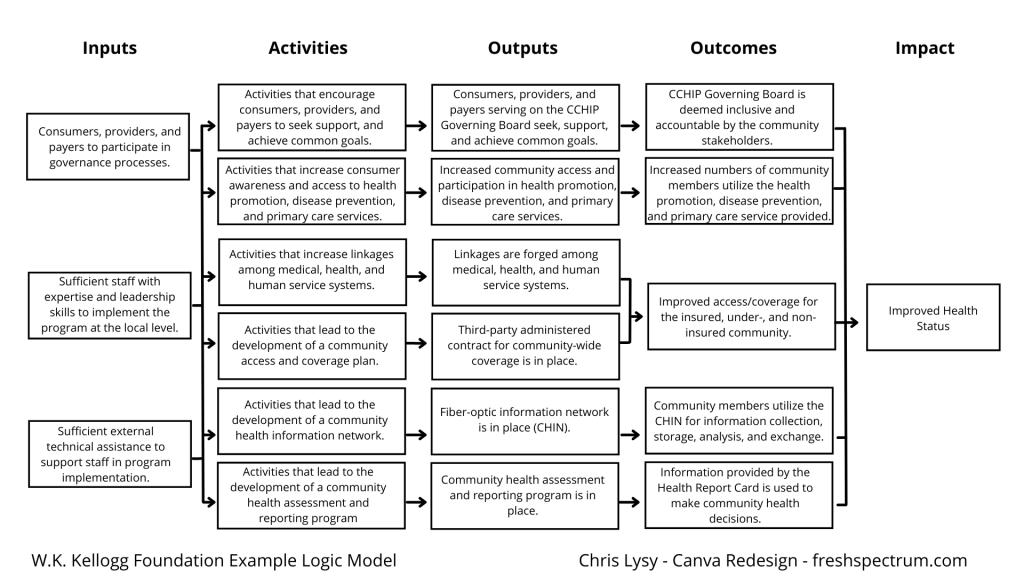
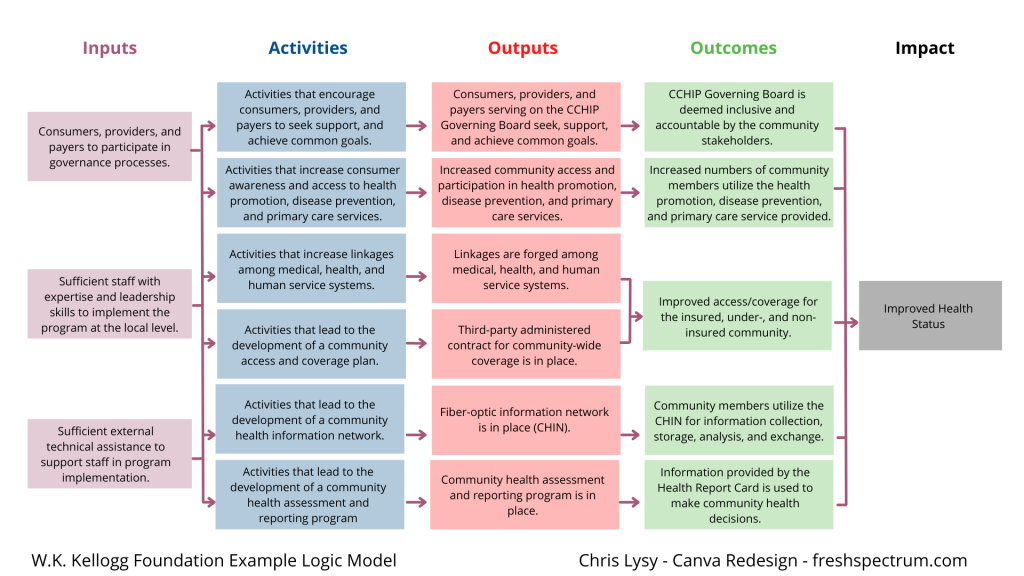
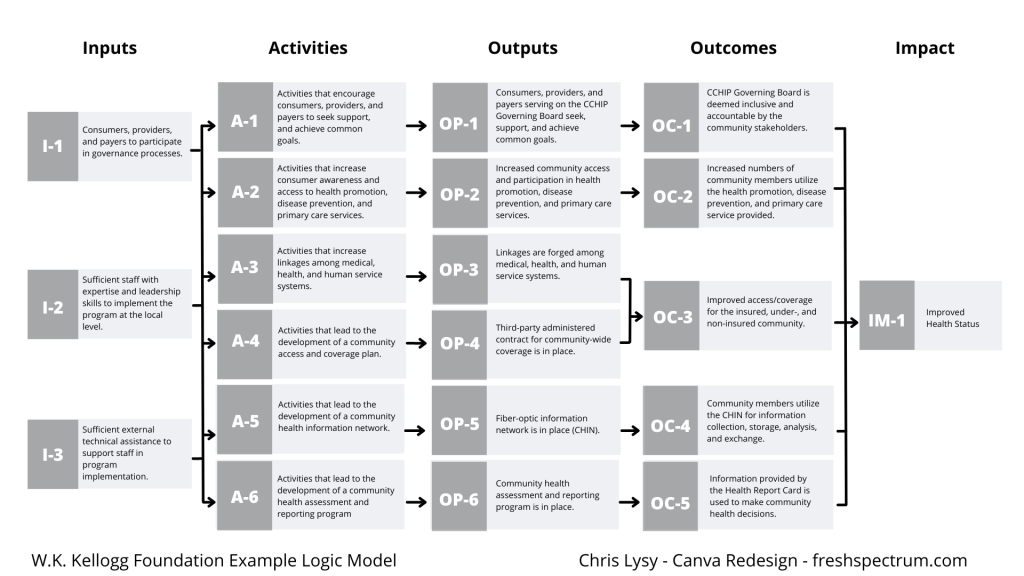
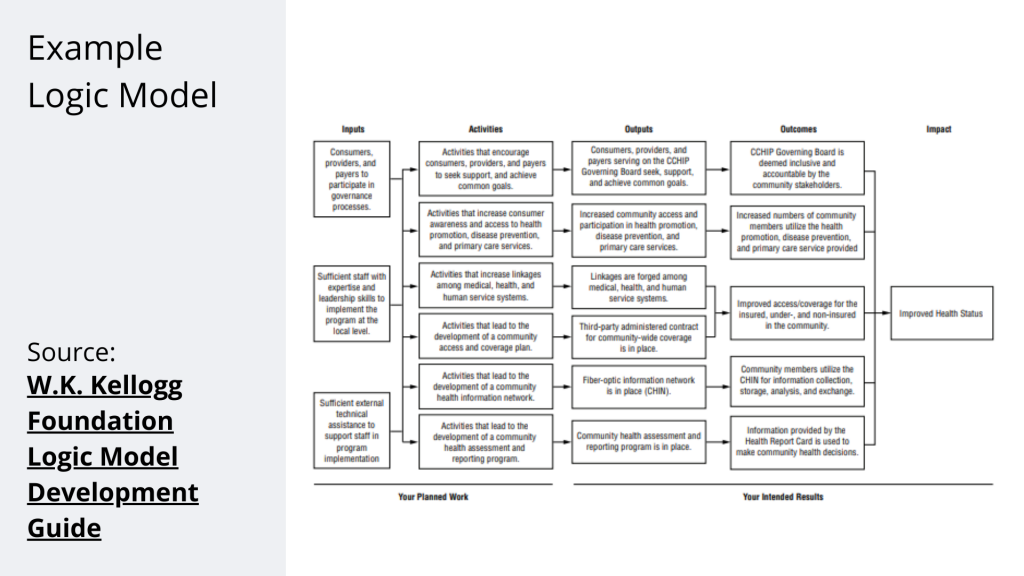
A Simple Results Chain Logic Model – Example from the W.K. Kellogg Foundation

Kellogg Foundation Logic Model Example

Okay, so as a starting point I’m going to use this example logic model found in the Kellogg Foundation logic model guide.

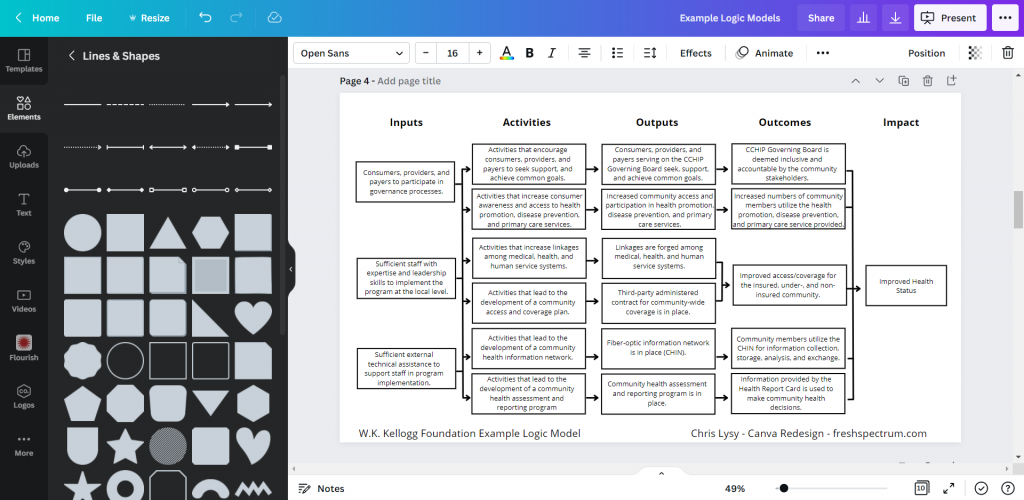
Recreating the Logic Model using Canva

When it comes down to it, most basic logic models are really simple to design. It’s just a bunch of shapes, arrows, and lines.

There are a few ways to do this in Canva.

  • Most rectangles and other shapes in Canva let you click inside them to add text directly to the shape.
  • You can put in all your text using individual text boxes and then add the “background effect” to turn it into a box.
  • You can put in a bunch of hollow rectangles, then add in all of your text using individual text boxes.

I tend to use the hollow rectangles and individual text boxes because it gives me the most visual control.

Kellogg Logic Model Created with Canva
Logic Model created in Canva

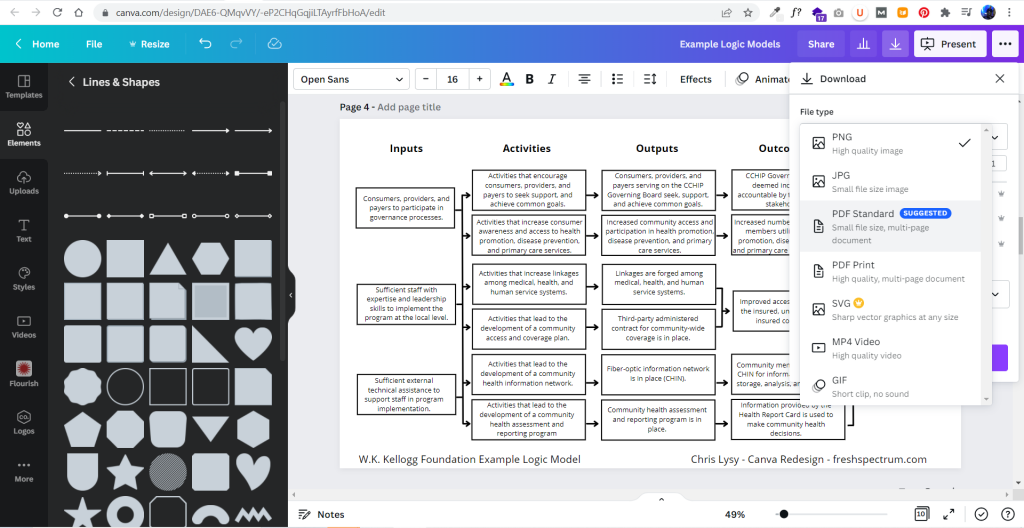
It didn’t take too long to create something that looked really similar to the original. And because it’s now in Canva, I have a lot of download options. If I just want an image I’ll usually download as PNG. If I want something printable, then I’ll download as a PDF Standard.

Exporting the logic model to PDF

Adapting your Canva Logic Model

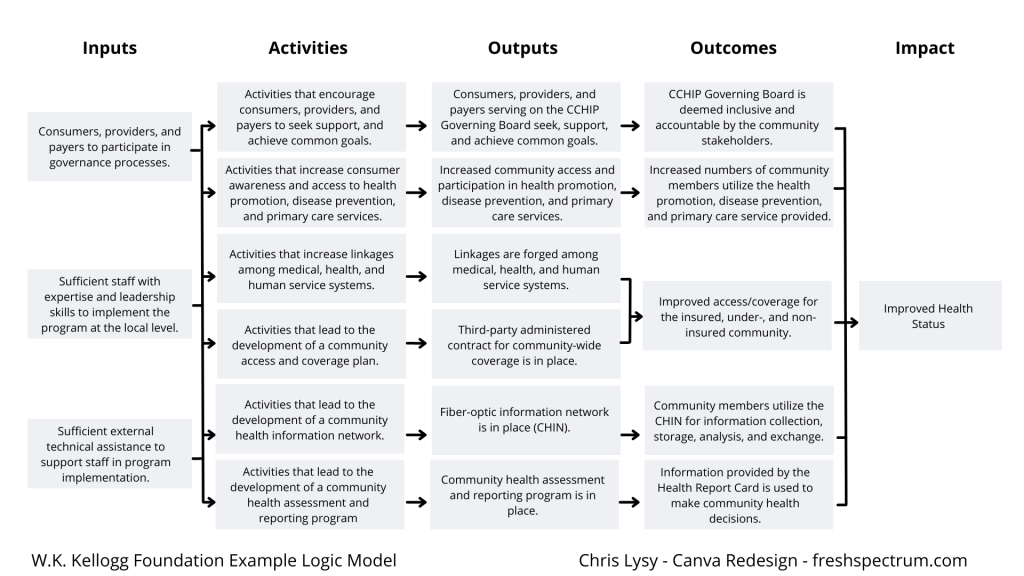
The nice thing about Canva is that it’s pretty easy to duplicate and adapt your logic model, trying out different styles. I find the outline boxes to be a little visually jarring. So instead I replaced the outline boxes with some solid color light gray boxes.

Alternative Canva Logic Model Style

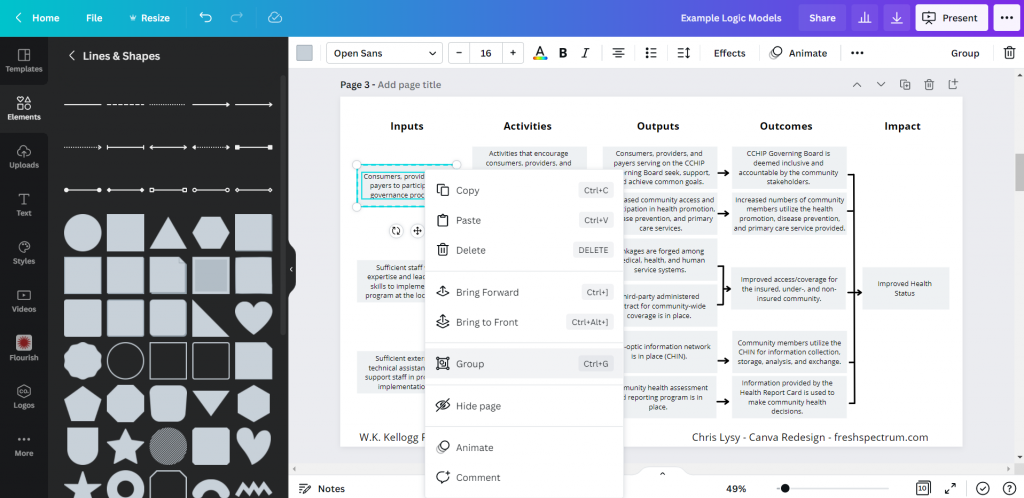
The shapes exist separately from the text, so you just insert the rectangle and send it to the back to set behind the text blocks. If you spend a lot of time moving the boxes around it’s a good idea to group the individual text/shape pairs.

Grouping items in Canva

Color coding the logic model.

Once you have the base shape and text there are all sorts of alterations you can do to the design. I know there are a lot of evaluators who like to color code different elements. That’s certainly simple enough to do.

Canva Logic Model Alternative

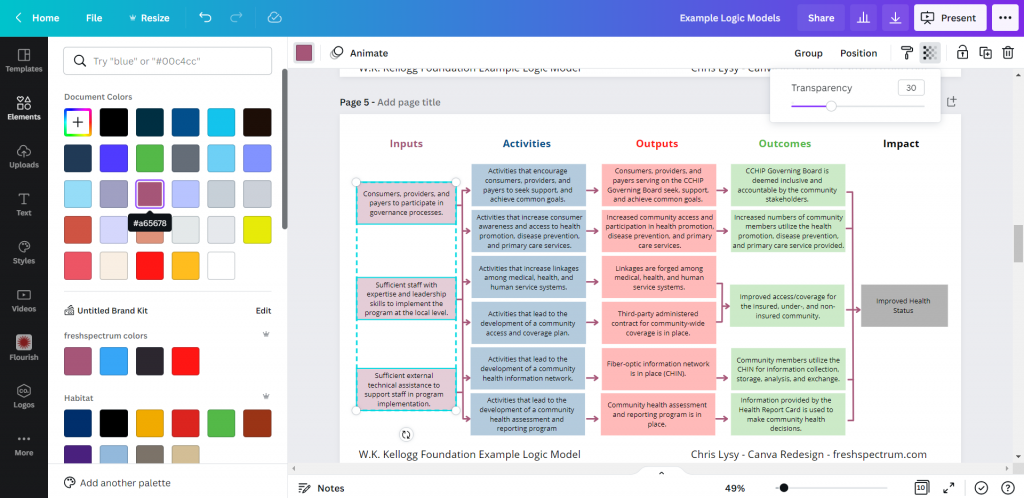
Occasionally you’ll want a softer color, especially for background elements. One way to do that is just make the boxes slightly transparent.

Changing colors in Canva

Photo annotating the logic model.

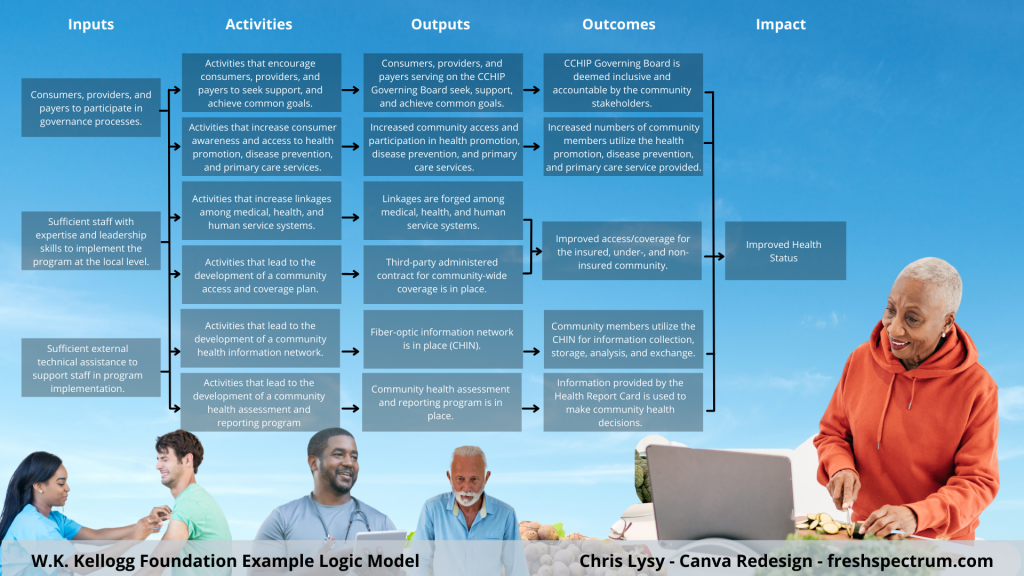
If you find yourself creating a lot of different logic models annotating with some photographs and background elements can really help you to differentiate. Especially if the photographs pair well with the actual project. I created this corny version with just some Canva stock photos.

Canva logic model with photo annotations

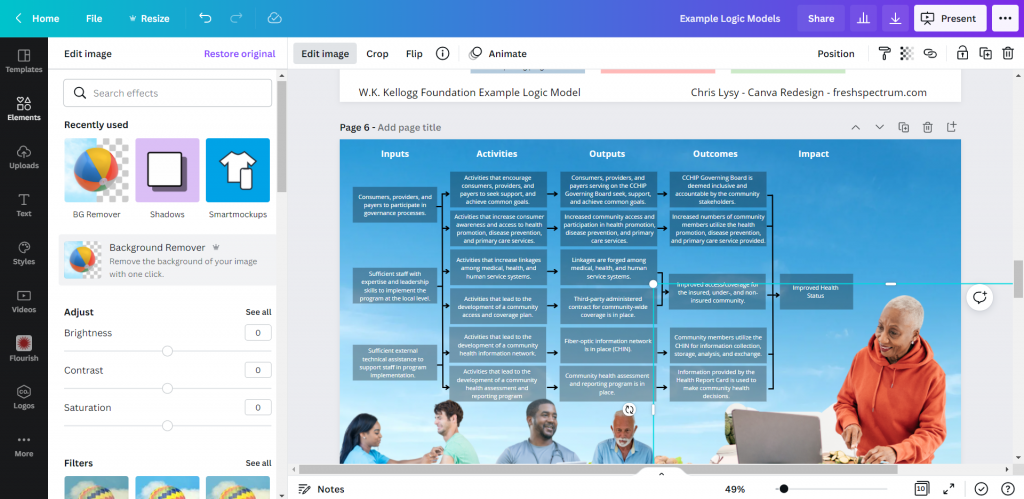
I use a Canva a lot, so I’ve made the investment in a pro account (~$10/month at the time of this post). Given the amount of stock content I use and the bonus features, this is well the worth the subscription cost. One of the features I like to use is the background remover. It’s a nice way to make certain stock images fit almost anywhere.

Background Remover in Canva

Coding Logic Model Elements

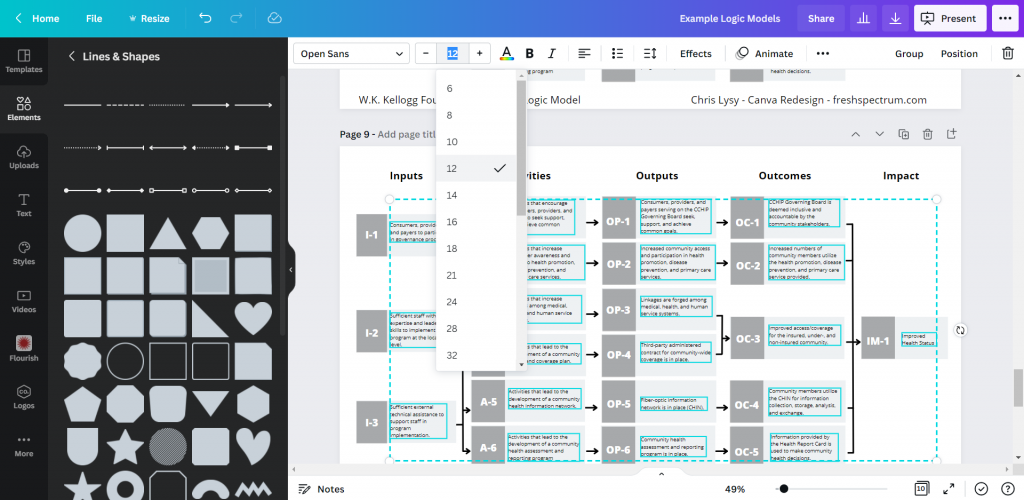
If your logic model is still being developed and fine tuned it can be a good idea to code the individual blocks. This makes it a lot easier to talk about individual elements.

Logic Model element map

For this I just shrunk the text and offset it to the right of the gray boxes. Then I darkened the side to create a space for codes.

Changing font size in Canva

Icon Illustrating your Logic Model

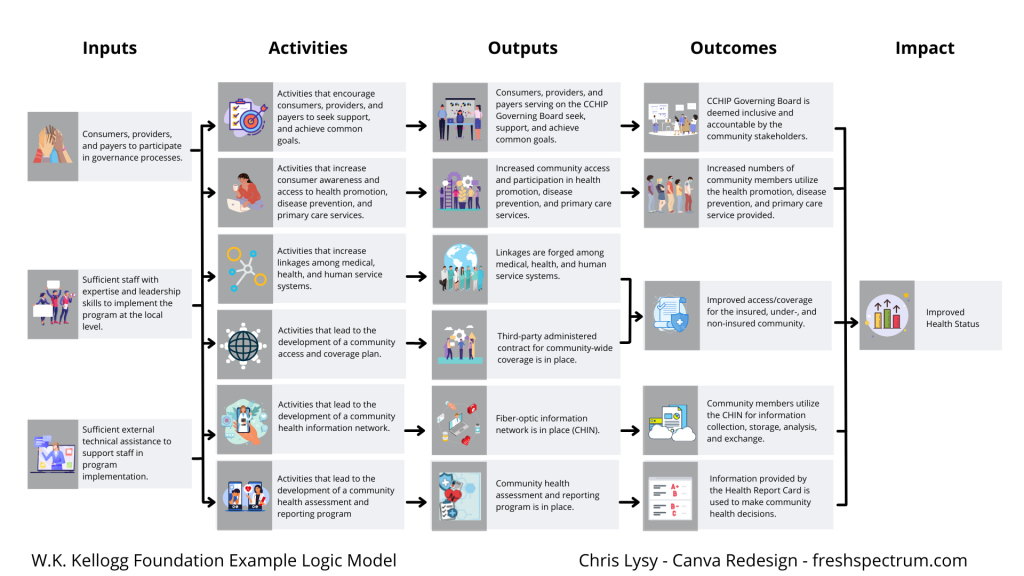
My favorite way to adapt a logic model is to simply icon illustrate the individual elements.

Icon Illustrated Logic Model

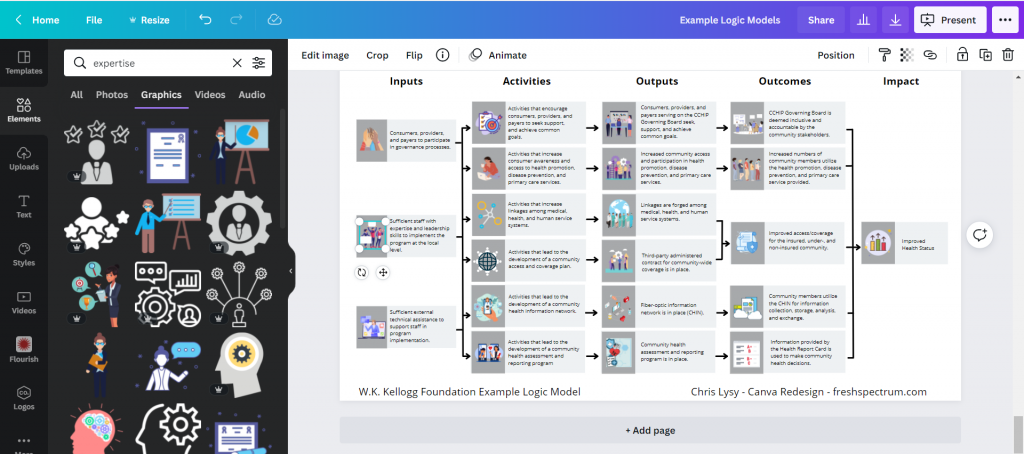
Just move from element to element looking for icons that somewhat illustrate each block of text. There are all sorts of icon styles available within Canva.

Showing how to find icons in canva

Do you want to start with these templates?

I made the Canva file a template file. Just make sure to log in to your Canva account before opening the following template (and if you don’t have a Canva account, create one, it’s free).

What tools do you use to create your logic models?

There is no one perfect tool for anything. Canva has some downsides just like every other tool. So what tool is your favorite?

Written by cplysy · Categorized: freshspectrum

Aug 21 2025

What is a Logic Model?

Summary: A logic model is an attempt to show how your program is supposed to work.

Have you ever gone for a walk or a drive without a particular destination in mind?

I think it’s one of my favorite things. Because there is absolutely no way to get lost. When you wander the only time you can get lost is when you try to find your way home.

On the other hand if you’re trying to solve some kind of big social problem, it’s probably not the time to wander.  You should have a little direction to go with your purpose.

Logic models are tools that lots of evaluators use to visually show how a program is supposed to work.  If we take this action, we should see this result.

A basic logic model just looks like a simple flow chart.

This example comes from the Kellogg Foundation’s Logic Model Development Guide

Reverse engineering a program’s logic.

You might think that most logic models get drawn when a program is being designed. It sure looks like a plan of action. But I don’t think that’s actually true, at least not always, and probably not even most of the time.

Many programs get their start because a person or group is trying to solve a problem. Somebody’s hungry, they give them food.  A family gets evicted, they find them somewhere to stay.  They don’t always have some grand plan for how their actions are going to lead to desired results at a large scale.

If you’re an evaluator being tasked with the job of judging how a program works, you really need to start by asking a very basic question, “how is this program supposed to work?”

And that’s what a logic model does, it gives us a picture of how.  It’s a tool we can build by reverse engineering a program’s logic, usually through collaboration with the program staff.

The basic elements of a logic model.

There are all different types of logic models, but they usually share some similar components.

Inputs > Activities > Outputs > Outcomes

Inputs: What goes in (money, people power, time, etc).

Activities: The stuff you do (actions)

Outputs: Counting the stuff we did or people we served.

Outcomes: The consequences of our actions.

If there is anything that people get hung up on it’s probably knowing the difference between an output and an outcome. 

Let’s say you’re teaching an after school program.  Ten kids show up each night.  That would be an output. Did they actually learn anything, or retain more of what they learned earlier in the day?  That would be an outcome.

Let’s practice with something silly

You can create a logic model out of all sorts of things you do on a daily basis.  So practice creating one with low stakes.

I have a very food motivated dog named Jaina.  If anyone visits the pantry to grab a snack, she hears it and comes running.  Her hope is that the person with the snack might be willing to share with her.

Input: Snack food in pantry (if no snack food, nobody gets snacks).

Activity: After hearing a cracker box opening, join the family member at the pantry door. Give them your most pathetic puppy dog look.

Output: Followed two family members today to the pantry.

Outcome: One of the two family members tossed a delicious cracker that was thoroughly enjoyed.

Learners, what questions do you have?  Evaluators, what am I missing?  

These guides are meant to be conversational and easy to read.  But that means I leave out a bunch of potentially useful stuff.  If you have any lingering questions, or suggestions as to what should be added to this guide, please leave a comment.

Written by cplysy · Categorized: freshspectrum

Aug 21 2025

Formative vs Summative Evaluation: Which One Do You Need?

Summary: A formative evaluation is about improving your program, activity, or intervention.  A summative evaluation is about showing proof that it works.

Let’s say you run a non-profit food kitchen.  You see your job as feeding the hungry people in your community.  You have a pretty basic strategy that involves collecting food from the community and distributing that food through a storefront you rent in a strip mall.

Your local chamber of commerce decides to raise some money to help you.  With some of that money you decide to evaluate your work and see how you could improve your strategy.  

This is what we would call a formative evaluation.  

A little while later you stumbled on some potential grant funding from a local philanthropy.  This group wants an evaluation that shows whether or not your program works.  That the funds they give you are directly leading to fewer hungry people.

This is what we would call a summative evaluation.

A formative evaluation is about improving your program, activity, or intervention.  A summative evaluation is about showing proof that it works.

The soup metaphor and what formative and summative have in common.

When the cook tastes the soup, that’s formative; when the guests taste the soup, that’s summative

Bob Stake

I like this metaphor because it’s simple and useful. It shows us the difference between formative and summative but it also gives us another important element.  

What do both of these examples have in common?

Soup.

I know it sounds kind of silly, but it’s important.  The cook is making soup. The customer is eating soup.  Soup is the “intervention.”

Both formative and summative evaluations generally require an intervention (i.e. something specific to evaluate).  An intervention is a potential solution to a problem.

Back to our food kitchen example.  Let’s say you didn’t have a strategy.  You want to do something for people in your community who might not have enough food to eat.  You don’t quite know what you’re going to do, you just know there is a problem.  

There are certainly evaluation methods that could help, but without a potential solution you’re not ready for either a summative or a formative evaluation. 

Quick Activity: Formative, Summative, or Something Else?

Let’s end with a quick activity to help you determine next steps.  I find that almost everything we do can be broken down into a few basic elements.  See if you can break down one of your own activities.

What is your problem, challenge, or opportunity?

In my food pantry example above, the problem could have been a lack of affordable food options in the community.  In the soup metaphor, the basic challenge was about delivering a tasty meal to a customer.  An opportunity could be that somebody wrote you a big check to help you do something, but they’re letting you decide what that something is.

When we develop programs, activities, and interventions it’s usually in response to something.  So what is that something for you?

What is your solution, activity, or intervention?

In order to show that what you’re doing is working or not, you have to be able to identify the thing that you’re doing (your “soup”).  If you just have a problem, and no solution, then you’re not ready for a formative or summative evaluation.

And if you’re in a testing mode, trying out a variety of different solutions, you’re probably better off with a different type of evaluation approach.

What are your desired outcomes?  

Actions have consequences, positive and negative. An activity, intervention, or solution is a type of action.

A consequence of an action is an outcome.  Ideally, this is the positive change we hope to bring about.  But remember, we could also make things worse.  

Pulling it all together.

Can you fill this out?

We are facing _____ (problem).  Our solution is to ________ (action).  Ultimately that should lead to _______ (outcome).

A formative evaluation will attempt to show how you can improve the action in order to better lead to the desired outcome.  This can help you make the stuff you do better.

A summative evaluation will attempt to show whether or not the action did lead to the desired outcome.  This will show that you have a working solution and help you go and get more money to do more of it.

Learners, what questions do you have?  Evaluators, what am I missing?  

These guides are meant to be conversational and easy to read.  But that means I leave out a bunch of potentially useful stuff.  If you have any lingering questions, or suggestions as to what should be added to this guide, please leave a comment.

Written by cplysy · Categorized: freshspectrum

Aug 20 2025

Try This: The Data-Driven Decision Tree Walk-Through

Turn your team’s data into clear, actionable insights with this walk-through of the Data-Driven Decision Tree.

The post Try This: The Data-Driven Decision Tree Walk-Through appeared first on Nicole Clark Consulting.

Written by cplysy · Categorized: nicoleclark

  • « Go to Previous Page
  • Go to page 1
  • Go to page 2
  • Go to page 3
  • Go to page 4
  • Go to page 5
  • Interim pages omitted …
  • Go to page 310
  • Go to Next Page »

Footer

Follow our Work

The easiest way to stay connected to our work is to join our newsletter. You’ll get updates on projects, learn about new events, and hear stories from those evaluators whom the field continues to actively exclude and erase.

Get Updates

Want to take further action or join a pod? Click here to learn more.

Copyright © 2026 · The May 13 Group · Log in

en English
af Afrikaanssq Shqipam አማርኛar العربيةhy Հայերենaz Azərbaycan dilieu Euskarabe Беларуская моваbn বাংলাbs Bosanskibg Българскиca Catalàceb Cebuanony Chichewazh-CN 简体中文zh-TW 繁體中文co Corsuhr Hrvatskics Čeština‎da Dansknl Nederlandsen Englisheo Esperantoet Eestitl Filipinofi Suomifr Françaisfy Fryskgl Galegoka ქართულიde Deutschel Ελληνικάgu ગુજરાતીht Kreyol ayisyenha Harshen Hausahaw Ōlelo Hawaiʻiiw עִבְרִיתhi हिन्दीhmn Hmonghu Magyaris Íslenskaig Igboid Bahasa Indonesiaga Gaeilgeit Italianoja 日本語jw Basa Jawakn ಕನ್ನಡkk Қазақ тіліkm ភាសាខ្មែរko 한국어ku كوردی‎ky Кыргызчаlo ພາສາລາວla Latinlv Latviešu valodalt Lietuvių kalbalb Lëtzebuergeschmk Македонски јазикmg Malagasyms Bahasa Melayuml മലയാളംmt Maltesemi Te Reo Māorimr मराठीmn Монголmy ဗမာစာne नेपालीno Norsk bokmålps پښتوfa فارسیpl Polskipt Portuguêspa ਪੰਜਾਬੀro Românăru Русскийsm Samoangd Gàidhligsr Српски језикst Sesothosn Shonasd سنڌيsi සිංහලsk Slovenčinasl Slovenščinaso Afsoomaalies Españolsu Basa Sundasw Kiswahilisv Svenskatg Тоҷикӣta தமிழ்te తెలుగుth ไทยtr Türkçeuk Українськаur اردوuz O‘zbekchavi Tiếng Việtcy Cymraegxh isiXhosayi יידישyo Yorùbázu Zulu