• Skip to main content
  • Skip to footer
  • Home

The May 13 Group

the next day for evaluation

  • Get Involved
  • Our Work
  • About Us
You are here: Home / Archives for allblogs

allblogs

Apr 27 2023

Data Dashboard FOMO

Does a data dashboard really have to support decision making to be useful?

Links

In the video I mention my workshop, if you’re interested, check it out here > diydatadesign.com.

Transcript

?So I teach a data design virtual workshop. It’s called DIY data design. And each week we get together and have conversations. So I’ll give a little presentation and then we’ll just chat about stuff. The last week we were talking about data dashboards. And one of the things that came up, it was interesting.

It was one of the participants was talking about how she has access to a set of dashboards. And she looks at them they’re about libraries and books and. Mostly because she’s interested. Not because she has any particular need for that data. Just because she’s interested and they have the data.

And when we were talking a little bit more. This idea came out about data dashboard FOMO. And. How sometimes. We need dashboards or we want dashboards, not because there’s any particular decision-making need. Just because we have this fear of missing out on data that we don’t know exist. And so you end up with this large, huge dashboard of like tons and tons of pages.

And he asked the question like why does anybody want to use this? What are they going to use this for? And the more I thought about it, the more I could see a counterpoint to that, the idea that. That there needs to be a use. So here’s a, here’s like a little story. So you have a person.

And they go, can I see the data? And they come up to the data person. And the data person says why. Now there might be all sorts of reasons why the data person is wondering why maybe they want to set up the dashboard in a way. That it could help facilitate decision-making. And, the person’s just like sheepishly just, interested.

And I think this happens often actually. Or maybe if, an organization is data savvy or you have people who are interested in understanding some of the data. That there is a world of data. Inside of organizations. That we don’t really know what exists. you don’t know what you don’t know. And for a lot of people, the way that they have to go and find that data is to go to a middleman. Somebody who knows enough about the data who has access, who can get the right information.

And they control the access point. And. It ends up becoming like a sort of gatekeeper. Even if unintentionally. I think there are two reasons that you might want to create that data dashboards. You don’t want is to use support decision-making so this is the idea that, okay, this is actionable data.

There is a very Clear reason. Why we have this data, why we’re sharing this data? Why this date is going from one place to the other. So the person can learn and make decisions about their work. This is the data as decision-making. Everybody can agree on, but there’s this other part that.

Dashboard is really. An access tool. It’s about taking something that is inaccessible. Because people don’t have the access rights or the skill or. The time to find a way to get to that data. So it becomes like this mysterious thing. And honestly, This person, the person that says why. They don’t know what. Necessarily might be interesting to know. And sometimes you just need to create a dashboard. You just need to create an interface. So that people who are interested. In an organization can find data that is available. And make their own decisions as to why they might want to see it.

And perhaps just following an interest. Perhaps, they just have some data dashboard FOMO. Yeah, that’s it for today? Hope you’re having a great week. We’ll talk soon. Alright, bye.
Written by cplysy · Categorized: freshspectrum

Apr 25 2023

What is social object theory?

You might know a lot about social networks, but what do you know about social objects?

Resources

Social Objects for Beginners (Gaping Void)
What are Social Objects? [I totally forgot I created this random podcast episode…]

Transcript

?Hey. So I think social objects are really important. To sharing information over the web. Or really sharing information in general. But over the web especially. But to start understanding what is social. Objects are, I think we should talk about social networks in general. So you probably already, have an idea of what are social networks.

There are people connected to people to connected to people. And this is how information spreads, person, a person. Or maybe all these people are connected through a school or through some other way. But we don’t tend to think about when we think about social networks is that usually there are objects involved here too.

It’s not just people connected to people. It’s people connected to other people for some reason. They’re talking about something. Social objects. Could be all sorts of things. It could be like talking about a phone. And how the weather is today.

It could be an object. An idea, a concept. It could be something physical. It could be a report. It could be a cartoon. So that’s actually where I got the idea.

I remember a while ago, back in 2007 I used, follow this guy named Hugh McLeod. And he had this cartoon called gaping void and he talked a lot about social. Objects. And in his cartoon. He used to draw on the back of business cards. Shared a lot about creative confidence, marketing, that sort of thing.

But a lot of my, cartooning theory why a draw cartoons stems from this? So I draw cartoons to illustrate a blog post. But then those cartoons can then be lifted from the blog posts and put into presentations. They can also be lifted from the blog post and put into books and put in on social media.

And those cartoons themselves have a life of their own. They, can be a center point for discussion. And ground everything. Social objects are a way too. Export your ideas. So you have an idea, you turn it into some kind of object so that it can travel.

And then you share it out. Across the web or across the world in some other way.

And it’s really helpful. I think when you’re talking about creating a report that you think about it as a social object, what is it about that report? That can create conversation among different people can have its own like gravity. And pull people in and create its own orbit. And that’s, basically it. So I have some links.

In the show notes. And I would say start considering. How your work can be turned into objects that can take your ideas.

Further than just a PDF archive. So that’s it for today. I’ll talk to you soon. Alright, bye.

Written by cplysy · Categorized: freshspectrum

Apr 24 2023

Toward a Collective Power Framework

Written by Alissa Marchant and Cory Georgopolous

Current Knowledge on Collective Power

Advocacy evaluation is a rapidly growing field that has seen the emergence of several frameworks for building power for social change, measuring equity, coalition effectiveness, collective impact and creating communities of practice.

However, none of these pieces speak to each other or address measuring collective power specifically centered on equity. This wasn’t a total surprise: funders and evaluators have only recently begun to talk about coalitions in terms of collective power or seen as places to cultivate equity.

Because there are no existing frameworks for collective power that centers equity, we looked to the advocates who are building collective power as part of their regular practice. In the past two years, we followed two collectives who brought together traditional policy organizations with equity and grassroots organizations. They are changing the ways in which policies are created and advocated for, starting first with their internal structures. These collectives have helped us understand what it takes to center equity in groups who want to build collective power.

Learning from Two Collectives

Since 2021, Innovation Network worked with two collectives: Towards Equity in Electric Mobility (TEEM) organized by the Greenlining Institute and Forth Mobility, and Child Care Next (CC Next) organized by the Alliance for Early Success.

As their names suggest, these two groups focus on very different issue areas. TEEM was formed through recruitment and invitations, while CC NEXT had a competitive process with detailed proposals and states forming groups before they applied. But they have many similarities: TEEM and CC NEXT are both new, founded in 2021. They both have a national gathering, and state cohorts in 6 states. They both have Foundation support.

Most importantly, both are trying to build collective power rooted in equity among their members. They do this by bringing together grassroots, community representatives with expertise in centering equity and grasstops organizations with research and legislative expertise. These groups are able to learn from each other, build relationships, and take action together while centering grassroots voices in spaces that have typically been the domain of grasstops organizations.

Draft Framework for Collective Power

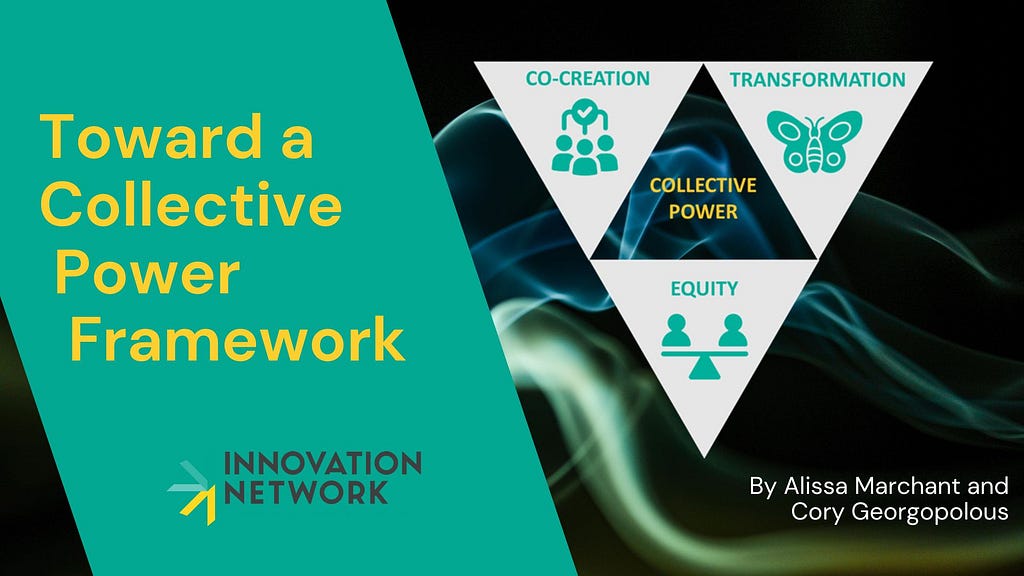
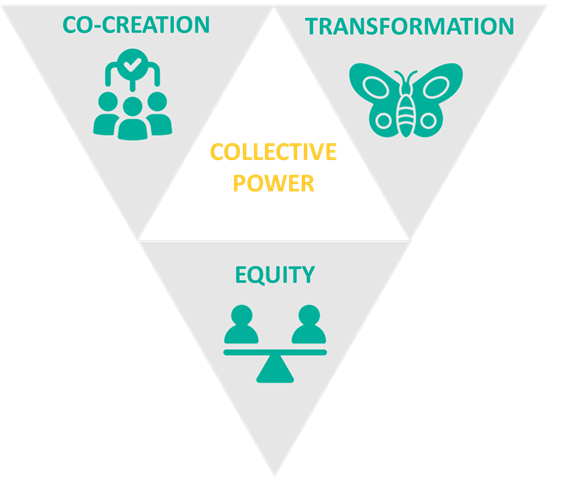
We decided to look across TEEM and CC Next to see if the beginnings of a framework could be pieced together from what we knew of these coalitions, how they operated, and how they aspired to operate. Taking into account their similarities and differences, we identified three intersecting components that make up our draft framework for collective power (Figure 1):

  1. Equity
  2. Co-creation
  3. Transformation
Collective power is shown in the center, with three pillars of a collective power framework surrounding it: co-creation, transformation, and equity

Equity

The recognition that everyone at the table holds different levels of power, and there needs to be a concerted, intentional effort to shift and build the power of members who come in with less. While all these components are important, co-creation and transformation rest upon the presence of equity in a group and would not be possible without it.

  • A commitment and vision for equity is at the heart.​
  • Members respect, appreciate, and leverage the different strengths other members bring. There’s acknowledgment that each member brings their own unique value. ​
  • The coalition openly addresses and strives to mitigate inequitable power dynamics. ​
  • Whatever the issue, those most impacted have power and weight over the coalition and its work equal to other groups or more. Within the coalition, this can mean active elevation of grassroots voices and leadership. ​
  • Participants have the resources to engage in the coalition.​

Co-creation

The space is owned, shaped, and created by members in collaboration with each other.

  • Members feel like they have a voice to share their honest opinion and that it is valued. ​
  • The coalition strives for group-based decision-making that reaches for or achieves consensus. ​
  • There’s a spirit of collaboration in how members approach realizing their shared vision rather than competition.​

Transformation

Not only are members of the group striving to affect their chosen issue (i.e., electric mobility, childcare), they are changing the way the work is done and looking at long-term social change.

  • Members are not only valued for their unique skills and the constituency they bring to the group, but for their perspective. The goals created by the group are bigger, more comprehensive, and visionary.​
  • Members can see their work and contributions make an impact. This impact could be concrete policy change but is often a transformational change in perspective as well.

These three components underpinned how the coalitions were facilitated and how members showed up in relationship with each other: not as a competition but as a place where each member has decision-making power and differences of perspective are valued rather than erased.

Continuing Refinement of the Framework

While we hope this framework is useful to other evaluators, it is still a draft with many missing parts and remaining questions, and our intention in sharing it is not to provide answers but to spark discussion. What other components are integral to collective power? How does this framework resonate with other coalitions? We hope to explore these questions — and revisit and revise the framework — as we continue to partner with these groups and others, but we also want to hear from you: what has your experience been in measuring and building collective power?

Please share your thoughts and experiences in the comments!


Toward a Collective Power Framework was originally published in InnovationNetwork on Medium, where people are continuing the conversation by highlighting and responding to this story.

Written by cplysy · Categorized: innovationnet

Apr 21 2023

What is Datawrapper?

Friday is tool day! Datawrapper is one of my all time favorite data design tools, watch the video to learn why.

Transcript

Hello. So this week, I thought we try something new on Fridays. I was thinking, maybe we talk about tools like different pieces of software. That could be helpful to you. If you were trying to do any type of information, design data design work. So that’s what we’ll talk about today. All right. Let’s start with the problem. If you’re creating reports. You need to create more than just the one pager, the three pager that 30 pager. In the modern setting. Because we need to reach more audiences. It’s harder to reach those audiences. So we need more things out there in order to even hope. To reach a broader audience. So that means we have to create a lot of reports and that means a lot of charts and that sort of thing.

So it’s one thing to say it would be great if we had tons of money and we could invest more time in reporting. But that doesn’t really happen. Really? It’s the same amount of time you just are expected to create more reports. So you need to change your process, need to have tools that let you create things faster.

Some of those tools are tools that are built for data, journalists or journalists in general. If you think about it newspaper creates tons of charts and they have to create charts on a regular basis. And they have, especially if they’re reporting daily or even weekly that’s a lot of charts they have to create.

And they have to be publishable quality and ready to go. So there are a few tools out there that help you with this. And one of my favorites is a tool called data wrapper. You’ll find it at data, rapper dot D E. It’s one of the eights, one of these new types of tools that really starts. Close to a professional looking professional quality chart.

You don’t have to do much for it. Once he created a really easy to share. It’s not like you’re working in Excel and you have to like, almost break down everything to create something that’s ready to be published. It’s ready to be published right off the bat. It’s also not complicated, like Tableau or power BI or anything. You’re not diving into huge datasets and trying to reformulate everything.

It’s really a chart builder or a map maker. A modern kind of data, visualization chart and map and table tool. There are a few things that you should know about it. One, the price. It is either free or lots of money. This is one of the things about these kind of journalism dataviz tools.

They have fantastic free plans link. You can do so much with the free plan. They’re forever free. Not like trial version kind of free plans. But if you wanted to actually pay for it you need like, 600 a month and it’s for a team that kind of thing. So there was not really a price point for somebody who’s just an individual designer, that sort of thing.

Luckily, you can do tons with the free plan, so you don’t even have to pay for the pro plan. One day, maybe they’ll have an individual pro plan. And if anyone from data wrapper is watching maybe 80 bucks a month, a hundred bucks a month for an individual plan might not be a bad idea. But until that happens.

Free is great. Let’s keep it free. All right. Better faster. So that’s what we’re trying to do. We’re trying to not be overwhelmed. Data wrapper. Sets it up. It’s 1, 2, 3, 4 steps to a chart and they walk you through step-by-step. So you start with the data, then you work into the design and then some other factors. And then finally you get to the publishing part of things.

And they really walk you through the process, make it really easy. All your data is private by default. This isn’t like Tableau, public. It’s not going up to a public server immediately. It is private. You don’t even have to log in to data wrapper in order to create charts.

You can just go to data, wrapper dot D E, open it up, run through the process.

Data wrapper is GDPR friendly. They don’t track. Make money selling other people’s data. So that’s an important aspect here too. A lot of companies do. Not this one. It really is a high quality company, I think. So hopefully it stays that way, but right now I am a big fan of data wrapper as a company.

And then finally accessibility. This is one of those afterthought kind of things. It’s one of my biggest gripes with tools like Canva is their lack of accessibility tools. With data wrapper there, just like you can test different types of colorblindness. On the actual charts, it’ll show you what it looks like for different people. So you can test your, colors and that sort of thing. It gives you a really easy way to do alt text.

Which is also really useful. And then you can embed these charts in other places. Just straight from data wrapper. You, once you log in, you’ll have a library of your charts. And that’s a reason to log in, or you can just save them as PNGs and put them out elsewhere like that. So that’s my tool of the day.

Today’s data wrapper. So again, data wrapper. Dot D E it’s a German company. And yeah. Check it out, play with it. It’s super fun. Have a great weekend. And I’ll talk to you soon. All right. Bye.

Written by cplysy · Categorized: freshspectrum

Apr 19 2023

Stop it with the car dash thing…and other data dashboard tips.

In today’s vlog I walk through 5 of my favorite quantitative data dashboard design tips.

Transcript

Okay. So last week I fielded a question about data dashboards. And in that particular video, I talked about why they failed and why you might want to consider using a website instead of a regular kind of dashboard. Uh, quantitative dashboard. But I also know that there are plenty of you that have tons of quantitative data and just want to create. The regular kind of dashboard that you see all over the place.

So let’s get into that today. You know, I, I think that issue. The thing that we should talk about first. Are the reasons why we have this data dashboard in the first place. So this is a person. Okay. I don’t even know what exists. And that’s true. A lot of the time.

There are a lot of data sources within organizations that. Are not necessarily accessible to the decision-makers stakeholders who could really get a lot of value out of that data. So that’s the reason why a lot of dashboards are created or at least the theory behind creating dashboards.

And I’ve talked about this a little last week, but.

I see dashboards as being an interface between the data and a user, some user. So. It can be hard to. Have a person just go, okay, well, I want to access some data. I’ll just go into SQL and pull some data and then I’ll analyze it and pull it up over here. That just doesn’t happen. I mean, some people it does, but most people, it does not happen. You have to reformat data most of the time to make it useful.

It’s a resource. You have to process it. In some way. And when you process it, our goal really is to reduce the amount of overwhelm. Because it can really quickly, we can get overwhelmed by the amount of data. And depending on who you are. I mean, there are some organizations like places like a retail establishment.

Are analyzing tons and tons and tons of data. And that data is you cannot access it. Most research and evaluation data is a little different though, because it’s accessible enough. You could probably pull it up in Excel and just put together some pivot tables and do some analysis.

Even so it’s enough data that having some kind of interface makes sense. So what are my tips? Well, let’s go through five. I think. Yeah, about five. Alright. Tip number one. It does not have to look like a car dashboard. Like it doesn’t have to have the little gauges or look like it’s speed limit thing.

Everything doesn’t even have to fit on one page. You can have it. So it’s up and down. Scrolling, scrolling, scrolling, actually that’s a much better idea most of the time than having anybody click on anything. ’cause. I don’t know if you know this about people, but they’re pretty lazy. They don’t like clicking on things.

So something has to be really valuable for somebody to click. That’s why so many social media sites. Now you just have the endless scroll, scroll, scroll, scroll, scroll, scroll. Well, you can develop dashboards in the same way. All right. Tip number two. It really comes down to familiarity and frequency.

Um, in terms of how you would design your dashboard. Alright. If you are really familiar with the data. Where if the, the people, the user that you’re trying to reach is really familiar with the data. It doesn’t really matter how it’s formatted. I mean, you just give them tables, you give them numbers. They’re going to understand it.

So they’re very familiar. And you have a lot of data. You create a dashboard. If they’re very familiar and you have a little bit of data, you create some kind of report. It doesn’t really matter what it looks like. They’re going to get it. If they’re not so familiar or they need to be introduced to the data.

Then you need an engaging report if it’s less frequent and if it’s more frequent, then you need some kind of annotated engaging dashboard. The idea is that we have to not Jess. Deliver the data and the information, but we also have to deliver the context behind that. So we have to walk our user through it.

All right. Tip number three. Um, and this is particularly useful for researchers and evaluators.

If something’s useful. Um, and insightful. That’s what you want to put into a dashboard. You want something useful?

I know a lot of researchers and evaluators who will look at a dataset and they will systematically start analyzing it and pulling it apart. And then pull it into pieces in a dashboard. Like you have to share all that stuff. But a good dashboard. Isn’t just a set of comprehensive documentation. It’s not just replacing a big table with a bunch of charts.

You know, it is something that is supposed to be useful. So that means picking and choosing, deciding what’s valuable. What’s not valuable. And you can use some different UX. A user experience design approach is user interface. Design approach is card sorts. Stuff. I’ll talk about in future episodes.

All right. The interactive design mantra. Um, I learned this pretty early on by Shneiderman. Um, I think that’s the name. I hope I didn’t just mess it up, but if I did, I’ll go back and change it. All right. So wait. There are three things. Overview first. Zoom and filter details on demand. The idea is.

When we’re developing dashboards that are interactive. There’s a different level, a different element. And that’s that you can explore, you can dive into it. So it means approaching the data in a little bit different way. And yet, sometimes that means starting from a. Bigger picture kind of point of view.

And then allowing people to zoom in and filter on the things that they really want to know. And then when they want more details, they click and they can get details. Right? So you have an overview then you can filter. This is like, if you see a dashboard in shifts, like a full country, And then you have, like, let’s say it’s the us.

And you have a dropdown filter and all the states are in the filter and you can click from the U S as a whole to individual states. So that’s your filtering. And it lets you zoom into different states. Maybe you can even zoom on the screen on a map. And then when you want more information about a particular area, you click and it gives you details. So that’s kind of how you design it.

Um, it’s a little bit different than designing a regular report. But. That’s pretty much it. All right. And the other thing is stay consistent. It’s great. If you know how to create lots of different chart types. But you don’t have to create lots of different chart types. Actually, it probably takes away. Anytime you change your chart, you kind of put that in somebody’s head that they have to like understand a new type of chart.

It’s better. If all the data is similar or kind of on similar dreams to, you know, just use bar charts, line graphs, scatter plots, these are all through things that are clickable filterable. Zoomable so they’re really nice charts to use in these kinds of situations. I’d avoid pie charts most of the time, unless you only have a couple of numbers.

I’d avoid, um, anything too complicated. I would. Try to avoid using, uh, multiple axes and anything too, like crazy. It’s better to do something simple. And repeated over and over and over again, then to jam everything into one chart. Which is usually what people try to do. When they try to turn it into a car dashboard.

So full circle, don’t do a car dashboard. Let it flow. Um, Yeah. If you have any questions, any requests for future? Episodes of this vlog. Let me know. I did get a request about doing something on qualitative dashboards. And we’ll talk about that next time, or I don’t know, in a couple of vlogs, we’ll see how things go.

But if you have any requests, please let me know. Again, just visit my site, down below, leave a comment here on YouTube. For how send me an email, do something like that. Either way. I hope you have a great day and we’ll talk soon. Alright. Bye.

Written by cplysy · Categorized: freshspectrum

  • « Go to Previous Page
  • Go to page 1
  • Interim pages omitted …
  • Go to page 91
  • Go to page 92
  • Go to page 93
  • Go to page 94
  • Go to page 95
  • Interim pages omitted …
  • Go to page 310
  • Go to Next Page »

Footer

Follow our Work

The easiest way to stay connected to our work is to join our newsletter. You’ll get updates on projects, learn about new events, and hear stories from those evaluators whom the field continues to actively exclude and erase.

Get Updates

Want to take further action or join a pod? Click here to learn more.

Copyright © 2026 · The May 13 Group · Log in

en English
af Afrikaanssq Shqipam አማርኛar العربيةhy Հայերենaz Azərbaycan dilieu Euskarabe Беларуская моваbn বাংলাbs Bosanskibg Българскиca Catalàceb Cebuanony Chichewazh-CN 简体中文zh-TW 繁體中文co Corsuhr Hrvatskics Čeština‎da Dansknl Nederlandsen Englisheo Esperantoet Eestitl Filipinofi Suomifr Françaisfy Fryskgl Galegoka ქართულიde Deutschel Ελληνικάgu ગુજરાતીht Kreyol ayisyenha Harshen Hausahaw Ōlelo Hawaiʻiiw עִבְרִיתhi हिन्दीhmn Hmonghu Magyaris Íslenskaig Igboid Bahasa Indonesiaga Gaeilgeit Italianoja 日本語jw Basa Jawakn ಕನ್ನಡkk Қазақ тіліkm ភាសាខ្មែរko 한국어ku كوردی‎ky Кыргызчаlo ພາສາລາວla Latinlv Latviešu valodalt Lietuvių kalbalb Lëtzebuergeschmk Македонски јазикmg Malagasyms Bahasa Melayuml മലയാളംmt Maltesemi Te Reo Māorimr मराठीmn Монголmy ဗမာစာne नेपालीno Norsk bokmålps پښتوfa فارسیpl Polskipt Portuguêspa ਪੰਜਾਬੀro Românăru Русскийsm Samoangd Gàidhligsr Српски језикst Sesothosn Shonasd سنڌيsi සිංහලsk Slovenčinasl Slovenščinaso Afsoomaalies Españolsu Basa Sundasw Kiswahilisv Svenskatg Тоҷикӣta தமிழ்te తెలుగుth ไทยtr Türkçeuk Українськаur اردوuz O‘zbekchavi Tiếng Việtcy Cymraegxh isiXhosayi יידישyo Yorùbázu Zulu