• Skip to main content
  • Skip to footer
  • Home

The May 13 Group

the next day for evaluation

  • Get Involved
  • Our Work
  • About Us
You are here: Home / Archives for allblogs / rka

rka

May 07 2020

Social and Emotional Learning is Imperative and in Museum Educators’ Wheelhouse: Part 2

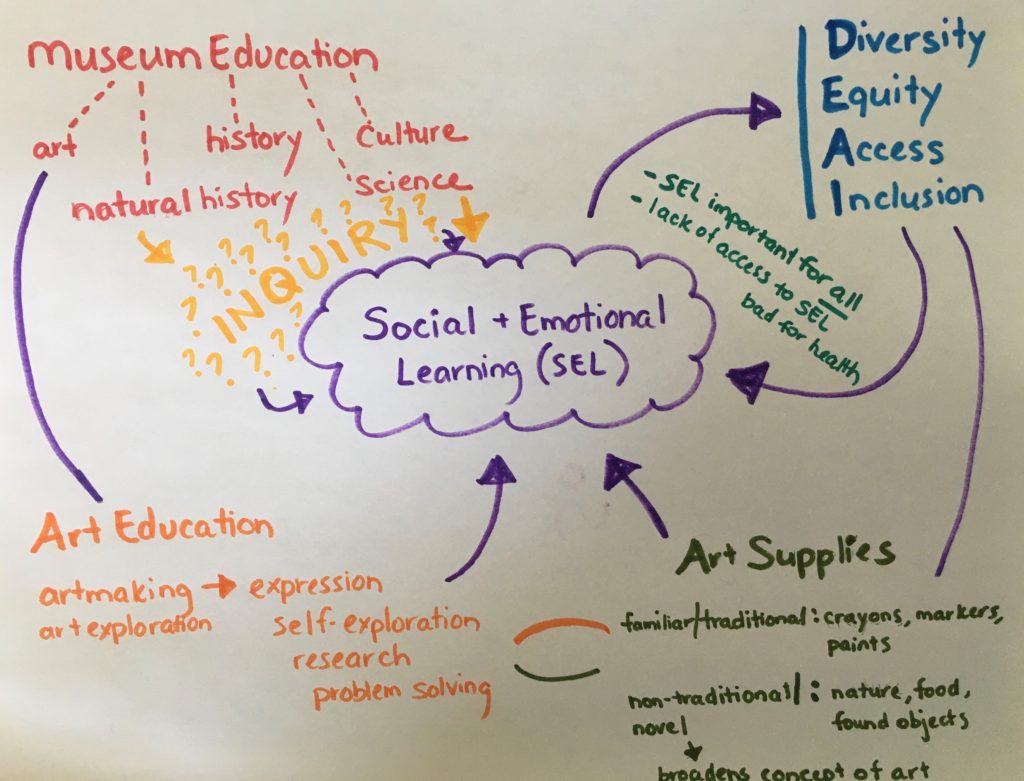
Shortly after posting my last blog on social and emotional learning being imperative and in museum educators’ wheelhouse, some conversations with clients, colleagues, and research participants further drove this point home for me.  In my first post, I wrote about how important question-posing is for social and emotional learning and how museum educators are often masters of questioning.  I realized this week there are other ways art museum educators can play a critical role in promoting social and emotional learning, all the while attending to museum’s audience-focused Diversity Equity Access and Inclusion (DEAI) efforts during this time.

Here are the three experiences that have led me to this conclusion:

1. Interviews with preschool teachers about art and art museums: I have been speaking with preschool teachers, many of whom work for state-funded public preschools, about the role of art and art museums in support of their curriculum.  One of the trends across these interviews is how integrated art is into the preschool classroom.  Art is often described as a means of expression, reflection, and meaning making.  For instance, preschool teachers ask students to draw as a way to reflect on fieldtrips and other classroom learning (e.g., draw something you remember from the fieldtrip, or draw something you recall from a story we read this week).  Other times, drawing prompts are more broad, such as draw your house or room, to stimulate conversation.  Preschool educators may ask the children about what they drew as a means to support social and emotional learning specifically (e.g., child talks about being sad because grandmother who lives with them is ill, etc.).

2. Update from an art museum client on their work: In a project update phone call, one of our art museum clients shared how they have used the funding from the family programs they would have been hosting if the museum were open to donate art supplies to the community. The museum plans to disseminate art supplies to local students’ families when they pick up breakfast and lunches at their schools (free- and reduced-lunch program).  This idea personally struck me as so resonant. At my child’s school, her art teacher has been posting art assignments each week.  Conversations in the Google Classroom have raised the issue that some families do not have “traditional” art supplies at home (and maybe cannot afford them).  To the art teacher’s credit, she always gives a found-object option to complete assignments, but it still seems that guardians have some anxiety around their child not having art aupplies.  As noted in the example, access to art making is an important outlet for social and emotional learning among preschool students and others.  Therefore, providing access to art supplies seems to be a really on-point undertaking and one that is likely mission-related for art museums.  Furthermore, our client noted that this endeavor will allow them to connect to even broader audiences than they may have reached through their family programs.  Which leads me to…

3. Visitor Studies Association webchat, Attending to DEAI during the time of COVID–19: I helped to support a DEAI webchat with Jill Stein, Dr. Cecilia Garibay, and VSA’s Understanding Communities focused interest group. The conversation emphasized not letting DEAI conversations fall to the wayside at this time.  As Cecilia pointed out, there seems to be a false dichotomy set up where museum leadership feels they cannot tackle DEAI and the current pandemic.  As the example above demonstrates, it is possible to do both even if it is through what may be perceived as a small gesture.  Circling back to social and emotional learning, the American Physchological Assocation notes that socioeconomic status (SES) “is a consistent and reliable predictor of a vast array of outcomes across the life span, including physical and psychological health.”   There is a high need for support of social and emotional learning, particularly for those challenged by socioeconomic inequalities—access to social and emotional learning support is indeed an equity issue.  Children most in need of social and emotional learning support are those disconnected from sources of that support which they receive in school from counselours and in the art classroom.  Donating art supplies may not typically have been consider a DEAI initiative before, but it is certainly linked to such issues.

Again, I think social and emotional learning is a place art museums in particular can fill a void.  It may mean doing things differently, but that is exactly what we should be embracing at this time.  It reminds me of when a museum educator shared during an American Alliance of Museums conference in 2015 that she felt the education team was better and more innovate when their museum building was closed for construction.  All museums are now without a building, so let’s start thinking outside that box.


 While I was writing this blog, a conversation was posted to Art Museum Teaching that is extremely relevant: Trauma-aware Art Museum Education: A Conversation
The post Social and Emotional Learning is Imperative and in Museum Educators’ Wheelhouse: Part 2 appeared first on RK&A.

Written by cplysy · Categorized: rka

May 04 2020

Zero

I have long lobbied for museums to avoid using numbers as indicators of their success. I note in Intentional Practice for Museums: A Guide for Maximizing Impact that when museums boast their success with numbers, such as the number of annual exhibits and programs they offer, the dollars they add to their local economy, and the number of visitors they welcomed, they are sending the wrong message to whomever might be listening. These numbers are devoid of the most important and vital element of the museum experience—the quality and meaningfulness of the experience to people (the wonderful story in the LA Times about Ben Barcelona, the devoted museum-goer, comes to mind). How would museums report their on-site numbers today (take a look at the title of this post)?  Online counts have the same problem as onsite counts—they, too, are devoid of meaningfulness—which brings me to my second point: shouldn’t museums seek measures that are useful when there isn’t a crisis and when we are amidst one? 

Numbers had their purpose (they are easily gathered and understood), but they have outlived their usefulness. The silver lining: with nary a visitor to count inside the building, is now not the perfect time to rethink and change how your museum measures success? How does a museum arrive at metrics that will stand the test of time?

Numbers floating through space.
Image credit: Shutterstock

First, imagine the canvas blank, the slate clean. Don’t worry if you continue to see numbers floating aimlessly in your mind; that’s fine. Consider that numbers may need companions. Honor the numbers, and then imagine suitable partners, as in “numbers and . . .”

There may be a few ways to begin this imagination process. Here are two—a free-form approach and a structured approach.


Free-form approach: If your museum is accustomed to having important conversations about the purpose of your museum, where everyone’s input is sought and respected, then a free-form conversation could work. If that is the case, schedule a conversation with your museum family about alternative measures of success. Request or invite someone to facilitate the conversation and another person take notes. Explore and debate the value of the museum in your lives, others’ lives, and in the lives of people in your local community. Through dialogue, you may come to know the qualitative value of the museum, which can lead to articulating qualitative measures. Because I have facilitated many such dialogues, I have come to expect this enormously popular question, “but how will we measure that?” which is sure to prohibit further conversation or create a defeatist feeling (and we don’t need that right now!)  If the question emerges, someone can say, “a quality may be hard to measure, but it doesn’t mean it isn’t measurable; let’s not worry about that now; let’s continue going deep with qualitative measures.”

With notes in hand, skip to step 5 below.

Structured approach:  If your museum is more comfortable using a structured conversation rather than a free-form approach, here are several steps you might take with your colleagues:

Step 1: Set ground rules for an open dialogue.  Here are ones I might establish:

  • Mutually agree on a facilitator who will initiate the dialogue using the questions below and maintain focus and fairness.
  • Apply active inquiry and listening without passing judgement.
  • Listen to first understand, then respond (if you need clarification, respectfully ask follow-up questions).
  • Seek to be understood (think before you speak and carefully select your words).
  • Accept that process is an art and a science, which could create a bumpy conversation at times.

Step 2: Select a note-taker—someone to record people’s thoughts so you have data.

Step 3: Break the ice.  Rather than approach the question directly, dance around the question of quality to reduce stress and encourage free thinking. You may only need a few questions to get the dialogue going; then it will take on a life of its own. Here are a few questions to consider:

Talk about yourselves—why you do what you do is an important variable:

What about your work is most important to you?
Why is that important?

(If the online platform you use has rooms, ask staff to self-organize into interdisciplinary groups so each group can respond to the above questions. Then reconvene and share a synthesis of the conversations.)

Step 4: Ask deeper questions:

What unique capabilities do you bring to your daily work? How do you apply those unique qualities to create quality museum experiences?

What are the qualities of your museum’s most impressive museum experience?

Imagine the visitor experience within that context: What do you see visitors doing? What do you hear visitors talking about? How do they describe the meaningfulness of that experience?  How would you describe the meaningfulness of that experience?

 (Set aside 2 hours for steps 1 – 4)

Step 5: Analyze the notes.  Ask the museum’s most analytical person to review the notes with the goal of identifying the qualities that staff discussed. Share the list of qualities prior to the next gathering (Step 6).

Step 6: Discuss those qualities.  The goal of this step is to: prioritize qualities because ultimately, you want 3 or 4 qualities.  Less is more! This is hard work. Don’t give up.

Whew!  With 3 or 4 qualitative indicators of how your museum affects people’s lives, you have completed the hardest part of this work! Now, if you want, feel free to start thinking about measuring. Lookout for future posts to help you with that task.

The post Zero appeared first on RK&A.

Written by cplysy · Categorized: rka

Apr 29 2020

Social and Emotional Learning is Imperative and in Museum Educators’ Wheelhouse

Just months ago (but what feels like an eternity ago), I was in an art museum observing museum educators lead a group of fifth-grade students on a museum visit.  One work of art they viewed highlighted inequities in the world by zooming in on areas where there is an abundance or absence of light across the globe at night.  Students’ emotions were clearly triggered.  Some called out “wow”; “what?”; and “that is so unfair.”  After experiencing several minutes of the media piece, the museum educators then guided a discussion about the work of art using simple questions from Harvard Project Zero’s Artful Thinking Routines: “what do you see?”; “what do you think?”; “what do you wonder”; etc.  These questions are tools museum educators, and not exclusively art museum educators, use regularly in their teaching.

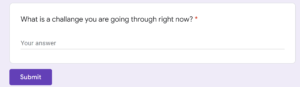
Evaluators know the power of questions.  A good question can unlock so much knowledge.  And that is what happened for me when I was helping my daughter completing a Social and Emotional Learning (SEL) assignment given to her grade by the school counselor.  The counselor posed a few simple questions about how students are thinking and feeling in a Google Form.  This simple question is the one that really resonated: “What is a challenge you are going through right now?”

Google Form question

My daughter and I looked at the question together, and I read it aloud.  To paraphrase, my daughter told me (and her school counselor) how she misses her friends.  She explained that she is an only child, and because my husband and I are working at home, we cannot play with her all the time.  She also explained that, while she has a dog, he isn’t such a good playmate sometimes.  (TRUTH: he recently chewed the foot off a new doll, and she was very upset!)  Of course, her feelings gave me the feels, and are still doing so right now as I write this.  It also gave me data I could work with.  I needed to prioritize setting up more FaceTime calls with her friends (one this weekend that lasted 2 hours!) and other social and emotional activities.

In addition to thinking about my daughter’s needs, this experience made me think about all the inquiry-based museum teaching I have seen.  It seems to me museum educators are well-suited to share their inquiry-based teaching expertise in support of social and emotional learning.  Even pre-pandemic, I was seeing this need.  For example, at the National Art Education Association convention in March of 2019, a school district administrator told me how mental health is becoming a hot topic for schools, and that museums would be wise to discuss their ability to support children in this way.  And now mid-pandemic and beyond, social and emotional learning will be critical.  As Tim Walker wrote on the National Education Association blog: Social-Emotional Learning Should Be Priority During COVID-19 Crisis  I am looking forward to seeing what museums can do for our students, and for all of us, in our social and emotional well-being during this time since this expertise is certainly in their wheelhouse.

The post Social and Emotional Learning is Imperative and in Museum Educators’ Wheelhouse appeared first on RK&A.

Written by cplysy · Categorized: rka

Apr 27 2020

Stephanie’s Guest Post in Art Museum Teaching: Continuing Museum-School Relationships During and After COVID-19

The coronavirus pandemic has shaken the museum community to its core.   In a guest post for Art Museum Teaching, Stephanie grapples with one aspect of museum work that will face continuing challenges, now and in the months to come—sustaining museum-school relationships during and after COVID-19.  She writes:

The question for me isn’t “will museums keep working with schools during this time?” but instead, “how do museums continue working with schools throughout and beyond the pandemic?”

See the full post here.

The post Stephanie’s Guest Post in Art Museum Teaching: Continuing Museum-School Relationships During and After COVID-19 appeared first on RK&A.

Written by cplysy · Categorized: rka

Apr 24 2020

Randi’s Piece in the SuperHelpful Newsletter: Intentional Practice During a Crisis

Randi wrote a piece for this week’s SuperHelpful newsletter reflecting on the value of Intentional Practice during the current pandemic.  The questions she poses are an excellent jumping off point for anyone trying to navigate a purposeful path forward for their department or organization in these uncertain times. For example:

All museums will need to face the “who” part of the equation—who in our community has the greatest need now? Museums cannot be all things to all people (one of [Intentional Practice’s] core beliefs) and achieve impact. Now, more than ever, that core belief reverberates. Which one audience (yes, one) will you choose to serve now?

Check out the full post here.

The post Randi’s Piece in the SuperHelpful Newsletter: Intentional Practice During a Crisis appeared first on RK&A.

Written by cplysy · Categorized: rka

  • « Go to Previous Page
  • Go to page 1
  • Interim pages omitted …
  • Go to page 11
  • Go to page 12
  • Go to page 13
  • Go to page 14
  • Go to page 15
  • Go to Next Page »

Footer

Follow our Work

The easiest way to stay connected to our work is to join our newsletter. You’ll get updates on projects, learn about new events, and hear stories from those evaluators whom the field continues to actively exclude and erase.

Get Updates

Want to take further action or join a pod? Click here to learn more.

Copyright © 2026 · The May 13 Group · Log in

en English
af Afrikaanssq Shqipam አማርኛar العربيةhy Հայերենaz Azərbaycan dilieu Euskarabe Беларуская моваbn বাংলাbs Bosanskibg Българскиca Catalàceb Cebuanony Chichewazh-CN 简体中文zh-TW 繁體中文co Corsuhr Hrvatskics Čeština‎da Dansknl Nederlandsen Englisheo Esperantoet Eestitl Filipinofi Suomifr Françaisfy Fryskgl Galegoka ქართულიde Deutschel Ελληνικάgu ગુજરાતીht Kreyol ayisyenha Harshen Hausahaw Ōlelo Hawaiʻiiw עִבְרִיתhi हिन्दीhmn Hmonghu Magyaris Íslenskaig Igboid Bahasa Indonesiaga Gaeilgeit Italianoja 日本語jw Basa Jawakn ಕನ್ನಡkk Қазақ тіліkm ភាសាខ្មែរko 한국어ku كوردی‎ky Кыргызчаlo ພາສາລາວla Latinlv Latviešu valodalt Lietuvių kalbalb Lëtzebuergeschmk Македонски јазикmg Malagasyms Bahasa Melayuml മലയാളംmt Maltesemi Te Reo Māorimr मराठीmn Монголmy ဗမာစာne नेपालीno Norsk bokmålps پښتوfa فارسیpl Polskipt Portuguêspa ਪੰਜਾਬੀro Românăru Русскийsm Samoangd Gàidhligsr Српски језикst Sesothosn Shonasd سنڌيsi සිංහලsk Slovenčinasl Slovenščinaso Afsoomaalies Españolsu Basa Sundasw Kiswahilisv Svenskatg Тоҷикӣta தமிழ்te తెలుగుth ไทยtr Türkçeuk Українськаur اردوuz O‘zbekchavi Tiếng Việtcy Cymraegxh isiXhosayi יידישyo Yorùbázu Zulu