I agree with much that you are saying throughout the article. As a museum professional I found the second definition unattractive – I get the sentiment but there are too many words. There are times when the bigger museums forget about staying relevant and the fact that they are “for the people” but the smaller volunteer museums can over step the mark and do the same, repelling visitors by only accepting visitors who are like them. I wrote a blog post a few years ago about Museums in the 21st Century on Museum Whisperings and my view is still the same, that museums are about being “connected” – museums to their own collections and museums to their audiences. Nothing is static. Collections must be researched and reinterpreted and audiences need to be studied and nurtured so that they keep coming back. Museums are about connecting their visions and collections (or exhibitions if there is no collection) with the public to share knowledge and shape/reflect community values or discuss issues which may add value in a place that is safe for all.
rka
Comment on If we cannot define “museums,” how do museums survive? by Diane
I would hope there would be a variety of museum “types”.
But the note about jargon is a real issue for me. The language should be straightforward and not contrived.
Here is a little fun about what I mean:
115950217_3245495082163683_2161735501010600354_n.jpeg
If we cannot define “museums,” how do museums survive?
Last year, my colleagues and I chatted about the work of the International Council of Museums (ICOM) to propose a new definition of museums. We listened to the MuseoPunks podcast, which featured different speakers talking about their perspectives on the definition process. At the time, I remember being intrigued by the discussions. The old definition did not seem terrible to me. It struck me as bland and generic—similar to mission statements for most museums—but not erroneous:
“A museum is a non-profit, permanent institution in the service of society and its development, open to the public, which acquires, conserves, researches, communicates and exhibits the tangible and intangible heritage of humanity and its environment for the purposes of education, study and enjoyment.”
By comparison, the new definition is bold and aspirational even. I recall thinking it is a little long and full of jargon, but exciting:
“Museums are democratising, inclusive and polyphonic spaces for critical dialogue about the pasts and the futures. Acknowledging and addressing the conflicts and challenges of the present, they hold artefacts and specimens in trust for society, safeguard diverse memories for future generations and guarantee equal rights and equal access to heritage for all people. Museums are not for profit. They are participatory and transparent, and work in active partnership with and for diverse communities to collect, preserve, research, interpret, exhibit, and enhance understandings of the world, aiming to contribute to human dignity and social justice, global equality and planetary wellbeing.”
Fast forward to today, and I come to recognize the bigger issue behind the discussion of the old, bland definition and ICOM’s inability to confirm a new definition. We as a museum profession do not agree with what a museum is.
While there is some agreement on what a museum does—collect, preserve, educate—there is not consensus on the museum’s purpose. From our theoretical perspective at RK&A, purpose is the impact a museum has on people. What is the positive difference a museum makes in the lives of people?
I had taken it as a given that museums were in agreement that the impact of a museum on people is the purpose. And certainly there are many who feel impact on people is the essence of museums. For example, Smithsonian Secretary Lonnie G. Bunch III recently said in an American Alliance of Museums session Racism, Unrest, and the Role of the Museum Field that museums have put education foreward as their vision, noting the success of several museums because of their focus on education, conversation, and collaboration. More pointedly, Lonnie said, “I think the key is not to forget that we are of the community, of the people, and that our job is service first and foremost.”
Certainly there has been a shift in museums to focus on education. However, where I have been naïve is in thinking that all museums have made this shift fully. With any change, it is slow and there is resistance. This is what became clear to me as I read the President of ICOM’s resignation letter:
“Now it feels like we are becoming more and more self-centred, our minds occupied with self-interests, focused on our own sustainability rather than the sustainability of the whole which we are a part of. Can we have any relevance if we are so detached from the communities we want to serve?”
In our intentional practice work, the impact on audiences is a driving focus for a museum’s work. While we think that each museum should strive for its own unique impact based on what the museum considers to be their unique qualities, passions, and specific target audiences, there is an underlying assumption that museums want to impact public audiences. Museums are for the people.
A host of problems emerge if museum professionals cannot agree that museums are for public audiences. How can we consider our field to be professionalized without an agreed upon definition that drives our best practices and training? How can we expect individual museum professionals to carry out their work without this shared understanding? Most importantly, how can we expect individuals to value and support museums if they don’t really know what a museum is—because how could the public know what we are if we as professionals don’t agree on their purpose?
The post If we cannot define “museums,” how do museums survive? appeared first on RK&A.
Five Ways Evaluators Can Further Accessibility Efforts in Museums
Sunday marked the 30-year anniversary of the Americans with Disabilities Act (ADA). My first thought was, “Really, only 30 years?” It is shocking that people in the United States with disabilities had to wait so long to have their rights acknowledged by our government. I also couldn’t help but notice that the 30th anniversary of ADA coincides closely with RK&A’s 30th anniversary (Randi founded Randi Korn & Associates, an evaluation firm, in 1989). Perhaps these similar anniversaries are not a coincidence, but suggestive of a time in U.S. history when greater accountability was being called for generally.
This overlap between the founding of RK&A and the ADA made me pause and think critically about my own role (as an evaluator who works with museums) in addressing the needs of museum visitors who have disabilities. I’ve been in this field for 20 years, and until the last few years, accessibility was not front and center in conversations about evaluations of museum spaces, programs, or exhibitions. As a new museum evaluator in the early 2000’s, I was led to believe ADA compliance was not something I needed to evaluate, that someone else took care of that. It also is clear, looking back, that accessibility in the context of museums was narrowly conceived of as primarily relating to accommodating physical disabilities.
The lack of a robust and holistic approach to considering the needs of people with disabilities has been a pervasive issue across most sectors, not just museums, for years. In an Opinion piece in the July 26, 2020 issue of The New York Times, Judith Heumann and John Wodatch share the United States’ shameful disability history. The authors note that while the ADA was a significant turning point for people with disabilities, as with many forms of injustice, we are nowhere close to having fulfilled this country’s promises. They also raise an important point affirmed by my early experience as a museum evaluator:
In most cases, we [people with disabilities] remain an afterthought… That invisibility persists at least partly because so few disabled people are in leadership positions in government, business and education.
But that is changing. In the last few years, Diversity, Equity, Accessibility, and Inclusion (DEAI) efforts have been in the spotlight across the museum field, which has great implications for people with disabilities. The A in DEAI stands for Accessibility and speaks specifically to the call museums must answer to be fully accessible to visitors with disabilities. Accessibility is defined by the American Alliance of Museum’s DEAI Working Group as:
Giving equitable access to everyone along the continuum of human ability and experience. Accessibility encompasses the broader meanings of compliance and refers to how organizations make space for the characteristics that each person brings.
Accessibility relates to physical spaces (e.g., wheelchair accessible spaces), but also accommodations for people with vision, hearing, and cognitive impairments through programming and exhibition elements specifically designed for and made available to people with disabilities. In recent years, many museums and organizations have done worthy, interesting work in all these areas and developed accessibility resources. For example, Access Smithsonian, a relatively new division within the Smithsonian Institution devoted to promoting inclusive design and increasing accessibility for visitors with disabilities, recently received national attention when its director, Beth Ziebarth, was interviewed on NPR on Sunday. There are many museum professionals (often, educators) who are dedicated and passionate about pushing accessibility efforts in their institutions. I want to call out one colleague of mine on the Museum Education Roundtable Board of Directors—Sarah Sims, Director of Visitor Engagement and Accessibility at the Missouri Historical Society—who has advocated over the years for her museum to address these issues head on. As a result of the efforts of Sarah and her colleagues, MHS now has three distinct teams devoted to accessibility—one internal team, one external team, and a third focused on audio description. I’m sure there are many other examples of museums making these kinds of inroads.
At RK&A, we have been exploring and trying ways to bring accessibility to the forefront of our evaluation work to help museums become more accessible and inclusive for visitors with disabilities. While this is an ongoing process, here are some of the things we are doing:
- Include visitors’ abilities in standard background/demographic questions. We are beginning to collect data about visitors’ abilities when doing exit interviews and visitor surveys. By regularly collecting certain data (e.g., race/ethnicity, age, gender, and education levels), we are saying it is important. By not collecting data about visitors’ disabilities, we perpetuate its invisibility and unimportance. Sure, asking about disabilities on a survey can be tricky, but so is asking about race/ethnicity and gender, and that doesn’t stop us. One approach is to ask an open-ended question, such as: “Do you or anyone in your visiting group identify as having a disability? If yes, please describe.” This open-ended approach allows us to identify the various forms of disabilities of museum visitors and the language they use to describe it. Another approach is to ask in a standardized way (see page 47 of Of/For/By All’s Respectful Audience Surveying Toolkitfor some examples).
- Use purposeful sampling. We are including purposeful samples of people with disabilities in our evaluation efforts when possible. For example, we have been growing a relationship with Access Smithsonian, and as a result have been able to include purposeful samples of people with physical, visual, cognitive, and hearing impairments (called User Experts) in several formative evaluations. When using random sampling, we risk not collecting data from any people with disabilities.
- Customize our research approach. We always try to customize our research approach to fit the institutions and audiences we are working with, and this is particularly important when collecting data from people with disabilities. A few examples include offering the opportunity to participate remotely (e.g., phone or video interview) if travel to the museum is a physical burden, providing an American Sign Language interpreter for people with hearing impairments, and adding alt text and/or creating audio descriptions to data collection materials for people with visual impairments. We have also customized data collection instruments to meet unique needs. For example, when collecting data from young adults with autism about their experience in a museum program we adjusted our original approach away from focus groups, which are social in nature and may make some people with autism uncomfortable, and instead designed visual feedback worksheets that allowed for individual written responses. It may take extra time and effort to coordinate, but it is worth the effort in order to make sure individuals are comfortable participating in the research or evaluation.
- Share results with end users of the data in a way they can act on. As evaluators, we work closely with program developers, curators, museum educators, and designers–accessibility efforts are often new to many of them, just as they are to us. So, it is especially important that we help those museum and design professionals make sense of data from visitors with disabilities so they can apply it in their work. We do this through conversations at the beginning of a project (e.g., what do we want to know from visitors with disabilities to help make decisions about a program or exhibition, and how can we best gather that information?) and again at the end of a project when we analyze, interpret, and discuss our results (e.g., what are the implications of this data for visitors with disabilities?).
- Communicate in an accessible way. We are working on making our evaluation reports and other forms communication more accessible to all types of audiences. For instance, we have started using tables that don’t merge cells so that they can be read more easily using a screen reader, and we use large text and high color contrast on slides in workshops and conference presentations to make these materials easier to read for all audience members, including those with low vision.
So far, I have talked about our work at RK&A, which is as external evaluators. If you are an in-house evaluator, you can advocate for these types of practices in your institution. For example, the evaluator at MHS who works with Sarah (mentioned above) is on both the MHS accessibility committee and the audio description team. She also writes alt text for all her evaluation reports and charts.
There are many ways evaluators can help further accessibility in museums. If you have ideas not mentioned here (or even critiques of what I have included), please share. I think most museum evaluators would agree that this kind of work is emergent and evolving. We are all learning as we go. By the 50th anniversary of the ADA, I hope we will have made much progress (and this 20-year old blog post will be a reminder of how far we had to come).
Image credit for ADA 30th Anniversary logo: https://www.adaanniversary.org/
The post Five Ways Evaluators Can Further Accessibility Efforts in Museums appeared first on RK&A.
Caution: Laying Off Museum Educators May Burn Bridges to the Communities Museums Serve
I started this blog about a month ago in frustration about the layoffs of museum educators (and other front-of-house staff although I am going to speak specifically about my experiences with museum educators). I wrote it in a fury one night, and each day since my anger and sadness have grown as I have witnessed more layoffs of talented museum workers who are critical to the museums’ missions and social and emotional learning (SEL) so important in this world.
Museum educators are essential to museums and make the institution what it is in a community. Trained as an educator, I certainly have a bias towards the value of museum educators. But, my evaluation experience reinforces my perception of the importance of museum educators. Museum educators are often a museum’s lifeline to the community, and particularly within the K-12 community as evidenced here:
Support of K-12 Teachers: I have been interviewing some preschool teachers about museum programs for the Zimmerli Museum of Art at Rutgers University. They often mention to me their museum educator contact by name and praise them for how helpful they have been. This echoes past evaluations I have done with teachers who participate in the Philadelphia Museum of Art’s Sherlock program and the National Gallery of Art’s Teacher Institute. The teachers highly value the respect and support they receive from museum educators. The work of K-12 educators is hard and can go unnoticed. But of all the museum educators I know, they consider K-12 educators essential to the well-being of our students and communities. As such, museum educators’ frame their work as bolstering the self-regard and confidence of K-12 educators.
Support of K-12 Students: I have had a long-term relationship with the Philadelphia Museum of Art as an evaluator for a multi-visit program with students in 5th and 6th In this multi-visit program, I have seen the progressive eagerness of students to participate in conversations with museum educators over several months. I also see the eagerness with which students seek out individual conversations with the museum educators as they move between artworks. Sometimes the students point out something they see to the museum educator, but other times the conversation is completely un-museum related—they just seem to seek adult engagement and interest. These individual museum educators are important to them. This was underscored to me when I administered assessments to students in the program. Students, knowing they were doing something related to the museum program, immediately asked me where are their museum educators (Adam, Ah-Young, Alicia, Barbara, Lindsey, Sarah, Suzannah)? They were notably disappointed to see me instead of their friends at the museum.
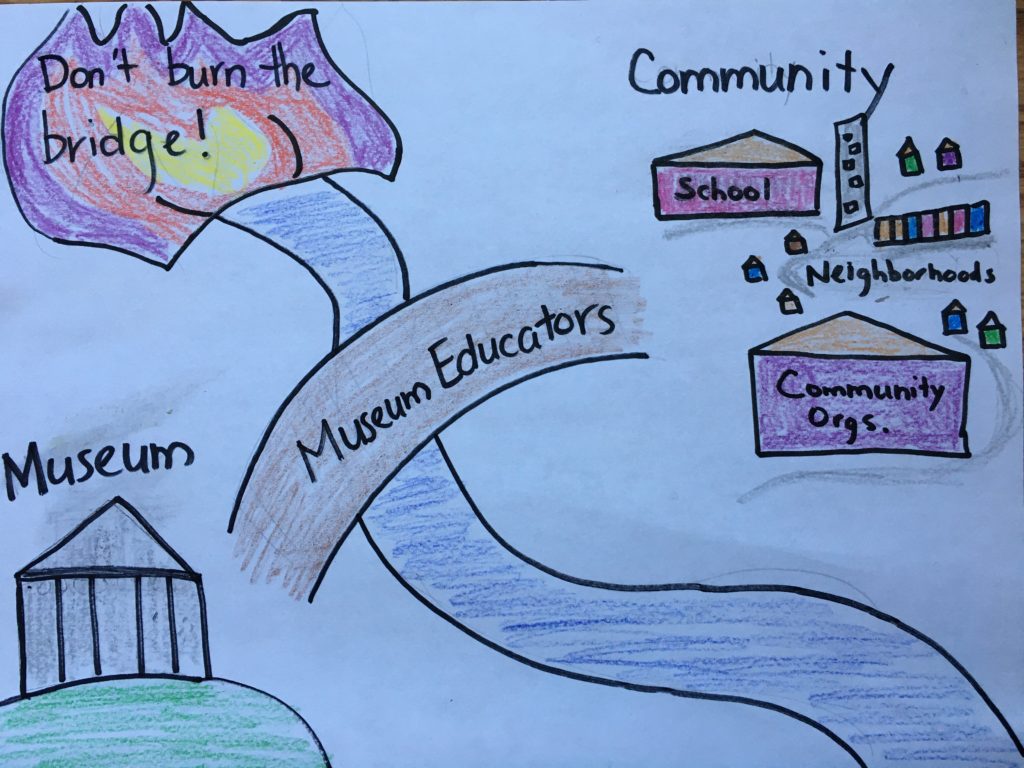
The kinds of relationships I have observed as an evaluator clearly demonstrates to me that museum educators are essential to a museum’s missions. Museum educators are often the name and face of the museum to the community. If these names and faces go away, I worry museum will have burned bridges into their communities.
The post Caution: Laying Off Museum Educators May Burn Bridges to the Communities Museums Serve appeared first on RK&A.
 English
 Afrikaans
 Shqip
Shqip አማርኛ
አማርኛ العربية
 Հայերեն
 Azərbaycan dili
 Euskara
 Беларуская мова
 বাংলা
বাংলা Bosanski
 Български
 Català
 Cebuano
 Chichewa
 简体中文
简体中文 繁體中文
繁體中文 Corsu
Corsu Hrvatski
 Čeština
 Dansk
Dansk Nederlands
 Esperanto
 Eesti
Eesti Filipino
 Suomi
Suomi Français
 Frysk
Frysk Galego
 ქართული
 Deutsch
 Ελληνικά
 ગુજરાતી
 Kreyol ayisyen
 Harshen Hausa
 Ōlelo Hawaiʻi
 עִבְרִית
 हिन्दी
 Hmong
Hmong Magyar
 Íslenska
 Igbo
Igbo Bahasa Indonesia
 Gaeilge
 Italiano
 日本語
日本語 Basa Jawa
 ಕನ್ನಡ
ಕನ್ನಡ Қазақ тілі
 ភាសាខ្មែរ
 한국어
한국어 كوردی
كوردی Кыргызча
 ພາສາລາວ
 Latin
Latin Latviešu valoda
 Lietuvių kalba
 Lëtzebuergesch
 Македонски јазик
 Malagasy
 Bahasa Melayu
 മലയാളം
 Maltese
 Te Reo Māori
 मराठी
मराठी Монгол
 ဗမာစာ
ဗမာစာ नेपाली
 Norsk bokmål
 پښتو
پښتو فارسی
فارسی Polski
 Português
 ਪੰਜਾਬੀ
 Română
 Русский
 Samoan
 Gàidhlig
 Српски језик
 Sesotho
 Shona
Shona سنڌي
سنڌي සිංහල
සිංහල Slovenčina
 Slovenščina
 Afsoomaali
 Español
 Basa Sunda
 Kiswahili
 Svenska
 Тоҷикӣ
 தமிழ்
தமிழ் తెలుగు
 ไทย
ไทย Türkçe
 Українська
 اردو
اردو O‘zbekcha
 Tiếng Việt
 Cymraeg
 isiXhosa
 יידיש
יידיש Yorùbá
 Zulu
Zulu