• Skip to main content
  • Skip to footer
  • Home

The May 13 Group

the next day for evaluation

  • Get Involved
  • Our Work
  • About Us
You are here: Home / Archives for cplysy

cplysy

Mar 20 2020

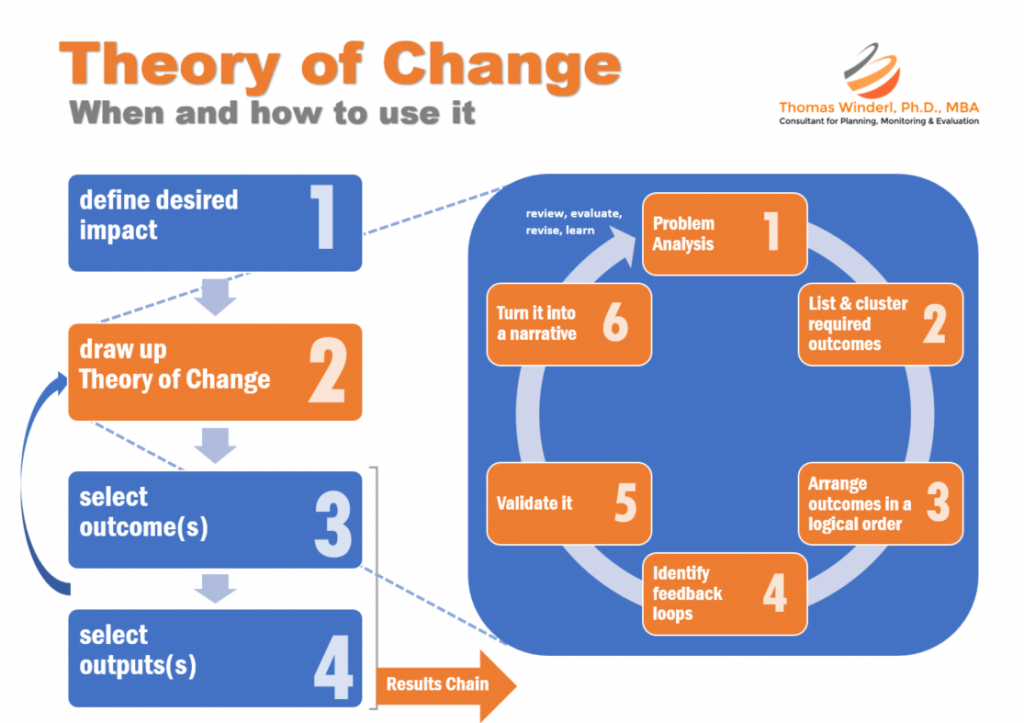
A Theory of Change

Probably as an inevitable result of the buzz in the past few years, many Theories of Change are often useless.

One reason for that is – is my feeling – that they are typically not developed in a logical sequence: without a thorough problem analysis, with a possible intervention already in mind, just as the opposite side of a result chain, etc.

Here is my suggestion in what sequence we should go about it:
The post A Theory of Change appeared first on Thomas Winderl.


Written by cplysy · Categorized: thomaswinderl

Mar 20 2020

Adapting for Improvement in Light of COVID-19

I naively said to my family a few weeks ago that I was lucky that my business wouldn’t be affected in the way that so many restaurants and other small businesses are by the pandemic. I couldn’t see then, but it has become incredibly clear since that every business and every industry have been and will be impacted on a massive scale by this pause in how we normally function. I am so fortunate that I can continue much of my work from home; yet every day, my heart breaks for other small business owners who are doing everything they can to keep their businesses afloat during this unprecedented time. 

I spoke to one of my former clients recently, and I expressed how badly I felt that the cancellation of schools would drastically affect his work. His response to me was this: “This is a time to pivot!“

All week, I’ve been thinking about what he said and what a resilient attitude he had. I’ve also been pondering how this affects not only my work but the organizations and communities I serve. Take the issue of chronic absenteeism in schools. Chronic absenteeism is typically defined as missing 10% of more of a given school year, and it has been empirically tied to a host of negative outcomes for students, including reading levels, special education identification, suspensions, dropout rates, and more. Students from vulnerable and underserved populations are at the highest risk. The good news about this issue is that it is both preventable and reversible, and I’ve found in my work that regular and collaborative data tracking on student absences and related interventions can make a huge difference for kids and schools. ​A recent article, Chronic Absenteeism in the Time of Coronavirus, discussed the implications of shuttered schools on how schools and systems typically address attendance issues, but also on what closed schools mean for the students themselves. ​

In thinking of how to pivot from the typical accountability measures associated with attendance, as Jordan’s article suggests, how can we in the education field work together during this time to address the root causes — the underlying reasons why so many students miss school? I am loving all of the positive news articles out there about school districts employing bus drivers to deliver meals, offering wifi hotspots to those without internet access at home, and teachers driving around students’ neighborhoods to help them feel connected. 

From my lens, I think this break from traditional schooling is an opportune time to go deep with our data and determine all that we can about which students are missing school the most and why. Once we’ve done that, we can get creative about our interventions for kids while they are in their homes and communities. I’ve got a few ideas in development for how my work can pivot to best serve our schools, districts, and non-profit organizations who have the most direct lines to children and families (more information on that to come!). In the meantime, if your organization is trying to better support its chronically absent students or more effectively engage with families during this time, let’s chat. Shoot me an email here so that we can set up a conversation. 

How are you planning to pivot? Share your ideas in the comments below – I’d love to start a conversation and channel our collective creativity!

Written by cplysy · Categorized: engagewithdata

Mar 19 2020

Being Launched from the Comfort Zone

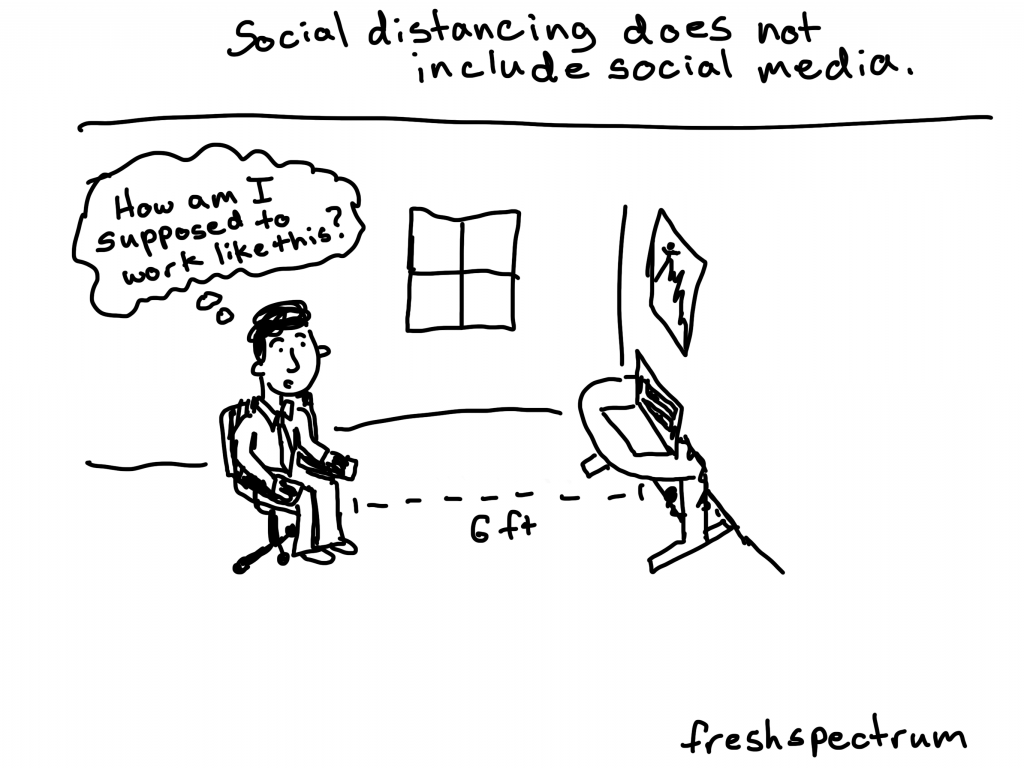
The last week has been a wild ride for many of us in the United States and abroad.  A wrench was thrown into my normal (although never regular) schedule of museum visits, research design, and conference attendance.  All of a sudden, I became a substitute classroom teacher to a first grader, all the while practicing social distancing and trying to adapt to my new working situation.

But as the news began unfolding rapidly last week and our lives changed in pace with developments in information, I did find some Zen.  Radical interruptions like we are experiencing provide great opportunities.  At RK&A, we often utilize the visualization of the learning zone, nestled between the comfort and panic zones.  We are currently being forcibly pushed out of our comfort zones.  “Pushed” may even be a little too gentle to describe what is happening.  More accurately, the little cartoon in my head shows us being shot from a cannon out of the comfort zone.  While the panic zone may seem to be a likely landing place, I am opting to open my parachute of creativity and land in the learning zone.  History tells us that important innovation arises from challenging times.  As Stephanie wrote on New Year’s Eve 2019, almost as a harbinger of what was to come in 2020, static can be comfortable but dull and uninspiring.  So, strap on your parachute, and let’s get creative and learn together to get through this!

Leonardo da Vinci’s parachute drawing
Image credit: https://fineartamerica.com/featured/2-da-vinci-parachute-1485-science-source.html?product=art-print

The post Being Launched from the Comfort Zone appeared first on RK&A.

Written by cplysy · Categorized: rka

Mar 19 2020

Learning to Support Social Movement Power

How funders and evaluators should think about learning and movement success.

Continue reading on InnovationNetwork »

Written by cplysy · Categorized: innovationnet

Mar 18 2020

The Evaluation Mindset: Evaluation in a Crisis

This post is a day late as recent events hit me with blogger’s block.

I didn’t want to just write another post, seemingly oblivious to the very real global pandemic that is on everyone’s mind. But I didn’t just want to add to the COVID-19 noise.

But the more I thought about it, the more I started to consider all of the super useful ways evaluators can contribute in times of crisis.

This post is a reflection of that brainstorm. It is what I see as evaluator roles during a crisis. How we can use our evaluation expertise and skills to support our society in an unprecedented time.

It is not comprehensive, after you read it, I would love to hear your thoughts and additions.

Remembering to Breathe

Breathe in, breathe out.

When you breathe in, you bring oxygen into your body.

When you breathe out, you expel carbon dioxide.

Hold your breath and your body doesn’t get the amount of oxygen it needs to work. This is particularly challenging when physically active and your body needs more oxygen.

On the other end, breathing in too much oxygen can also be bad. Hyperventilation causes our oxygen levels to go up and carbon dioxide to go down. But if the carbon dioxide goes down too far we suffer, as we have nothing to breath out.

Healthy breathing is about balance.

Evaluation is the oxygen that powers decision making. Too little and we are likely to make poor decisions. And when faced with big challenges, we need more than usual.

Too much evaluation without action leads to hyperventilation. Analysis paralysis.

As an evaluator, it is your responsibility to keep the breathing steady.

Informing decision makers

Dr. Bicknell believed “public health is much more dangerous than medicine. We deal with populations, doctors deal mainly with individuals. So bad public health professionals are far more dangerous than bad doctors. We can kill more people with less accountability.”

From Rationing, Data, and the Ethics of our Decisions by Amanda Makulec

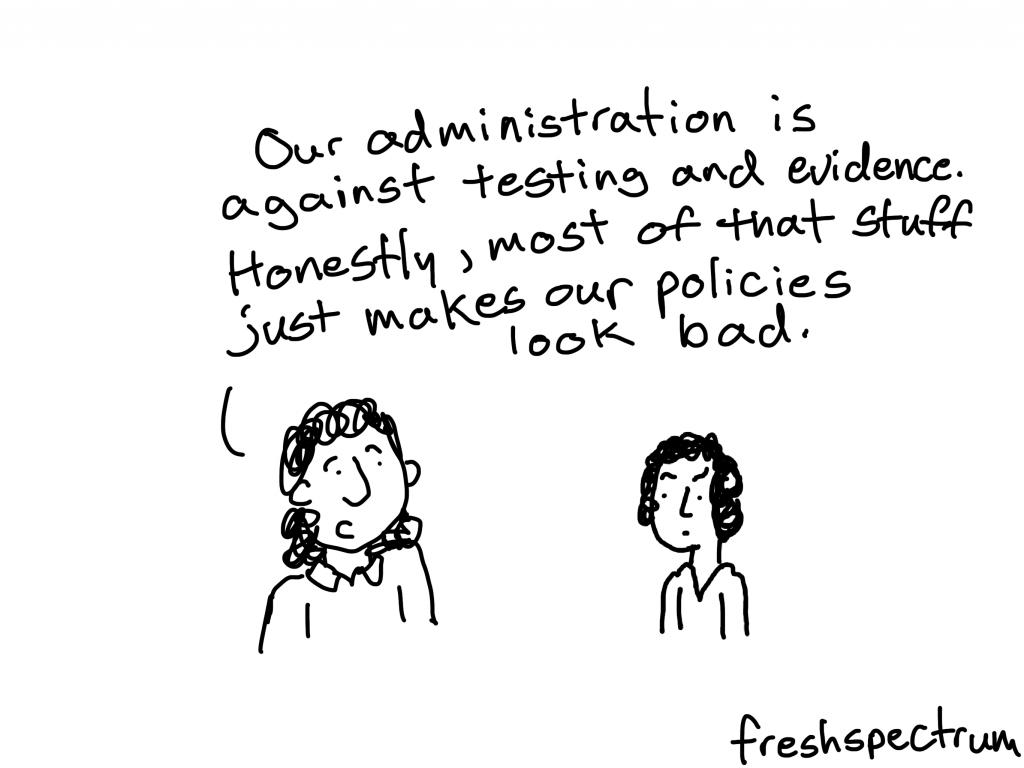
During times of crisis decisions must be made, with or without data.

Acting quickly, with the right decisions, can save lives.

Acting quickly, with the wrong decisions, can cost lives.

Most of the time decision making isn’t about yes or no, black or white, and wrong or right. It’s about making a choice at the time, with the information you have at hand.

There are decision makers who stay uninformed by choice. Deciding to follow their gut or only listen to others who are similarly uninformed.

But there are others who prefer to be informed. To show up with at least a sense of the decision that seems most supported by the information we have at hand. It isn’t always going to be the right choice, but it is less likely to be the wrong choice.

Informing those who wish to be informed, is also with the domain of evaluation.

Causality without control groups

Contrary to popular opinion, there are actually a lot of options [to measure attribution]. They range from the high-powered ones to some fairly low-tech common-sense options you can use even in small-scale community projects, and even if ALL of your evidence is qualitative. Yes, really!

From Understanding Causes by Jane Davidson

There is not always a control group.

When the situation at hand is complex and emerging, there might not be a proper comparison group. But that doesn’t mean we can’t determine how certain actions lead to desired consequences.

The often touted “gold standard” RCT methodology is not the only evaluation method capable of determining if something works. Especially for emerging social responses to crises.

Creating feedback loops, opportunities to understand and learn from our successes and mistakes, are critical to fueling rapid improvement.

As an evaluator, you have a role in the iterative process of rapid response.

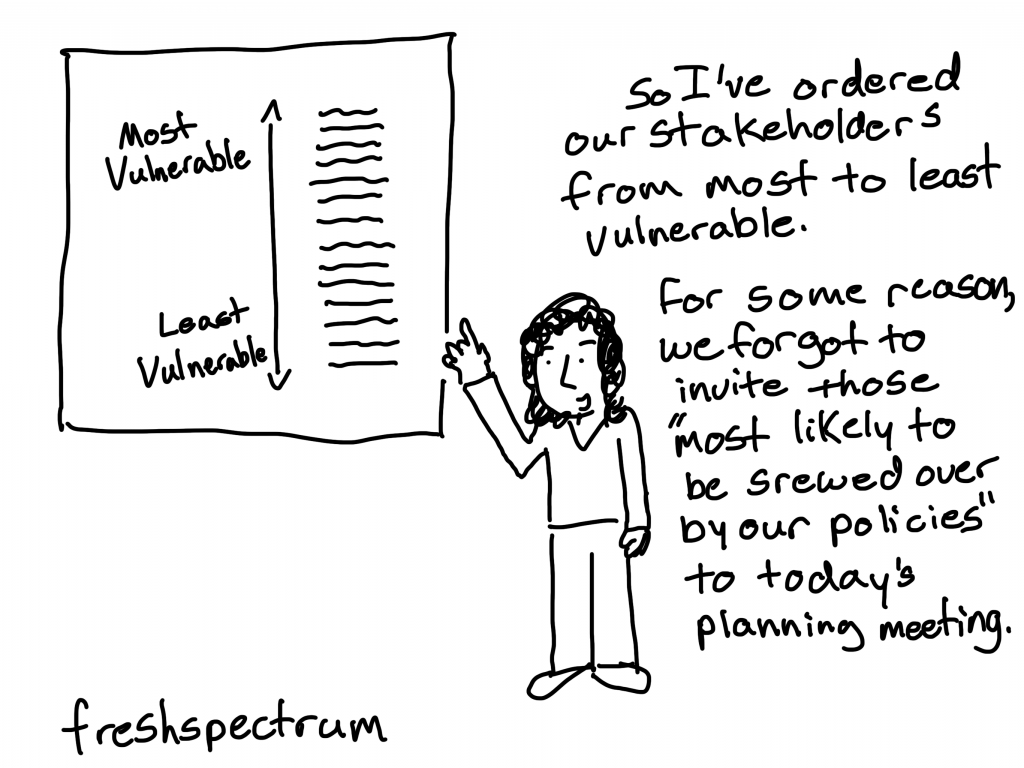
Speaking for the vulnerable

Social vulnerability refers to the resilience of communities when confronted by external stresses on human health, stresses such as natural or human-caused disasters, or disease outbreaks. 

From the CDC’s Social Vulnerability Index

Vulnerable populations need advocates even at the best of times.

But when the worst happens, the most vulnerable populations are likely to be most at risk. Vulnerability amplified.

When all the restaurants close their doors, a tip-reliant single-mother already living paycheck to paycheck, can get left without any options. Her child who might have been getting most of her meals at school, is now sheltering at home without that benefit.

When decisions are made to support the greater good, it is right to ask, “just what is that greater good?”

“Who doesn’t have a seat at the table?”

“Who is likely to see the most negative consequences from our actions?”

Out of mind, out of sight. As an evaluator, you can use your talents to help keep those with the highest needs stay in mind and in sight.

Not just an afterthought

Developmental Evaluation (DE) is an evaluation approach that can assist social innovators develop social change initiatives in complex or uncertain environments.

Better Evaluation’s Overview of Developmental Evaluation

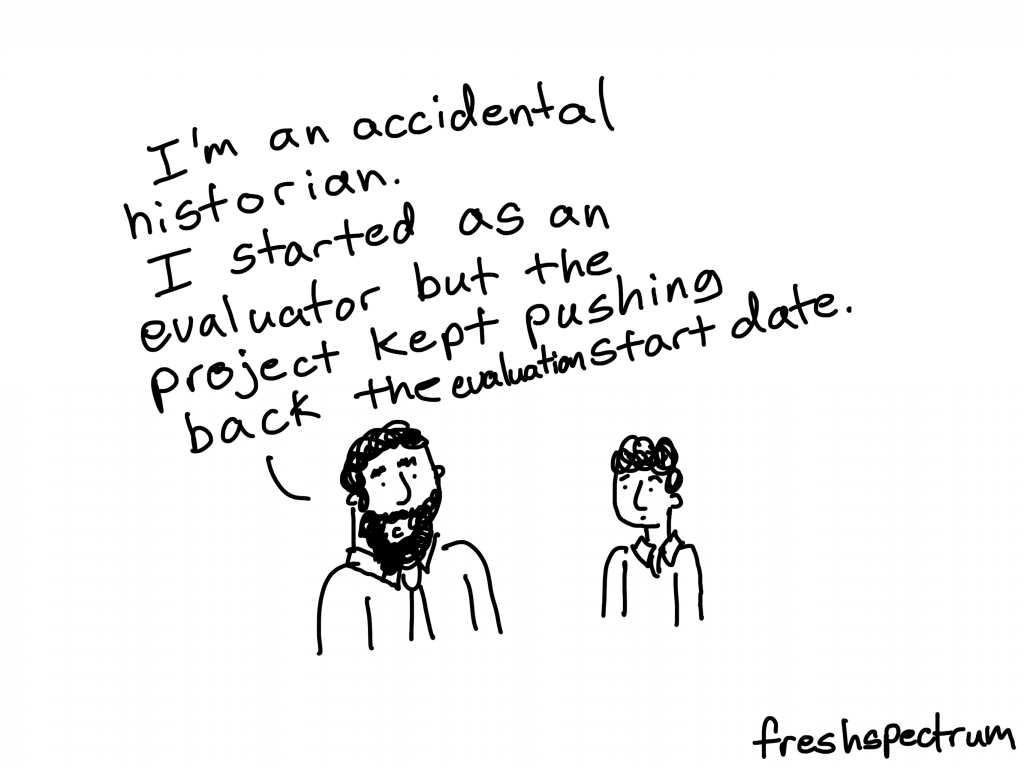
Even among the most data savvy of organizations, I think there is still a prevailing thought on the timing of evaluation. That it’s something you plan at the beginning, and do at the end.

But the role an evaluator, as a guide, is one that can be useful during every stage of a program or activity. It’s not just about lessons learned, but informing change.

Our methods are not simply about saying whether or not a program worked. They are not simply about improving designs. Our methods are also useful in discovering the right way to move forward.

In challenging times, we need step up.

Evaluation is an anytime activity.

Staying true to your values

Everyday narratives that continue to marginalize, minimize, and disrespect people of color and those with less privilege could be replaced with ones that do not demonize and place blame on the individual. They could instead lift up the historical, contextual, and powerful dynamics that create and sustain oppression and shed light on the strategies and solutions which can shift the “rules of the game” so that equity is achievable.

From the Equitable Evaluation Initiative

It is easy to live our values when everything is going along swimmingly. When the economy is solid and the uncertainty level is low.

As evaluators we have the responsibility to hold our organizations accountable for core values, especially when times are tough.

***

Facilitating Online Meetings

Let’s be honest. A poorly designed run meeting is a waste of time, energy and resources. This is true face to face and online.

From So You Want to Host a Web Meeting? by Nancy White, with Pete Cranston, Susan Stewart and Bonnie Koenig

The guide above is from a few years ago. But it’s well written and full of useful insight on hosting effective web meetings.

Wherever you are, stay safe. Flatten the curve. Lookout for your neighbors.

We’ll get through this.

Written by cplysy · Categorized: freshspectrum

  • « Go to Previous Page
  • Go to page 1
  • Interim pages omitted …
  • Go to page 276
  • Go to page 277
  • Go to page 278
  • Go to page 279
  • Go to page 280
  • Interim pages omitted …
  • Go to page 304
  • Go to Next Page »

Footer

Follow our Work

The easiest way to stay connected to our work is to join our newsletter. You’ll get updates on projects, learn about new events, and hear stories from those evaluators whom the field continues to actively exclude and erase.

Get Updates

Want to take further action or join a pod? Click here to learn more.

Copyright © 2026 · The May 13 Group · Log in

en English
af Afrikaanssq Shqipam አማርኛar العربيةhy Հայերենaz Azərbaycan dilieu Euskarabe Беларуская моваbn বাংলাbs Bosanskibg Българскиca Catalàceb Cebuanony Chichewazh-CN 简体中文zh-TW 繁體中文co Corsuhr Hrvatskics Čeština‎da Dansknl Nederlandsen Englisheo Esperantoet Eestitl Filipinofi Suomifr Françaisfy Fryskgl Galegoka ქართულიde Deutschel Ελληνικάgu ગુજરાતીht Kreyol ayisyenha Harshen Hausahaw Ōlelo Hawaiʻiiw עִבְרִיתhi हिन्दीhmn Hmonghu Magyaris Íslenskaig Igboid Bahasa Indonesiaga Gaeilgeit Italianoja 日本語jw Basa Jawakn ಕನ್ನಡkk Қазақ тіліkm ភាសាខ្មែរko 한국어ku كوردی‎ky Кыргызчаlo ພາສາລາວla Latinlv Latviešu valodalt Lietuvių kalbalb Lëtzebuergeschmk Македонски јазикmg Malagasyms Bahasa Melayuml മലയാളംmt Maltesemi Te Reo Māorimr मराठीmn Монголmy ဗမာစာne नेपालीno Norsk bokmålps پښتوfa فارسیpl Polskipt Portuguêspa ਪੰਜਾਬੀro Românăru Русскийsm Samoangd Gàidhligsr Српски језикst Sesothosn Shonasd سنڌيsi සිංහලsk Slovenčinasl Slovenščinaso Afsoomaalies Españolsu Basa Sundasw Kiswahilisv Svenskatg Тоҷикӣta தமிழ்te తెలుగుth ไทยtr Türkçeuk Українськаur اردوuz O‘zbekchavi Tiếng Việtcy Cymraegxh isiXhosayi יידישyo Yorùbázu Zulu