• Skip to main content
  • Skip to footer
  • Home

The May 13 Group

the next day for evaluation

  • Get Involved
  • Our Work
  • About Us
You are here: Home / Archives for cplysy

cplysy

Feb 20 2020

Our toolbox for primary data collection

To collect primary data (data that we need to collect first ourselves), we can rely on a rather sophisticated tool box– largely from social sciences – that has been developed over decades.

There are tools for quantitative and qualitative data collection. Here is a list of some of the important tools available to us:
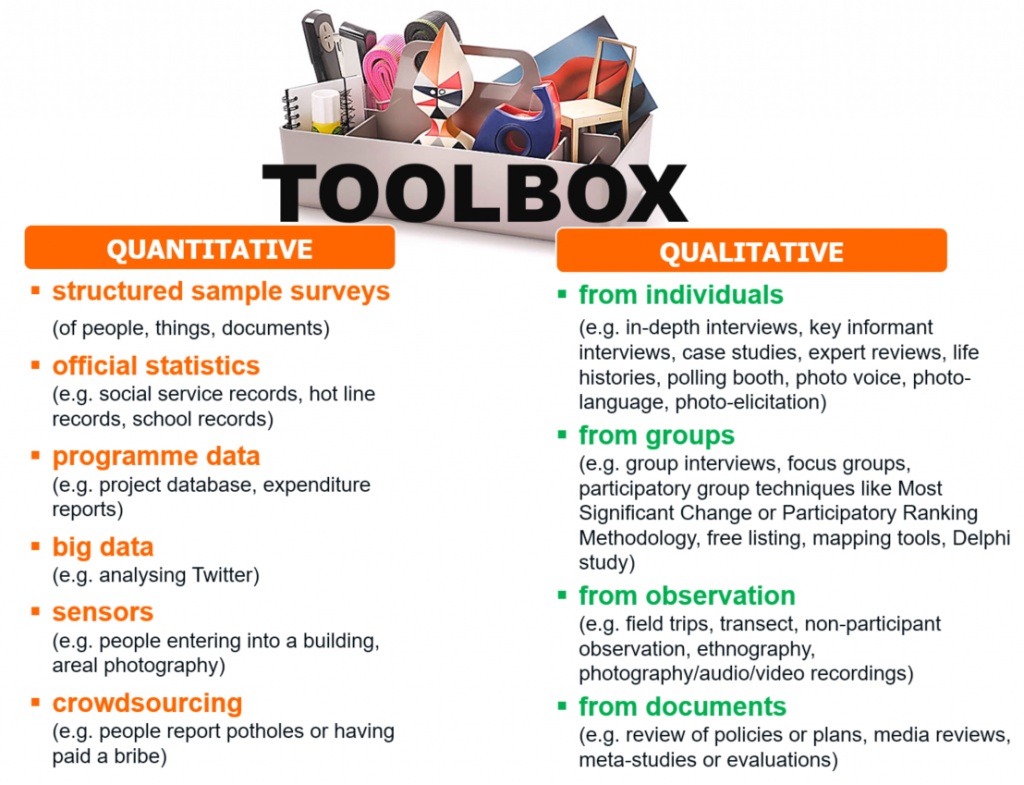
The post Our toolbox for primary data collection appeared first on Thomas Winderl.

Written by cplysy · Categorized: thomaswinderl

Feb 19 2020

Try This: Fortunately, Unfortunately

Try this activity, and let me know how it goes. “Fortunately, Unfortunately” is an improvisational storytelling game used in drama classes, with kids, and in group activities. The game involves coming up with a plot and building on as the story goes. It’s also a great way to add some program design and evaluation into […]

The post Try This: Fortunately, Unfortunately appeared first on Nicole Clark Consulting.

Written by cplysy · Categorized: nicoleclark

Feb 15 2020

Evaluation Roundup – February 2020


New and noteworthy — Reads


Foundations’ evaluation and learning practices

The Center for Evaluation Innovation recently released its most recent review of foundations’ evaluation and learning practices. This report offers benchmarking data on foundation evaluation practice collected in 2019 from 161 foundations. What were the results from this year’s survey?   

Here are some key takeaways:

1. Language is shifting – More job titles for foundation evaluation leaders include the word “learning”; while fewer contain the word “ evaluation”. Results also showed that nearly half of the foundations contained the name “learning” in the unit or department’s name.  

I have definitely felt this shift, but is it a good one? I’m all about learning, but evaluation is a key component to strategic learning.  

2. Evaluators are asked to do more with less – Despite larger foundations having more program staff the number of evaluators did not increase. In fact, the ratio of full-time staff to evaluation staff is widening (i.e. less evaluation staff are dedicated to more full-time staff). In addition, most foundation evaluators had responsibilities beyond evaluation as part of their work – an increase from 2015.  

Evaluators have unique skills that can be used across organizations in a variety of capacities. Because of this, I know I am often pulled into tasks that may not be specific to my job as an evaluator but something my clients feel I should support. 

3. Evaluation use is still an issue – Foundation staff are the primary intended users of evaluation efforts, over grantees and others in the field. Yet the biggest evaluation challenge faced is having evaluations result in meaningful insights for the foundation.  

So, if the primary users aren’t using the results in a meaningful way and foundations aren’t engaging external stakeholders (either throughout the evaluation or even when it comes to sharing findings) then what’s the point? Is this what is driving the shift to focus on “learning”?  

Learnings from early experiences of country-led SDG evaluations

The 2030 Agenda for Sustainable Development was adopted by UN member states in 2015. Since 2015, countries have been developing national Sustainable Development Goal strategies and action plans targeted at achieving the 17 Sustainable Development Goals (SDGs), but grappling with how to evaluate progress of such an enormous and complex agenda.  

The International Institute for Environment and Development (IIED) recently published a guide to support country-led Sustainable Development Goal (SDG) evaluation. This guide offers learnings from early experiences of country-led SDG evaluations in Finland and Nigeria. The guide can be used to support evaluation commissioners and managers designing a national SDG evaluation.  


New and Noteworthy — Resources


Creative ways to solicit stakeholder feedback

Public Profit recently released a guide evaluators can refer to when looking for alternate ways to capture feedback. Survey fatigue is a real thing and sometimes us evaluators need more creative, engaging ways to engage with our stakeholders. This guide provides step-by-step guidance on 15 different approaches, organized into three sections: visual, kinesthetic and verbal. It’s a very accessible guide that clearly outlines the activity’s purpose, gives an overview of how it works, and provides step-by-step instructions. They have also published similar guides for soliciting feedback from youth and virtually. 

Strategizing and planning – Save the Children’s strategic foresight toolkit

Speaking of clear and accessible tools, you need to check out Save the Children’s recent strategic foresight toolkit – especially if you are doing any strategic planning. In this toolkit Save the Children compiles participatory techniques that combine evidence and creativity to help teams or organizations create collective wisdom and embed learning in decision-making. There are numerous templates and resources included in the toolkits. While they are not necessarily specific to evaluation, there are many that can be adapted. Check out the “Futures Wheel” –  I can foresee myself using this to show outcome chains as opposed to traditional designs we are used to. 

Your guide to the best Theory of Change software

Inspiring Impact did the work and outlined the different options out there to create the maps for theories of change. Their top four: 1) Google Drawings, 2) MindMup, 3) Coggle, and 4) Changeroo. The first three are not specific theory of change software, so you’ll need to know what you are doing; however, Changeroo was created to develop theories of change and has elements specific to theories of change. For example, when you click on a block in a theory of change you are prompted to identify the type of outcome and stakeholder it concerns. The drawback – it is most expensive of all the options. 


Subscribe to Our Newsletter

Sign up with your email address to receive news and updates from Eval Academy every month.


We respect your privacy.

Thank you!


Written by cplysy · Categorized: evalacademy

Feb 14 2020

I ❤️ Less is More

Happy Valentine’s Day!  As many of you know, the idiom “Less is More” is attributed to minimalist architect Ludwig Mies van der Rohe.

The Neue Nationalgalerie (New National Gallery)
The New Gallery, Berlin. https://www.dwell.com/article/ludwig-mies-van-der-rohe-architect-19dd30ba

I am grateful to him for coining the phrase and inspiring me to adopt it into my Intentional Practice.  Intentional Practice has two important guiding beliefs, both of which are hard to practice. Despite their difficulty, I ❤ them anyway because of the conceptual and behavioral challenges they present.  I am not one to shy away from pursuing difficult tasks; in fact, they inspire me to learn new ways of thinking, which in turn may push me towards new actions.  I will save the other belief for another post (for the curious-minded—it is “Museums can’t be all things to all people”); today, the three simple words noted above—Less is More—are particularly important.

Simple words, only three of them, and all with so few letters, echo the point. Here are two ways that Less is More supports Intentional Practice thinking (I’ll try to be brief):

1. Intentional practice planning and evaluation activities support achieving impact. As such, to achieve and measure impact through supporting outcomes among visitors, visitors will have had to experience the essence of the museum so they can consider and process it and then know it. For example, if a museum’s impact statement is “People deepen their connection to nature and consider their role in sustaining their natural world for future generations,”[1] visitors may not be able to make sense of the experiences if exhibits and programming cover too much or different territory—conceptually.  If programs and exhibitions focus on ideas that support the museum’s core concept, as expressed in that the impact statement, and go deep with the concept, there is a greater chance that visitors will experience more.

One core concept—not two or three—one. One concept presented in a multitude of ways through a variety of mediums reinforces the concept that supports the museum’s intended impact.  From a planning perspective, the impact statement serves as a guidepost for disciplined, and sometimes ruthless, decision making.  From an evaluation perspective, visitors will be better able to process their experience because there are fewer ideas for them to manage; in turn, they will be experiencing the essence of the museum deeply, and as such, the evaluation process will have a better chance of detecting the effect of their experience and the ways in which the museum is achieving impact.

2. Less is More is also meaningful because it suggests that numbers may not equal success. For too long, museums’ focus on attendance suggests that high numbers are an indicator of quality.  A number is a number.  If numbers were important, I am compelled to ask, “What number is enough”?  What if success were measured by the quality of the visitor experience?  What if “More” came to mean quality of experience whereby visitors were describing the ways in which the museum did (or did not) help them understand the ramifications of climate change (for example)?  Let’s connect the visitor experience to point #1: what if “Less” was presented, thereby creating physical and conceptual space for the idea to sink in, and in doing so, the experience became “More”?  The “Less” part of the phrase invites depth, and experiences become “More.”

 
[1] Courtesy of The Wild Center, Tupper Lake, NY

The post I ❤️ Less is More appeared first on RK&A.

Written by cplysy · Categorized: rka

Feb 14 2020

Self Care Corner: Your Friendships Are Just As Important As Your Relationships

(Photo image courtesy) On the eve of my 30th birthday, I met a few friends at a hookah lounge on the Lower East Side of Manhattan in New York. At one point during the evening, one friend asked everyone to go around and share how they came into my life and one thing they’ve always […]

The post Self Care Corner: Your Friendships Are Just As Important As Your Relationships appeared first on Nicole Clark Consulting.

Written by cplysy · Categorized: nicoleclark

  • « Go to Previous Page
  • Go to page 1
  • Interim pages omitted …
  • Go to page 280
  • Go to page 281
  • Go to page 282
  • Go to page 283
  • Go to page 284
  • Interim pages omitted …
  • Go to page 304
  • Go to Next Page »

Footer

Follow our Work

The easiest way to stay connected to our work is to join our newsletter. You’ll get updates on projects, learn about new events, and hear stories from those evaluators whom the field continues to actively exclude and erase.

Get Updates

Want to take further action or join a pod? Click here to learn more.

Copyright © 2026 · The May 13 Group · Log in

en English
af Afrikaanssq Shqipam አማርኛar العربيةhy Հայերենaz Azərbaycan dilieu Euskarabe Беларуская моваbn বাংলাbs Bosanskibg Българскиca Catalàceb Cebuanony Chichewazh-CN 简体中文zh-TW 繁體中文co Corsuhr Hrvatskics Čeština‎da Dansknl Nederlandsen Englisheo Esperantoet Eestitl Filipinofi Suomifr Françaisfy Fryskgl Galegoka ქართულიde Deutschel Ελληνικάgu ગુજરાતીht Kreyol ayisyenha Harshen Hausahaw Ōlelo Hawaiʻiiw עִבְרִיתhi हिन्दीhmn Hmonghu Magyaris Íslenskaig Igboid Bahasa Indonesiaga Gaeilgeit Italianoja 日本語jw Basa Jawakn ಕನ್ನಡkk Қазақ тіліkm ភាសាខ្មែរko 한국어ku كوردی‎ky Кыргызчаlo ພາສາລາວla Latinlv Latviešu valodalt Lietuvių kalbalb Lëtzebuergeschmk Македонски јазикmg Malagasyms Bahasa Melayuml മലയാളംmt Maltesemi Te Reo Māorimr मराठीmn Монголmy ဗမာစာne नेपालीno Norsk bokmålps پښتوfa فارسیpl Polskipt Portuguêspa ਪੰਜਾਬੀro Românăru Русскийsm Samoangd Gàidhligsr Српски језикst Sesothosn Shonasd سنڌيsi සිංහලsk Slovenčinasl Slovenščinaso Afsoomaalies Españolsu Basa Sundasw Kiswahilisv Svenskatg Тоҷикӣta தமிழ்te తెలుగుth ไทยtr Türkçeuk Українськаur اردوuz O‘zbekchavi Tiếng Việtcy Cymraegxh isiXhosayi יידישyo Yorùbázu Zulu