• Skip to main content
  • Skip to footer
  • Home

The May 13 Group

the next day for evaluation

  • Get Involved
  • Our Work
  • About Us
You are here: Home / Archives for cplysy

cplysy

Feb 07 2020

Ask Nicole: How Do I Decide Whether or Not to Give Up?

Have a question you’d like to be featured? Let me know. Have you ever deconstructed the lyrics to a song? I did that recently with Beyoncé’s Ring the Alarm from her 2006 album B’Day. In particular, the chorus/hook of the song. If you’re not familiar, Ring the Alarm is about a woman contemplating whether to […]

The post Ask Nicole: How Do I Decide Whether or Not to Give Up? appeared first on Nicole Clark Consulting.
Written by cplysy · Categorized: nicoleclark

Jan 30 2020

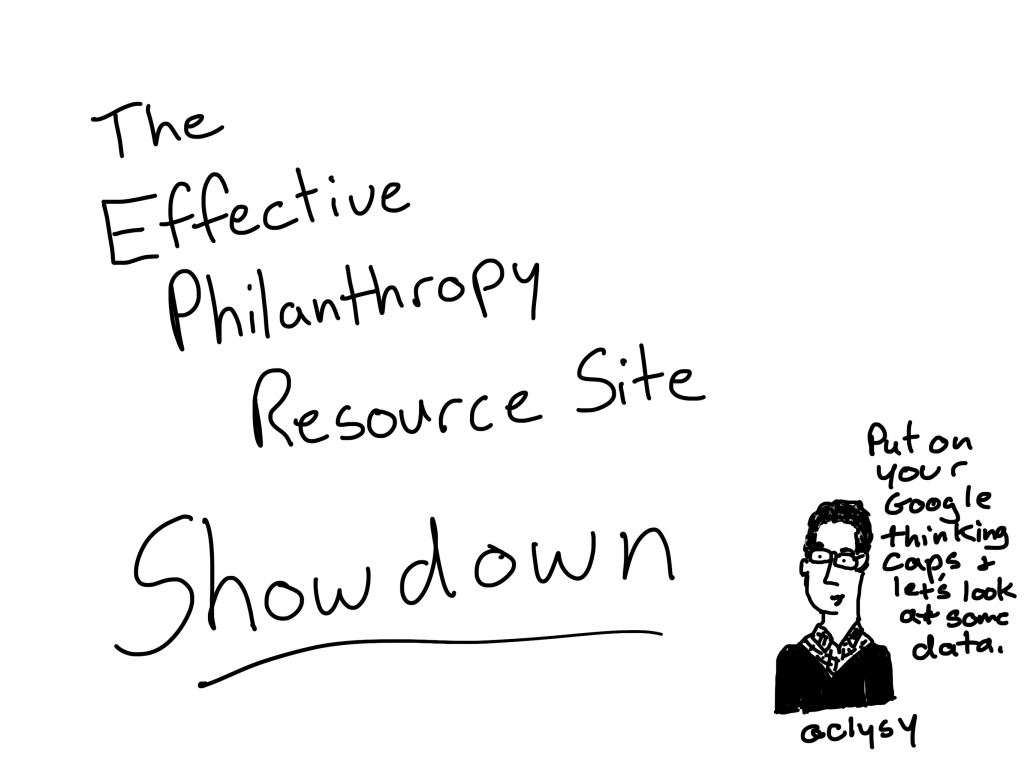
The Effective Philanthropy Resource Site Showdown – [a graphic novel data analysis]

The digital world is filled with underutilized data. I created this experimental data analysis as a way to show how datasets embraced by the SEO world can be valuable evaluation resources.

If the analysis leaves you with more questions. At the end of the post you will find a link to a Tableau Public dashboard I created in the process. I encourage you to explore away.

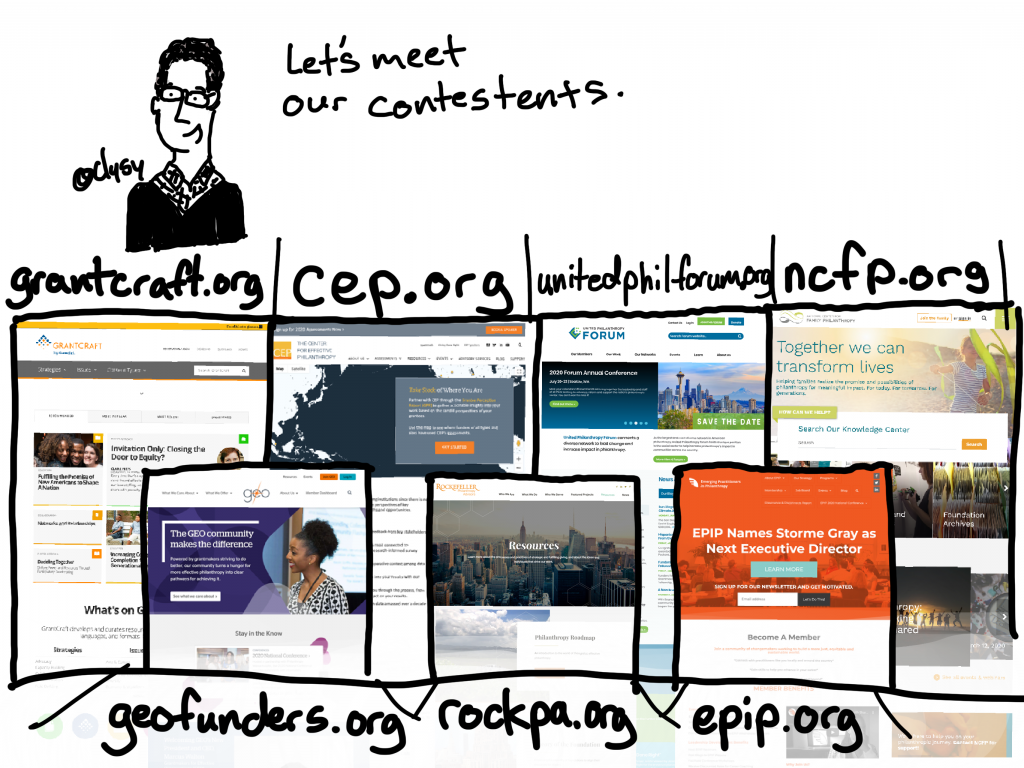
Sites compared in this analysis:

  • grantcraft.org
  • cep.org
  • unitedphilforum.org
  • ncfp.org
  • geofunders.org
  • rockpa.org
  • epip.org
The effective philanthropy resource site showdown. Put on your google thinking caps and let's look at some data.
Let's meet our contestants. grantcraft.org, cep.org, unitedphilforum.org, ncfp.org, geofunders.org, rockpa.org, epip.org
Now for the data. We'll be looking at search related data acquired through ahrefs.com 
Backlinks: pages linking directly to the domains of interest. n=22,910
Keywords: words and phrases where the domains of interest appear in the top 20 Google search results. n=32,710
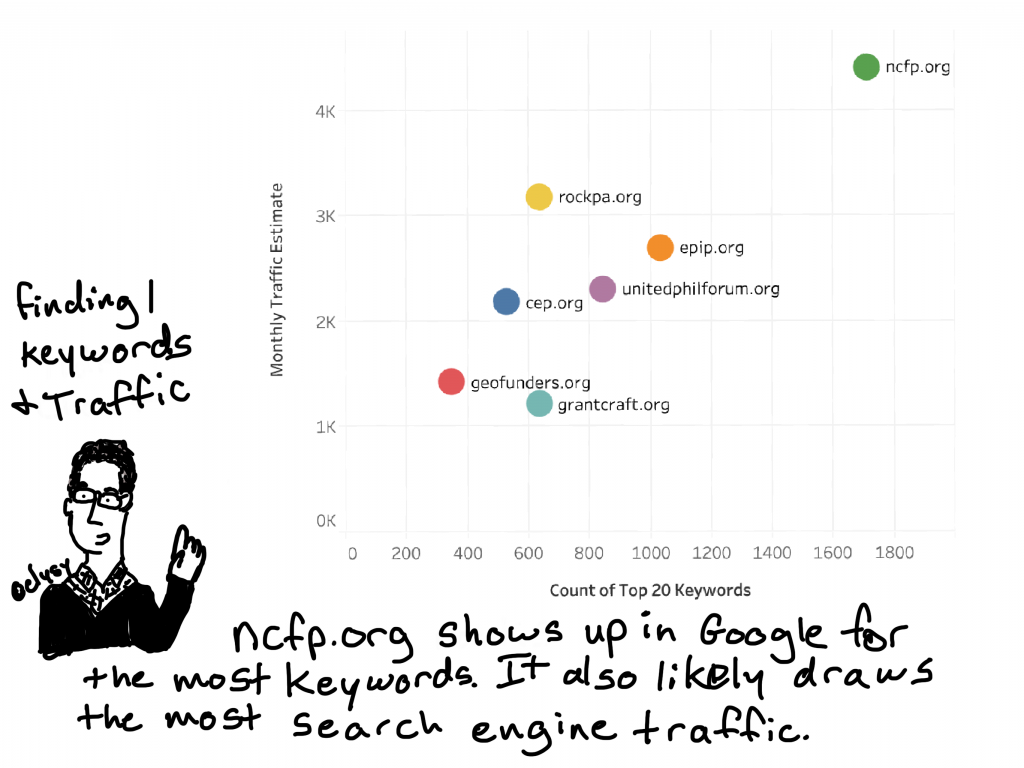
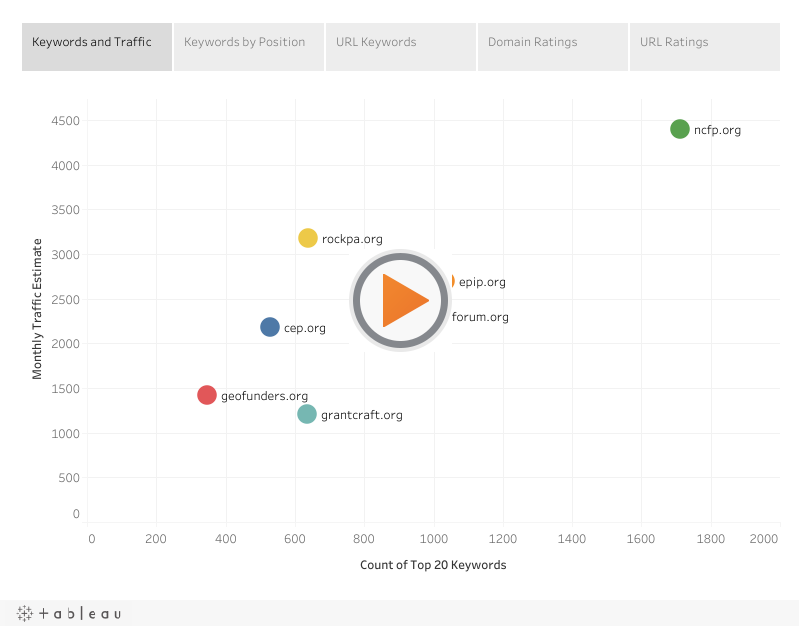
Finding 1 keywords and traffic. ncfp shows u in Google for the most keywords. It also likely draws the most search engine traffic.
Overall this looks like more keywords will correlate with more traffic. But rockpa.org and cep.org are exceptions.
This could be due to these sites ranking on higher ranking keywords, or simply ranking higher.
Okay, so before you comment. Yes! Of course more views and more search rankings are now how anyone would measure success. 
Let's dig deeper and look at the actual keywords.
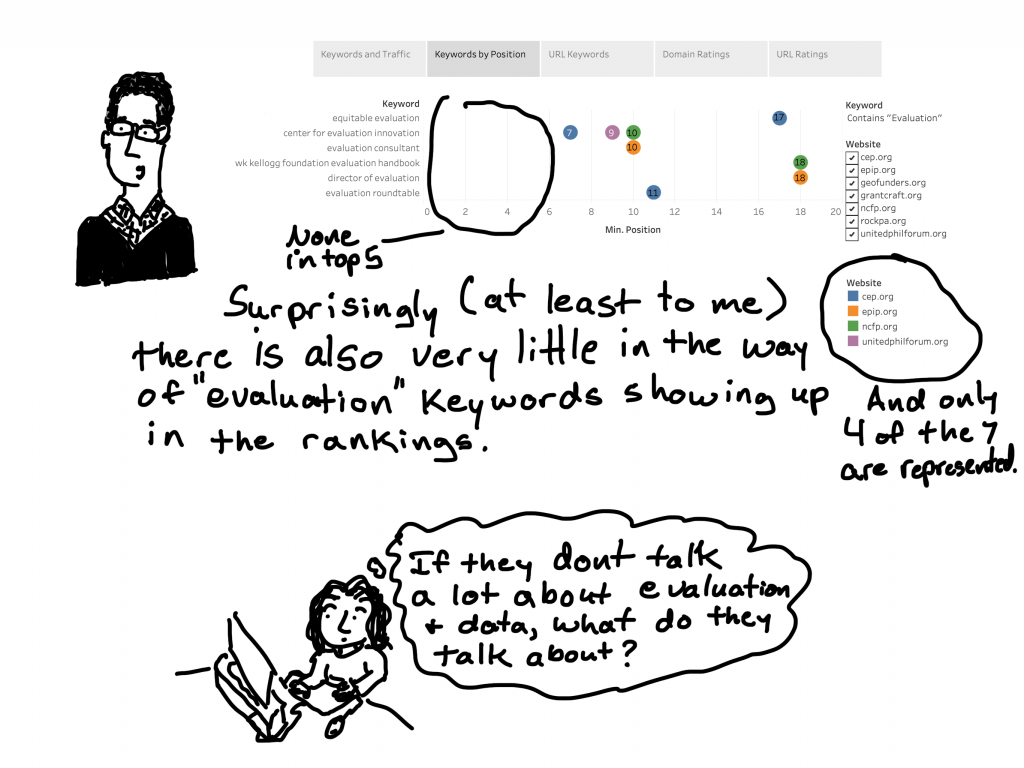
This this view we see keywords, ranking, and dots comparing the different sites.  And the results are filtered by keyword.
As we can see here, very few of the keywords ranked mention data.
Suprisingly (at least to me) there is also very little in the way of "evaluation" keywords showing up in the rankings.  And only 4 of the 7 sites are represented.
If they don't talk a lot about evaluation and data, what do they talk about?
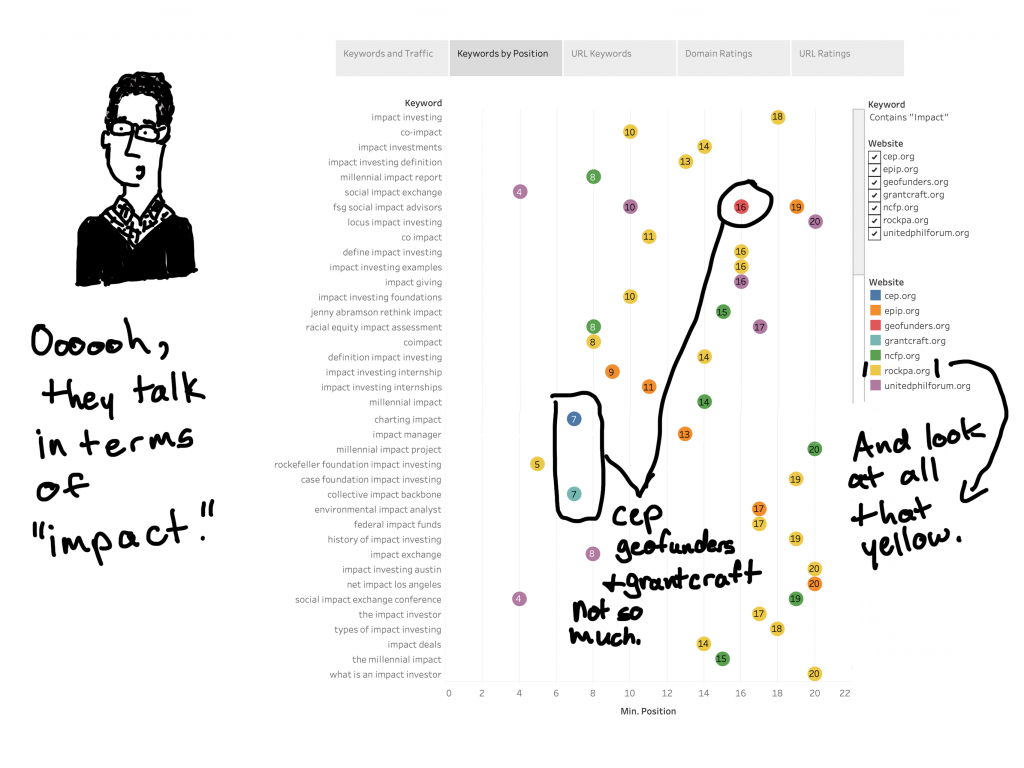
Oooh, they talk in terms of "impact."
CEP, geofunders, and grantcraft not so much.  But rockpa, definitely.
How about a super relevant topic like "equity"?  
Certainly more than evaluation!
Looks like ncfp has a popular resource on racial equity lens.  Curiosity will have me search this one later (fakequity).  
No rockpa or epip.
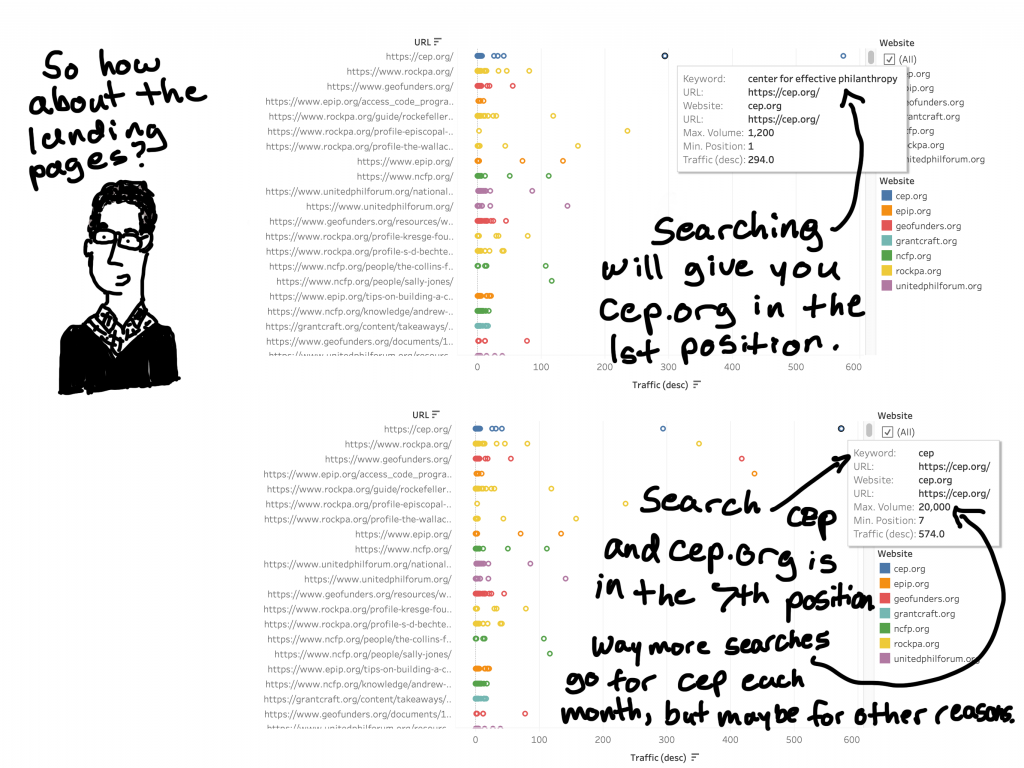
So how about landing pages?
Searching "center for effective philanthropy" will give you cep.org in the 1st position.
Search cep and cep.org is in the 7th position. Way more searches go for cep each month, but maybe for other reasons.
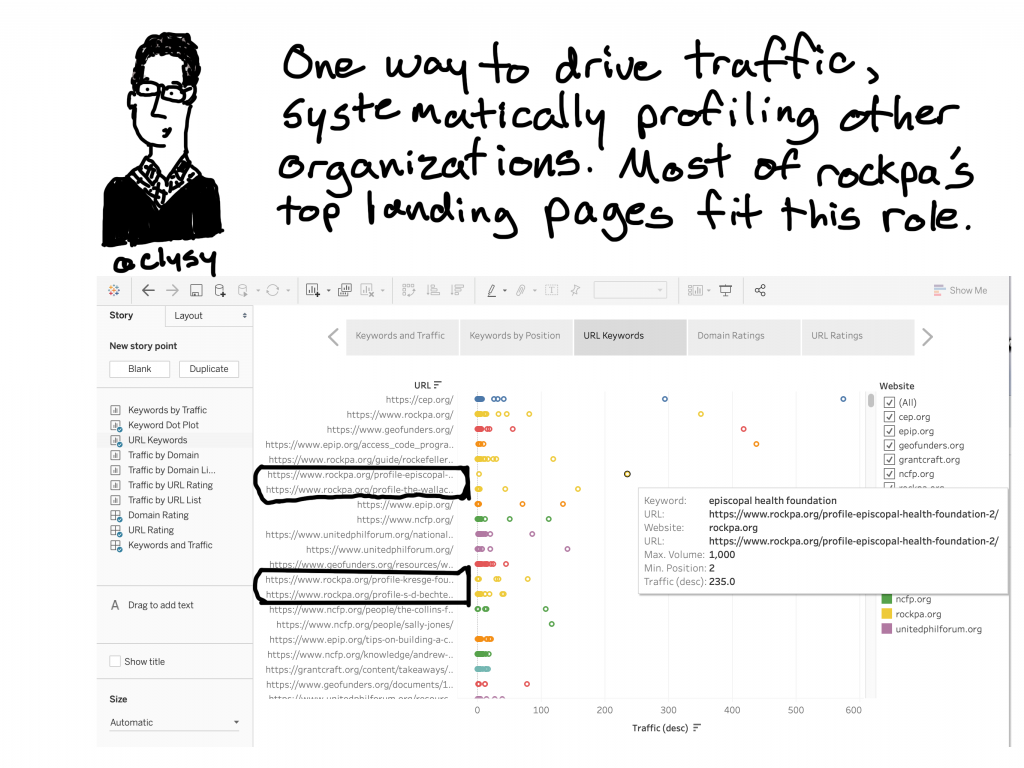
One way to drive traffic, systematically profiling other organizations. Most of rockpa's top landing pages fit this role.
Keywords go in Google.
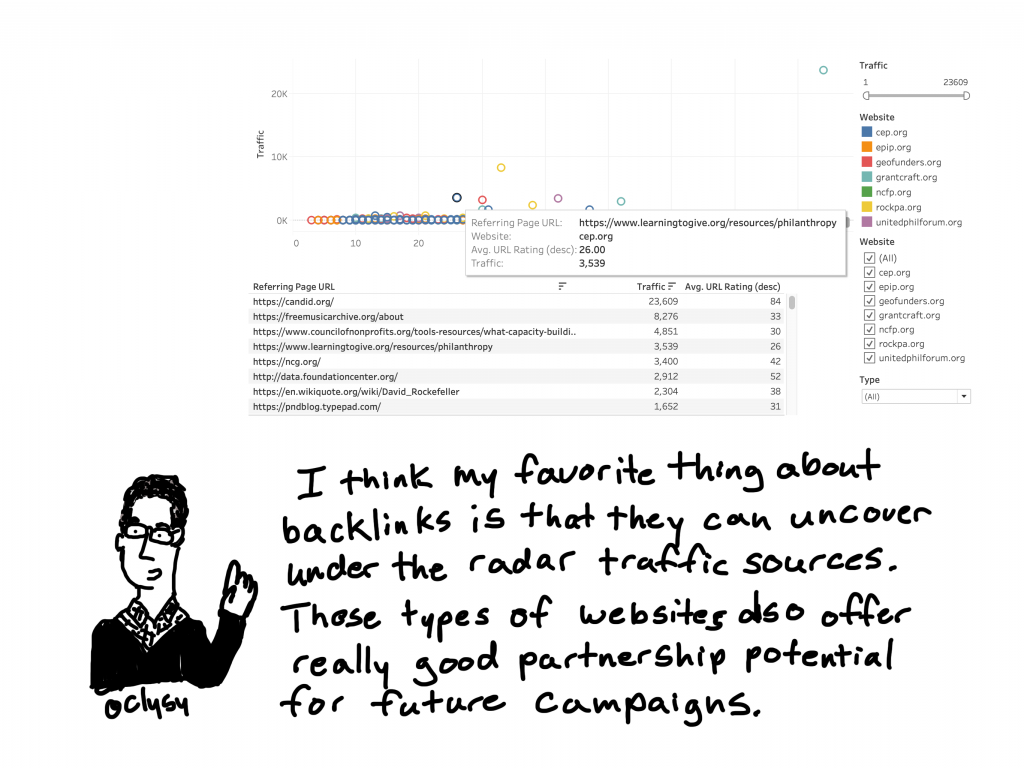
Backlinks connect other sites to your site.
While keywords connect with web search language, Backlinks build authority. Good links from trustworthy sources show that you're trustworthy too.
In terms of high authority/high traffic backlinks, candid.org stands out.  It's the parent organization for grantcraft, and the result of a merger between guidestar and the foundation center.
In the wide world of resource sites there are countless examples of websites that borrow authority from parent organizations.
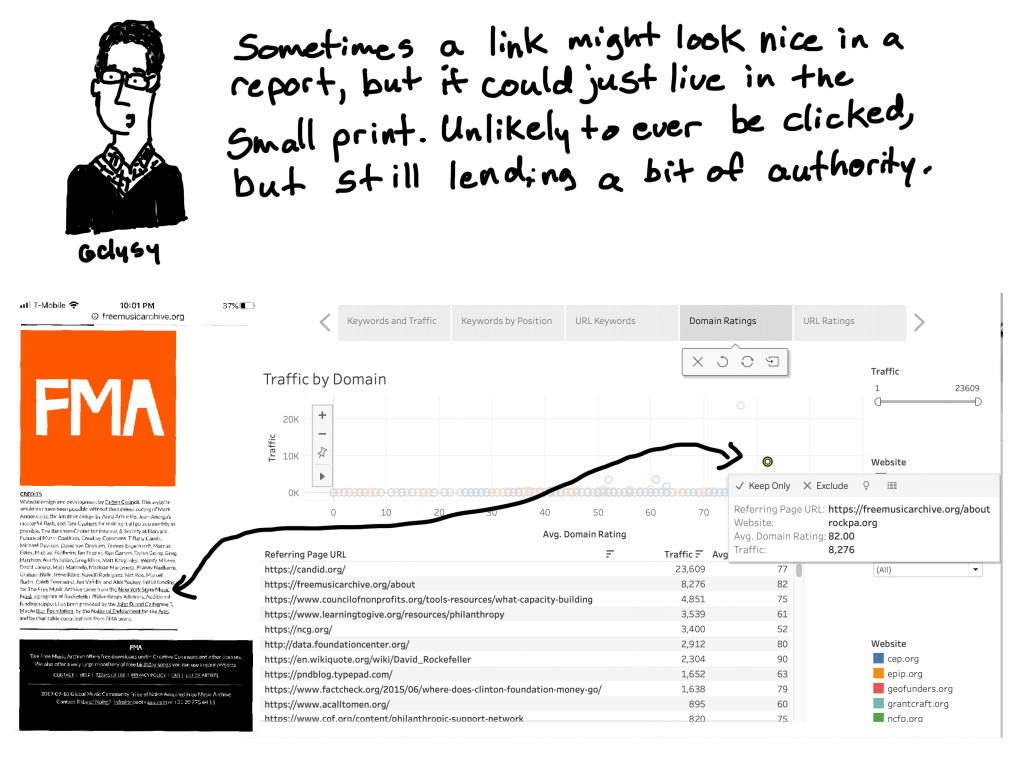
Sometimes a link might look nice in a report, but it could just live in the small print. Unlikely to ever be clicked, but still lending a bit of authority.
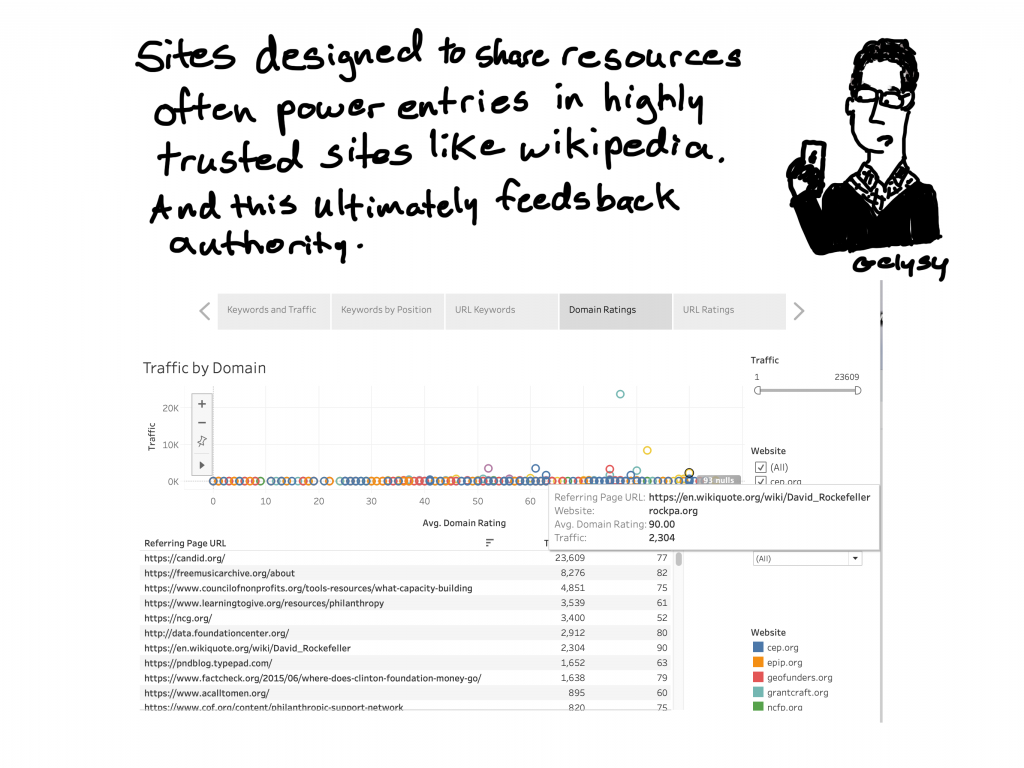
Sites designed to share resources often power entries in highly trusted sites like wikipedia. And this ultimately feeds back authority.
I think my favorite thing about backlinks is that they can uncover under the radar traffic sources. Those types of websites also offer really good partnership potential for future campaigns.
So after all of that, which site is the best?
I have no idea.
Sites with not-for-profit missions can't be evaluated in the same way as business sites or fundraising campaigns.
Sometimes the goal is really to connect with a specific small niche audience. Other times the goal is to provide information on obscure topics that will never draw much in the way of search engine traffic.
But here is what I do know. 
There are big useful data sources that are vastly underutilized.
A single Tableau Desktop license can boost the analysis potential.
In this analysis, I have only skimmed the surface of what is possible.
Evidence is always better in context, traditional analytics approaches lack the ability to analyze comparison sites.
And if you're running a site like this, here is my advice.
Don't try to create a resource.

Create THE resource.

The resource everyone else will want to link.
Collaborate (don't compete) with friends and partners. Shared authority boosts authority.
Don't create just a single post. Create a series. Systematically cover lots of ground. Depth is created with lots of little posts.
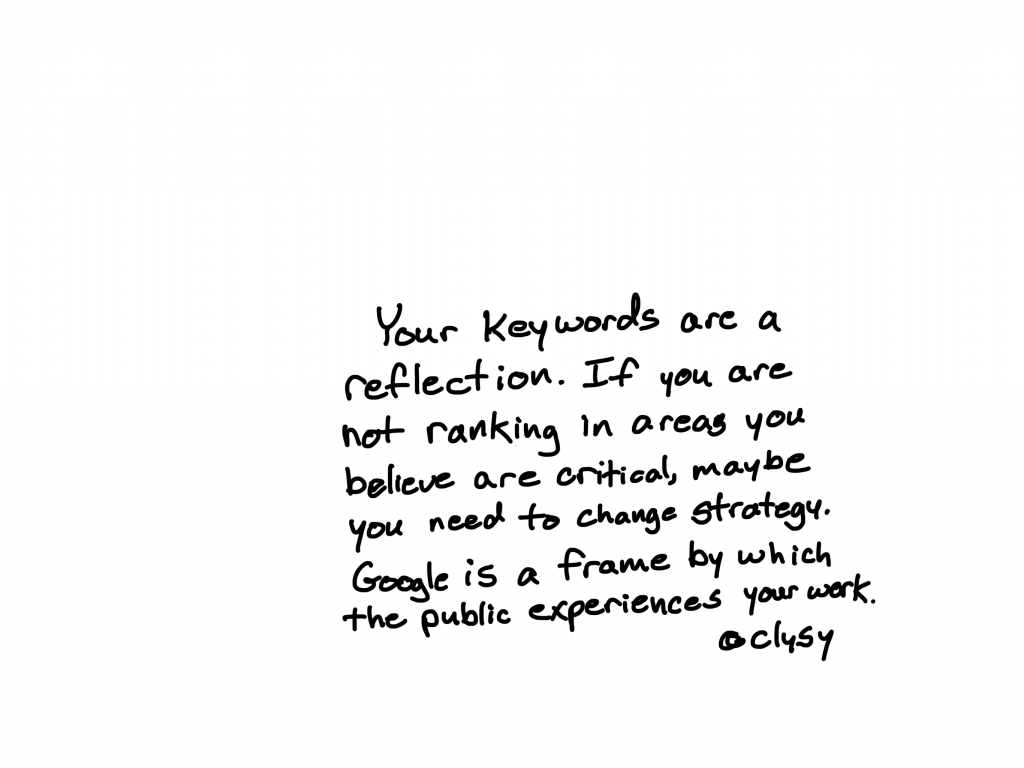
Your keywords are a reflection. If you are not ranking in areas you believe are critical, maybe you need to change strategy. Google is a frame by which the public experiences your work.
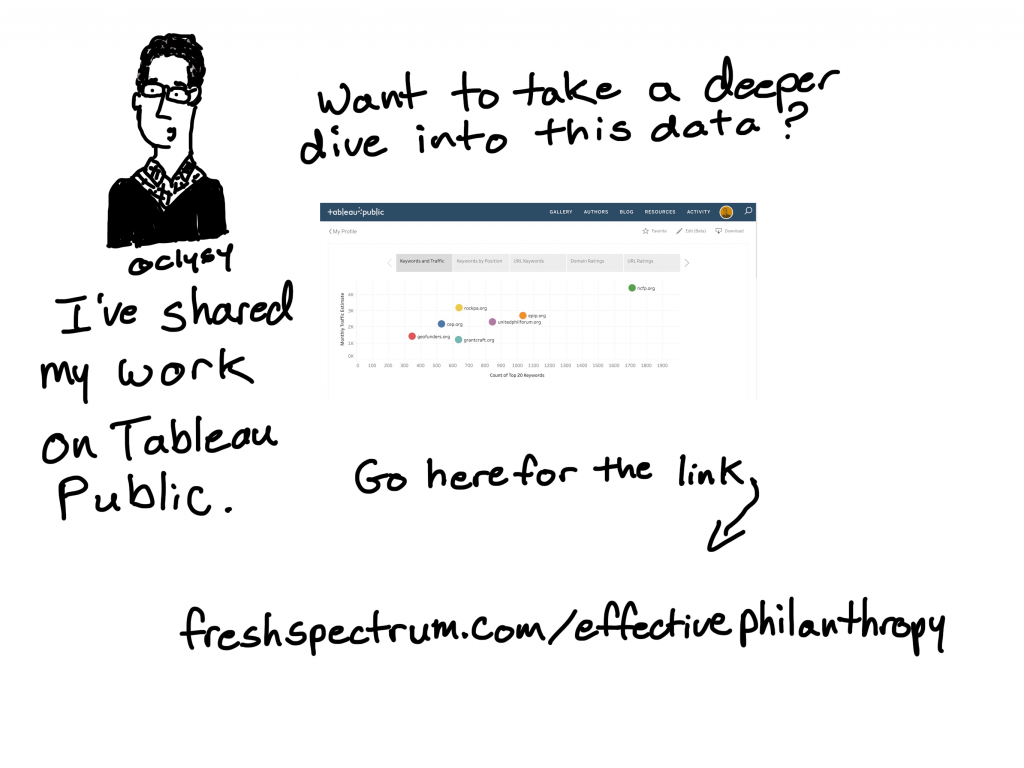
Want to take a deeper dive into this data?
I've shared my work on Tableau Public.  Go here for the link.

freshspectrum.com/effectivephilanthropy

You can see it here, or click this link to peruse it on Tableau’s site.

Written by cplysy · Categorized: freshspectrum

Jan 28 2020

Structured Solutions’ New Service Packages

You may notice that the website has gotten a bit of an overhaul. I wanted to better communicate what clients get from working with me and what makes Structured Solutions different from other small evaluation firms. 

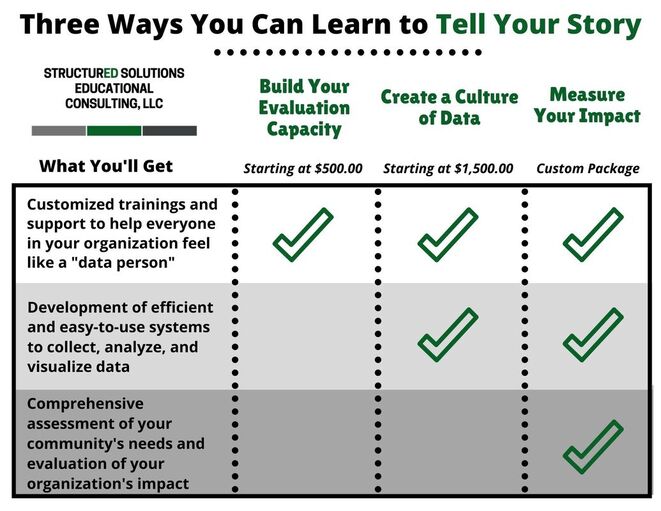
The biggest change is that I’ve restructured the services I provide. There are now three distinct packages that clients can buy — all still customizable, of course — that will help you achieve your data and evaluation goals. The graphic below gives a quick overview, but I go into more detail below:

Picture

All three packages are designed as steps that organizations can take towards telling a rich, compelling story about the work they do for students and families and the impacts they have on their clients. Here are the details about each package: 

BUILD YOUR EVALUATION CAPACITY
For organizations who are truly at the start of their data journey, this package is an ideal starting point. Your organization will get a customized training and follow-up technical assistance in the areas you need. The goal is for your entire team to leave the training with confidence that they can work with and use data like a pro. 

CREATE A CULTURE OF DATA
The second package builds on the first and will include the custom trainings and support from Build Your Evaluation Capacity. After your team has been trained, we will get to work on developing data systems and procedures that are accessible to all skill levels. Depending on your organization’s needs, we will create simple, customized systems for data collection, management, or visualization that allow for sustainability and continued attention to data in the future.

MEASURE YOUR IMPACT
In order to truly tell your organization’s story, you must first know what impact you’re actually having. The third package gives you all of the benefits of the first two but will culminate in a full-scale needs assessment or evaluation. As this type of work tends to be highly individualized and ongoing, we will work together to design a package that fits your needs and ensures that any evaluative requirements from funders or supervising organizations are met. 

If your organization is in the beginning stages of its data journey and could use some support, I’d love to set up a conversation with you. 

Written by cplysy · Categorized: engagewithdata

Jan 24 2020

How to Kick Off Your Evaluation Kick-Off Meeting


So you landed an evaluation contract and the first meeting date is set. Here are some pointers for kicking your evaluation off on the right foot.

Determine who is going to chair the evaluation meetings

It is important to determine who is going to plan and run the evaluation meetings. You do not necessarily need to be the person to plan and run the evaluation meetings; however, as the evaluator you should work closely with that person to ensure the agenda items include what it is you want/ need to discuss as the evaluation progresses.

Work with the meeting chair on meeting logistics

The meeting chair will likely be able to advise on meeting logistics (e.g. date, meeting location). However, you should work with the meeting chair and advise on the length of time for the first meeting, as well meeting attendees. I like to schedule the kick off meeting for 1.5 to 2 hours -1 hour is not enough time and anything over 2 hours and you start to lose people’s attention.

The meeting attendees should include your evaluation’s primary intended users. While you might not know who these people are at your first meeting, the meeting chair can help advise on who should be included in the evaluation meeting. Once you conduct your stakeholder analysis you can always invite the people that were not included from the beginning.

Request program documentation in advance

You may have received some high level information to inform the development of your proposal; however, it is best to request and review additional project documentation prior to your kick off meeting. You will likely want to get your hands on any documentation that outlines goals, objectives and activities of the program (more recent is better). Likewise, any previous evaluation reports are always useful. Previous evaluations show you what has been collected, any previous measurement challenges or limitations, and recommendations going forward – all of which are useful for your future evaluation planning.

Work with the meeting chair to set the meeting agenda

The program documentation that you reviewed in the previous step likely uncovered a lot of questions you want to hash out in your first meeting. However, temper your expectations for what you will cover in the first meeting. Your kick-off meeting is really about getting to know one another and beginning to build a shared understanding around the program and how it will be evaluated. Subsequent meetings are where you can really start digging in to what you need to build that evaluation plan. With that in mind, below is a sample agenda for your first evaluation meeting.


Agenda: Evaluation Kick-Off Meeting

  1. Introductions and icebreaker

  2. Program overview

    a. What is the program trying to achieve?

    b. What are its core activities?

  3. Evaluation stakeholders

    a. Who wants to know what?

    b. What will they use the information for?

  4. Evaluation principles

    a. What are some important considerations that should guide and inform the evaluation?

  5. Confirm project timelines and next meeting date(s)

Introductions and icebreaker

The kick off meeting is a chance to get out of the way people’s assumptions or negative ideas regarding evaluation and energize people about what evaluation can be. With that in mind, I like the first item on the agenda to be introductions, coupled with a bit of an icebreaker. You can keep it simple and have people introduce themselves and answer a question, such as “what comes to mind when you think of evaluation?” If you want to get a bit more creative, I have also asked people to look in their wallet and select an object they feel represents their feelings related to evaluation. Either way, this icebreaker will help you determine the evaluation perceptions people are coming to the table with. After everyone has introduced themselves I like to introduce myself, reflect on what was heard from people relating to evaluation, and then talk about my approach to evaluation.

Program overview

This is when it’s really important to put on your listening ears. As an evaluator it’s always important to listen, but it is especially important when learning about the program. Even if you are a subject matter expert, it is crucial to hear how others describe their work and how consistent or inconsistent that is with others at the meeting. Since the discussion is so important, I will often times ask to record it. Recording the discussion allows me to go back and listen for discrepancies or differing assumptions that can be addressed later on in evaluation planning. While it is valuable to have a completed evaluation plan, what is even more valuable is the process to get there and all the rich discussions you facilitate through that process.

Evaluation stakeholders

Why the evaluation is being conducted and how the information generated will be used will differ depending on the stakeholder. Your goal in this meeting is to get a general lay of the land of who is interested in what, and how they will use the information; most importantly, it will be to identify those primary intended users. Primary intended users will be your go-to’s and the ones you should be tailoring your evaluation to. They are the people with the “willingness, authority and ability” to put the evaluation findings to use. You don’t need to overcomplicate it – often times, after generating a stakeholder list and discussing it, I will just ask the group who these people are. If the primary intended users are not at the first meeting, make sure to catch them up after the meeting and invite them to subsequent ones!

Evaluation principles

It is likely that with the icebreaker described above that you will have touched on quite a few evaluation principles. If not, it is important to know people’s expectations for the evaluation and how it should be conducted. As described above, stakeholders have different wants and needs for the evaluation, but we can’t be all things to all people. Coming to a consensus on principles for the evaluation is helpful for providing direction when you are being pulled in all different directions! I am just starting to address this in my current evaluations, but I can already see the value principles serve for laying out expectations from the start. For more information on evaluation principles refer to Michael Quinn Patton’s Principles-Focused Evaluation: The Guide.

Confirm project timelines and next meeting date(s)

If you can get through all of the above, then pat yourself on the back because you are a rockstar! But don’t forget to leave time at the end of the meeting to wrap-up. If you have a good meeting chair they will leave time to summarize the action items and discuss timelines and meetings dates. If not, leave 10 minutes at the end of the meeting to review timelines with the group. If you have an upcoming deliverable that requires more discussion from the group, then that will help you determine when your next meeting(s) should be (i.e. before that deliverable due date).


That is a lot of ground to cover in one meeting. I always like to put more on the agenda than less. It takes a lot of time and effort to organize meetings so it is important to utilize as much of that time as you can; of greater importance is to be fully prepared and to utilize that time effectively. If you have a lot of ground to cover at your first kick-off meeting and are worried you won’t adequately cover it, then don’t feel like because it is called a “meeting” that it needs to resemble a traditional meeting format. I try to facilitate discussion through methods other than sitting around a big table and talking in a big group (don’t you find it is usually only a fraction of the people talking while the rest are too disinterested or unsure to speak?). So tape some big white sheets of paper around the room, write the questions outlined on the agenda at the top, and get your group up and jotting down ideas on each sheet. Depending on the size you may be able to discuss in one group. If not, break people into smaller groups and have them discuss and present back. No one says meetings need to entail sitting at a table – trust me, people are more energized, engaged, and willing to share when you remove that physical barrier (i.e. the meeting table) and literally come together.

So to sum it up…

When pressed for time and when we want to get going on an evaluation it is easy to default into jumping into timelines and deliverables at the kick-off meeting. While important, what is more important is carving out some time to talk (and listen!) about the program, what it is trying to achieve, how it is trying to do that, and how evaluation can support the work of the program. Aim for that at your next kick-off meeting and you’ll set yourself up to kick some ass!


Sign up for our newsletter

We’ll let you know about our new content, and curate the best new evaluation resources from around the web!


We respect your privacy.

Thank you!


Written by cplysy · Categorized: evalacademy

Jan 24 2020

Theory of Change Template (Get Useful Nonprofit Data)

Written by cplysy · Categorized: connectingevidence

  • « Go to Previous Page
  • Go to page 1
  • Interim pages omitted …
  • Go to page 282
  • Go to page 283
  • Go to page 284
  • Go to page 285
  • Go to page 286
  • Interim pages omitted …
  • Go to page 304
  • Go to Next Page »

Footer

Follow our Work

The easiest way to stay connected to our work is to join our newsletter. You’ll get updates on projects, learn about new events, and hear stories from those evaluators whom the field continues to actively exclude and erase.

Get Updates

Want to take further action or join a pod? Click here to learn more.

Copyright © 2026 · The May 13 Group · Log in

en English
af Afrikaanssq Shqipam አማርኛar العربيةhy Հայերենaz Azərbaycan dilieu Euskarabe Беларуская моваbn বাংলাbs Bosanskibg Българскиca Catalàceb Cebuanony Chichewazh-CN 简体中文zh-TW 繁體中文co Corsuhr Hrvatskics Čeština‎da Dansknl Nederlandsen Englisheo Esperantoet Eestitl Filipinofi Suomifr Françaisfy Fryskgl Galegoka ქართულიde Deutschel Ελληνικάgu ગુજરાતીht Kreyol ayisyenha Harshen Hausahaw Ōlelo Hawaiʻiiw עִבְרִיתhi हिन्दीhmn Hmonghu Magyaris Íslenskaig Igboid Bahasa Indonesiaga Gaeilgeit Italianoja 日本語jw Basa Jawakn ಕನ್ನಡkk Қазақ тіліkm ភាសាខ្មែរko 한국어ku كوردی‎ky Кыргызчаlo ພາສາລາວla Latinlv Latviešu valodalt Lietuvių kalbalb Lëtzebuergeschmk Македонски јазикmg Malagasyms Bahasa Melayuml മലയാളംmt Maltesemi Te Reo Māorimr मराठीmn Монголmy ဗမာစာne नेपालीno Norsk bokmålps پښتوfa فارسیpl Polskipt Portuguêspa ਪੰਜਾਬੀro Românăru Русскийsm Samoangd Gàidhligsr Српски језикst Sesothosn Shonasd سنڌيsi සිංහලsk Slovenčinasl Slovenščinaso Afsoomaalies Españolsu Basa Sundasw Kiswahilisv Svenskatg Тоҷикӣta தமிழ்te తెలుగుth ไทยtr Türkçeuk Українськаur اردوuz O‘zbekchavi Tiếng Việtcy Cymraegxh isiXhosayi יידישyo Yorùbázu Zulu