• Skip to main content
  • Skip to footer
  • Home

The May 13 Group

the next day for evaluation

  • Get Involved
  • Our Work
  • About Us
You are here: Home / Archives for cplysy

cplysy

Jul 29 2023

Planificando un sistema de información efectivo

Para una información más funcional y transparente (a nivel estratégico y operativo) se debe planificar y presupuestar el proceso de gestión de la información, cantidad y calidad de información, en cada una de los siguientes SIETE aspectos:

(1) diagnosticar las necesidades de información actuales y futuras de la organización;

(2) analizar  la información ya almacenada y la no existente: qué información está disponible y qué uso se hace de ella;

(3) Determinar la calidad de la información:

Generar información de calidad como pre requisito para su gestión

Sistematizar los aspectos relacionados con la precisión, el detalle, la frecuencia, el formato, la ubicación y mantenimiento de la información;

(4) considerar diferentes criterios, niveles y unidades en relación a las necesidades de información para diferentes actores:

(i) criterios de funcionalidad (¿para qué? ¿para quién?);

(ii) unidades de análisis (¿cómo?);

(iii) niveles de agregación (¿dónde y cómo?);

(5) Gobierno del sistema de información, apropiación y participación

Identificar cómo los actores implicados demandan, generan, utilizan e intercambian información; y fomentar la participación de los agentes implicados en el diseño, implementación y seguimiento de la estrategia de información;

Comprender los vínculos entre información, participación y poder: liderazgo y uso de la información

(6) estimar los recursos necesarios para poner en práctica la estrategia de información;

(7) establecer un sistema de seguimiento y evaluación de la estrategia de información.

Referencias:

Rodríguez-Ariza, C. (2010) “La gestión de la información en organizaciones de desarrollo (vol.II) El caso de los departamentos de las administraciones públicas españolas que trabajan a través de las ONGD. Un reto y un compromiso asociado a la agenda de calidad de la ayuda”. Nº 11 / 2010

Written by cplysy · Categorized: TripleAD

Jul 25 2023

Capture Your Baseline For Change-Making

If you are looking to make a change and demonstrate it to others, there’s one thing you must do: capture your baseline.

A baseline is your starting point. It can be done with whatever available data you have – the more specific, detailed and well-fitting, the better. However, don’t let the perfect be the enemy of the necessary.

Change is only understood as a from-to relationship. A situation starts as one thing and then changes to another. Too often, we see (and hear) people speaking of change in retrospect. We only understand change retrospectively, but it has to related to some starting point.

If you’re looking to initiate change, document what things are like before you start. This might mean measuring the presence of something (e.g., resources, sales figures, client service visits, etc..) or taking observations. Details help because it helps capture the specific aspects of the thing you want to change.

Our recommendation: take stock of what data you have on what you want to see change. Gather what you have to the best of your ability and consider what can be compared over time. Change is a comparison of like things — numbers to numbers, experiences to experiences, observations to observations etc.. You can always add additional layers of data gathering over time.

We would rather see an organization take action with limited data to start with than wait to have the perfect or ideal dataset in place. Look around, see what you have and use that as your baseline.

When you tell the story of change, that will be what you start with.

Are you unsure of what you have? We’ll bet you have much more data than you realize, and we can help you use that to capture stories of change over time. Let’s talk about how we can help you.

Photo by arvin keynes on Unsplash

The post Capture Your Baseline For Change-Making appeared first on Cense Ltd. .

Written by cplysy · Categorized: cameronnorman

Jul 17 2023

Una función de evaluación útil (I)

Caroline Heider, reflexionando sobre cómo establecer una función de evaluación útil, indicaba que es un acción que requiere equilibrios; e indicaba la importancia crítica de cuatro elementos: utilidad, imparcialidad, credibilidad y alcance.

Una función de evaluación útil también requiere múltiples capas, desde (a) un entorno propicio, pasando por (b) sistemas institucionalizados y (c) aptitudes y habilidades individuales, e implica un proceso iterativo con una visión a largo plazo, tácticas adaptables y correcciones de curso continuas.

En torno al «Entorno propicio«, hoy en día, el respaldo del liderazgo y de políticas sigue siendo necesario: las oficinas de evaluación generalmente se ven presionadas cuando informan evidencia que contradice las normas o las direcciones estratégicas existentes, pero también debe ir de la mano con una cultura que adopte el aprendizaje y responsabilidad.

En tal cultura, cada una de las partes necesita aportar su parte:

• La evaluación debe trabajar con los más altos estándares profesionales y con una clara intención de ayudar a mejorar los resultados y el desempeño.

• La gerencia debe crear una atmósfera de rendición de cuentas en lugar de culpa para garantizar una conducta responsable, el aprendizaje y las correcciones del curso en el cronograma, y la

• El organismo de supervisión, como las juntas ejecutivas o los parlamentos, debe responsabilizar a la institución o al gobierno e incentivar el aprendizaje.

Written by cplysy · Categorized: TripleAD

Jul 13 2023

Closest to the Problem, Closest to the Solution

When you’re closest to the problem, you’re closest to the solution. I’ve fallen down the rabbit hole of philanthropy. Specifically, how funders engage with and invest in communities and nonprofits. Most nonprofits have an ambivalent relationship with funders. They need funding to survive, but also wished they didn’t have to largely depend on philanthropy to do […]

The post Closest to the Problem, Closest to the Solution appeared first on Nicole Clark Consulting.

Written by cplysy · Categorized: nicoleclark

Jul 06 2023

Stop trying to create Goldilocks reports.

You know the story of Goldilocks and the three bears?

Little girl breaks into the house of three bears while they’re out for a walk. Then proceeds to eat their food, break one of their chairs, and eventually falls asleep in one of their beds.

The story came to mind when I was thinking about modern reporting challenges. Which I know makes absolutely no sense at all, but I stopped trying to understand my mind years ago. But I digress.

I think there is a lot we can get from the story that we can apply to how we report. Just not in an obvious way.

Goldilocks and the Three Reports

One day Goldilocks was talking to her organization’s evaluator about a few of the reports set to go out to their stakeholders.

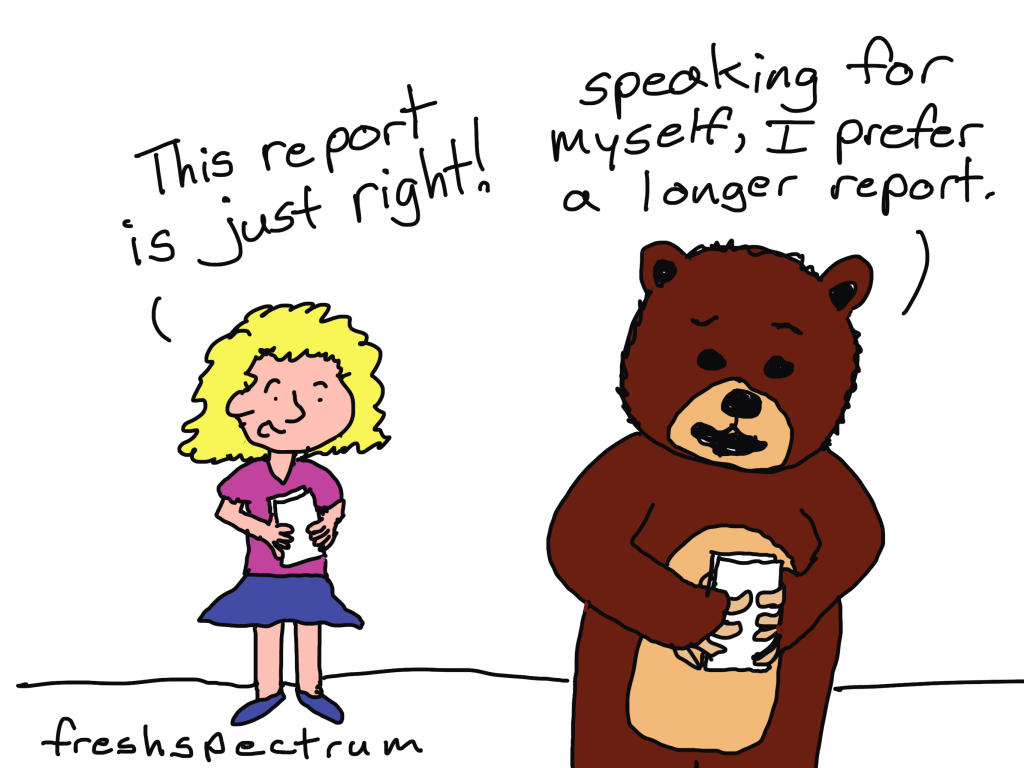
According to Goldilocks, the first report, the one designed for the large bear, was too long. It also had too few pictures and charts.

The second report, the one designed for the medium bear, was too short. This one had too many pictures and charts given the length.

Now the third report, the one designed for the little bear, was just right. Goldilocks loved everything about this report.

And because Goldilocks was the evaluator’s direct supervisor, she instructed the evaluator trash the too long report and the too short report. Because the “just right” report is the best of the bunch and why should the organization share anything that’s not the best?

So what’s the problem?

The “just right” report is only “just right” for Goldilocks (who is not the target audience) and for one of the three bears (who are part of the target audience).

By picking just the one report, she excluded 67% of the target audience. Not because the other reports didn’t work, but because the other reports didn’t match her vision of a good report.

Unfortunately this happens all the time.

We often design reports for just a small portion of our audience. And the reports that get the green light are the ones preferred by those with authority.

What to do instead.

The simple answer. Create and share all three reports. Actually, create more reports than that if you can.

Stop assuming that one report can do it all.

Want to learn how to approach reporting in a modern kind of way?

Join me for a free webinar on July 18 at 3PM Eastern.

Click the image below to learn more and register.

https://www.eventbrite.com/e/designing-with-chris-tickets-672609191197

Written by cplysy · Categorized: freshspectrum

  • « Go to Previous Page
  • Go to page 1
  • Interim pages omitted …
  • Go to page 80
  • Go to page 81
  • Go to page 82
  • Go to page 83
  • Go to page 84
  • Interim pages omitted …
  • Go to page 304
  • Go to Next Page »

Footer

Follow our Work

The easiest way to stay connected to our work is to join our newsletter. You’ll get updates on projects, learn about new events, and hear stories from those evaluators whom the field continues to actively exclude and erase.

Get Updates

Want to take further action or join a pod? Click here to learn more.

Copyright © 2026 · The May 13 Group · Log in

en English
af Afrikaanssq Shqipam አማርኛar العربيةhy Հայերենaz Azərbaycan dilieu Euskarabe Беларуская моваbn বাংলাbs Bosanskibg Българскиca Catalàceb Cebuanony Chichewazh-CN 简体中文zh-TW 繁體中文co Corsuhr Hrvatskics Čeština‎da Dansknl Nederlandsen Englisheo Esperantoet Eestitl Filipinofi Suomifr Françaisfy Fryskgl Galegoka ქართულიde Deutschel Ελληνικάgu ગુજરાતીht Kreyol ayisyenha Harshen Hausahaw Ōlelo Hawaiʻiiw עִבְרִיתhi हिन्दीhmn Hmonghu Magyaris Íslenskaig Igboid Bahasa Indonesiaga Gaeilgeit Italianoja 日本語jw Basa Jawakn ಕನ್ನಡkk Қазақ тіліkm ភាសាខ្មែរko 한국어ku كوردی‎ky Кыргызчаlo ພາສາລາວla Latinlv Latviešu valodalt Lietuvių kalbalb Lëtzebuergeschmk Македонски јазикmg Malagasyms Bahasa Melayuml മലയാളംmt Maltesemi Te Reo Māorimr मराठीmn Монголmy ဗမာစာne नेपालीno Norsk bokmålps پښتوfa فارسیpl Polskipt Portuguêspa ਪੰਜਾਬੀro Românăru Русскийsm Samoangd Gàidhligsr Српски језикst Sesothosn Shonasd سنڌيsi සිංහලsk Slovenčinasl Slovenščinaso Afsoomaalies Españolsu Basa Sundasw Kiswahilisv Svenskatg Тоҷикӣta தமிழ்te తెలుగుth ไทยtr Türkçeuk Українськаur اردوuz O‘zbekchavi Tiếng Việtcy Cymraegxh isiXhosayi יידישyo Yorùbázu Zulu