• Skip to main content
  • Skip to footer
  • Home

The May 13 Group

the next day for evaluation

  • Get Involved
  • Our Work
  • About Us
You are here: Home / Archives for cplysy

cplysy

Jun 29 2023

Pensamiento evaluativo para la evaluabilidad

En El pensamiento evaluativo en el ciclo de gestión y planificación ya identificamos algunos de los comportamientos en las organizaciones que son indicativos del pensamiento evaluativo en cada fase central de sus operaciones:

1.Desarrollo y diseño del programa

• Evaluar sistemáticamente el contexto de los servicios y programas para identificar brechas, redundancias y tendencias.

• Evaluar sistemática y regularmente (con datos) nuestra propia capacidad de crecimiento y nuestras capacidades para nuevos servicios.

• Incorporar los hallazgos de la evaluación en el diseño del programa.

• Involucrar a múltiples grupos de partes interesadas (beneficiarios, personal, gerentes, expertos, etc.) en el diseño y la planificación del programa.

• Desarrollar y documentar teorías y modelos de programas para guiar la implementación.

• Mejorar la evaluabilidad y desarrollar estrategias de evaluación desde/en el momento del diseño del programa para asegurar que la recopilación de datos sea significativa y manejable y esté integrada en las operaciones del programa.

• Integrar procesos de evaluación, reflexión, aprendizaje y mejora en los ciclos regulares del programa.

2.Gestión de programas

• Monitorear y reflexionar regularmente sobre los datos e informes que describen el proceso de implementación y la calidad del programa.

• Establezcamos tiempo y espacio para reflexionar regularmente como equipo sobre lo que funciona y lo que no funciona.

• Identifiquemos continuamente oportunidades de mejora.

• Incorporemos datos recopilados para adaptaciones y correcciones de rumbo en tiempo real.

3.Evaluación del Programa

• Recopilar datos con regularidad para describir y evaluar las características, actividades, productos y resultados del programa.

• Involucrar a múltiples grupos de partes interesadas (beneficiarios, personal, gerentes, expertos, etc.) en el desarrollo y revisión de planes y herramientas de evaluación, así como en la interpretación y uso de datos.

• Compartamos los resultados de la evaluación del programa con múltiples grupos de partes interesadas en formatos útiles y significativos.

• Utilicemos los resultados de la evaluación del programa para el aprendizaje y la mejora del programa en sí, así como de las estrategias y herramientas de evaluación.

• Garanticemos la formación, las herramientas y el apoyo adecuados para los esfuerzos de evaluación continuos y significativos.

4.Interacción con las poblaciones objetivo

• Evaluar periódicamente las necesidades de las poblaciones objetivo, así como de los beneficiarios individuales, y utilizar esos datos para informar la estrategia organizacional, el diseño y la mejora del programa, el aprendizaje y la mensajería.

• Evaluar periódicamente la satisfacción de l@s beneficiari@s y otros indicadores de calidad (compromiso, retención, etc.).

• Usar la satisfacción de los beneficiari@s y los datos de resultados conjuntamente para mejorar los programas.

5.Desarrollo de capacidades del personal

• Llevar a cabo una evaluación anual del desarrollo del personal necesario para asegurar la implementación exitosa de los programas existentes, para prepararse para cambios en el entorno o programa y para adoptar las mejores prácticas emergentes.

• Desarrollar un plan y evaluar el desarrollo del personal.

• Evaluar el impacto de los esfuerzos de desarrollo profesional (talleres, seminarios web, etc.) sobre las capacidades y el desarrollo del personal.
Written by cplysy · Categorized: TripleAD

Jun 28 2023

Access is NOT a Vanity Metric

Do you ever think about the amount of work that goes into a conference presentation?

How many hours do people spend planning their conference proposal, meeting with collaborators, putting together their presentation (or poster), traveling to the event, and then eventually presenting?

And then they complain that having a blog would take too much of their time.

This has bugged me for years. In fact, it was the topic of my first ever American Evaluation Association conference presentation. It was an ignite session that just so happened to be recorded and posted to YouTube.

Fun facts. I had dark hair then, it’s pretty much all gray now! It was at the start of “Movember” (to explain the peach fuzz). I had also just purchased my first iPad, which launched my cartooning. After the presentation, Kylie Hutchinson gave me a hug (we had never met before this moment).

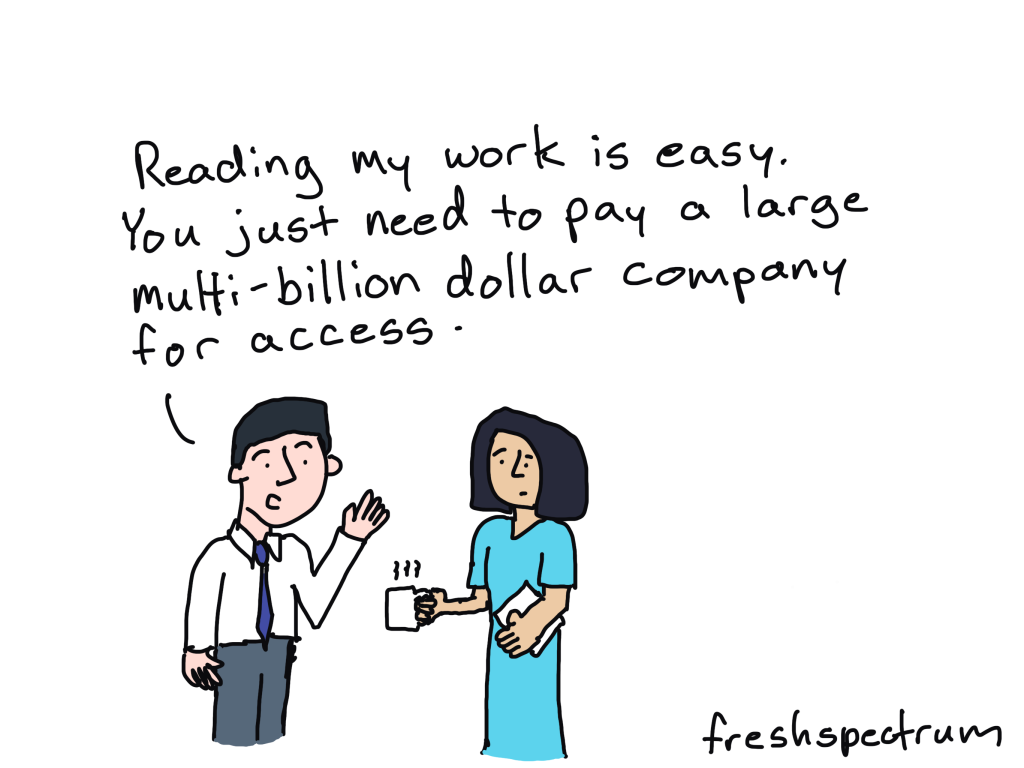
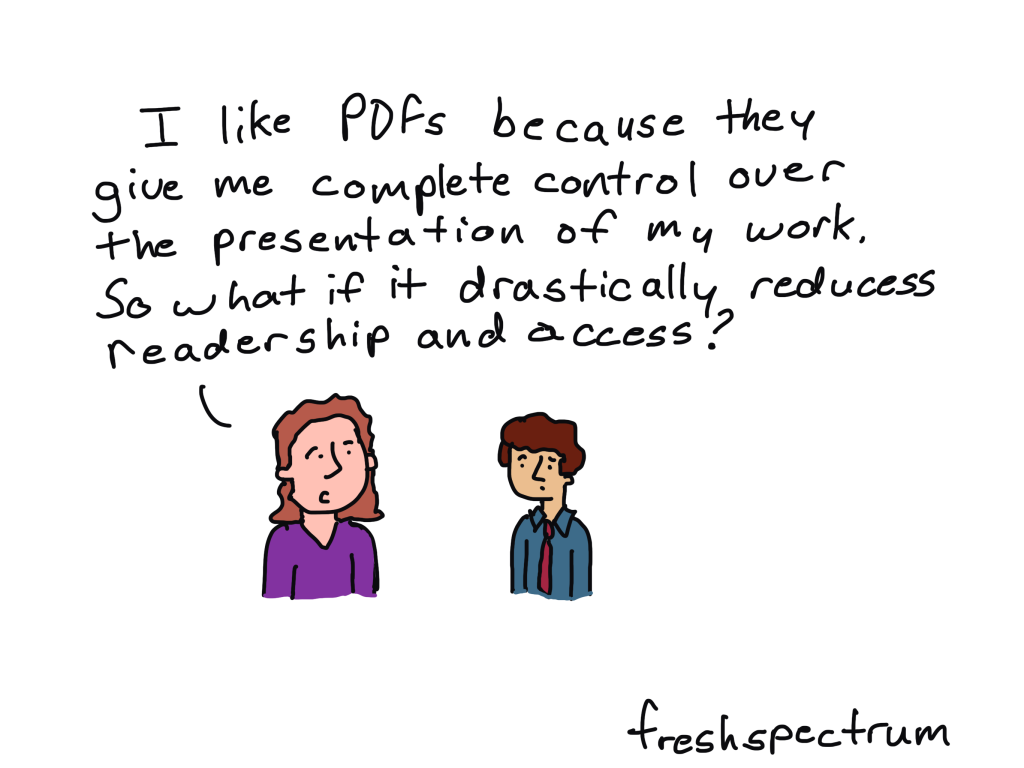
Academic conferences and journals restrict access (so do PDFs)

An academic conference can be exclusive. It often requires physical participation, registration fees, and insight into when and where it will take place.

A journal article can be exclusive. It often requires a hefty subscription, enrollment in a University, or membership in an association. You also have to have the patience/ability to read academic-speak that likely has little to no illustrations.

A PDF report or guide is often exclusive. It does not show up easily in search engines or on social media, does not change to meet the needs of mobile phones, cannot be quickly auto-translated by a tool like Google Translate, and is usually written in the same academic-speak found in journal articles.

Increase Access through Adaptation

I have learned a lot over the last 12 years since I delivered that presentation.

One of the things that I’ve learned is that trying to change the way academically trained researchers and evaluators write and share their work is not really a good idea. It’s not a lost cause, just really inefficient.

The better way to increase access faster is to just adapt their work. For instance, you can…

  • take a PDF and adapt it into an HTML-based report.
  • take a long wordy report and adapt it into a string of infographics.
  • take a report written at a post-graduate reading level and adapt it into a report that doesn’t require more than a lower secondary education level.
  • turn big tables or complicated charts into nice, easy-to-follow charts.
  • turn qualitative interview transcripts into a story collection.

There is no one right way to share or ensure access. But the more we do to adapt, the more accessible our work becomes. And there is so much more value in adaptation than there is in revision.

If you want help. I can help.

This is my job.

  • I can turn your pdf report into a html report.
  • I can turn your long reports into a string of infographics.
  • I can help you create illustrated versions of your resources for more appropriate reading levels.

All you have to do to get started, is grab a slot on my calendar.

https://calendly.com/clysy/30min

Written by cplysy · Categorized: freshspectrum

Jun 26 2023

Barreras para el aprendizaje en nuestras instituciones

Las instituciones y las personas cometemos errores, pero ¿por qué no aprendemos de estos errores? ¿Por qué seguir repitiendo los mismos errores? Mirando esto en términos de Aprendizaje Organizacional, y comparando con las dimensiones de una Cultura de Aprendizaje, existen varias barreras culturales para el Aprendizaje de las instituciones. Estos son los siguientes:

1.Corto plazo. Este es quizás el mayor problema: que la mayoría o todos los incentivos institucionales son a corto plazo: La próxima elección de dirigentes, la próxima Junta Directiva, la próxima reunión global de coordinacion, el próximo ciclo de planificación.  En la práctica, ¿cómo pensar más allá de 4/5 años? Todos los incentivos están a favor de ser decisivos y no deliberativos, de actuar y de ser vistos, y luego seguir adelante. Los incentivos a largo plazo para el aprendizaje y la deliberación simplemente no existen o son bajos, lo que influye en el tipo de responsabilidad y rendición de cuentas hacia el largo plazo.

2.Una cultura del “conocedor/a” en lugar de una cultura “aprendiz/a”. Existen vacíos masivos de habilidades y conocimientos en las instituciones y, sin embargo, no parece haber un deseo ardiente de llenar estos vacíos. Los tomadores de decisiones parecen confiar en lo que “saben que saben”, incluso cuando ese conocimiento está desconectado culturalmente y tiene prejuicios intelectuales. Cuando se identifican las lagunas de conocimiento, éstas parecen tardar en cubrirse.

3.Falta de honestidad y “decir la verdad al poder”. La naturaleza poderosa, decisiva y ambiciosa de los líderes o dirigentes hace que sea difícil decir “esto nunca funcionará”. Es difícil decirle al poderoso lo que no quiere escuchar, o por qué su iniciativa favorita está condenada al fracaso.

4.Una falta de desafío a la verdad o al saber «aceptados”. Sin este desafío, el problema del Pensamiento de Grupo nunca desaparece. ¿Dónde estaba la voluntad de preguntar si ”nos estamos perdiendo algo”? ¿Nuestras suposiciones resisten el desafío? Sin desafío y discusión, los errores se perpetúan. Qué pasa en las instituciones que nos son capaces de cuestionarse a sí mismas, ni siquiera internamente…

Fuente Barreras culturales para el Aprendizaje Gubernamental

Written by cplysy · Categorized: TripleAD

Jun 25 2023

¿Por qué la colaboración es tan compleja entre organizaciones de desarrollo?

Al trabajar en problemas sociales complejos, ningún actor, ni siquiera el más poderoso, puede lograr mucho por sí mismo. El sector social necesita más y mejor colaboración para lograr un impacto, pero ¿por qué la colaboración es tan compleja en la práctica? Hay cuatro barreras importantes e interrelacionadas para el impacto colectivo:

1. Comparación de sectores privado y desarrollo social: La primera barrera es la tendencia del sector del desarrollo de búsqueda de comparaciones con el sector privado, entre las dinámicas de los sectores privado y no lucrativo. La principal diferencia es la ausencia de un mercado explícito de oferta y demanda en el sector no lucrativo del desarrollo social, aunque sí exista una competencia implícita por recursos financieros (donantes) y a veces por zonas de trabajo y destinatarios finales (socios, beneficiarios, clientes, sujetos de derecho…).

2. Incentivos de medición desalineados: El segundo factor que trabaja en contra de la colaboración es un esfuerzo excesivo en la causalidad y la atribución. Las organizaciones intentan demostrar su responsabilidad y mostrar a sus juntas directivas sus logros, creando entonces consecuencias negativas no deseadas, como, por ejemplo, demasiada energía dedicada en obtener reconocimiento o en construir una “marca”. Esto lleva a un esfuerzo excesivo en la institución individual que se convierte en «la unidad de análisis» (en lugar del impacto colectivo), que en realidad socava la fuerza colectiva.

3. Dinámica de poder: La dinámica de poder entre los donantes / financiadores y sus colaboradores más importantes, así como los intermediarios y los sujetos de derecho, es otro impedimento para una colaboración exitosa. Rodeados de aduladores y aspirantes a obtener financiación, los donantes / financiadores viven en una burbuja de positividad.

Esta dinámica se traduce en la forma en la que los actores y organizaciones comparten los problemas con sus financiadores / donantes. En caso de fallo o fracaso, en el peor de los casos, tanto las organizaciones receptoras, como los sujetos de derecho retienen información crucial para sus donantes/financiadores por temor a penalizaciones o sanciones. Esta información retenida en muchos casos se pierde y no se utiliza para la mejora. Los financiadores, a su vez, están protegidos y desconectados, no solo de los sujetos de derecho, sino también de otros decisores más importantes.

4. Ego: El cuarto factor que conspira para inhibir la colaboración organizacional es el ego: “Quiero que colabores conmigo, pero no quiero colaborar contigo”. Escuchamos interminables charlas de liderazgo, apalancamiento, e “influencia sobre otros actores”. Pero a veces lo que estamos buscando en realidad es simplemente un buen número de seguidores.

Nuestro reto: una buena colaboración entre los donantes y los sujetos de derecho, del tipo que supera estas cuatro barreras, puede suceder. El trabajo colaborativo lleva tiempo y requiere paciencia. En última instancia, superar las barreras para la colaboración tiene que ver con el liderazgo, una concepción de liderazgo que es menos basado en «comando y control», y más en «apoyo, consejo y facilitación».

Referencia:  Phil Buchanan (Mayo de 2017) en «Barreras para financiar la colaboración y la voluntad de superarse

Written by cplysy · Categorized: TripleAD

Jun 23 2023

Strategic Thinking for Strategic Planning

Strategic planning describes a lot of what we do, yet we don’t use the term strategic planning to describe our approach. Instead, our focus is on strategic thinking. Here’s why you might want to do the same.

Strategic planning is used as a structured way to transform goals into action plans and frame decisions. That’s the shorthand. It’s now so popular that you’ll find strategic planning done within organizations large and small and is often considered a prerequisite for receiving funding or investment.

Yet, strategic planning is often done poorly — not by method but style. It’s not fit for purpose or designed for the conditions it is meant to serve. That has much to do with its history.

Strategic Planning: A Short History

Strategic planning has its roots in military strategy and has evolved as something that’s now a core part of organizational management in corporate, healthcare, non-profits and foundations.

  1. Early Military Origins: The origins of strategic planning can be traced back to ancient civilizations. Military leaders, such as Sun Tzu in ancient China and Carl von Clausewitz in 19th-century Prussia, developed principles and techniques for strategic thinking and planning in warfare. Their works emphasized the importance of assessing the environment, understanding the enemy, and aligning resources effectively.
  2. Industrial Revolution and Business Strategy: The concept of strategic planning began to find its way into the business world during the Industrial Revolution in the late 18th and early 19th centuries. As industrialization increased competition, companies started adopting strategies to gain a competitive edge. Key figures like Alfred Sloan of General Motors and Henry Ford played significant roles in shaping early business strategy.
  3. Post-World War II: The aftermath of World War II saw a shift in strategic planning. Military planning techniques, such as scenario planning, were adapted for business use. This expanded over the following decades and saw the introduction of formalized processes like SWOT (Strengths, Weaknesses, Opportunities, and Threats) analysis and the Boston Consulting Group’s growth-share matrix.
  4. Emergence of Strategic Management: In the 1980s and 1990s, strategic planning evolved into strategic management. The focus shifted from a rigid, long-term planning approach to a more flexible, adaptive, and ongoing strategic management process. Scholars like Michael Porter and Gary Hamel significantly contributed to strategic management theories during this period. In the 2000’s Agile and lean methodologies, as well as the concept of disruptive innovation emerged along with an increasing emphasis on environmental sustainability, social responsibility, and stakeholder engagement in strategic decision-making.

Understanding where strategic planning comes from aids us in framing where we are and what comes next with strategic planning.

Strategic Design for Strategic Planning

Strategy is about going from here to there. It helps you figure out where ‘here’ is and where is ‘there’, explores ways to get from one to the other, and embeds a means to tell the story of your journey and know where you are.

That’s it.

This is a design issue. As designers, we look to shape things and an organizational journey is no different. We design it by asking certain questions about and exploring where an organization is:

  1. What do you have (assets, people, resources, etc.)
  2. What is your situation? Look at the context, climate, unique and shared challenges of the organization and the opportunities to act. Where are the constraints, pressures, and demands on your energy?
  3. What are your needs, challenges, desires, and wants? Looking at these collectively helps align different aspects of an organization’s aspirations and concerns together. The work here is defining what goals you want to pursue and what you value and is valued.
  4. What do the present, emerging, and longer-term futures look like? This means conducting environmental scans and foresight analyses to ensure you’re designing for the emerging future rather than planning for a past present. This failure to anticipate appropriately is one of the biggest mistakes organizations make.
  5. What are the outputs, outcomes and influence (impact) of importance? This is your evaluation plan and looks at what measures, metrics, tools, and approaches best fit with helping you attend to what you’re doing, assist in decision-making, and demonstrate success.
  6. How will you learn and adapt? This frames the data you gather — the things you pay attention to — and the way you connect that to your situations and goals and decide what to do while you’re doing it.
  7. How might you connect all of this? Strategic design means fitting the plans to the purpose to achieve certain outcomes.

Putting all of this together is where strategic thinking comes in.

Strategic thinking is the mindset you bring to all of this. It’s about knowing yourself, wayfinding (knowing where you are and want to go), and an openness to learning.

Strategic Planning for Living Systems

#image_title

The fault in traditional strategic planning is a mindset that assumes were are operating in a controlled system where we can produce, measure, and control things with high reliability over time. This implies systems that are stable, predictable, and without many extraneous factors. Think of an industrial factory. Much strategic planning in human systems has been done with this mindset, and it’s had detrimental effects.

While there is evidence that strategic planning can moderate effects on performance, much of that requires a strict set of parameters. In other words, we need to design-in narrow boundaries and methods. That might work for some organizations and situations with more closely connected ties between activities, outputs, and outcomes — (e.g., surgical delivery, service wait times). It’s far more difficult when those outcomes and outputs are tied to more complex, unpredictable things (e.g., public health practices, applied learning).

But as others have noted, we no longer live in industrial times. Most human service organizations are dealing with complexity. We don’t work the same way, and work conditions and the employment and skills markets are changing dramatically. We have rapidly evolving tools to shape work, and the environmental conditions — from COVID to wildfire smoke or extreme weather — are substantially different from year to year.

None of these factors support traditional 5-year planning cycles using traditional methods.

Planning now involves complexity considerations. Words like resilience, adaptation, learning, innovation, collaboration, co-creation, and flexibility are now part of the conversation around planning. This is a different way of planning, and it can be designed into your organization. It has to be designed in if it’s to work.

This requires the enrolment of your teams, boards, senior leaders, and the entire organization. It involves systems to learn, evaluation plans that respond, and principles to guide the process.

Yet, it is possible. It also makes your organization more resilient and your plans more feasible, realistic and effective in helping you get from here to there.

Developing Strategic Thinking and the Adaptive Mindset

Here are some simple ways to build this mindset. It’s simple, but not always easy without help.

Developing an open, flexible, and adaptive growth mindset involves cultivating certain attitudes, beliefs, and behaviors that support continuous learning, resilience, and personal development. Here are some key elements involved in developing such a mindset:

  1. Embrace a Learning Orientation: Adopt a mindset that sees challenges, failures, and setbacks as opportunities for growth and learning. Understand that abilities and intelligence can be developed through effort and practice.
  2. Emphasize the Power of Yet: Use the word “yet” to reframe limitations as temporary and view them as opportunities for improvement. For example, instead of saying “I can’t do this,” say “I can’t do this yet, but I’m working on it.”
  3. Develop Self-Awareness: Reflect on your strengths, weaknesses, and areas for improvement. Recognize your fixed mindset triggers (e.g., fear of failure, seeking validation) and consciously shift your thinking towards a growth mindset.
  4. Embrace Challenges: Welcome challenges that push you out of your comfort zone. Embracing challenges helps you develop new skills and fosters a mindset of continuous improvement.
  5. Cultivate Resilience: Understand that setbacks and failures are a natural part of the learning process. Focus on bouncing back from setbacks, learning from them, and persevering despite difficulties.
  6. Emphasize Effort and Process: Recognize the importance of effort, hard work, and effective strategies in achieving success. Shift the focus from outcomes to the journey, and celebrate progress and effort rather than just the end result.
  7. Embrace Feedback: Be open to receiving feedback and view it as an opportunity to learn and grow. Actively seek feedback from others and use it to identify areas for improvement.
  8. Foster Curiosity: Ask questions regularly and often. Approaching your situations like a child might can help because we’ll ask questions, rather than presume answers.
  9. Develop a Growth-Oriented Network: Surround yourself with individuals who have a growth mindset and who support and encourage your development. Engage in discussions and collaborations that challenge your thinking and inspire growth.
  10. Practice Self-Reflection: Regularly reflect on your progress, achievements, and areas where you can further develop a growth mindset. Consider journaling, meditation, or other self-reflective practices to deepen your self-awareness.

Remember that developing a growth mindset is an ongoing process that requires consistent effort and self-reflection. By intentionally cultivating these elements, you can foster an open, flexible, and adaptive mindset that supports your personal and professional growth.

Strategic planning helps direct our focus. A good strategic plan, developed with complexity and living systems in mind, can help us find, clarify, and achieve that focus and connect your here to a better, more sustainable there.

We work with organizations and their leaders to design and implement strategic plans that are fit for purpose. If you want help in designing for the future and success, contact us; we can help.

The post Strategic Thinking for Strategic Planning appeared first on Cense Ltd. .

Written by cplysy · Categorized: cameronnorman

  • « Go to Previous Page
  • Go to page 1
  • Interim pages omitted …
  • Go to page 82
  • Go to page 83
  • Go to page 84
  • Go to page 85
  • Go to page 86
  • Interim pages omitted …
  • Go to page 304
  • Go to Next Page »

Footer

Follow our Work

The easiest way to stay connected to our work is to join our newsletter. You’ll get updates on projects, learn about new events, and hear stories from those evaluators whom the field continues to actively exclude and erase.

Get Updates

Want to take further action or join a pod? Click here to learn more.

Copyright © 2026 · The May 13 Group · Log in

en English
af Afrikaanssq Shqipam አማርኛar العربيةhy Հայերենaz Azərbaycan dilieu Euskarabe Беларуская моваbn বাংলাbs Bosanskibg Българскиca Catalàceb Cebuanony Chichewazh-CN 简体中文zh-TW 繁體中文co Corsuhr Hrvatskics Čeština‎da Dansknl Nederlandsen Englisheo Esperantoet Eestitl Filipinofi Suomifr Françaisfy Fryskgl Galegoka ქართულიde Deutschel Ελληνικάgu ગુજરાતીht Kreyol ayisyenha Harshen Hausahaw Ōlelo Hawaiʻiiw עִבְרִיתhi हिन्दीhmn Hmonghu Magyaris Íslenskaig Igboid Bahasa Indonesiaga Gaeilgeit Italianoja 日本語jw Basa Jawakn ಕನ್ನಡkk Қазақ тіліkm ភាសាខ្មែរko 한국어ku كوردی‎ky Кыргызчаlo ພາສາລາວla Latinlv Latviešu valodalt Lietuvių kalbalb Lëtzebuergeschmk Македонски јазикmg Malagasyms Bahasa Melayuml മലയാളംmt Maltesemi Te Reo Māorimr मराठीmn Монголmy ဗမာစာne नेपालीno Norsk bokmålps پښتوfa فارسیpl Polskipt Portuguêspa ਪੰਜਾਬੀro Românăru Русскийsm Samoangd Gàidhligsr Српски језикst Sesothosn Shonasd سنڌيsi සිංහලsk Slovenčinasl Slovenščinaso Afsoomaalies Españolsu Basa Sundasw Kiswahilisv Svenskatg Тоҷикӣta தமிழ்te తెలుగుth ไทยtr Türkçeuk Українськаur اردوuz O‘zbekchavi Tiếng Việtcy Cymraegxh isiXhosayi יידישyo Yorùbázu Zulu