• Skip to main content
  • Skip to footer
  • Home

The May 13 Group

the next day for evaluation

  • Get Involved
  • Our Work
  • About Us
You are here: Home / Archives for allblogs / cameronnorman

cameronnorman

Aug 25 2020

Camera Work and Cultural Probes

Gathering insights about how people live, work, socialize and experience their world is one of the principal challenges facing innovators, design researchers or those looking to do design-driven evaluation. It’s easy to forget that most of us have access to a powerful tool for data gathering on our phone or in the body of a camera.

Camera work can be a great means for capturing social life and patterns. Whether it is through using a process like Photovoice or using it as part of an array of data gathering tools, cameras are often forgotten when we think about how to learn from our users. Let’s look at one way we can use cameras to support understanding our users’ context better: The cultural probe.

The Probe

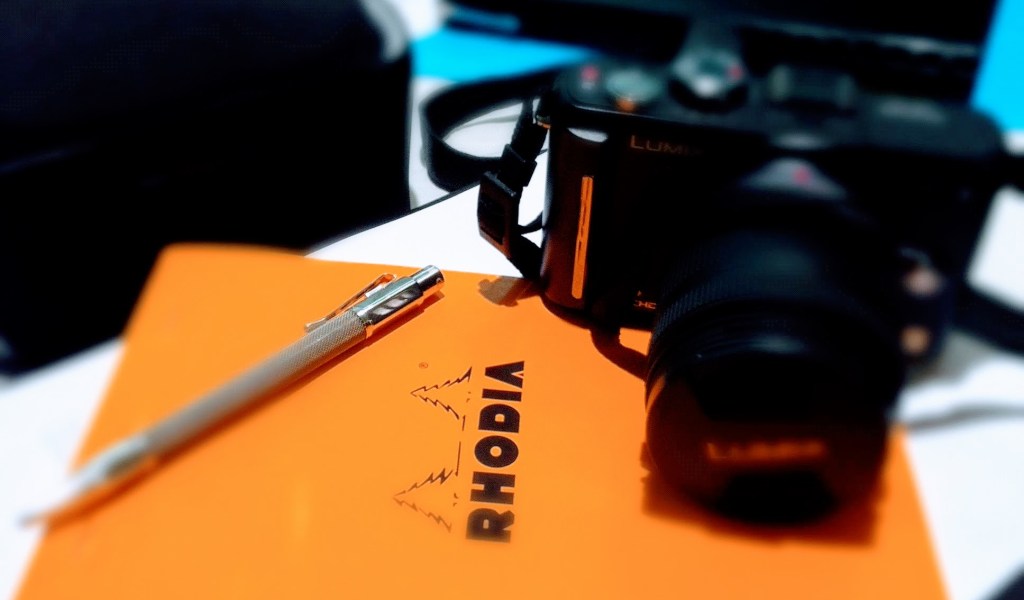
A camera (or phone camera), notebook, and instructions are all that’s needed for your prospective users to turn their lives into an anthropological adventure. This method is user-focused and meant to involve your prospective users taking pictures and notes and thoughts about what they are recording. The instructions are tied mostly to the basics of photography (e.g., consideration of light, framing, and ethics of taking pictures of others, in certain settings, etc.).

Instructions can also focus participants’ attention on specific things. For example, you may wish to have your participants focus on a topic, setting, context, interaction, or situation — anything you want to learn more about. Keeping it too general is often not a good idea and can be anxiety- or confusion-provoking in your participants. If they are too specific, you might lose some of the creative possibilities.

The probe part of this method is the ‘thing’ you want your participants to focus on. The cultural part comes from what context, framing, explanation, or interpretation participants (and others) bring to the photos.

Interpretation & Expression

What makes the cultural probe method useful is that it allows for a guided activity that has a standard format while producing artifacts — pictures — that delve into the uniqueness of your users’ lives.

What participants choose to take pictures of can be instructive. It provides an opportunity to discuss why something was included and why other things might not be.

What context the photos were taken is also helpful as it indicates priorities, habits, situations, or choices that the participant makes.

Photographs provide a means to ask questions about what is in the pictures, how things are framed, and what kind of reflections are made by participants from the photos.

This method can also be used in group settings where people agree ahead of time (with the right to withdraw agreement, of course) to share some of the photos they take. It can be useful in times of conflict or ambiguity when participants themselves aren’t sure what is going on and collective sensemaking is needed.

The camera is a powerful tool. Its insights can help us design services and products better, create and learn more from people, and provide a means of qualitative evaluation data, too.

We love this method. If you want help using cameras as a storytelling, design, or evaluation tool contact us and we can help you along.

Written by cplysy · Categorized: cameronnorman

Aug 18 2020

Dive In Process

Much attention is paid to tools, methods, models, and other artifacts as a means to support learning and innovation while much of what makes real change happen is actually a process. It is doing, not thinking. It’s diving in to the pool rather than focusing on the fences around it.

Today we look at one of the most simple, powerful means for creating change in complex systems: the diving-in process.

From Confusion to Coherence

Uncertainty is troublesome and often prompts a pause. When the situation is murky and situation complex, the strategy forward is to generate coherence where there isn’t any. That comes from taking action with a commitment to evaluation and learning.

By taking action we start to affect the situation around us creating a pathway forward. By paying attention and learning as we go ahead we can quickly determine whether the coherence we create is beneficial or not and start adjusting as we go until we are able to generate a stable situation where the path forward is clearer.

Diving in to a situation is not being reckless when accompanied by strategic learning through evaluation. Capturing data on what happens (e.g., observations, quantitative, etc..) will provide you with something to focus on amid the confusion and that will lead to seeing patterns, which is where coherence emerges.

Application

Diving in is as it sounds: take a leap of hope. First, make a conscious, deliberative strategic decision to pursue a path of action without expectation for an outcome, only for learning.

Build a set of metrics that are simple, have low ambiguity, and can be applied readily to capture feedback from your actions. These might be sales numbers, website traffic, number of clients or patients seen, occurrence figures — anything that is tied directly to your actions. It’s about creating that smallest visible system. These can be observational, numerical, or something else.

Next, commit to attentive, reflective sensemaking. This means capturing and examining your data regularly and often to look for patterns. Where you see patterns — and preferably, where your team sees them (this is best done as a group) — start reflecting on what it might mean. Is it positive? Negative? Too soon to tell? As patterns emerge, you follow them and document what actions you take in response to those patterns.

The last step is to adjust your strategy as necessary and repeat until you’re moving into a place of greater certainty and clarity about what to do.

This will generate coherence and enable you to take a wise action next.

It doesn’t eliminate uncertainty altogether, rather this approach allows you to avoid being paralyzed by it and potentially create positive benefits in the process of reducing it.

If you want help with finding pathways forward through uncertainty reach out and contact us. We can help you see opportunities and design strategies to take you away from confusion to coherence, safely.

Written by cplysy · Categorized: cameronnorman

Aug 12 2020

Innovation Design Quality Control

You want and need help in transforming your organization or business line and are seeking a consultant to help you. What should you look for? Let’s look at questions and issues you may want to consider when starting an innovation journey.

We break it down into three (plus) areas: Design research and foresight, service development, and evaluation.

Design Research

Design research is about exploring the problem or circumstance that you’re looking to intervene in through introducing a new product, service offering, or policy (which we’ll refer to as an innovation).

Design research is much more than ‘doing your homework’ and is meant to work with any marketing and financial studies you may have done. Design research is about exploring your end-user(s) — both identified and potential additional users. Responsible design research is also about looking at who else your innovation affects.

It will incorporate systems thinking into the process by considering the various ways in which your innovation affects and is affected by the various interconnections around it. For example, your service might be tied to other things (e.g., supply chain, regulatory issues, community norms) and good design research will help articulate these and allow you to map and model systems using visual tools.

Your innovation design team should have skills in design and research and understand a variety of methods and approaches such as quantitative analysis, qualitative data collection, sensemaking (for innovations dealing with complex situations), and behavioural science. The last point — behavioural science – is what allows you to understand what, why, and how an individual or group will choose to engage with your innovation and serves as a foundation for the next stage of work: service development.

But first, let’s go a little ahead into the future to look at the other part of design research: foresight.

Foresight

Strategic foresight is an approach to research that looks at the trends and drivers that influence specific domains of interest like your market, community, or social life as a whole. It draws on a variety of data sources such as published reports, publicly available (or privately held — if you have access) databases, as well as a series of exercises and activities that allow you and other stakeholders to envision what possible futures might look like.

The UK Social innovation agency Nesta has a useful, accessible primer on some of the methods that are used to envision futures.

Future-thinking is important because your innovation will always be applied to tomorrow, not today. Sustainable, effective innovations are those that meet emerging needs not just present ones. Foresight considers how and why things might change and, when combined with strategy and behavioural science, allows you to shape the design of your innovation to better anticipate and (hopefully) meet those changes as they emerge.

Service Development

Service development can include everything from exploring the physical space where your innovation will be deployed to undertaking usability research on digital platforms. The range of practices associated with what is more commonly called service design are many and when enlisting support to design your innovation it’s critical to ensure you have the right talent.

Service design often seeks to develop models of your intended users based on the design research you’ve undertaken. This can result in tools such as personas that provide evidence-informed caricatures of your users that you can use to develop and test scenarios.

Service design methods incorporate visual thinking methods and tools and design thinking by exploring the research, developing ideas, testing and trying these ideas out in ways that inform strategy, and then deploying them into the world. Having a design team with skills in design methods, facilitation, and visual presentation will make this much easier.

Visuals can include everything from simple (but illustrative) maps like the image above to more sophisticated visual models, ‘gigamaps‘, and storyboards.

Evaluation

Last and certainly not least is evaluation. It’s one thing to design an innovation, it’s another to know whether it does what you think it does. Evaluation allows us to assess what kind of impact our innovation has on the world, what processes lead to that impact, and what aspects of our service, product, or policy are most likely influencing this impact.

It is through evaluation of our innovation that we are better able to fine-tune, amplify, or retract our offering to ensure it’s creating the most benefit and not doing harm. Evaluation also allows us to understand what hidden value our innovation might be offering, to articulate your return on investment (ROI), and to widen your perception of what your innovation does and could do.

Bringing in design firms that do not build in professional-grade evaluation to the project is like doing half the work. What good is your new product or service if you have little idea how or whether it works in the real world over time?

These are some of the things that anyone looking to develop an innovation in-house or with a consultant team needs to consider. We have a lot of resources on our learning page on some of these methods and tools as well as overall approaches to supporting groups in asking better questions prior to engaging a contractor.

This is what we do. If you want help with any of this and doing good, quality service design, design research, evaluation and foresight, please reach out and contact us. We’d love to hear from you.

Written by cplysy · Categorized: cameronnorman

Aug 04 2020

After-Action Review: Learning Together Through Complexity

Complexity science is the study of how systems behave when under conditions of high dynamism (change) and instability due to the number, sequencing, and organization of actors, relationships, and outcomes. Complex systems pose difficulty drawing clear lessons because the relationship between causes and consequences are rarely straightforward. To illustrate, consider how having one child provides only loose guidance on how to parent a second, third or fourth child: there’s no template.

An After-Action Review is one such way to learn from actions you take in a complex system to help shape what you do in the future and provide guidance on what steps should be taken next.

The After-Action Review (AAR) is a method of sensemaking and supporting organizational learning through shared narratives and group reflection once an action has been taken on a specific project aimed at producing a particular outcome — regardless of what happened. The method has been widely used in the US Military and has since been applied to many sectors. Too often our retrospective reviews happen only when things fail, but through examining any outcome we can better learn what works, when, how, and when our efforts produce certain outcomes.

Here’s what it is and how to use it.

Learning Together

An AAR is a social process aimed at illuminating causal connections between actions and outcomes. It is not about developing best practice, rather it is to create a shared narrative of a process from many different perspectives. It recognizes that we may engage in a shared event, but our experience and perceptions of that event might be different and within these differences lie the foundation for learning.

To do this well, you will need to have a facilitator and a note-taker. This also must be done in an environment that allows individuals to speak freely, frankly, and without any fear of negative reprisals — which is a culture that must be cultivated early and ahead of time. The aim isn’t to point blame, but to learn. The facilitator can be within the team or outside the team. The US Military has a process where the teams undertake their own self-facilitated AAR’s.

To begin, gather those individuals directly involved in a project together in close proximity to the ‘end’ (e.g., launch, delivery of the product, etc..). As a group, reflect on the following three question sets:

  1. The Objectives & Outcomes:
    • What was supposed to happen?
    • What actually happened?
    • Practice Notes: Notice whether there were discrepancies between perceptions of the objective in the first place and where there are differences in what people pay attention to, what value they ascribe to that activity (see below), and how events were sequenced.
  2. Positive, Negative, and Neutral Events:
    • What created benefit / what ‘worked’ ?
    • What created problems / what ‘didn’t ‘work’?
    • Practice notes: The reason for putting ‘work’ in quotes is that there may not be a clear line between the activities and outcomes or a pre-determined sense of what is expected and to what degree, particularly with innovations where there isn’t a best practice or benchmark. Note how people may differ on their view of what a success or failure might be.
  3. Future Steps:
    • What might we do next time?
    • Practice notes: This is where a good note-taker is helpful as it allows you to record what happens in the discussion and recommendations. The process should end with a commitment to bringing these lessons together to inform strategic actions going forward next time something similar is undertaken.

Implementing the Method

Building AAR’s into your organization will help foster a culture of learning if done with care, respect and a commitment to non-judgemental hearing and accepting of what is discussed in these gatherings.

The length of an AAR can be anywhere from a half-hour to a full-day (or more) depending on the topic, context, and scale of the project.

An AAR is something that is to be done without a preconceived assessment of what the outcome of the event is. This means suspending the judgement about whether the outcome was a ‘success’ or ‘failure’ until after the AAR is completed. What often happens is successes and ‘wins’ are found in even the most difficult situations while areas of improvement or threats can be uncovered even when everything appeared to work (see the NASA case studies with the Challenger and Columbia space shuttle disasters).

Implementing an AAR every time your team does something significant as part of its operations can help you create a culture of learning and trust in your organization and draw out far more value from your innovation if you implement this regularly.

If your team is looking to improve its learning and create more value from your innovation investments, contact us and we can support you in building AAR’s into your organization and learn more from complexity.

Written by cplysy · Categorized: cameronnorman

Jul 28 2020

Personas: Visualizing Your Audience & Customer

When we design any service or product we are creating it with someone in mind. Personas are a design-oriented approach that can enable us to envision this ‘someone’ – our markets – to better design our products and services for them.

Whether it is a new software product, a grant-making project, a collaborative initiative, or a social policy — any product or service is designed for some person(s) and groups. The more we can anticipate what the needs, wants, and preferences are of this group and how they live, work, and play — the better fit we’ll have.

Personas are a visual way to develop hypotheses and insight into what our customers, clients, and audiences might think, act, and use .

Personas: Qualities

Personas provide evidence-based insights that help us reframe
challenges by creating caricatures that are rooted in data and observations and can provide us with a means to anticipate how or why these individuals might engage with our products and services.

• Personas are not just descriptions of what we already believe about our audience. They come from the perspectives of our actual users. They may challenge or differ from the usual categories we rely on to think about our users.
• Each persona represents a group of users with similar characteristics,
habits, needs, and/or goals
. Demographics may or may not play a key
part in a persona.
• Users also differ in important ways from each other; personas highlight
differences that matter
.
• Personas are formed by bringing together multiple sources of
quantitative and qualitative data
from diverse internal and outside
sources. If the data is not available, then design research is recommended to gather what’s required to make informed decisions.

This might include: surveys, published research from elsewhere, government or external reports, key informant interviews, field observations and direct observation or engagement with users.

Design Steps

Personas begin by looking at the data you have available and, where necessary, gathering more data to ensure you have a reasonable sample that captures both who you believe is your primary user and those who might be potential users.

Examine patterns and look for qualities among the sample — those individuals and groups that are represented in the data — that might go together. This includes things like:

  • Demographics – those that matter related to your product (e.g., age, sex, gender, race, ethnocultural heritage, income, sexual identity, education, employment)
  • Personal Identifiers (e.g., lifestyle behaviours, consumption patterns)
  • Experience with product or service. Are they experienced or new? What knowledge do they have or need to use it? What motivation might they have to use it?
  • Aspirations. What does the product or service solve for this individual? What does it bring to them or allow them to achieve? What are their goals?
  • Fears and Hopes. What are the ‘pain points’ or the things that will attract or detract users from engaging with your product?
  • Skills and Knowledge. What do users know, need to know, and what skills are necessary to engage with your product or service?

Next, sketch out the user. Make them visual — a look or feel and even a name. You might find yourself coming up with many different personas and this is helpful do allow you to determine the differences that make a difference. For example, if you find that the use of your product isn’t highly influenced by a certain demographic quality then that persona isn’t as affected by what you choose on that issue.

Once your personas have been developed, it’s helpful to consult with actual users that represent those personas in some form to test or validate some of the assumptions you used to develop those personas. Personas are not representative of actual people, they are combinations of qualities so the fit doesn’t have to be perfect, just coherent. Coherence is what you’re looking for.

After this, refine and design. Take what you learn and start designing your product or service for these users.

Sample

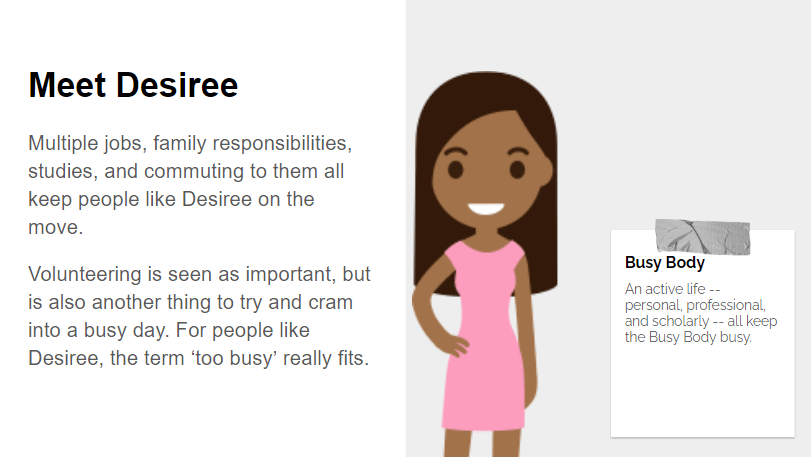
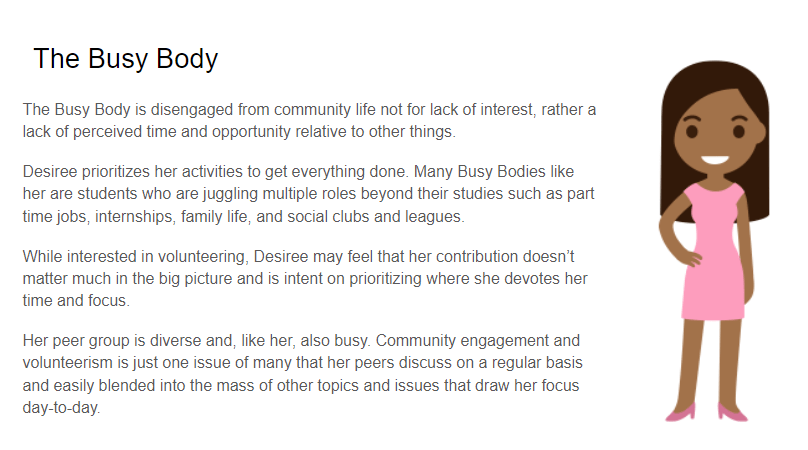
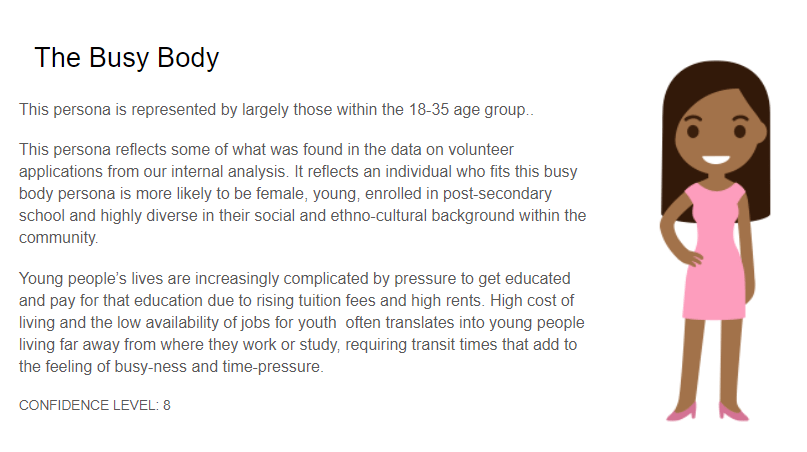
Below is an example of what a Persona could look like. The example below is modified from a real project undertaken by Cense Ltd and uses the example of volunteerism within a particular community as the focus. It represents one of many personas that were developed as part of an understanding of the issue. In this case, there was considerable data available on users which made it possible to give a confidence score out of 10 based on how confident the team felt the persona adequately represented characteristics of actual users.

What you’ll find is that by undertaking this research and the process of envisioning your users and potential users you can create a better fit with your product, higher adoption rates, and far fewer problems down the road.

This is a highly participatory process and when combined with the best data and developmental design approach increases the learning of your organization as well as creating better, more innovative products.

Want to apply this to your work and need some help? Contact us and we can help. This is what we do.

Written by cplysy · Categorized: cameronnorman

  • « Go to Previous Page
  • Go to page 1
  • Interim pages omitted …
  • Go to page 15
  • Go to page 16
  • Go to page 17
  • Go to page 18
  • Go to page 19
  • Interim pages omitted …
  • Go to page 21
  • Go to Next Page »

Footer

Follow our Work

The easiest way to stay connected to our work is to join our newsletter. You’ll get updates on projects, learn about new events, and hear stories from those evaluators whom the field continues to actively exclude and erase.

Get Updates

Want to take further action or join a pod? Click here to learn more.

Copyright © 2026 · The May 13 Group · Log in

en English
af Afrikaanssq Shqipam አማርኛar العربيةhy Հայերենaz Azərbaycan dilieu Euskarabe Беларуская моваbn বাংলাbs Bosanskibg Българскиca Catalàceb Cebuanony Chichewazh-CN 简体中文zh-TW 繁體中文co Corsuhr Hrvatskics Čeština‎da Dansknl Nederlandsen Englisheo Esperantoet Eestitl Filipinofi Suomifr Françaisfy Fryskgl Galegoka ქართულიde Deutschel Ελληνικάgu ગુજરાતીht Kreyol ayisyenha Harshen Hausahaw Ōlelo Hawaiʻiiw עִבְרִיתhi हिन्दीhmn Hmonghu Magyaris Íslenskaig Igboid Bahasa Indonesiaga Gaeilgeit Italianoja 日本語jw Basa Jawakn ಕನ್ನಡkk Қазақ тіліkm ភាសាខ្មែរko 한국어ku كوردی‎ky Кыргызчаlo ພາສາລາວla Latinlv Latviešu valodalt Lietuvių kalbalb Lëtzebuergeschmk Македонски јазикmg Malagasyms Bahasa Melayuml മലയാളംmt Maltesemi Te Reo Māorimr मराठीmn Монголmy ဗမာစာne नेपालीno Norsk bokmålps پښتوfa فارسیpl Polskipt Portuguêspa ਪੰਜਾਬੀro Românăru Русскийsm Samoangd Gàidhligsr Српски језикst Sesothosn Shonasd سنڌيsi සිංහලsk Slovenčinasl Slovenščinaso Afsoomaalies Españolsu Basa Sundasw Kiswahilisv Svenskatg Тоҷикӣta தமிழ்te తెలుగుth ไทยtr Türkçeuk Українськаur اردوuz O‘zbekchavi Tiếng Việtcy Cymraegxh isiXhosayi יידישyo Yorùbázu Zulu