• Skip to main content
  • Skip to footer
  • Home

The May 13 Group

the next day for evaluation

  • Get Involved
  • Our Work
  • About Us
You are here: Home / Archives for allblogs / cameronnorman

cameronnorman

Jul 24 2020

The Personal Inventory Method

What’s important to you? It might sound simple, but when we engage in service design the way we ask that question will shape the answers we get.

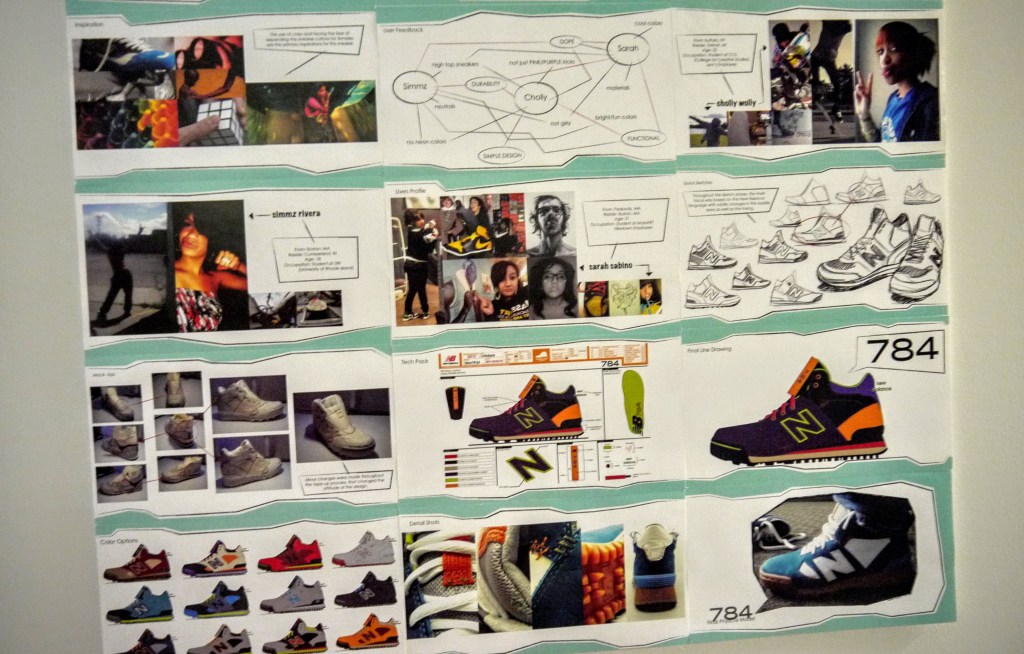
Keeping with a design-inspired ethos of ‘show, don’t tell’ the Personal Inventory method is a simple means to answer that question of importance for people.

The method is simple, flexible, and can be used in physical, digital, or hybrid contexts so it’s suited to a variety of situations where we might seek to understand the values and beliefs of an audience or particular service user. The Personal Inventory method is a means for participants to gather and catalogue artifacts and evidence of their activities that help answer the question they are posted about what is important to them in a particular context.

Setting Up

The Personal Inventory is shaped around a specific question tied to importance and value within a context. While it can be helpful to ask the question generally, most often we want to focus attention on a particular topic. For example, if we are seeking to design a system that supports patients in navigating their healthcare, we might ask a question: What is important to you about your healthcare experience? Or, What is important to you when being cared for?

The next step is to provide a context for data gathering and presentation. For those who are using digital tools, it might be worth using a platform that is easy to navigate such as a Pinterest board, a shared Google Photos or Flickr folder, or a more sophisticated, but highly modifiable tool like Milannote. The tool should be something that your participants feel comfortable with and this might require some initial training and support.

For using a physical media, a simple scrapbook or posterboard will do.

Gathering, Sharing, and Learning

Provide a timeline for the project that is reasonable and have individuals capture artifacts that represent or illustrate what is important to them. This might include original photos or videos, representative images from the Internet or magazines, even sound recordings. For physical-based projects, this could also including bringing in physical items (or photos of them).

The guidance for the participants is recommended to be light so that individuals aren’t too directed toward a particular ‘idea’ and influenced to give what they think the researcher wants.

Once gathered, the process of ‘show and tell’ can be illuminating for everyone involved. This can be done as part of an individual interview/conversation or as part of a group (with permission from all participants) to allow everyone to speak to what they are sharing. Sometimes items might have a clear explicit meaning and an implicit meaning. The design team has an opportunity to converse with participants and ask further questions to help understand values, behaviours, and memories.

Outcomes

The Personal Inventory method is a creative, visual means to engage participants in research and elicit knowledge about values-in-practice. The opportunities to inquire about things in context and in relation to the problem domain that we are design for is high and it allows individuals to speak to their experience freely in a non-technical way. This method works well for people of various literacy levels and means and can produce insights into what both current designs do (and don’t) and what future designs might consider.

This is a simple method to use. If you want or need help designing your project and using this, reach out and contact us. This is what we do.

Written by cplysy · Categorized: cameronnorman

Jul 21 2020

Design for Living: A Day in the Life

Product and service developers can easily be fooled into thinking all they need to focus on is the moment of engagement with their product. The design method “A Day in the Life” can help us put our potential audience (customer, client, or “user”) into a clearer perspective.

A Day in the Life is a simple activity that seeks to catalogue the activities and contexts that your audience might engage in within a typical day to help shed light on the life circumstance and situations that could influence your product.

Begin at the Beginning

Let’s illustrate this simple method with an example: education and training. When we design for education and training, the actual service might be a class, webinar, or workshop. However, the total experience of learning may involve much more than that.

Rather than assume your service starts at the moment people sit down (in person, at the computer etc..) go back to the start of their day.

Start with imagining a ‘user’ — be as specific as possible about this person with as much detail as you can provide that reflects a ‘typical’ or a particular (e.g., specific segment) service or product user.

Then ask: What happened the moment they woke up?

This question tells you a lot and invites other questions: Did they get a good sleep? What were the conditions that they slept in? What time did they wake up?

This matters because one of the assumptions behind your education and training service might be that people are attentive, able to listen and process the material, participate when necessary, and able to codify what’s learned into their brain and apply that later to whatever problem is at hand.

If you want your service to be useful, it needs to fit the circumstances of your user. If your participants didn’t sleep well, had to get up early to commute, are living in a state of fear or violence, or have no good place to sleep at all they are already facing some challenges before they start.

Continue the Story

The first question will lead you to a series of other questions that continue with: What happened next?

You continue this story as you progress through the day in the life of your participant up to and through the actual service event you’re involved in. After that? Continue the story through to the end of the day.

Along the way you will identify such things about your audience like:

  • Demographics
  • Social life and network
  • ‘Touchpoints’ with other systems and services
  • Preferences
  • Social and psychological circumstances.

These are imaginations of sorts based on what you think is a ‘typical user’. To increase the likelihood of reflecting the experience of a diversity of users it is best to conduct some background research to ensure you are reflecting the true characteristics of your audience. This method also works for identifying qualities about non-typical or non-users to help you understand why they might not use or desire your product or service.

Putting it into Practice

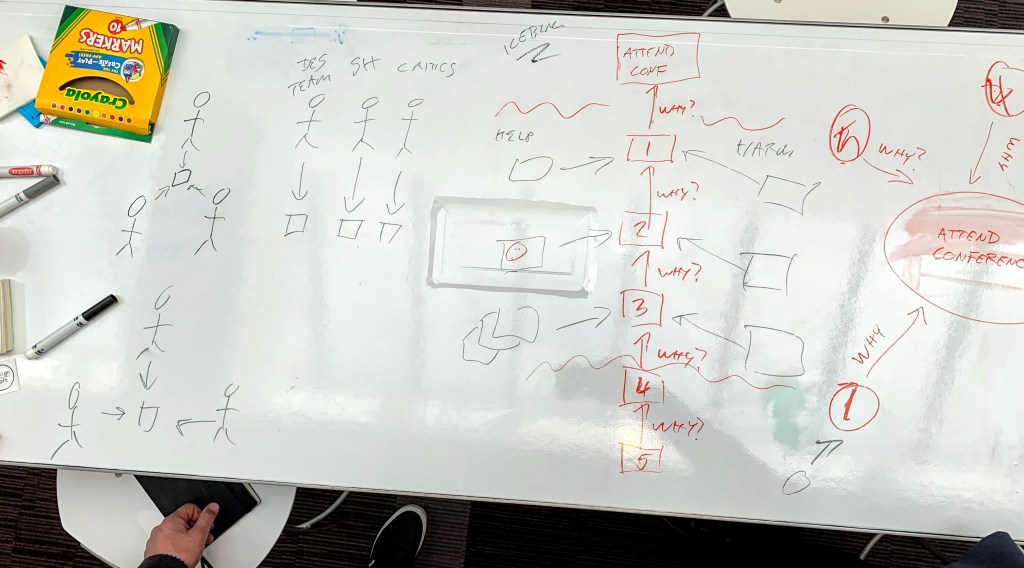
This exercise is best done as a group and can be conducted within 2 hours comfortably with more time for more granular exploration. It is meant to be participatory, engaging and allow for some creative reflection.

Materials include:

  • Whiteboards or large flipchart paper
  • Markers
  • Sticky notes
  • Stickers (optional)

Over the course of a morning or afternoon, you can bring your team into a place of greater understanding of your users — current and potential — and help set the context for your service. If we consider our example of education and training, the lessons we learn from this might be that we break programming into different chunks, change the distribution model, provide additional or alternative means to access content, or perhaps follow-up with reminders and tips to aid memory or application.

This simple, engaging and powerful method will help you tell better stories about your product or service and those of the people you wish to influence and serve.

A Day in the Life is one of the methods that we teach as part of the Design Loft Experience pop-up held as part of the annual American Evaluation Association annual conference each year. It’s one of many methods we use to help our clients understand the bigger picture and gain new insights into their work. Want help implementing it? Contact us — this is what we do.

Written by cplysy · Categorized: cameronnorman

Jul 14 2020

Simple Systems Scoping

Systems thinking done broadly allows us to take into consideration the various factors — structures, activities, relationships, interconnections — that can influence our organization, market, and domain of inquiry.

One of the fundamental qualities of systems is that they have boundaries. For example, when we consider an organization as a system we need to place boundaries on that organization such as who to include (e.g., all employees? full-time vs part-time? paid staff vs volunteers? settings or sites? etc..). There is no correct choice, just a useful one. Your boundary choices are to reflect what you are seeking to understand and how you’re seeking to act.

But how do you tell? We share with you a remarkably simple, but powerful way to scope your systems and determine if you have set the right boundaries.

Two Criteria

If you set your boundaries of inclusion in the system and find that you are lost and struggling to identify, map, or monitor the various interconnections, actors, actions, and outcomes within a system because there is too much to focus on then that is a sign you have bounded your system too loosely.

If you’re continuously finding yourself trying to explain what happened in the system by things outside of the boundaries, then you have bounded your system too tightly.

That’s it.

It may take some experimentation to get your boundaries right, however these two criteria can tell you if you’re on the right track or not.

Systems-informed strategy, mapping, and evaluation can be complicated, but understanding the boundaries does not have to be. This simple strategy has consistently allowed organizations to focus on what matters and avoid getting lost. The key is to make sure you have the ‘just right’ amount of detail and focus to allow you to make a meaningful sense of things and guide your action.

If you want help implementing a systems strategy for innovation and change in your organization or network, contact us.

Written by cplysy · Categorized: cameronnorman

Jul 07 2020

Surfacing Invisible Rules

What often can hold our change initiatives back are mental models about how or why something happens. Historically, many innovations and discoveries were held back or failed outright because people were unable to see or believe what was in front of them. By asking a set of questions at the outset and throughout your project you can avoid many mishaps.

The scene below from Men In Black illustrates what happens when our mental models about the world get upended and ask a simple question about what we know*. (*Just prior to this scene, Will Smith’s character confronts alien life forms for the first time — something that Tommy Lee Jones’ character already knows and lives with.)

One way to surface these hidden assumptions is through an exercise we might call ‘Invisible Rules‘. This three-part exercise can help you surface and uncover those ‘hidden’ rules we live by that might be holding us back from what we are seeking to change.

The exercise involves asking a series of questions in three stages:

1. Assumptions

  • What assumptions am I operating under?
    • Consider things like people (populations, characteristics, traits, knowledge, skills, preferences), time and timing, the likelihood of success, resources required.
  • How did these assumptions come about?
    • Is the evidence based on fact or folk knowledge?
  • What evidence is there to support that these assumptions are true?
    • Is this evidence still valid? (e.g., is it based on a historical or current position? Has something changed considerably since the evidence was first generated to prompt questions about its relevance?)

2. Design

With these answers, we move to a new set of questions tied to the design of your innovation (project, product, service, etc..)

  • Can I modify any part of the design (e.g., remove, reduce, amplify, or replace) that might make it better?
  • What can I learn (borrow, modify, adapt) from other designs addressing similar issues?

3. Future-casting

Lastly, it is useful to ask yourself three “How might” questions about your innovation.

  • How might this project fail?
    • For whom? Under what conditions?
  • How might we learn about what we’re doing while we’re doing it?
    • The evaluation and reflection metrics, measures, and processes in place to learn what works and doesn’t as you go.
  • How might things change beyond our control?
    • Possible surprises that might sidetrack your plans (e.g., pandemic, government change, policy change).

These simple set of questions can produce an enormous amount of data for you and your team. In just a few hours you might save years of pain and problems and see beyond the fence into the pool of opportunity beyond.

Want help in seeing things differently and asking better questions in your work? There are some simple steps that can help your team see things that others can’t. Contact us. This is what we do.

we’d be happy to help.

Written by cplysy · Categorized: cameronnorman

Jun 30 2020

Sensemaking in Crisis

Sensemaking is a social process that helps us make sense of data, information, and knowledge in a time of complexity. It’s used often in innovation contexts when we are fitting data to a unique situation.

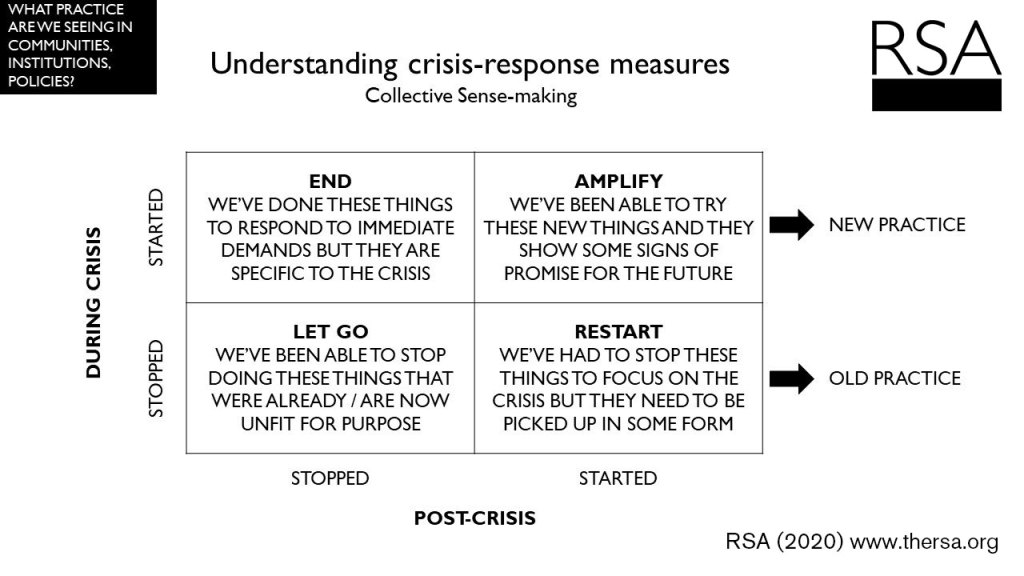
The RSA (the Royal Society for the encouragement of Arts, Manufactures and Commerce) a UK-based charity and think-tank has recently updated and revised its collective sense-making framework which provides a clear example of ways to consider change-making and leading in times of crisis.

The 2×2 framework, presented below, helps to frame activities that may have stopped or started during a crisis and what activities we may wish to amplify, end, abandon, and re-start.

Developmental Thinking

What the RSA framework embodies is what we call developmental thinking. This is the kind of thinking embedded in Developmental Evaluation, design and innovation. This thinking is about taking information and feedback from the activities in the system and making adaptive, strategic decisions to keep the organization developing (evolving) through learning.

Learning is about taking action based on new information and in some cases — such as those in complex situations with lots of change and activity — this learning must come from sensemaking. It tells us when to stop, start, pause, and wind-down activities.

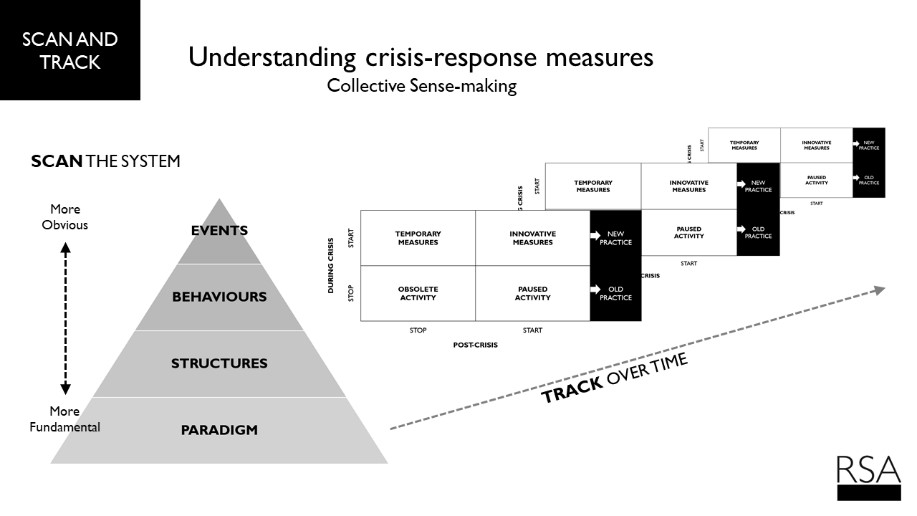
The RSA proposes conducting this sensemaking over time through a process that is akin to developmental design and developmental evaluation through the crisis which, in the case of events like COVID-19, might be protracted and evolve. As noted below, it also recognizes that sensemaking is tied to systems thinking where events (the most visible parts of a system) are actually built upon larger sets of behaviours, structures, and paradigms.

To make use of this requires a monitoring and evaluation system tied to an overall developmental, design-driven process. It’s not difficult, but it does require substantial mindframe shifts and organizational supports. Yet, the payoff is that your organization is adaptive and working with what’s happening and what’s emerging, rather than stuck trying to make what used to work come alive in an environment that has not only changed, but might be different altogether.

If your organization needs help in reshaping your work to make the most of what you have and pivot to what’s needed next, contact us. This is what we do.
Written by cplysy · Categorized: cameronnorman

  • « Go to Previous Page
  • Go to page 1
  • Interim pages omitted …
  • Go to page 16
  • Go to page 17
  • Go to page 18
  • Go to page 19
  • Go to page 20
  • Go to page 21
  • Go to Next Page »

Footer

Follow our Work

The easiest way to stay connected to our work is to join our newsletter. You’ll get updates on projects, learn about new events, and hear stories from those evaluators whom the field continues to actively exclude and erase.

Get Updates

Want to take further action or join a pod? Click here to learn more.

Copyright © 2026 · The May 13 Group · Log in

en English
af Afrikaanssq Shqipam አማርኛar العربيةhy Հայերենaz Azərbaycan dilieu Euskarabe Беларуская моваbn বাংলাbs Bosanskibg Българскиca Catalàceb Cebuanony Chichewazh-CN 简体中文zh-TW 繁體中文co Corsuhr Hrvatskics Čeština‎da Dansknl Nederlandsen Englisheo Esperantoet Eestitl Filipinofi Suomifr Françaisfy Fryskgl Galegoka ქართულიde Deutschel Ελληνικάgu ગુજરાતીht Kreyol ayisyenha Harshen Hausahaw Ōlelo Hawaiʻiiw עִבְרִיתhi हिन्दीhmn Hmonghu Magyaris Íslenskaig Igboid Bahasa Indonesiaga Gaeilgeit Italianoja 日本語jw Basa Jawakn ಕನ್ನಡkk Қазақ тіліkm ភាសាខ្មែរko 한국어ku كوردی‎ky Кыргызчаlo ພາສາລາວla Latinlv Latviešu valodalt Lietuvių kalbalb Lëtzebuergeschmk Македонски јазикmg Malagasyms Bahasa Melayuml മലയാളംmt Maltesemi Te Reo Māorimr मराठीmn Монголmy ဗမာစာne नेपालीno Norsk bokmålps پښتوfa فارسیpl Polskipt Portuguêspa ਪੰਜਾਬੀro Românăru Русскийsm Samoangd Gàidhligsr Српски језикst Sesothosn Shonasd سنڌيsi සිංහලsk Slovenčinasl Slovenščinaso Afsoomaalies Españolsu Basa Sundasw Kiswahilisv Svenskatg Тоҷикӣta தமிழ்te తెలుగుth ไทยtr Türkçeuk Українськаur اردوuz O‘zbekchavi Tiếng Việtcy Cymraegxh isiXhosayi יידישyo Yorùbázu Zulu