• Skip to main content
  • Skip to footer
  • Home

The May 13 Group

the next day for evaluation

  • Get Involved
  • Our Work
  • About Us
You are here: Home / Archives for allblogs / innovationnet

innovationnet

Feb 26 2024

What Reparations Taught Me as an Evaluator

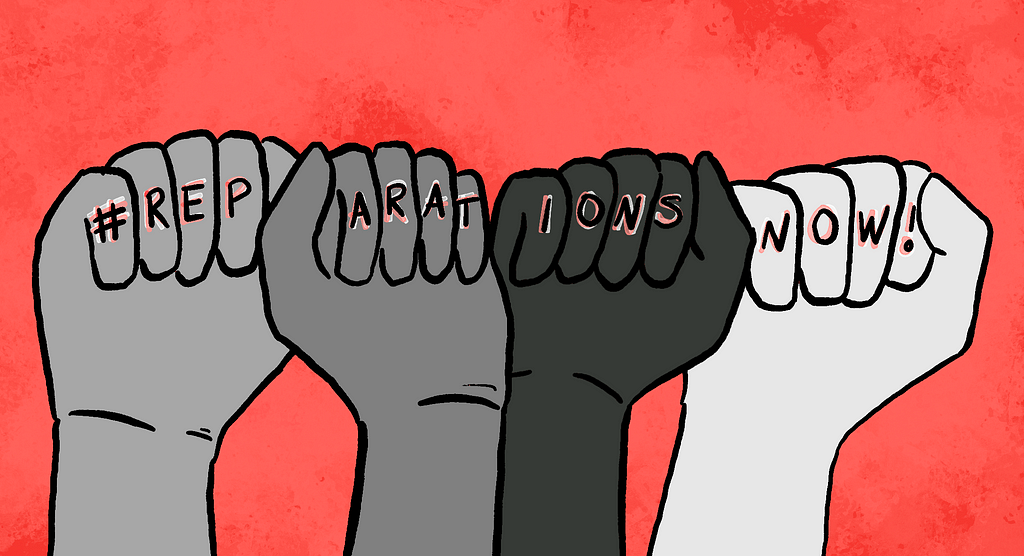
Over the past year, I’ve been diving deep into concepts around reparations — in a course I took about reparations for slavery in the US (check out my 5 Key Takeaways!), as well as in my dissertation work where I’m looking at reparations as a new way to frame international development and humanitarian aid.

In my work as an evaluator and researcher, I’ve been asking myself — what can we learn from reparations and anti-racism work that can shift our evaluation practice towards equity and justice? I’ve come up with 3 things we need to do better:

  1. Name and talk (and write) about race and coloniality. Too often, our work as evaluators does not meaningfully examine histories and contemporary contexts of slavery, White supremacy, and colonialism/imperialism. If we are going to contribute meaningfully to social change, we need to explore how these issues affect opportunities and outcomes for people of marginalized identities. We need to include this analysis in our presentation of findings. We need to frame our work as seeking to shift the Racial Contract.
  2. Critically examine the cultural, political, and economic contexts of our work. The current neoliberal capitalist system in the US and globally was built on the conquest and exploitation of Black and Brown folks. And it relies on continued injustice to survive. If we are to contribute to social change, as evaluators we need to interrogate the unjust systems — the power hierarchies, mental models, and relationships — in which the policies and practices we aim to shift are embedded.
  3. Problematize our own role in maintaining the status quo. We all live in a White supremacist, imperialist, capitalist society. Even if we actively work to dismantle it, our mere existence and participation in it upholds it. We are what Michael Rothberg calls ‘implicated subjects’.As evaluators, we need to continuously examine how our practices in our organizations, our work, and in relationship with communities may be contributing to injustice. We need to practice reflexivity to move towards a constructive complicity.
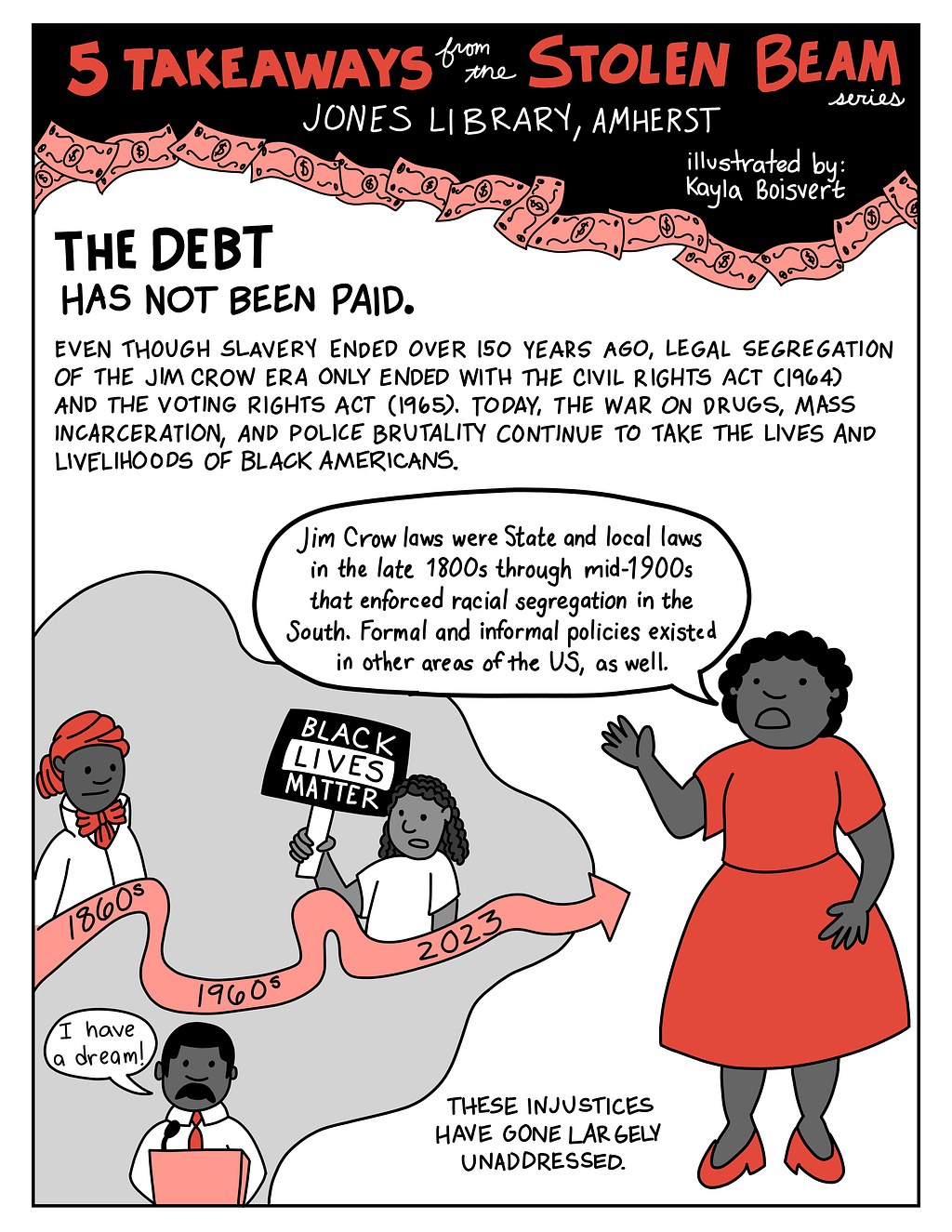
I illustrated 5 key takeaways from the course on reparations for slavery. Click here to read the full comic!

There are many other ways evaluators are examining their complicity in White supremacist systems. Leave a comment to share your thoughts, or follow our blog for more insights in how this shapes our evaluation work!

Kayla Boisvert is an artist and researcher for advocacy initiatives that promote social justice at Innovation Network. She lives in Western Massachusetts with her husband and silly dog-monster. She is often found running trails and climbing mountains where she lives and around the world.


What Reparations Taught Me as an Evaluator was originally published in InnovationNetwork on Medium, where people are continuing the conversation by highlighting and responding to this story.


Written by cplysy · Categorized: innovationnet

Feb 14 2024

Inspiration Week Highlights

Written by Rebecca Perlmutter, Innovation Network Senior Associate

Inspired by our friends at CEI, who begin every January with two weeks of independent study, we decided to pilot a similar week for the first of week of January. The purpose of the week was to seek inspiration and insight, and we intentionally did not create any rules or guidelines about how to use our time.

What did we do?

We’d like to share some of the resources related to learning, evaluation, and social change that resonated most with us during our week. We hope you also find some inspiration in these resources, or are motivated to look further into similar topics!

Two of us read books on emergent strategy by adrienne maree brown: Emergent Strategy and Holding Change.

  • Emergent Strategy: Shaping Change, Changing Worlds. This book is an introduction to emergent strategy, which is about “how we shape and generate complex systems and patterns through our own relatively simple interactions.” We found in it a helpful reminder that we are trying new things in order to create a better world, and trying new things requires that we slow down as we feel the change and learn what works for us.
  • Holding Change: The Way of Emergent Strategy Facilitation and Mediation. This book provides ideas for incorporating emergent strategy practices and principles in your facilitation and mediation practice and also includes essays from Black feminist facilitators. We are always seeking to deepen our wisdom as facilitators, and this book helped remind us of the importance of using facilitation to build relationships, help groups surface answers, and center each person’s humanity.

Two colleagues explored different ways to tell visual stories. One took a creative data visualization course with Gabrielle Merite (Gabrielle also offers some free resources on her website) and one took a course on non-fiction comics for writers.

  • The data viz course combines digital illustration and collage techniques to help you create engaging data visualizations.
  • The comics course demonstrates how to transform research, interviews, and articles into graphic storytelling.

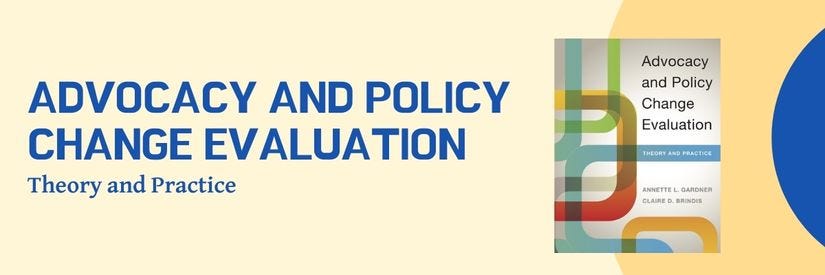
We found the book Advocacy and Policy Change Evaluation by Annette L. Gardner and Claire D. Brindis to be a great way to refresh our understanding of the different approaches to the complex world of advocacy evaluation.

  • This book provides an overview of the concepts, designs, methods, and tools for conducting advocacy and policy change evaluations. It is informed by a large-scale survey of evaluators working in the field and includes case studies that provide concrete examples of advocacy and policy change evaluations.

So what did we learn?

This was a successful experiment for us! Beyond learning about the different topics in the books we read or courses we took, we had some broader reflections about what an inspiration week meant for us individually and as an organization. These reflections may be useful if you are considering holding your own inspiration week.

  • The openness of the week was empowering and enabled each of us to best choose what we needed for personal development and to prepare for the year ahead.
  • It was important to be intentional about how we used our time. We all tried to use the time for things we may not have space for during busier periods of the year. For a lot of us, this meant spending time with longer materials, like an entire book. At the same time, having a mix of learning options was key, which for us included videos and courses in addition to books.
  • Doing this right after our end of year break was the perfect way to ease into the new year, before client meetings and other commitments crowded our calendars.
  • Four days were both too slow and too fast! We realized it was important to create space to process what we were learning, rather than just moving on to consuming the next product.

Have you ever had an independent study or inspiration week at your organization? How did you spend your time and what did you learn? Let us know your thoughts, and any recommendations you might have for our approach, in the comments!


Inspiration Week Highlights was originally published in InnovationNetwork on Medium, where people are continuing the conversation by highlighting and responding to this story.

Written by cplysy · Categorized: innovationnet

Jan 11 2024

Transforming our decision-making

“The truth is, structure matters. How you do your work is equally as important as the work itself”

Kendra Hicks — Resist Foundation

Author’s note: I started working on this blog post in May 2023, only a few weeks after we began piloting the decision-making structures and processes whose co-creation is described below. Then, we had not yet implemented these systems so the post doesn’t describe how they are working out in practice, which is something we are reflecting on in an ongoing way and will share in the future. Still, we wanted to be open about what has emerged for us so far, as a way to learn together and be in community with others who are transforming their organizational governance in similar ways.

Our journey itself has been inspired by Emergence Collective, a Michigan-based learning and evaluation firm that has co-created and operated according to a co-op model since its inception. We are deeply grateful to Lauren Beriont who generously shared information and materials about their governance structure and the process they used to create it, which we have perused and — where appropriate — modeled our journey and the structures we created on. As I wrote this blog, Lauren also kindly offered to write an addendum for it. I am delighted that you will hear her voice as well as mine, as Emergence Collective has been an incredible source of inspiration throughout our journey.

When I joined Innovation Network just a little over three years ago, the last thing I expected was that I would have found myself leading the organization after two years. When Alissa Marchant and I became interim co-directors in April last year, there was very little we knew about what it takes to steward an organization — particularly one that was healing from trauma and is on a journey to center equity and social justice. There was one thing that we knew for sure: we did not want to nor could do it alone. While our titles were fancy, we were aware that we did not know more than the rest of our team so, instead of pretending that we did and using that as a flimsy excuse to justify the positional power we found ourselves holding, we decided to try a different type of leadership, one that valued and harnessed the experiences and knowledge of every single member of the team.

To transform the whole organization, we thought the entire team should lead in the decisions that mattered the most to them. We shared this vision with the rest of our colleagues, and by common accord, collectively embarked on a process to transform our decision-making to more horizontal, team-led structures that share power across the different positions and roles and center junior team members and team members from communities that have historically had less power and privilege.

Image by: Lucie Chabaud

Co-creation process

Our collective process had the ultimate goal of creating a decision-making framework that articulated how and by whom decisions would be made so that our decision-making would embody our values while allowing us to move along at the pace required by our work which — as an organization that provides consulting services — can be hectic at times. To achieve this, we met for 12, 1.5-hour sessions over eight months. The entire team, as configured at the time and inclusive of interns, participated in every session. I created and facilitated the process. In an ideal world, we would have hired an external facilitator or, short of that, the process would have been co-led with a team member with less positional power. Neither solution was feasible at the time. To mitigate this, we did a few things:

  • Used a consent-based decision-making approach (i.e., every person involved can live with the decision made) throughout the process. The team consented to my facilitation as well as to the overall process trajectory and the individual sessions’ objectives.
  • Set norms for the co-creation space. To create what a team member called a “brave space” (as it would be disingenuous to call it a safe space, given the power differentials). At the start of the process, we collectively set norms to support the full participation of all team members involved, acknowledge and help mitigate power dynamics, and constructively handle disagreements if they arose. Norms were revisited throughout the process to see if edits or additions were needed.

Decision-making framework

How will decisions be made?

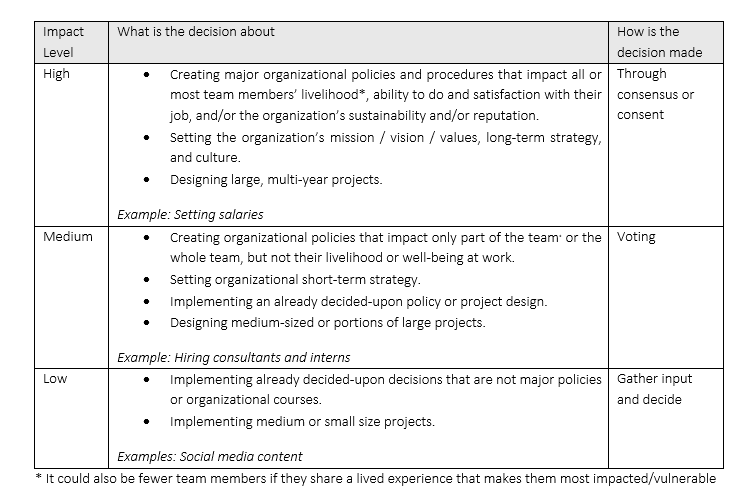
Through our process, we examined the most significant and/or common decisions that we make in our work life and collectively decided what decision-making approach we would use for each. We considered both organizational decisions such as creating new policies, as well as decisions related to our client-facing work. In doing so, we noticed a close correlation between the impact of and the desired approach for the decision: the more impactful a decision, the more participatory the approach we decided to use (see framework below). While we were concerned that using consensus or consent approaches would make decision-making cumbersome and slow, we are quickly realizing that being a small team of people who have built trust and care for each other makes unanimity-based processes much speedier than their reputation. Also, using a sociocratic consent process provided us with a clear roadmap to undertake complex decisions.

A table displaying the decision-making framework, with 3 columns: Impact Level, What is the decision about, How is the decision made.
Decision-making framework

Who participates in decision-making?

For medium- and high-impact decisions, all people who are impacted by the decision get to be involved in it, if they want to. This is the cornerstone of how we want our decision-making to be aligned with our values, particularly that of furthering equity. Actualizing it runs up against two opposite tensions:

  1. Determining who is or is not impacted can be tricky. We decided that people — including external consultants and interns — will be able to self-identify as impacted. If there are misaligning impressions among people involved on who is “impacted,” the rest of the team will have to consent to the self-identification.
  2. Balancing intent and capacity for participation is not always possible. While centering junior team members and team members from communities that have historically had less power and privilege sounds great in theory, we also wanted to make sure that we were not “putting the labor of equity” on them. If the people closest to the decision don’t have the bandwidth to be involved as much as they would want, other team members — particularly those with more positional power — will step in to do the legwork, ensuring that most impacted people/people with lived experiences are appropriately involved, within the boundaries of their capacity and interests.
Image by Daniel Alexander Bleau

Growing edges

This may sound like a complicated dance, and we anticipate it will be, at times. Transforming decisional structures is not easy, particularly for an organization embedded in an ecosystem of relationships with actors who also hold significant power like our board and our clients and partners. Cognizant that this is an experiment, we also agreed to put safeguards in place to make sure that we stay true to our vision for decision-making while navigating the tensions that doing so may entail.

Mitigating positional power and other forms of oppression

While we are trying to shift power, we are still operating — at least for now — within the constraints of a traditional nonprofit organization structure in which the Director — who answers to the Board — has the ultimate responsibility for the organization. We also still have other staff levels (Associates, Senior Associates, etc.). We are starting to discuss how our structures may need to change to better align with our values. Our recent decision to nominate Alissa Marchant as Innovation Network’s Director was made collectively by the team and board through a consent-based process led by an external facilitator.

Still, we cannot equate transparency with equal power in decision-making. Anyone who has concerns that abuse of power or other forms of oppression are going on will be able to veto a decision. Vetoing will move the decision to a higher decision-making category. We also agreed to create a whistleblower process. Feedback shared through this process will be available to all team members and the board. Finally, we acknowledge the need to collectively decide what accountability will look like at Innovation Network.

Having clear fallback processes

We know that timelines, capacity, and other external constraints misaligned with our values, as well as potential unresolvable disagreements among team members will stand in the way of conducting decision-making as we have agreed upon. We laid out a few strategies for mediating between the pressures of a consulting organization and living into our vision for decision-making. For example, we agreed that at times we may need to make “placeholder” decisions and set plans for iterating such decisions when the necessary conditions are in place to make them according to our agreed-upon structures and processes. At the same time, we understand that a lot of the sense of urgency we experience is rooted in white supremacy and commit to creating and advocating for the necessary conditions to conduct decision-making as we have agreed upon. We have set funds aside to hire external facilitators and mediators if we need support for crucial decisions.

Creating both ongoing and set opportunities for iteration and learning

Ultimately, we accept that this is an experiment and know that all pilots require ongoing learning as well as the possibility to fail. At this point, we are reviewing our decision-making every time we make a decision — even if it is just a gut check that we are acting according to our vision for a horizontal, team-led approach. We will also be setting times — hopefully in person — to conduct formal, overarching reviews. Finally, we were excited to share our decision-making structures and processes with our newer team members, asking them to use their fresh perspectives to identify opportunities to strengthen this model.

Image by: Mika Sahin

Reflections and next steps

In truth, our journey was much more than co-creating the decision-making framework. Making the time and space to envision and articulate how we wanted to decide about our life at work also drew us closer together at this transitional time by helping us understand each other more, what our values and priorities are, and how we can be kind as well as truthful when having hard conversations. Possibly, the most important outcome of this process has been building true connections among us and the belief that when entrusted with decisions, each of us will make them keeping everybody’s best interest at heart.

We are curious and optimistic about how this all will shake out. Expanding our team, doing strategic planning, and figuring out what growth can look like for all of us in a relatively small organization will all be interesting opportunities to pressure test our new decision-making. We will keep you in the loop and would love to hear from you: both if you want to poke holes in our thinking and if you are also considering and working to change your organization’s governance to be more democratic. What are you learning? What are some of your growing edges?

From Lauren Beriont at Emergence Collective

I’ve found in my work on justice and equity a tendency to conflate trust and implicitness. For me there is a voice in my head that says “We should just trust each other” or “I don’t want to be too process-heavy” or “I don’t want to leave an impression that I don’t trust my colleague’s experiences or ways of working”. I’ve learned however that being explicit is a way to build trust that is just and equitable and that our default towards implicit processes is really about our own assumptions and discomfort.

At Emergence Collective (EC), even though it has been over 5 years, it still feels like we’re at the beginning of a grand experiment. In many ways we are — just in the past six months, we ourselves revisited what shared decision-making looks like — our ideals and our realities — and how our co-ownership structure allows for or limits participatory decision-making on our team. I’ve left our internal discussions feeling strongly about how to keep these discussions alive, living, and not just an intellectual exercise that we did at a team retreat three years ago.

I’m so excited and grateful to Virginia for getting these ideas out there and continuing the conversation about explicit decision-making models. We at EC are certainly not perfect and have a lot to learn from continuing to unlearn and question motivations for how and why decisions are made internally and with our partners or clients.


Transforming our decision-making was originally published in InnovationNetwork on Medium, where people are continuing the conversation by highlighting and responding to this story.
Written by cplysy · Categorized: innovationnet

Dec 13 2023

Finding Our Stories through Digital Storytelling

The act of creating our stories and sharing them with others is a powerful way to better understand our experiences. I realized this in a training on digital storytelling with the Institute for Social Science Research at the University of Massachusetts Amherst.

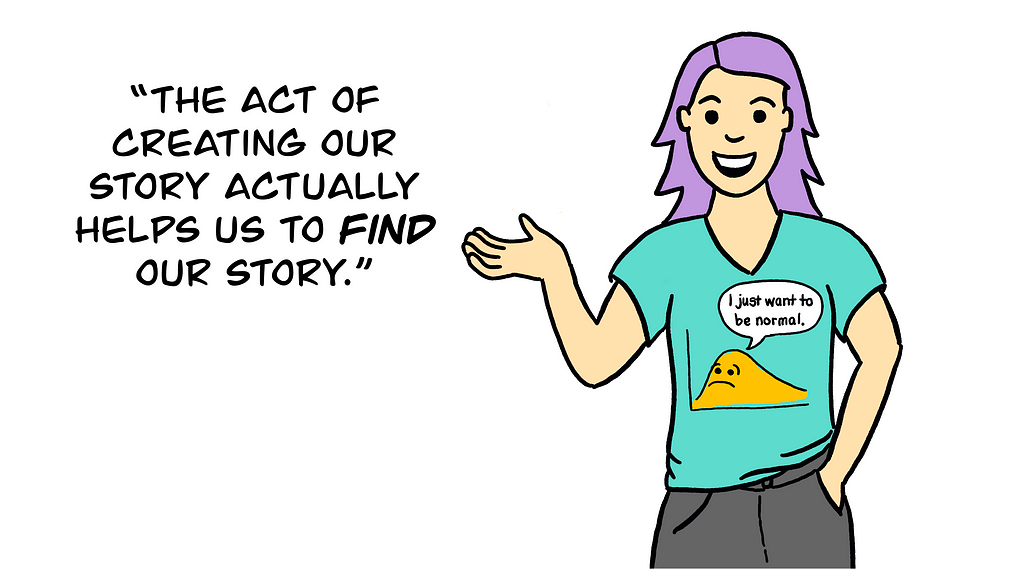
I’ve long used the metaphor of storytelling in my work as an applied researcher and evaluator. The way that we ask questions, conduct our analyses, and represent our results all convey a message or story. As a qualitative and equity-focused evaluator, my aim is to tell the stories that participants in the study want to tell about their own experiences — what meaning they are making, what is important to them, what they want the audience to learn. But it occurred to me while taking this course that we don’t always fully know the message we want to share about our experiences. And the act of creating the story — in written narrative, in visual art, in film or comics or otherwise — actually helps us find our story.

Take, for example, my own digital story on the cocktail of emotions I felt when my mom was diagnosed with cancer. I began writing the story, intending to share a message about the incredible support I received from my community of people. However, through the process of creating my story, I was able to come to the meaning I needed to make about my experience — about the numerous, shifting, and often contradictory emotions I felt through my mom’s diagnosis, treatment, and ultimately recovery.

https://medium.com/media/415589ed81d66316310177aa0c76efae/href

So, what is digital storytelling? How might we use it in learning and evaluation? And what are important ethical issues we evaluators need to consider?

What is digital storytelling and why use it?

Digital storytelling is a method often used in learning and evaluation. It invites participants to identify, create, and produce a 3- to 5-minute video that shares a personal story through an artful combination of narration, images, and sound. The videos produced can then be used to collectively identify and analyze themes to answer learning questions.

Digital storytelling is a form of critical narrative research, which means that participants engage with their stories as a way to critique wider cultural, political, and economic phenomena. It’s easy to see how digital storytelling can also be used as an intervention, education, and advocacy in fields as wide as health/reproductive justice, education, work/labor rights, and more!

Digital storytelling can be used in learning and evaluation many ways. Using Cocktail as an example, the creation of my digital story was a form of data generation itself. As I was writing the narrative, reading it aloud to my peers, and getting feedback from the group, we shared insights about our experiences with the illness of a loved one. When the video was complete, and I showed it to the group, it became an elicitation device — a conversation starter for further discussion on the topic. Our collective of digital stories could even be shared publicly — for example, to advocate for supports to family members and caretakers or to educate health professionals!

How can I use digital storytelling?

Digital storytelling is a flexible method that can be adapted to meet the needs of the participants in the study. For example, if participants are based around the country, the process can be facilitated online or in a hybrid format. If participants have limited digital literacy or technology access, or a more professional appearing video is needed for advocacy purposes, a collaborative process of creating the stories can be used between the researcher and the participant (and maybe even a professional photographer and video editor). And digital storytelling can be used as one of multiple methods in a mixed-methods study.

Just be sure not to simply ‘add-on’ digital storytelling! It’s a time and resource intensive method that requires care to ensure respect and ethical treatment of participants and their stories, and to produce quality stories that generate dialogue and reflection.

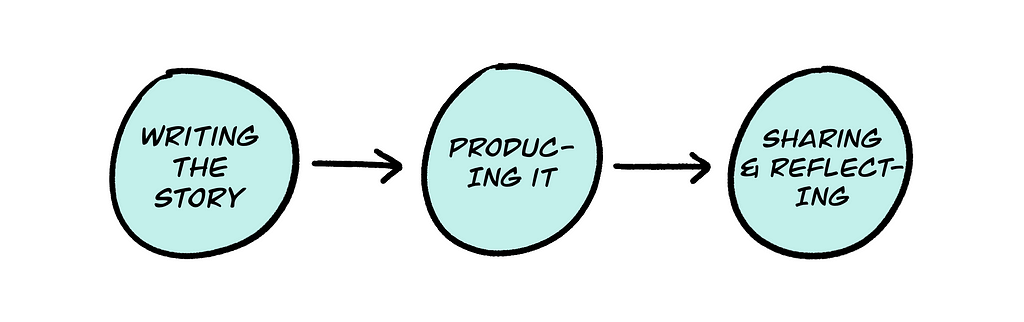
In digital storytelling, there are at least three steps:

  1. Writing the story. Once a group topic or question is defined (connected to the evaluation and learning project), participants spend time drafting their storyline and narrative. This could be done within a single session or for homework. Some people may prefer to create an outline before writing — for me, I just began free-writing, and that is how I learned what my story would eventually become! The first story circle is held when participants have a first draft. Each participant takes a turn reading aloud their draft and receiving feedback from the group. Facilitators and the group can help participants strengthen their stories by identifying key messages, clarifying language, helping with tone/pacing, knowing where to cut or add content, etc.
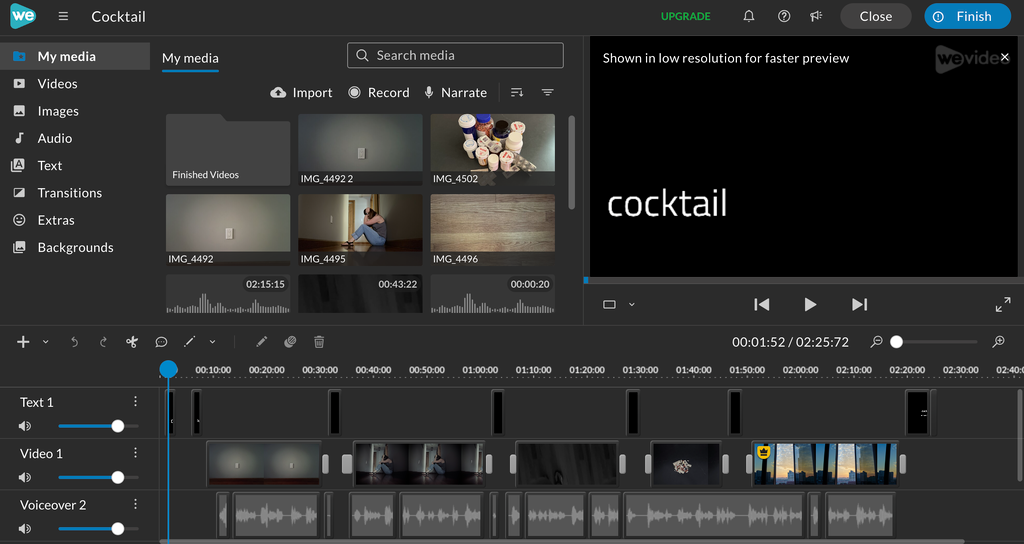
  2. Producing the story. When stories are finalized, participants then produce their stories. This involves recording the voiceover, creating or finding images, and selecting sound effects. We used an app called WeVideo, which was pretty easy to learn. I recorded my voiceover (it took a few tries and involved hiding in a closet to reduce background noise) and took pictures with my iPhone. I’ve even seen digital stories with hand drawn or illustrated images, which I hope to try next!
  3. Sharing and reflecting. When all digital stories are complete, the group holds a second story circle to screen the videos. Each participant shows their story to the group. We provided feedback and reflection after each video, but it may be more timely to share 2–3 videos followed by a discussion, and then repeat until all videos are screened. Sharing the stories is the core purpose of digital storytelling, and it is what allows participants to engage critically with their ideas. In a learning and evaluation setting, facilitators could encourage participants to reflect on the conditions leading to the issues identified in the stories, what systemic issues need to change (or are changing), and what factors enable or constrain those changes. The stories could also be a powerful educational or advocacy tool for sharing with organizations, decision-makers, and the wider public.
Screenshot of WeVideo app.

Ethical issues and power in digital storytelling

Importance of choice. Creating my story, Cocktail, taught me one of the most important ethical considerations in visual and narrative methods — the importance of choice. I have really bad stage fright — even if it’s just reading my own story aloud to a group. Before I read my story during the story circle (which was held online), I told the group that I might turn my camera off if I start to clam up. In other situations, I’ve had to recuse myself from sharing my story personally and have found other ways to share, like asking someone else to read aloud for me. A major ethical consideration is that everyone is being vulnerable in sharing their stories — which may be quite painful. Participants need choices — to read their story aloud, to share it in writing, to ask someone to read it aloud for them, etc.

Telling a personal story that involves others. At the same time, the experience highlighted the important privacy issue of telling my own story, not someone else’s. Throughout the process of creating Cocktail, I had to continually ask myself — whose story am I telling? I made decisions about what I told in my story (and what I left out) because the cancer, the treatment, and all the emotions that went along with that wasn’t my story to tell — it was my mom’s. But I also recognized that as her primary caretaker for a time, I also had a story that needed to be told.

Confidentiality. Another essential ethical consideration in digital storytelling is the timing of obtaining permission to share stories outside of the group (e.g., as educational or advocacy materials). People may participate in the digital storytelling project with full intention to share their stories publicly. But that may change as they move through the process and realize their story is too difficult. Permission to use the stories should only be requested after the stories are finalized and screened within the group, when people have a greater sense of what it feels like to share their story and who they are comfortable with hearing it.

Fortunately for me, the course instructors were not only professionals, but were highly conscientious in ensuring we retained the power over our stories and how they were shared. Staying off camera as I screened my story, I choked up at the overwhelming support I received from my peers and the care and reciprocity they showed. Sharing it with my mom later opened up a conversation we had not had in nearly 10 years since her diagnosis. Creating Cocktail helped me to name and tell my story — of how I felt fear, sadness, and guilt, alongside love, inspiration, and community — a true cocktail of emotions.

How has digital storytelling helped you to find your story? I’d love to hear from you about how you’ve used it (or other participatory visual methods) to find and share your story, or help others do the same!


Finding Our Stories through Digital Storytelling was originally published in InnovationNetwork on Medium, where people are continuing the conversation by highlighting and responding to this story.

Written by cplysy · Categorized: innovationnet

Jun 01 2023

Building Equitable Structures

As I step into my role as the Director of Innovation Network, I am reminded that I am not alone. My strength as a leader comes from my ability to set free the amazing knowledge and talent around me: from the Innovation Network team, our foundation and nonprofit clients, and the advocates we work with.

When Virginia Roncaglione and I took on the roles of Interim Co-Directors last year, one of our first priorities was to center our people — regardless of role — as decision-makers for our organization. This was evidenced through the selection process for the Director role: with an outside facilitator and team-based discussions where we strived for equal power for team and board members, including salary decisions and expectations for the first year. We recognized that erasing feelings of powerlessness and fostering a culture where everyone can be their authentic selves is crucial for creating a truly equitable organization. I am excited to continue working with Virginia as she provides her leadership to crucial shifts in our organization’s culture.

One of our first priorities was to center our people — regardless of role — as decision-makers for our organization.

In the field of evaluation, we have learned (and learned and learned) how BIPOC voices are often ignored and/or deprioritized in our society. This is true for evaluators of color as well as the communities of color who are often the focus of evaluations. As a white cisgender woman, I acknowledge the privilege I have coming into a leadership role. I carry a genuine desire to interrupt the ways of working that perpetuate racial injustice that I hope can guide me as a leader to make real, tangible changes. I know I must elevate myself-awareness of natural human biases and embrace differences in identity and race. I have learned so much from BIPOC teammates who have since moved on from Innovation Network, and I strive to honor them by centering equity in all aspects of our work, from our processes to the outcomes we seek. We are just getting started, and I know there is work to do — from shifting mindsets to building a diverse team and Board.

I know what it feels like to experience powerlessness in the workplace, and I am determined to create a culture where everyone has power and can express their unique value. Our efforts to dismantle hierarchies — structures that often hoard power at the top, creating powerlessness at the bottom — liberates the power and unique value that each person brings to our organization.

I see our efforts to dismantle hierarchies and center equity within Innovation Network as extending beyond our organization and informing how we approach our projects.

My background in social work has taught me that the way we show up in small groups is indicative of how we show up in the world. That is why I see our efforts to dismantle hierarchies and center equity within Innovation Network as extending beyond our organization and informing how we approach our projects. We have an incredible team that is committed to equitable learning and evaluation and is leading new efforts to shift power to evaluation participants and measure how advocates are building and shifting power. We are learning alongside advocates and approaching our work with an orientation towards equity that — I hope one day — feels like second nature because of the structures we are building within our own organization.

I have seen a growing interest in evaluation that centers around learning and defines success by asking those most affected by the work. I am excited to continue and find new partnerships where equity is not performative and relationships are real. To do work in the way that lives our values.

The path ahead of us is not without challenges, but we at Innovation Network are committed to this vision: a future where evaluation is a tool for communities to live into their power and have the information they need to lead the decisions impacting their future and well-being. In the coming year, we will engage in participatory strategic planning and intentionally center racial equity within our organization and learning projects. We understand that this work requires ongoing accountability, and we welcome our community (all of you) to hold us to our values.

We welcome our community (all of you) to hold us to our values.

Your voices and feedback are invaluable in guiding us on this path. To start this conversation, I will be holding office hours on June 6 at 2–3pm and June 8 at 5–6pm EST (email me directly at amarchant@innonet.org for the link). I would be delighted to meet with any of you to discuss our vision and plans for the future. If you are unavailable at these times, please reach out to me and we can find another time to chat!

I am honored to become the new Director of Innovation Network, and I am excited to continue living into our values, find new ways to dismantle traditional structures, and better serve us and our communities.


Building Equitable Structures was originally published in InnovationNetwork on Medium, where people are continuing the conversation by highlighting and responding to this story.
Written by cplysy · Categorized: innovationnet

  • « Go to Previous Page
  • Go to page 1
  • Go to page 2
  • Go to page 3
  • Go to page 4
  • Go to page 5
  • Go to Next Page »

Footer

Follow our Work

The easiest way to stay connected to our work is to join our newsletter. You’ll get updates on projects, learn about new events, and hear stories from those evaluators whom the field continues to actively exclude and erase.

Get Updates

Want to take further action or join a pod? Click here to learn more.

Copyright © 2026 · The May 13 Group · Log in

en English
af Afrikaanssq Shqipam አማርኛar العربيةhy Հայերենaz Azərbaycan dilieu Euskarabe Беларуская моваbn বাংলাbs Bosanskibg Българскиca Catalàceb Cebuanony Chichewazh-CN 简体中文zh-TW 繁體中文co Corsuhr Hrvatskics Čeština‎da Dansknl Nederlandsen Englisheo Esperantoet Eestitl Filipinofi Suomifr Françaisfy Fryskgl Galegoka ქართულიde Deutschel Ελληνικάgu ગુજરાતીht Kreyol ayisyenha Harshen Hausahaw Ōlelo Hawaiʻiiw עִבְרִיתhi हिन्दीhmn Hmonghu Magyaris Íslenskaig Igboid Bahasa Indonesiaga Gaeilgeit Italianoja 日本語jw Basa Jawakn ಕನ್ನಡkk Қазақ тіліkm ភាសាខ្មែរko 한국어ku كوردی‎ky Кыргызчаlo ພາສາລາວla Latinlv Latviešu valodalt Lietuvių kalbalb Lëtzebuergeschmk Македонски јазикmg Malagasyms Bahasa Melayuml മലയാളംmt Maltesemi Te Reo Māorimr मराठीmn Монголmy ဗမာစာne नेपालीno Norsk bokmålps پښتوfa فارسیpl Polskipt Portuguêspa ਪੰਜਾਬੀro Românăru Русскийsm Samoangd Gàidhligsr Српски језикst Sesothosn Shonasd سنڌيsi සිංහලsk Slovenčinasl Slovenščinaso Afsoomaalies Españolsu Basa Sundasw Kiswahilisv Svenskatg Тоҷикӣta தமிழ்te తెలుగుth ไทยtr Türkçeuk Українськаur اردوuz O‘zbekchavi Tiếng Việtcy Cymraegxh isiXhosayi יידישyo Yorùbázu Zulu