In this series of Data UX reviews I take real published reports and look for areas of improvement. The ultimate goal for these reviews is shared learning. This week, we discuss readability.
Today’s Report is an Evaluation Synthesis Report (2022-2023) produced by the Evaluation Office of the UN Environment Programme (UNEP). You can peruse the report on your own by following this link.
This is a long but fairly standard type of report. 114 pages plus a 20 page appendix. It feels professionally designed, with uniform structure throughout. My guess is that the evaluation team wrote the report and then handed it off to a graphic designer to organize and polish at the end.
There are charts throughout and a few icons but it is not systematically illustrated. The report also has fairly lengthy sections without any illustrations at all. It is not designed to be easy to skim and does not highlight important or critical information. On a skim your eyes will probably go from chart to chart and possibly stop to reach the chapter introductions.
There are quite a few things that we can learn from this report in terms of user experience, but let’s focus on one in particular. Readability.
Most reports fail at basic readability.
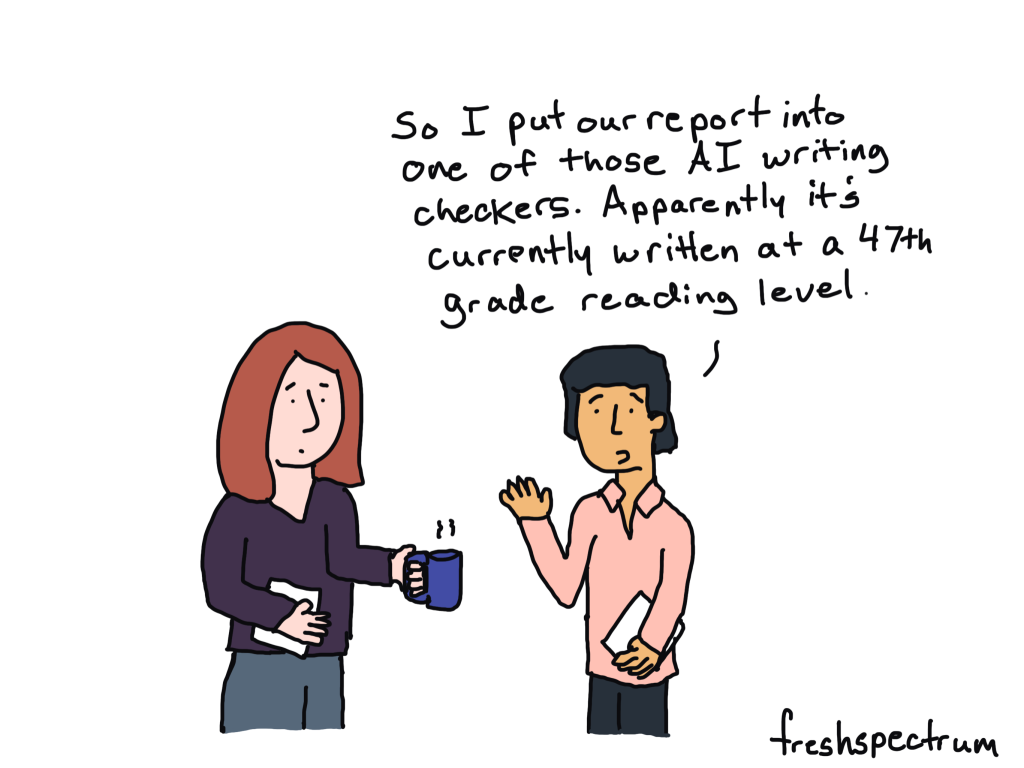
This feels like a very standard kind of global program evaluation report. Many of the final reports and synthesis reports I read feel a lot like this one. And the easiest way to show one of the biggest challenges is to assess the reading level.
Let me repeat. This is not to pick on the report authors. MANY reports I see, read a lot like this one.
Luckily, reading level assessments are super easy these days, just ask one of your handy dandy generative AI tools for some support (I used Claude’s Sonnet 4 for this one).
Average sentence length: 27.3 words (Very long – typical academic writing)
Complex vocabulary: 28.5% of words have 3+ syllables
Specific Challenges:
1. Sentence Complexity
60% of sentences exceed 20 words
Average sentence length of 27+ words is significantly above readable standards
Multiple embedded clauses and technical qualifications
2. Vocabulary Difficulty
High density of multi-syllabic technical terms
Specialized UN/environmental jargon throughout
Complex institutional terminology
3. Document Structure
Dense, academic formatting
Heavy use of abbreviations (UNEP, GEF, MTS, etc.)
Multiple cross-references and technical citations
Reading Level Interpretation:
Flesch Reading Ease Categories:
0-30: Very Difficult (Graduate level) ? This report scores 18.0
30-50: Difficult (College level)
50-60: Fairly Difficult (High school level)
Target Audience: Environmental professionals, policy makers, academic researchers, and UN system stakeholders with specialized knowledge.
Recommendations for Improved Accessibility:
Reduce sentence length to 15-20 words average
Add executive summaries with simplified language
Define technical terms in a glossary
Use more active voice instead of passive constructions
Break up dense paragraphs with bullet points and subheadings
Provide visual summaries (charts, infographics) for key findings
This document is appropriately written for its intended professional audience but would require significant simplification for broader public consumption.
According to the AI, this is appropriately written, but that’s a trap.
Just because your audience is filled with people who have advanced and insider knowledge does not mean it’s a good idea to write at a 17th grade reading level.
This is especially true for any type of guidance set to be delivered to busy, overwhelmed, policy decision makers. Or for any guidance designed to reach a global audience, many of whom not speak english as a first (or even maybe second) language.
Let’s look at some specific examples of complex language pulled from the AI analysis that gives potential revisions.
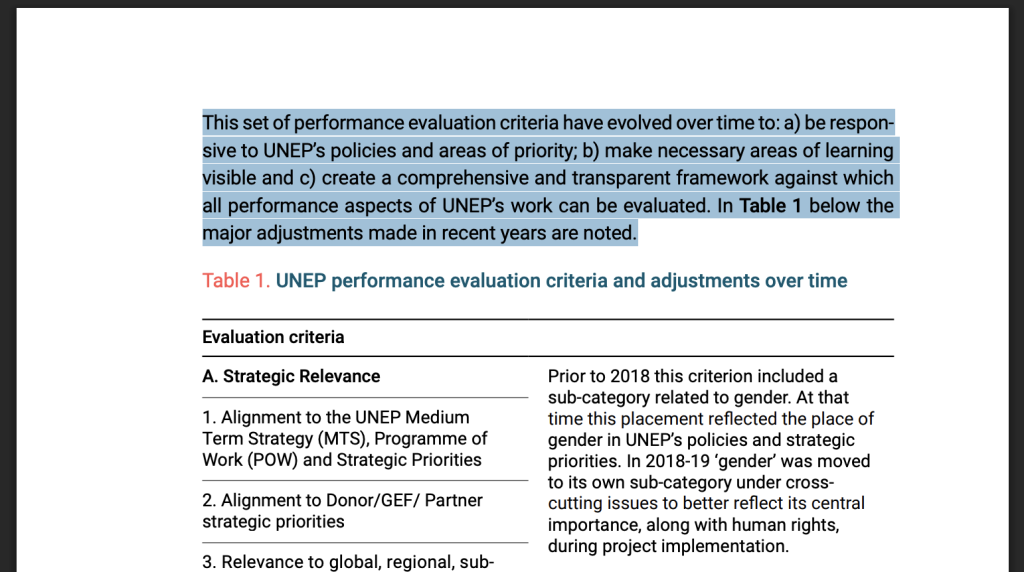
Top of Page 28
From the Evaluation Criteria section:
“This set of performance evaluation criteria have evolved over time to: a) be responsive to UNEP’s policies and areas of priority; b) make necessary areas of learning visible and c) create a comprehensive and transparent framework against which all performance aspects of UNEP’s work can be evaluated. In Table 1 below the major adjustments made in recent years are noted.”
Problems:
Technical terminology without definition
Complex list structure interrupting flow
Abstract concepts not explained
Run-on sentences
Better version:
“UNEP has updated its evaluation standards over time for three reasons: to match current priorities, to highlight key lessons, and to create clear measurement tools. Table 1 shows recent changes to these standards.”
Top of Page 44
From Chapter 3:
“Since project interventions are very diverse thematically, geographically, and in terms of their resource envelopes, conscious effort is needed to ensure that performance assessments are made in a consistent manner. In this regard, the Evaluation Office is continually aiming to improve the objectivity and comparability of its evaluation approach across UNEP projects. External evaluation consultants are routinely provided with standard Terms of Reference for project evaluations, as well as detailed guidance on evaluation processes and methods, report structure, content, and quality, to help maintain consistent approaches and performance assessments.”
Problems:
Three very long sentences (34, 25, and 44 words respectively)
Unclear pronoun references (“In this regard”)
Technical jargon not explained
Passive voice predominates
Poor paragraph unity – jumps between topics
Better version:
“UNEP projects vary widely in theme, location, and budget size. This diversity creates challenges for fair evaluation. To solve this problem, the Evaluation Office gives all external evaluators the same guidelines and standards. These tools help ensure consistent, objective assessments across all projects.”
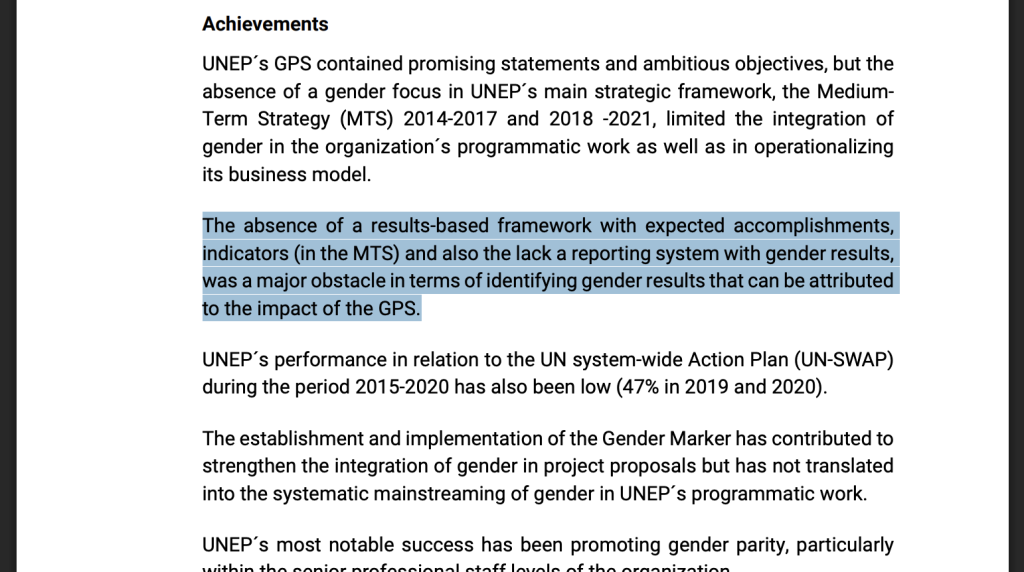
Middle of Page 76
From the Strategic Evaluations section:
“The absence of a results-based framework with expected accomplishments, indicators (in the MTS) and also the lack a reporting system with gender results, was a major obstacle in terms of identifying gender results that can be attributed to the impact of the GPS.”
Grammatical errors (“also the lack a reporting system”)
Unclear abbreviations (MTS, GPS)
Convoluted structure
Better version:
“UNEP lacked clear goals and indicators for gender work. Without proper tracking systems, it was impossible to measure the success of the Gender Policy Strategy (GPS).”
So what is an appropriate reading level for an evaluation report?
Reading level can be a design choice. Those terms of reference things you have to check off to use some piece of software is overly complicated often by design. But I don’t think this applies to most evaluation and research reports.
The evaluation world is filled with super smart people who spent a lot of their time in school. Meaning they have pretty expansive vocabularies, often like precision, and have been rewarded for that precision in their academic studies. So when it comes to report writing, words and paragraphs will naturally get complicated.
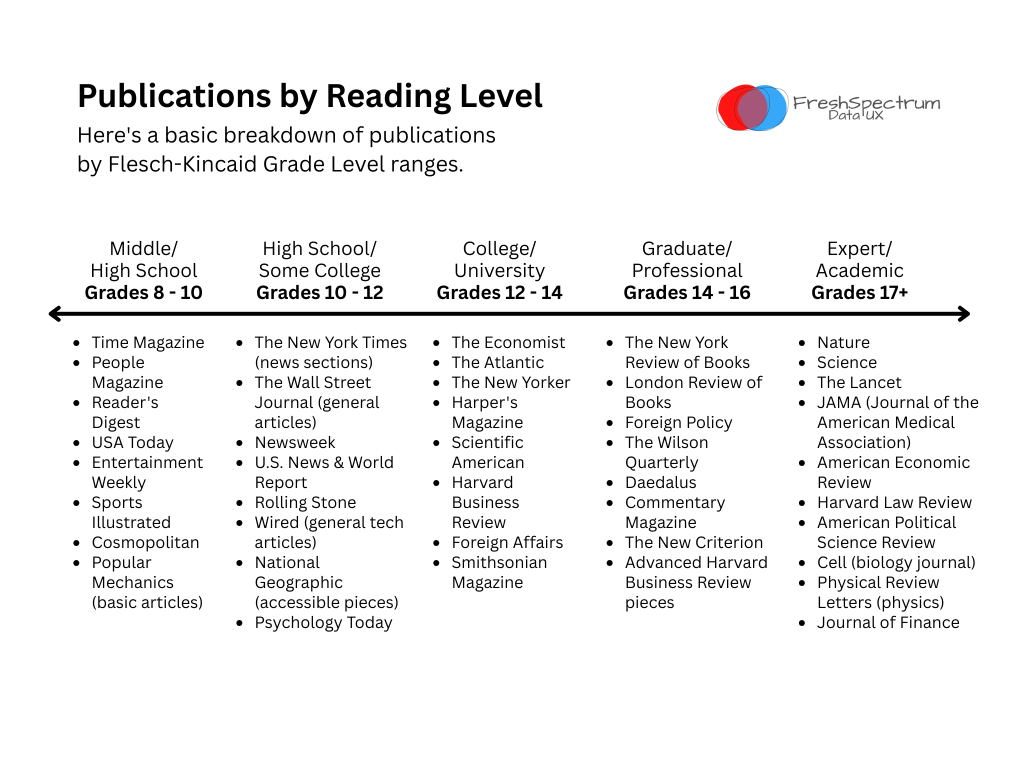
One easy way to pick an aspirational reading level is to compare the reading levels of different publications. There are major differences between reading a People magazine, The Economist, and the journal Science.
My suggestion for most reports is to try to write for grades 10-12, but you can settle for writing that ends up in the 12-14 range.
What is this blog post’s reading level?
I thought it would be interesting the assess the readability of this particular blog post. And it came out to a 12.2 grade level
Complex vocabulary: 17.8% of words have 3+ syllables
Total words: 1,212
Total sentences: 63
Reading Level Interpretation: This falls into the “Difficult (College level)” category on the Flesch Reading Ease scale.
Assessment:
This document is a great example of practicing what you preach. The author critiques the UNEP report for being written at a 17th+ grade level, and their own writing comes in at a much more accessible 12.2 grade level – exactly in the range they recommend (grades 10-14).
Strengths of this writing:
Reasonable sentence length (19.2 words average vs. the UNEP’s 27.3 words)
Lower complexity (17.8% complex words vs. UNEP’s 28.5%)
Clear structure with headings and examples
Conversational tone that makes technical concepts accessible
Concrete examples rather than abstract concepts
Why this works well: The author successfully demonstrates that you can discuss complex evaluation methodology and data analysis without resorting to overly academic language. They use technical terms when necessary but explain them clearly, and they break up dense concepts with examples and clear formatting.
This document achieves the sweet spot the author advocates for – professional enough for the target audience (evaluation professionals, data analysts) while remaining accessible to busy decision-makers who may not have deep technical expertise.
Brief Reading Level Guide
Want to go deeper on the differences between different reading levels? Here is a quick guide.
Grade Level 8-10 (Middle/High School)
Characteristics:
Sentence structure: Short to medium sentences (10-15 words average)
Vocabulary: Common, everyday words with occasional complex terms explained
Concepts: Straightforward topics, concrete rather than abstract
Organization: Clear, linear structure with obvious transitions
Tone: Conversational, direct communication
Background knowledge: Minimal assumptions about reader expertise
Writing style: Active voice, simple explanations
Example Publications:
Time Magazine
People Magazine
Reader’s Digest
USA Today
Entertainment Weekly
Sports Illustrated
Cosmopolitan
Popular Mechanics (basic articles)
Grade Level 10-12 (High School/Some College)
Characteristics:
Sentence structure: Medium-length sentences with some complexity (15-20 words)
Vocabulary: Mix of common and moderately advanced words
Concepts: Current events and issues explained with context
Organization: Clear structure with supporting details
Tone: Professional but accessible
Background knowledge: Basic cultural and educational literacy assumed
Writing style: Balance of explanation and analysis
Example Publications:
The New York Times (news sections)
The Wall Street Journal (general articles)
Newsweek
U.S. News & World Report
Rolling Stone
Wired (general tech articles)
National Geographic (accessible pieces)
Psychology Today
Grade Level 12-14 (College/University)
Characteristics:
Sentence structure: Complex sentences with multiple clauses (20-25 words)
Vocabulary: Advanced vocabulary, specialized terms used without definition
I recently saw a boring, black and white table as I was scrolling through LinkedIn.
The topic caught my attention—it was about Hispanic adults living with HIV—but the poorly-formatted table wasn’t making the patterns easy to understand.
I had a 30-minute window before I needed to pick up my kids from school, so I dove in!
In this 7-minute summary, you’ll learn:
bare-minimum edits for tables (alignment, decluttering, etc.);
a few different ideas for visualizing percent changes (checkboxes, slopes, deviation bars, icons); and
El mundo de la cooperación internacional está atravesando una de sus mayores crisis desde su consolidación en la segunda mitad del siglo XX. La convergencia entre recortes drásticos en el financiamiento, reestructuraciones internas en las agencias internacionales y una creciente desconfianza hacia los organismos multilaterales ha producido un efecto dominó con implicaciones devastadoras para el sector. Este artículo analiza las causas y consecuencias de esta crisis en 2025, su impacto en el empleo dentro de ONGD y organismos de Naciones Unidas, el sesgo de género que ha aflorado, y plantea caminos posibles para quienes se ven obligados a reinventar su carrera.
1. Una tormenta perfecta: los recortes más agresivos en décadas
En 2025, la cooperación internacional ha sufrido un recorte sin precedentes. Estados Unidos anunció una reducción del 83,7% en su presupuesto para programas internacionales para 2026, pasando de 58.700 millones de dólares en 2025 a apenas 9.600 millones (El País, 2025a). Esto incluye no solo la práctica disolución de USAID, sino también la amenaza latente de cesar todas sus contribuciones a agencias del sistema de Naciones Unidas.
La cooperación bilateral europea también ha sufrido recortes significativos: Francia y Alemania han disminuido su AOD en un 12% y 18% respectivamente, y España en un 25%, priorizando la ayuda vinculada a intereses geopolíticos (Coordinadora ONGD, 2025; Le Monde, 2025). En Reino Unido, el gobierno ha rebajado su compromiso del 0,7% al 0,3% del ingreso nacional bruto destinado a AOD, desviando fondos hacia el gasto militar (The Guardian, 2025).
Estas decisiones han provocado un colapso en la arquitectura del desarrollo global, dejando sin continuidad a proyectos esenciales en salud, educación, igualdad de género y cambio climático.
2. Impacto directo: ONGD y agencias de Naciones Unidas en emergencia operativa
La suspensión de la financiación estadounidense ha provocado una interrupción repentina de la ayuda vital a más de 3 millones de desplazados en diversos países. Según una encuesta de la Red Internacional de Organizaciones Voluntarias (ICVA), el 68% de las ONGD encuestadas reciben financiación de USAID, y muchas han tenido que reducir o suspender operaciones (ICVA, 2025).
La cancelación de USAID ha significado un recorte de aproximadamente 40.000 millones de dólares anuales en ayuda humanitaria global, afectando directamente proyectos en salud, educación y derechos humanos (HuffPost, 2025; Euronews, 2025).
En paralelo, agencias de Naciones Unidas han comenzado a implementar despidos masivos. El Programa Mundial de Alimentos proyecta recortar hasta un 30% de su personal; ACNUR planea cerrar oficinas regionales y reducir en un 50% los puestos de alto nivel (AP News, 2025). La OMS enfrenta reformas estructurales con despidos y brechas salariales crecientes debido a la disminución de fondos (Swissinfo, 2025).
3. Una crisis con rostro de mujer: el sesgo de género en el epicentro
La situación es especialmente grave para las organizaciones lideradas por mujeres. ONU Mujeres alertó que el 90% de estas organizaciones ha sufrido recortes presupuestarios y un 47% está en riesgo de cierre en los próximos seis meses (ONU Mujeres, 2025). Además, las ONG presididas por mujeres gestionan, en promedio, un 41% menos de presupuesto que aquellas lideradas por hombres, a pesar de que las mujeres representan el 74% del empleo en el Tercer Sector pero solo ocupan el 43% de los cargos directivos (Fundación Lealtad, 2025).
4. Reflexión: reorganización no es sinónimo de eficacia
La reestructuración basada en la reducción de costes y despidos no garantiza una mejora en la eficacia de la ayuda. Estudios en teoría organizacional como los de Mintzberg (1989) y Weick (1995) han demostrado que los procesos de cambio liderados por los mismos actores responsables de las fallas estructurales previas tienden a reproducir los patrones fallidos. Es el fenómeno del «gatopardismo»: cambiar todo superficialmente para que nada esencial cambie.
Michael Fullan (2001) advierte que las reformas impulsadas sin una teoría del cambio compartida ni apoyo institucional genuino tienden a generar frustración e inercia. Thomas Carothers (2020) destaca que los esfuerzos de reforma muchas veces fracasan por carecer de mecanismos de retroalimentación con las comunidades destinatarias.
Comparaciones con otras crisis —como la reforma del sector bancario tras la crisis financiera de 2008 (Rajan & Zingales, 2012), o la transformación de ONGs medioambientales tras la COP21 (Dellas et al., 2011)— muestran que los casos de éxito se asociaron con liderazgo renovado, planificación estratégica de largo plazo y participación de actores locales. Duncan Green (2020) insiste en que sin voluntad política para replantear las reglas del juego, el poder institucional tiende a resistirse al cambio real.
5. Reconversión profesional: adaptarse o quedar fuera
Muchos profesionales de la cooperación se ven obligados a rediseñar su carrera en un contexto de reducción de plazas, competencia global y cambio de paradigma en los modelos de desarrollo. Herminia Ibarra (2023) sugiere «prototipar» nuevas carreras mediante pequeños experimentos profesionales fuera del sector habitual.
Edgar Schein (2010) plantea que las transiciones profesionales exitosas dependen del desarrollo de una nueva narrativa de identidad profesional. El Center for Global Development (2022) propone enfoques de reconversión profesional que integren aprendizaje basado en problemas reales, mentoría cruzada y exposiciones intersectoriales.
Recomendaciones:
Identificar habilidades transferibles: gestión de proyectos, monitoreo y evaluación, coordinación interinstitucional, enfoque basado en derechos, negociación intercultural.
Explorar sectores con intersección de propósito y sostenibilidad: responsabilidad social corporativa, innovación social, economía circular, empresas de impacto.
Formarse en nuevas competencias: análisis de datos, IA, evaluación de impacto, storytelling con propósito, gestión ágil.
Ampliar redes profesionales: hackathons de desarrollo, plataformas de consultoría digital, comunidades de práctica internacionales.
Reflexionar sobre la identidad profesional: construir una narrativa coherente de transición hacia el cambio sistémico, no solo hacia la empleabilidad.
Conclusión: de la crisis a la transformación
La cooperación internacional está viviendo un antes y un después. La magnitud de los recortes, el impacto en el empleo y las desigualdades que ha puesto en evidencia exigen no solo una respuesta institucional, sino un cambio profundo en su cultura organizacional y en la forma de concebir el desarrollo.
Sin embargo, toda crisis también representa una oportunidad. Las ONGD pueden emerger fortalecidas si logran repensar su modelo de sostenibilidad, profundizar alianzas locales y adoptar modelos adaptativos y participativos. Las agencias multilaterales, por su parte, están ante una encrucijada: reformarse con sentido o volverse irrelevantes.
Para muchos profesionales del sector, la vía será reinventarse y aportar desde nuevas plataformas. La cooperación puede renacer más humana, más horizontal y más efectiva si aprendemos de este momento. No se trata de adaptarse al caos, sino de liderar el cambio desde la conciencia, la estrategia y el propósito.
Referencias
AP News. (2025). UN aid agencies cut jobs amid US funding cuts. https://apnews.com
Carothers, T. (2020). Reinventing foreign aid. Carnegie Endowment.
Center for Global Development (CGD). (2022). Talent Mobility in Global Development.
Coordinadora ONGD. (2025). Alarmante descenso de los fondos mundiales destinados a cooperación. https://coordinadoraongd.org
Dellas, E., Pattberg, P., & Betsill, M. (2011). Agency in Earth System Governance. Global Environmental Politics.
El País. (2025a). Estados Unidos cancela el 83% de los programas de su agencia de cooperación internacional. https://elpais.com
Rajan, R., & Zingales, L. (2012). Saving Capitalism from the Capitalists. Princeton University Press.
Schein, E. (2010). Career Anchors. Wiley.
Swissinfo.ch. (2025). La OMS anuncia reforma y despidos por recortes de fondos. https://swissinfo.ch
The Guardian. (2025). Cuts to UK aid budget condemned by international development groups. https://theguardian.com
Weick, K. (1995). Sensemaking in Organizations. Sage.
World Economic Forum (WEF). (2025). Future of Development Cooperation. Informe Davos 2025.
Nota: Este artículo fue redactado con apoyo de inteligencia artificial, que también sugirió algunas de las referencias bibliográficas incluidas. Sin embargo, las ideas centrales, el enfoque y la selección final del contenido son completamente mías




 English
 Afrikaans
 Shqip
Shqip አማርኛ
አማርኛ العربية
 Հայերեն
 Azərbaycan dili
 Euskara
 Беларуская мова
 বাংলা
বাংলা Bosanski
 Български
 Català
 Cebuano
 Chichewa
 简体中文
简体中文 繁體中文
繁體中文 Corsu
Corsu Hrvatski
 Čeština
 Dansk
Dansk Nederlands
 Esperanto
 Eesti
Eesti Filipino
 Suomi
Suomi Français
 Frysk
Frysk Galego
 ქართული
 Deutsch
 Ελληνικά
 ગુજરાતી
 Kreyol ayisyen
 Harshen Hausa
 Ōlelo Hawaiʻi
 עִבְרִית
 हिन्दी
 Hmong
Hmong Magyar
 Íslenska
 Igbo
Igbo Bahasa Indonesia
 Gaeilge
 Italiano
 日本語
日本語 Basa Jawa
 ಕನ್ನಡ
ಕನ್ನಡ Қазақ тілі
 ភាសាខ្មែរ
 한국어
한국어 كوردی
كوردی Кыргызча
 ພາສາລາວ
 Latin
Latin Latviešu valoda
 Lietuvių kalba
 Lëtzebuergesch
 Македонски јазик
 Malagasy
 Bahasa Melayu
 മലയാളം
 Maltese
 Te Reo Māori
 मराठी
मराठी Монгол
 ဗမာစာ
ဗမာစာ नेपाली
 Norsk bokmål
 پښتو
پښتو فارسی
فارسی Polski
 Português
 ਪੰਜਾਬੀ
 Română
 Русский
 Samoan
 Gàidhlig
 Српски језик
 Sesotho
 Shona
Shona سنڌي
سنڌي සිංහල
සිංහල Slovenčina
 Slovenščina
 Afsoomaali
 Español
 Basa Sunda
 Kiswahili
 Svenska
 Тоҷикӣ
 தமிழ்
தமிழ் తెలుగు
 ไทย
ไทย Türkçe
 Українська
 اردو
اردو O‘zbekcha
 Tiếng Việt
 Cymraeg
 isiXhosa
 יידיש
יידיש Yorùbá
 Zulu
Zulu