• Skip to main content
  • Skip to footer
  • Home

The May 13 Group

the next day for evaluation

  • Get Involved
  • Our Work
  • About Us
You are here: Home / Archives for allblogs

allblogs

May 14 2025

Which Graphs Can I Make in Excel?

Sure, Excel can handle bar charts and line charts. But it can also make population pyramids, dot plots, and maps!

In this video, you’ll see more than a dozen different charts that are possible inside Microsoft Excel.

What’s Inside

  • 0:00 Intro
  • 0:17 Dataviz On The Go
  • 0:36 3 Levels of Excel Skills
  • 1:05 Level 1: Overused Native Charts (Bars, Lines, Pies, etc.)
  • 2:35 Level 2: Underused Native Charts (Combo, Tree, Sunburst, Maps, etc.)
  • 4:01 Level 3: Non-Native Charts (Population Pyramids, Dumbbell Dots, Lollipops, etc.)
  • 5:02 Disguises Needed for Non-Native Charts
  • 5:54 Interactive Dashboards in Excel (Excel Tables, Pivot Tables, Pivot Charts, and Slicers)
  • 6:16 Static Dashboards in Excel (Made in Excel, but Saved/Shared as PDFs)
  • 6:41 Your Turn
  • 6:55 A Personal Note

3 Levels of Excel Vizardry

I’ve taught data visualization in Excel a dozen different ways over the years.

Nowadays, I teach Excel dataviz based on the degree of behind-the-scenes hacking needed to produce that chart.

We start easy. Then, we work up to harder battles.

Here are the three Levels of Excel Vizardry:

  • Level 1: Overused Native Charts
  • Level 2: Underused Native Charts
  • Level 3: Non-Native

Let’s go through some of the Excel secrets in more detail.

Level 1: Overused Native Charts

These are the familiar faces:

  • Pies
  • Donuts
  • Bars and columns
  • Clustered bars and clustered columns
  • Stacked bars and stacked columns
  • Line graphs

What are Native Charts?

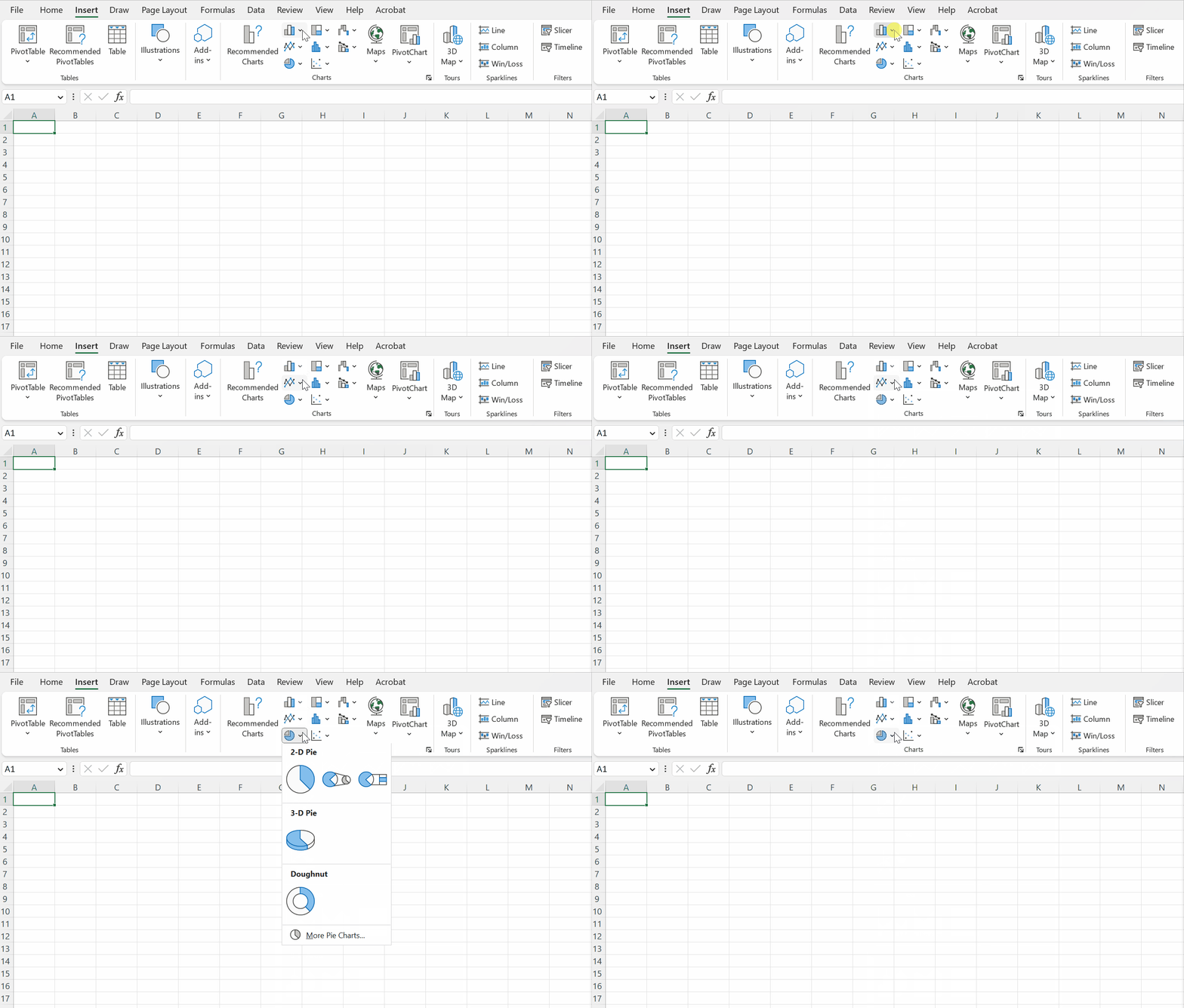
“Native” charts mean they’re available from our menu with just a few clicks:
What’s Wrong with Overused Charts?

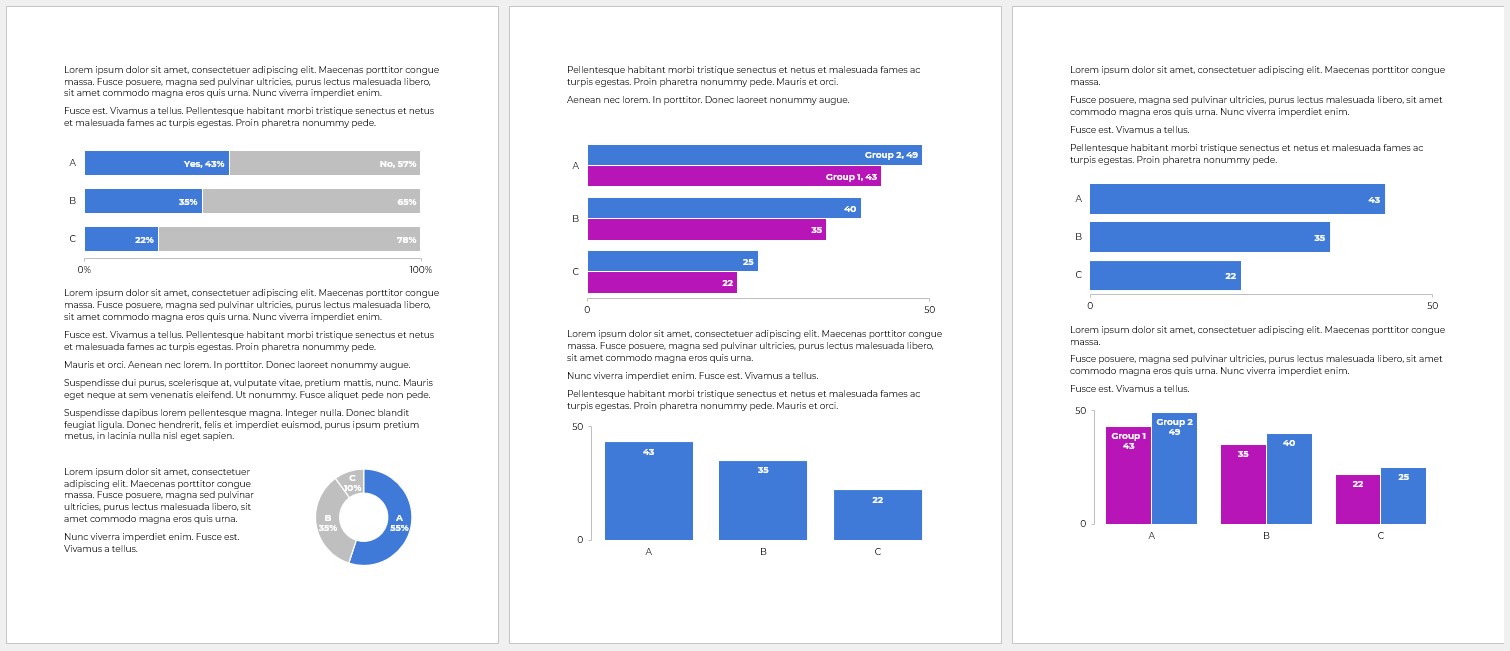
There’s nothing wrong with a bar chart here or there… but any chart gets boring when we show it over and over and over and over and over and over.

There’s also the issue of analytical depth — or lack of depth.. If we’re only using bar charts… then we’re only showing totals and averages. There are dozens more statistical approaches!
Snooze. And no analytical depth.

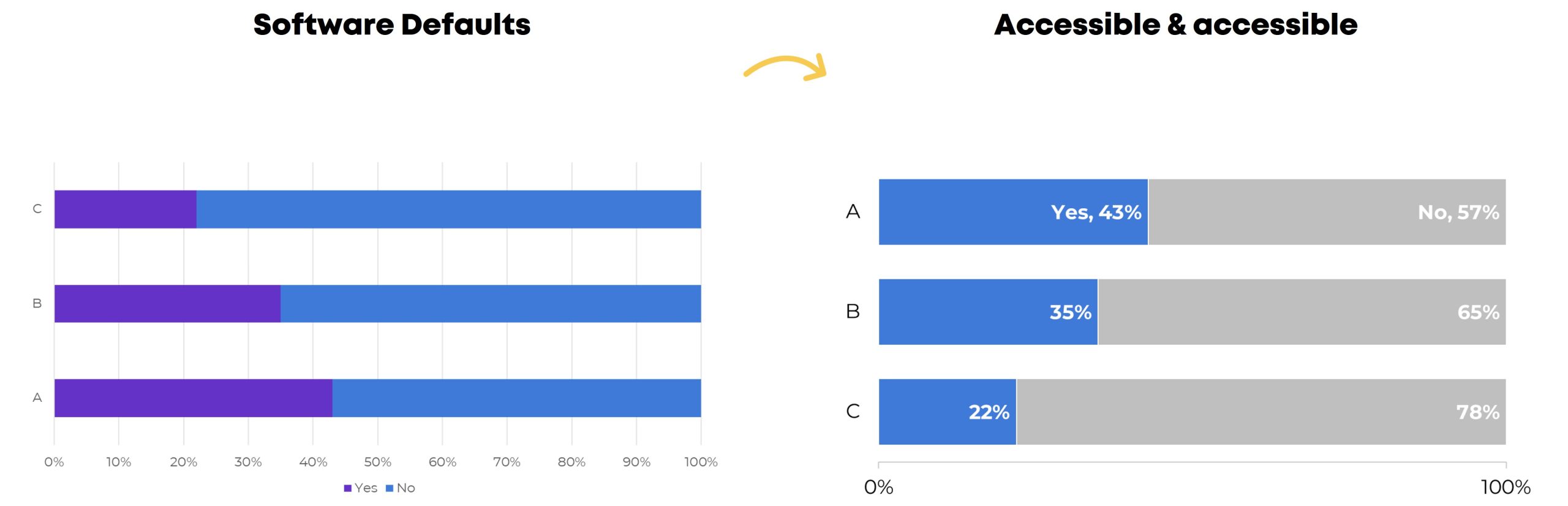
Beware! Formatting Needed

Stacked bar charts, for example.

They’re easy to make.

But we still have to:

  • enlarge the font;
  • darken the font (to pass official Accessibility rules for color contrast);
  • directly label the data (so viewers aren’t relying on the colored legend alone — another Accessibility rule);
  • outline the touching shapes in white (which helps with colorblindness and grayscale printing);
  • show fewer increments in the scale (so it’s not so busy);
  • decide whether to apply a dark-light contrast — or not (learn about data storytelling here); and
  • adjust the gap width (if you want) to nudge the bars closer together.
Level 2: Underused Native Charts

This is where it starts getting fun!!

Excel can make:

  • Combo charts (e.g., a column chart with a target line, as shown below)
  • Overlapping Bars
  • Area charts (where you shade the area underneath the line for better oomph and high color contrast)
  • Slopes (a line chart with exactly 2 points in time, like pre and post)
  • Small Multiples Lines (to combat the spaghetti line graph)
  • Bumps (for rankings)
  • Scatter plots (x and y)
  • Bubble charts (x, y, and z)
  • Tree maps (for nested categories)
  • Heat Maps
  • Sunbursts (nesting)
  • Box and Whisker (to go beyond averages and show the min, quartile 1, median, quartile 3, and max)
  • Waterfall (how pieces add to a net number)
  • Radar (to compare several ordinal categories at once)
  • Icons & Symbols (to make our graphs easier to navigate — and more memorable!)
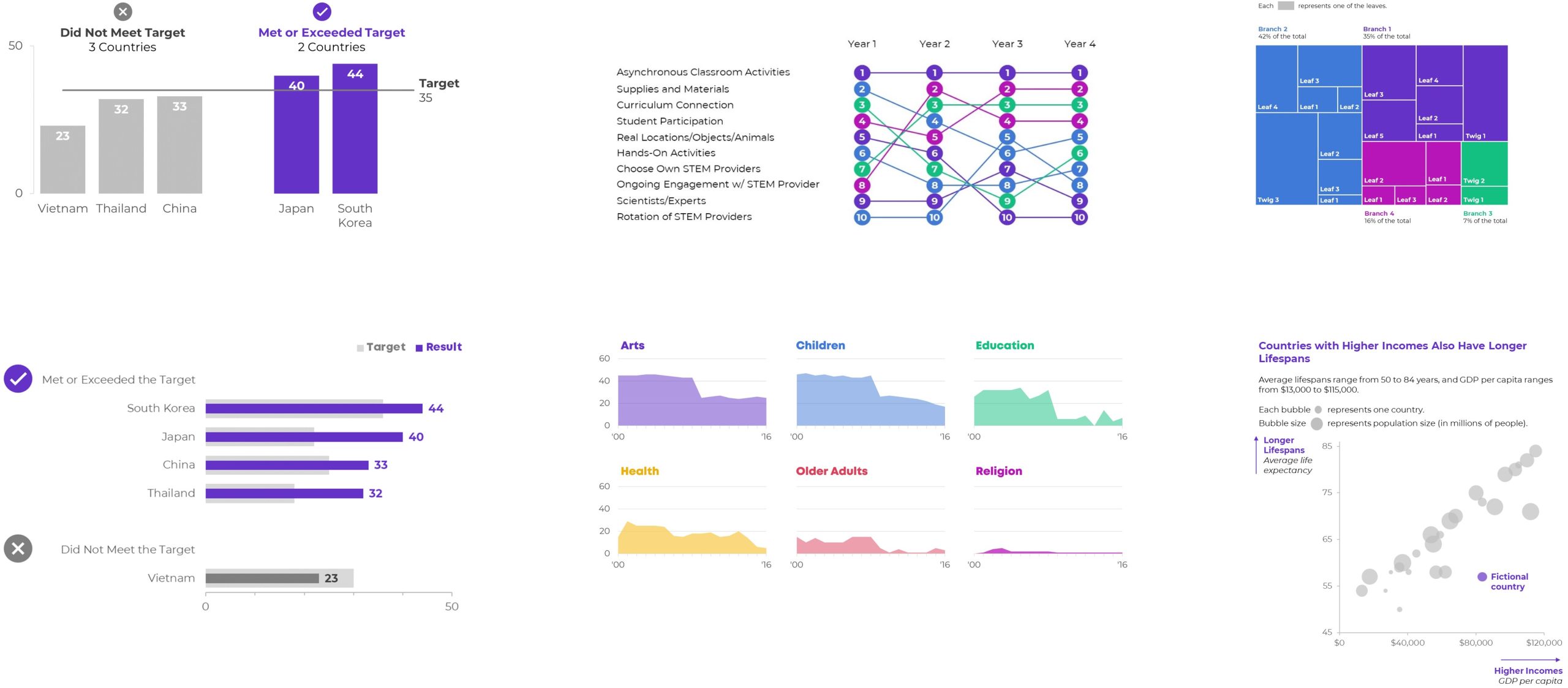
Yes, These are Native Charts 🙂

Well… if you’re using the latest version of Excel.

If you’re on outdated software, (most of) these charts are still possible. They just get harder to make, i.e., they’re in Level 4 territory.
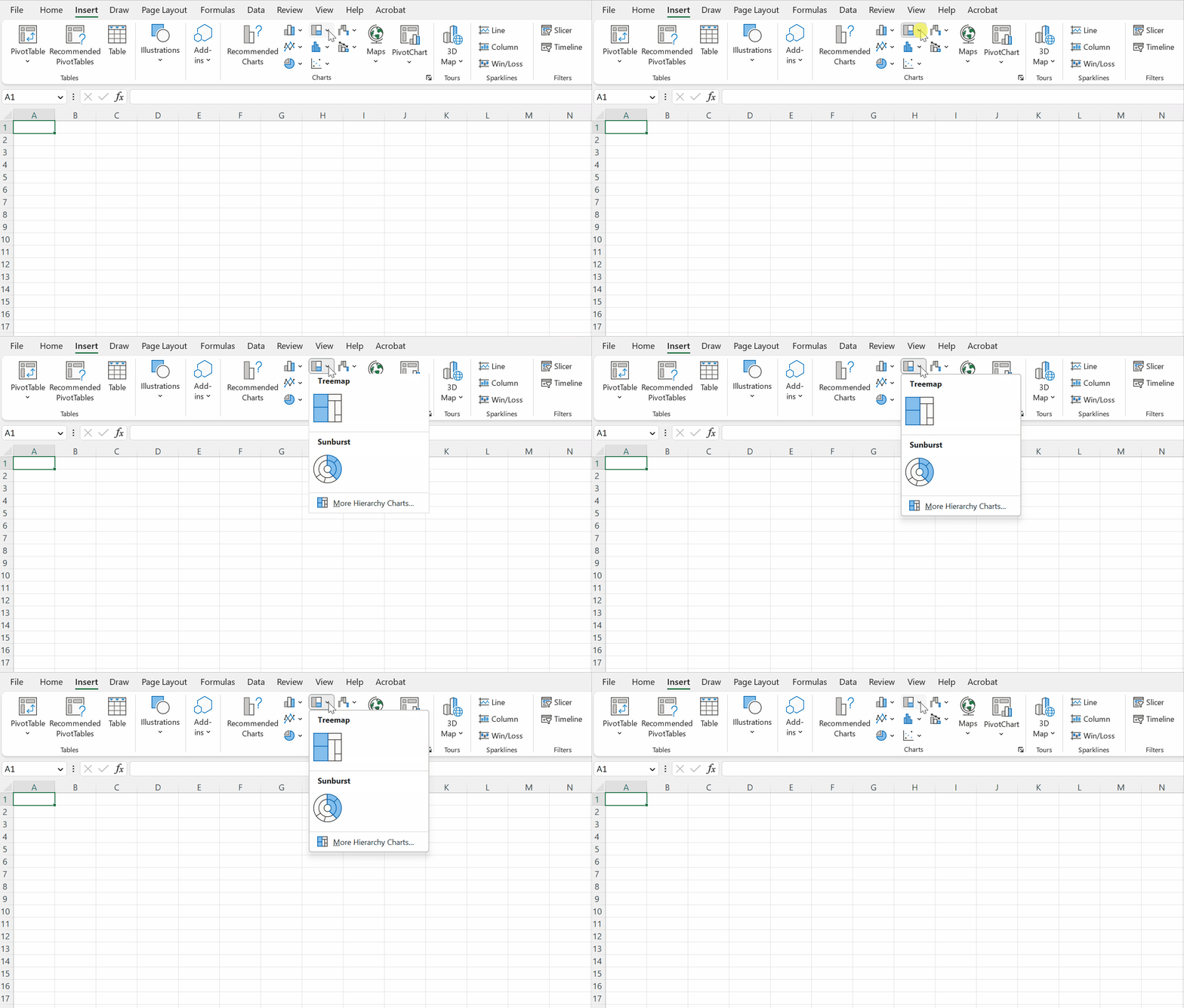
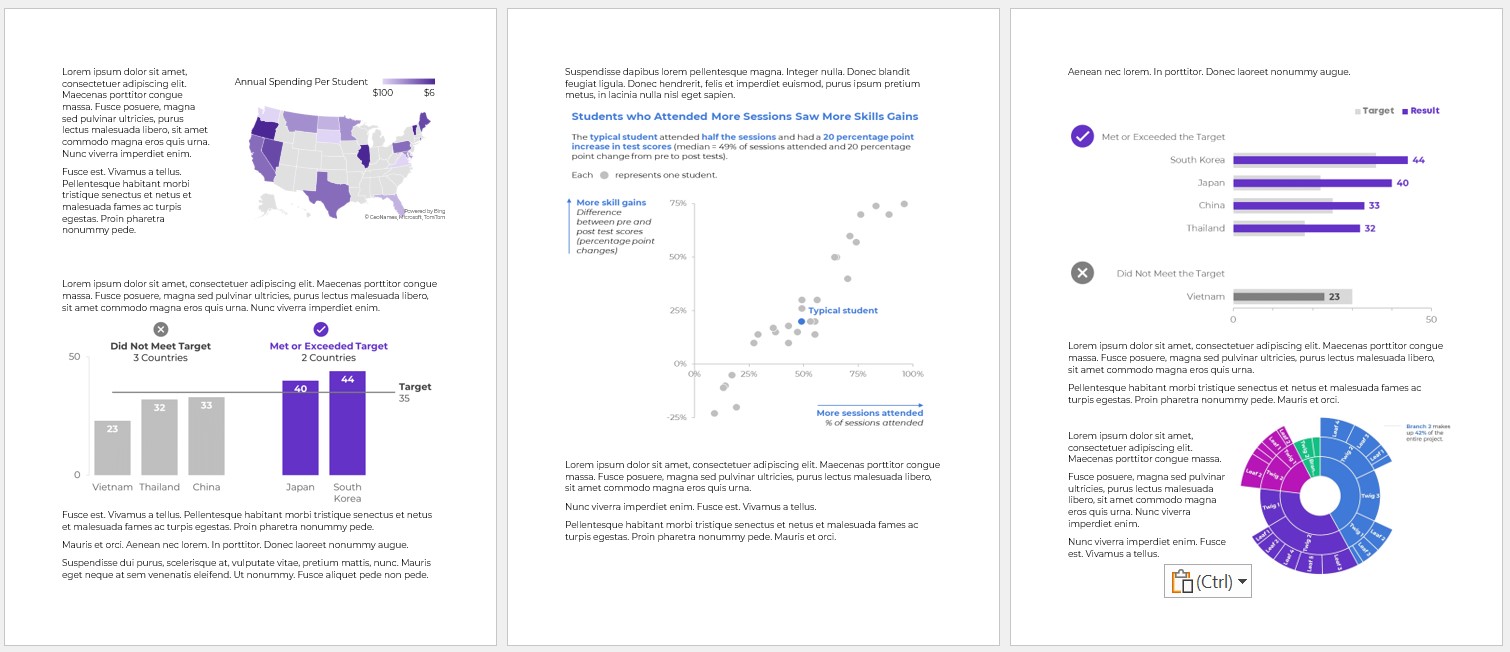
Yes, Underused Native Charts Add Variety (and Analytical Depth)

We’re not just adding variety for variety’s sake.

(Although common sense — and hundreds of consulting projects — has shown me that dataviz novelty is one of the best ways to increase engagement.)

Most importantly, we’re adding analytical depth. For example, a regular ol’ bar chart just compares the average or total of several categories. What if we compare them by location, too? Now we’ve got a heat map! We can spot geographical patterns, which would’ve been impossible in a bar chart.
Beware! Formatting Needed

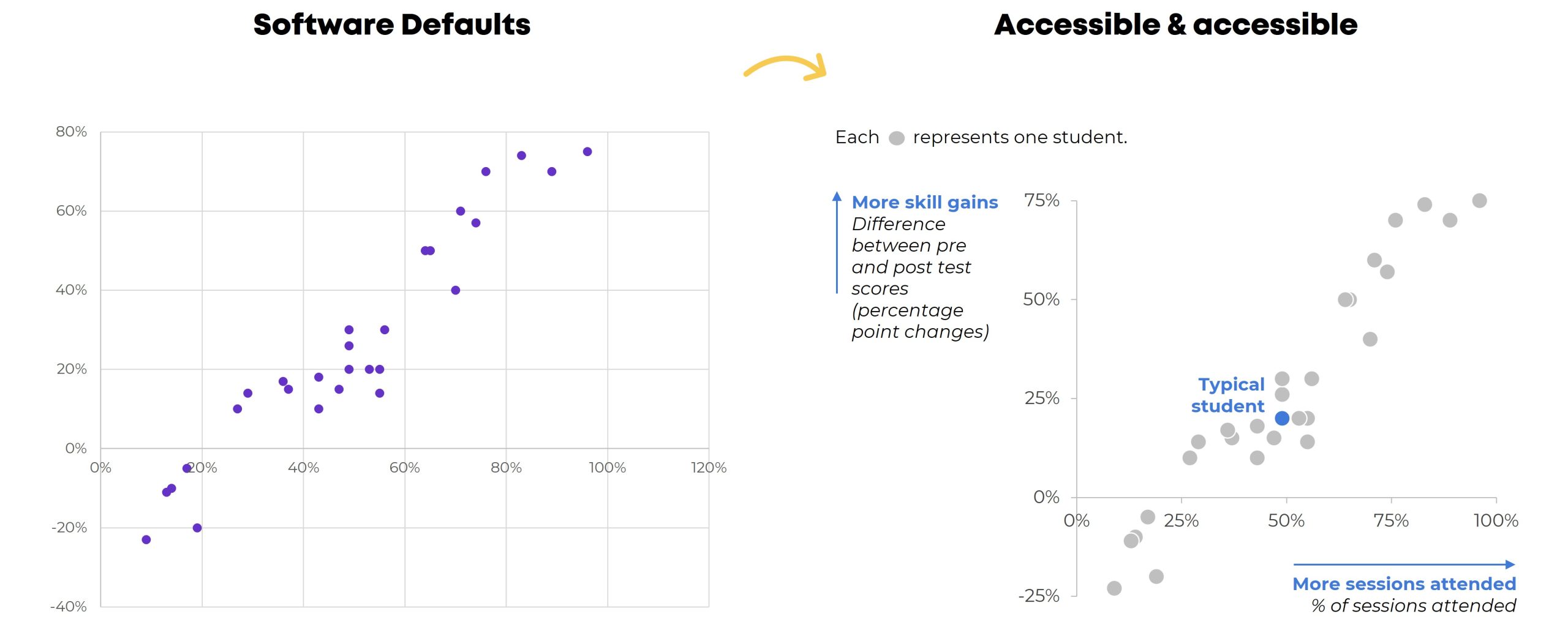
Scatter plots are easy to make.

But we still have to:

  • enlarge the font;
  • darken the font (to pass official Accessibility rules for color contrast);
  • add a key (that each dot represents one student);
  • label the scales (with everyday language, like More skills gains, because scatter plots are notoriously difficult to read for people who don’t stare at graphs all the time); and
  • decide whether to add a dark-light contrast.
Level 3: Non-Native Charts

Are you already using a variety of charts? Have you actually analyzed your data (beyond averages, and beyond totals)? Can you adjust the gap width, annotate the data, and apply colors strategically in your sleep?

Then you’re ready for Level 3!

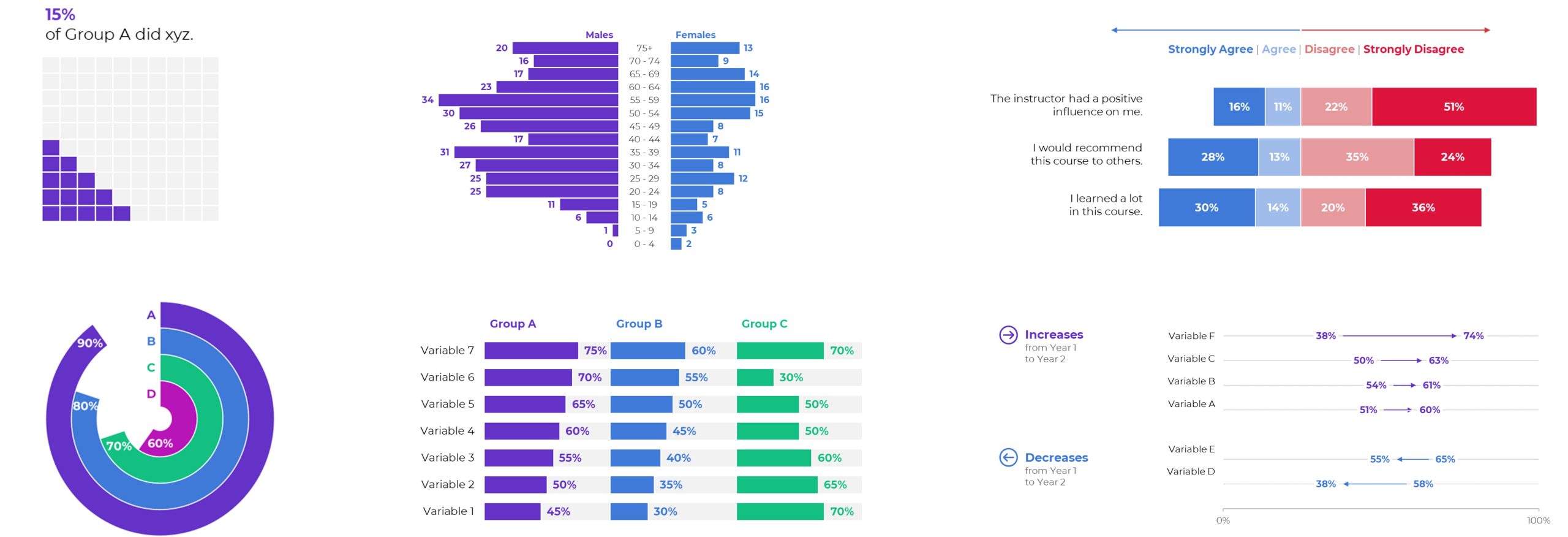
With behind-the-scenes elbow grease, you can make:

  • Stream Graphs
  • Waffles
  • B’Arcs
  • Small Multiples Bars
  • Population Pyramids
  • Diverging Stacked Bars
  • Lollipops
  • Dots
  • Swarm Plots
  • Tile Grid Maps
  • Sankey Diagrams

What are Non-Native Charts?

You won’t find any buttons that automatically make these charts.

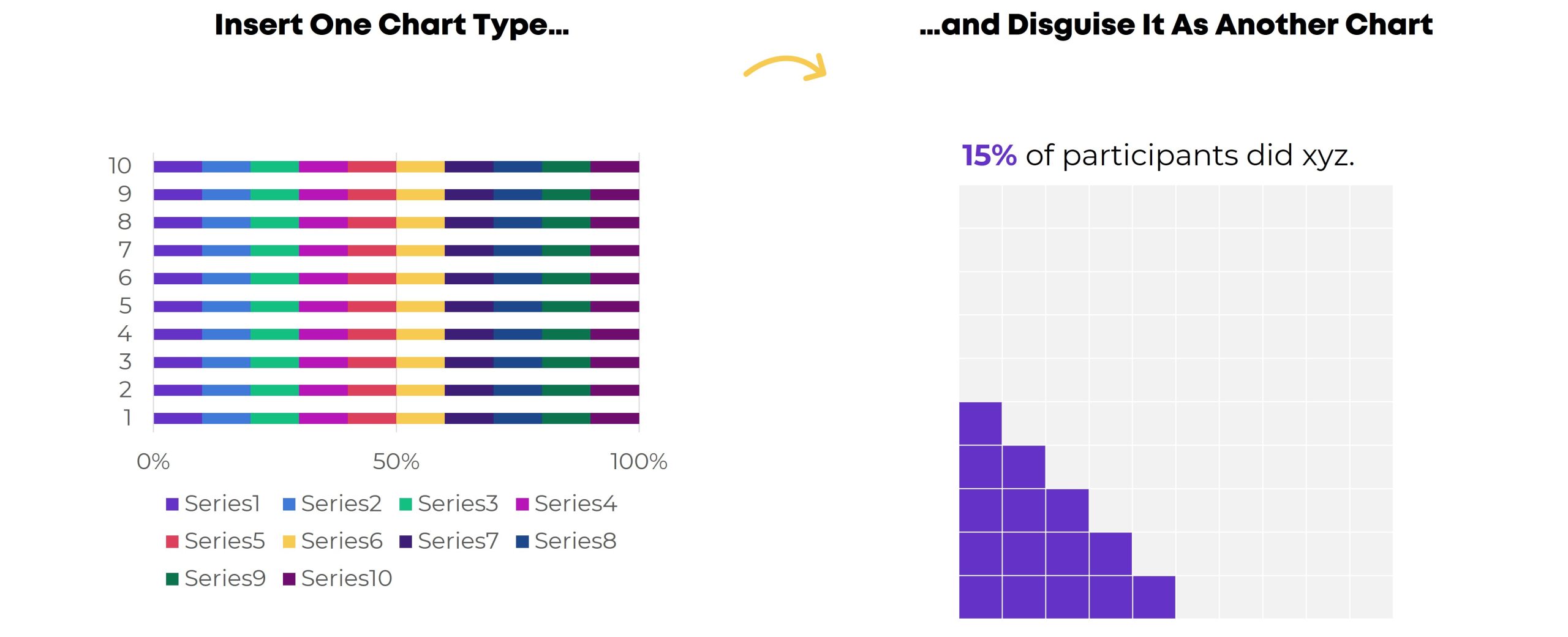
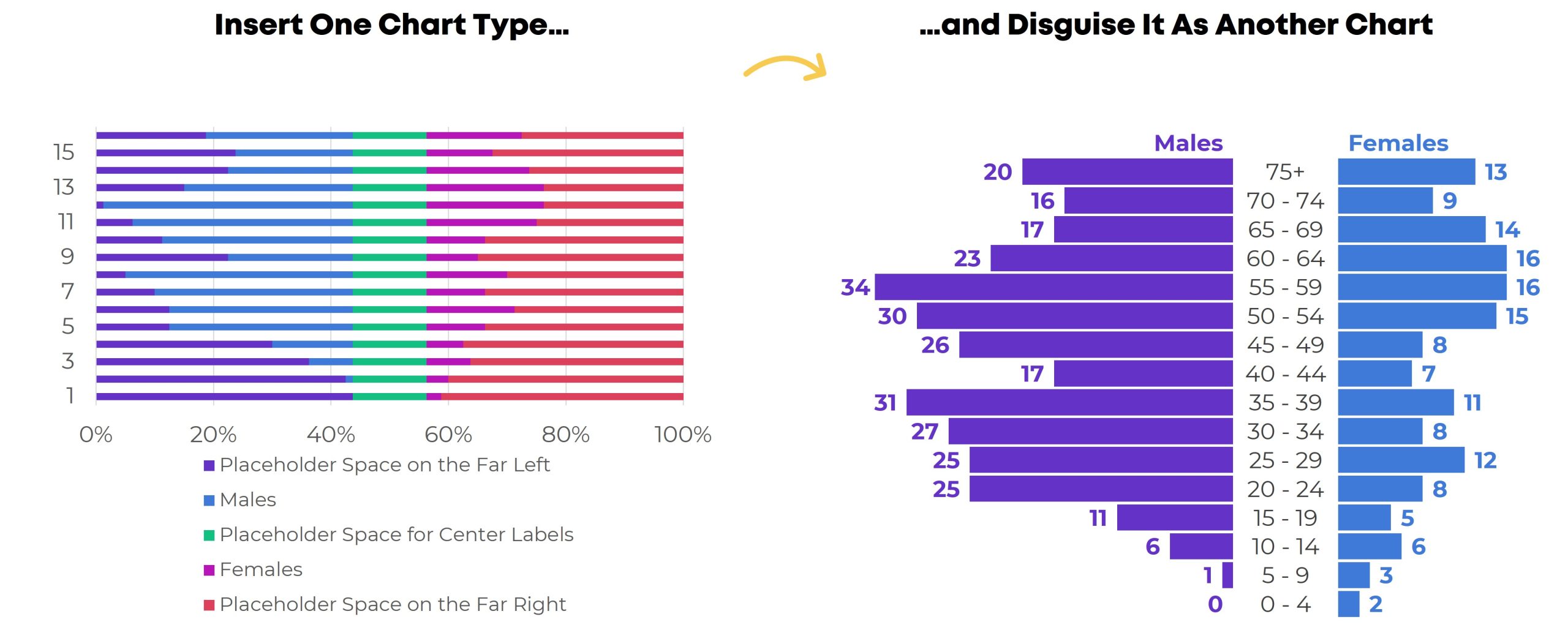
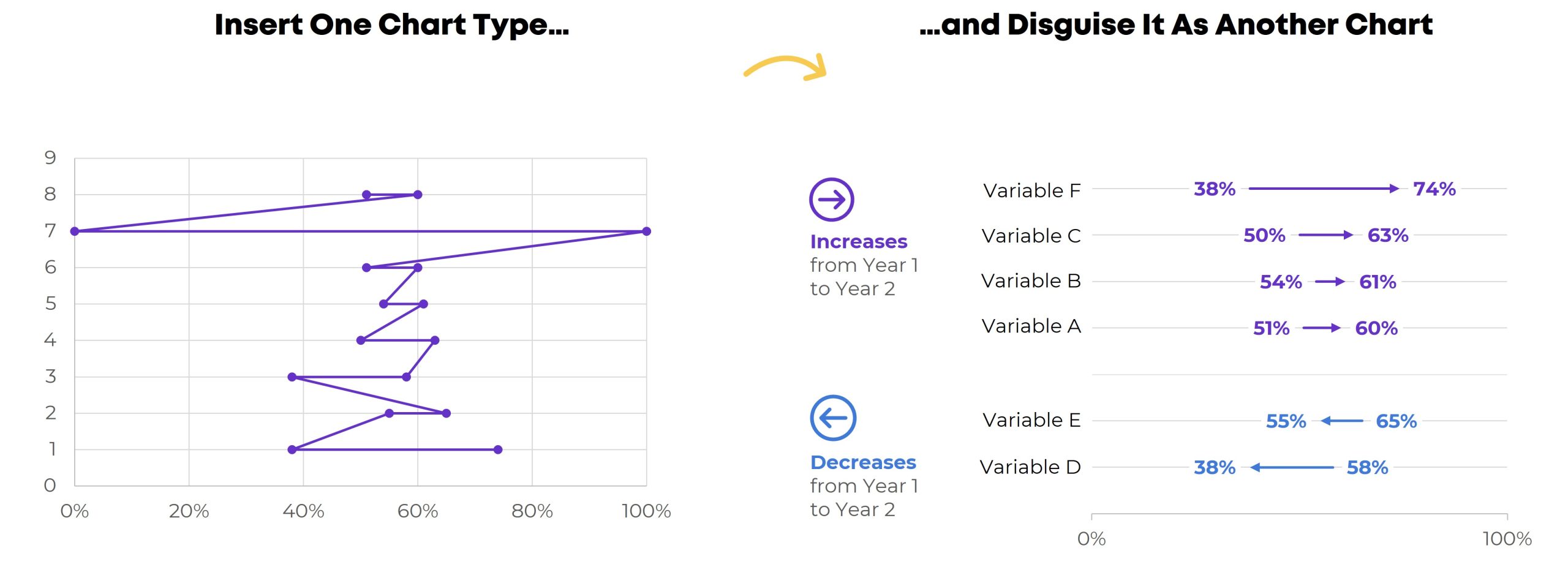
Instead, we have to insert one chart type… and disguise it as something else.

For example, we have to insert a stacked bar chart… and disguise it as a waffle chart. You’ll need a Magic Table behind the scenes, too.
A stacked bar chart gets disguised as a population pyramid. Yes, you’ll need a Magic Table with placeholder values.
A scatter plot gets disguised as a dot plot, and so on. Each value gets assigned a x-y placeholder location inside the Magic Table.
Do these maneuvers turn your brain inside out and upside down? You’re not alone.

Learn More

If you’re consistently making, editing, and applying graphs from Level 3, you’re already a vizard. Get in touch so I can send work your way!

If you’re in Level 1 or 2, you’ll love Data Storytelling in Excel. You’ll go slow and steady so you don’t feel overwhelmed. You’ll dip your toe in… and then you’ll be swimming in the deep end in no time.

Written by cplysy · Categorized: depictdatastudio

May 14 2025

Ask Nicole: Why Staff Hate Working with Consultants

Staff resistance to consultants isn’t always about the consultant themselves—it’s often about the process. When staff are left out of the loop, unclear on expectations, or unsure how their roles will change, it’s easy to feel frustrated or disengaged. In this Ask Nicole post, we explore why some staff feel caught off guard when a consultant joins a project, how that disconnect can be avoided, and what you can do to feel more prepared and empowered before the consultant even arrives.

The post Ask Nicole: Why Staff Hate Working with Consultants appeared first on Nicole Clark Consulting.

Written by cplysy · Categorized: nicoleclark

May 13 2025

Descolonizar el pensamiento: la herida abierta de la filosofía latinoamericana

América Latina no está simplemente en los márgenes del mundo. Está en los márgenes del saber. Esta idea no es solo una metáfora potente: es un eje estructural de la crítica decolonial contemporánea. Según Aníbal Quijano (2000), la colonización no solo impuso una economía extractiva o una estructura de dominación política, sino que también generó una colonialidad del saber: una jerarquización global del conocimiento en la que Europa se autoproclamó fuente legítima de lo universal, mientras relegaba los saberes del Sur a lo anecdótico, folclórico o premoderno.

Walter Mignolo (2011) lo formula de forma complementaria: el conocimiento moderno eurocéntrico opera desde un locus de enunciación que se oculta a sí mismo, pretendiendo universalidad mientras silencia otras geografías epistémicas. En este marco, América Latina no solo fue colonizada territorialmente, sino epistémicamente.

A esto se suma Boaventura de Sousa Santos (2014), quien sostiene que el Sur global no es una categoría geográfica, sino una metáfora del saber silenciado por la modernidad occidental. Desde esa herida —simbólica y real— puede emerger lo que él llama una epistemología del Sur, capaz de cuestionar la monocultura del conocimiento válido.

Esa herida, entonces, puede ser también un espacio fértil: de ruptura, de reinvención, de posibilidad.

La pregunta que se impone es: ¿Puede una filosofía latinoamericana, desde el punto de vista epistemológico, proponer una alternativa al poder universal de la filosofía occidental?

No solo puede: debe.

Durante siglos, Occidente ha proclamado su filosofía como universal. En realidad, ha sido una construcción geopolítica del conocimiento: lo que Enrique Dussel llama “el mito eurocéntrico del origen griego de la filosofía” (Dussel, 1985). Esta narrativa oculta o niega las múltiples formas de filosofar que existen fuera del canon europeo, etiquetando otras formas de pensamiento como “pre-filosóficas”, “mitológicas” o simplemente “inferiores”.

Pero el sur ha comenzado a hablar. Y no en eco, sino con voz propia.

Autores como Dussel, Quijano, Silvia Rivera Cusicanqui, Walter Mignolo, Rita Segato, Catherine Walsh y Boaventura de Sousa Santos nos invitan a desobedecer el mandato epistemológico europeo. Desde la propuesta de la transmodernidad (Dussel, 1985), se trata de no quedar atrapados entre la negación del pensamiento moderno y su reproducción acrítica. La transmodernidad no niega a Kant o a Hegel, pero los descentra. Les exige diálogo, no sumisión.

En esta línea, el pensamiento decolonial propone una interculturalidad crítica: un espacio de encuentro entre saberes desde la dignidad epistémica, no desde la tolerancia condescendiente. Como afirma Rivera Cusicanqui: “No queremos ser el Otro del blanco, sino otros que piensan, sienten y saben desde su lugar” (Rivera Cusicanqui, 2010).

Filosofar desde América Latina no es un acto de defensa identitaria. Es un gesto político y epistémico que apunta a la pluriversidad del saber. Como señala Escobar, “el mundo no está compuesto de una sola realidad, sino de muchos mundos coexistiendo” (Escobar, 2014). Esto no niega la racionalidad: la amplía.

Descolonizar la filosofía implica aceptar que todo conocimiento está situado, encarnado, geoposicionado. Lo resume Walsh al hablar de una “epistemología de la frontera” que no huye del conflicto, sino que lo transforma en potencia creativa (Walsh, 2005).

El colonialismo epistémico no es solo una herencia: es una herida abierta. Pero de esa herida puede nacer una filosofía reparadora, como plantea Segato (2015): una filosofía que “restaure el sentido común arrancado por la colonialidad”.

Una filosofía reparadora no solo cura. También incomoda. Desarma la lógica hegemónica del pensamiento único. Propone otro modo de estar en el mundo: más justo, más relacional, más sensible a las memorias rotas del sur.

Porque quizás, como nos recuerda Dussel, “la verdadera universalidad no es la que excluye, sino la que incluye lo diverso sin anularlo” (Dussel, 1985).

Referencias

  • De Sousa Santos, B. (2014). Epistemologías del Sur: Perspectivas. Madrid: Akal.
  • Dussel, E. (1985). Philosophy of Liberation. Maryknoll, NY: Orbis Books.
  • Escobar, A. (2014). Sentipensar con la Tierra: Nuevas lecturas sobre desarrollo, territorio y diferencia. Bogotá: ICANH.
  • Mignolo, W. D. (2011). The Darker Side of Western Modernity: Global Futures, Decolonial Options. Durham: Duke University Press.
  • Quijano, A. (2000). Colonialidad del poder, eurocentrismo y América Latina. En La colonialidad del saber: eurocentrismo y ciencias sociales. Perspectivas latinoamericanas (pp. 201–246). Buenos Aires: CLACSO.
  • Rivera Cusicanqui, S. (2010). Un mundo ch’ixi es posible: Ensayos desde un presente en crisis. Buenos Aires: Tinta Limón.
  • Segato, R. L. (2015). La crítica de la colonialidad en ocho ensayos. Buenos Aires: Prometeo Libros.
  • Walsh, C. (2005). Interculturalidad y colonialidad del poder: Un pensamiento desde la diferencia colonial. Quito: Ediciones Abya-Yala.

Written by cplysy · Categorized: TripleAD

May 12 2025

Tables with Check Marks (in Excel!)

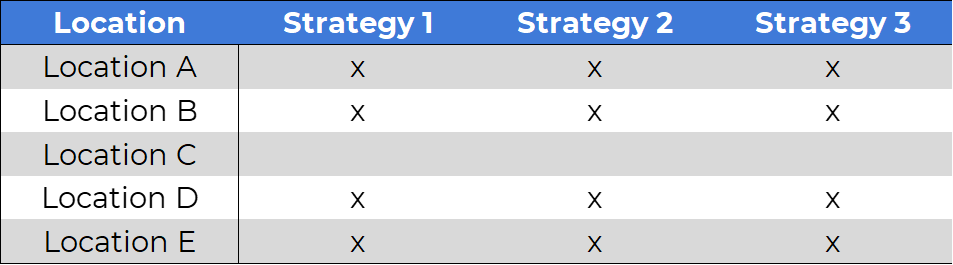
I recently saw two (!) of these tables within the same week:

In this tutorial, you’ll see a few ideas for transforming tables with check marks.

These tiny tweaks can be accomplished in everyday software like Excel.

What’s Inside

  • 0:00 Intro
  • 0:18 The “before” version
  • 1:05 Decluttered
  • 1:38 Left-aligned text for speed-reading
  • 1:57 X’s into checks with built-in checkmarks
  • 3:05 Filled vs. empty squares (with Webdings g and c)
  • 4:48 Dark vs. light circles (with Webdings n)
  • 5:47 Showing totals with tallies at the bottom
  • 6:10 Showing totals with tallies at the right with countif, concatenation, and rept
  • 6:48 Bars or stacked bars
  • 6:59 The before-after transformation

Related Resources

How to Add Checkboxes to Excel

Download the Spreadsheet

It’s here.

Written by cplysy · Categorized: depictdatastudio

May 12 2025

Liminalidad: Oportunidad para el Cambio Organizacional

Introducción

Durante los primeros meses de 2025, como otras organizaciones, UNICEF atraviesa un período de transición institucional que ha dado lugar a una serie de reflexiones profundas sobre el cambio y la transformación organizacional. En este contexto, Bo Viktor Nylund, Director de UNICEF Innocenti, junto a Shai Naides Chief of Youth Engagement and Strategy, ambos del UNICEF Innocenti Global Office of Research and Foresight, publicaron cinco artículos que ofrecen un marco conceptual y operativo sobre cómo gestionar lo que denominan «liminalidad» (Nylund, 2025a-e; Nylund & Naides, 2025).

Este análisis se basa en el contenido de esos artículos basados en UNICEF, pero aplicable a cualquier organización que esté atravesando procesos de incertidumbre, cambio estructural o redefinición estratégica. Se complementa con otras fuentes y enfoques contemporáneos sobre cambio institucional, resiliencia organizacional y liderazgo adaptativo.

¿Qué es la liminalidad?

El concepto de liminalidad proviene de la antropología, introducido por Arnold van Gennep (1909) y desarrollado por Victor Turner (1967), para describir los rituales de paso donde una persona transita entre dos estados sociales. En contextos organizacionales, se refiere a aquellos momentos de transición donde una institución ha dejado atrás una forma estable sin haber consolidado aún la nueva (Garsten, 1999; Czarniawska & Mazza, 2003).

Nylund (2025a) recupera este concepto para abordar el cambio institucional como una fase fértil, aunque incierta, donde se redefinen roles, significados y estructuras. Esta visión coincide con Ibarra & Obodaru (2016), quienes destacan la dimensión identitaria y emocional de la liminalidad en contextos laborales. El enfoque permite entender el cambio más allá de lo técnico y abrazar lo simbólico, emocional y político de estos procesos.

Claves analíticas y transversales

1. La liminalidad como oportunidad de reinvención

En When Everything Falls Apart (Nylund, 2025a), se explora cómo el colapso temporal de marcos organizacionales puede permitir la emergencia de nuevas estructuras, ideas y relaciones. En lugar de evitar la incertidumbre, se propone navegarla con visión, vulnerabilidad y apertura. Esto se alinea con las fases propuestas por Bridges (2009) en la gestión del cambio: final, zona neutra y nuevo comienzo.

2. Narrativas emocionales como instrumento de gestión

La serie entera está atravesada por una narrativa que reconoce el impacto emocional del cambio, lejos de los discursos institucionales despersonalizados. Tal como argumenta Kahn (2019), una organización que enfrenta cambios debe cuidar la salud emocional colectiva si quiere sostener su desempeño y legitimidad. Nylund (2025b) vincula esta reflexión con la historia del Renacimiento, mostrando cómo el arte, la filosofía y el humanismo emergieron de una crisis.

3. Juventud, justicia social y gobernanza inclusiva

En A Voice for Youth in a Time of Change (Nylund & Naides, 2025), se posiciona la participación juvenil no como un gesto decorativo, sino como parte esencial de una democracia intergeneracional. Siguiendo a Fraser (2008), proponen un marco de reconocimiento, representación y redistribución que puede servir de guía para oficinas regionales con alta presencia de talento joven o poblaciones juveniles claves.

Más aún, se cita el Barómetro de Confianza de Edelman (2025), donde los jóvenes muestran una desconfianza sin precedentes hacia las instituciones, lo cual debe ser abordado mediante inclusión real y no performativa.

4. Foresight institucional: anticipar en vez de reaccionar

En What Can We Learn from the Renaissance? y An Opportunity for Strengthening Systems (Nylund, 2025b, 2025c), se promueve el uso del foresight o pensamiento de futuros como herramienta institucional para navegar el cambio. El Institute for the Future (n.d.) ha defendido este enfoque como esencial para construir resiliencia sistémica y preparar escenarios estratégicos que eviten improvisación crónica.

5. Agilidad como capacidad colectiva

En Agile Decision-Making in a Time of Liminality (Nylund, 2025e), se desarrolla una visión sobre cómo la toma de decisiones en tiempos de cambio debe ser rápida, distribuida y experimental. Esto implica descentralizar poder, aprender de errores y fomentar una cultura organizacional adaptativa. Se conecta directamente con el enfoque de liderazgo adaptativo de Heifetz, Grashow y Linsky (2009).

Recomendaciones estratégicas

  1. Formalizar espacios de transición: Equipos o comités que documenten, acompañen y evalúen los efectos del cambio en cada oficina.
  2. Practicar la escucha activa organizacional: Espacios seguros para expresar emociones, sugerencias y temores.
  3. Integrar juventud en la gobernanza: Crear estructuras de codirección con jóvenes profesionales y actores externos.
  4. Capacitar en foresight y planificación adaptativa: Utilizar escenarios prospectivos para gestionar la incertidumbre.
  5. Revisar y humanizar la narrativa institucional: Adoptar un lenguaje que valide experiencias y emociones reales.

Conclusiones

La serie de artículos de Nylund y Naides representa una rara combinación de pensamiento estratégico, sensibilidad institucional y liderazgo ético. A través del concepto de liminalidad, se plantea que el cambio no debe gestionarse solo desde la eficiencia, sino desde la empatía, la inclusión y la visión de largo plazo. Este enfoque es replicable en múltiples niveles: desde oficinas hasta organizaciones públicas o privadas en transformación. Más allá del caso concreto, estas reflexiones constituyen una guía viva para navegar la complejidad contemporánea sin perder la humanidad ni el propósito.

Referencias

  • Boin, A., & van Eeten, M. (2013). The Resilient Organization. Public Management Review, 15(3), 429-445.
  • Bridges, W. (2009). Managing Transitions: Making the Most of Change. Da Capo Press.
  • Czarniawska, B., & Mazza, C. (2003). «Consulting as a Liminal Space.» Human Relations, 56(3).
  • Fraser, N. (2008). Scales of Justice: Reimagining Political Space in a Globalizing World. Polity Press.
  • Garsten, C. (1999). «Betwixt and Between: Temporary Employees as Liminal Subjects in Flexible Organizations.» Organization Studies, 20(4).
  • Heifetz, R., Grashow, A., & Linsky, M. (2009). The Practice of Adaptive Leadership. Harvard Business Press.
  • Ibarra, H., & Obodaru, O. (2016). «Betwixt and between identities: Liminal experience in contemporary careers.» Research in Organizational Behavior, 36.
  • Institute for the Future. (n.d.). Foresight Essentials.
  • Kahn, W. A. (2019). Trauma and Resilience at Work. Routledge.
  • Nylund, B. V. & Naides S. (2025a). When Everything Falls Apart: Exploring Liminality in UNICEF. LinkedIn. https://www.linkedin.com/pulse/when-everything-falls-apart-exploring-liminality-unicef-nylund-qynoc
  • Nylund, B. V. & Naides S. (2025b). What Can We Learn from the Renaissance? LinkedIn. https://www.linkedin.com/pulse/what-can-we-learn-from-renaissance-bo-viktor-nylund-uhmqf
  • Nylund, B. V. & Naides S. (2025c). An Opportunity for Strengthening Systems. LinkedIn. https://www.linkedin.com/pulse/opportunity-strengthening-systems-bo-viktor-nylund-r4evf
  • Nylund, B. V. & Naides S. (2025e). Agile Decision-Making in a Time of Liminality. LinkedIn. https://www.linkedin.com/pulse/agile-decision-making-time-liminality-bo-viktor-nylund-np81f
  • Nylund, B. V., & Naides, S. (2025). A Voice for Youth in a Time of Change. LinkedIn. https://www.linkedin.com/pulse/voice-youth-time-change-bo-viktor-nylund-iuoff
  • Turner, V. (1967). The Forest of Symbols: Aspects of Ndembu Ritual.
  • Van Gennep, A. (1909). Les rites de passage.

Written by cplysy · Categorized: TripleAD

  • « Go to Previous Page
  • Go to page 1
  • Interim pages omitted …
  • Go to page 11
  • Go to page 12
  • Go to page 13
  • Go to page 14
  • Go to page 15
  • Interim pages omitted …
  • Go to page 310
  • Go to Next Page »

Footer

Follow our Work

The easiest way to stay connected to our work is to join our newsletter. You’ll get updates on projects, learn about new events, and hear stories from those evaluators whom the field continues to actively exclude and erase.

Get Updates

Want to take further action or join a pod? Click here to learn more.

Copyright © 2026 · The May 13 Group · Log in

en English
af Afrikaanssq Shqipam አማርኛar العربيةhy Հայերենaz Azərbaycan dilieu Euskarabe Беларуская моваbn বাংলাbs Bosanskibg Българскиca Catalàceb Cebuanony Chichewazh-CN 简体中文zh-TW 繁體中文co Corsuhr Hrvatskics Čeština‎da Dansknl Nederlandsen Englisheo Esperantoet Eestitl Filipinofi Suomifr Françaisfy Fryskgl Galegoka ქართულიde Deutschel Ελληνικάgu ગુજરાતીht Kreyol ayisyenha Harshen Hausahaw Ōlelo Hawaiʻiiw עִבְרִיתhi हिन्दीhmn Hmonghu Magyaris Íslenskaig Igboid Bahasa Indonesiaga Gaeilgeit Italianoja 日本語jw Basa Jawakn ಕನ್ನಡkk Қазақ тіліkm ភាសាខ្មែរko 한국어ku كوردی‎ky Кыргызчаlo ພາສາລາວla Latinlv Latviešu valodalt Lietuvių kalbalb Lëtzebuergeschmk Македонски јазикmg Malagasyms Bahasa Melayuml മലയാളംmt Maltesemi Te Reo Māorimr मराठीmn Монголmy ဗမာစာne नेपालीno Norsk bokmålps پښتوfa فارسیpl Polskipt Portuguêspa ਪੰਜਾਬੀro Românăru Русскийsm Samoangd Gàidhligsr Српски језикst Sesothosn Shonasd سنڌيsi සිංහලsk Slovenčinasl Slovenščinaso Afsoomaalies Españolsu Basa Sundasw Kiswahilisv Svenskatg Тоҷикӣta தமிழ்te తెలుగుth ไทยtr Türkçeuk Українськаur اردوuz O‘zbekchavi Tiếng Việtcy Cymraegxh isiXhosayi יידישyo Yorùbázu Zulu