• Skip to main content
  • Skip to footer
  • Home

The May 13 Group

the next day for evaluation

  • Get Involved
  • Our Work
  • About Us
You are here: Home / Archives for allblogs

allblogs

Dec 31 2021

What you do is important.

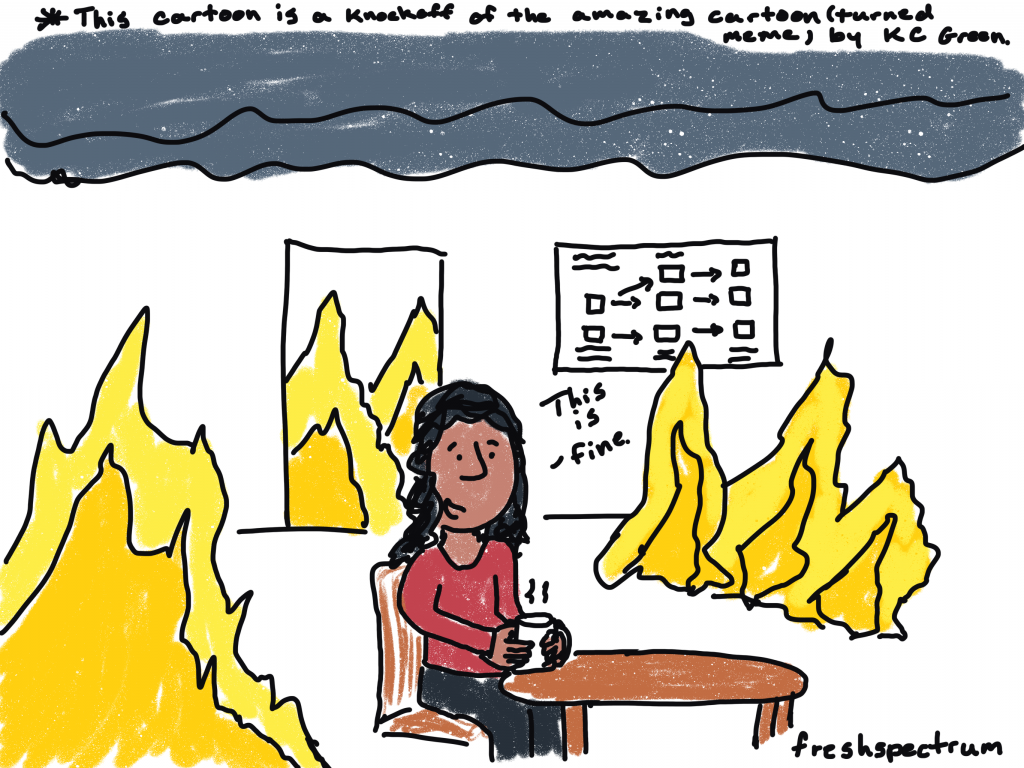
freshspectrum cartoon by Chris Lysy

There is a lady sitting at a table drinking coffee. There is a logic model on the wall. The room is on fire.  She is saying, "This is fine."

This cartoon is a knockoff of the amazing cartoon (turned meme) by KC Green

I had a really hard year back in 2017.  

It was filled with the loss of close family which left a lingering mark on both my personal and professional lives. The couple years that followed saw my business falling apart and then a promising new job ending with a layoff. 

And by the end of 2019, the mix of depression, uncertainty, anxiety, and entrepreneurship had darkened my outlook on life and spiked my cynicism.

I shared my troubles with a mentor, who sent me a framed inside joke.  And stuck to the back of the frame, written in type, were these words…

“What you do is important.”

I know for many of you, 2021 was a shitty year. 

Undoubtedly, some of you have lost close family or friends. Our daily lives have been flipped upside down with a massive jolt of change. We see constant reminders of unjust and unfair systems still thriving in our contemporary society.

The hope and optimism surrounding the vaccines has soured a bit with every new variant. And then there is the significantly large anti-vax movement.

The beginning of the pandemic was hard, but this sustained social anxiety and trauma wears on the soul. 

freshspectrum cartoon by Chris Lysy.

Lady sitting at a desk.  There is a hammer on the desk next to a shattered web camera.

She says, "unfortunately I can't turn on my video for today's Zoom. My webcam just stopped working."

It’s okay…

  • if you haven’t accomplished what you wanted to accomplish this past year.
  • if you have no clue what your plan should be for next year.
  • if you don’t know who you’re supposed to be.
  • if you feel stuck.
  • if you feel lost.

Tomorrow is a new day.

And if tomorrow doesn’t work out, well, there will be another.
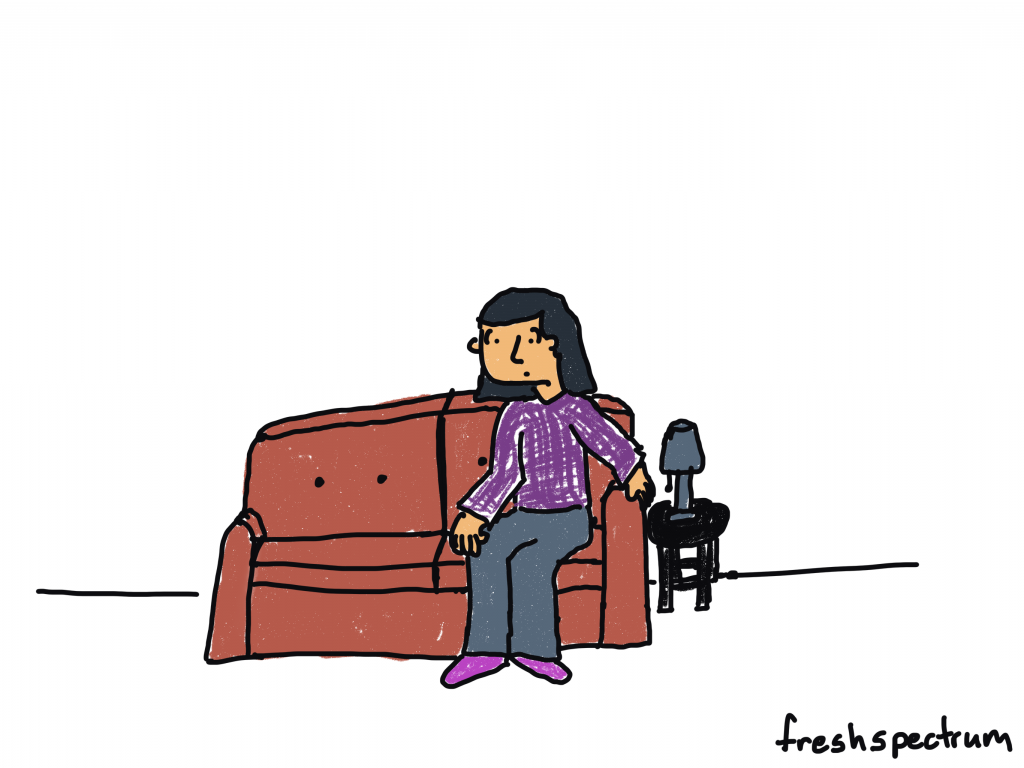
freshspectrum cartoon by Chris Lysy

Lady sitting on couch staring ahead with an overwhelmed look.

I never cease to be amazed that there are people who read this blog.  People who appreciate the cartoons that I draw.  People who share what I write with their friends and colleagues.

And when I start to feel lost, I think about all of you.

Because you care.

It’s why you’re here. It’s why you can appreciate and share my cartoons.

Most of your audiences are not demanding cartoons from your presentations or better charts from your reports. They’re not looking to you to provide them with more engagement. 

But it’s not enough for you to just present or report. To just show up at 9 and then leave at 5 (metaphorically speaking). You believe in your work, and you want your audience to be engaged.

You want your work to have an impact.  To change the way your audience thinks or acts based on your collected evidence.

So you put in the work to try to make that happen.

freshspectrum cartoon by Chris Lysy

Guy on phone says... 
"So there is no style guide, format requirements, content requests, or other additional guidance.  Just keep it short?"

"One quick follow-up, does anyone actually give a shit?"

Evidence is insufficient.

It’s not enough to just know something to be true if you can’t convince anyone else to hear what you say or trust what you share. Especially if the evidence you are sharing is counter to your audience’s beliefs. Just think about all the ways you can finish this sentence.

Despite ample evidence to the contrary…

  • many republican politicians continue to claim that the 2020 election was stolen. 
  • global warming is seen by large sectors of the population as not a man-made problem.
  • many Americans hold onto the fictional historical perspectives they learned in grade school.
  • some communities hit hard by COVID-19 continue to downplay the virus and refuse even the most basic precautions.
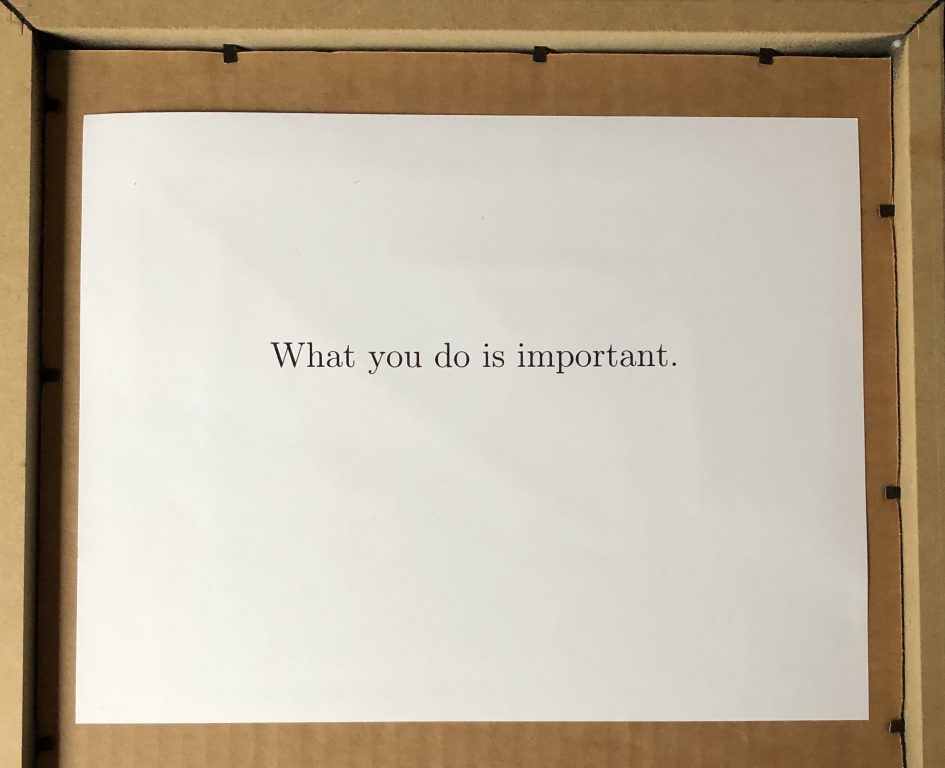
The back of a picture frame.  In type is reads, "What you do is important."

While evidence is insufficient, it is indeed necessary.

We can’t change this world for the better without it.  We need you to engage, collect, analyze, and support our communities, programs, and changemakers.

Our role as data people and evaluators can sometimes be thankless, lonely, and frustrating.  Our best work is not always celebrated.  Our audiences can be hard to engage.

But whatever happens in this new year. Don’t stop trying.

That’s the only way to fail completely.

I believe in you.

What you do is important.

Till next year,

Chris.
Written by cplysy · Categorized: freshspectrum

Dec 30 2021

Habit Design: A Starting Place

Among the greatest means to promoting sustained behaviour change is to create healthy (beneficial) habits. The science of behaviour change provides many recommendations for how to form, break, and maintain good habits.

While we often believe that beliefs change habits, we often find that behaviours themselves can just as profoundly affect our beliefs.

There are many ways to shape the design of habits with good research and we’re going to introduce you to a few of them.

  1. Pay attention. The first step toward understanding habits is recognizing which ones we have — as individuals and organizations. Doing sufficient research to observe and record the degree to which we perform an activity repeatedly is essential. A habit is something that requires little or no conscious decision-making. It’s not that we don’t know it doesn’t exist, we just do it with the most minimum amount of ‘friction‘. Observation, recording, and reflection all contribute to this part of the process.
  2. Model the benefits. All of our habits benefit us in some ways. The key is to determine what those benefits are and if those habits are harmful or detrimental to our goals. By knowing what we are doing we can begin to change what we do. By understanding the benefits of harmful or unproductive habits we can also start to determine how we might be able to replace them down the road with our designs.
  3. Understand history. How salient is a habit? Once we know what we do, it’s important to see how strong habits are. For example, someone who started using cigarettes two weeks ago will have a different habit structure than someone who’s smoked for 25 years. Whether its consumer habits, health, productivity, or otherwise, the salience and strength of a habit is tied partly to a person’s history with that behaviour.
  4. Model the context. It’s not enough to know what we do, it’s important to understand what context we do it. The environment is a powerful force in shaping what habits we engage in and to what degree. By understanding our context, including how and what triggers our habit, we can start to begin to re-design this context. This can be done by tracking what behaviour is performed, where, and what other variables were present at the time.
  5. Identify leverage points. A leverage point is something that can be adjusted — amplified or reduced — that can yield large benefits indirectly within a system of activities. Most of what we seek to change is one behaviour among many that are, as we’ve seen, often connected to one another. For example, to use the cigarette example, many smokers cite drinking alcohol as a co-habit (the two are done together). In this case, reducing or changing the way one behaviour is done can also affect the other. This is called habit stacking. It’s having one behaviour affect another .

By engaging in systematic inquiry — observation, interviews, surveys, or reflective practice — we can start to illuminate some of these powerful hidden forces that shape and direct our choices and behaviour.

Try these methods out. The application does not need to be complicated, just systematic.

Need help or want more detailed design research to help your organization change and design for something different? We can help you – contact us.

Photo by Drew Beamer on Unsplash

The post Habit Design: A Starting Place appeared first on Cense Ltd. .

Written by cplysy · Categorized: cameronnorman

Dec 29 2021

How Can We measure 2021?

How can we measure 2021?

Over the past few months, we’ve been playing a lot of music for our baby girl, to keep her entertained (mostly because Mommy and Daddy sing and dance around the house like fools) and to help lull her to sleep. 

We may not be helping her get along with her future peers, but for now, she’s becoming an aficionado of Queen, The Beatles, and Broadway classics.

So, in the spirit of the musical RENT, let’s amuse ourselves with a game of “how do we measure a year?” – 2021 edition.

I don’t think that 2021 was the year that any of us were expecting. 

Right now, it feels like we are right back where we started in early 2020, with school being disrupted, cases surging, and holiday plans being canceled. 

For me, while the world feels very much the same, most everything in my daily life has changed!

If I’m going to be super nerdy (which should be expected of me at this point), we can take a lesson from “Seasons of Love” and see that we can both quantify and qualify our measurements. 

So what metrics could I use to describe my year?


  • How many ounces our little one takes at each feeding and over the course of a day


  • How many hours of sleep we get (or don’t get!) each night


  • How many times a day our dog licks the baby or her stuff (sigh)


  • How many hours (no wait, minutes) of work I get done before needing to put her pacifier back in her mouth

These are all VERY REAL metrics for me right now! 

But of course, they don’t capture the full picture of my year or my experience as a new working mom.

It’s also important to consider how joyful we feel when our daughter breaks into a grin when she sees us, or the burning rage that comes with being woken from a much-needed nap (me, of course – not the baby), or the fear I have on a daily basis of exposing my child to one of the many diseases running rampant right now. 

All of these things are both valid and critical to understanding my experience and to uncovering unmet needs.

When we think of how to tell the story of our family engagement work during yet another challenging year, we need to consider how to quantify and qualify our efforts and impacts. 

Of course, we’ll want to know who we reached and track our efforts to do so.

But it’s also important to know how those people felt after that outreach and the ways in which their lives were (hopefully) made a bit easier as a result. 

Sometimes, we also need to know how we can do better and what else our students and families need.

It just takes a creative approach to data collection to capture the full story.

As you reflect on how 2021 went for you, both personally and professionally, how would you measure your year?

Leave a comment below and let me know what measures feel authentic to your year!

Written by cplysy · Categorized: engagewithdata

Dec 27 2021

Comment on Earth Day at 51: Why Museums Must Embrace the Anthropocene by Relevance Revisited: A Postscript for the Museum Field » RK&A

[…] Earth Day at 51: Why Museums Must Embrace the Anthropocene for drawing our attention to the world’s new geologic context of the Anthropocene and pleading for museums to present a unified [rather than the all-to-common divided] portrait of nature and culture, “with equal respect for both.” […]

Written by cplysy · Categorized: rka

Dec 22 2021

Comment on When Disaster Strikes: Assistance by Museums Nearby by Relevance Revisited: A Postscript for the Museum Field » RK&A

[…] When Disaster Strikes: Assistance by Museums Nearby because of its gripping personal narrative of 9/11 combined with a real-world example of a museum stepping up in times of crisis, and […]

Written by cplysy · Categorized: rka

  • « Go to Previous Page
  • Go to page 1
  • Interim pages omitted …
  • Go to page 147
  • Go to page 148
  • Go to page 149
  • Go to page 150
  • Go to page 151
  • Interim pages omitted …
  • Go to page 310
  • Go to Next Page »

Footer

Follow our Work

The easiest way to stay connected to our work is to join our newsletter. You’ll get updates on projects, learn about new events, and hear stories from those evaluators whom the field continues to actively exclude and erase.

Get Updates

Want to take further action or join a pod? Click here to learn more.

Copyright © 2026 · The May 13 Group · Log in

en English
af Afrikaanssq Shqipam አማርኛar العربيةhy Հայերենaz Azərbaycan dilieu Euskarabe Беларуская моваbn বাংলাbs Bosanskibg Българскиca Catalàceb Cebuanony Chichewazh-CN 简体中文zh-TW 繁體中文co Corsuhr Hrvatskics Čeština‎da Dansknl Nederlandsen Englisheo Esperantoet Eestitl Filipinofi Suomifr Françaisfy Fryskgl Galegoka ქართულიde Deutschel Ελληνικάgu ગુજરાતીht Kreyol ayisyenha Harshen Hausahaw Ōlelo Hawaiʻiiw עִבְרִיתhi हिन्दीhmn Hmonghu Magyaris Íslenskaig Igboid Bahasa Indonesiaga Gaeilgeit Italianoja 日本語jw Basa Jawakn ಕನ್ನಡkk Қазақ тіліkm ភាសាខ្មែរko 한국어ku كوردی‎ky Кыргызчаlo ພາສາລາວla Latinlv Latviešu valodalt Lietuvių kalbalb Lëtzebuergeschmk Македонски јазикmg Malagasyms Bahasa Melayuml മലയാളംmt Maltesemi Te Reo Māorimr मराठीmn Монголmy ဗမာစာne नेपालीno Norsk bokmålps پښتوfa فارسیpl Polskipt Portuguêspa ਪੰਜਾਬੀro Românăru Русскийsm Samoangd Gàidhligsr Српски језикst Sesothosn Shonasd سنڌيsi සිංහලsk Slovenčinasl Slovenščinaso Afsoomaalies Españolsu Basa Sundasw Kiswahilisv Svenskatg Тоҷикӣta தமிழ்te తెలుగుth ไทยtr Türkçeuk Українськаur اردوuz O‘zbekchavi Tiếng Việtcy Cymraegxh isiXhosayi יידישyo Yorùbázu Zulu