• Skip to main content
  • Skip to footer
  • Home

The May 13 Group

the next day for evaluation

  • Get Involved
  • Our Work
  • About Us
You are here: Home / Archives for allblogs

allblogs

Jan 13 2022

Inform, Engage, Inspire, with data visualization.

Are you the kind of person who likes to nitpick other people’s charts?

I’m really not.

I wasn’t there when they decided to use that chart. I don’t know what factored into their decision. As far as their intended audience, I don’t know if anybody actually cares what chart gets chosen. So when a conversation among data folk about a chart pops up on social media, I usually stay out of it (unless it’s funny, or intentionally misleading, or I’m super bored).
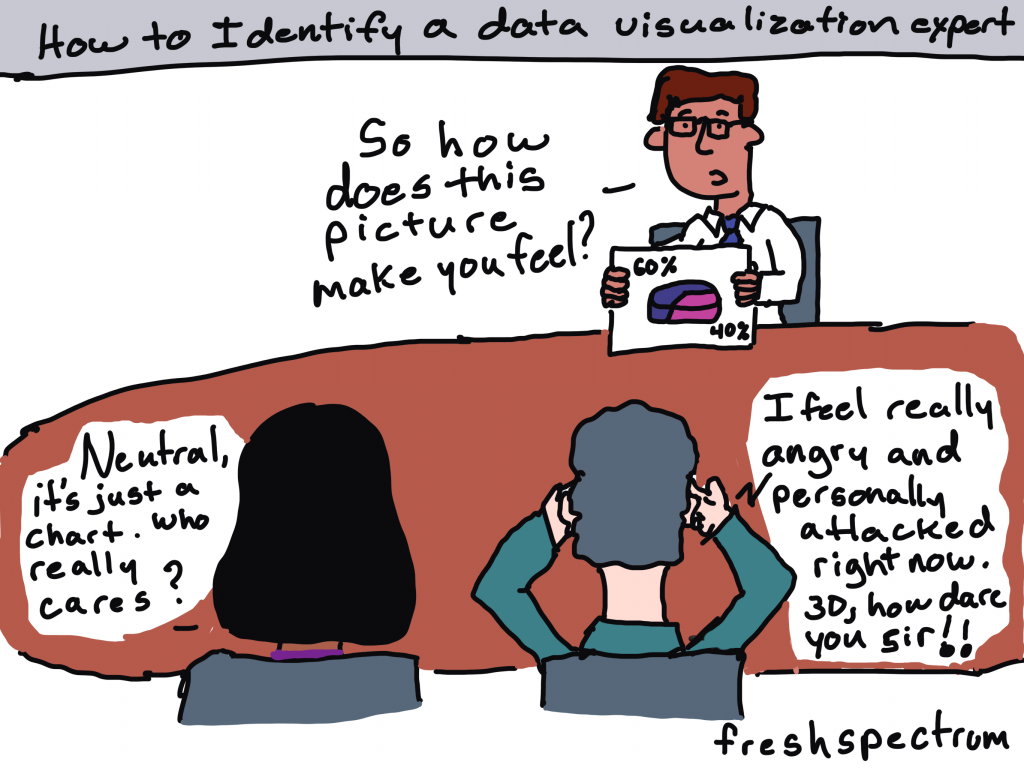
Cartoon by Chris Lysy of freshspectrum.com
"How to Identify a data visualization expert."
Person holding up a photo of a 3D pie chart. He asks, "so how does this picture make you feel?"
Two people at the table.
Person one says, "Neutral, it's just a chart. Who really cares?"
Person two says, "I feel really angry and personally attacked right now. 3D, how dare you sir!!"

But last week, right around the time I was posting my blog post on tailoring your reports based on interest level, there was one of those conversations about a chart published by the NY Times.

This week I want to talk about that chart and a few others, not to nitpick, but because they are good examples to highlight the differences between Engage style data visualizations and Inform style data visualizations.

Quick Recap: Inform, Engage, Inspire

Cartoon by Chris Lysy of Freshspectrum.com
Audience Interest Level Spectrum
High Interest, Medium Interest, Low Interest.  
The High Interest person says "Give me ALL the data."
The Medium Interest person says, "Okay, I'm listening, what you got?"
The Low interest person says, "I'm sorry. Did you say something?"

Your audiences’ interest levels in the data that you are sharing vary WIDELY (unless nobody cares, in which case they don’t vary at all).

Some audiences care a lot about the data you are trying to share. For those people, your goal should be to INFORM. When someone is already super engaged and looking for specific answers, they just need the data. Your job is to give them the data and get out of their way.

Some audiences care enough about the topic to be mildly interested in what you have to say. But you have to pique their curiosity to get them to stay with you. In these times your goal should be to ENGAGE.

Finally, some audiences are not even mildly interested. If we have any shot at getting them interested, we need to INSPIRE.

The Spiral Graph

So last week, at the top of a New York Times guest essay there was a spiral graph.

This was an out of the ordinary way to report time series data.
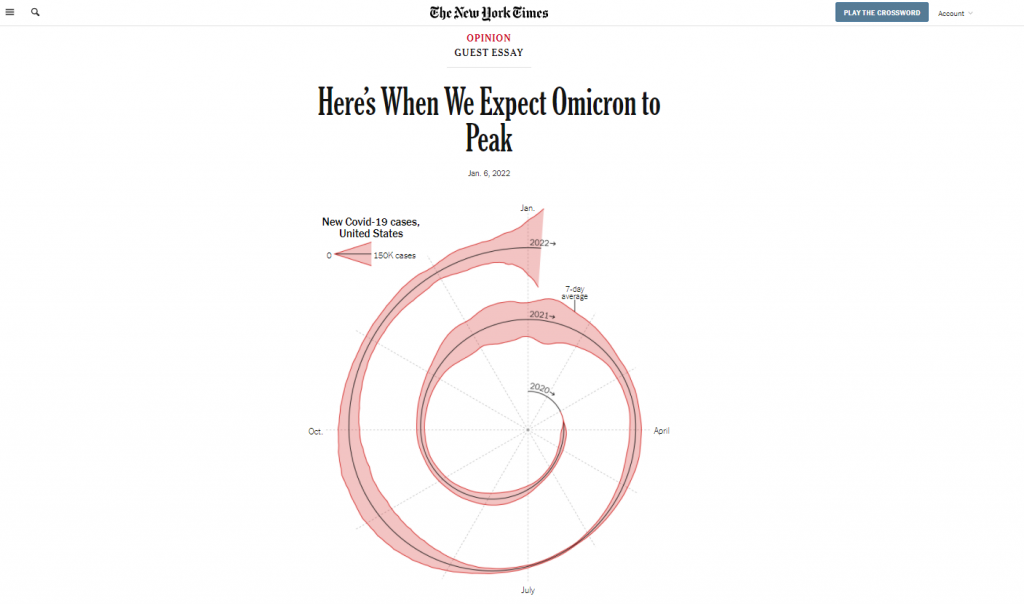
A spiral graph showing Covid-19 cases from January 2020 to January 2022.  Created by the NY Times for the article Here's when we expect Omicron to peak"
Chart from NYTimes -> “Here’s When We Expect Omicron to Peak”

And when something is different in a major publication known for its high quality visualizations, data people talk. Right after it was published I started to see multiple social media conversations and a string of blog posts discussing the merits of this particular chart.

Maybe alluding to seasonality? What are your thoughts? https://t.co/5OSQWJOEMA

— Amanda Makulec MPH (@abmakulec) January 6, 2022

The Spiral Graph is an ENGAGE Chart

If we’re just talking straight up minimalist well designed data communication, the spiral graph is not it.

But let’s talk about context:

  • This chart is just a lead-in illustration to an Opinion piece.
  • It’s not even the only chart in the essay, there is another that plays more of an inform role.
  • The NY Times has created and shared MANY other Coronavirus visualizations over the last couple of years.

What the spiral graph does well is attempt to change the way we look at data we have come to know all too well.

In just about every usual chart we see in the modern digital world, the width of the chart is dependent on the device we are using to read the article. That width stays fixed, as days go and more data gets added, the chart stays the same width.

By spiraling the chart, you get to show something about the length of the pandemic that you wouldn’t be able to show in the standard line graph. You get to make the chart longer, without forcing a scroll by the reader. And ultimately, it’s strange enough to pique curiosity.
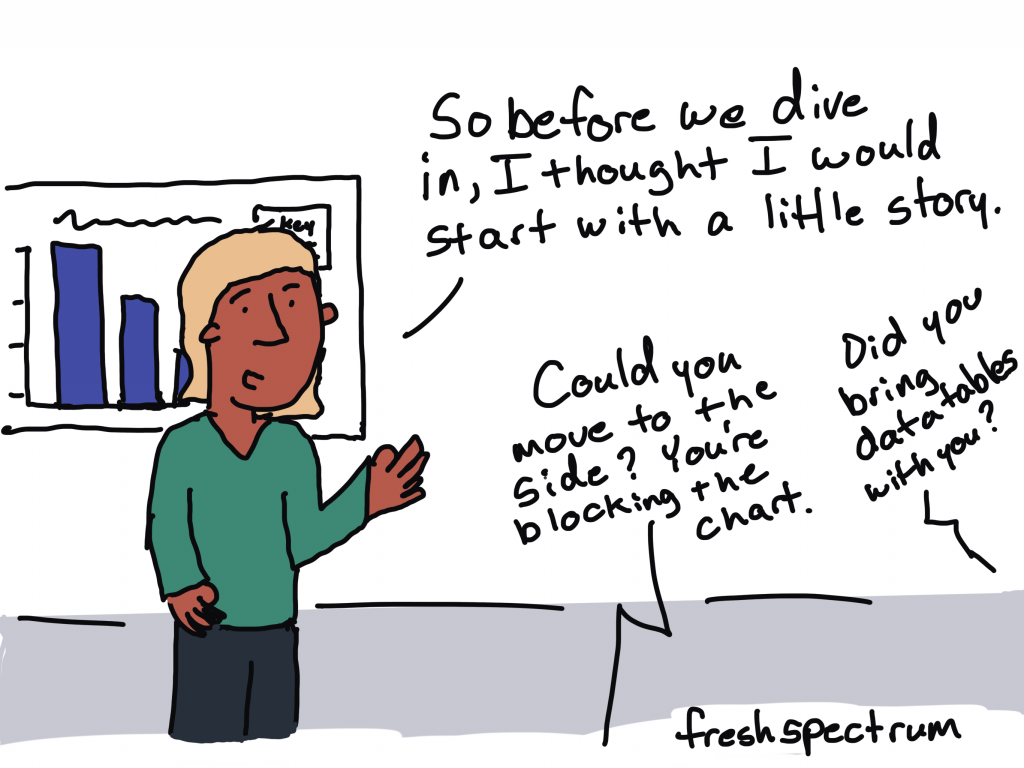
Cartoon by Chris Lysy of freshspectrum.com
Person presenting says, "So before we dive in, I thought I would start with a little story."
Someone asks, "Could you move to the side? You're blocking the chart."
Second someone asks, "Did you bring data tables with you?"

For an INFORM graph check out the NY Times Case Count page.

If you want an INFORM style graph head over to the NY Times case count page. This data presentation is phenomenal as a dashboard style information sharing device.

The goal with this kind of graphic is to give the data and get out of the way. I can’t tell you how many times in the last couple of years I have turned to the NY Times to get informed about the current state of the Coronavirus, but it’s been a lot.
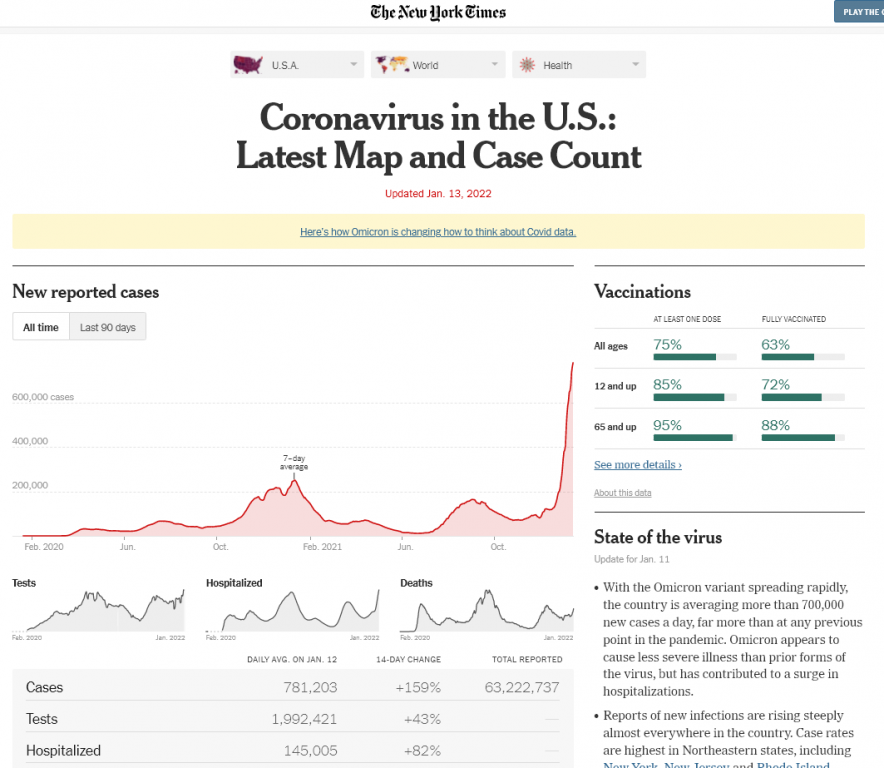
New York Times Coronavirus in the US Case Count screen shot.
NY Times Case Count page as seen on January 13, 2022.

The simple line graph delivers the information on case waves almost effortlessly. Add in that it is interactive, provides analysis, and is followed up by collections of supporting graphs that provide other key metrics and break the data down by important categories like age and state.

But no matter how amazing the delivery, if you keep repeating the same graphic it gets stale. And considering this page lives in parallel to the far more short lived opinion essay, you can’t just use the same charts if your goal is entice readers to read on.

Another example of a NY Times ENGAGE graph.

Okay, so there are certainly ways to make an inform style graph a little more engaging without making it really odd.

Check out the leading graph in this piece that was put out on Friday January, 7. The Omicron case wave is so big in the US that it jumps out of the normal bounds of the graphic into the header space.

In a usual NY Times article, the article title would be centered and the chart would not start until after the by line. But in this case, they let the chart extend to the top of the page. And they actually shifted the whole title off to the right of center so that the line could fit.

Why could they do that? Well the Covid wave peaked so much that the chart was naturally unbalanced. So instead of just shifting everything down as normal, they let the wild peak break their formatting structure.
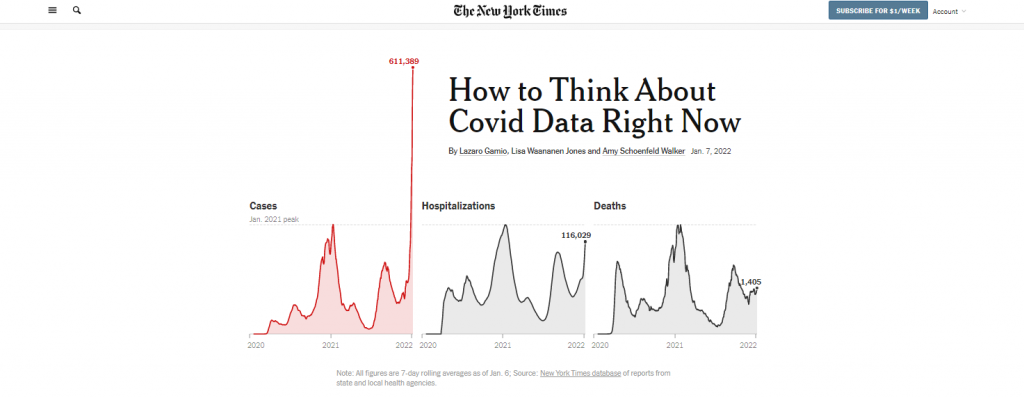
Screenshot of the top of the New York Times article, "How to Think about Covid data right now."
“How to Think About Covid Data Right Now”

Okay, what about an INSPIRE graph?

So we’ll stick with the NY Times because I found a good one.

To INSPIRE with data visualization, we usually have to tell some kind of story. And it needs to be a big story, a major idea or moment in time.

The following is a snapshot from an interactive visualization put out by the NY Times in May of 2020, just as the US reached a COVID death toll of 100,000. For this moment in time the Times was trying to connect the big number to the thing it represented…Human Lives.

So instead of a chart, we have lots of little people silhouettes, some annotated with names and little obituaries. The The page is a scroller, and it takes time to go through. As you scroll down the date changes and the number of deaths increase. Little bits of story also find their way into the visualization.
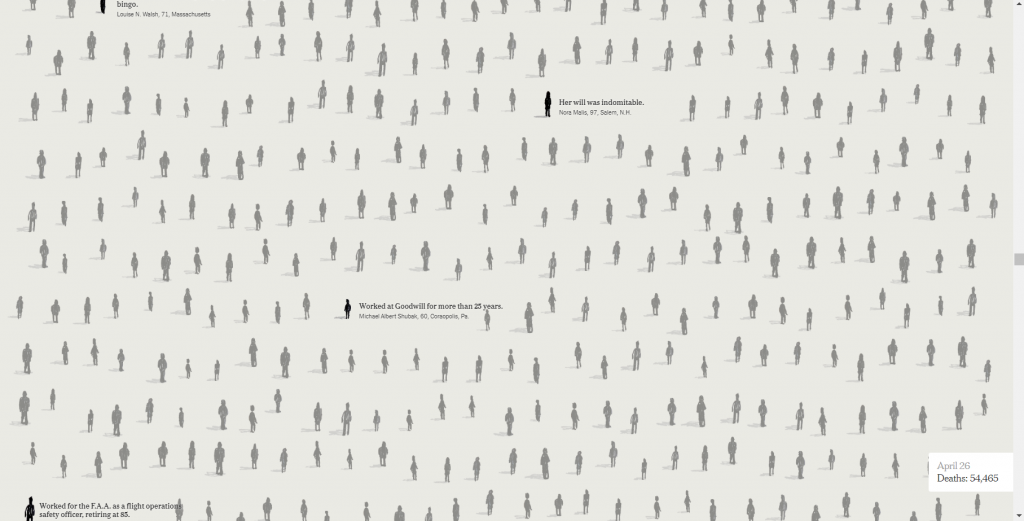
Screenshot from the New York Times interactive called "An Incalculable Loss"
“An Incalculable Loss” the NY Times interactive when the US Death Toll reached 100,000 at the end of May in 2020

This isn’t the way you simply inform a data hungry audience of the numbers. It’s also not just a simple engaging graphic designed to pique interest that will lead a reader forward.

This is the kind of data visualization that tries to connect with human emotion. To convey a big idea and leave a lasting impression.

So what do you think?

Have you ever created a graph or other visualization just to pique interest?

See any examples from within your own domains of expertise that could fall in any of these three buckets?

If so, would love to hear about them. Write me a comment, I most certainly read the comments and try to respond to every single one.
Written by cplysy · Categorized: freshspectrum

Jan 12 2022

Your Staff Knows Your Programs Better Than You

You know your community better than your funder, and your programs are only successful when staff feel supported and have the capacity to do their jobs. Your staff knows your programs so much in fact, that when you report to your board of directors or engage new funders, you rely heavily on them to provide […]

The post Your Staff Knows Your Programs Better Than You appeared first on Nicole Clark Consulting.

Written by cplysy · Categorized: nicoleclark

Jan 12 2022

Reflecting and Imagining: What’s Ahead in 2022

Read reflections from 2021 and learn what’s ahead for Elizabeth Grim Consulting, LLC in 2022 with evaluation and data coaching, training, and speaking.

The post Reflecting and Imagining: What’s Ahead in 2022 appeared first on Elizabeth Grim Consulting, LLC.

Written by cplysy · Categorized: elizabethgrim

Jan 11 2022

Are Viewers Expecting a Story? Lightning Talk from the DATAcated Expo

Never, ever keep the default settings.

That was the overarching theme of my Lightning Talk at the DATAcated Expo, which was held virtually in October 2021.

You’re not going to keep the ugly, outdated defaults. Great!

But what should you do instead?

And how do you modify a graph so that it’s just right for your audience?

Surely a group of scientists will need something different from a group of policymakers.

Some audiences adore data. Others don’t.

Some audiences have plenty of time. Others don’t.

In this blog post, you’ll learn about:

  • the differences between default, traditional, and storytelling graphs;
  • which techniques can help you tell a story with data (e.g., dark colors); and
  • when to use each type of graph.

Watch the DATAcated Expo Lighting Talk

Missed the live event?

Watch the Lightning Talk here.

This is a 17-minute video. If you’re short on time, just watch a 10-minute segment — minutes 2 through 12 of the video.

Here’s a summary of what’s inside.

Defining the Term “Data Storytelling”

This is a tricky term with lots of definitions.

Some people love this term.

Others hate it.

In the recording, you’ll see me ask the attendees to share what “data storytelling” means to them.

You might define data storytelling as:

  • “What does data really mean, and what do you want it to tell.” — an Expo attendee
  • “Translating data for non-data centric users.” — an Expo attendee

And data storytelling is NOT:

  • Fiction
  • Making things up
  • Biasing our audience
  • Fudging the numbers

Data Storytelling in a Bar Chart

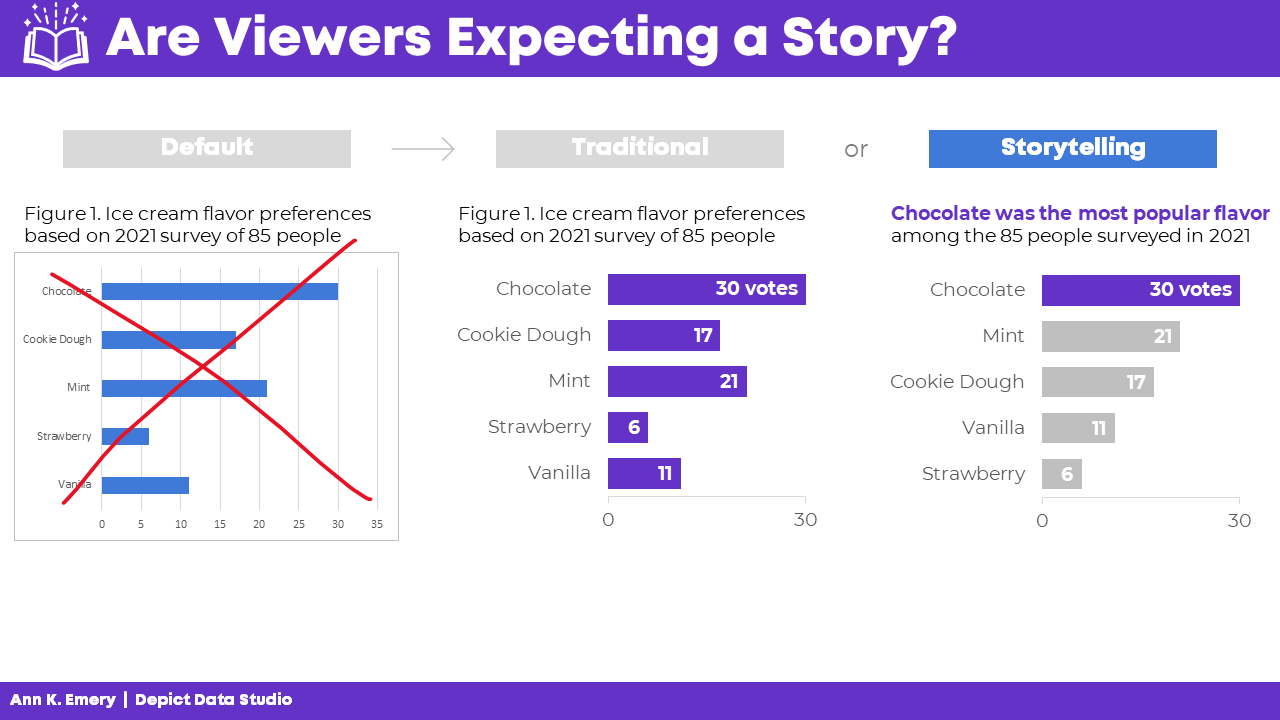
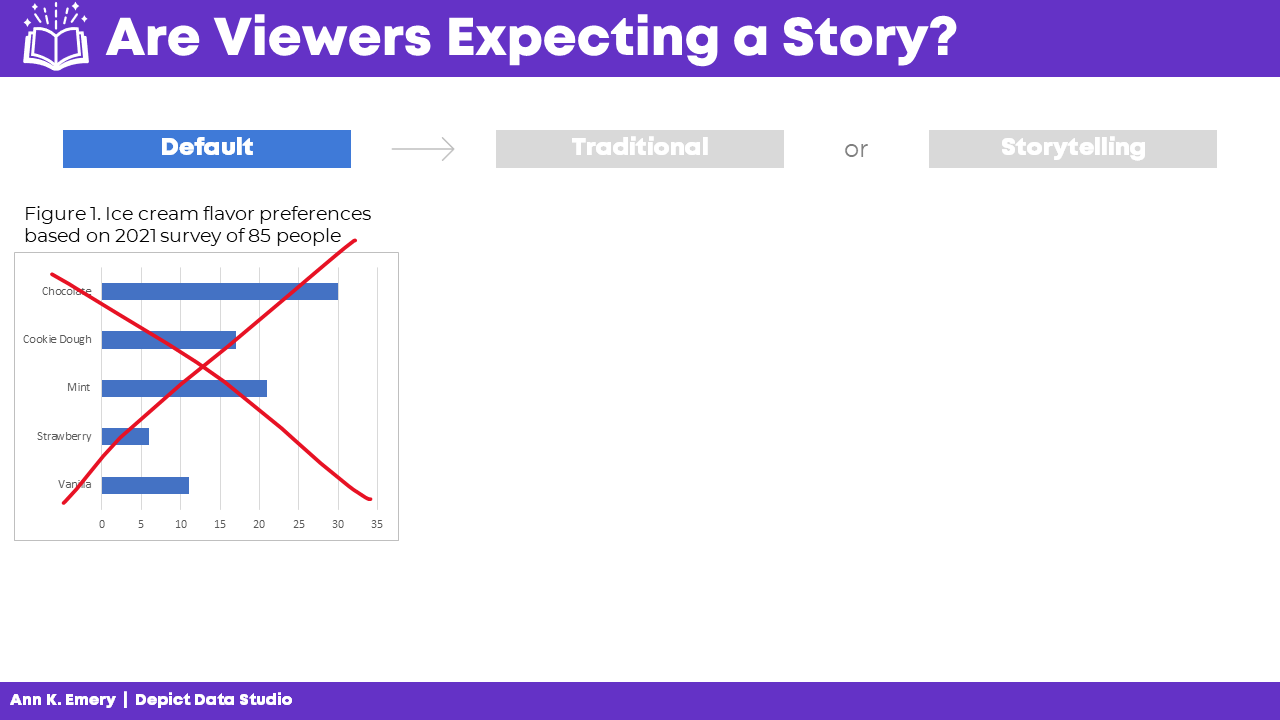
In the Lightning Talk, I showed attendees three versions of the same graph: default, traditional, and storytelling.

We’ll look at each of these side by side, so that you can see how they’re similar and how they’re different.

At the end, I’ll ask you to comment and share which style you think each of your audiences need.

The Default Bar Chart

We never, ever keep the default settings.

The Traditional Bar Chart

Instead, at a bare minimum, we need to design a traditional graph.

We would:

  • Enlarge the font
  • Enlarge the bars (by decreasing the gap width)
  • Remove the border
  • Add labels (optional—if we think our audiences would want specificity)
  • Adjust the scale
  • Use brand colors
  • Use brand fonts

It’s up to the viewers to read the chart and figure out the “so what?” for themselves.

The Storytelling Bar Chart

Sometimes, our audiences prefer storytelling graphs.

You already spent 60 seconds cleaning up the default settings.

In another 60 seconds of editing, we would:

  • Sort the bars (e.g., greatest to least)
  • Gray everything out
  • Highlight one takeaway finding with a dark color
  • Add the takeaway finding to the graph title
  • Bold a few key words to make the title even more skimmable

Data Storytelling in a Slope Chart

You can apply these principles to any and all chart types.

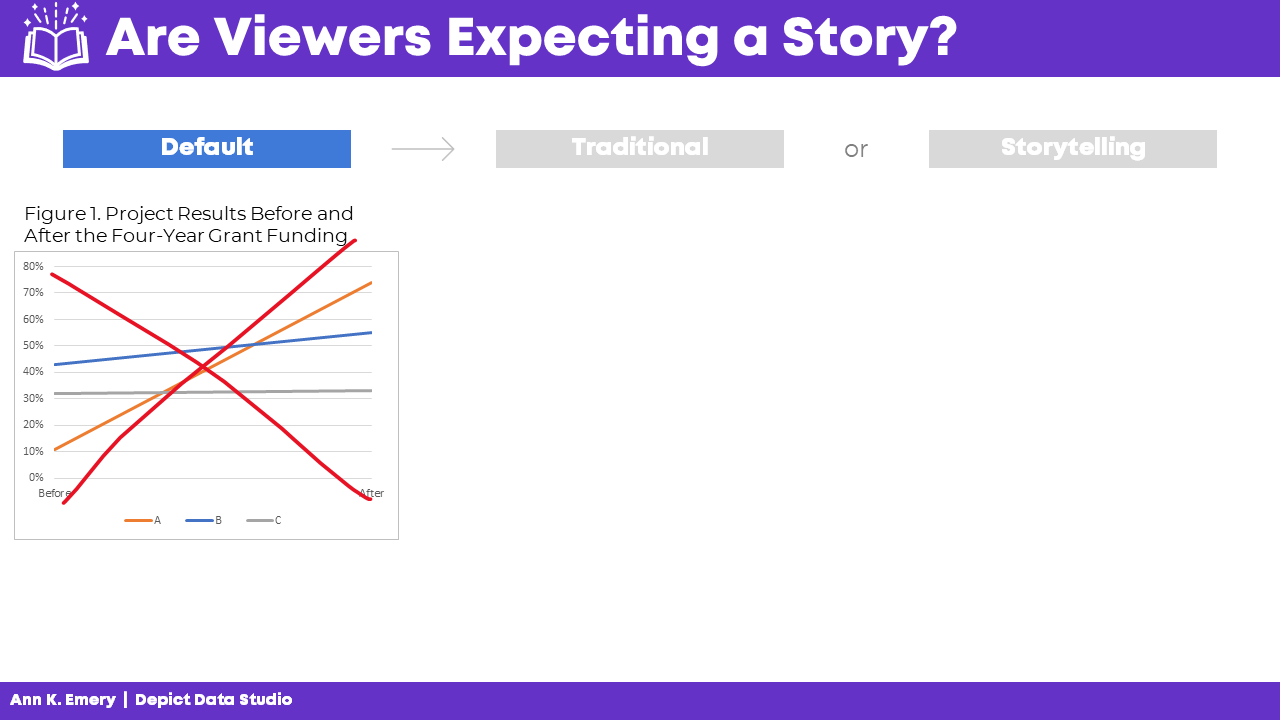
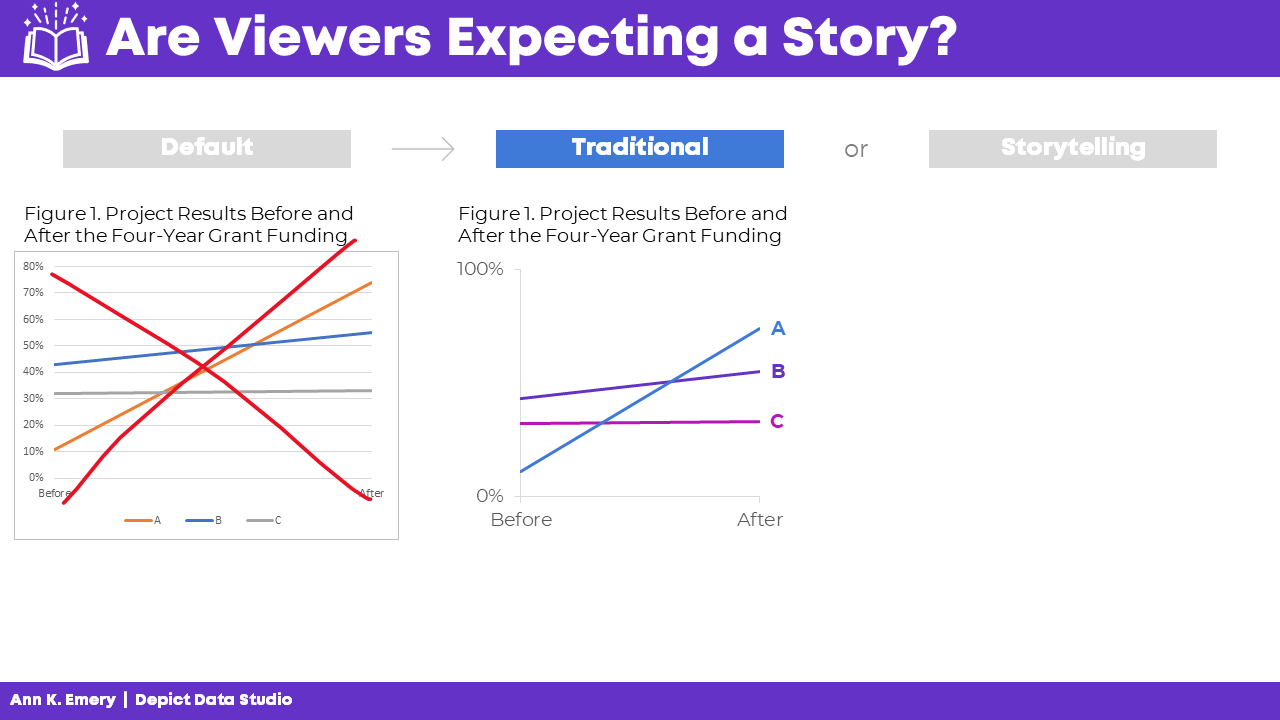
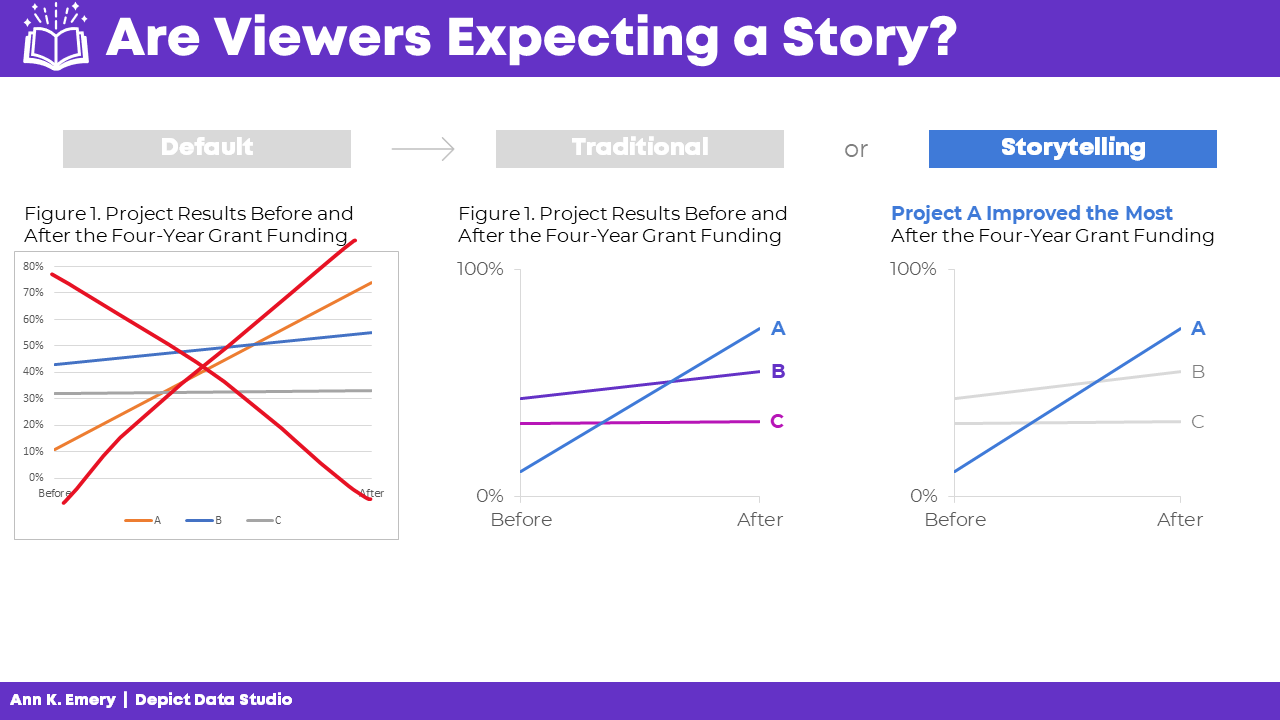
Here’s what the three different styles look like in a slope chart.

(A slope chart is just a fancy name for a line chart that has exactly two points in time.)

The Default Slope Chart

Defaults are for 2005.

We know better.

C’mon, Excel. And Tableau. And PowerBI. And and and.

The Traditional Slope Chart

At a bare minimum, we need to:

  • Enlarge the fonts
  • Adjust the scale
  • Remove the border
  • Add brand colors
  • Add brand fonts
  • Remove the legend and directly label the data

(Direct labels have three key advantages: They’re faster to read; they’re better for people who are colorblind; and they print better in grayscale.)

The Storytelling Slope Chart

Take the edited graph you just made, and keep going!

In a storytelling slope chart, we would:

  • Gray everything out
  • Highlight one thing at a time
  • Re-write the title and put the takeaway message in the title
  • Bonus points: Bold a few key words to make it even more skimmable

Which finding will you highlight in a darker color?

You might highlight:

  • The Success Story (Project A)
  • The Debbie Downer Story (Project C)

Be careful with red; in Western cultures, red means caution! warning! But colors are culturally-specific; in Eastern cultures, red doesn’t necessarily mean anything bad.

Data Storytelling in a Scatter Plot

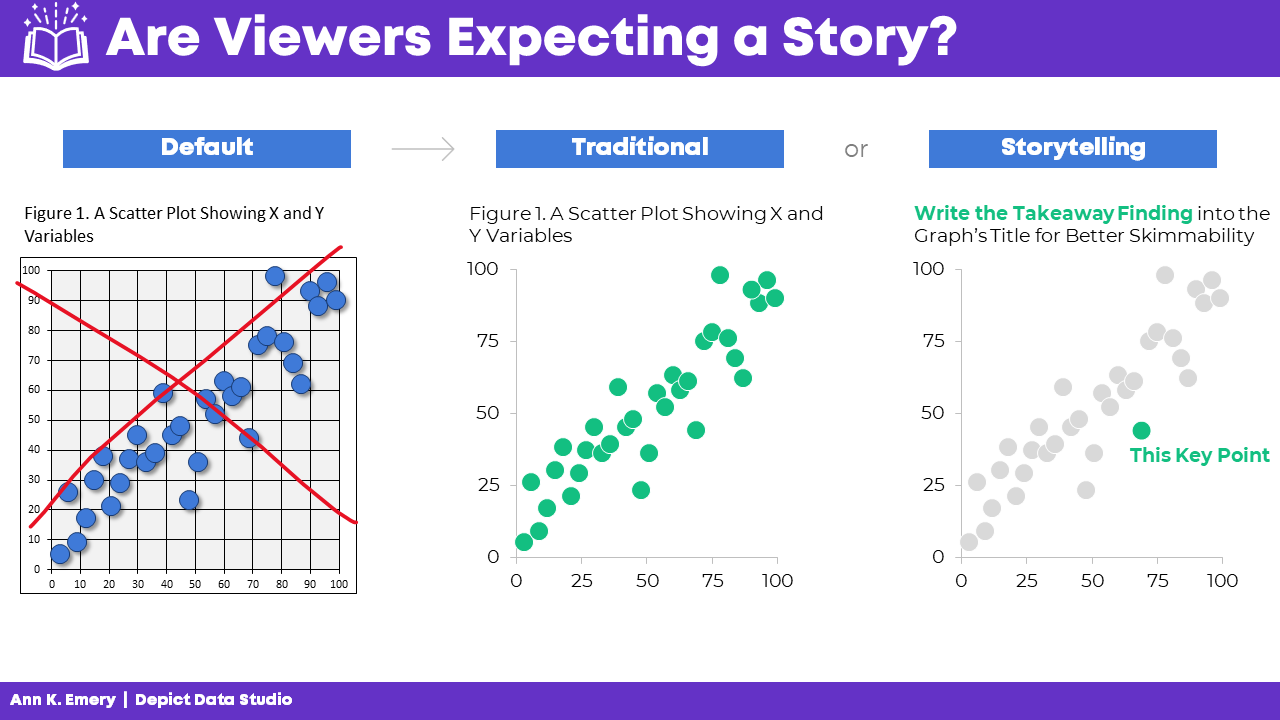
We didn’t have time to discuss scatter plots at the DATAcated Expo, but I’d still like to share this example with you.

Here’s how data storytelling would be applied to a scatter plot.

Never keep the default settings!!!!!!!!!!

Traditional graphs are all one color and they have topical titles.

Storytelling graphs have a dark-light contrast and takeaway titles. For bonus points, you could label a few key points.

Data Storytelling in a Map

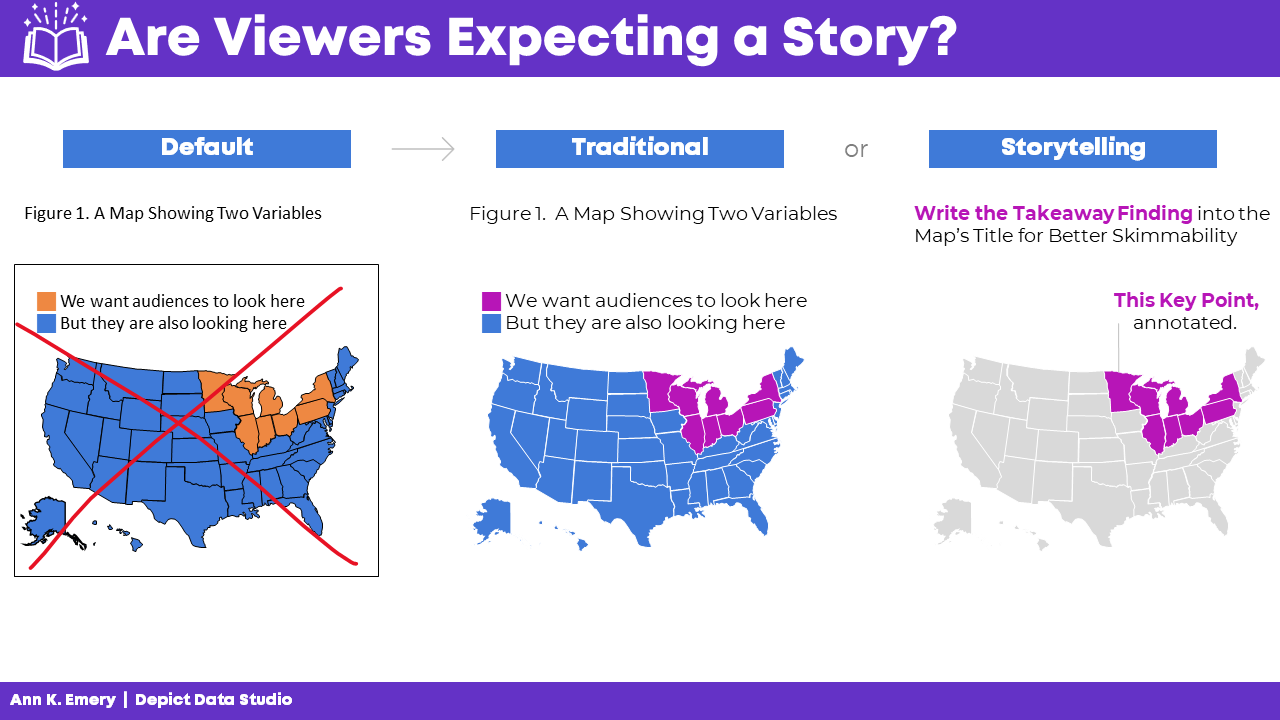
Finally, here’s how data storytelling would be applied to a choropleth map.

Never keep the default settings!!!!!!!!!!

In traditional maps, none of the colors stand out, and they have topical titles.

In storytelling maps, we’d add an intentional dark-light contrast and takeaway title. For bonus points, you could label a few key points.

When Should You Use Data Storytelling?

Comment below: When would you use each style?

Which of your audiences prefer traditional graphs?

Which of your audiences prefer storytelling graphs?

In the video, you’ll also hear the conference attendees share their perspectives, and you’ll hear from me, too.

Written by cplysy · Categorized: depictdatastudio

Jan 10 2022

Five Welcome Changes to Embrace in 2022

Up close shot of a green and white road sign that reads "CHANGE AHEAD", with a blue sky and clouds visible in the background.

As we begin 2022, nearly two years since the pandemic began, what I’m most struck by is that the world I operate in is a fundamentally changed one.  It’s fascinating and a bit disorienting that these changes happened so quickly, sped up by circumstance of the pandemic.  Change is happening all the time, but more often than not, it happens so gradually and subtly that it goes undetected in real time.  The accelerated changes in 2020 and 2021 allowed me to be a conscious witness and active participant in transformation.  In particular, the world of museums and cultural organizations changed in five ways that make me optimistic about my work as a researcher and evaluator in 2022.

1. There is room for vulnerability in the workplace. 

We let our guards down professionally during the pandemic which allowed us to connect with one another human to human.  Zoom had a lot to do with this by the sheer fact that we got a sense of each other’s day-to-day surroundings and context at home.  In two years, we went from types of communication that convey formality and reserve (like in conference rooms) to virtually getting a glimpse into people’s everyday lives (baskets of laundry, artwork on walls, cats on keyboards, etc.).  It’s subtle, but I have felt an opening up, a breath of relief, to bring our full selves—flaws and all—to professional encounters.  I don’t see that reversing even once we meet in person more often (except maybe less athletic wear).

2. There has been a broadening in who we include in research. 

This change has been a long time coming.  For many years now, research in museums and cultural organizations has tended to focus on current audiences rather than potential audiences.  One reason was access—it is easier to collect data from an onsite audience than to recruit and collect data from people out in the world.  But a more insidious reason is “navel gazing”— a tendency among museums to focus inward rather than acknowledge the complex, wider context in which they are situated.  The tables turned during the pandemic; not only was access to in-person audiences impossible for several months, but the question “who are museums for?” was amplified as protests for social justice took hold. So, audience research went remote, and in doing so a whole world of possibilities opened.  Even now, with museums open again, remote research that includes broader audiences is here to stay.

3. A reckoning in museums is leading to a dismantling of the status quo. 

This change is enormous, and even with all the attention to Diversity, Equity, and Inclusion in 2019, still felt like something in the distant future.  In 2020, with many museums pledging a commitment to Black Lives Matter, I wondered along with others, was it all lip service? Could museums walk the talk?  The answer is, “yes, sometimes.”  Some museums and cultural organizations are deliberately making choices that make space for a break down in the status quo. One of the strongest signs of this is the number of black leaders hired in museums and cultural organizations in 2021.  Along with staffing changes, I have noticed other more subtle changes, having to do with vulnerability described in #1 above, in which cultural workers are bringing their full selves to meetings, raising difficult questions and challenging topics that disrupt an implicit protection of the status quo.  I am hopeful for more real talk in the future.

4. The colonial roots of social science research and evaluation are being questioned. 

My training is in anthropology, and perhaps more than any other social science, anthropology grew from and thrived during colonialism.  Many anthropologists go on to be evaluators, taking their colonial origins with them.  None of this is news, but what is news is a strong and vocal outcry by evaluators questioning our role in social change and the methods we use.  I asked myself in the last 18 months, how have I protected the status quo in museums and cultural organizations through evaluation?  Two years ago, this kind of questioning was done privately—more often than not we evaluators found a way to justify our work despite its role in perpetuating systemic injustices.  During 2021, I have drawn inspiration from many posts on the American Evaluators Association daily blog, AEA365, that offer alternatives to traditional evaluation approaches, like this one about culturally specific research and indigenous liberation.  I feel freedom to explore new, more inclusive and responsive research methodologies moving forward.

5. Audience research and community engagement have been blurred.

This change grows from #1-4 above, and I am still working out what it means for my practice.  Prior to 2020, I thought of audience research and community engagement as separate, but related, endeavors.  Audience research is the study by a researcher of an organization’s audiences (current or potential) to learn how to serve those audience best, and community engagement is the actions of an organization building relationships with its surrounding community.  In my mind, audience research could inform community engagement, but I never saw them as the same thing.  Yet, in the last year a couple things have happened.  First, some museums have asked us specifically for community engagement services.  This immediately raises a red flag for me— should we, third-party researchers, be the first outreach to a potential new audience?  Is collecting data from someone really the best first step to engagement and relationship building?  Secondly, as our research and evaluation has started to include more and more people who do not visit museums, I felt uncomfortable extracting data from them for the museums’ benefit alone.  How do the research participants benefit other than a small honorarium that we provide?  I no longer see audience research and community engagement as separate.  I want audience research to include engagement by the museum as part of the process.  I am still very much in the process of working out what this looks like.

Being a part of these radical transformations, I am not the same person professionally that I was in 2019.  I am more energized, more focused, and grateful to be working in this field at this extraordinary time in history. 

The post Five Welcome Changes to Embrace in 2022 appeared first on RK&A.

Written by cplysy · Categorized: rka

  • « Go to Previous Page
  • Go to page 1
  • Interim pages omitted …
  • Go to page 145
  • Go to page 146
  • Go to page 147
  • Go to page 148
  • Go to page 149
  • Interim pages omitted …
  • Go to page 310
  • Go to Next Page »

Footer

Follow our Work

The easiest way to stay connected to our work is to join our newsletter. You’ll get updates on projects, learn about new events, and hear stories from those evaluators whom the field continues to actively exclude and erase.

Get Updates

Want to take further action or join a pod? Click here to learn more.

Copyright © 2026 · The May 13 Group · Log in

en English
af Afrikaanssq Shqipam አማርኛar العربيةhy Հայերենaz Azərbaycan dilieu Euskarabe Беларуская моваbn বাংলাbs Bosanskibg Българскиca Catalàceb Cebuanony Chichewazh-CN 简体中文zh-TW 繁體中文co Corsuhr Hrvatskics Čeština‎da Dansknl Nederlandsen Englisheo Esperantoet Eestitl Filipinofi Suomifr Françaisfy Fryskgl Galegoka ქართულიde Deutschel Ελληνικάgu ગુજરાતીht Kreyol ayisyenha Harshen Hausahaw Ōlelo Hawaiʻiiw עִבְרִיתhi हिन्दीhmn Hmonghu Magyaris Íslenskaig Igboid Bahasa Indonesiaga Gaeilgeit Italianoja 日本語jw Basa Jawakn ಕನ್ನಡkk Қазақ тіліkm ភាសាខ្មែរko 한국어ku كوردی‎ky Кыргызчаlo ພາສາລາວla Latinlv Latviešu valodalt Lietuvių kalbalb Lëtzebuergeschmk Македонски јазикmg Malagasyms Bahasa Melayuml മലയാളംmt Maltesemi Te Reo Māorimr मराठीmn Монголmy ဗမာစာne नेपालीno Norsk bokmålps پښتوfa فارسیpl Polskipt Portuguêspa ਪੰਜਾਬੀro Românăru Русскийsm Samoangd Gàidhligsr Српски језикst Sesothosn Shonasd سنڌيsi සිංහලsk Slovenčinasl Slovenščinaso Afsoomaalies Españolsu Basa Sundasw Kiswahilisv Svenskatg Тоҷикӣta தமிழ்te తెలుగుth ไทยtr Türkçeuk Українськаur اردوuz O‘zbekchavi Tiếng Việtcy Cymraegxh isiXhosayi יידישyo Yorùbázu Zulu