• Skip to main content
  • Skip to footer
  • Home

The May 13 Group

the next day for evaluation

  • Get Involved
  • Our Work
  • About Us
You are here: Home / Archives for allblogs

allblogs

Mar 23 2021

La descolonización de la evaluación

Fuente

En relación a las dinámicas de poder en la producción de conocimiento Foucault (1977) observa que lo que sabemos y cómo sabemos se basa en prácticas humanas, políticas y de poder históricos cambiantes y diversos. En la producción de conocimiento existen múltiples centros de poder en constante lucha; conflicto, compromiso y negociación, y el grupo más fuerte establece sus propias reglas sobre lo que se puede conocer y cómo se puede conocer. Un juego de la verdad no relacionado con el poder no es posible, por lo que la humanidad instala cada una de sus violencias en un sistema de reglas y así avanza de dominación en dominación.

El sector del desarrollo internacional ha enfrentado reiterados llamamientos para su descolonización desde hace tiempo, tanto en la teoría como en la práctica. Sin embargo, la comprensión hegemónica del desarrollo y a quién debe servir continúan dominando (en la teoría y en la práctica). A pesar de no ser un debate nuevo, con demasiada frecuencia surgen problemas con las fuentes de financiación, la dinámica de poder en la metodología y el sesgo en la elaboración de perfiles de investigación y evaluación. Es urgente reflexionar y tener una comprensión común sobre lo que se entiende por descolonización del desarrollo y cómo podemos emprender la investigación o evaluación a través de la lente de la descolonización.
La evaluación es una lente a través de la cual se emiten juicios y se establecen estándares sobre lo que deben considerarse resultados reales del programa, qué conocimiento mide esa realidad y qué valores respaldan la práctica de la evaluación. La evaluación aspira a incidir en la implementación de los programas, lo que l@s evaluador@s deben ver y cómo deben medir e informar lo que ven. En los países en desarrollo, la evaluación podría convertirse/haberse convertido en un instrumento más del imperialismo epistemológico: un intento de determinar (a) el tipo de hechos que se recopilarán, (b) las técnicas adecuadas para recopilar y teorizar los datos y ( c) la generación de informes basados ​​en unos procesos de investigación o evaluación específicos. La evaluación tiene la rendición de cuentas y la utilización de los resultados de la evaluación como uno de sus objetivos. Como práctica, la evaluación ambiciona llegar a juicios convincentes sobre las realidades consideradas relevantes para medir la rendición de cuentas y sobre las formas de mejorar las intervenciones.

La evaluación descolonizada se centra en los valores y metas nativas o indígenas. Asegura que los procesos y resultados de evaluación sean apropiados para las comunidades nativas al centrarse en sus cosmovisiones, incluyendo activamente la participación y enfocándose a la relevancia definida por sus comunidades.

Las historias compartidas de  colonización nos han vuelto cautelosos con las prácticas de evaluación que ignoran las visiones del mundo y las formas de conocimiento indígenas, que sabemos que son válidas. Aunque l@s nativ@s en muchas ocasiones han sido marginad@s dentro de nuestras tierras, siguen siendo soberan@s e insisten en el derecho a desarrollar su propias metodologías de evaluación. Lo han hecho, por ejemplo, basándose en el marco indígena desarrollado por evaluadores locales. Las evaluaciones de intervenciones en comunidades nativas o indígenas deben (a) ser vistas e implementadas en el contexto de un lugar, tiempo, comunidad e historia específicos; (b) promover y practicar una cosmovisión indígena; y (c) facilitar colaboraciones que abarquen perspectivas tanto culturales como académicas.


Referencias

Improving the Practice of Evaluation Through Indigenous Values and Methods: Decolonizing Evaluation Practice—Returning the Gaze From Hawaiÿi and Aotearoa. Alice J. Kawakami, Kanani Aton, Fiona Cram, Morris K. Lai, and Laurie Porima

Decolonizing and Indigenizing Evaluation Practice in Africa: Toward African Relational Evaluation Approaches Bagele Chilisa , Thenjiwe Emily Major, Michael Gaotlhobogwe , & Hildah Mokgolodi University of Botswan

Decolonizing Evaluation: The Necessity of Evaluation Advisory Groups in Indigenous Evaluation. Katie Johnston-Goodstar

Written by cplysy · Categorized: TripleAD

Mar 22 2021

Comment on Social and Emotional Learning is Imperative and in Museum Educators’ Wheelhouse by Social and Emotional Learning is Imperative and in Museum Educators’ Wheelhouse: Part 2 » RK&A

[…] clients, colleagues, and research participants further drove this point home for me.  In my first post, I wrote about how important question-posing is for social and emotional learning and how museum […]

Written by cplysy · Categorized: rka

Mar 19 2021

Síntesis de evaluaciones: tesoros, oportunidades y retos

Fuente

Seguimos hablando de “Síntesis” con el documento “Compendio revisado de métodos de evaluación (2019-2020)”, del “Grupo de trabajo de métodos” del Grupo de Evaluación de Naciones Unidas (UNEG), donde encontramos que la síntesis de evaluaciones intenta (1) combinar el conocimiento de evaluación existente y los hallazgos relevantes para un tema en forma de nuevos productos de conocimiento, para (2) apoyar una mejor difusión de los resultados de las evaluaciones y (3) ayudar en el diseño de nuevas evaluaciones. (4) Aborda el desafío de la “sobrecarga de información”, (5) entregando productos que destilan evidencia relevante para la toma de decisiones y (6) se lleva a cabo siguiendo un proceso bien estructurado.

A continuación se exponen ventajas, desventajas, oportunidades y retos:

1.Ventajas

• Ahorro en costos directos e indirectos (tanto para evaluador@s como para los grupos evaluados).

• Se enfoca en analizar factores estructurales / comunes de éxito / fracaso.

• Aumenta la percepción de solidez a medida que se basa en hallazgos anteriores, en lugar de comenzar desde cero.

2.Desventajas

• El acceso restringido a / disponibilidad de evaluaciones adecuadas (es decir, aquellas que han evaluado el mismo tema, en contextos similares y con los mismos objetivos) puede afectar la viabilidad / calidad de una síntesis.

• Recursos y tiempo disponibles para el trabajo de síntesis.

• Los métodos de revisión sistemática pueden ser complejos (como métodos de búsqueda integrales y metanálisis).

3.Idoneidad

Este método tiene varias aplicaciones posibles:

• Puede aplicarse para informar el diseño de una nueva evaluación: una síntesis de los hallazgos de evaluaciones anteriores sobre el tema y / o la región geográfica sujeta a evaluación puede informar las discusiones sobre los objetivos y el alcance de una nueva evaluación.

• Puede complementar la evidencia recopilada por una evaluación: una síntesis de los hallazgos de evaluaciones anteriores sobre el tema y / o la región geográfica sujeta a evaluación se puede utilizar para propósitos de triangulación y / o llenar vacíos en la evidencia evaluativa.

• Puede evitar la necesidad de una nueva evaluación: cuando existe suficiente evidencia, una síntesis puede satisfacer las necesidades de información de los tomadores de decisiones, sin la necesidad de recopilar datos primarios adicionales.

4.La Síntesis no debería utilizarse en los siguientes casos:

• Cuando no hay suficiente evidencia disponible para la síntesis.

• Cuando los usuarios esperan que los datos primarios sean la principal fuente de evidencia evaluativa.

Written by cplysy · Categorized: TripleAD

Mar 19 2021

Social Network Analysis and Evaluation: Learnings From the Evaluator and the Client


This past year, our team at Three Hive Consulting worked with a community development initiative to evaluate their activities. A key function of the initiative was to serve as a connector and integrator, bringing together different individuals, groups, and organizations who were all interested in strengthening the lives of the citizens in a specific community. 

One of the goals of the initiative was to create community linkages and foster collaboration. We chose social network analysis (SNA) as the methodology to understand how the initiative had affected the relationships and collaborations in the community. 

Before we jump into what we learned, and what the client thought, let’s back up and review what an SNA is and how our team used the methodology for this client. 


What Is A Social Network Analysis?

An SNA is a quantitative approach to measure the strength and types of relationships within a network. It examines how different players relate to each other and assesses the characteristics of those relationships. 

An SNA focuses on network structure, rather than the individual characteristics of the partners. 

Data about who is included in the network, how they are related, and how they are working together is collected to create a picture of the relationships in that specific network. 

The focus of a SNA is to understand the network structure rather than the individual characteristics of the partners in the network. 


What Is Social Network Analysis Used For?

An SNA can be used in an evaluation to measure how groups of people are working together to achieve a common goal. It’s a particularly useful tool when addressing complex issues where multiple players are working towards a common outcome.

When the functioning of the network can impact whether the group achieves its goal, an SNA analysis can uncover insights about how the players are working together and pinpoint areas for improvement- where relationships can be strengthened or built.

A Social Network Analysis is also useful for community development or population health initiatives where the actions of a group of players contribute to change.

 Social network analyses can help to answer questions such as:

  • Who is connected to whom?

  • How well are the existing relationships working?

  • How connected are different sectors within the network?

    • How strong are these connections?

    • Do these connections have directionality?

    • Who are the central players and outliers?

  • Where do relationships need to be built or strengthened?

  • How is power shared within a network?

  • Who shares resources with whom? What kind of resources?

How Did We Use Social Network Analysis?

One of the first steps in a social network analysis is bounding the network; which means deciding who is or isn’t considered part of the network. 

In our case, the evaluation sub-committee, which was made up of community partners and staff from the initiative, listed who the initiative was directly working with and categorized each partner by sector (e.g. faith, education, recreation) and by the type of community capital they provided (e.g. natural, built, social, financial). 

We used the PARTNER Platform by Visible Network Labs to send the survey and analyze the data.

Although the use of the PARTNER platform simplified the process, gathering the data was still time-intensive for all involved to achieve the high response rate (>75%) required for data accuracy.

While using the PARTNER platform also simplified data analysis, sense-making was, again, time-consuming. 

The data from the survey was complex. We as evaluators looked to find the overarching trends in the data, then worked with the evaluation sub-committee to delve into the nuances and understand what the data meant to them.

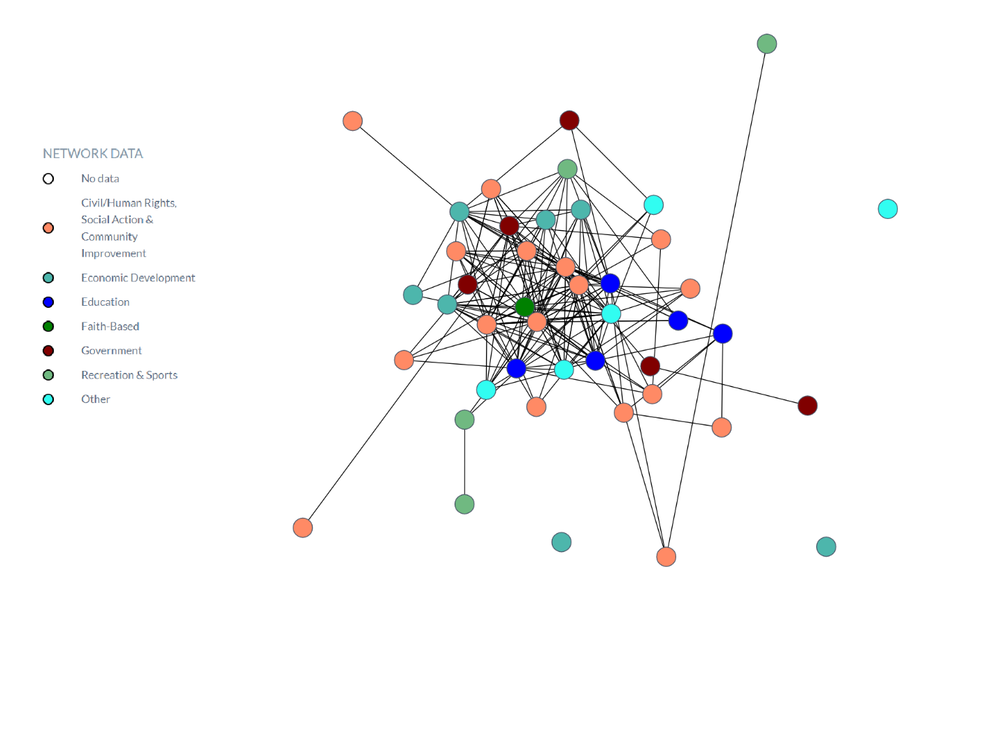
For example, we generated a map of which partners were sharing resources with each other (see graph below). The colour coding represented the partner’s sector. 

image2.png

The SNA generated many maps like this, which helped the client visually see which organizations were connecting with each other and who was being left out. However, when it came to understanding what the map meant for contributing to the initiative’s success, we needed more context. 

We presented these maps to the evaluation sub-committee and together we worked to make sense of the data. Some maps and insights were more relevant and inspired ideas for action based on who could be collaborating more or which two unconnected partners might work well together.

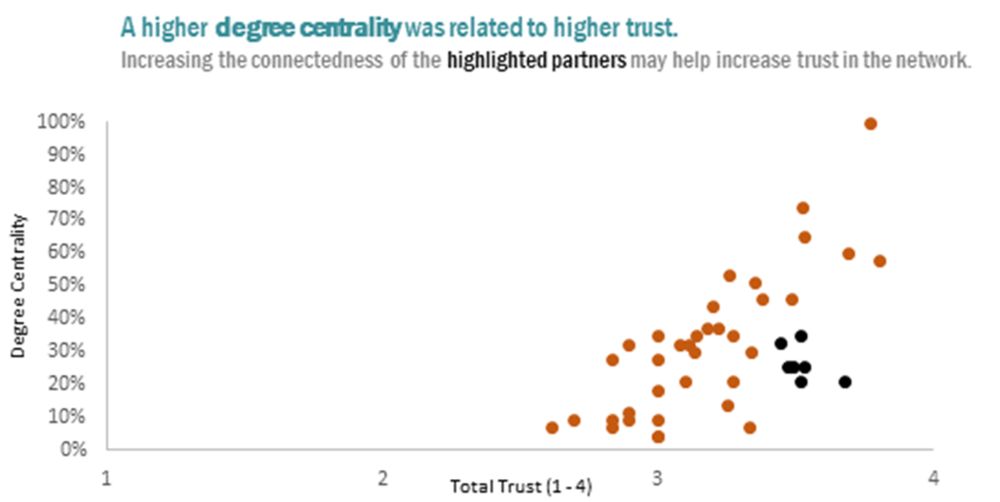
We also generated value, trust, and connectedness scores for the network as a whole and for each individual partner. 

When we compared each partner’s degree of trustworthiness with how well connected they were, an interesting pattern emerged. Visualizing these results allowed us to identify partners who were highly trusted but not well connected (black dots in the graph below). 

image002.png

Again, it was up to the evaluation sub-committee to put these results into context, using their knowledge of the partners to decide this was an expected result or whether connecting these highly trusted but not well-connected partners was feasible and relevant to achieving the network’s goals. 

In some cases, a highly trusted but not well-connected partner may only be involved in the network’s work tangentially and it wouldn’t have made sense to connect them with more organizations.

To learn more about using the results, we asked our client how the social network analysis was useful to them. 

Client Perspective

About the overall experience:

“Being invited to design and create a Social Network Analysis was a meaningful experience. It was helpful to consider different variables of our network, that perhaps had only been tacitly considered – like value and trust. Or, we had considered these things, as they come up regularly in partnerships, but we hadn’t formalized the concepts or explored how they could be measured. Learning more about this was insightful and empowering.”


About visualizing the connection in the network as a map:

“Practically, I had a visual understanding of our network and saw right away that meaningful connections needed to be made between some of our partners. Having partners collaborating with us does not mean that they are collaborating with each other, or even aware of each other. We have used this insight to connect more people to [one organization], as well as linking some of our partners from the business sector into what have traditionally been agency-dominated conversations exploring food security. “


About using the trust and value scores:

“In some ways, the obvious is profound and humbling. We were well connected, in our network, but we were also shown to be trusted and valued. This was immediately encouraging and affirming, especially when considering that we haven’t always delivered, or moved forward with clarity, or met the expectations of all stakeholders.”

About using the recommendations:

“The recommendations in the final report have been very valuable and will inform strategy, especially over the next 11 months…[for example]  we are working to improve our communication with partners and employing a number of different methods. We have intentionally started… to share information and to host projects and groups. It is working.”

What we Learned From Conducting A Social Network Analysis

A social network analysis must be a collaborative effort

Everyone needs to be on board with taking a collaborative approach to the project; from deciding who is included in the network and how to categorize them, to encouraging partners to participate in the survey, and understanding the data in context.

Interpret the data with the client to make it more meaningful

Understanding how groups work together requires an understanding of the context and a level of detail that an external evaluator doesn’t have. The data only became useful once we started asking the client what it meant to them. If a client isn’t willing to work through the data and generate insights and recommendations together, the SNA loses much of its value.

Your social network analysis will take time

The biggest lesson here was how much time and effort it takes to conduct a meaningful social network analysis. It takes communication and follow-up with network members to get buy-in and a high response rate on the network survey. Analyzing the results and making sense of the data must be done in conjunction with those involved in the network.

Clearly defining your network is extremely important

Without a clearly defined network, an SNA can quickly become bloated and confusing. A network should have clear inclusion or exclusion criteria and include a clear definition of the goal the network is working towards. An SNA may not be very useful when a group of organizations or people are not working towards a specific goal.


To learn more about applying evaluation in practice, check out more of our articles, or connect with us over on Twitter (@EvalAcadmey) or LinkedIn.


Sign up for our newsletter

We’ll let you know about our new content, and curate the best new evaluation resources from around the web!


We respect your privacy.

Thank you!


Written by cplysy · Categorized: evalacademy

Mar 18 2021

Síntesis de evaluaciones

Fuente

Desde la plataforma BetterEvaluation comparten este post “Sintetizar datos a través de evaluaciones“, donde se presentan enfoques y técnicas con el objetivo de responder a preguntas sobre un tipo de intervención en lugar de sobre un solo caso, respondiendo a preguntas como “¿Funcionan estos tipos de intervenciones?” o “¿Para quién, de qué manera y en qué circunstancias funcionan?” La tarea consiste en localizar la evidencia (que a menudo implica búsquedas bibliográficas en bases de datos, con especial énfasis en la búsqueda de estudios inéditos), evaluar su calidad y relevancia para decidir si incluirla o no, extraer la información relevante y sintetizarla. Las diferentes opciones utilizan diferentes estrategias y tienen diferentes definiciones de lo que constituye evidencia creíble.

Opciones para sintetizar procesos y/o productos evaluativos:

  1. Lecciones aprendidas del proceso evaluativo: las lecciones aprendidas pueden desarrollarse a partir del proceso de evaluación a medida que los evaluadores reflexionan sobre sus experiencias al realizar la evaluación.
  2. Mejor síntesis de evidencia: una síntesis que, como una síntesis realista, se basa en una amplia gama de evidencia (incluidos estudios de casos individuales) y explora el impacto del contexto, y también se basa en un enfoque iterativo y participativo para construir y usar una base de conocimientos. .
  3. Revisión sistemática: una síntesis que adopta un enfoque sistemático para buscar, evaluar, extraer y sintetizar evidencia de múltiples estudios. (1) Metanálisis, (2) metaetnografía y (3) síntesis realista son diferentes tipos de revisión sistemática.

3.1. Metanálisis: un método estadístico para combinar evidencia numérica de estudios experimentales (ya veces cuasi-experimentales) para producir un tamaño de efecto promedio ponderado.

3.2 Meta-etnografía: un método para combinar datos de evaluación e investigación cualitativa, especialmente datos etnográficos, mediante la traducción de conceptos y metáforas entre estudios.

3.3. Síntesis realista: sintetizar toda la investigación existente relevante para hacer recomendaciones de políticas basadas en evidencia.

  1. Valoración rápida de la evidencia: un proceso que es más rápido y menos riguroso que una revisión sistemática completa, pero más riguroso que la búsqueda ad hoc, utiliza una combinación de entrevistas a informantes clave y búsquedas bibliográficas específicas para producir un informe en unos pocos días o unas pocas semanas.
  2. Síntesis narrativa textual: dividir los estudios en grupos relativamente homogéneos, informar las características del estudio dentro de cada grupo y articular similitudes y diferencias más amplias entre los grupos.
  3. Recuento de votos: comparar el número de estudios positivos (estudios que muestran beneficios) con el número de estudios negativos (estudios que muestran daños).

Written by cplysy · Categorized: TripleAD

  • « Go to Previous Page
  • Go to page 1
  • Interim pages omitted …
  • Go to page 197
  • Go to page 198
  • Go to page 199
  • Go to page 200
  • Go to page 201
  • Interim pages omitted …
  • Go to page 310
  • Go to Next Page »

Footer

Follow our Work

The easiest way to stay connected to our work is to join our newsletter. You’ll get updates on projects, learn about new events, and hear stories from those evaluators whom the field continues to actively exclude and erase.

Get Updates

Want to take further action or join a pod? Click here to learn more.

Copyright © 2026 · The May 13 Group · Log in

en English
af Afrikaanssq Shqipam አማርኛar العربيةhy Հայերենaz Azərbaycan dilieu Euskarabe Беларуская моваbn বাংলাbs Bosanskibg Българскиca Catalàceb Cebuanony Chichewazh-CN 简体中文zh-TW 繁體中文co Corsuhr Hrvatskics Čeština‎da Dansknl Nederlandsen Englisheo Esperantoet Eestitl Filipinofi Suomifr Françaisfy Fryskgl Galegoka ქართულიde Deutschel Ελληνικάgu ગુજરાતીht Kreyol ayisyenha Harshen Hausahaw Ōlelo Hawaiʻiiw עִבְרִיתhi हिन्दीhmn Hmonghu Magyaris Íslenskaig Igboid Bahasa Indonesiaga Gaeilgeit Italianoja 日本語jw Basa Jawakn ಕನ್ನಡkk Қазақ тіліkm ភាសាខ្មែរko 한국어ku كوردی‎ky Кыргызчаlo ພາສາລາວla Latinlv Latviešu valodalt Lietuvių kalbalb Lëtzebuergeschmk Македонски јазикmg Malagasyms Bahasa Melayuml മലയാളംmt Maltesemi Te Reo Māorimr मराठीmn Монголmy ဗမာစာne नेपालीno Norsk bokmålps پښتوfa فارسیpl Polskipt Portuguêspa ਪੰਜਾਬੀro Românăru Русскийsm Samoangd Gàidhligsr Српски језикst Sesothosn Shonasd سنڌيsi සිංහලsk Slovenčinasl Slovenščinaso Afsoomaalies Españolsu Basa Sundasw Kiswahilisv Svenskatg Тоҷикӣta தமிழ்te తెలుగుth ไทยtr Türkçeuk Українськаur اردوuz O‘zbekchavi Tiếng Việtcy Cymraegxh isiXhosayi יידישyo Yorùbázu Zulu