• Skip to main content
  • Skip to footer
  • Home

The May 13 Group

the next day for evaluation

  • Get Involved
  • Our Work
  • About Us
You are here: Home / Archives for allblogs

allblogs

Mar 15 2021

Museum propulsion and performance: orchestral insights

The next time our senses are filled with an orchestral experience, Emlyn Koster suggests we take away some contemplative lessons for the needs of museums. 

A lecture titled ‘The Two Solitudes’ by novelist and chemist C.P. Snow at the University of Cambridge in 1959 became famous. It voiced alarm that the sciences and humanities had become split into two cultures with the division a major handicap to solving global problems. Sadly, this cultural split has grown to include separate associations for science, art, history, site of conscience, and children’s museums with ICOM struggling to negotiate an overarching museum definition. It would be uplifting if 2020’s environmental and societal crises spurred some blurring of these boundaries.

In a 1980 Pulitzer Prize winning book about the composer Bach, the artist Escher and the logician Gödel, the principles of an intelligent approach have long intrigued me. These include responding to situations very flexibly, finding similarities between situations despite differences which may separate them, and synthesizing new concepts by taking old concepts and putting them together in new ways. In a similar vein, the Frameworks Institute reminds us that “metaphors can spark new associations and understandings, putting an issue in a new light and prompting people to rethink their opinions or assumptions” and also “to extend metaphors over time, across contexts, and across networks”.

This spirit of innovative thinking guides me to link the seemingly unconnected worlds of orchestras and museums. An article about the needed evolution of orchestras revived a memory about an up-close experience with an orchestra, itself made possible by a science center program acquainting students with heart surgery in real time. Intrigued? Here are summaries of each element.

Anthony Tommasini, a music critic for The New York Times, opines: “It’s 2021, and we are still debating how to reinvent the orchestra for the 21st century… Now is the moment for orchestras to think big and take chances – yes, even as many players have agreed to salary reductions and administrators are coping with crushing deficits… It starts with creative programming which isn’t just important; it’s everything. I’ve long argued that American orchestras think too much about how they play, and not enough about what they play and why they’re playing it… But perhaps the impediment to creative programming and fresh thinking — including broader racial representation — remains the subscription-series schedule that prevails at all major American orchestras and locks them into standard-issue, week-after-week programs loaded with the classics and sprinkled, at best, with unusual or new choices… Why can’t orchestras be nimble and respond to sudden inspiration, or current events?”.

When Liberty Science Center won ASTC’s Award for Innovation in 2002 for its ‘Live from Surgery’ program, the CT-NJ-NY region of the American Heart Association invited me to join its annual leadership program that featured an immersive two-hour experience with the Stamford Symphony Orchestra. Imagine a ballroom with an orchestra occupying twice its normal space. Next to each musician is a chair for each participant. You choose one of your favorite instruments. The conductor is about to become a facilitator and the symphony is about to become a series of learning modules. Visualize the levels of an orchestra — musicians, section leads, conductor, and the entire orchestra — as correlatives to the employees, section leads, CEO, and the entire organization at your museum. Anticipate that when the interactive session ends, the orchestra plays a whole movement and the conductor guides a lessons-learned and Q&A-styled discussion.

What follows are examples of insights about each level with a caveat that the maximum benefit arises from their seamless integration with a holistic sense of purpose:

  • Musicians/employees: giving one’s best to what one decides to pursue… commitment to contribute to a larger result… understanding one’s role in a total context… being energized by a magnificent outcome.
  • Sections: different sections have different impacts at different times… ability to peripherally notice everything… become more energized at times of directional change… committing to a conformity of purpose.
  • Conductor/CEO: avid student of her/his profession… thinking in many dimensions at the same time… visualizing the journey to the finale… bringing out the best in each player… adept at changing the pace… owning the total acoustical and visual experience.
  • Orchestra/Organization: starting only when fully ready… different music, different difficulty… same music played by different orchestras have different outcomes… owning the total sound… the whole rises for applause… the audience inspires the musicians… only a fine orchestra can play with a ballet or opera.

I summarized this powerful experience at the next all-manager forum with members randomly divided in halves and facing each other. Each side took turns voicing positive and negative traits of management which led to an article in the all-staff newsletter. Illustrative excerpts from those lists are, respectively, invested + inclusive + flexible + respectful + supportive and egocentric + close minded + disrespectful + discouraging + discourteous. Roger Nierenberg, the maestro of the Connecticut Symphony Orchestra, has taken his approach to hundreds of organizations in more than a hundred countries and has authored a top-rated leadership book.
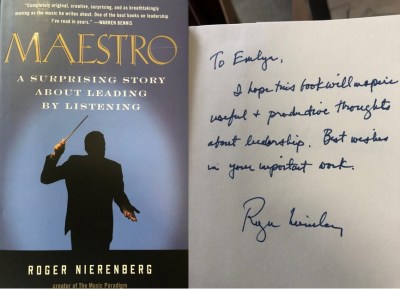
Book cover of "Maestro" by Roger Nierenberg, showing an orchestra conductor, next to a handwritten note to Emlyn Koster from the author
The book Maestro: A Surprising Story About Leading By Listening, by veteran conductor Roger Nierenberg, is full of refreshing angles for successful leadership. His inscription reads: “To Emlyn: I hope this book will inspire useful & productive thoughts about leadership. Best wishes in your important work. -Roger Nierenberg”

Discussing the intent of this blog with a colleague who helps arts, history and science nonprofits to find their next chief executive led to my awareness of a recap by a renowned researcher of managerial practices at Montreal’s McGill University of a day with the conductor of the Winnipeg Symphony Orchestra. The resulting Harvard Business Review article concluded with an insight germane to the museum sector which has been lately besieged by news headlines of directional uncertainties and internal tensions. “Get past the myth of the conductor in complete control and you may learn from this example what a good deal of today’s managing is all about. Not obedience and harmony, but nuances and constraints … Perhaps that is how the manager and the organization can make beautiful music together”.

More than ever, the linked dynamics of organizational propulsion and performance are ripe for reflection and innovation.  Museums and symphonies should surely do their utmost to provide society with uplifting experiences. In what ways can exhibitions, programming and facilitated conversations become nimble vehicles for greater public engagement (a question I explore in my upcoming Exhibition article, Paradigm shift to illuminate this disrupted planet)? Preparing this blog also reminded me of a partnership between the NC Museum of Natural Sciences and NC Symphony to celebrate the centenary of NC Parks. Projected images of Appalachian-to-Atlantic scenery above the orchestra were synchronized with Vivaldi’s Four Seasons.

Emlyn Koster, PhD (koster.emlyn@gmail.com) has been the CEO of the Royal Tyrrell Museum of Paleontology, Ontario Science Centre, Liberty Science Center, and NC Museum of Natural Sciences. His focus on humanity’s disruption of the Earth System applies reflections about the enablers of museum relevance. Current appointments include ambassador for the International Coalition of Sites of Conscience, planning task force chair for the board of the International Big History Association, and adjunct professor in Marine, Earth and Atmospheric Sciences at NC State University.

The post Museum propulsion and performance: orchestral insights appeared first on RK&A.

Written by cplysy · Categorized: rka

Mar 14 2021

Los siete secretos de un buen seguimiento y evaluación

Fuente

Jess Dart de Clear Horizon Consulting  comparte sus siete secretos para un buen monitoreo y evaluación. Aquí están las ideas ahora no tan secretas para ayudar a mejorar su seguimiento y evaluación (M&E):

  1. Muchas iniciativas de M&E fracasan, así que adoptemos el M&E como algo que primero debe satisfacer las necesidades de nuestra propia organizació.
  2. ¡Un buen seguimiento y evaluación es deliberado! Fijemos, acotemos, el alcance bien.
  3. ¡Desarrollemos un modelo lógico de programa de manera participativa desde el principio! Generemos apropiación y claridad
  4. Desarrollemos preguntas de evaluación REALES para enmarcar nuestro plan de M&E, ¡y no muchas preguntas!
  5. Elijamos métodos mixtos para contar la historia de su programa
  6. Desarrollemos la capacidad del personal de nuestra organización en M&E: es el trabajo de todos
  7. Empleemos el arte de la gestión japonesa para informar: ¡comencemos pensando en el final, con el final en mente!


Written by cplysy · Categorized: TripleAD

Mar 12 2021

6 Report Design “Quick Fixes”

Imagine going to a fancy restaurant (pre-COVID).

The dish you order is fantastically presented, it looks and smells phenomenal. It looks so delicious you consider taking a picture and sharing on your favorite social media account.

But what would happen if you surrounded that dish with a grungy atmosphere and put it on a dirty table? What if your server is pre-occupied with their phone and forgot to get your drink? What if the food was spoiled before it was cooked and plated? What if it makes you ill?

The presentation of the food is important, but context and quality really matter.

freshspectrum cartoon by Chris Lysy.
"This is a highway rest stop vending machine."
"Yea, but the parmesan risotto it offers is fantastic."

The same goes with a well designed chart. If you put it into a poorly designed report it’s never going to have the same impact. I often get asked to review charts in reports. But most of the time it’s not the charts that need the most work.

Want to make your charts shine? Start by fixing your report design. Here are some ways you can fix your report.

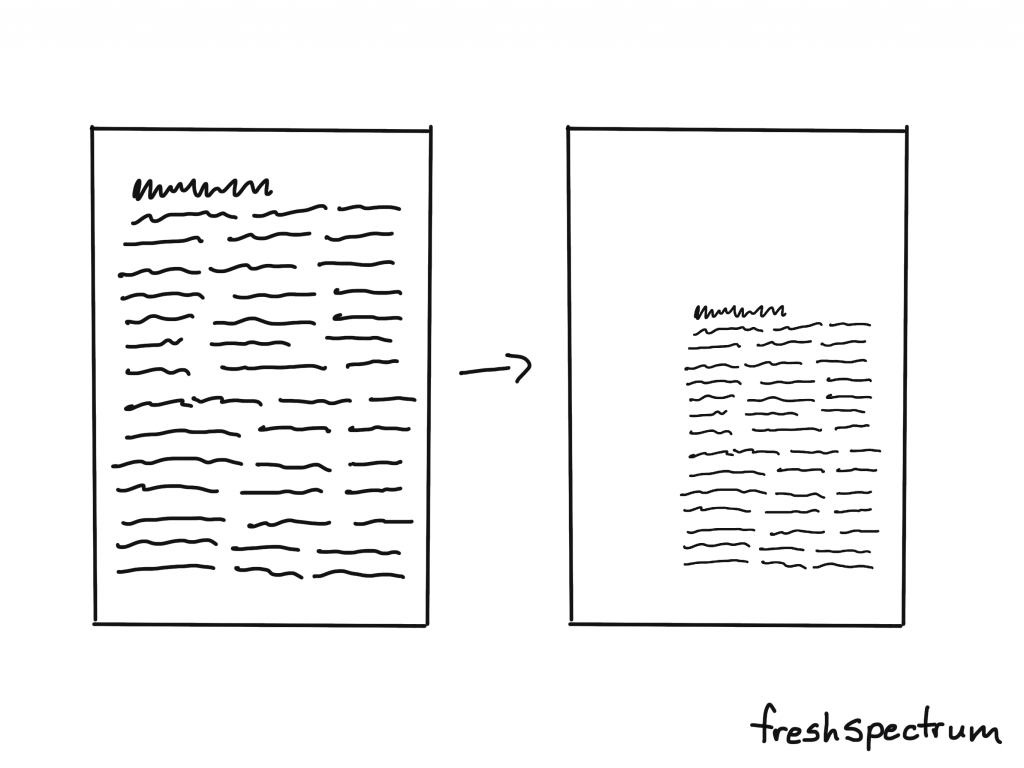
1. Incorporating white space into your template.

Incorporating white space into your template illustration.

When you write a report it’s standard practice just to fill page after page with words. But just because you write it that way doesn’t mean it’s the best way to present your words to others.

A little white space can give your words breathing room. Even if it means reducing the type face, the result is worth it.

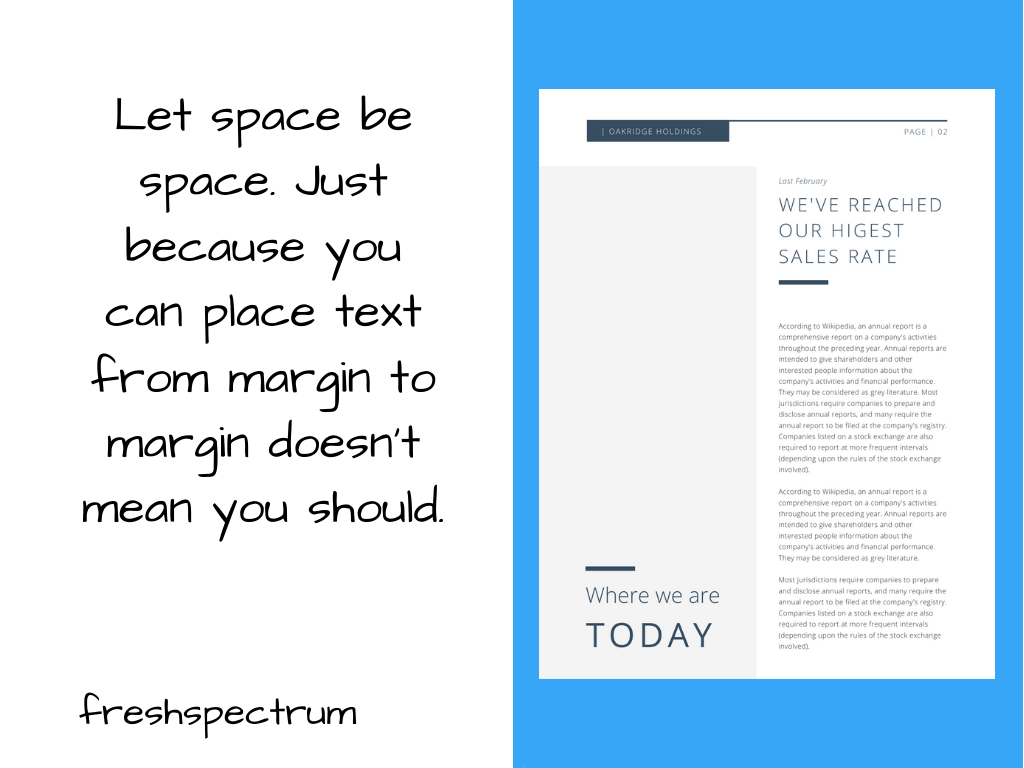
My suggestion, put your words into a basic 3 or 4 column grid for your final draft. But keep at least one column empty. Use it only for call-outs and captions. It can do wonders. Not sure how to do that? This post I wrote on creating a sidebar style one-pager in Adobe XD will give you the gist. Then just copy and paste the page until you have enough for your full report.

Let space be space. Just because you can place text from margin to margin doesn't mean you should.

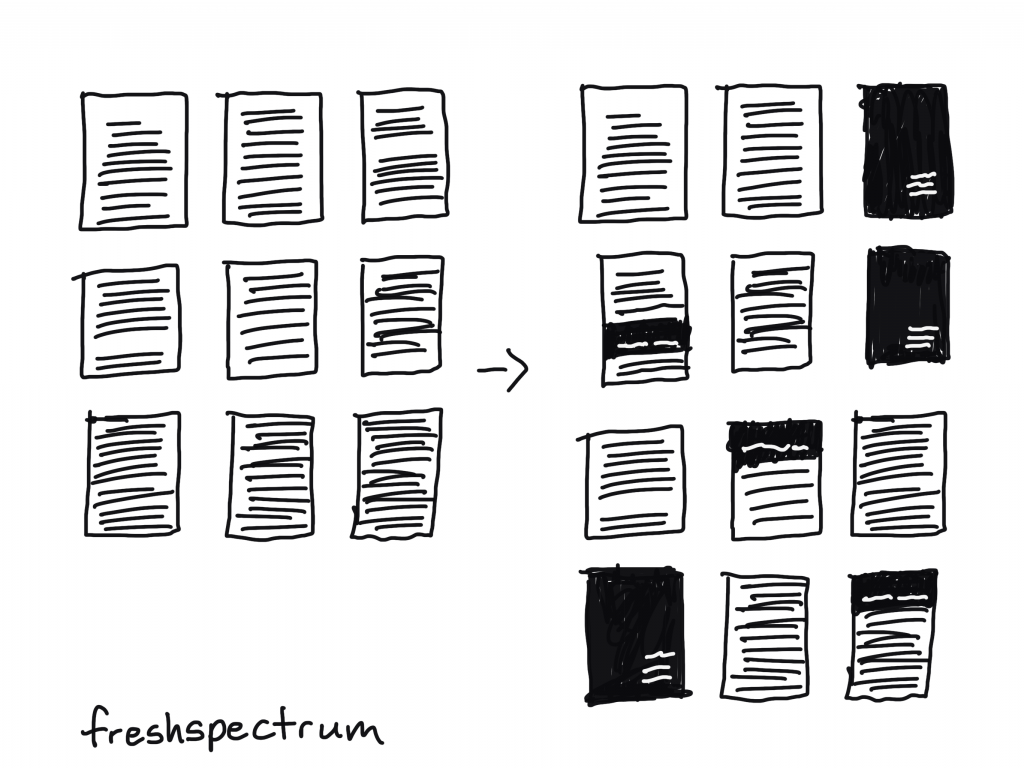
2. Designing your sections and subsections to create a rhythm.

Designing your sections and subsections to create a rhythm illustration.

Blank pages and empty color blocks might seem like wastes of space, but they can really set a nice rhythm for your reader to follow. This improves the overall skimmability and makes the report feel like more than just one continuous stream of thought.

All you really have to do is create a mostly blank page at the start of a new section. And possibly use some kind of color block or large header to denote section breaks. Also don’t be afraid to start the next section or subsection on a new page. This can give your reader a chance to catch their breath.

Ann K. Emery has a nice post that shows the value of sectioning. I suggest you check it out. A Two-Hour Turnaround: How to Transform a Text-Heavy Report into a Visual-Lite Report.

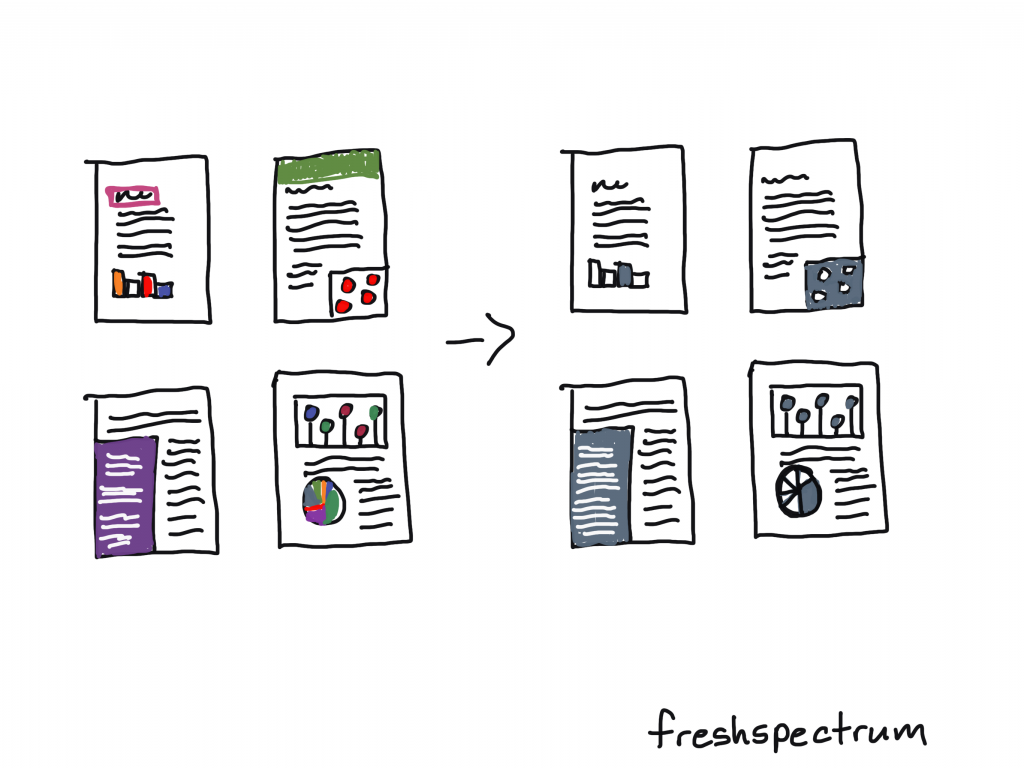
3. Making your colors consistent.

Making your colors consistent illustration.

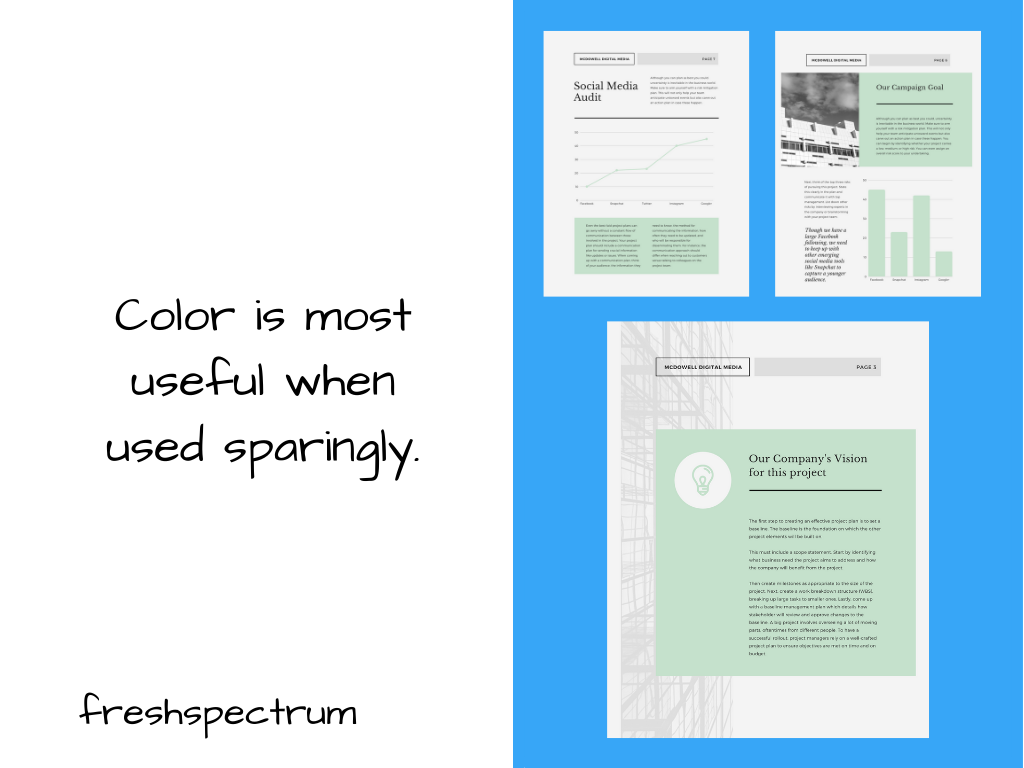
Color can be an incredibly useful tool in spotlighting specific information or differentiating important points. But you need to see color, not just in a single figure, but in the context of the whole report.

Far too often individual charts/tables/pictures get picked without regard to the other elements in the report. The result is a hodgepodge of colors that don’t fit together.

Before you finish with your report, go back through and make your colors consistent. If there is a reason to break the rule (to showcase a specific point) then do it intentionally. Haphazard colors and formats are quick tells that the report has been designed by an amateur.

Having trouble with colors, this post might be helpful: How to develop a data visualization color palette.

Color is most useful when used sparingly.

4. Add basic illustrations to create visual break points.

Add basic illustrations to create visual break points illustration.

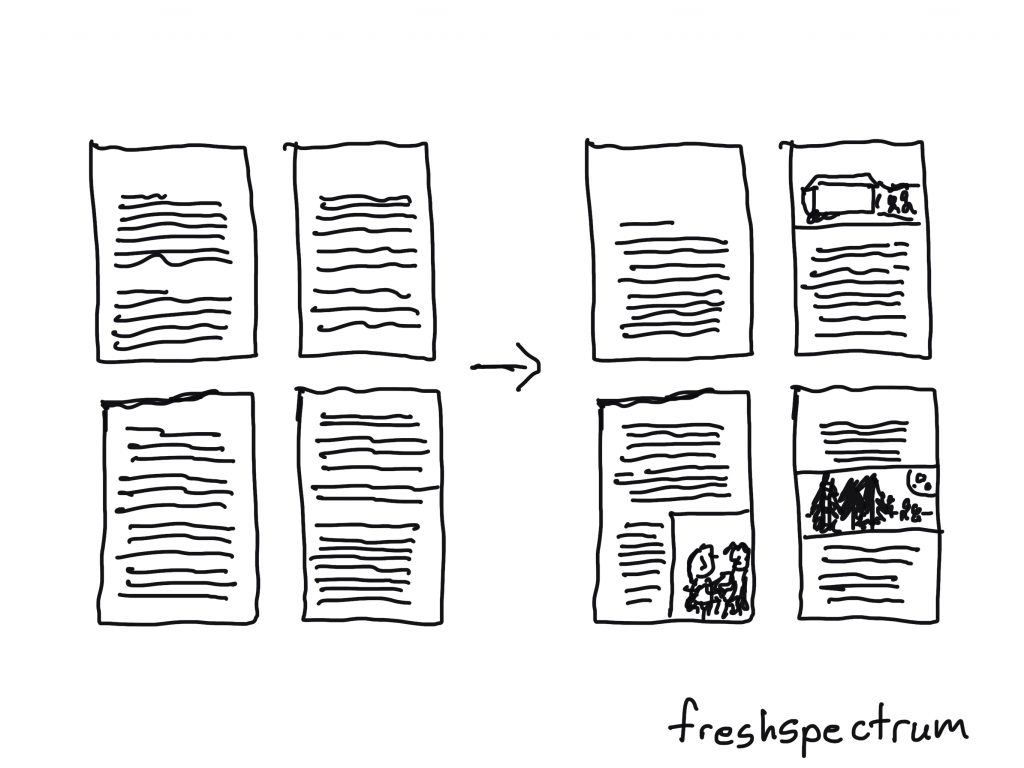
In a lot of reports you only find pictures when there is a chart to share.

But pictures can really help create break points, especially in long narrative sections. Skim readers often react to long narrative sections by skipping to the next section header or visual. So if you want them to stop and look more often, a mid-narrative illustration can really help.

And if it’s an evaluation report, you can always drop in one of my cartoons: 111 Evaluation Cartoons for Presentations and Blog Posts.

5. Systematically spotlight important takeaways.

Systematically spotlight important points illustration.

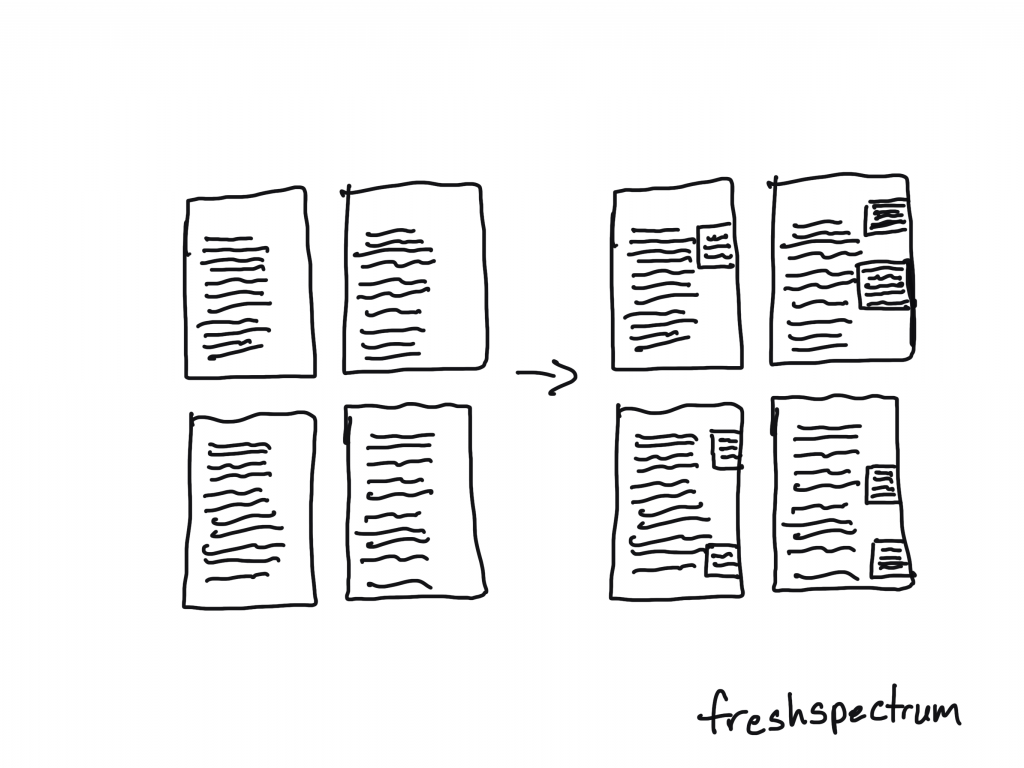
The idea that your target report audience is going to pick up your report and read it like a book is a good bit outdated. That’s just not how people read. Especially since most reports now-a-days are going to be read on a screen.

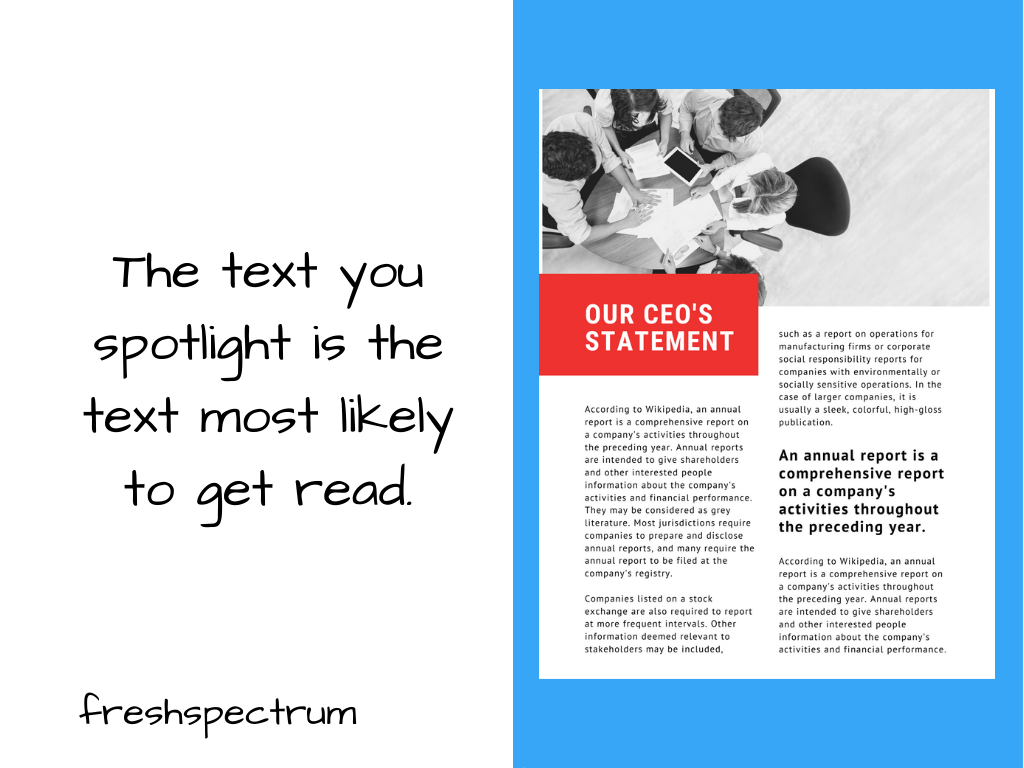
Systematically spotlighting take-aways with call-out boxes can help you layout a broader narrative. Even if your reader only skims your report.

If you’re interested in diving deeper into how people read, this Nielsen Norman Group post is a solid read: How People Read Online: New and Old Findings.

The text you spotlight is the text most likely to get read.

6. Review and revise as a skim reader.

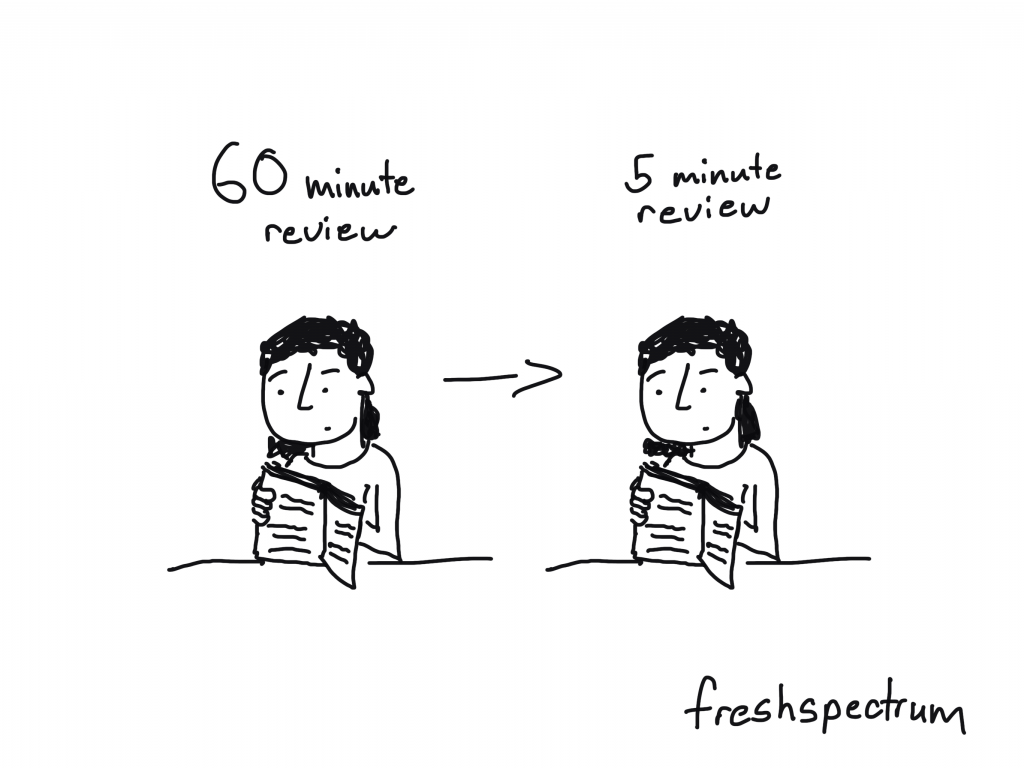
Review and revise as a skim reader illustration. Go from a 60 minute review to a 5 minute review.

Okay, so you can complain about how nobody takes the time to read anything but what good does that do. We are oversaturated with information. It overwhelms and reduces our ability to pay attention to even the things that are most important to us.

My suggestion, just understand that and adapt your report.

Your report should tell a story even to people who just skim it. But when you have your head down writing out all the stuff it’s hard to see what the skim reader will see.

So take 5 minutes and review the report like somebody who doesn’t have the time or attention span to properly review the report. What are they going to get out of it? Is there anything interesting that might really draw them in?

If not, don’t be surprised when nobody reads it.

Written by cplysy · Categorized: freshspectrum

Mar 11 2021

Impacto de COVID-19 en las evaluaciones de acción humanitaria

Fuente

Cuando se cumple un año ya del comienzo, y siguiendo con nuestra serie sobre “evaluación y COVID” o “COVID19” interesante este borrador sobre “Prácticas en evolución en la evaluación de la acción humanitaria: desafíos pasados, presentes y futuros” de Scott Chaplowe, Ann Marie Castleman y Minji Cho

COVID-19 ha exacerbado las necesidades humanitarias en todo el mundo. A medida que las agencias humanitarias adaptan su programación para satisfacer estas necesidades emergentes, los enfoques de evaluación también deben adaptarse y evolucionar. , Ha habido una serie de publicaciones, orientaciones, declaraciones y protocolos relacionados con la evaluación en respuesta al COVID-19 (por ejemplo, ALNAP, 2020; Evaluation in Crisis, 2020; Patton, 2020; PNUD, 2020; UNFPA, 2020). A continuación se resumen algunas de las consideraciones clave para la Evaluación de la Acción Humanitaria (EAH) relacionadas con COVID-19 identificadas por organizaciones humanitarias:

1 No hacer daño. La crisis ha subrayado este principio en términos de los riesgos de salud y seguridad de la interacción cara a cara durante la recopilación de datos y de sobrecargar a las partes interesadas cuyos recursos y capacidades ya pueden verse afectados por la pandemia de COVID-19.

2 Análisis de evaluabilidad. Existe una mayor necesidad de análisis de contexto / riesgo para evaluar en qué medida se puede evaluar una intervención de manera confiable y creíble durante la crisis del COVID-19 (IED-OIOS, 2020; IEO / PNUD y OECD / DAC, 2020; PNUD, 2020; PMA, 2020; UNICEF, 2020)

3 Aplazamiento de la evaluación. El aplazamiento es una opción viable si los resultados de la evaluación seguirán siendo útiles para la toma de decisiones en un momento posterior, aunque se debe tener cuidado de evitar una acumulación de evaluaciones que resultará imposible de realizar (PNUD, 2020; PMA, 2020). .

4 Adaptar el diseño y los métodos de evaluación. Los enfoques metodológicos de EAH se han visto enormemente afectados por COVID-19 debido a los riesgos de transmitir el virus a través de la interacción cara a cara y la movilidad general. Las adaptaciones importantes para el diseño y los métodos de evaluación incluyen:

I. Incrementar el uso de datos secundarios. El uso de datos existentes (asegurando que sean relevantes y confiables) es un enfoque para satisfacer las necesidades de evaluación dadas las dificultades para acceder a las personas.

ii. Recolección de datos a distancia. Esto incluye una variedad de plataformas y herramientas para recopilar datos de personas sin interacción directa, como el uso de teléfonos, teléfonos móviles con acceso a Internet, computadoras e imágenes satelitales.

iii. Recopilación de datos de terceros. Se pueden utilizar organizaciones de terceros confiables, consultores nacionales o grupos comunitarios para recopilar datos en el campo cuando se puede garantizar el principio de No Hacer Daño, lo que evita el riesgo adicional de transportar evaluadores desde un lugar distante.

iv. Reducir el alcance o el rigor de la evaluación. Dadas las limitaciones de recursos y capacidad para la evaluación en el contexto de COVID-19, puede ser aconsejable reducir el alcance geográfico, temporal o temático de una evaluación utilizando tamaños de muestra más pequeños, empleando un muestreo intencionado o reduciendo el número de preguntas de evaluación respondidas.

v. Utilizar una evaluación conjunta o colaborativa. La consolidación de los esfuerzos de recopilación de datos entre varias organizaciones reduce los riesgos para la salud asociados con COVID-19 y la carga sobre las partes interesadas que ya se ven afectadas por la pandemia. También apoya una respuesta humanitaria más coherente, basada en principios, eficaz y rentable.

vi. Utilizar autoevaluaciones o revisiones. En lugar de encargar a evaluadores externos que realicen una evaluación, la autoevaluación del programa de ejecución o del equipo del proyecto es otro enfoque que minimiza la interacción cara a cara.

5 Cancelación de la evaluación. En algunos casos, cancelar la evaluación puede ser la opción más recomendable dadas las circunstancias (UNFPA, 2020; WFP, 2020).

Bibliografía

La bibliografía de este artículo está disponible en línea en la Biblioteca de Aprendizaje y Desempeño de Evaluación Humanitaria (HELP)

Written by cplysy · Categorized: TripleAD

Mar 10 2021

Pensamiento evaluativo para la evaluación transformadora

Fuente

Siguiendo con nuestra serie sobre “Pensamiento evaluativo”,  exploramos el post de Thomas Archibald sobre “Habilidades de pensamiento crítico y evaluativo para la evaluación transformadora” y nos centramos en la parte referida a Pensamiento evaluativo para la evaluación transformadora

Según Patton, “La evaluación es una actividad. El pensamiento evaluativo es una forma de hacer negocios. Esta distinción es fundamental. Se deriva de estudios de uso de la evaluación. La evaluación es más útil, y realmente se usa, cuando el programa y la cultura organizacional manifiestan un pensamiento evaluativo “.

Thomas Archibald y su equipo han definido “Pensamiento evaluativo” de la siguiente manera:

(1) aplica el pensamiento crítico en el contexto de la evaluación,

(2) motivado por (a) una actitud de curiosidad y (b) una creencia en el valor de la evidencia, que

(3) implica (a) identificar supuestos, (b) plantear preguntas reflexivas, (c) buscar una comprensión más profunda

(4) por medio de (a) la reflexión y (b) la toma de perspectiva, e (c) informar las decisiones en preparación para la acción”.

El pensamiento evaluativo es tanto un fundamento filosófico fundamental de la evaluación como una forma de desarrollar la capacidad de evaluación de los individuos y las organizaciones, para liberar el poder de la indagación. Aquí hay algunas formas en que el pensamiento evaluativo se relaciona con la transformación de la evaluación para evaluar la transformación: (1) Liderazgo descentralizado, (2) gestión del conocimiento, (3) pensamiento de sistemas, (4) construcción colectiva.

  1. Democratiza y descentraliza la investigación evaluativa. Por lo tanto, sensibles a la dinámica del poder, los ciudadanos de todos los ámbitos de la vida pueden encontrar su lugar en la recopilación, el análisis y el uso de datos.
  2. Aprovecha la sabiduría práctica y una pluralidad de formas de conocimiento y razonamiento. Debido al desorden de los “problemas complejos”, los profesionales no solo aplican soluciones técnicas a los problemas técnicos: participamos en la “reflexión en acción, una especie de experimentación continua, como un medio para encontrar una solución viable a tales problemas”. que conduce a “un tipo particular de conocimiento artesanal (o la sabiduría de la práctica)”.
  3. Es el pensamiento de sistemas y equidad. Al identificar constantemente suposiciones, adoptar múltiples perspectivas y explorar relaciones, el pensamiento evaluativo ayuda a realizar el trabajo “glocal” orientado a los sistemas, incluida la atención al poder, al posicionamiento y prioridades que requiere una evaluación equitativa.
  4. Equilibra la intuición y la racionalidad: el pensamiento evaluativo admite una pluralidad de formas de conocimiento mientras mantiene un ojo crítico sobre la credibilidad de las afirmaciones y la evidencia

Written by cplysy · Categorized: TripleAD

  • « Go to Previous Page
  • Go to page 1
  • Interim pages omitted …
  • Go to page 199
  • Go to page 200
  • Go to page 201
  • Go to page 202
  • Go to page 203
  • Interim pages omitted …
  • Go to page 310
  • Go to Next Page »

Footer

Follow our Work

The easiest way to stay connected to our work is to join our newsletter. You’ll get updates on projects, learn about new events, and hear stories from those evaluators whom the field continues to actively exclude and erase.

Get Updates

Want to take further action or join a pod? Click here to learn more.

Copyright © 2026 · The May 13 Group · Log in

en English
af Afrikaanssq Shqipam አማርኛar العربيةhy Հայերենaz Azərbaycan dilieu Euskarabe Беларуская моваbn বাংলাbs Bosanskibg Българскиca Catalàceb Cebuanony Chichewazh-CN 简体中文zh-TW 繁體中文co Corsuhr Hrvatskics Čeština‎da Dansknl Nederlandsen Englisheo Esperantoet Eestitl Filipinofi Suomifr Françaisfy Fryskgl Galegoka ქართულიde Deutschel Ελληνικάgu ગુજરાતીht Kreyol ayisyenha Harshen Hausahaw Ōlelo Hawaiʻiiw עִבְרִיתhi हिन्दीhmn Hmonghu Magyaris Íslenskaig Igboid Bahasa Indonesiaga Gaeilgeit Italianoja 日本語jw Basa Jawakn ಕನ್ನಡkk Қазақ тіліkm ភាសាខ្មែរko 한국어ku كوردی‎ky Кыргызчаlo ພາສາລາວla Latinlv Latviešu valodalt Lietuvių kalbalb Lëtzebuergeschmk Македонски јазикmg Malagasyms Bahasa Melayuml മലയാളംmt Maltesemi Te Reo Māorimr मराठीmn Монголmy ဗမာစာne नेपालीno Norsk bokmålps پښتوfa فارسیpl Polskipt Portuguêspa ਪੰਜਾਬੀro Românăru Русскийsm Samoangd Gàidhligsr Српски језикst Sesothosn Shonasd سنڌيsi සිංහලsk Slovenčinasl Slovenščinaso Afsoomaalies Españolsu Basa Sundasw Kiswahilisv Svenskatg Тоҷикӣta தமிழ்te తెలుగుth ไทยtr Türkçeuk Українськаur اردوuz O‘zbekchavi Tiếng Việtcy Cymraegxh isiXhosayi יידישyo Yorùbázu Zulu