Chris, This is one of the most useful blog posts from any source that I’ve received. Rather than just referring us to Canva, you walk through all the steps. I love the idea of creating the powerpoint blocks with color labels. And super thanks for the site to check colors for persons with color blindness, which if I remember correctly affects 11% of people–8% of men and 3% of women.
Your post is great!
Lyn
allblogs
How to develop a data visualization color palette.
In this post I am going to walk you through the process of creating your own data visualization color palette.
- Why you should have a color palette before you chart
- Picking your first color
- Picking Color Number 2
- Picking Colors 3, 4, 5, and 6
- Developing a color palette guide
- Accessibility Checks
Why you should have a color palette before you chart.
A lot of the researchers and evaluators I know don’t think a lot about color when they go to create charts. And as a result, they end up creating reports with a diverse mix of colors reminiscent of late 80s/early 90s fashion.
This happens even when the data person works for an organization that has a defined style guide. Of course that style guide might be limited and is not always helpful when it comes to data visualization.
Having some pre-defined colors in hand when creating charts can help you stay consistent. Design consistency keeps artificial aesthetic differences from appearing significant in some way. It also takes away a step (saving your brain power) the next time you need to write a report on a deadline.
Picking your first color.
I like to start with one color, then build out from that color. It helps keep things from getting too overwhelming.
If you already work for an organization, that first color might be decided for you. Often the primary action color sits within an organization’s logo that you’ll find on their website.
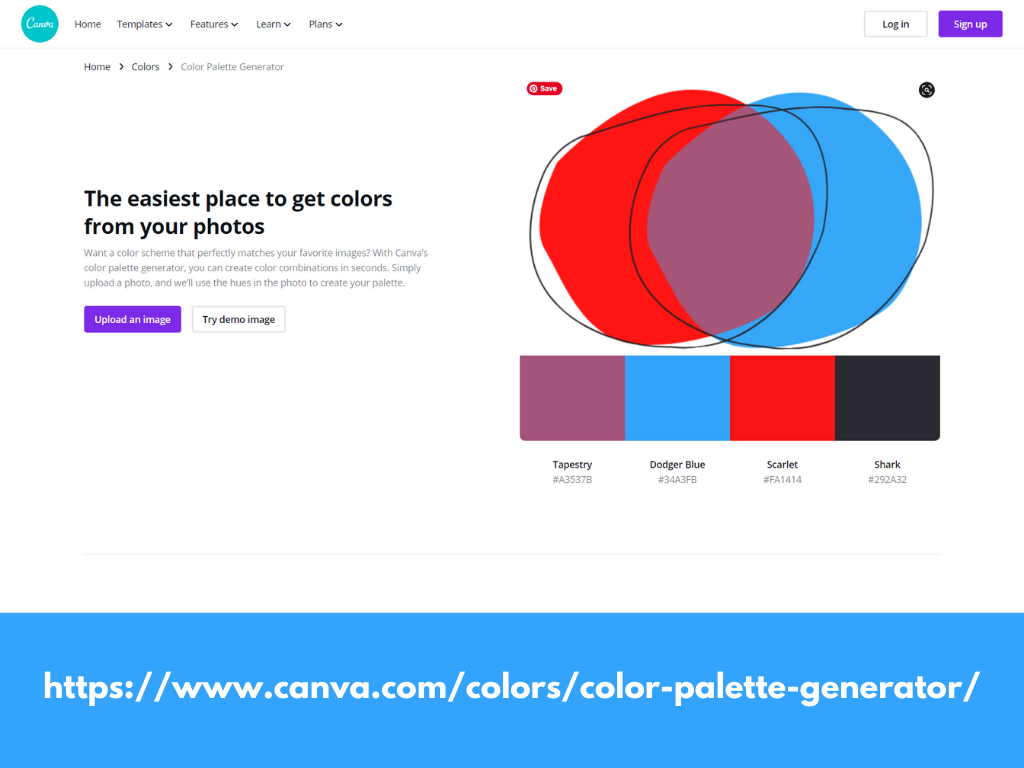
Don’t know what that color is? Canva has a nice free tool that generates a basic palette from a picture. So if you downloaded a logo (or even if you just have picture you find inspires you) you can upload it to the generator and see the colors within.
In my case I am going to start with the blue color from my logo, which Canva calls Dodger Blue. You’ll see the hex code (6 digit alpha-numeric) underneath.
Picking Color Number 2
In a lot of charting it’s good to have at least two main colors.
I highly advocate for choosing the second color based on what is sitting on the other side of the color wheel. In other words, the complementary color.
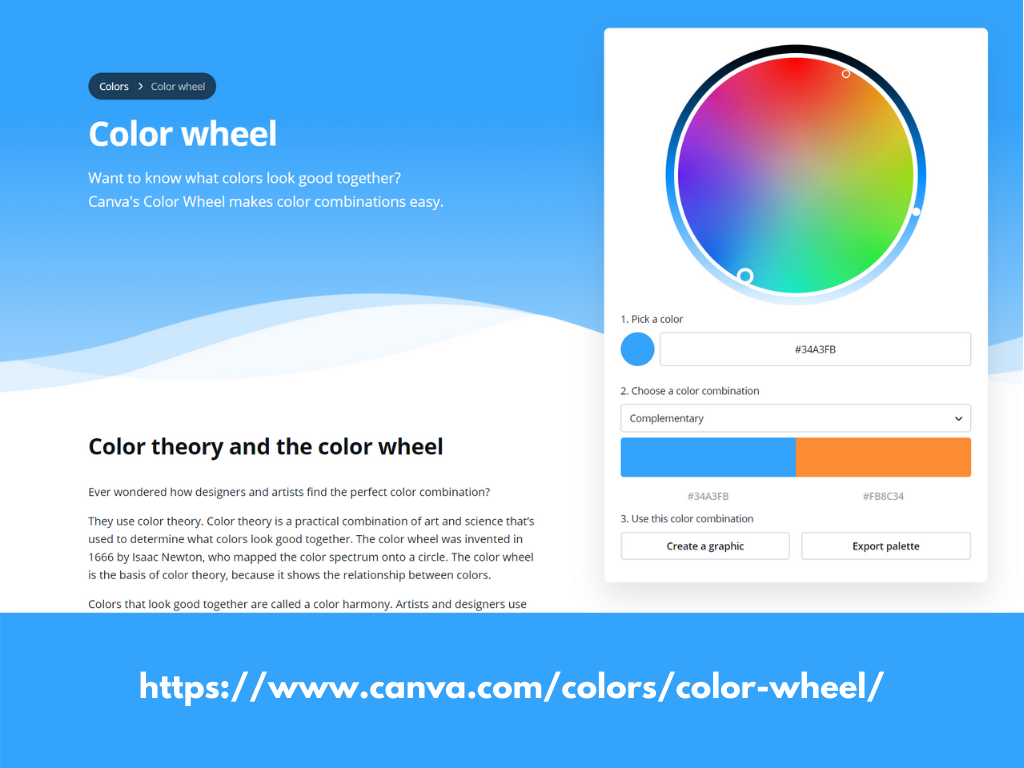
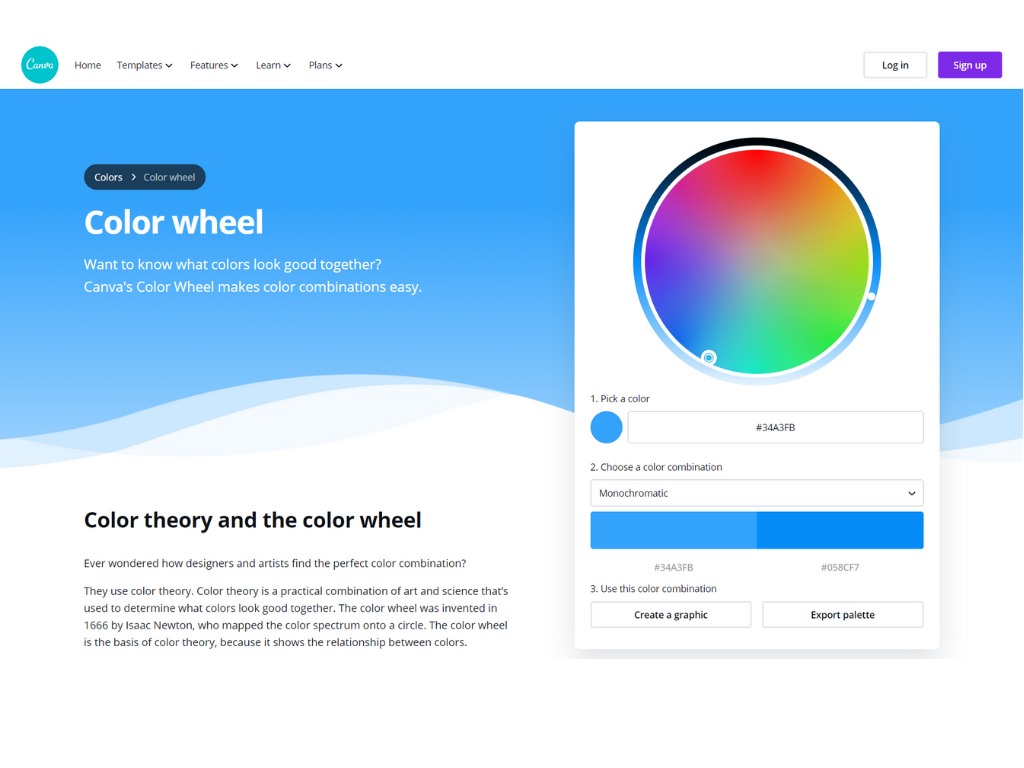
Canva also has a color wheel tool that let’s us see that color.
Just stick in the hex code from your first color into the “Pick a color” space. Then look at the color in the “complementary space.” So for my blue, the complementary color would be an orange.
Picking Colors 3, 4, 5, and 6
Here is the thing about charting. You almost always need several colors. But rainbow coloring your report is not going to help anyone.
Instead I like to draw my next 4 colors using monochromatic versions of my first 2.
Again, with just the hex code in the primary color spot, choose “Monochromatic” in the next space. The Canva color wheel will just repeat the one color and give you another shade of that color on the right.
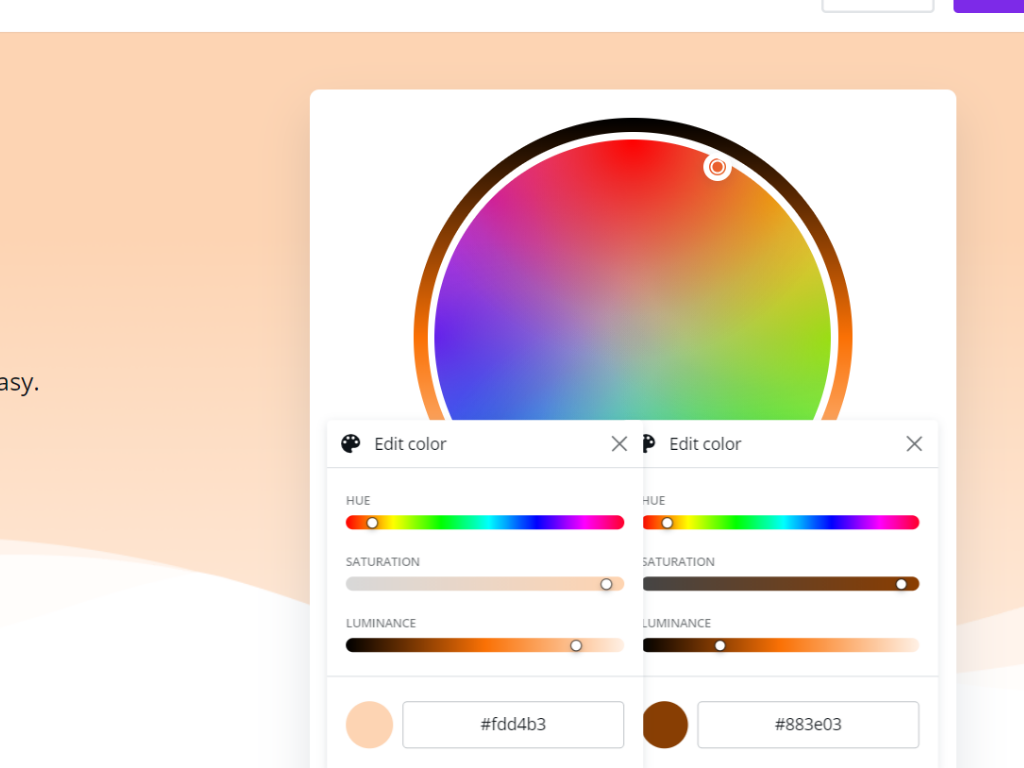
Personally, I don’t think this is different enough to use for most charts. So instead I click on each individual tile it gives me and select “Edit color.” This will give you some sliding scales.
I want to keep the change monochromatic, so the only thing I’m going to move is the luminance. On one I am going to take the base color and make it really light. On the other I’m going to go really dark.
So in my case, I will end up doing this two times for the blue and two times for the orange. This will give me 6 total colors (2 complimentary, and then 2 shade options for each color).
Once you figure out the colors, remember to write down the Hex codes.
Developing a color palette guide.
Having a whole bunch of handwritten hex codes is probably not super helpful.
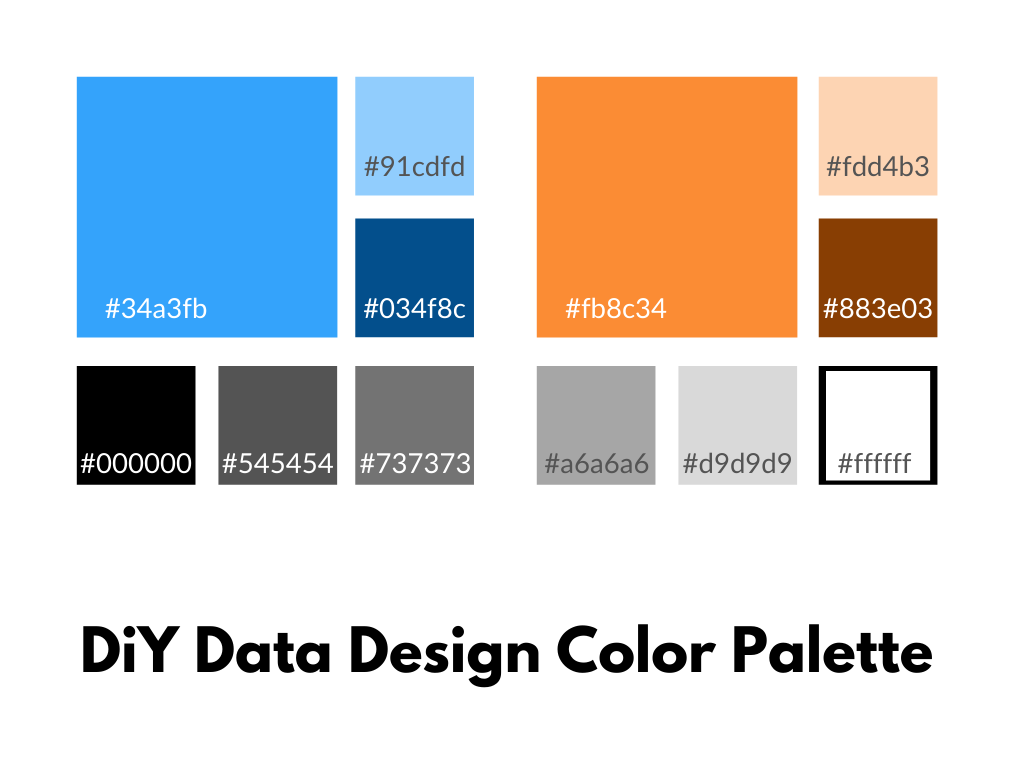
So let’s turn it into a basic color guide using Canva’s regular design tools. I’ll start by creating a blank “Presentation (4:3).” This will be easy to print, share as an image, download to pdf, or even download to Power Point.
Once I create the presentation I just drop in a simple square element.
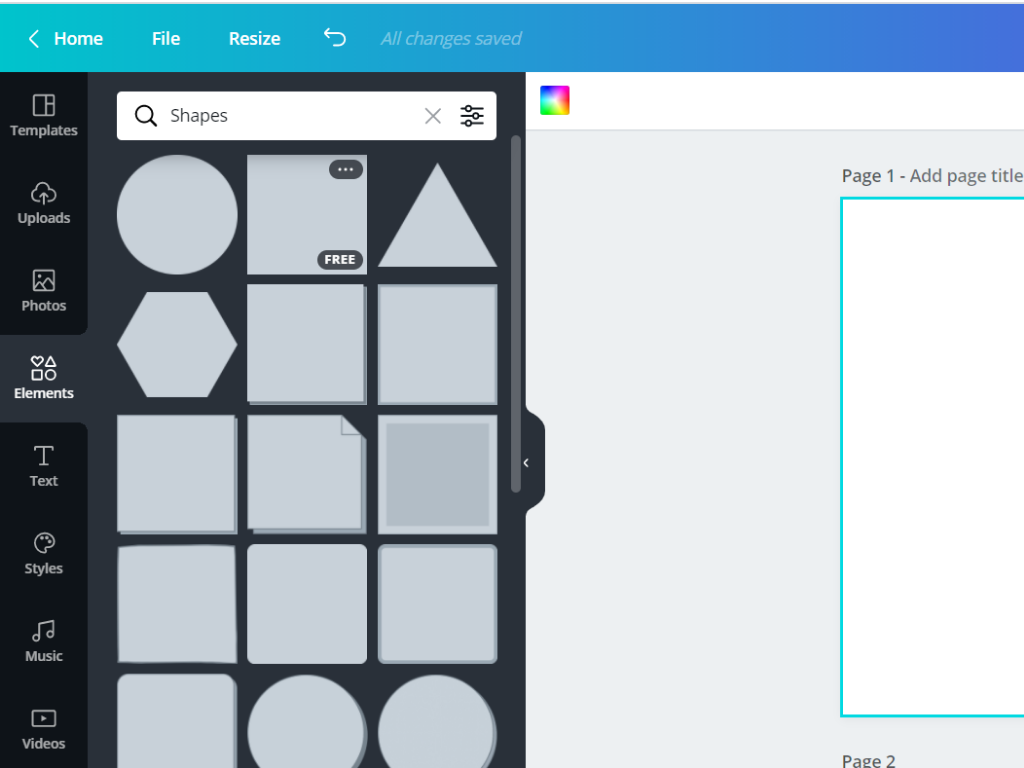

Then I’ll drop in more squares until I have a pattern that has two big blocks in focus (two blocks to the side of each) and then six blocks underneath.

I’m going to want to put the hex codes into the design, so I also go ahead and add some body text in white to each of the blocks.
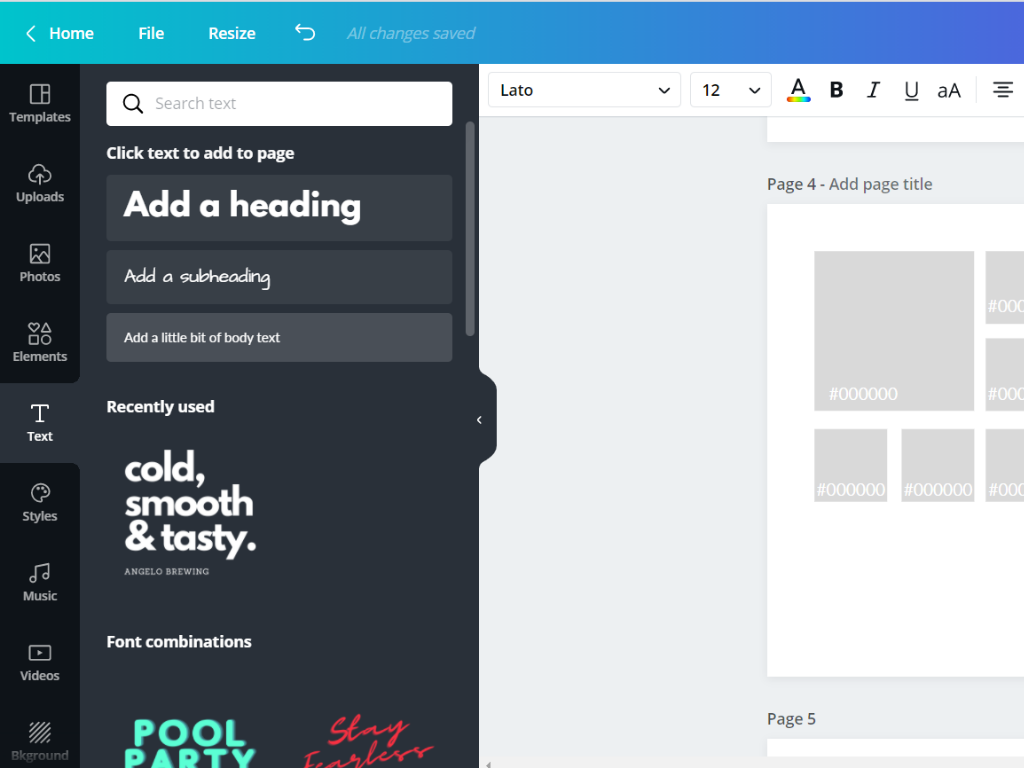
Now comes the easy part. You just click on the first square, then the color up top, and search for your hex code. You’ll also want to paste the code into your label.
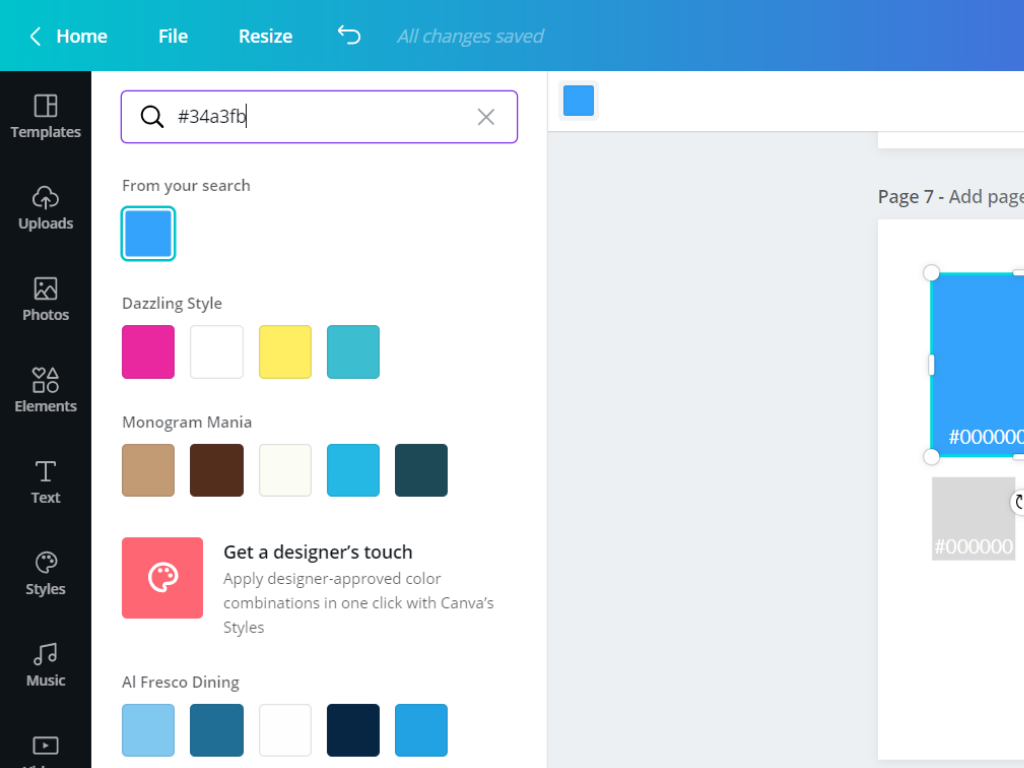
Now just keep repeating the process for your 6 colors.
To round things out I also like adding a simple 6 color gray scale from Black to White. That’s why I put the six blocks on the bottom.
All told, we will have two complimentary colors, 2 additional shade varieties for each, and then 6 grayscale blocks.
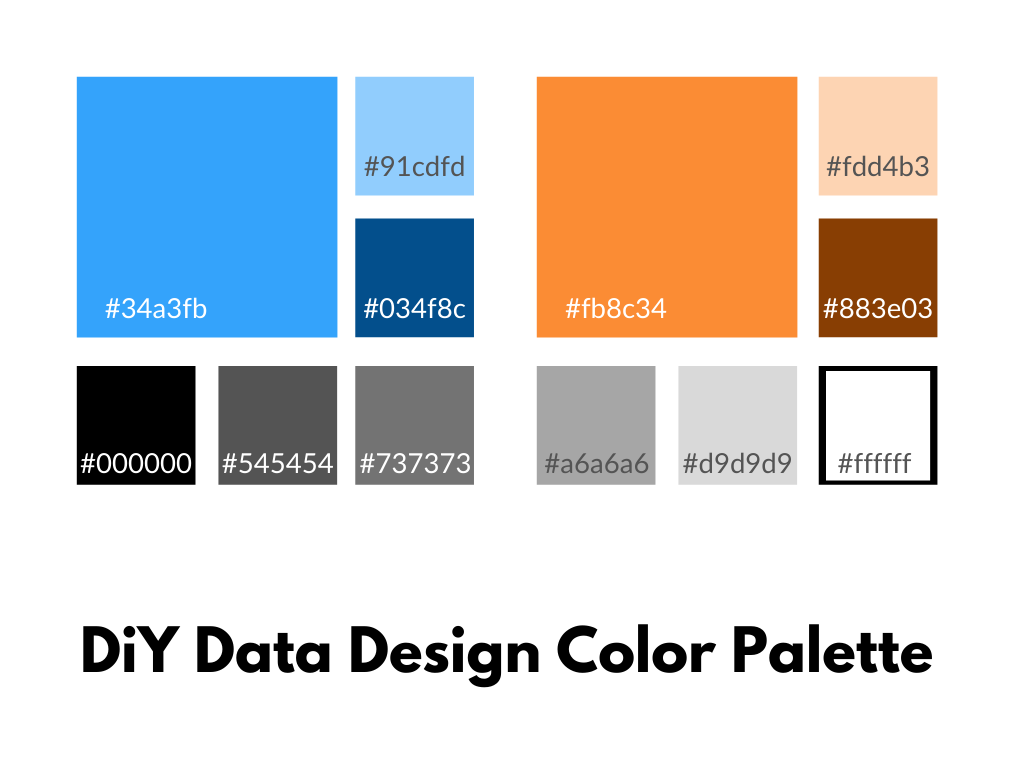
This color collection will give you a lot of variety when it’s time to create your charts.
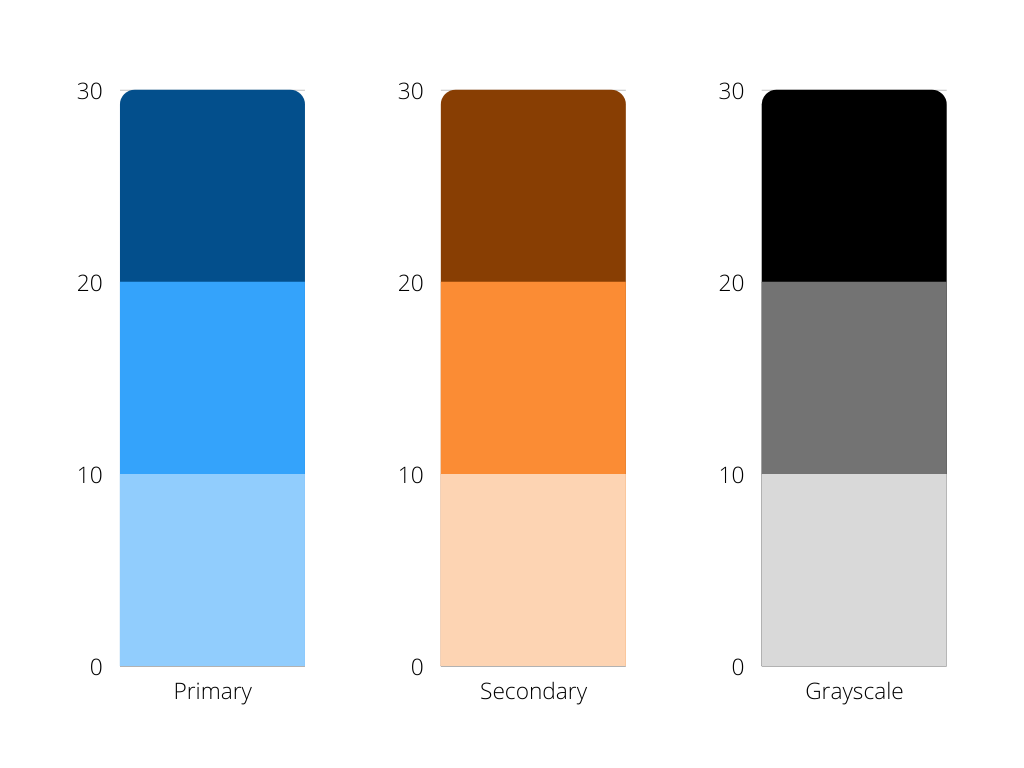
You’ll want to go ahead and download your color guide. I like to download it as a simple PNG.
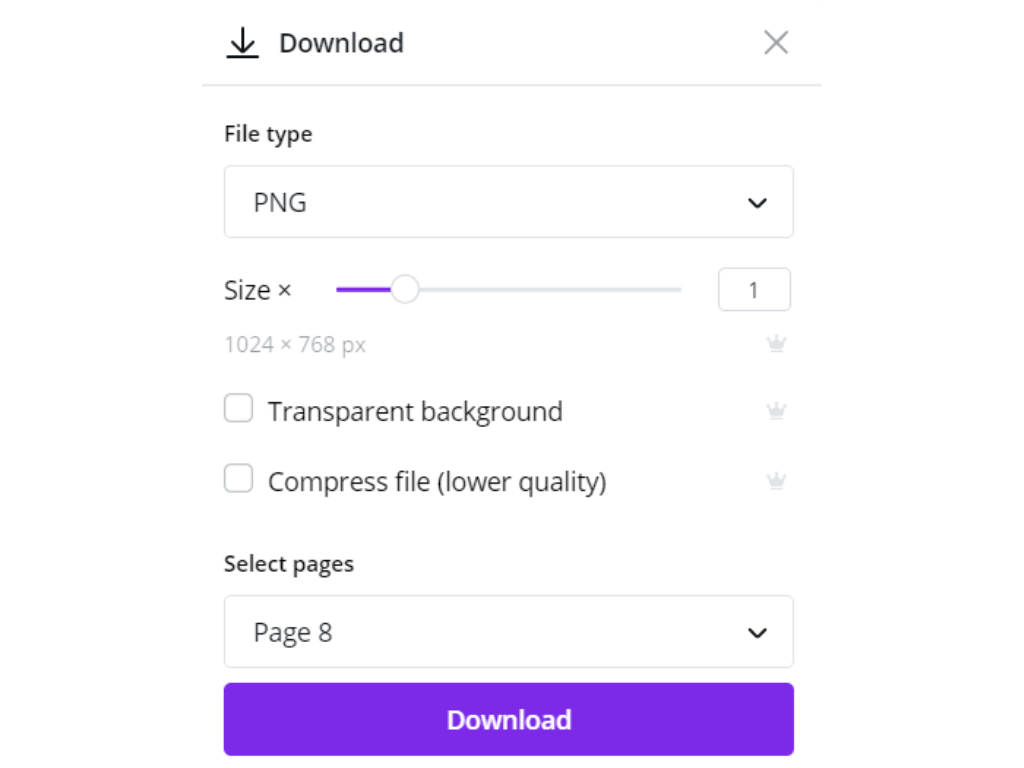
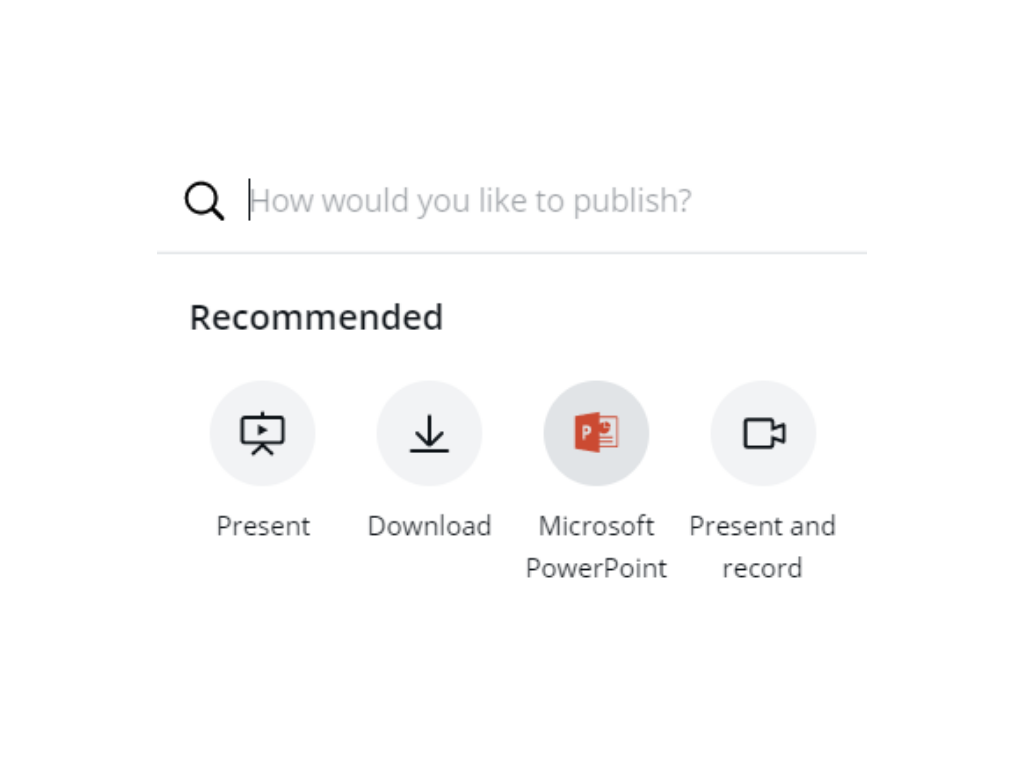
Canva has also added support for downloads directly into Power Point. Which is perfect for pretty much everyone who spends most of their time in Excel, Word, and PowerPoint.
Accessibility Checks
When using color in charts and visualizations it’s good practice to not only use color. Meaning, color should not be the only thing that differentiates different categories.
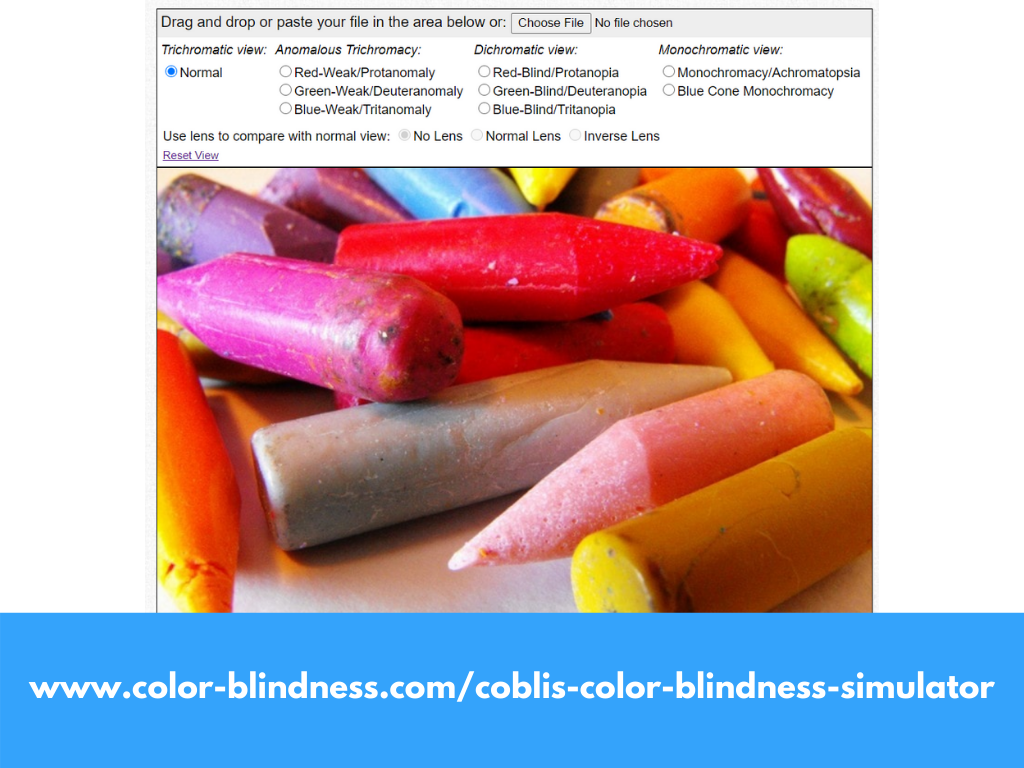
But we should also check our colors for issues in differentiation due to common color blindness. Here is one color blindness simulator you can use to upload your color guide and check it out.
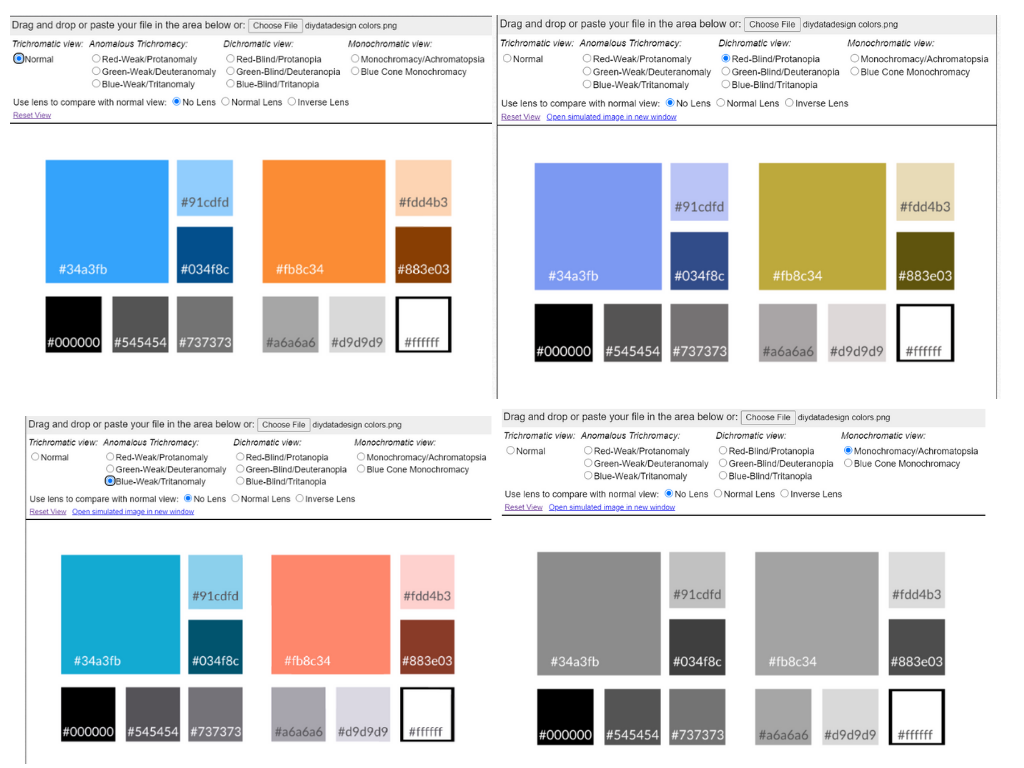
As you can see, my colors do not fair too poorly. The important piece here is having the ability to differentiate.
One additional thing to note is that as different as two colors look it’s the shade that matters when an image gets printed in black and white. If you know your charts will be printed in black and white it’s a good idea to vary not only colors but shades.
Webinar Notes: Ethical Storytelling
Panelists: Amy Costello & Frederica Boswell
Hosted by: Nonprofit Quarterly
- Tiny Spark podcast
- Sophie Otiende, Activist and Advocate, HAART Kenya:
- non-profits “parade and exploit” the people they are claiming to help
- e.g., asking someone who has been assisted by an NPO to share their story – the organization holds power over the victim – can that survivor give proper consent about telling their stories?
- “survivor porn” – why do we need a person to come and tell us that these horrible things are bad?
- people don’t talk to survivors about the risks and impacts of telling your story. People live in an ideal world where they think that if they tell their story, people will be compassionate. But that’s not true – some people will abuse those who tell their stories, or we just forget about the person and move onto to getting the next survivor’s stories
- we are interested in the whole person -not just their trauma
- not everyone wants to be called “survivor” or “person who formerly experienced homelessness” or “recovering addict” – how does the person whose story is being told want to be represented?
- the person whose story it is should be a full partner in the storytelling
- ensure they are in the loop at all developments in the storytelling and being extra sure at every step that they are comfortable with any details that are shared
- never want to surprise someone with details about their story being made public
- don’t want to engage in trauma porn – just sharing the trauma in isolation
- figure out what the message is – e.g., in a story on the Me Too movement in the charitable sector, the message was that serial predators are hiding in the charitable sector and their institutions are protecting them
- figure out what the purpose of telling the story is – things like holding organizations to account or highlighting resilience
- when conducting interviews, establish trust and intimacy
- be fully present in the interview
- ask follow up questions, based on really listening to them, rather than just following the interview guide in order
- don’t drive the interview – the interviewee should have autonomy and control. The story is hers, not the interviewer’s
- interviewer’s job is to help the interviewee feel safe
- we should let people know what their rights are – that they can say “no” to answering our questions
- interviewing “experts” (e.g., professors who study a topic)
- isn’t someone who has years of experience living with homelessness an expert on the subject?
- “professional” “experts” are often well rehearsed when you interview them – you have to push them to be real, rather than just being on auto-pilot
- think about the stereotypes you may be perpetuating with your storytelling
Webinar Notes: Beyond the Board Statement: How Can Boards Join the Movement for Racial Justice?
Sheila Matano, who is the VP of the board of the BC Chapter of the Canadian Evaluation Society (CESBC), who is also the chair of our Diversity, Equity, and Inclusion (DEI) committee, told me about this two-part webinar series. Like many boards, we are wanting to do better when it comes to doing our work in an inclusive way, and we didn’t want to just put out a board statement that says “Black Lives Matters” but then just go on operating the way that we always have. So I was excited to check out this series for some concrete ideas about how we can do this well. And I was not disappointed!
Panelists: Robin Stacia (RS) https://sageconsultingnetwork.com/meet-our-ceo/ and Vernetta Walker (VW).
Hosted by: Nonprofit Quarterly
Part 1: Date: June 22, 2020
Watch part 1 here. Watch part 2 here.
Here are my notes from the webinars.
My takeaways:
- board statements need to state a commitment to what you are going to do
- it’s not about waiting out the uprising until you can go “back to business”
- how can boards use their influence in a way that aligns with their mission?
- the work needs to be done by the whole board – it’s not to be on the one Black person on your board to own this work. It can be retraumatizing for them. And Black people are tired from fighting for centuries – white people need to step up.
- look at your board composition – we need a diverse board and a coalition of all of us
Understanding our history:
- we are a post-colonial society – there was a narrative that “natives” were “savage” –> white supremacy –> allowed white people to enslave Black people
- slavery did not end – it just evolved
- there is still a presumption of danger re: Black and brown people
- truth and reconcilitation/justice/reparation are sequential – the truth must come first
- as boards, we need to tell the truth about what we’ve ignored, overlooked, and benefitted from
Debunking Myths
Myth: “It’s just a few bad actors”
- RS: this myth “minimizes the centuries long struggled that Black, brown, indigenous people have experienced”
- it is a system of racism:
- restricts every aspect of life for Black, brown, and indigenous people (healthcare, criminal justice, politics, education, wealth – everything)
- institutional policies/practices/laws/regulations designed to benefit and create advantages for white people and oppress and disadvantage Black, brown, and indigenous people
- exists no matter your age, location, socioeconomic status
- VW: we have a lot to unlearn
- we’ve been socialized to not talk about race
- boards should talk about why they are so uncomfortable to talk about race
- boards should learn about unconscious bias
- do you have authentic relationships with Black and brown people? Because we’ve been separated
- COVID-19 and this uprising = perfect storm, because people had time to reflect and feel the pain
- we can’t show up effectively for the board work if you haven’t done the individual work
Myth: People try to replace “Black Lives Matter” with “All Lives Matter”
- VW: saying “Black Lives Matter” is not saying “only Black Lives Matter” – it’s saying “Black Lives Matter too”
- there is violence against Black bodies, often by state actors
- lots of people have heard that “race is a social construct”, but they don’t get it. They think there are differences between the races that justify the violence, but there are not.
- “waking up Black” has a level of stress that is measurable – decreased life expectancy, gaps in educational acheivement, maternal mortality, criminal justice system involvement – bias and systemic racism leads to all of this
- RS: people misunderstand “racial equity” – it means the state where my racial identity doesn’t have an impact on me -e.g., I can go to the bank or go birdwatching and my racial identity does not dictate the outcome
A board statement alone is not enough
- When they polled the webinar audience, about 3/4 said that their board had issues a statement in the wake of the BLM protests, but only 1/4 said that their board had an indepth conversation about the issues
- VM: some statements just say something to the effect of “we stand with you”, but nothing about what they will actually do
- good statements will say what they are doing and what they commit to doing
- there was a backlash if you didn’t put out a statement, and there was also a backlash if your statement didn’t have any teeth – it shows that people are paying attention
- put putting out a statement for the sake of public perception is not good
Questions to ask when if and when you do speak out:
These are taken verbatim from their slide:
- How does your statement acknowledge the historical injustices of structural and systemic racism?
- How do you use the document to bring about awareness concerning systemic and structural racism to your audiences?
- How does the statement align with your organization’s mission?
- Is your organization willing to be an ally in supporting the work? If so, how?
- What is the call to action and committment to the work? Examples can include:
- How do you plan to alleviate barriers and create access to opportunities to bring about equitable and just outcomes?
- How do you plan to leverage the various forms of capital that are at your disposal to address the issues?
Source: Robert L. Dortch, Jr. Vice President, Programs & Innovation, Robins Foundation
As I look at these questions, I think that not only are they useful for our work on the CESBCY board, but they can also be helpful for me to think about how I do my teaching.
Resources
- The Racial Equity Institute’s Groundwater Approach to explaining structural racism.
- Equity in the Centre’s Awake to Woke to Work: Building a Race Equity Culture
Comment on Can evaluators be the bridge in the research-practice gap? by Kari Reitz
Thank you for your post. This is one of the motivations I had for becoming an evaluator. I agree that we are in a unique position to bridge this, and may do so.
What specific activities can help bridge this divide? Standardized rubrics for measurement come to mind but curious if you have other examples?
How does bridging these communities fit into the process of evaluation and evaluator competencies?
What could incentivize those activities? How can researchers, programs, funders, or policy benefit?
I am very interested in your dissertation and hope these questions can help!
 English
 Afrikaans
 Shqip
Shqip አማርኛ
አማርኛ العربية
 Հայերեն
 Azərbaycan dili
 Euskara
 Беларуская мова
 বাংলা
বাংলা Bosanski
 Български
 Català
 Cebuano
 Chichewa
 简体中文
简体中文 繁體中文
繁體中文 Corsu
Corsu Hrvatski
 Čeština
 Dansk
Dansk Nederlands
 Esperanto
 Eesti
Eesti Filipino
 Suomi
Suomi Français
 Frysk
Frysk Galego
 ქართული
 Deutsch
 Ελληνικά
 ગુજરાતી
 Kreyol ayisyen
 Harshen Hausa
 Ōlelo Hawaiʻi
 עִבְרִית
 हिन्दी
 Hmong
Hmong Magyar
 Íslenska
 Igbo
Igbo Bahasa Indonesia
 Gaeilge
 Italiano
 日本語
日本語 Basa Jawa
 ಕನ್ನಡ
ಕನ್ನಡ Қазақ тілі
 ភាសាខ្មែរ
 한국어
한국어 كوردی
كوردی Кыргызча
 ພາສາລາວ
 Latin
Latin Latviešu valoda
 Lietuvių kalba
 Lëtzebuergesch
 Македонски јазик
 Malagasy
 Bahasa Melayu
 മലയാളം
 Maltese
 Te Reo Māori
 मराठी
मराठी Монгол
 ဗမာစာ
ဗမာစာ नेपाली
 Norsk bokmål
 پښتو
پښتو فارسی
فارسی Polski
 Português
 ਪੰਜਾਬੀ
 Română
 Русский
 Samoan
 Gàidhlig
 Српски језик
 Sesotho
 Shona
Shona سنڌي
سنڌي සිංහල
සිංහල Slovenčina
 Slovenščina
 Afsoomaali
 Español
 Basa Sunda
 Kiswahili
 Svenska
 Тоҷикӣ
 தமிழ்
தமிழ் తెలుగు
 ไทย
ไทย Türkçe
 Українська
 اردو
اردو O‘zbekcha
 Tiếng Việt
 Cymraeg
 isiXhosa
 יידיש
יידיש Yorùbá
 Zulu
Zulu