• Skip to main content
  • Skip to footer
  • Home

The May 13 Group

the next day for evaluation

  • Get Involved
  • Our Work
  • About Us
You are here: Home / Archives for allblogs

allblogs

Oct 20 2020

Re-envisioning a University’s Monthly Report: Two Reports with Two Different Purposes

A million years ago, I was invited to be the keynote speaker for the Southeastern Library Assessment Conference in Atlanta, Georgia. As part of that process, we redesigned several of their existing reports and dashboards.

Before

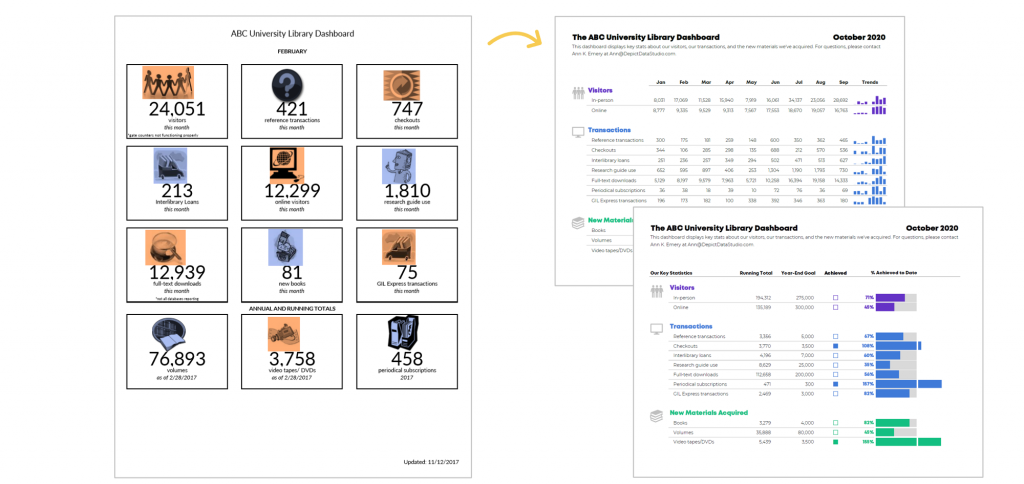
When asked to submit their existing visualizations to be redesigned, one of the conference attendees sent me this dashboard (shown below).
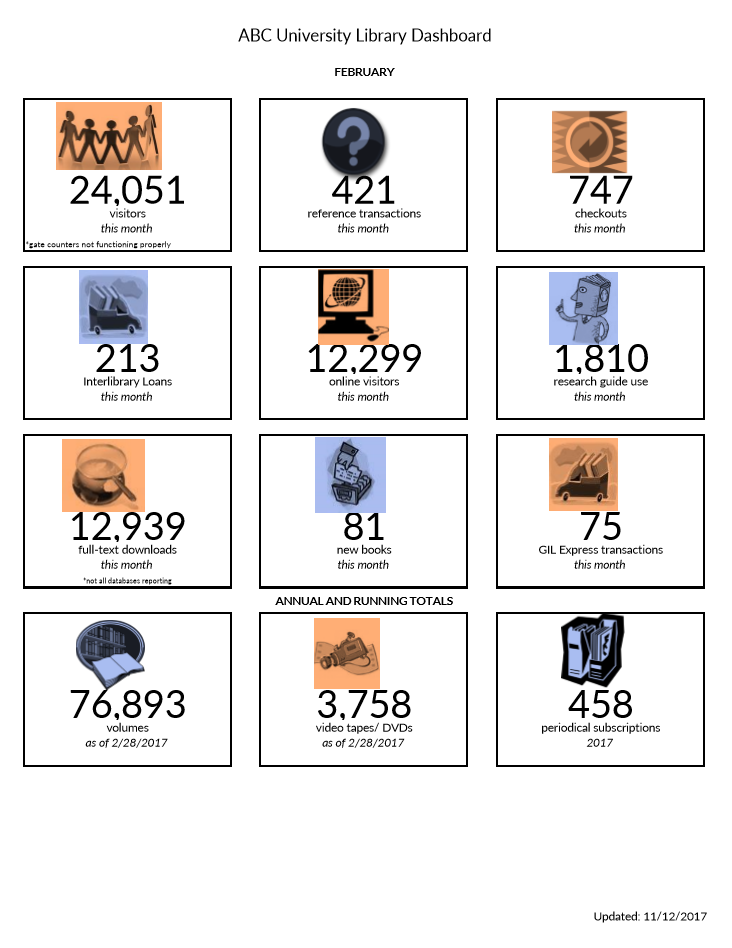
Image of a University Library Dashboard sheet that shows facts about the library.

The attendee was responsible for monitoring key statistics
about the university’s library.

The dashboard included information about the number of
visitors, transactions, checkouts, and interlibrary loans.

These twelve metrics and their associated icons were intended to provide an at-a-glance overview about the library during a given month.

What’s Working Well: Length, Icons, and Text Size Hierarchy

A few things were already working well for this dashboard:

  • The most notable accomplishment was that it already fit on one page! I typically see “dashboards” that drone on for way too many pages. I’m not an old school dashboard designer. I don’t believe that dashboards have to fit on a single page or screen. But sometimes the multi-page dashboards also contain so much narrative text that they’re more of a report than a dashboard.
  • The icons were also working well. Michelle Borkin and her team found that icons make graphs more memorable, so I add or keep icons whenever I can.
  • Finally, the dashboard already incorporated a text size hierarchy of sorts. A hierarchy means that the most important information should be large, dark, and bold so that it grabs our attention. The twelve big numbers are already stood out, which was a plus.

What Needs Editing: Clutter, Alignment, and Context

There are a couple easy edits:

  • We’re going to do the usual decluttering for
    this dashboard. That’s a given, right? We’ll simply remove the borders that
    outline each of the twelve data points.
  • We also need to adjust the alignment. The numbers and words are centered within their boxes. Yet
    the icons aren’t quite centered over them. Intentional alignment makes our visualizations
    look polished.
  • The biggest edit needed is context. The dashboard
    currently shows February’s numbers. For example, 24,051 people visited the
    university’s library during February alone. I have no idea if that’s a huge
    number or a tiny number. A single number on its own doesn’t tell us much. We
    need more context. We need to be able to compare that number to something. There are a few comparisons
    we could make. For example, we could compare that number to the prior month
    (January vs. February). Or, we could compare that number to our goal
    (February’s actual number compared to February’s goal).  

After: Monitor Patterns Over Time

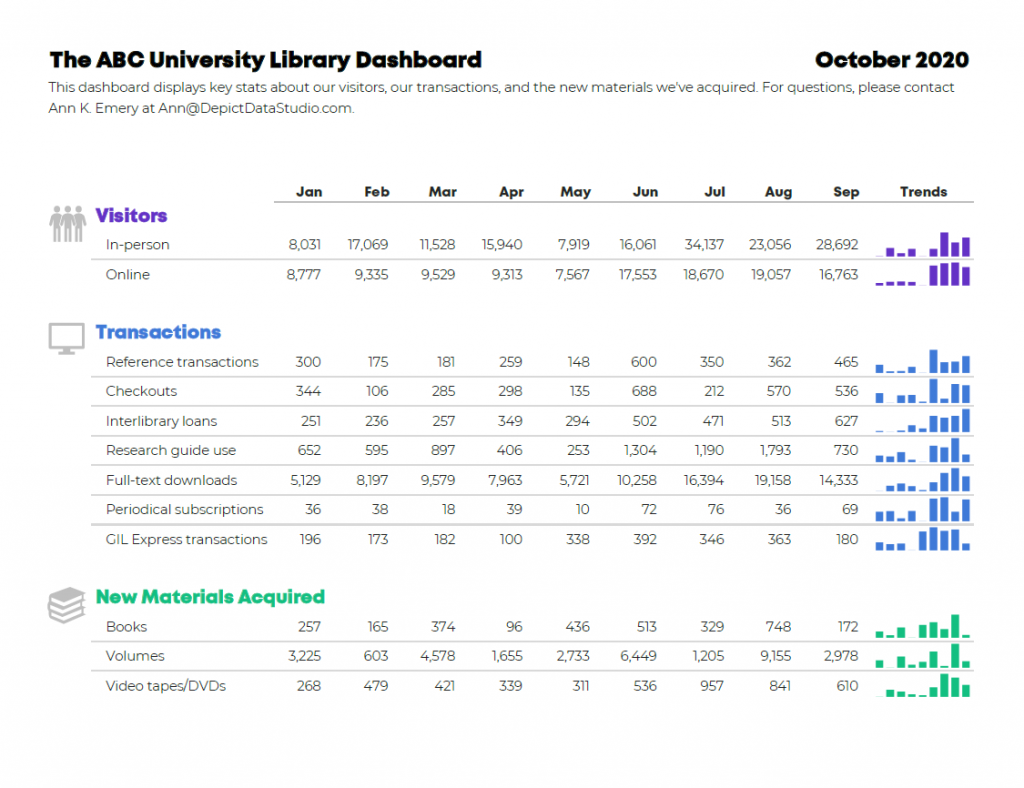
Here’s the first idea for this university’s monthly
dashboard.

These are made-up numbers, but hopefully you still
understand the gist of the makeover.

I:

  • gave viewers the opportunity to monitor patterns over time. Each month has its own column. Now, we can compare the current month to past months, which adds much-needed context.
  • added graphs, which I created with Microsoft Excel’s spark columns.
  • decluttered the dashboard by removing unnecessary outlines. I chose to keep the single horizontal line beneath the months, but that line is gray, not black.
  • color-coded by category. I grouped the twelve data points into categories: Visitors (blue), Transactions (purple), and New Materials Acquired (turquoise).
  • applied a text hierarchy. The title is large, dark, and bold. The headings (Visitors, Transactions, and New Materials Acquired) are a medium size because they’re of medium importance.
  • adjusted the alignment. The words are left-aligned and the numbers are right-aligned. The icons are center-aligned with one another, and they’re top-aligned beside each of their categories.
After: Track Progress Towards Goals  

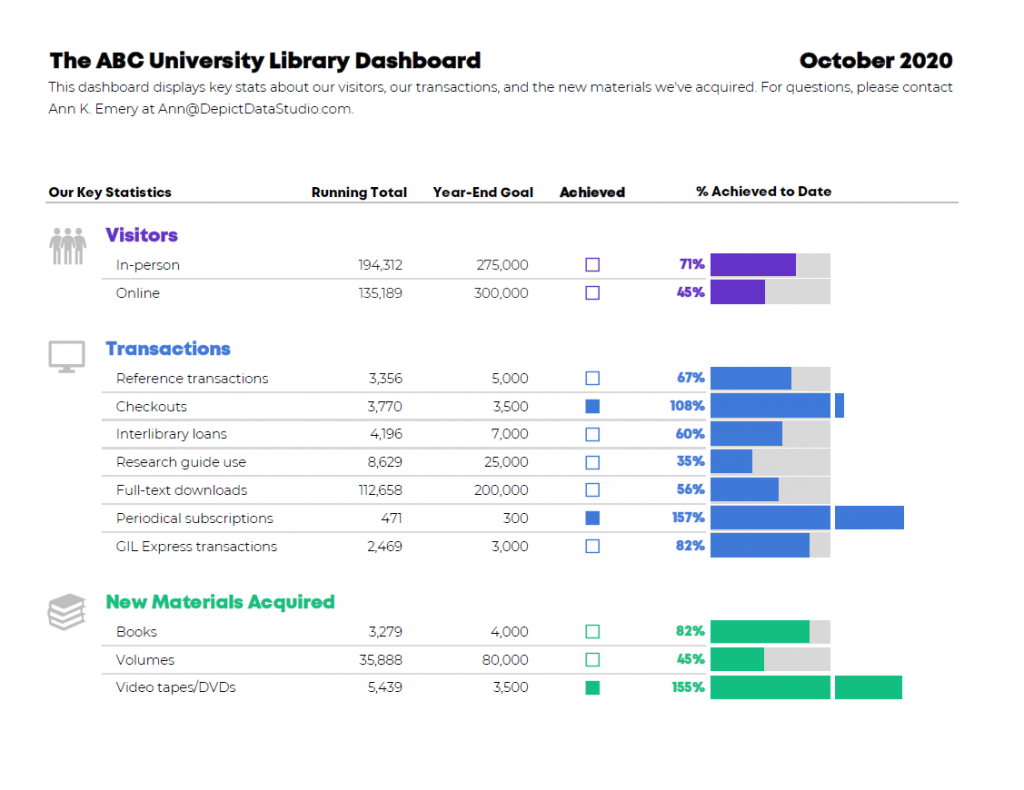
Here’s the second idea.

It’s also clutter-free; includes graphs and a text
hierarchy; and groups the twelve data points into categories (which are
color-coded, of course).

The difference is the dashboard’s purpose. The before version only looked at one month
at a time. To provide more contextual details, the first makeover allowed
viewers to compare patterns over time.
This second makeover allows viewers to track
progress towards goals
.

I included columns for Running Totals and Year-End Goals. Then, I indicated whether the goal was achieved with filled-in squares and empty squares. I taught you how to create these square icons in an earlier post. They’re just lowercase g’s and c’s in the Webdings font!

Finally, I visualized the percentage of the goal that had been achieved so far. I call these progress bars. In some areas, the library has already exceeded their goal, so the bars spill past the 100% mark—a cause for celebration!
The Winning Idea

Which dashboard is correct?! Both of them!

Two dashboards, two different purposes.

I recommend designing several options for your viewers. Ask which one they prefer. Gathering feedback is one of the most important steps of the design process.
Bonus! Download the Spreadsheets

These are Microsoft Excel files, which are then distributed
to viewers as static PDFs.

(I rarely make interactive dashboards with drop-down menus
or checkboxes anymore. Leaders are busy and simply don’t have the time to
explore interactive dashboards. I’ve found that the busier the audience, the
more they prefer receiving a PDF’d one-pager.)

You can download my file and adapt the templates however you’d like for your own metrics and numbers.

Download the Excel File

Bonus! Learn the How-To Steps

Looking for detailed how-to instructions? Dashboard Design: The Full Course opens for once-a-year registration in November 2020.


Written by cplysy · Categorized: depictdatastudio

Oct 20 2020

5 Questions to Ask about 501(c)(4) Organizations in Advocacy Ecosystems

By Johanna Morariu

Advocacy ecosystems are a community of interacting individuals and organizations. They unite around a shared purpose of influencing policies and practices of institutions. A quote attributed to Helen Keller, “Alone we can do so little; together we can do so much,” aptly sums up what it takes for advocates to be successful in local, state, and national policy change campaigns.

Many different types of organizations make up these ecosystems, including policy advocacy organizations and think tanks, community organizing groups, memberships and associations, faith organizations, labor groups, and funders. For the most part, philanthropic funding and evaluation efforts have focused on the role of 501(c)(3) organizations within these ecosystems.

By Tim Mossholder @ https://unsplash.com/photos/zs-PAgqgenQ

So, why should we pay attention to 501(c)(4) organizations in advocacy ecosystems? It takes many organizations, coalitions, allies, and others to influence policy change. Rarely if ever is one organization or individual able to catalyze a policy change victory. Often, 501(c)(4) organizations are a critical part of these efforts, but less visible.

Many 501(c)(4) advocacy organizations play special roles in their advocacy ecosystems. Staff of 501(c)(4) organizations work with decision-makers behind closed doors, speak on behalf of other advocates, and negotiate policy deals. And 501(c)(4) organizations can engage in potent strategies that are off-limits to 501(c)(3) organizations. Because of this special role, it is important to better understand the role of 501(c)(4) organizations in advocacy ecosystems.

What are 501(c)(4) advocacy organizations? A 501(c)(4) organization is a social welfare organization that may pursue educational, lobbying, and some limited political activities. 501(c)4 organizations are especially important in policy change efforts as they can engage in issue-based advocacy and the political process.

What might happen if we don’t pay attention to 501(c)(4) organizations in advocacy ecosystems? While the unique role and contributions of 501(c)(4) organizations are often needed for policy change, funding for these activities can be scarce or non-existent. From an advocacy strategy perspective, if 501(c)(4) organizations are needed in an advocacy ecosystem but are not present or funded, a critical gap exists and the ecosystem may struggle to be effective. If an evaluation of the ecosystem is performed and takes the common focus on 501(c)(3) organizations, there is likely to be a critical deficiency in our understanding of the advocacy ecosystem.

I hope you agree that it is important to understand 501(c)(4) organizations within advocacy ecosystems. To help you get started, here are five questions I’ve used in my work.

1. What is the size and location of the 501(c)(4) resources in the advocacy ecosystem?

How do these resources compare to the 501(c)(3) resources in the advocacy ecosystem?

Within an advocacy ecosystem, the amount and type of resources going toward 501(c)(3) vs. 501(c)(4) organizations determines the scale and nature of an advocacy campaign. The extent to which those resources and the work they support are complementary may make an ecosystem more or less effective.

Knowledge of the location and size of 501(c)(3) and 501(c)(4) organizations in the ecosystem provides a foundation on which to build further analysis. For example, who are the influential 501(c)(4) organizations in the advocacy ecosystem and how are they regarded by influential 501(c)(3) organizations? Or how are the influential 501(c)(4) organizations regarded by organizations that have a base of directly affected people?

To dig in to this question, here are two assessment options I’ve used:

● Collect grantmaking/financial data from funders and grantees via document reviews, interviews, and other forms of data collection.

● Layer this information on organization profiles or a network map.

In my experience, this can be challenging information to collect. Advocates and their funders may be unwilling or unable to share complete funding information.

2. Who is the 501(c)(4) organization accountable to?

Does the 501(c)(4) organization have its own base of directly affected people? How does this affect their role in their advocacy ecosystem?

In my experience evaluating advocacy efforts for nearly 15 years, organizations that have a base or are more directly accountable to a constituency behave differently than other organizations. Organizations with a defined constituency, members, or other forms of a “base” may engage in policy negotiation differently. They may move slower at times, as they collect input and feedback from their base. Or they may behave differently in policy negotiations, as people in their base grapple with how their lives may change with the policy ramifications.

To dig in to this question, here are two assessment options I’ve used:

● Surveys, interviews, or desk research to identify which organizations have members and if those members are people who are directly impacted by the advocacy issue.

● Layer organization data on network maps to get a feel for which organizations are more/less accountable to a base or where their accountability lies. Take a close look at key influence and decision-making areas of the network such as relationship hubs, coalitions, and key actors.

3. What is the nature of relationships among 501(c)(3) and 501(c)(4) organizations?

As the 501(c)(4) organization can be a gatekeeper with decision-makers, do the 501(c)(3) organizations trust the 501(c)(4) organization to speak and act on their behalf?

Relationship dynamics are a key component that can help or hinder success in advocacy ecosystems. Are advocates able to work through tough decisions on strategy and resources? Do advocates trust each other and depend on each other?

To dig in to this question, here are two assessment options I’ve used:

● Interviews or surveys with advocates from across an advocacy ecosystem to gauge their relationships with each other. Depending on the situation, this could be generally about the ecosystem or specifically about relationships between specific advocates.

● Observation of campaign forums and communication.

By Photo Boards @ https://unsplash.com/photos/KZNTEn2r6tw

4. How well aligned and coordinated are the goals and strategies of 501(c)(4) and 501(c)(3) organizations?

Are the “inside” and “outside” games pointed in the same direction? Are both sufficiently resourced?

When advocates make good use of the complementary contributions of 501(c)(3) and 501(c)(4) organizations, they maximize the value of both resources. Yet in most advocacy ecosystems, 501(c)(4) resources are rare and insufficient. Aligning the contributions of 501(c)(4) organizations with those of 501(c)(3) organizations — artfully, yet lawfully — enhances the ecosystem’s influence and impact.

First, do all organizations in the ecosystem share the same north star? Or are they pointed toward different galaxies? The extent to which advocates share a north star is an important attribute of the ecosystem that may affect tactical alignment, trust and decision-making, and other dynamics.

Next, understand the relative contributions of 501(c)(3) and 501(c)(4) organizations. What are their unique contributions? Are resources focused on 501(c)(3) organizations? Expect a focus on strategies like public education and non-partisan get-out-the-vote (GOTV) drives. Are at least some resources going to 501(c)(4) organizations? You may see other strategies such as voter registration drives, voter guides, candidate endorsements, ballot measure campaigns, or significant lobbying. Once the unique contributions of 501(c)(3) and 501(c)(4) organizations are known, also explore the points of overlap, alignment, or coordination.

Ideally, the advocacy ecosystem has enough resources to deploy the strategies best fit to the need at hand. Importantly, “enough” does not mean equally split between 501(c)(3)s and 501(c)(4)s. And there may not be agreement about what is enough — in total or among 501(c)(3)s and 501(c)(4)s. At the end of the day, what matters is the strategic complementarity of 501(c)(4) and 501(c)(3) organizations, and that there are enough resources for both.

To dig in to this question, here are two assessment options I’ve used:

● Advocate interviews about their individual and collective efforts and their perspectives on how well aligned/coordinated those are.

● Bellwether interviews or other key informant interviews.

5. Who can engage in learning conversations about advocacy ecosystems that encompass 501(c)(3) and 501(c)(4) organizations?

Strategic learning helps advocates learn from their efforts to “to make their next move in a way that increases their likelihood of success” (Coffman & Beer, 2011). In the context of advocacy ecosystems where 501(c)(3) and 501(c)(4) organizations are both necessary for success it can be difficult to engage in strategic learning. Why?

501(c)(3) organizations and funders may limit their engagement with 501(c)(4) organizations short of legal boundaries, limiting the ability to learn as an integrated ecosystem. Sometimes there is a fear of being too partisan or political. Or, it could stem from uncertainty about what activities are permissible for a 501(c)(3).

With a little legwork, advocates should be able to figure out how to engage lawfully in strategic learning together. Seek the involvement of an expert about the legal parameters for learning and strategy conversations. One resource is Bolder Advocacy, which provides training, a free technical assistance hotline, and other resources for nonprofits and foundations who want to engage more actively in the policy-making process to advance their work.

By Adi Goldstein @ https://unsplash.com/photos/n2V4ZNflsHM

“Alone we can do so little; together we can do so much.”

Advocacy ecosystems are a rich mix of 501(c)(3) organizations, 501(c)(4) organizations, and their funders working together to advance policy change. To accurately evaluate the full range of strategies that make policy change possible, we must pay more attention to the unique role that 501(c)(4) organizations play in these ecosystems.

Johanna Morariu is the former Co-Director of Innovation Network. If you would like to connect about the ideas in this post, you can find her on LinkedIn or email info@innonet.org.

If you like this post and want to see more from Innovation Network, be sure to clap for this article and follow our publication.


5 Questions to Ask about 501(c)(4) Organizations in Advocacy Ecosystems was originally published in InnovationNetwork on Medium, where people are continuing the conversation by highlighting and responding to this story.

Written by cplysy · Categorized: innovationnet

Oct 20 2020

We can’t let them fall through the cracks.

I started writing a completely different blog post for this week, but when I read the news this morning, I knew I had to shift gears. 

CNN featured a story yesterday called “​Teachers and social workers search for students who are ‘missing’ in the pandemic.”

The word “missing” made my heart drop. 

It immediately reminded me of this story, of a young girl from Washington, DC named Relisha Rudd. I heard about her story in 2014, and it broke my heart — at the time, I was a community school coordinator and led our school’s charge for attendance and engagement tracking and interventions. Staff from Relisha’s school tried to track her down, only to find that a man working at the homeless shelter where she was staying had been impersonating her doctor to the school.

She is still missing to this day. 

As a community school coordinator, her story lit a fire under me to do everything I could to make sure that we knew, to the best of our ability, that our kids were safe and able to come to school. 

I have thought of Relisha over the years and find the tragedy of her story to be a call to action for schools, districts, and other youth- and family-serving organizations. 

How can we make sure that no other students fall through the cracks?

When I read the story this morning about the Robla School District in California doing home visits and trying everything they can to find their students “missing” from online school, I had so many thoughts:

Labeling students as “missing” drives home the gravity of the situation our country is in. Families are truly struggling because of the virus and the economy, but honestly, lacking access to the internet, to stable housing, and to consistent work have been challenges for so many families for so long. The fact that things are only getting worse is upsetting and shows us that we have so much work to do. 

Literally going into neighborhoods searching for children is heroic, but also emotionally grueling. I remember the disappointment and worry of having a string of unsuccessful home visits — you gear yourself up for making a difference, only to find that addresses were incorrect or have changed, or worse — you just don’t know where students and families are living. That is scary, and it is emotionally taxing for educators. 

While data tracking can’t help us physically locate a family, it can help us focus our efforts where they are needed most. You may have seen that last week, I released a guide for how to Track Your Engagement Data in 4 Simple Steps. I believe strongly that using simple functions in Excel can help educators pinpoint exactly which students and families need additional support — whether that’s with attendance, engagement, or academics. 

(I know it can work because I’ve seen the impact it has had on my own work in schools!)

So in honor of Relisha and in commitment to the well-being and success of students who may be “missing” from online school today, let’s get tracking. 

To learn more about data tracking, visit my Engage with Excel page or sign up below. 

Written by cplysy · Categorized: engagewithdata

Oct 19 2020

Comment on Wearing Many Hats: Where Does the Role of Evaluator End? by How Am I? I’m Sitting in the Suck – Elizabeth Grim

[…] an evaluator, I am a professional question asker. And yet personally, the hardest question for me has been to […]

Written by cplysy · Categorized: elizabethgrim

Oct 19 2020

How Am I? I’m Sitting in the Suck

“How are you?” Ugh this question makes me cringe. My answer to this is usually “fine.” And not because I am. I am most certainly not fine right now. As an evaluator, I am a professional question asker. And yet personally, the hardest question for me has been to depend on others and ask for help. To show up as fully human in all spaces and let others know my experience.

Written by cplysy · Categorized: elizabethgrim

  • « Go to Previous Page
  • Go to page 1
  • Interim pages omitted …
  • Go to page 227
  • Go to page 228
  • Go to page 229
  • Go to page 230
  • Go to page 231
  • Interim pages omitted …
  • Go to page 310
  • Go to Next Page »

Footer

Follow our Work

The easiest way to stay connected to our work is to join our newsletter. You’ll get updates on projects, learn about new events, and hear stories from those evaluators whom the field continues to actively exclude and erase.

Get Updates

Want to take further action or join a pod? Click here to learn more.

Copyright © 2026 · The May 13 Group · Log in

en English
af Afrikaanssq Shqipam አማርኛar العربيةhy Հայերենaz Azərbaycan dilieu Euskarabe Беларуская моваbn বাংলাbs Bosanskibg Българскиca Catalàceb Cebuanony Chichewazh-CN 简体中文zh-TW 繁體中文co Corsuhr Hrvatskics Čeština‎da Dansknl Nederlandsen Englisheo Esperantoet Eestitl Filipinofi Suomifr Françaisfy Fryskgl Galegoka ქართულიde Deutschel Ελληνικάgu ગુજરાતીht Kreyol ayisyenha Harshen Hausahaw Ōlelo Hawaiʻiiw עִבְרִיתhi हिन्दीhmn Hmonghu Magyaris Íslenskaig Igboid Bahasa Indonesiaga Gaeilgeit Italianoja 日本語jw Basa Jawakn ಕನ್ನಡkk Қазақ тіліkm ភាសាខ្មែរko 한국어ku كوردی‎ky Кыргызчаlo ພາສາລາວla Latinlv Latviešu valodalt Lietuvių kalbalb Lëtzebuergeschmk Македонски јазикmg Malagasyms Bahasa Melayuml മലയാളംmt Maltesemi Te Reo Māorimr मराठीmn Монголmy ဗမာစာne नेपालीno Norsk bokmålps پښتوfa فارسیpl Polskipt Portuguêspa ਪੰਜਾਬੀro Românăru Русскийsm Samoangd Gàidhligsr Српски језикst Sesothosn Shonasd سنڌيsi සිංහලsk Slovenčinasl Slovenščinaso Afsoomaalies Españolsu Basa Sundasw Kiswahilisv Svenskatg Тоҷикӣta தமிழ்te తెలుగుth ไทยtr Türkçeuk Українськаur اردوuz O‘zbekchavi Tiếng Việtcy Cymraegxh isiXhosayi יידישyo Yorùbázu Zulu