• Skip to main content
  • Skip to footer
  • Home

The May 13 Group

the next day for evaluation

  • Get Involved
  • Our Work
  • About Us
You are here: Home / Archives for allblogs

allblogs

Jul 31 2020

Scoping an Evaluation: Begin with the Purpose


Recently I made the decision to buy a bike. Like many others, I’ve put on some COVID weight and thought incorporating some exercise into my daily routine would help. I didn’t have a bike, so I started shopping for one.

Google is good, but not that good; it could bring up a bunch of bikes when I searched but I still needed to filter my search in order to figure out which bike to pick. What type of bike? (e.g. commuter, electric, road, etc.) Which brand of bike? What size of bike? How much did I want to pay? What features and accessories did I want? Admittedly, I know little about bikes, but what I did know was what I wanted to use it for. I wanted a bike to commute 5 km to and from work, on a non-hilly bike lane. In addition to that, I didn’t want to spend more than $750.

I ended up choosing a 3-speed commuter bike, with hand brakes, and a step-through frame. I added a bell and a box that sits on a carrier on the back of the bike. Two months in and there are no regrets with the purchase – it fits my needs to a tee. I can wear a skirt to work, carry my laptop back and forth, and switch gears if needed when my legs are feeling tired.


The two most important questions when scoping an evaluation

When you are asked to conduct an evaluation for a program it can be like shopping for a bike – there are various types, sizes and budgets. Designing an evaluation that meets your stakeholders’ needs begins with a scoping process. There are a number of questions that you should ask to scope an evaluation (refer to our scoping guide for a complete list of questions), but ultimately scoping an evaluation focuses on purpose.

1.     What does the initiative do (and for what purpose)?

2.     Who wants to know what (and for what purpose)?


What does the program do and for what purpose?

With scoping you want to get a detailed understanding of the program by asking stakeholders about the program’s:

  • history

  • stage of implementation

  • activities

  • intended results

  • target population

  • scale

  • budget

  • measurement activities

When I ask stakeholders about the program, I am listening for details that help me understand the scope and complexity of the program. However, what is equally important during the scoping process is listening for any disagreements or gaps in what is known about the program and its purpose. Does the program’s theory of change pass the sniff test? In other words, is the program designed to bring about its intended results? Listening for these clues are important to note, as they will help guide your conversation for the next scoping question.

Who wants to know what and for what purpose?

There are many different reasons and uses for a bike. Similarly, there can be many reasons for conducting an evaluation and how those evaluation findings get used. However, the more focused you can be on whose needs you are meeting through the evaluation, the more useable the evaluation will be.  

When I ask stakeholders about the evaluation and its purpose, I am listening for details that help me understand who needs what information. However, I am also listening to see if expectations for the evaluation align with the details that were given regarding the program. For example, if you discover the primary purpose for the evaluation is to determine the value and future of the program then a summative evaluation is likely the right type of evaluation. For a summative evaluation we need a strong theory of change and program data to monitor changes over time. However, if you heard through your discussion to the first scoping question that the program does not have a clear, established theory of change and has not collected data then there is likely a discrepancy in expectations that you should address. Addressing the discrepancy means a more detailed discussions with stakeholders questioning them about the readiness of the program for a summative evaluation and advising on more appropriate evaluation support given the stage of the program.

Focusing your scoping process on understanding the program and evaluation purpose will equip you with the knowledge you need to develop a quote and/or an evaluation design. However, it also provides a framework for expectation setting with stakeholders that will result in more accurate quotes and appropriate, focused and useable evaluation designs.


Check out our guide to program scoping here


Sign up for our newsletter

We’ll let you know about our new content, and curate the best new evaluation resources from around the web!


We respect your privacy.

Thank you!


Written by cplysy · Categorized: evalacademy

Jul 30 2020

Five Ways Evaluators Can Further Accessibility Efforts in Museums

Logo for 30th Anniversary of the ADA

Sunday marked the 30-year anniversary of the Americans with Disabilities Act (ADA).  My first thought was, “Really, only 30 years?”  It is shocking that people in the United States with disabilities had to wait so long to have their rights acknowledged by our government.  I also couldn’t help but notice that the 30th anniversary of ADA coincides closely with RK&A’s 30th anniversary (Randi founded Randi Korn & Associates, an evaluation firm, in 1989).  Perhaps these similar anniversaries are not a coincidence, but suggestive of a time in U.S. history when greater accountability was being called for generally.

This overlap between the founding of RK&A and the ADA made me pause and think critically about my own role (as an evaluator who works with museums) in addressing the needs of museum visitors who have disabilities.  I’ve been in this field for 20 years, and until the last few years, accessibility was not front and center in conversations about evaluations of museum spaces, programs, or exhibitions.  As a new museum evaluator in the early 2000’s, I was led to believe ADA compliance was not something I needed to evaluate, that someone else took care of that.  It also is clear, looking back, that accessibility in the context of museums was narrowly conceived of as primarily relating to accommodating physical disabilities.

The lack of a robust and holistic approach to considering the needs of people with disabilities has been a pervasive issue across most sectors, not just museums, for years.  In an Opinion piece in the July 26, 2020 issue of The New York Times, Judith Heumann and John Wodatch share the United States’ shameful disability history.  The authors note that while the ADA was a significant turning point for people with disabilities, as with many forms of injustice, we are nowhere close to having fulfilled this country’s promises.  They also raise an important point affirmed by my early experience as a museum evaluator:

In most cases, we [people with disabilities] remain an afterthought… That invisibility persists at least partly because so few disabled people are in leadership positions in government, business and education.

But that is changing. In the last few years, Diversity, Equity, Accessibility, and Inclusion (DEAI) efforts have been in the spotlight across the museum field, which has great implications for people with disabilities.  The A in DEAI stands for Accessibility and speaks specifically to the call museums must answer to be fully accessible to visitors with disabilities.  Accessibility is defined by the American Alliance of Museum’s DEAI Working Group as:

Giving equitable access to everyone along the continuum of human ability and experience. Accessibility encompasses the broader meanings of compliance and refers to how organizations make space for the characteristics that each person brings.

Accessibility relates to physical spaces (e.g., wheelchair accessible spaces), but also accommodations for people with vision, hearing, and cognitive impairments through programming and exhibition elements specifically designed for and made available to people with disabilities.  In recent years, many museums and organizations have done worthy, interesting work in all these areas and developed accessibility resources.  For example, Access Smithsonian, a relatively new division within the Smithsonian Institution devoted to promoting inclusive design and increasing accessibility for visitors with disabilities, recently received national attention when its director, Beth Ziebarth, was interviewed on NPR on Sunday.  There are many museum professionals (often, educators) who are dedicated and passionate about pushing accessibility efforts in their institutions.  I want to call out one colleague of mine on the Museum Education Roundtable Board of Directors—Sarah Sims, Director of Visitor Engagement and Accessibility at the Missouri Historical Society—who has advocated over the years for her museum to address these issues head on.  As a result of the efforts of Sarah and her colleagues, MHS now has three distinct teams devoted to accessibility—one internal team, one external team, and a third focused on audio description.  I’m sure there are many other examples of museums making these kinds of inroads.

At RK&A, we have been exploring and trying ways to bring accessibility to the forefront of our evaluation work to help museums become more accessible and inclusive for visitors with disabilities.  While this is an ongoing process, here are some of the things we are doing:

  1. Include visitors’ abilities in standard background/demographic questions. We are beginning to collect data about visitors’ abilities when doing exit interviews and visitor surveys.  By regularly collecting certain data (e.g., race/ethnicity, age, gender, and education levels), we are saying it is important.  By not collecting data about visitors’ disabilities, we perpetuate its invisibility and unimportance.  Sure, asking about disabilities on a survey can be tricky, but so is asking about race/ethnicity and gender, and that doesn’t stop us.  One approach is to ask an open-ended question, such as: “Do you or anyone in your visiting group identify as having a disability?  If yes, please describe.”  This open-ended approach allows us to identify the various forms of disabilities of museum visitors and the language they use to describe it.  Another approach is to ask in a standardized way (see page 47 of Of/For/By All’s Respectful Audience Surveying Toolkitfor some examples).
  2. Use purposeful sampling. We are including purposeful samples of people with disabilities in our evaluation efforts when possible.  For example, we have been growing a relationship with Access Smithsonian, and as a result have been able to include purposeful samples of people with physical, visual, cognitive, and hearing impairments (called User Experts) in several formative evaluations.  When using random sampling, we risk not collecting data from any people with disabilities.
  3. Customize our research approach.  We always try to customize our research approach to fit the institutions and audiences we are working with, and this is particularly important when collecting data from people with disabilities.  A few examples include offering the opportunity to participate remotely (e.g., phone or video interview) if travel to the museum is a physical burden, providing an American Sign Language interpreter for people with hearing impairments, and adding alt text and/or creating audio descriptions to data collection materials for people with visual impairments.  We have also customized data collection instruments to meet unique needs.  For example, when collecting data from young adults with autism about their experience in a museum program we adjusted our original approach away from focus groups, which are social in nature and may make some people with autism uncomfortable, and instead designed visual feedback worksheets that allowed for individual written responses. It may take extra time and effort to coordinate, but it is worth the effort in order to make sure individuals are comfortable participating in the research or evaluation.
  4. Share results with end users of the data in a way they can act on. As evaluators, we work closely with program developers, curators, museum educators, and designers–accessibility efforts are often new to many of them, just as they are to us. So, it is especially important that we help those museum and design professionals make sense of data from visitors with disabilities so they can apply it in their work.  We do this through conversations at the beginning of a project (e.g., what do we want to know from visitors with disabilities to help make decisions about a program or exhibition, and how can we best gather that information?) and again at the end of a project when we analyze, interpret, and discuss our results (e.g., what are the implications of this data for visitors with disabilities?).
  5. Communicate in an accessible way.  We are working on making our evaluation reports and other forms communication more accessible to all types of audiences.  For instance, we have started using tables that don’t merge cells so that they can be read more easily using a screen reader, and we use large text and high color contrast on slides in workshops and conference presentations to make these materials easier to read for all audience members, including those with low vision.

So far, I have talked about our work at RK&A, which is as external evaluators.  If you are an in-house evaluator, you can advocate for these types of practices in your institution.  For example, the evaluator at MHS who works with Sarah (mentioned above) is on both the MHS accessibility committee and the audio description team.  She also writes alt text for all her evaluation reports and charts.

There are many ways evaluators can help further accessibility in museums.  If you have ideas not mentioned here (or even critiques of what I have included), please share.  I think most museum evaluators would agree that this kind of work is emergent and evolving.  We are all learning as we go.  By the 50th anniversary of the ADA, I hope we will have made much progress (and this 20-year old blog post will be a reminder of how far we had to come).


Image credit for ADA 30th Anniversary logo: https://www.adaanniversary.org/

The post Five Ways Evaluators Can Further Accessibility Efforts in Museums appeared first on RK&A.

Written by cplysy · Categorized: rka

Jul 29 2020

No Data?

Star Trek Cat GIF by Cheezburger - Find & Share on GIPHY

Ok, Nonprofit leaders, now that I have your attention……Shameless use of a cat and Star Trek GIF I know.

In fact, I bet you are actually drowning in data, but it’s just not organized and used!

I once worked with a large nonprofit and when I asked them if they collected data, they enthusiastically said, yes! Then promptly pulled out a yellow legal pad with, I kid you not, tick marks. Their Annual Report was very slick, but I can only imagine the time it took someone to add up and present all those tick marks! Let’s just assume it was accurate.

You, my nonprofit friend can do better. The best part is you don’t need any fancy or expensive software to get started!

I know you are probably most concerned with fundraising for your nonprofit right now, but stick with me here! To attract donors and funders, you have to be able to tell your story. In order to do that, you need information that shows your nonprofit’s value and impact.

Here is a simple way to begin. Start by listing all of the information you collect about the people your nonprofit serves. Whether you run a program or service or a community coalition, this is your first step.

All you need is a simple Excel spreadsheet (or Google Sheets if you prefer) that lists these 7 categories in separate columns:

  • First Name
  • Last Name
  • Community sector they represent (if applicable)
  • The organization they represent (if applicable)
  • The Program they participated in
  • Contact information (email)
  • Dates of attendance

You can use simple formulas to sum the total number of people attending, the number of sectors, organizations, or programs and attendance by sectors.

Still confused? Let’s fix that.  

Ann

aprice@communityevaluationsolutions.com

Written by cplysy · Categorized: communityevaluationsolutions

Jul 29 2020

Now is the time.

Fear. Uncertainty. Frustration. Isolation. 

In recent conversations with districts across the country and in analyses of surveys for clients, these words have come up a lot. Families, educators, and community members are feeling a whole lot of unpleasant things as we grapple with how – or if – we can simultaneously facilitate safety and high-quality learning experiences in our nation’s schools.

Instead of shopping sprees at Staples (oh, how I wish!), we are experiencing back-to-school season like never before. Reopening plans change so quickly we can’t keep up, and districts are scrambling to ensure that the safety protocols can be met and that all students can actually access and benefit from remote learning. My conversations and analyses lately have shown me how palpable and salient these fears and questions are for so many people. 

The good news? While no one really knows what will happen with COVID, we do have some ways to alleviate the feelings I listed above. Think about these: Communication. Relationships. Empathy. Engagement. 

Let’s be honest: we have always needed these things. However, with most districts going fully or partially remote this fall, the role of families in children’s education is even more prominent than before. For those of us who have long promoted the critical nature of family and community engagement, we’ve been saying to ourselves lately, “Now’s our time.”

It’s time for family engagement to be a priority for all educators, community members, and policymakers, not an afterthought. We must lift up the voices of families, truly hear what they have to say, and use their feedback as a key driver for decisions moving forward. 

It’s time for us to leverage the wealth of resources in our communities to support families who are struggling right now. In my city, I was pleased to see that the City of Columbus and Columbus City Schools have agreed to spend $7 million of the CARES Act funds on providing Chromebooks for every student and wifi hotspots for families who lack internet access.

It’s time to embrace partnerships with organizations who can help make learning fun, interactive, and accessible. Here’s an example of how one of my favorite local institutions, the Center of Science and Industry (COSI), is facilitating the exploration of science for children in under-resourced communities. 

It’s time for us to focus our energy and public dollars on practices that have been proven effective and to put systems in place to begin tracking our progress. AttendanceWorks has done a great job of bringing data tracking to the forefront as we work to ensure that all students have an equitable school experience this fall.

More than anything, it’s time for us to dismantle barriers created by historical and institutionalized racism and to embrace all children and families as our own. We need to be unafraid to check our privilege, acknowledge racist policies and practices, and work to rectify harm that has been done. If you’re not sure where to get started, here is a free training on implicit bias for K-12 educators from the Kirwan Institute on the Study of Race and Ethnicity at Ohio State (I attended an incredibly powerful trainings with them this week.).

As we continue to weather the uncertainty from COVID, we need to remember that we all have the ability to communicate effectively, build meaningful relationships, empathize with others, and engage families in partnership. With these priorities and a plan for how to measure if we’re doing them right, we will be able to help all children, families, and communities make the most of this unconventional back-to-school time. 

How are institutions and organizations near you embracing engagement during this time?

Written by cplysy · Categorized: engagewithdata

Jul 28 2020

Can Your Dataviz Have an Influence on School Reopening Plans?

Our organizations collect all this data—through surveys, assessments, interviews, and so on—and then what? 

The default: The data just sits there inside a Dusty Shelf Report.  

But what if your data could actually inform real-life decisions?  

I recently sat down with Vivian Jefferson from Loudoun County Public Schools, a growing district in the Washington, D.C. metro area.   

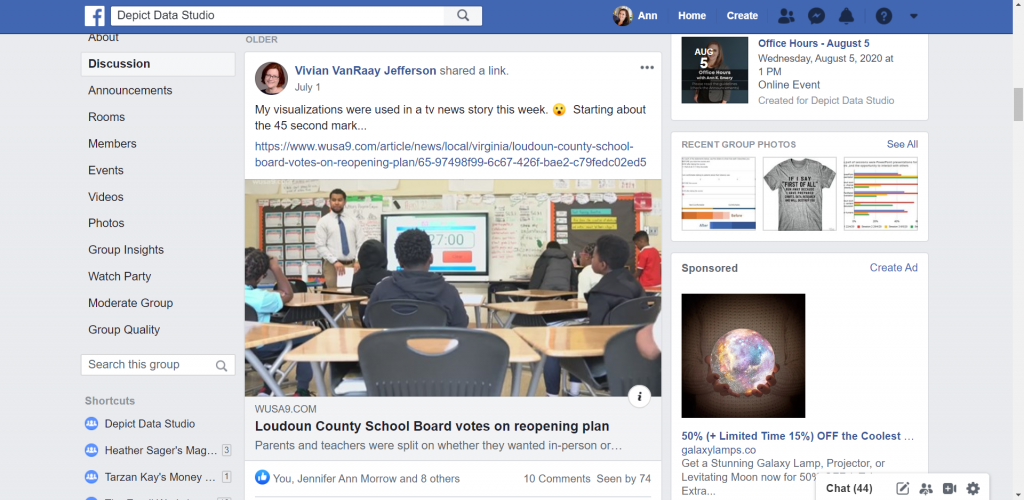
Vivian and I are both members of the same Facebook group (a community for everyone taking data visualization training with me).  

A couple weeks ago, Vivian mentioned that her graphs had been featured on the news (!!!).  

Vivian Jefferson shares how her graphs where used in a news story.

The topic was school reopening plans for the 2020-2021 academic year. Vivian and her colleagues had collected surveys from parents and teachers to gauge their opinions.  

Watch the Conversation Below 

Vivian and I talked about the 52,000 surveys that her office designed, administered, cleaned, and visualized within a two-week timeframe.  

She’ll teach you how they visualized the data, making sure to have detailed reports for technical audiences and a storytelling slideshow for a school board meeting with hundreds of attendees.  

And, she’ll tell you how her graphs ended up being featured inside a news story for an even broader audience. 

About Vivian Jefferson 

Vivian works in the research office of Loudoun County Public Schools in Virginia. The district is one of the largest in the state, with 83,000 students and 94 school facilities (and counting–they open a new school almost every year!). They average about 2,500 new students each year.  

Loudoun County Public Schools in Virginia is one of the largest districts i the state with 83,000 students and 94 school facilities.

The research office is a four-person team consisting of a program analyst, data analyst, office supervisor, and Vivian, who manages surveys.  

How Vivian’s Role Has Shifted Due to COVID-19 

Vivian noted that the data requests have been more urgent and bigger in size as the leadership tries to make decisions quickly. Loudoun County Public Schools closed in early March but was able to implement some online learning using existing tools.  

“The leadership wanted to monitor how that was going: Are students logging in, are they engaged? What we found was that the tools that we had couldn’t necessarily collect all of that data. We could tell how many students were logging in, but not if that were completing the activities or for how long they were logged in,” said Vivian.  

Vivian and her colleagues have been doing more surveys to try and find where people stand and what their concerns are.   

Vivian also said that the biggest impact she feels has been on what they haven’t been able to do.  

In the spring, they usually conduct assessments to see how students have progressed. They haven’t been able to do that, so they don’t know if the interventions they had in place worked. They also don’t know what the student needs and strengths are going into the next school year.  

“We won’t have the whole last quarter of data to be able to compare with previous years. Anytime we see trend data for 2020, it’s going to have an asterisk that it’s showing only three-quarters of the data. And I think that’s probably happening all over with school districts across the country,” Vivian said.  

Designing the School Reopening Surveys 

Let’s dive into the survey that was featured on the news. 

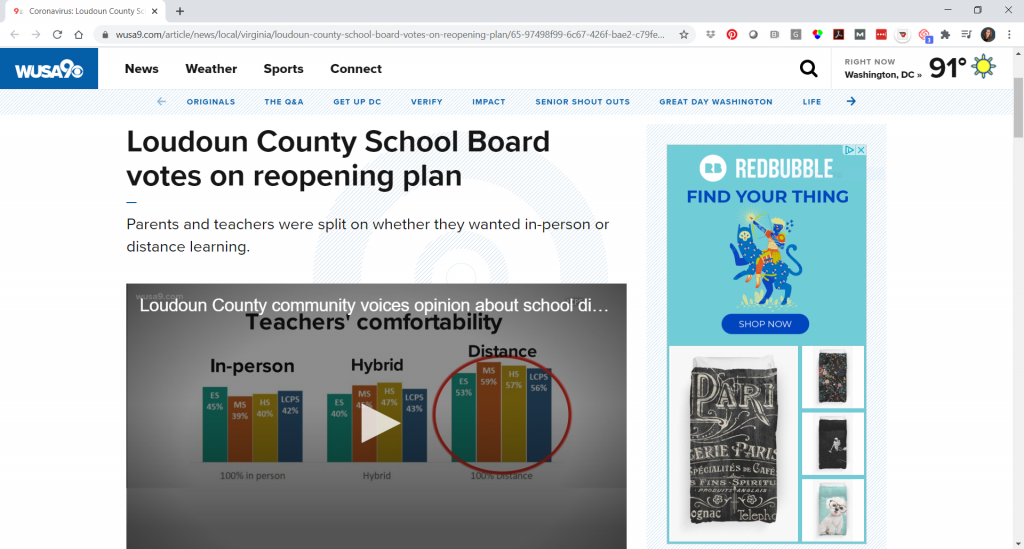
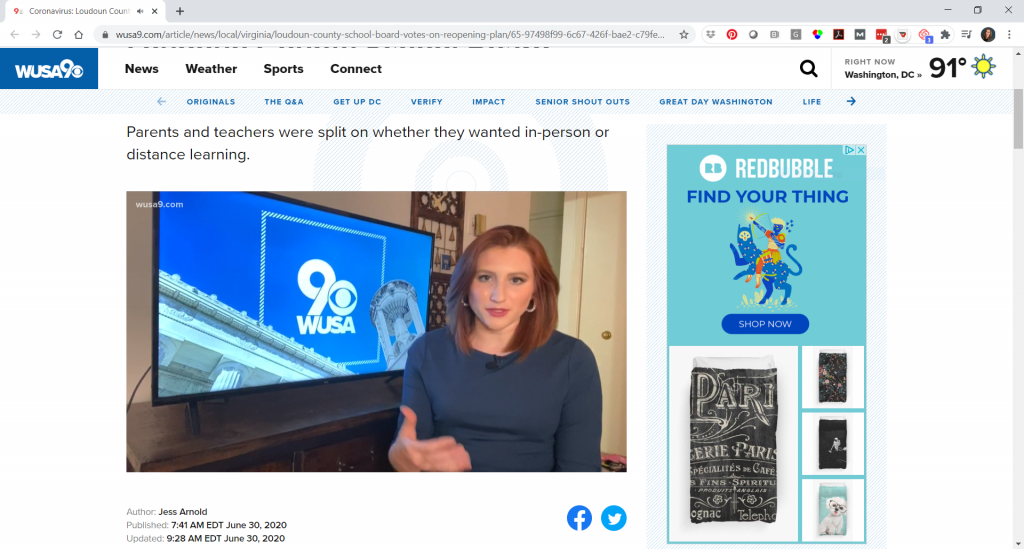
A local new station featured Vivian Jefferson's graphs in their story about Loudoun County Public Schools reopening plan during COVID-19.

School leaders requested a “survey of families and staff to see where their comfort level is with these three models that we’ve developed, what they’re concerned about and their needs are.” The school system was considering three models: 100% in-person, 100% virtual, or a hybrid. 

Vivian’s office designed and administered two surveys: one for parents and one for all school-based staff, such as administrators, office staff, and other professionals in addition to teachers. 

They reviewed similar surveys from other school districts, and then added questions specific to their own county. 

Parents were asked about their spring 2020 online learning experience; which of the three reopening models they preferred; whether they had computer access for distance learning; and more. 

Staff were asked whether they received the support and resources they needed in spring 2020; whether they would be comfortable being inside a classroom with physical distancing measures in place; and whether they were comfortable taking their temperatures and wearing face coverings. 

Then, the surveys were translated into Spanish, and links were emailed to parents and staff, and further promoted on social media.  

Collecting the Survey Responses 

Vivian said, “We knew we were going to get a lot interest in it because it’s such a hot topic. We do a school climate survey every spring for staff and parents. The parent survey usually gets 11,000 to 12,000 responses. This survey had 46,000 parents respond. And then about 6,000 staff responded (usually only a couple thousand respond). It was huge.”  

Vivian’s office designed the surveys, collected 52,000 responses, and compiled the data into reports and a slideshow within just two weeks. 

Visualizing the Data 

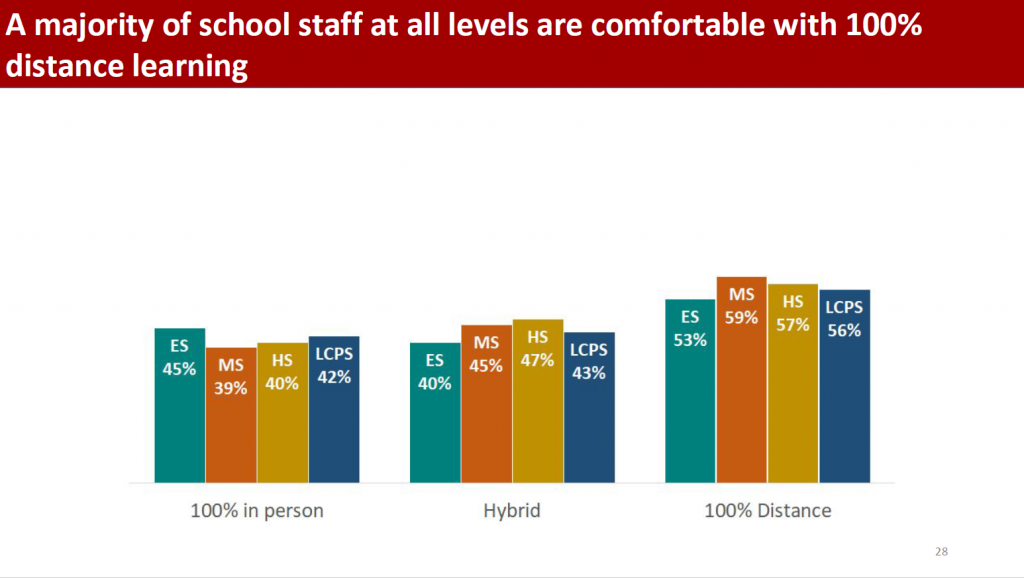
Vivian color-coded the data to make the categories easier to navigate. For example, they consistently used teal for elementary schools, orange for middle schools, gold for high schools, and blue for the county. 

Vivian Jefferson color-coded the data to make the categories easier to navigate. For example, they consistently used teal for elementary schools, orange for middle schools, gold for high schools, and blue for the county.

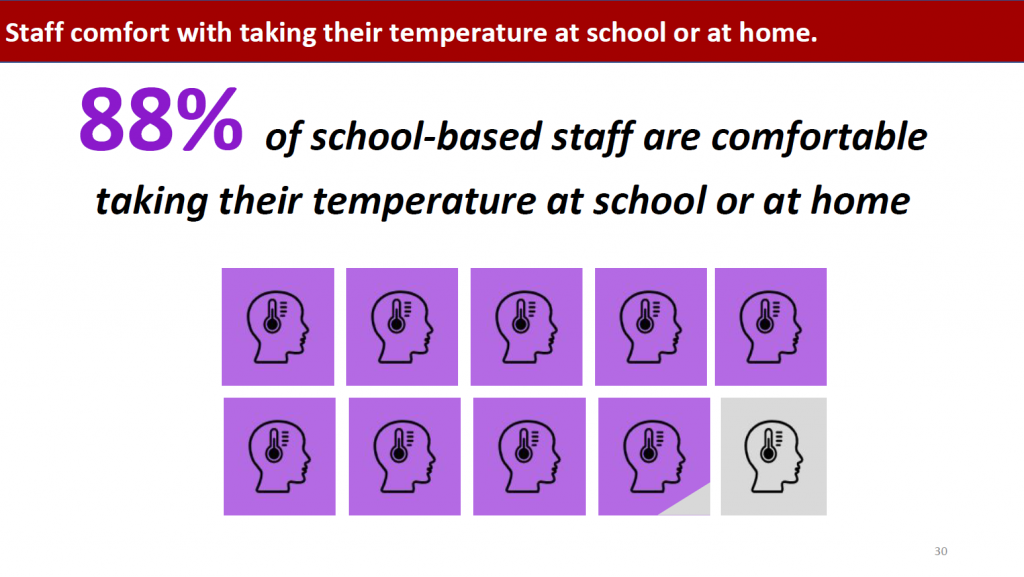
Vivian also drew attention to key findings by making pieces of the visuals darker or lighter: 

Vivian Jefferson also drew attention to key findings by making pieces of the visuals darker or lighter such as this graphs that showed 88% of school-based staff are comfortable taking their temperature at school or at home.

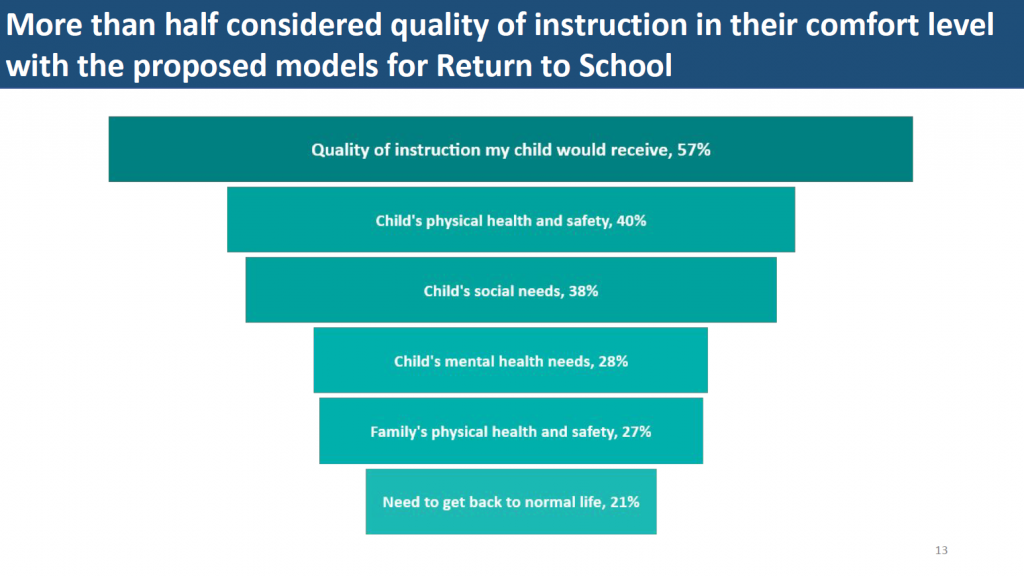
Vivian also said that, “On the titles of the slides, I tried to pull out what the main finding was, to highlight what they should be looking for.” 

Vivian also said that she tried to pull out what the main finding was such as in this graphs that shared that more half of parents considered quality of instruction in their comfort level with the proposed return to school models.

The Reporting Model 

I personally love the reporting model that Vivian’s office followed. 

They developed two detailed reports plus a slideshow with key findings. And, the news story provided a high-level overview. There’s something available for every type of audience. 

Vivian and her colleagues have evolved their communications strategy. “When I first started there 14 years ago, we were doing the full Dusty Shelf Reports.  Over the past few years, we’ve realized that our decision makers need data to make policy and decisions within a few weeks. They don’t have time to wait for a year long, in-depth program evaluation. We’ve been kind of gearing up for a fast response model of reporting anyway, but this was really fast.” 

Two 13-Page Technical Reports 

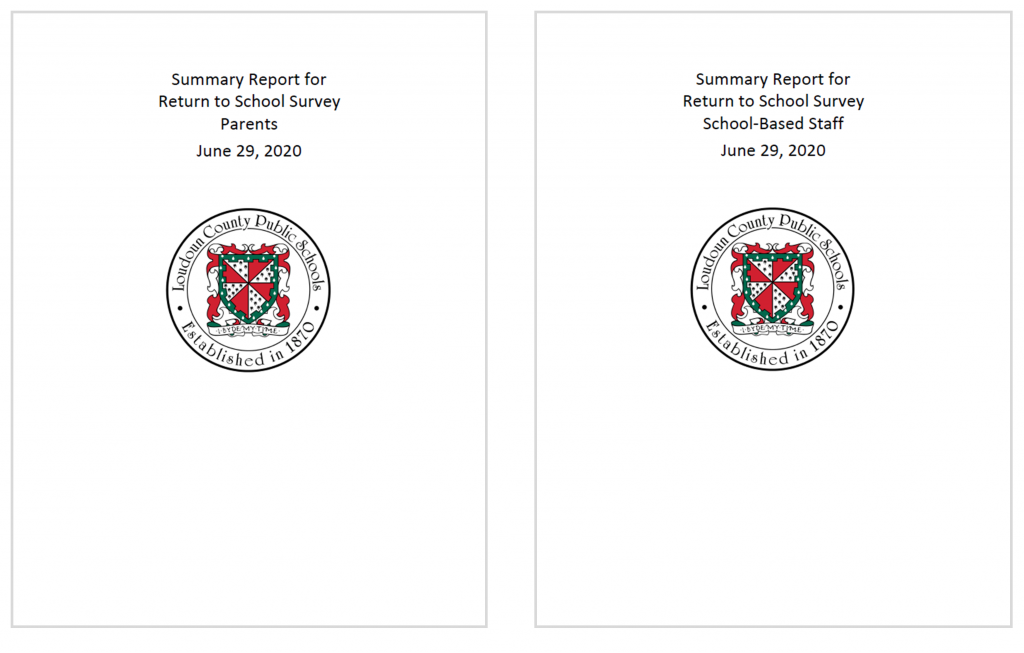
Vivian’s office shared detailed results within two 13-page reports, one for the parent survey and one for the staff survey. 

Vivian Jefferson’s office shared detailed results within two 13-page reports, one for the parent survey and one for the staff survey.

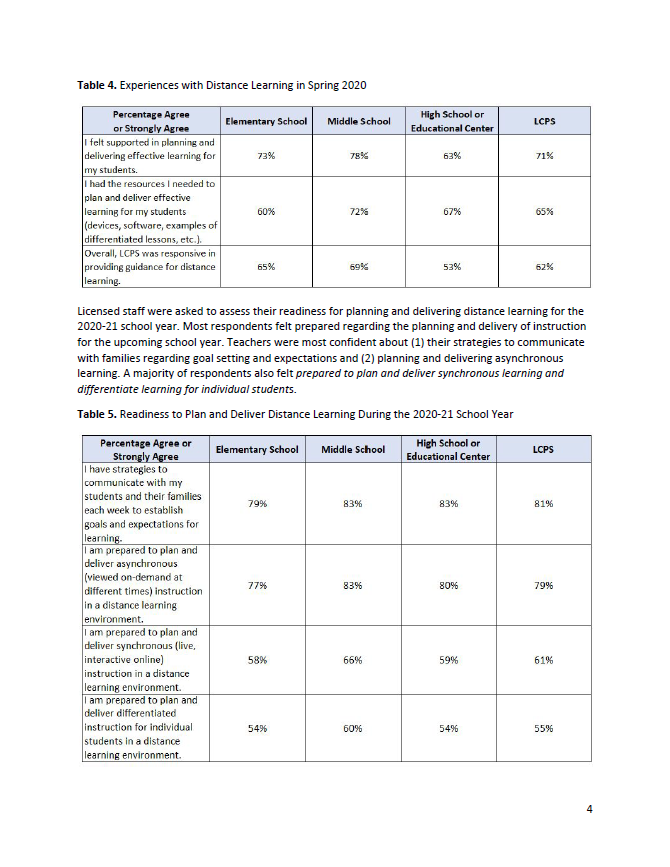
These reports contained tables of both quantitative and qualitative survey results. 

The reports contained tables of both quantitative and qualitative survey results.

The Slideshow 

Vivian and her colleagues also developed a slideshow, which would be presented at a school board meeting. The slideshow was viewed by school board members, administrators, staff, and parents. 

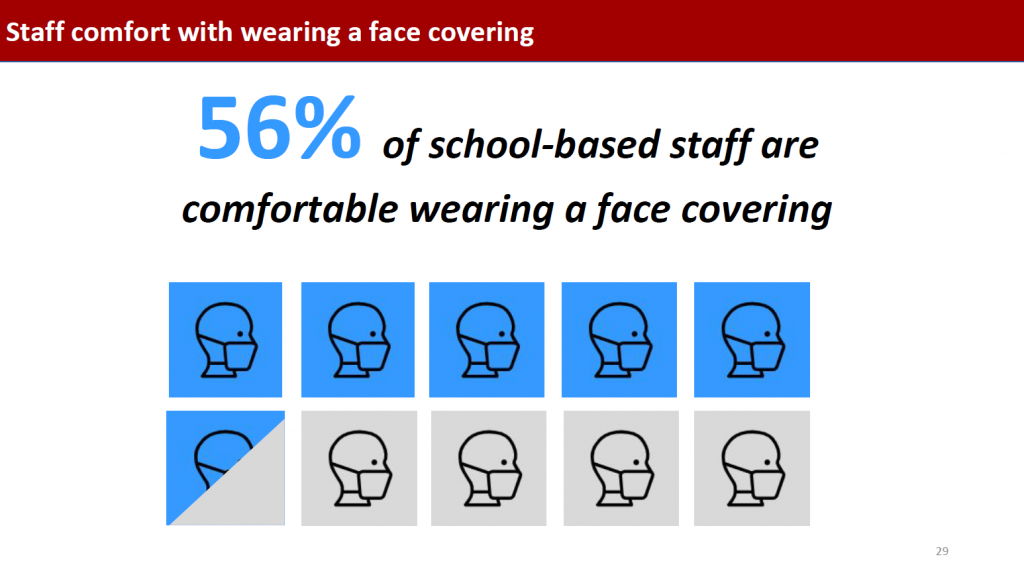
Vivian and her colleagues also developed a slideshow, which would be presented at a school board meeting. This slide shared that 56% of school-based staff are comfortable wearing a face covering.

The News Story 

Finally, the news article and 90-second video provided a high-level overview of the survey results. 

Vivian said she was very surprised to see that someone on a Facebook group she’s a member of linked to the new story and said, “LCPS was on the news today!”  

Vivian Jefferson said she was very surprised to see that someone on a Facebook group she’s a member of linked to the new story and said, “LCPS was on the news today!”

“I thought, ‘I wonder what they said?’ And I clicked on it, and watched it, and I almost fell out of my chair, literally. They had used the graphs from my presentation!” she said.  

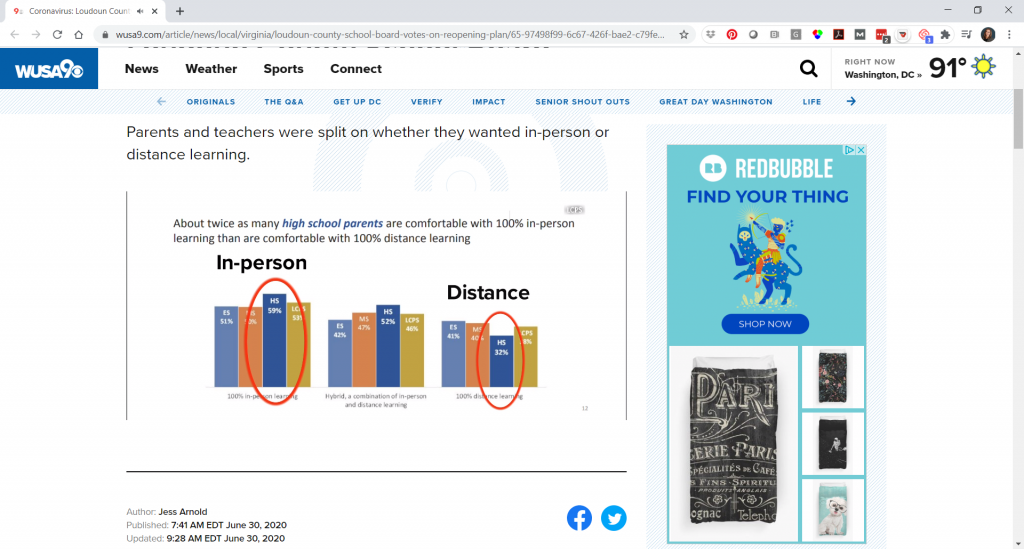
The news station used several of Vivian’s graphs, even enhancing one by circling one set of columns that they wanted to draw attention to.  

The news station used several of Vivian Jefferson's graphs, even enhancing one by circling one set of columns that they wanted to draw attention to.

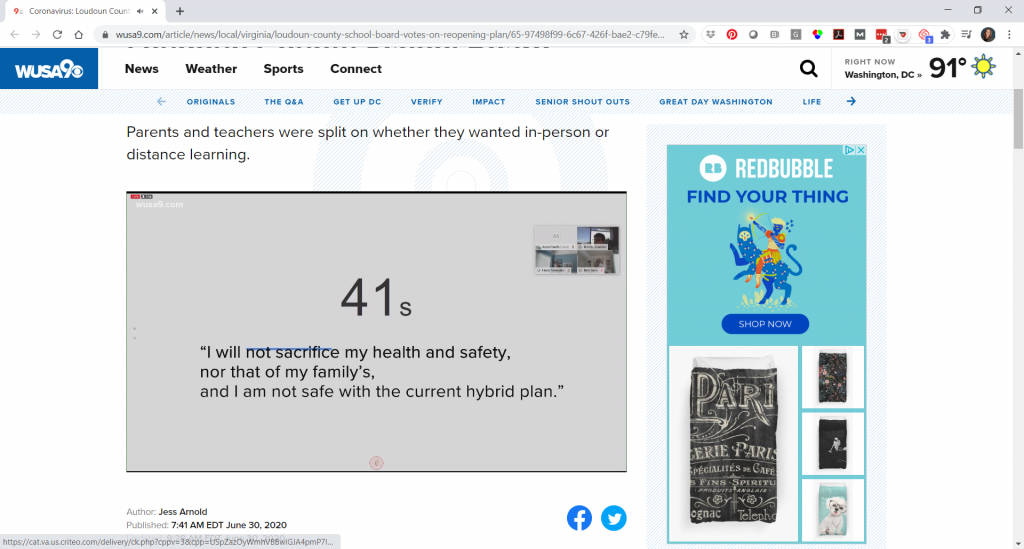
The news story combined the survey’s quantitative data with audio clips from the public comment portion of the school meeting: 

The news story used audio clips from the public comment portion of the school meeting, including one person's statement of, "I will not sacrifice my health and safety, nor that of my family's, and I am not safe with the current hybrid plan".

“I knew that people would be looking at the report, but I thought mainly like the school board, people who tuned in to watch the school board meeting,” Vivian mentioned. “But I didn’t realize that people would take anything from it and use it in a different way.” 

Reactions from the School Board and Parents 

And, a couple days after the school board meeting, Vivian was out shopping in a store and overheard a couple parents discussing statistics from the report. 

The school board also gave Vivian’s office good feedback on the data. 

Loudoun County Public Schools had considered three models for the 2020-2021 academic year: 

  1. 100% in-person 
  1. 100% virtual 
  1. A hybrid model 

The school system opted for the hybrid model, in which half the students would be in school at a time. Parents will also have the option to opt-out and follow 100% virtual learning.  

Note: Vivian reached out to let us know that “as typical of the times we are in, this week the school board and superintendent changed the reopening plan to be all distance learning at first, with a phased approach to the hybrid model. You can see their revised plan here: Revised Plan for 2020-21.  

Learn More about Vivian’s Survey 

The survey results were shared publicly on the school board’s site.  

  • The slides that were presented at the school board meeting in June 2020.
  • The tables from the parent survey.
  • The tables from the staff survey.

Read the WUSA 9 story, Loudoun County School Board votes on reopening plan, and watch the 1.5-minute video where Vivian’s work was featured.

Connect with Vivian Jefferson on LinkedIn.

Your Turn 

Comment below. Let us know which part of the conversation resonated with you the most.  

Written by cplysy · Categorized: depictdatastudio

  • « Go to Previous Page
  • Go to page 1
  • Interim pages omitted …
  • Go to page 247
  • Go to page 248
  • Go to page 249
  • Go to page 250
  • Go to page 251
  • Interim pages omitted …
  • Go to page 310
  • Go to Next Page »

Footer

Follow our Work

The easiest way to stay connected to our work is to join our newsletter. You’ll get updates on projects, learn about new events, and hear stories from those evaluators whom the field continues to actively exclude and erase.

Get Updates

Want to take further action or join a pod? Click here to learn more.

Copyright © 2026 · The May 13 Group · Log in

en English
af Afrikaanssq Shqipam አማርኛar العربيةhy Հայերենaz Azərbaycan dilieu Euskarabe Беларуская моваbn বাংলাbs Bosanskibg Българскиca Catalàceb Cebuanony Chichewazh-CN 简体中文zh-TW 繁體中文co Corsuhr Hrvatskics Čeština‎da Dansknl Nederlandsen Englisheo Esperantoet Eestitl Filipinofi Suomifr Françaisfy Fryskgl Galegoka ქართულიde Deutschel Ελληνικάgu ગુજરાતીht Kreyol ayisyenha Harshen Hausahaw Ōlelo Hawaiʻiiw עִבְרִיתhi हिन्दीhmn Hmonghu Magyaris Íslenskaig Igboid Bahasa Indonesiaga Gaeilgeit Italianoja 日本語jw Basa Jawakn ಕನ್ನಡkk Қазақ тіліkm ភាសាខ្មែរko 한국어ku كوردی‎ky Кыргызчаlo ພາສາລາວla Latinlv Latviešu valodalt Lietuvių kalbalb Lëtzebuergeschmk Македонски јазикmg Malagasyms Bahasa Melayuml മലയാളംmt Maltesemi Te Reo Māorimr मराठीmn Монголmy ဗမာစာne नेपालीno Norsk bokmålps پښتوfa فارسیpl Polskipt Portuguêspa ਪੰਜਾਬੀro Românăru Русскийsm Samoangd Gàidhligsr Српски језикst Sesothosn Shonasd سنڌيsi සිංහලsk Slovenčinasl Slovenščinaso Afsoomaalies Españolsu Basa Sundasw Kiswahilisv Svenskatg Тоҷикӣta தமிழ்te తెలుగుth ไทยtr Türkçeuk Українськаur اردوuz O‘zbekchavi Tiếng Việtcy Cymraegxh isiXhosayi יידישyo Yorùbázu Zulu