• Skip to main content
  • Skip to footer
  • Home

The May 13 Group

the next day for evaluation

  • Get Involved
  • Our Work
  • About Us
You are here: Home / Archives for allblogs

allblogs

Jun 11 2024

Dotted Lines are for Projections (& How-To Instructions for Excel)

Dotted lines have a specific purpose in dataviz: for projections or estimations. Not just because.

Stick around for the how-to lesson in Microsoft Excel.

You’ll learn how to select a single dot (or “marker”) along the line, which controls the preceding line segment.

Then, you can turn just one section of the graph into a dotted line.

https://www.youtube.com/watch?v=titF7TQcwDc

What’s Inside

0:00 Don’t Use Dotted Lines “Just Because”

0:20 Dotted Lines are for Projections or Estimations

1:24 How to Make Dotted Lines on Excel Graphs

3:44 Questions??

Written by cplysy · Categorized: depictdatastudio

Jun 09 2024

La Construcción Social del Yo

La construcción de la identidad y el yo es un tema fascinante en la psicología social. Estos conceptos no son inherentes al individuo, sino que se construyen socialmente a través de elementos culturales, como el lenguaje, las disciplinas científicas y diversos discursos ideológicos.

El papel que desempeñamos: Nuestra identidad se forma en parte por los roles que asumimos en la sociedad. Ya sea como estudiante, amigo, profesional o miembro de una familia, estos roles influyen en cómo nos percibimos a nosotr@s mism@s y cómo nos ven los demás.

La comparación social: Constantemente nos comparamos con l@s demás para evaluar nuestro propio valor y posición. La comparación social puede afectar nuestra autoestima y percepción de nosotr@s mism@s.

Experiencias de éxito y fracaso: Nuestras experiencias de éxito y fracaso moldean nuestra identidad. El éxito puede aumentar nuestra autoconfianza, mientras que el fracaso puede generar dudas y afectar nuestra autoimagen.

Los juicios de otras personas: La percepción que los demás tienen de nosotr@s influye en cómo nos vemos a nosotr@s mism@s. Los juicios y opiniones de los demás pueden afectar nuestra autoestima y autoconcepto.

La cultura y el yo: La cultura en la que vivimos también juega un papel importante en la construcción de nuestra identidad. Las normas culturales, valores y creencias influyen en cómo nos definimos y cómo nos relacionamos con los demás.

En resumen, nuestra identidad y yo no son estáticos, sino que evolucionan a lo largo de la vida en función de nuestras experiencias, roles sociales y la cultura que nos rodea. No existe un “yo auténtico” universal, ya que nuestra identidad es multifacética y contextual.

Written by cplysy · Categorized: TripleAD

Jun 07 2024

Ask Nicole: Reflecting on 8 Years of Full Time Consulting

Have a question you’d like to be featured? Let me know. Once upon a time, I wanted to be a professional violinist. Then I wanted to start a nonprofit. Today, I’m reflecting on the journey of being a consultant, 8 years after leaving my full time job. Social workers aren’t taught about self-employment or being […]

The post Ask Nicole: Reflecting on 8 Years of Full Time Consulting appeared first on Nicole Clark Consulting.

Written by cplysy · Categorized: nicoleclark

Jun 06 2024

The Magic of the Messy Middle

So much of the noise in our world is screaming — bigger, faster, stronger, scalable, more, more, more! But what if more isn’t the answer? What would slowing down to imagine possibilities feel like? These are the types of questions I geek out over in my learning and evaluation work.

The post The Magic of the Messy Middle appeared first on Elizabeth Grim Consulting, LLC.

Written by cplysy · Categorized: elizabethgrim

Jun 06 2024

Creative Self-Assessment

If I could go back in time to my university days, I would certainly take some different electives.

Like so many of you, I spent my time in college learning how to be a social scientist. Which included absolutely zero practical creative or design courses. My professional evolution would probably have been easier if I had taken just a few credit hours on graphic design, user experience design, and creative storytelling.

But alas, that’s not how things work. The good thing is, with countless blogs, books, and YouTube, there has never been a better time to teach yourself new stuff. Even if you can’t commit a semester to a single course.

Comic.  Person one, "Did you bedazzle all of your charts?"
Person two, "Fancy, right?"

Starting with a creative self-assessment.

If you’re here, I’m going to assume you’re likely a data person of some sort. This blog is read by a lot of program evaluators, social science researchers, and all sorts of other data folk.

I think it’s a good idea, every once and awhile, to take stock of your creative ability. Because even though we never learned this stuff in grad school, creative expectations are on a continuous rise.

And since many of those rising expectations are self-imposed, the best way to take stock is with a simple creative self-assessment. So pull out some paper and follow along with me.

Rate yourself twice.

For each of the following questions I want you to rate yourself twice.

  • The scale for both is 1 to 5, with 1 being “very uncomfortable with your ability to do this task” and 5 being “very comfortable with your ability to do this task.”
  • The first rating is your current comfort level with the specific creative skill.
  • The second rating is an aspirational comfort level (where do you want to be in terms of the particular creative skill).
  • You don’t need to be an expert at everything!

Here is a set of skills based on my discussions of practical creative challenges data people face on a regular basis. Rate yourself twice for each one.

Creative Skills for Data People

This is a self-assessment just for you, so be honest with your ratings.

1 (= Very Uncomfortable) to 5 (= Very Comfortable)

Here are 30 skills.

  • Create a good presentation slide deck.
  • Deliver an interesting presentation.
  • Create basic charts and graphs.
  • Create advanced charts and graphs.
  • Find effective data stories.
  • Tell effective data stories.
  • Create a short visual report.
  • Create a little infographic for social media.
  • Create an easy to understand visual slidedoc.
  • Write a blog post.
  • Write a series of social media posts.
  • Write an effective email newsletter.
  • Evaluate digital dissemination efforts.
  • Get a creative project approved by a non-creative boss or client.
  • Share creative responsibilities with a team.
  • Create a mood board.
  • Develop a user persona.
  • Adapt a long report into a slide doc.
  • User test a report.
  • Increase the readability of a long report.
  • Develop a high quality data dashboard.
  • Develop a simple interactive report.
  • Develop a comprehensive web report.
  • Produce a video.
  • Develop a storyboard.
  • Illustrate a qualitative report.
  • Adapt a long report into a series of infographics.
  • Annotate a chart or graph.
  • Settle creative disagreements.
  • Find creative inspiration.

Okay, that’s it for now. I might add more over time, but that should give you a good starter assessment.

Now, how to improve.

Going from a 1 to a 2.

This is just about learning the basics. You can a learn a lot by just spending an afternoon hopping around the internet, watching videos and going down rabbit holes.

Going from a 2 to a 3.

This is where you go from simply knowing to doing. If you were learning to cook, this is where you start following recipes. Here you can spend more time on YouTube and blogs following tutorials, maybe take a basic course.

Going from a 3 to a 4.

This is where your skills improve. At this stage you need ongoing practice to develop your techniques. Try for gradual but constant improvement. Take courses from people with first hand experience. Finding a mentor can help speed up the process.

At a comfort level of 4, you already have more skill than most of your data colleagues. You might even be asked to train others, or get requests to lead bigger creative projects.

Going from a 4 to a 5.

You are no longer just a leader in your office, you a leader in the field. At a 5 you feel comfortable offering workshops of your own or even building a business around your creative skills.

Going from 4 to 5 requires a lot of repetition (practice, practice, practice). At this stage you are starting to develop your own person style and process. Mentorship can help you discover the little things that you can do to get better.

About my blog and DiY Data Design Courses

The goal of the blog (and my YouTube channel) is to get you from a 1 or 2 to a 2 or 3. A lot of that is just about knowing what exists and learning some basic recipes.

The goal of my courses is to get you from a 2 or 3 to a 3 or 4. You can do this through self study, but my courses are designed to make it happen faster. And the tailored support and mentoring I provide through office hours can help you grow into that 4 or 5 range.

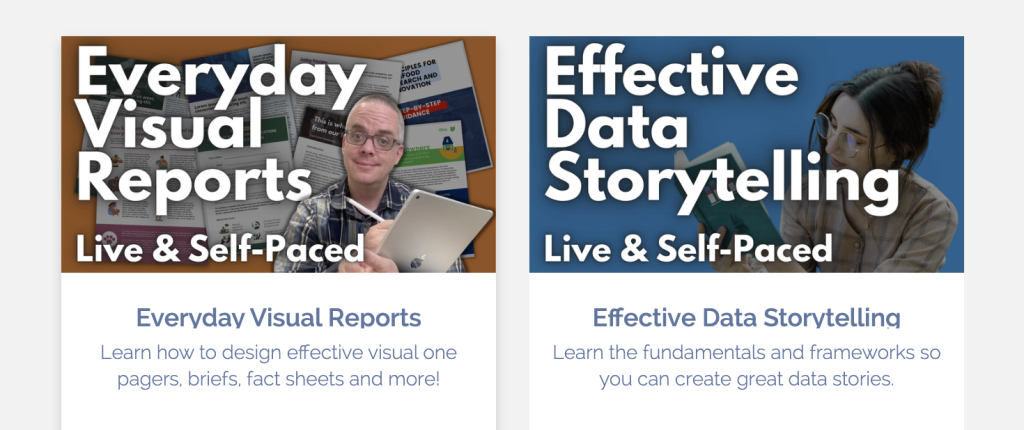
Courses available right now (fully self-paced with office hours and future live sessions included).

  • Everyday Visual Reports
  • Effective Data Storytelling

Written by cplysy · Categorized: freshspectrum

  • « Go to Previous Page
  • Go to page 1
  • Interim pages omitted …
  • Go to page 46
  • Go to page 47
  • Go to page 48
  • Go to page 49
  • Go to page 50
  • Interim pages omitted …
  • Go to page 310
  • Go to Next Page »

Footer

Follow our Work

The easiest way to stay connected to our work is to join our newsletter. You’ll get updates on projects, learn about new events, and hear stories from those evaluators whom the field continues to actively exclude and erase.

Get Updates

Want to take further action or join a pod? Click here to learn more.

Copyright © 2026 · The May 13 Group · Log in

en English
af Afrikaanssq Shqipam አማርኛar العربيةhy Հայերենaz Azərbaycan dilieu Euskarabe Беларуская моваbn বাংলাbs Bosanskibg Българскиca Catalàceb Cebuanony Chichewazh-CN 简体中文zh-TW 繁體中文co Corsuhr Hrvatskics Čeština‎da Dansknl Nederlandsen Englisheo Esperantoet Eestitl Filipinofi Suomifr Françaisfy Fryskgl Galegoka ქართულიde Deutschel Ελληνικάgu ગુજરાતીht Kreyol ayisyenha Harshen Hausahaw Ōlelo Hawaiʻiiw עִבְרִיתhi हिन्दीhmn Hmonghu Magyaris Íslenskaig Igboid Bahasa Indonesiaga Gaeilgeit Italianoja 日本語jw Basa Jawakn ಕನ್ನಡkk Қазақ тіліkm ភាសាខ្មែរko 한국어ku كوردی‎ky Кыргызчаlo ພາສາລາວla Latinlv Latviešu valodalt Lietuvių kalbalb Lëtzebuergeschmk Македонски јазикmg Malagasyms Bahasa Melayuml മലയാളംmt Maltesemi Te Reo Māorimr मराठीmn Монголmy ဗမာစာne नेपालीno Norsk bokmålps پښتوfa فارسیpl Polskipt Portuguêspa ਪੰਜਾਬੀro Românăru Русскийsm Samoangd Gàidhligsr Српски језикst Sesothosn Shonasd سنڌيsi සිංහලsk Slovenčinasl Slovenščinaso Afsoomaalies Españolsu Basa Sundasw Kiswahilisv Svenskatg Тоҷикӣta தமிழ்te తెలుగుth ไทยtr Türkçeuk Українськаur اردوuz O‘zbekchavi Tiếng Việtcy Cymraegxh isiXhosayi יידישyo Yorùbázu Zulu