• Skip to main content
  • Skip to footer
  • Home

The May 13 Group

the next day for evaluation

  • Get Involved
  • Our Work
  • About Us
You are here: Home / Archives for allblogs

allblogs

Jun 19 2023

Conductores de la colaboración

Recordamos TRES conductores de la colaboración, que tienen que ver con (1) compromiso, claridad de prioridades y objectivos, (2) existencia de capacidades, reciprocidad, participantes elegidos, (3) facilitación y rendición de cuentas.

1) Liderazgo y apropiación:

El propósito y los resultados deseados de la colaboración deben ser claros

El éxito colaborativo requiere: (a) la aceptación y el compromiso de las agendas individuales y (b) perspectivas diversas, si no distintas.

El compromiso con la colaboración (a) de las organizaciones debe ir más allá de las personas que participan, (b) Cada miembro de un proceso colaborativo debe tener una creencia auténtica tanto en la colaboración como en la razón por la cual se lleva a cabo

2) Marcos de planificación (rendición de cuentas), Capacidades conjuntas

Recursos/capacidades efectiv@s.

La inclusión de los participantes correctos/elegidos

Los esfuerzos de colaboración tienen resultados internos y externos que lograr.

3) Incentivos:

La equidad de la reciprocidad debe impulsar a los actores a colaborar.

Los participantes en la colaboración deben cumplir con sus responsabilidades pero también deben tener la autoridad suficiente para participar en la toma de decisiones.

Muchas colaboraciones, si no la mayoría, requieren herramientas, mecanismos de ayuda y experiencia externa para ser eficaces.
Written by cplysy · Categorized: TripleAD

Jun 14 2023

6 Big Reasons to Ditch the PDF Report

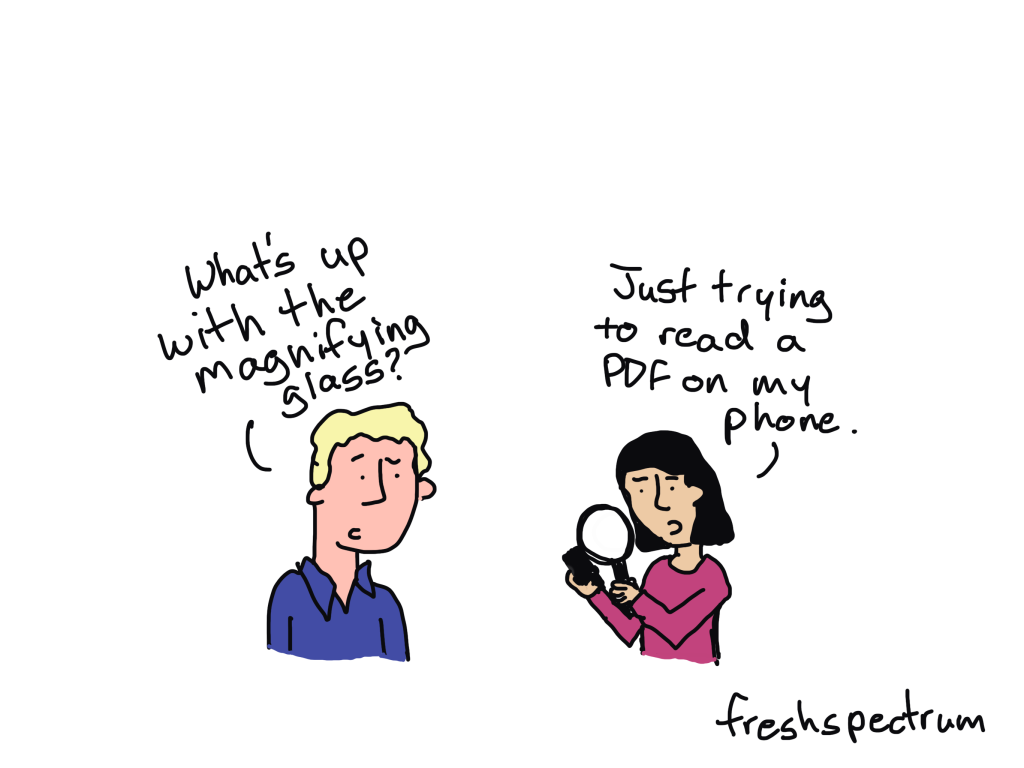
Still delivering your final report as a PDF? You’re definitely NOT alone. The PDF final report is still very much status quo in the research and evaluation worlds.

But I think it’s time we move on.

We give too much up when we choose to use PDFs for our reports. And the features we give up are not at all trivial. Here are 6 big things you get standard with a web-based report that you do NOT get with a PDF.

1. A PDF Report is NOT mobile responsive.

PDFs used to be a huge pain on just about every device. But that’s gotten a little better over time.

You can now open PDFs easily with your web browser. And most of the time they’ll load just fine. But what it won’t do is adjust to the screen you are reading it on.

Every modern website these days is mobile responsive. That means the content on the site will usually reorganize based on the device you are using. For example, a three column website when opened on a laptop web browser might instantly turn into a single column on your mobile phone.

PDFs are not that way. As such, most people don’t even consider opening a PDF on their smart phone.

At a time when well over half of all internet use happens on mobile phones, sticking with a platform that doesn’t adapt based on context instantly limits our reach.

2. A PDF Report is NOT SEO friendly

The best advice to give a new blogger is not to worry about search, but on writing quality content.

But blogging platforms like WordPress are designed to deliver that quality content across the web. And Google is designed to search that content and deliver the results to the people searching for that information.

A PDF is not optimally designed to work well with search. It’s designed to control visual presentation.

But what good is visual presentation if nobody can find what you’re sharing?

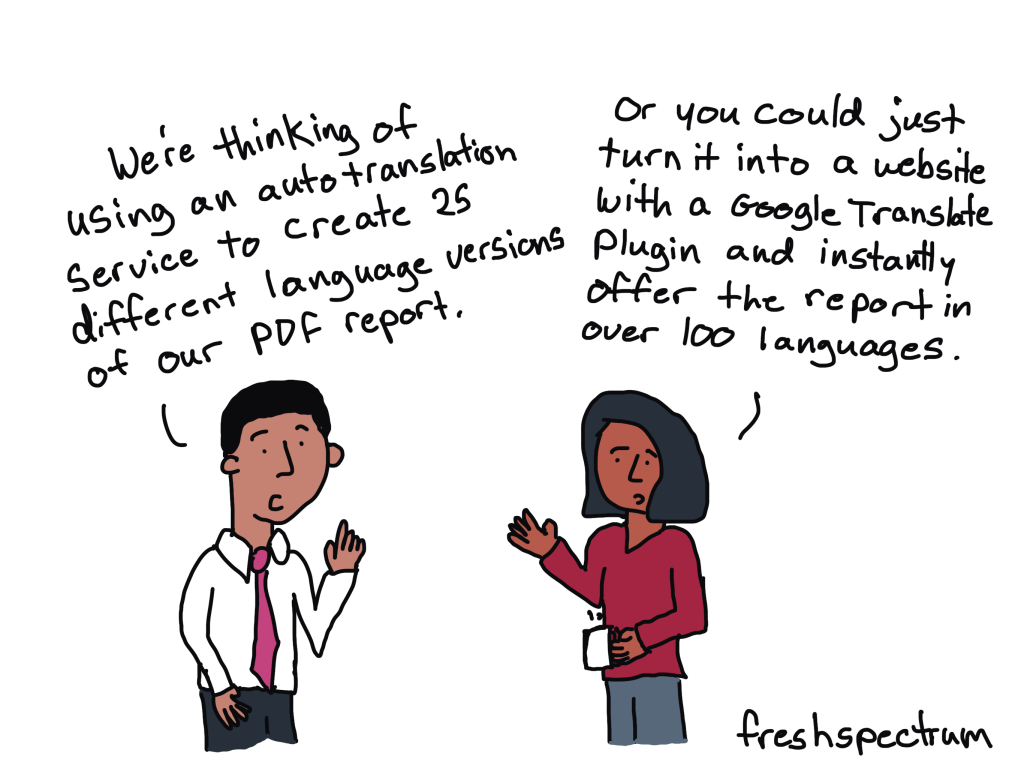
3. A PDF Report will NOT auto translate.

If you’re using Google Chrome and you visit a website offered in a different language, it’s likely that Chrome will ask if you want it translated.

That’s because Chrome has Google Translate built in and turned on by default.

Google Translate is not perfect. But it is pretty good, and getting better all the time.

At the time of this writing, Google Translate works with 133 different languages. There are plugins you can add to your WordPress site that will give you a selector menu to cycle through different iterations.

You don’t get that with a PDF.

4. A PDF will NOT auto update.

As anyone who was worked with data knows, updates happen.

Even if you think a dataset is final and clean, doesn’t mean you won’t find some reason for it to need a revision. Perhaps someone somewhere made a sort mistake with an Excel file.

With your PDF report, that data is set in stone. With an online report you can auto connect your charts and tables to a CSV file. If you update the CSV, all the charts will update automatically.

Not to mention the idea that sometimes, as is the case with data dashboards, auto-updating is the point.

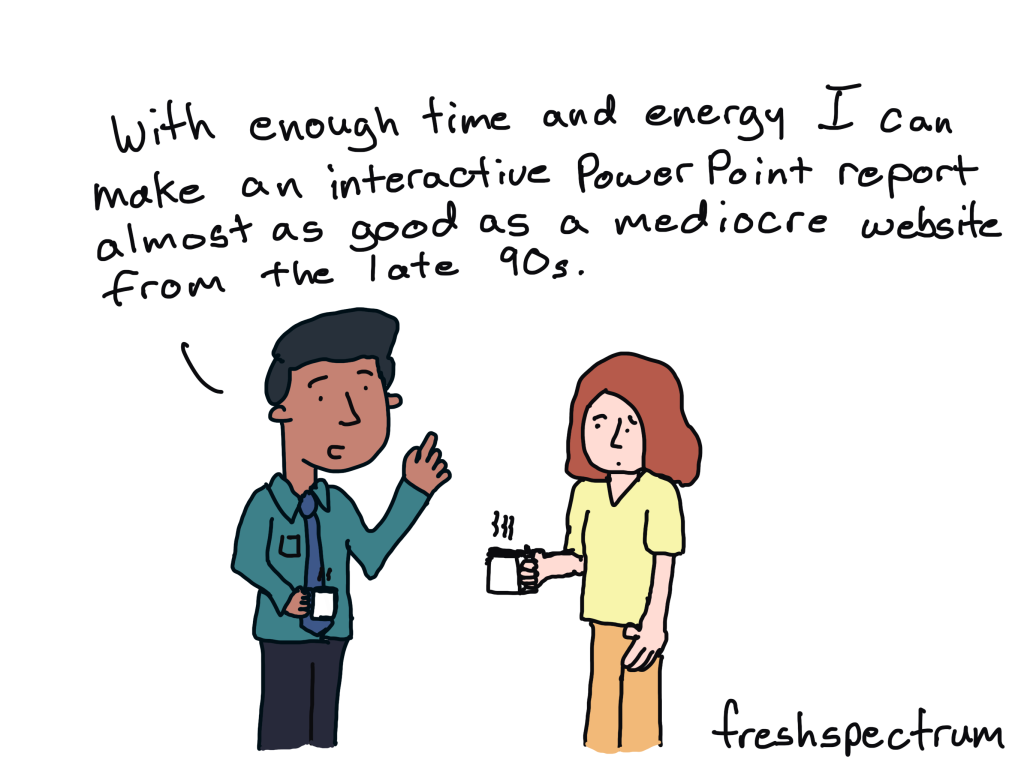
5. A PDF is barely interactive.

I wrote about this a few weeks ago, but even with a ton of work, a PDF can only be as interactive as a website from the late 90s. We have better tech, we should use it.

6. A PDF is much harder to share over social media.

When you share a link to a blog post on social media (i.e. LinkedIn, Twitter, Facebook, etc.) the tool will likely pick up some metadata to use in the sharing. This is how with a simple link the social tool can pull a featured image, the title, and an excerpt.

PDFs are not designed that way. Dropping a direct link to a PDF will just show up as a boring old link.

And I know, you might not think that matters. You might have very low expectations for anyone possibly reading or sharing your report. But it’s a self-fulfilling prophecy.

By simply committing to sharing our work through PDF, we are making so many decisions that limit the reach of our work. We can do better.

There’s so much more.

A basic WordPress site offers so many plugins and features that are just simply not available with a PDF. A PDF is harder to make accessible than a basic website. You can share your web reports with private, public, or hybrid permission models. You can easily add multi-media (like video and audio).

I could go on and on and on, but I think you get the point.

Want to explore moving your reports to the web?

I offer an all-in-one service called ReportPress Full Service. I use WordPress and modern interactive data visualization design tools to build cutting edge interactive reports and data dashboards.

If you want to learn more, head to my consulting page to schedule a free consultation.

Written by cplysy · Categorized: freshspectrum

Jun 14 2023

Before You Start Collecting Data, Read This

The first evaluation I ever led was for The Doula Project. My relationship to The Doula Project started with being a volunteer as a graduate student, and joining the board of directors a few years later. Based on feedback from the organization’s Leadership Circle, there was a gradual decrease in volunteer shift sign-ups, and as […]

The post Before You Start Collecting Data, Read This appeared first on Nicole Clark Consulting.

Written by cplysy · Categorized: nicoleclark

Jun 08 2023

Make Me Think

There is this fantastic book on usability written by Steve Krug called, Don’t Make Me Think. It’s not new, first released out all the way back in 2000. But if you have never read it, you should. Even if you have never really considered yourself a web designer.

“Don’t Make Me Think!”

Krug’s First Law of Usability

Following the “Don’t Make Me Think” law is a fantastic way to make an easy-to-use website, mobile app, or data dashboard. Because most of the time in those situations, making people think is unnecessary.

Let’s say you need to change your home’s air filters, and you go online to your home improvement store of choice. You should be able to easily find your air filter, buy it, and then have it delivered to your home. Thinking should not be required.

Most data dashboards also don’t require thinking. Picture a COVID-19 tracking dashboard. When you visit one, chances are you are not up for an in-depth study. You just want to know the numbers.

A site like Amazon is really good at not making us think. But that clunky resource website filled with too many words, acronyms, oddly named sections, and poorly designed content, not so much.

When thinking is necessary.

Our data work sometimes requires making people think. Occasionally we need to challenge someone’s world view because the evidence we’ve collected warrants a challenge. Challenging a reader in the right way at the right time can help them to learn something new.

Where thinking is useful.

  • When trying to understand a new concept.
  • When questioning a commonly held view.
  • When calling a reader to take action beyond just a button click.
  • When a point is so important you want to slow the reader down.

Where thinking is NOT useful.

  • When trying to figure out the button to click next.
  • When deciphering menu items.
  • When pulling data for well-known indicators.
  • When searching for answers to easy questions.

There isn’t a hard and fast rule on what thinking is useful and what is not useful. But you should be able to defend your decision to make people think. Forced thinking can be a barrier, use it wisely.

Flip Card Game Concept

Working with a colleague I created a little concept game based on a published report.

The following paragraph included a meaningful finding from the study. In paragraph form it’s really easy for a reader to just skim right through the data. Does it deliver the data? Yes. Is it efficient? Yes.

However, these assets are not equally distributed across neighborhoods. SOMA (23%), Richmond (21%), and Sunset (19%) neighborhoods have the highest number of food assets; while some of the most disadvantaged neighborhoods, such as Japantown (4%), Bayview (3%), Excelsior (2%), and Visitacion Valley (1%), have much fewer assets. Among all food assets in these API priority areas, only approximately 1 in 5 (19%) accept SNAP or WIC.

Food Justice in Turbulent Times – Needs & Opportunities in San Francisco’s API Communities

But what if we wanted to slow down the reader instead?

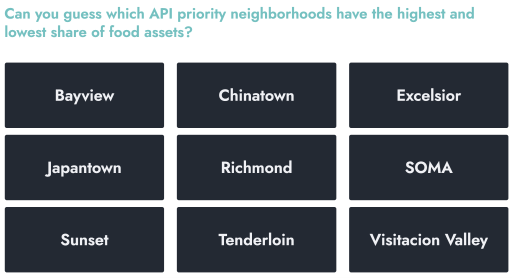
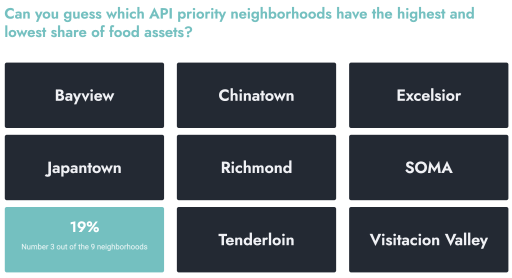
Perhaps we can simply make them guess their way to the answers. Clicking on the image below will take you to a demo version of the simple game I created in WordPress.

Click to see the live concept.

By simply moving your mouse over each neighborhood, the card will flip. And from the flipped card you’ll see the percentage share of food assets along with the neighborhood’s ranking (out of 9).

Why I design reports in WordPress.

Something like this is super simple to do in WordPress. But you won’t find a game in a PDF.

Speaking of reporting using web design tools…did you know?

I now offer The Modern Reporting Solution: an all-in-one design, technology, and copywriting service using WordPress to create cutting edge interactive reports and data dashboards. The result, accessible online reports your audiences will love.

Curious about this? Set a free consultation with me at freshspectrum.com/consulting

Written by cplysy · Categorized: freshspectrum

Jun 07 2023

Ask Nicole: Should Research Come Before Evaluation?

Have a question you’d like to be featured? Let me know. This question comes from Larissa, a graduate student in Arizona. Larissa write: Hi Nicole, I’m a graduate student currently taking a class about research and evaluation. I also just finished a course in evaluations within education and training. My first assignment is to distinguish […]

The post Ask Nicole: Should Research Come Before Evaluation? appeared first on Nicole Clark Consulting.

Written by cplysy · Categorized: nicoleclark

  • « Go to Previous Page
  • Go to page 1
  • Interim pages omitted …
  • Go to page 84
  • Go to page 85
  • Go to page 86
  • Go to page 87
  • Go to page 88
  • Interim pages omitted …
  • Go to page 310
  • Go to Next Page »

Footer

Follow our Work

The easiest way to stay connected to our work is to join our newsletter. You’ll get updates on projects, learn about new events, and hear stories from those evaluators whom the field continues to actively exclude and erase.

Get Updates

Want to take further action or join a pod? Click here to learn more.

Copyright © 2026 · The May 13 Group · Log in

en English
af Afrikaanssq Shqipam አማርኛar العربيةhy Հայերենaz Azərbaycan dilieu Euskarabe Беларуская моваbn বাংলাbs Bosanskibg Българскиca Catalàceb Cebuanony Chichewazh-CN 简体中文zh-TW 繁體中文co Corsuhr Hrvatskics Čeština‎da Dansknl Nederlandsen Englisheo Esperantoet Eestitl Filipinofi Suomifr Françaisfy Fryskgl Galegoka ქართულიde Deutschel Ελληνικάgu ગુજરાતીht Kreyol ayisyenha Harshen Hausahaw Ōlelo Hawaiʻiiw עִבְרִיתhi हिन्दीhmn Hmonghu Magyaris Íslenskaig Igboid Bahasa Indonesiaga Gaeilgeit Italianoja 日本語jw Basa Jawakn ಕನ್ನಡkk Қазақ тіліkm ភាសាខ្មែរko 한국어ku كوردی‎ky Кыргызчаlo ພາສາລາວla Latinlv Latviešu valodalt Lietuvių kalbalb Lëtzebuergeschmk Македонски јазикmg Malagasyms Bahasa Melayuml മലയാളംmt Maltesemi Te Reo Māorimr मराठीmn Монголmy ဗမာစာne नेपालीno Norsk bokmålps پښتوfa فارسیpl Polskipt Portuguêspa ਪੰਜਾਬੀro Românăru Русскийsm Samoangd Gàidhligsr Српски језикst Sesothosn Shonasd سنڌيsi සිංහලsk Slovenčinasl Slovenščinaso Afsoomaalies Españolsu Basa Sundasw Kiswahilisv Svenskatg Тоҷикӣta தமிழ்te తెలుగుth ไทยtr Türkçeuk Українськаur اردوuz O‘zbekchavi Tiếng Việtcy Cymraegxh isiXhosayi יידישyo Yorùbázu Zulu