• Skip to main content
  • Skip to footer
  • Home

The May 13 Group

the next day for evaluation

  • Get Involved
  • Our Work
  • About Us
You are here: Home / Archives for allblogs

allblogs

Jun 06 2023

Identity Dress-up For Strategic Thinking

#image_title

Seeing into the future is fraught with creative issues. While we might know about a future opportunity or situation, what might it feel like? What would it look like if we could ‘try on’ a decision before we bought it?

We can.

The idea of Identity Dress-Up is a simple visualization exercise that brings together foresight, futures thinking, behavioural science and design. It does this by getting you to ‘try on’ the outcomes of a decision. For example, could you imagine that you achieved a particular goal? Let’s say it was to serve a new clientele for your agency — what would success look like? What would it feel like? What would have had to be in place in your organization for that to have happened?

Take some time to imagine this and challenge yourself (and your team) to add detail to this imagination and explore its assumptions.

We’ve found that sometimes our clients don’t want that future after ‘trying it on.’ It happens all the time: we get the thing we’ve strived for and realize we didn’t really want it after all.

More often, organizations begin to see what it will take to get to this vision. This is where the strategic design process comes in. By setting up your preferred future first, you can then walk back from there to the present to determine what needs to be in place and how it needs to be organized to set yourself up for success.

Identity Design

We act as we see ourselves. This process is so effective because it provides us with a safe way to change how we see ourselves without having to make substantive changes – yet. Trying on ideas helps socialize the idea of change and allows us to see the pros and cons of it and make it feel more familiar. The more familiar it is, the more likely we are able to consider it, adopt it, and design for it.

Just like a kid playing dress up, we can do the same and fit our fantasies and hopes for the future on with what we experience in the present.

This is a simple, fun, and powerful exercise that can be done in a short amount of time. We explain this in short, below.

If you need or would like help doing it, we can help – let’s talk. Good luck!

Photo by Saksham Gangwar on Unsplash

The post Identity Dress-up For Strategic Thinking appeared first on Cense Ltd. .

Written by cplysy · Categorized: cameronnorman

Jun 05 2023

Grandpa Henry’s Potato Leek Soup

I’m taking a sick day today. Picked up a case of strep throat at the end of last week that’s now hopefully working its way out of my system. But sick days are boring, and instead of streaming yet another movie or show, I thought I would share the recipe for my favorite soup.

My dad was a trained chef. He cooked many of our family meals when I was growing up. But I think the food I most connect with my father was his soup. And the soup that I think of first and foremost was his potato leek.

After he died I started making the soup every year on his birthday. Potato leek for me has a kind of magical quality. My dad would make it in big batches. He made it for us but would also often share it with friends around town. I remember coming back home to visit from college, if he had made soup it would always come with an offer.

“Hey Chris, would you like a mug of soup?”

The soup was rarely a dinner of ours. Sometimes it was a lunch. But mostly it was just there when you needed a nice warm mug of something tasty. Why a mug and not a bowl? No idea. I think this soup is really the only food we ever ate out of mugs.

And while I can’t make a mug for you right now (even if we lived close I don’t think you want someone with strep making you soup), I can offer you a recipe.

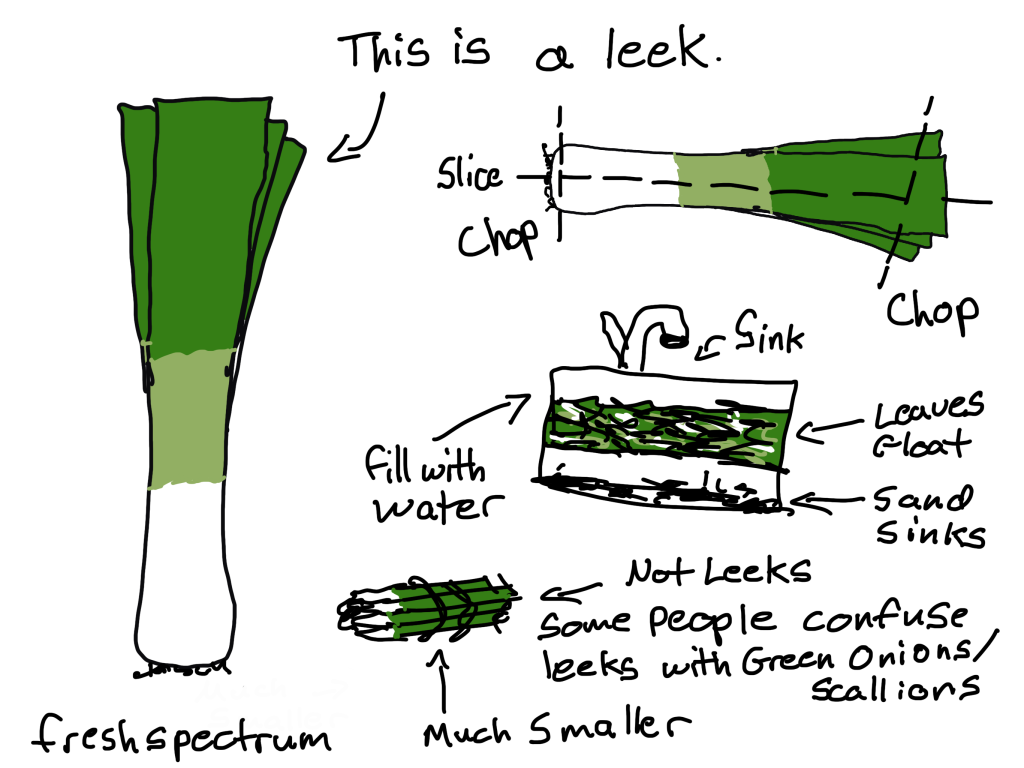
It’s pretty easy, the most annoying part is cleaning the leeks. But it is worth the effort.

The Recipe-ish

My dad’s recipes were like directions before Google maps. They were never set in stone and based often on whim and the availability of certain ingredients. But I’ll do my best to give you something you can follow.

The ingredients.

  • A bunch of leeks (A bunch usually includes 2 or 3 often held together with a big rubber band).
  • Some potatoes (Yukon gold potatoes were his favorite for this. Like 4 or 5 medium sized potatoes).
  • Half & Half (2 cups)
  • Butter (Unsalted, 1 stick)
  • Stock (~6 cups, give or take depending on how thick you like your soup. He used chicken stock, vegetable if you want it vegetarian).
  • Garlic (how much depends on your taste)
  • Salt & Pepper (too your taste)

The directions.

  1. Wash the leeks.
    This part is a pain because there is usually lots of sand all around the inside of the leeks. To do it I usually cut the base & tips of the leaves (leaving most of the dark green parts). Then slice the leek in half longways. Then you fill your sink with water and drop all the leaves in, agitate the water with your fingers and the sand should fall the the bottom while the leaves float.
  2. Cut the leeks.
    Eventually we are going to blend the soup, but they soften better if you chop them into smaller pieces.
  3. Cook leeks & garlic with butter until soft.
    Throw the butter into the bottom of a stock pot and turn it on medium until melted. Then drop in all your leeks. If you’re using garlic cloves, drop them in during this stage. Cook for a while, stirring occasionally and adjusting the heat so it doesn’t stick. You want them nice and soft and cooking it for awhile will break down all the little fibers.
  4. Peel and Quarter potatoes.
    Keep the pieces in a bowl of cold water as you peel to remove some of the starch.
  5. Boil potatoes until soft.
    Now drop the potatoes in another pot filled with fresh cold water. Then bring to a boil and then simmer until the potatoes are soft. Once you can easily pierce with a fork drain off the water using a colander.
  6. Mix together Leeks, Potatoes, and Stock
    Once leeks & potatoes are soft, drop the potatoes in with the leeks and add then stock. Then bring to a boil. Let it simmer together for a little bit.
  7. Blend it together.
    An immersion blender is a fantastic tool for this. In the old days my dad used to scoop it all out into a regular blender.
  8. Add half & half and blend some more.
    You want it nice and smooth. If the leeks weren’t soft enough, chances are they’ll stick in clumps in your immersion blender. The soup will still taste good, it will just be a little chewier than you want.
  9. Adjust to liking.
    Want it “soupier” add more stock. Want more salt, add more salt. Same goes with pepper and garlic. I don’t think two of my dad’s pots of soup were ever the same, that’s part of their charm.
  10. Serve in mugs.
    Even if you never serve soup or any other kind of food in mugs.
  11. Share/keep in fridge/freeze.
    This soup can be frozen. It can be brought to pot-lucks. It can be brought to sick friends. It can be shared at work. Offer it at times people are not used to eating. It’s an especially good mid-afternoon, mid-morning, or late evening snack.

The thing about recipes and cooking.

Cooking isn’t baking. The instructions are often not that precise, you usually don’t have to cook with fidelity. Most recipes, even the ones that seem precise, can be fudged. Where baking is a kind of hard science, cooking is more a social science.

It’s kind of like the programs you evaluate. A lot of organizations may try to follow recipes, but they usually tweak things based on available ingredients and taste. Sometimes it comes out better, sometimes worse.

But either way, it’s the outcomes that really matter.

My dad’s soup never won awards. But now, even a half decade after his death, his soups still bring back memories. Anytime over the last couple of decades that I have run into my best friend’s dad, he has always mentioned how a certain cream of mushroom soup my father made when I was younger was the best he had ever had.

I hope you make the soup. I hope you share the soup. I hope you drink it out of a mug.

But even if you don’t. I hope you find the soup like thing in your life. The thing that you deliver and share with love. The thing that will undoubtedly make impressions on the people whose lives you have touched.

Written by cplysy · Categorized: freshspectrum

Jun 05 2023

How to Analyze Data with Excel’s Pivot Tables (No Formulas Required!)

In May 2023, I led a 45-minute session at Good Tech Fest about using pivot tables to analyze a dataset from start to finish.

The conference recording wasn’t perfect — I got kicked out of the conference session midway, and again towards the end. The audio sounds funky; it sounds… mechanical? Static-y? Unfortunately the conference platform was glitchy for many, many sessions. Lots of presenters got kicked out and had to re-load and re-join. Sigh.

I was hesitant to share the recording and materials at all. But, maybe you’re brand new to pivot tables and something is better than nothing? Fingers crossed that this blog post reaches the right people!

What are Pivot Tables?!

Pivot tables are a great option for our recurring analyses, like weekly, monthly, or quarterly updates to our boss; or for annual reports to our funders.

You’ll create the pivot tables you need just once, so you can save precious time and avoid having to re-do your analyses over and over again for each report deadline.

My Goal

Let’s move you up a half-step within just 45 minutes!

What’s your current familiarity with pivot tables?

  • Beginner: “I’ve never heard of pivot tables.” “I heard of pivot tables years ago, but never used them.” “Everything in spreadsheets takes forever.” “Using Excel is the least favorite part of my job.”
  • Intermediate: “I used pivot tables a couple times, but I don’t have the hang of them yet.” “I need a refresher.” “I get stuck sometimes.” “I’m not sure if I’m doing it right; sometimes I’m guessing.”
  • Advanced: “I use pivot tables daily.” “I could teach others to use pivot tables.”

Did you move up a half-step after participating in the session?

Comment below and let me know!

Download the Spreadsheet

This session was interactive; I demonstrated a skill, the attendees practiced, and so on.

Here’s the spreadsheet: https://depictdatastudio.gumroad.com/l/GoodTechFest

Watch the Conference Session

What You’ll Learn about Pivot Tables

Here’s what we covered during the conference session.

Step 0: Optional: Use An Excel Table

How familiar are you with Excel Tables? Comment below and let me know!

Excel Tables help to future-proof our analyses, making it easier to add new rows to the bottom of our spreadsheet (“append” the table).

Here’s how to add Excel Tables:

  • Go into your dataset and click on the upper left corner.
  • Go to the Insert tab.
  • Click on the Table button.
  • In the pop-up window, click OK.
  • That’s it! You’ve got an Excel Table.

You probably recognize the banded rows?

You’re probably familiar with filters?

My favorite part of Excel Tables is that they expand easily to handle new columns and rows; i.e., our new entries will feed easily into our Pivot Tables (as long as you “refresh” the pivot table).

Step 1: Make Sure Pivot Table Prerequisites Have Been Met

There are two prerequisites:

  • All columns must be labeled. If you add a new column, make sure to give the variable a name. Otherwise, you’ll get an error message later.
  • We need contiguous cells. We can’t have any completely empty columns or rows. A “Swiss cheese pattern” with a few empty cells here and there is normal and fine.

Luckily, having an Excel Table makes this step unnecessary!

In other words, if you add an Excel Table, then you’ll automatically have labeled columns and contiguous cells, phew!

In the video, you’ll see me demonstrate what type of errors can arise from non-contiguous cells that aren’t stored in Excel Tables. Knowing what not to do is just as important as knowing what to do.

Step 2: Add a New Pivot Table

Let’s insert a brand new pivot table from scratch!

In the video, you’ll see me go to the dataset… go to the Insert tab… and click on the Pivot Table button.

You’ll see a pop-up window, which can be confusing for newbies. It’s just (1) verifying that your correct columns and rows are selected and (2) asking where you’d like your pivot table.

You can put your new pivot table in:

  • a brand new sheet, or
  • an existing sheet (like if you’d want multiple tables, linked to multiple graphs, which is great for interactive dashboards).

(In this example, I simply added a pivot table to a brand new sheet.)

Then, you’ll re-name your sheet to stay organized. Don’t leave your sheets as Sheet1, Sheet2, or Sheet3! This is a red flag. It tells me your Excel file is a disorganized disaster.

On your new sheet, you’ll see a few boxes on the right side. Here’s an overview of what they mean:

  • Fields: The names of all the variables in your dataset. (The column headers.)
  • Filters, Columns, Rows, and Values: The boxes where you’ll drag-and-drop your variables into.

Step 3: Drag and Drop Variables!

You’ll drag-and-drop variables to build a summary table (so you don’t have to learn formulas like countifs and sumifs).

Here are some Rules of Thumb:

  • If your dataset has unique IDs, then you’ll drag those into the Values box, and you’ll change them to a Count. (You’ll see me demonstrate this in the video.) By default, Excel gives us Sums, which don’t make any sense for variables like ID numbers.
  • Start your analysis by dragging one variable at a time into Rows. (In the video, you’ll see me drag Q1 into Rows.) Then, we get a summary table, like how many people selected Strongly Agree or Agree on our fictional survey.
  • Pivot your table! Drag variables into Rows… and then into Columns! This is where the pivot table gets its name. You can rearrange your summary table as many times as you need. I encourage you to trust your gut instinct here!!! You’ll find summary tables that are naturally easier to read then others.
  • Then, try crosstabs — where you keep one variable in Values (the ID numbers) and drag two variables into Rows and/or Columns. For example, you might look at how people responded to Q1, by cohort. This is my personal max for pivot tables: one variable in Values, and two in Rows or Columns. Once you add three, four, or five variables into Rows or Columns… it gets impossible to read.

Optional: Re-order variables within the pivot table. For example, you can sort the variables from Strongly Agree to Agree to Disagree to Strongly Disagree (instead of the default setting, which is alphabetical).

Optional: Show percentages in addition to, or instead of, your counts. In the video, you’ll learn how to Show Values As a percentage. Finally, you’ll learn how to round the percentages with the Decrease Decimal button.

Behind the scenes, Excel is calculating countifs and/or sumifs for us. I personally love love love formulas… but I love that pivot tables can bypass these formulas entirely. In the video, you’ll see me create a countifs formula.

Optional: Add quick vizzes, like Color Scales, to your pivot table. Color Scales help the patterns jump off the screen and into our brains.

Step 4: Refresh Your Pivot Table

Anytime you update your dataset… you’ll need to refresh the linkage with your Pivot Table.

You might add new columns. Or new columns. Or make tiny adjustments within the body of your dataset.

You’ll simply click on your Pivot Table, right-click, and choose Refresh. That’s it!

Phew! Right as I was describing the Refresh button, the conference platform kicked me out for a second time. I was definitely crying inside because all my hard prep work was getting flushed down the drain. Sigh.

Written by cplysy · Categorized: depictdatastudio

Jun 05 2023

Habilidades asociadas con la gestión del conocimiento personal

En un post pasado ya analizamos la La gestión del conocimiento personal (en ingles Personal knowledge management PKM), donde se indicaba que PKM:

(1) Es un proceso que una persona utiliza (a) para recopilar, clasificar, almacenar, buscar, recuperar, compartir, internalizar e integrar conocimientos en sus actividades diarias,  y (b) la forma en que estos procesos respaldan sus actividades laborales. (Grundspenkis 2007 y Wright 2005)

(2) Es un enfoque de abajo hacia arriba para la gestión del conocimiento (KM) y una respuesta a la idea de que l@s trabajador@s del conocimiento deben ser responsables de su propio crecimiento y aprendizaje. (Pollard 2008)

PKM integra la gestión de la información personal (PIM), centrada en las habilidades individuales, con la gestión del conocimiento (KM), además de las aportaciones de una variedad de disciplinas como la psicología cognitiva, la gestión y la filosofía (Pauleen 2009). Desde una perspectiva organizacional, la comprensión del campo se ha desarrollado a la luz de la expansión del conocimiento sobre las capacidades cognitivas humanas y la permeabilidad de los límites organizacionales. Desde una perspectiva metacognitiva, compara varias modalidades dentro de la cognición humana en cuanto a su competencia y eficacia (Sheridan 2008). Es un área poco investigada (Pauleen 2009). Más recientemente, se han realizado investigaciones para ayudar a comprender «el papel potencial de las tecnologías Web 2.0 para aprovechar y gestionar el conocimiento personal» (Razmerita, Kirchner & Sudzina 2009). «La Gran Renuncia» ha ampliado la categoría de trabajadores del conocimiento y se prevé que aumente la demanda de gestión del conocimiento personal en el futuro (Serenko 2023).

Las habilidades asociadas con la gestión del conocimiento personal incluyen:

• Habilidades de colaboración. Coordinación, sincronización, experimentación, cooperación y diseño.

• Habilidades de comunicación. Percepción, intuición, expresión, visualización e interpretación.

• Habilidades creativas. Imaginación, reconocimiento de patrones, apreciación, innovación, inferencia. Comprensión de los sistemas adaptativos complejos.

• Alfabetización informacional. Comprender qué información es importante y cómo encontrar información desconocida.

• Gestionar el aprendizaje. Gestionar cómo y cuándo aprende el individuo.

• Redes de Contactos. Saber lo que sabe tu red de personas. Saber quién podría tener conocimientos y recursos adicionales para ayudarlo

• Habilidades organizativas. Biblioteconomía personal. Categorización personal y taxonomías.

• Reflexión. Mejora continua sobre cómo opera el individuo.

• Habilidades de investigación, sondeo, atención, entrevistas y observación de «antropología cultural

Referencias

Grundspenkis, J. (2007), «Agent based approach for organization and personal knowledge modelling: knowledge management perspective», Journal of Intelligent Manufacturing, vol. 18, no. 4, pp. 451–457, doi:10.1007/s10845-007-0052-6, S2CID 6466978.

Pauleen, David (2009), «Personal knowledge management: putting the ‘person’ back into the knowledge equation», Online Information Review, vol. 33, no. 2, pp. 221–224, doi:10.1108/14684520910951177.

Personal knowledge management 

Pollard, Dave (2008), PKM: A bottom-up approach to knowledge management. In Knowledge Management in Practice: Connections and Context, ed. T.K. Srikantaiah and M.E.D. Koenig, Information Today, pp. 95–114

Razmerita, L.; Kirchner, K.; Sudzina, F. (2009), «Personal Knowledge Management: The Role of Web 2.0 tools for managing knowledge at individual and organisational levels», Online Information Review, vol. 33, no. 6, pp. 1021–1039, doi:10.1108/14684520911010981.

Sheridan, William (2008), How to think like a knowledge worker (PDF), United Nations Public Administration Network

Serenko, Alexander (2023), «The Great Resignation: The great knowledge exodus or the onset of the Great Knowledge Revolution?» (PDF), Journal of Knowledge Management, 27 (4): 11042–1055, doi:10.1108/JKM-12-2021-0920, S2CID 249652534.

Snowden, David; Pauleen, David J. (2008), Knowledge management and the individual: it’s nothing personal—an interview with Dave Snowden by David J. Pauleen

Written by cplysy · Categorized: TripleAD

Jun 01 2023

Building Equitable Structures

As I step into my role as the Director of Innovation Network, I am reminded that I am not alone. My strength as a leader comes from my ability to set free the amazing knowledge and talent around me: from the Innovation Network team, our foundation and nonprofit clients, and the advocates we work with.

When Virginia Roncaglione and I took on the roles of Interim Co-Directors last year, one of our first priorities was to center our people — regardless of role — as decision-makers for our organization. This was evidenced through the selection process for the Director role: with an outside facilitator and team-based discussions where we strived for equal power for team and board members, including salary decisions and expectations for the first year. We recognized that erasing feelings of powerlessness and fostering a culture where everyone can be their authentic selves is crucial for creating a truly equitable organization. I am excited to continue working with Virginia as she provides her leadership to crucial shifts in our organization’s culture.

One of our first priorities was to center our people — regardless of role — as decision-makers for our organization.

In the field of evaluation, we have learned (and learned and learned) how BIPOC voices are often ignored and/or deprioritized in our society. This is true for evaluators of color as well as the communities of color who are often the focus of evaluations. As a white cisgender woman, I acknowledge the privilege I have coming into a leadership role. I carry a genuine desire to interrupt the ways of working that perpetuate racial injustice that I hope can guide me as a leader to make real, tangible changes. I know I must elevate myself-awareness of natural human biases and embrace differences in identity and race. I have learned so much from BIPOC teammates who have since moved on from Innovation Network, and I strive to honor them by centering equity in all aspects of our work, from our processes to the outcomes we seek. We are just getting started, and I know there is work to do — from shifting mindsets to building a diverse team and Board.

I know what it feels like to experience powerlessness in the workplace, and I am determined to create a culture where everyone has power and can express their unique value. Our efforts to dismantle hierarchies — structures that often hoard power at the top, creating powerlessness at the bottom — liberates the power and unique value that each person brings to our organization.

I see our efforts to dismantle hierarchies and center equity within Innovation Network as extending beyond our organization and informing how we approach our projects.

My background in social work has taught me that the way we show up in small groups is indicative of how we show up in the world. That is why I see our efforts to dismantle hierarchies and center equity within Innovation Network as extending beyond our organization and informing how we approach our projects. We have an incredible team that is committed to equitable learning and evaluation and is leading new efforts to shift power to evaluation participants and measure how advocates are building and shifting power. We are learning alongside advocates and approaching our work with an orientation towards equity that — I hope one day — feels like second nature because of the structures we are building within our own organization.

I have seen a growing interest in evaluation that centers around learning and defines success by asking those most affected by the work. I am excited to continue and find new partnerships where equity is not performative and relationships are real. To do work in the way that lives our values.

The path ahead of us is not without challenges, but we at Innovation Network are committed to this vision: a future where evaluation is a tool for communities to live into their power and have the information they need to lead the decisions impacting their future and well-being. In the coming year, we will engage in participatory strategic planning and intentionally center racial equity within our organization and learning projects. We understand that this work requires ongoing accountability, and we welcome our community (all of you) to hold us to our values.

We welcome our community (all of you) to hold us to our values.

Your voices and feedback are invaluable in guiding us on this path. To start this conversation, I will be holding office hours on June 6 at 2–3pm and June 8 at 5–6pm EST (email me directly at amarchant@innonet.org for the link). I would be delighted to meet with any of you to discuss our vision and plans for the future. If you are unavailable at these times, please reach out to me and we can find another time to chat!

I am honored to become the new Director of Innovation Network, and I am excited to continue living into our values, find new ways to dismantle traditional structures, and better serve us and our communities.


Building Equitable Structures was originally published in InnovationNetwork on Medium, where people are continuing the conversation by highlighting and responding to this story.

Written by cplysy · Categorized: innovationnet

  • « Go to Previous Page
  • Go to page 1
  • Interim pages omitted …
  • Go to page 85
  • Go to page 86
  • Go to page 87
  • Go to page 88
  • Go to page 89
  • Interim pages omitted …
  • Go to page 310
  • Go to Next Page »

Footer

Follow our Work

The easiest way to stay connected to our work is to join our newsletter. You’ll get updates on projects, learn about new events, and hear stories from those evaluators whom the field continues to actively exclude and erase.

Get Updates

Want to take further action or join a pod? Click here to learn more.

Copyright © 2026 · The May 13 Group · Log in

en English
af Afrikaanssq Shqipam አማርኛar العربيةhy Հայերենaz Azərbaycan dilieu Euskarabe Беларуская моваbn বাংলাbs Bosanskibg Българскиca Catalàceb Cebuanony Chichewazh-CN 简体中文zh-TW 繁體中文co Corsuhr Hrvatskics Čeština‎da Dansknl Nederlandsen Englisheo Esperantoet Eestitl Filipinofi Suomifr Françaisfy Fryskgl Galegoka ქართულიde Deutschel Ελληνικάgu ગુજરાતીht Kreyol ayisyenha Harshen Hausahaw Ōlelo Hawaiʻiiw עִבְרִיתhi हिन्दीhmn Hmonghu Magyaris Íslenskaig Igboid Bahasa Indonesiaga Gaeilgeit Italianoja 日本語jw Basa Jawakn ಕನ್ನಡkk Қазақ тіліkm ភាសាខ្មែរko 한국어ku كوردی‎ky Кыргызчаlo ພາສາລາວla Latinlv Latviešu valodalt Lietuvių kalbalb Lëtzebuergeschmk Македонски јазикmg Malagasyms Bahasa Melayuml മലയാളംmt Maltesemi Te Reo Māorimr मराठीmn Монголmy ဗမာစာne नेपालीno Norsk bokmålps پښتوfa فارسیpl Polskipt Portuguêspa ਪੰਜਾਬੀro Românăru Русскийsm Samoangd Gàidhligsr Српски језикst Sesothosn Shonasd سنڌيsi සිංහලsk Slovenčinasl Slovenščinaso Afsoomaalies Españolsu Basa Sundasw Kiswahilisv Svenskatg Тоҷикӣta தமிழ்te తెలుగుth ไทยtr Türkçeuk Українськаur اردوuz O‘zbekchavi Tiếng Việtcy Cymraegxh isiXhosayi יידישyo Yorùbázu Zulu