• Skip to main content
  • Skip to footer
  • Home

The May 13 Group

the next day for evaluation

  • Get Involved
  • Our Work
  • About Us
You are here: Home / Archives for allblogs / rka

rka

Aug 06 2021

Gen Z are Identity Crafters: What does this mean for Cultural Institutions?

By: Sadiya Akasha

Population demographics have been shifting towards greater diversity for the last few generations with Generation Z being the most diverse generation yet. Research published by the Pew Research Center shows that nearly 48% of Gen Zers born between 1997 and 2012 belong to a racial or ethnic minority, compared to 39% of Millennials. As cultural institutions pivot towards serving this generation of visitors, it seems like a particularly salient time to query how this change in demographics might affect strategy, planning, and outreach for visitor engagement.

Researching and Crafting Identities

Many Gen Zers find themselves struggling with an outdated demographic model where they are expected to keep their race as clearly delineated as a shorthand way to describe themselves. In 2019, Vice Magazine led a research study enrolling older members of their Gen Z readership (aged 16 – 22) to answer questions about identity. Their findings suggest that this generation experiences many aspects of their identity, like racial and ethnic background, gender, and faith, as both more fluid and more holistic than our Western culture currently accommodates. For example, a study participant of Filipino and Korean American descent described her difficulty in simply checking a demographic box on forms:

“I remember for the longest time Filipino wasn’t an option,” she said. “And so my sister and I thought that we were Pacific Islanders just because of what the options were. I really don’t like the fact that you either have to be Hispanic or not Hispanic. Also, what does Hispanic even mean? The Spanish colonized the Philippines, so for you to say that I’m Filipino but not Hispanic or Hispanic, it’s so weird. The entire language needs to be changed.”

Beyond being multicultural, members of Gen Z also exhibit a flexible attitude with their adoption of religious traditions. Gen Zers approach their relationship with religion by researching the faiths of their living family members, and even their ancestors, in order to identify the elements that best align with their values and create an entirely new blend of religious rituals to better suit their needs. In this fashion, members of Gen Z are able to craft a well-researched and well-rounded identity that incorporates many of their cultural and religious practices into their daily lives.

But Gen Z doesn’t stop there! Since their identity is molded around their values, activism is also a part of their self-identity. The Pew Research Center has identified that a much larger percentage of Gen Z are born to immigrant parents in the United States when compared to Millennials. This means that on top of being more diverse, Gen Z is also less likely to be foreign-born. Early signs indicate that Gen Z is already playing an active role in civic engagement. The Vice Magazine study conducted research across the US and UK and found that 76% of Gen Z identify as activists and 54% plan to get involved in politics. It’s easy to see that for the generation whose members include the likes of Malala Yousafzai, X Gonzalez, and Greta Thunberg, activism and civic engagement is as much a part of their identity as their chosen gender, culture, religion, and so on.

Dynamic Intersectionality in Action

For Gen Z, all of these identifiers are not a hierarchical list but a multifaceted, self-consistent exposition on who they are becoming at present. For Gen Z, identity is actively shaped and carved like a sculpture out of stone, not accepted as handed down or absorbed through our cultural milieu. This kind of exploration and constant self-examination is such a foundational trait to Gen Z that it is clearly reflected in their overwhelming support of others’ rights to self-designation and exploration. The Culture Marketing Council released a comprehensive study on Gen Z in 2020 showing that values of freedom, equality & healthcare for all matter most to Gen Z, with heightened priority on the “For All”.

Gen Z is the most racially diverse and multiethnic generation to date. Their multicultural background is different from that of their predecessors in that many are US-born to immigrant parents rather than foreign-born themselves, and that they are much more likely to come from a mixed racial and multicultural background. This is reflected in a sense of self that is much more blended and holistic than our Western cultural model currently supports. So if we accept that Gen Z naturally inhabits an intersectional space with a flexible but intentional sense of identity that is ever-evolving, then we might need to re-consider current demographic data collection tools and their underlying assumptions.

Redefining Demographics

I recently collaborated with a prominent modern art museum in London to perform a user study targeting young people (high school and college-age) as well as families with young children (Gen Z and younger). The demographic data for the interviewees listed their ethnic background, in singular, such as Caribbean or Indian or Bengali. Curiously, I noticed interviewees who were not People of Color (POC) were listed as either ‘British’ or ‘White Other’. The idea here was to seek out diverse visitors within the target audience to ensure representation and inclusion for non-English speaking communities. However, what I learned during the interviews was that many of the interviewees who were identified by the museum as POC were in fact London-born Gen Z children of immigrant parents for whom the British culture and English language were an inseparable part of their identity. On the other hand, several of the interviewees who were listed as ‘White Other’ by the museum were first-generation immigrants themselves from other European nations who learned English as a second language in adulthood. It certainly turned some assumptions upside down about who was ‘British’ and which communities needed to be supported in their understanding of interpretive material.

It would be prudent at this point to question our assumptions and rethink our approach to racial demographics.  It is clearly out of date and largely irrelevant to the lived experiences of our Gen Z visitors.  We should start by asking Gen Z how they would like to be identified and go from there.

What’s next?

In my previous post in this series, I described how Gen Z actively investigates media narratives and questions sources, while in this post I’ve outlined that they take the same approach in crafting their own identities. With this in mind, my final post will investigate how cultural institutions can meet Gen Z where they are by engaging with them as collaborators.

About the Author

A brown woman with shoulder length hair looks into the camera. She is a millennial, not Gen Z.

Sadiya Akasha is the co-founder and Director of Product Development at Sitara Systems, a design and technology laboratory that creates interactive experiences with emerging technologies. Sadiya partners with cultural institutions to help them conceptualize and deliver technology initiatives by leveraging her background in human-centered design, agile thinking, and audience research. In her free time Sadiya enjoys exploring the rugged yet delicate landscapes of the great Southwest. 

The post Gen Z are Identity Crafters: What does this mean for Cultural Institutions? appeared first on RK&A.
Written by cplysy · Categorized: rka

Jul 29 2021

Comment on IRB 101: What are they? Why do they exist? by IRB 101: Risks to Research Participants » RK&A »

[…] my first post in this IRB 101 series, I described what IRBs are and why they exist.  IRBs exist to protect […]

Written by cplysy · Categorized: rka

Jul 29 2021

IRB 101: Risks to Research Participants

In my first post in this IRB 101 series, I described what IRBs are and why they exist.  IRBs exist to protect research participants.  In this second post, I focus on risks to research participants. 

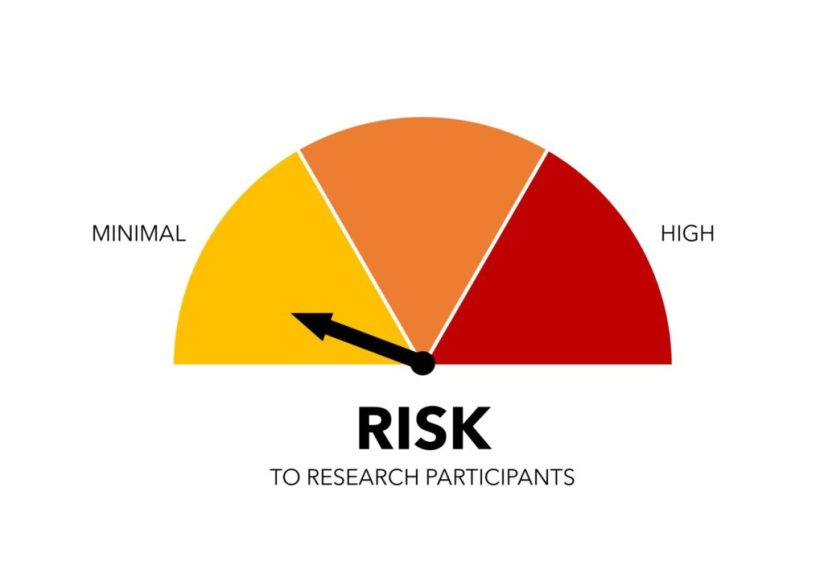
Risk Meter Pointing to Minimal Risk

What are risks to research participants?

Risk is the probability that harm will occur.  All research involves some level of risk to research participants (never say a study has no risk to research participants!).  Most visitor studies research and evaluation can be classified as minimal risk.  Minimal risk is defined in the Common Rule as: “probability and magnitude of harm or discomfort anticipated in the research are not greater in and of themselves than those ordinarily encountered in daily life or during the performance of routine physical or psychological examinations or tests.” Assessing whether your study is of minimal risk requires you to: (a) think about both the probability as well as the magnitude of harm; and (b) consider the probability and magnitude of harm against what a research participant may encounter in everyday life.

What types of risks might research participants face?

The Belmont Report defines types of potential risks to help researchers assess the risk level of their proposed study. Potential risk types include: physical, psychological, social, legal, and economic.  Below are the descriptions of these type of risks.  For visitor studies research and evaluation, risks typically fall within psychological and social risks. It is important to be aware of all types of risks though.

  • Psychological risks can include anxiety, sadness, regret and emotional distress, among others. Psychological risks exist in many different types of research in addition to behavioral studies.
  • Social risks exist whenever there is the possibility that participating in research or the revelation of data collected by investigators in the course of the research, if disclosed to individuals or entities outside of the research, could negatively impact others’ perceptions of the participant. Social risks can range from jeopardizing the individual’s reputation and social standing, to placing the individual at risk of political or social reprisals.
  • Physical risks may include pain, injury, and impairment of a sense such as touch or sight. These risks may be brief or extended, temporary or permanent, occur during participation in the research or arise after.
  • Legal risks include the exposure of activities of a research subject that could reasonably place the subjects at risk of criminal or civil liability.
  • Economic risks may exist if knowledge of one’s participation in research, for example, could make it difficult for a research participant to retain a job or to find a job, or if insurance premiums increase or loss of insurance is a result of the disclosure of research data

How do you weigh risks to research participants against study benefits?

The IRB’s official function is to weigh the risks to research participants against the benefits of the study. There is no clear formula to do so.  Risk assessment requires multiple perspectives and interpretations. That is why IRBs include multiple people with different expertise on a review panel. 

As researchers and evaluators, we are always aiming to minimize risks to research participants.  It is our duty under the principles of the Belmont Report.  From my perspective, visitor studies research and evaluation should always be of minimal risk to participants.  I don’t mean to diminish the importance of museum work. But, I cannot envision a study benefit that would rationalize researchers proposing a study of more than minimal risk.

The post IRB 101: Risks to Research Participants appeared first on RK&A.

Written by cplysy · Categorized: rka

Jul 07 2021

How Museums Can Nurture Diverse Talent

On May 6, 2021, arts professionals from around the country convened to explore best practices for nurturing diverse talent within museums and cultural institutions. Advancing Change: The Future of Museum Leadership was a virtual summit that presented lessons learned from over 30 years of offering the Romare Bearden Graduate Museum Fellowship at the Saint Louis Art Museum (SLAM).

In 2019, RK&A conducted the first ever multi-method evaluation of the Bearden Fellowship.  Results of the evaluation informed the development of a Case Study collaboratively produced by SLAM and RK&A that outlines seven key considerations for any museum interested in starting and sustaining a diversity-focused fellowship program.  As part of the summit, SLAM’s Chief Diversity Officer and Fellowship Director, Renée Brummell Franklin, and I had a conversation about the Case Study.  I talked generally about the importance of the seven considerations and Renée shared the ways SLAM has applied them.  Here, we provide a transcript, edited for length and clarity, of one of the presentations. You can find full videos of the presentations here.

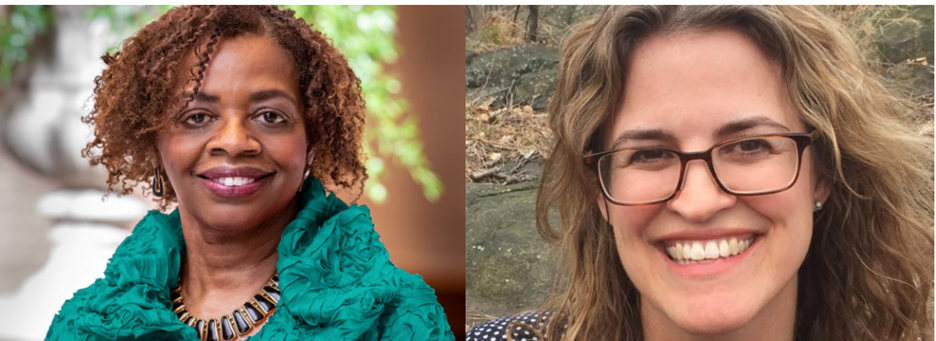
Two headshots side by side. On the left is a black woman (Renée), on the right, a white woman (Stephanie).
SLAM’s Chief Diversity Officer and Fellowship Director, Renée Brummell Franklin (left) and RK&A’s Director, Stephanie Downey (right).

Stephanie
The first consideration [from the Case Study] is to “define fellowship goals and design fellowship structure to achieve those goals.”  It’s important to carefully consider the logic behind the design and structure of the fellowship and how it will lead to the goals you intend.   By structure, I mean things like the length of the fellowship, the area of focus, and whether you support one fellow or cohort.  You can’t necessarily rely on previous experience running other fellowships and internships because a diversity focused fellowship will have unique goals.  Renée, can you talk about the Bearden Fellowship structure and how it has changed since we did the evaluation?

Renée
Our program was set up so that we selected one fellow per year. The outgoing fellow and the incoming fellow overlap by two weeks.  We find that that overlap is very important, it starts to build the network. Following the evaluation study, we have extended the program. We are going from one fellow to two fellows at a time, and from a one-year program to a two-year program [which relates to other considerations discussed below].

Stephanie
The second consideration is to “align fellowship supervision to the fellowship goals.” We found in the evaluation that the supervisory structure of a diversity-focused fellowship has enormous influence on its success. Museums need to plan carefully for what department the fellowship is situated within, who will supervise that position and also provide training for supervisors and mentors, including DEAI training. These kinds of decisions are especially important for a fellowship for people of color in a predominantly white institution. What is the supervisory structure of the Bearden fellowship and how has it changed?

Renée
The intent of the Fellowship has always been to have Fellows work throughout the Museum on a variety of projects targeted at their interest and the Museum’s needs.  However, over time because the Fellows were supervised by the Director of Education and workspace was in the Education Department, the experiences became very Education focused [which was later changed to align with the program’s intentions].  Additionally, some Fellows often felt the additional burden of working only on Black initiatives [even though that was not the intention of the program].  And before I formally began to supervise and mentor Fellows as a senior staff member, Fellows often sought me out to discuss ways to navigate within the museum as a person of color.

Stephanie
Next is to “commit financial resources to the fellowship.”  This may seem obvious but not too long ago, many museum internships and fellowship across the country were low or not paid.  Thankfully, in the last few years there has been a shift away from no pay or low pay internships and fellowships to ones that offer a livable wage.  Can you talk about financial resources for the Bearden Fellowship?

Renée
I have to say that we have been very fortunate. A significant contributing factor to the Bearden Fellowship being one of the longest-running museum fellowships has been our continuous funding.  And thanks to a presentation that we made at a board meeting about the research [and evaluation], we are delighted that the Museum has received a generous gift from the Frost Family to establish a Romare Bearden Graduate Fellowship Endowment. In the future we will use the endowment’s harvest to support the Bearden Fellowship 100%.  Until that happens, we will continue to support the program with our operating budget and a modest endowment established by the original funders, Daniel and Adelaide Schlafly.

Stephanie
Number four is to “seek a wide range of applicants and define qualifications broadly”. The environmental scan [one evaluation method was a scan of similar diversity fellowships] and SLAM’s experience reveal that recruiting individuals from underrepresented backgrounds can be challenging. And if you go about it in a business-as-usual way, you might not be successful.  Diversity-focused fellowships require rethinking what makes a candidate eligible and where to promote opportunities so that you’re reaching your desired candidates. How does recruitment work at SLAM and what kind of changes are you making?

Renée
One of the great ways that we are able to get a broad variety of applicants is word of mouth, through the Bearden fellows themselves. But we do see the benefit of having a recruiter, an external person going out, building awareness for job opportunities. However, at the museum, we have just under 300 employees and after consideration, we do not feel that we could justify having a full-time recruiter as the study suggests [might be needed]. But, our director of HR is re-imagining the department and she is adding a new staff person, and that staff person will have, as one of their duties, the role of external relationship building and recruitment with the focus on increasing the diversity of museum staff overall.

Stephanie
Number five is to “provide opportunities for fellows to foster networks of support.” Networking both with professional networks and with peers is key to any emerging professional, but even more so for fellows of color working in predominantly white institutions.  Our study found that a peer network—especially peers who are also people of color—can foster a sustaining sense of community.  Fellowships that host one fellow at a time versus a cohort should consider ways to create that kind of network. Renée, what are you doing at SLAM to provide networks?

Renée
I’ll start with the good news. [As result of the evaluation] study, we are moving from one fellow at a time to two fellows, so we will have a cohort.   Prior to this move, one of the ways we tried to build a network for the Bearden fellows is that one of their first annual projects is to reach out to each of the previous Bearden alums, introduce themselves and establish a relationship. We also, for the past 8 years, have had a residency program with the Bearden Foundation in New York. So that gives our fellows an additional network.  From the RK&A evaluation, we [now] have local efforts underway to establish a St. Louis cohort of interns and fellows of color. And those fellows will be able to connect through the different arts organizations in St. Louis.

Stephanie
Number six is to “create an environment that embraces diversity.”  Attracting and retaining professionals from historically underrepresented backgrounds depends on creating an environment where individuals feel comfortable bringing their whole self to work. Creating that environment requires a commitment to equity across the entire museum on a structural level with initiatives like organization-wide diversity plans, as well as targeted training for staff, especially those who will serve as mentors. Could you talk about this at SLAM?

Renée
Starting this year, we have put forth a new structure to continue our DEAI practice with the creation of a DEAI department, which I lead.  Second, we have board support. According to a recent study, only 10% of museums’ DEAI initiatives include a board-level action plan. I am pleased to say that the St. Louis Art Museum is one of those 10%. I acknowledge that there is much work to be done, and I sincerely believe that we are moving in the right direction to create an institution that is welcoming and inclusive to everyone.

Stephanie
The last consideration is to “continuously reflect and evaluate the fellowship to improve” the fellows’ experiences. Evaluation and tracking long-term outcomes are important elements that allow you to adapt and improve over time. What is evaluation like at SLAM and for the Bearden Fellowship?

Renée
I would say that the evaluation findings are having a substantial impact on the fellowship and gathering data has become a regular part of the museum. I would say that we are not data driven, but we are data informed. And we now regularly collect data in every function of the museum. I am confident that continued formal evaluation of the Bearden Fellowship is in our future.

The post How Museums Can Nurture Diverse Talent appeared first on RK&A.

Written by cplysy · Categorized: rka

Jul 02 2021

IRB 101: What are they? Why do they exist?

Green Kermit the Frog against dark background. Kermit looks nervous and bites his nails, reflecting how the author feels about IRB.

Last week, I led an IRB 101 workshop for the Visitor Studies Association.  IRB is the acronym for Institutional Review Board.  That short three-letter acronym, IRB, can instill a lot of fear and anxiety in researchers and evaluators for multiple reasons.  For one, IRBs are an oversight organization, so non-compliance can have repercussions.  Additionally, the language used by IRBs is technical and governmental (e.g., non-compliance, human subjects research). Plus, there are so many acronyms (e.g., IRB, HHS, OHRP)!!

I have 15 years of experience using multiple IRBs with many methodologies and audiences.  Yet, I still had a lot of anxiety in leading an IRB 101 workshop. I felt like nervous, nail-biting Kermit the Frog.  I don’t feel like an IRB expert.  My hope in leading the IRB 101 workshop and writing these posts is to help others overcome their nervousness about IRBs.  Let’s start with a shared, foundational understanding of IRB.

What is an IRB?

An Institutional Review Board (IRB) is a formally designated administrative body established to protect the rights and welfare of human research subjects (research participants, in simpler terms).  IRBs do three main things:

  1. Review research and evaluation protocols involving human subjects prior to starting research and evaluation. Prior is a key word.  The review needs to take place before researchers start recruiting any research participants.
  2. Approve, disapprove, or request modifications to research and evaluation protocols. Researchers submit their protocols (and instruments, consent and assent forms, etc.) to an IRB.  The IRB reviews these materials, weighing the risks to research participants against the benefits of doing research and evaluation.  They have the authority to reject or request modifications if they decide the risks to research participants outweigh the benefits.
  3. Monitor research and evaluation activities. Once research begins, IRBs can request to review research activities. This may happen if the IRB has received complaints from research participants. They may also request to review activities if there is potential non-compliance with the approved research protocols (i.e., not following the rules).

Note that IRBs are specifically US entities.  The Office of Human Research Protections (OHRP) within the Department of Health and Human Services (HHS) oversees all IRBs.  This short video from OHRP provides a good overview about IRBs.

Why do IRBs exist?

Historically, researchers have too often mistreated research participants.  An egregious example is the Tuskegee Study of Untreated Syphilis in the Negro Male (1932-1972).  For 40 years, medical researchers studied black men in Alabama. Some had syphilis, and some did not.  The men thought researchers were providing medical treatment. However, researchers were only monitoring them to study untreated syphilis.  At the initiation of the study, treatment for syphilis did not exist.  When treatment became available, researchers withheld it from research participants.

When the public became aware of the study in the 1970s, the US government began to implement policies to protect research participants.  The National Research Act of 1974 established IRBs to oversee research with human subjects.  Then, in 1979, the The Belmont Report was published.  The report identifies three ethical principles for the protection of research subjects: respect for persons, beneficence, and justice.  Providing further guidance to IRBs was the 1991 establishment of the Common Rule.  The Common Rule takes the three principles of The Belmont Report and outlines practices researchers apply to protect research participants.  The Common Rule was revised in 2018, although the revision did not change practices drastically.

The need to protect research participants has not diminished over time.  As society changes, so does our understandings of potential risks to research participants.  For instance, physical effects on research participants were an initial risk concern (e.g., not treating syphilis).  But, the US government now acknowledges that risks to research participants also include psychological, social, economic, and legal risks.  The Protecting Human Research Participants Training identifies the Facebook Social Contagion Study of 2014 as a modern example of the mistreatment of research participants psychologically.  Researchers manipulated a random sample of Facebook users’ news feeds to show either more positive or negative posts.  They were studying the effects of these manipulations on Facebook users’ emotions.

More on IRBs

Hopefully, this post has established the unquestionable need to protect research participants and instills empathy for the process of applying to IRBs. Check back for more IRB 101 posts soon!

Have questions about IRBs? Let us know in the comments!

The post IRB 101: What are they? Why do they exist? appeared first on RK&A.

Written by cplysy · Categorized: rka

  • « Go to Previous Page
  • Go to page 1
  • Interim pages omitted …
  • Go to page 3
  • Go to page 4
  • Go to page 5
  • Go to page 6
  • Go to page 7
  • Interim pages omitted …
  • Go to page 15
  • Go to Next Page »

Footer

Follow our Work

The easiest way to stay connected to our work is to join our newsletter. You’ll get updates on projects, learn about new events, and hear stories from those evaluators whom the field continues to actively exclude and erase.

Get Updates

Want to take further action or join a pod? Click here to learn more.

Copyright © 2026 · The May 13 Group · Log in

en English
af Afrikaanssq Shqipam አማርኛar العربيةhy Հայերենaz Azərbaycan dilieu Euskarabe Беларуская моваbn বাংলাbs Bosanskibg Българскиca Catalàceb Cebuanony Chichewazh-CN 简体中文zh-TW 繁體中文co Corsuhr Hrvatskics Čeština‎da Dansknl Nederlandsen Englisheo Esperantoet Eestitl Filipinofi Suomifr Françaisfy Fryskgl Galegoka ქართულიde Deutschel Ελληνικάgu ગુજરાતીht Kreyol ayisyenha Harshen Hausahaw Ōlelo Hawaiʻiiw עִבְרִיתhi हिन्दीhmn Hmonghu Magyaris Íslenskaig Igboid Bahasa Indonesiaga Gaeilgeit Italianoja 日本語jw Basa Jawakn ಕನ್ನಡkk Қазақ тіліkm ភាសាខ្មែរko 한국어ku كوردی‎ky Кыргызчаlo ພາສາລາວla Latinlv Latviešu valodalt Lietuvių kalbalb Lëtzebuergeschmk Македонски јазикmg Malagasyms Bahasa Melayuml മലയാളംmt Maltesemi Te Reo Māorimr मराठीmn Монголmy ဗမာစာne नेपालीno Norsk bokmålps پښتوfa فارسیpl Polskipt Portuguêspa ਪੰਜਾਬੀro Românăru Русскийsm Samoangd Gàidhligsr Српски језикst Sesothosn Shonasd سنڌيsi සිංහලsk Slovenčinasl Slovenščinaso Afsoomaalies Españolsu Basa Sundasw Kiswahilisv Svenskatg Тоҷикӣta தமிழ்te తెలుగుth ไทยtr Türkçeuk Українськаur اردوuz O‘zbekchavi Tiếng Việtcy Cymraegxh isiXhosayi יידישyo Yorùbázu Zulu