• Skip to main content
  • Skip to footer
  • Home

The May 13 Group

the next day for evaluation

  • Get Involved
  • Our Work
  • About Us
You are here: Home / Archives for allblogs / rka

rka

Jun 30 2021

Gen Z are Investigators: What Does This Mean for Cultural Institutions?

Summer is here, and with it, a new guest blogger series! Today we are excited to share a new post by our friend Sadiya Akasha of Sitara Systems. Sadiya is a researcher, product designer, and expert on Gen Z (people born between 1995 and 2010).  In this summer series, Sadiya will make the case for how and why engaging Gen Z is critical and share research-based insights that cultural institutions should note if they want to survive and thrive.

Her first post, below, highlights how Gen Z’s tendency to act as “investigators” affects their expectations of museums and cultural institutions.

Thank you, Sadiya, for sharing your expertise!


“Generation Z is the most tech-savvy generation” or “Generation Z spends the most time on social media.” We hear sentiments like these all the time, but what does it mean?  It means that Gen Z, born between 1995 and 2010, has greater access to information and people compared to any prior generation.  Being the most *connected* generation allows them to curate and create communities, build meaningful connections that help them define themselves, and hold perspectives that were not possible for any other generation.

Members of this generation, coming of age during a global pandemic, are currently eyeballing your cultural institution as a place to spend an afternoon engaging in active learning while socializing. How is that different from the way older generations engage with your museum or library? It turns out Gen Z has an entirely different set of expectations shaped by their unique upbringing that affects their decisions.

Growing up in an information-dense world

For starters, this generation has grown up during the Great Recession, a continuous war on terror, a global rise in authoritarianism, ideological polarization, massive racial protests, mass incarceration of children and asylum seekers, and, of course, a global pandemic. Though prior generations have struggled with some of the same (or similar) issues, none since the Silent Generation have grown up in an era with so little to buffer them from the onslaught of current events. The Silent Generation came of age in the shadow of World War II, and it left a lasting impact on their attitudes and worldview. Similarly, Gen Z has grown up in the aftermath of 9/11 and the ensuing War on Terror and that is likely to have a lasting impact. The oldest Gen Z kids would have been 6 years old on September 11, 2001. Throughout their lives, they have been immersed in media, with polarized news coverage competing for attention against the constant marketing of digital distractions. All of these information sources have their own agenda; thus this generation, composed currently of 11 to 26 year-olds, have learned to be particularly critical of any information presented to them and thoroughly scrutinize every source.

Cutting through the noise as a core competency

The unique combination of nearly infinite access to information (and a global reach) coupled with a near-constant evaluation of the motives behind consumable content has caused Gen Z to become both global and critical thinkers in a way quite beyond the norm for previous generations. 

This generation has become avid researchers, blurring the lines between work, play, hobbies, and academic pursuits. They have created online micro-communities to share the fruits of their research, deepen their understanding of particular topics, and be seen and heard by like-minded folks. Values, it turns out, are equally important to this generation as meaningful identity markers in an otherwise fluid and multicultural society. 

Ubiquitous internet access has given them a truly global reach where it would not be odd for a high schooler from Philadelphia to befriend a postal worker from a small town in Scotland if their specialized interests in sea shanties and respect for personal pronouns overlap. Where once we had to make do with AOL chat rooms populated by students in our own schools and neighborhoods, Gen Z is catapulted into depression-busting video dance challenges originating in places like Limpopo, South Africa! 

This kind of access and exposure forces them to be discerning and selectively inclusive. They can, and do, think about the values and agenda that drive online interactions. Consequently, in sharing resources, findings, and experiences with their peers, Gen Z clearly articulates their agenda and values to ease the burden on their viewers and collaborators. Furthermore, they provide sources to back up their statements. Gen Z is used to doing the work to see through marketing and propaganda. Cultural institutions will also have to engage in the work of declaring and living up to their institutional values to be able to meet this generation in good standing.

Authenticity is foundational to building trust

In my work as a Researcher, I’ve seen the value of sharing an institution’s agenda with Gen Z audiences firsthand. In interviews and test sessions I clearly state that the cultural institution I am working with is trying something new, they are doing this specifically to reach people like them, and they are looking for open feedback to better understand them and build a deeper connection. This is a simple thing to do, but it sets the tone of the interaction to one with a clearly understood values-based agenda. Seeking feedback on a new project or approach is a highly authentic opening that invites the audience in to participate. 

Most recently, I worked with a small museum that was experimenting with a new way of engaging with Gen Z audience members in their community. During the interviews, it was like seeing the lightbulb turn on when the participant would suddenly realize their feedback was of real import to the museum. They felt valued, and they said so! It was an immediate connection and the participants were all extremely excited about the project and looking forward to its launch. Of course, after building this authentic connection the next (and most important!) step is to listen deeply and reflect the research findings in your final production, whether that’s a virtual interactive, a change in exhibit layouts, or a newly commissioned work of art.

Cultural Institutions need to do the work to build trust with Gen Z.  Trust can only be earned through a clear statement of agenda, acknowledgment of when that agenda has differed in the past, transparency of the process, and actively lived values. And all this needs to be delivered with authenticity as part of an ongoing conversation with Gen Z in order to deeply engage this generation. 

What’s next?

In the next post in this series, I’ll uncover how being the most racially diverse and multicultural generation in the US affects Gen Z’s views on identity and humanity. The existence of the most multicultural and multiethnic generation to date is going to upend traditional approaches to audience research and redefine demographic collection protocols.

About the Author
A brown woman with shoulder length hair looks into the camera. She is a millennial, not Gen Z.

Sadiya Akasha is the co-founder and Director of Product Development at Sitara Systems, a design and technology laboratory that creates interactive experiences with emerging technologies. Sadiya partners with cultural institutions to help them conceptualize and deliver technology initiatives by leveraging her background in human-centered design, agile thinking, and audience research. In her free time Sadiya enjoys exploring the rugged yet delicate landscapes of the great Southwest. 

The post Gen Z are Investigators: What Does This Mean for Cultural Institutions? appeared first on RK&A.

Written by cplysy · Categorized: rka

Jun 23 2021

Collaboration, Expertise, and Museum Education: Reflections from a COVID-era Furlough

By: Sarah Boyd Alvarez

In early April I returned to work after a three month furlough. While being furloughed was not welcome news in an already challenging year for the field of museum education, this period away from my job as an art museum educator gave me ample time to think deeply and reflectively, something that feels in short supply when carrying out my regular duties and schedule. I was able to take time for calls with colleagues at other museums, attend or observe virtual programs while not also trying to work on emails or other projects, and rest my body and mind so I could be fully present and engaged in whatever I was doing (with my family or in my own personal pursuits).

This pause also yielded new insights about the nature of museum education work, particularly the idea of expertise as it relates to our field. While I am an art museum educator, I believe my insights can apply across the museum education field. We often say our expertise, or core competency, is in teaching methodology and practice, program design, and knowing our audience and content. We are indeed strong in all of these things. I would add that we are also very skilled in collaboration, but sometimes this capacity gets overlooked or even misconstrued. Collaboration is in fact critical to the ways in which we push back against “expertise” as a manifestation of inequitable hierarchies in our museums and in the broader landscape of teaching and learning.

Collaboration is in fact critical to the ways in which we push back against “expertise” as a manifestation of inequitable hierarchies in our museums and in the broader landscape of teaching and learning.

Excellence Through Collaboration

Because we are good at collaborating, our work as museum educators takes us into dialogue with many different people both in and outside of our museums, each with knowledge and skill sets often distinct from our own. These colleagues, partners, and stakeholders in turn each rely on us to be informed and adept in different ways that are defined by the context of our work together and it can seem as if we are constantly repositioning or reframing ourselves to some degree. At times, this may feel disorienting or unfocused. I have certainly felt this way. I wonder, however, how we can better understand and celebrate collaboration as core to our skill set. Might we even see it as our hidden strength?

In my career, the most impactful work has always happened in collaboration. When I started museum programs for medical and nursing students, law enforcement, and corporate professionals in 2005, it was the shared capacities between myself and an educator who had previously worked with the specific audience that produced the most engaging experience for learners (and for us). For instance, I didn’t know much about nursing education or leadership training and was pretty sure it would be largely ineffective if I tried to pretend I did during the programs. So, like with any good co-teaching model, success came from mutual respect between the two of us in planning and facilitating, ultimately lifting up each other as well as the quality of the experience for the learners. Another, later collaborative experience involved a partnership with a historian who was not used to teaching with images but was highly effective in teaching about historical inquiry. Our paired skills in training teachers was transformational for all involved.

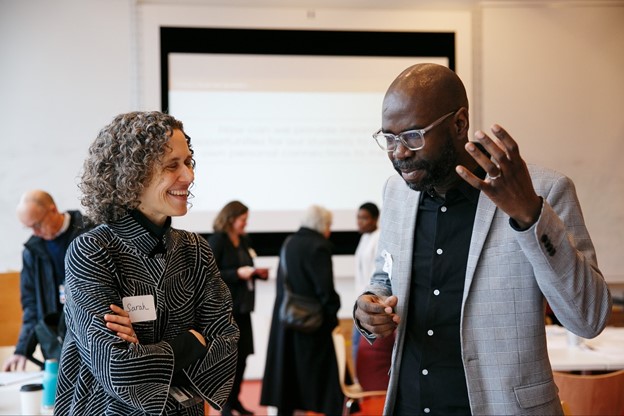
A woman and a man are conversing and collaborating in the foreground. The woman's arms are crossed and she is smiling, while the man is gesturing with his left hand in the air and looks to be in thought. Other people are conversing in the background. They all appear to be in a conference room.
Sarah Boyd Alvarez and Duone Brown, visual art teacher at Murray Elementary Language Academy in Chicago Public Schools, participate in an ideation session about using artworks to teach the theme of “Asia in the World”. The collaborative session included K-12 teachers, local scholars, curators, and museum educators.

I have so many more examples like this in my 20-year career and I won’t list them all, but these collaborations are something that only now I come to realize as a truly defining aspect of my work. These experiences have allowed me to see the relevance of object-based and art museum learning in so many contexts I had never previously imagined, although—and most importantly—they have never made me feel as if I was or needed to be an expert in each of those contexts. Instead, the work was so much richer because I partnered with people whose capacities were distinct from yet complementary to mine.

“Expertise” in Equitable Partnerships

Despite these examples of effective collaboration, I continue to see instances in our work as museum educators where we feel pressure to be all to everyone, which can feel like a constant reinvention of our professional selves. Colleagues in our museums or even audiences that seek us out unwittingly assume that when we are designing programs in response to important issues and events, museum educators must inherently become experts in that thing. For example, as calls for racial justice have increased and intensified, museums are embracing their role as spaces for dialogue, interaction, and change. As such, there is urgency among and for museum educators to learn and transform our practice to be one that is fundamentally antiracist. It can feel like we must become experts, and fast.

Rather than see this as a need to reinvent ourselves, however, I would posit that museum educators can always (and already do) seek to learn and grow our skills, perspectives, and understanding in response to the needs of our audience or time, and that we should continue to rely on our skills as collaborators with experienced partners to expand this effort. In fact, I want to make a case for museum educators to be more fully recognized for their skills in collaborating. In response to the world around them, they actively identify and seize opportunities to complement their experience and resources equitably with those of others and to truly create a whole greater than the sum of its parts.

I want to make a case for museum educators to be more fully recognized for their skills in collaborating.

Collaboration is one of the most unique and treasured qualities of museum education. And, in the case of antiracist pedagogy, it is essential to the ways we can contribute to dismantling the hierarchies and power dynamics associated with “expertise”. For instance, as a white woman of acknowledged privilege, whose formal education and training did not focus on antiracism, I embrace and commit to rigorously learning, reflecting, and transforming my practice, accepting that I will never be an expert since the work of antiracism is an ever-evolving fight against racism within changing contexts. My work as an antiracist educator will instead manifest in these various ways: at times teaching on my own while drawing from the lessons learned from observing others; in other instances partnering or co-teaching with peers who have different perspectives, skills, and experiences than I do; and sometimes fully stepping aside to let someone else take the lead. The “expertise” in this work will always be dynamic and situated within an equitable partnership, honoring the ways that the experience, knowledge, and perspectives of each contributor can elevate the teaching practice.

Such ongoing efforts to connect, learn, and create impact together with others are core to museum education. Museum educators’ “expertise” therefore isn’t singular, but rather contingent upon an equitable model of collaborative practice. As we navigate an ever-changing society and trajectory for museums, this approach to collaboration is truly our hidden strength and it deserves greater understanding and recognition. Who’s with me?

About the Author

Sarah Boyd Alvarez is Senior Director for Students and Educators in the Department of Learning and Public Engagement at the Art Institute of Chicago. She is responsible for a comprehensive program of learning resources and opportunities for K-12 schools, centering shared inquiry, cross-cultural connections, and accessible, multimodal experiences, with priority for Chicago Public Schools. In addition to her specific activities at the Art Institute, Sarah actively engages in city-wide dialogue about high quality, equitable arts education experiences for Chicago students and has published various articles and essays about museum learning. She can be reached at salvarez@artic.edu.

The post Collaboration, Expertise, and Museum Education: Reflections from a COVID-era Furlough appeared first on RK&A.

Written by cplysy · Categorized: rka

Jun 18 2021

Anti-racism Pledge: 7-month Update

Seven months ago, RK&A committed to anti-racist practice. To hold ourselves accountable, we write these updates to publicly document the work we have been doing and work still to do.

We at RK&A, individually and collectively, pledge our commitment to being anti-racist—which we recognize as an ongoing pursuit through our everyday actions.

“Being racist or antiracist is not about who you are; it is about what you do.”

—National Museum of African American History and Culture’s Talking About Race website

Regular and Deeper Internal Discussions on Anti-racist Practices

Anti-racist practice is an agenda item at every staff meeting, so the work is top-of-mind.  We document and share what we have been reading related to anti-racist practices.  We reflect on anti-racist practices in our current work.  Also, we set goals for anti-racist practices for future work.  As RK&A staff, we have been working together for 5 years or longer. There is a great deal of trust among us, so our conversations are open and vulnerable.  We don’t always have solutions or the right words to talk about anti-racist practices.  But, we have a safe space to do the work together, which I value.  I think it helps us build the confidence to apply anti-racist practices in our client-facing work.

Our conversations about anti-racist practices are not relegated just to staff meetings.  For example, staff recently witnessed the way language and actions can cause harm to people of color during a recent project meeting.  They brought this experience back to the whole RK&A team.  We talked about what happened, and how the project partners of color responded.  We also discussed potential ways we might anticipate and handle similar situations in the future.

Using Anti-racist Language in Public-facing Situations

In RK&A’s public-facing work, we have grown comfortable using anti-racist language.  Speaking for myself, I try to be clear about the value I place on anti-racist practices.  I am still not very confident in my anti-racist practice though.  And, I am sure I make mistakes in both anti-racist and inclusive language. (For example, in trying to lay out the biases of a homogeneous group in a conversation with colleagues, I used the term “heteronormative” incorrectly.  I did not mean to say the group believed heterosexuality was the preferred orientation).  When I doubt myself, I like to revisit the National Museum of African American History and Culture’s Talking About Race website. It helps remind me to keep doing the work.

Work To Do

It is intimidating to acknowledge that anti-racist work is never done. Anti-racist practice is not a competence to be mastered but a constantly evolving practice.  In the next few months, we will continue to reexamine our evaluation and research practices with our new understandings of anti-racist practices.  In our commitment to anti-racist practices last year, we committed to systematically examine our work using We All Count’s Data Equity Framework.  We did this to some extent at the time of making this pledge.  But, we and the world have changed since then.  It is time to take stock again of where we are and where we want to go.

The post Anti-racism Pledge: 7-month Update appeared first on RK&A.

Written by cplysy · Categorized: rka

Jun 16 2021

Illuminating Culture and Nature Equally: Generative Thinking at a Critical Time

By: Emlyn Koster

Spurred by the art-dominated sections on Museums in The New York Times, Emlyn reflects on this sector’s pressing need for a balanced profile between people/society and non-human life/nature.

Eminence of Art Museums

Titled ‘Reinventing the Future,’ the May 23, 2021 Museums section of The New York Times reveals its bias with this front-page statement: “As museums emerge from a devastating pandemic, they are seeing their art and their purpose in a new light”. Art museums dominate its 30 pages. Two-thirds were occupied by ads for exhibits and stories about art museums: the other third comprised exhibit ads and stories about the American Museum of Natural History (AMNH) and New York Historical Society with a miscellany of articles about Black Lives Matter, Indigenous, and other pressing civic matters. I also reviewed the 40-page Museums section on March 13, 2020. Two-thirds were ads for art and photography shows with the rest featuring exhibits in history museums about colonization, oppression, racism, immigration, and tolerance, plus there were half-page reports about coverage of the 1918 flu pandemic at Philadelphia’s Mütter Museum and climate change at the AMNH.

Astonishingly, the art museum dominance of the May 23 section was accentuated by its opening Critic’s Notebook titled ‘10 Ways for museums to survive and thrive in a post-Covid world’: 26 of its 28 cited institutions are art museums. Three days later, this unbalanced picture was reiterated in an opinion, ‘Still searching for the reimagined museum,’ by a Canada-based museum consultancy lauding the Critic’s Notebook article as if it had provided insights for museums of all types. With repeated admiration for a virtual program from The Frick Collection and concern over a partnership between the Canadian Museums Association (CMA) and Canadian Heritage towards a federal policy for museums, it criticized a perceived lack of impact by Canada’s museums as if their national association determines programs at member institutions. On International Museums Day on May 18, the CMA’s public statement wisely concluded: “The pandemic has changed society. For museums to continue serving the Canadian public, new paradigms, approaches, and solutions must be formed”.

In many quarters, the arts and culture are regarded as equivalent despite early and ongoing efforts to also elevate science into the realm of mainstream culture. Indeed, it remains common to encounter publications and news stories with titles implying broad coverage of the museum sector but which are mostly or only about art museums. While full- and half-page ads understandably help to finance the Museums sections in The New York Times, it would be useful to enlighten readers, while they are drawn to the sector as a whole, about issues such as monetization of artworks, relevance to contemporary matters, and internal stresses with changing priorities. Surely the masthead slogan on every edition of The New York Times―”All the News That’s Fit to Print”―should include a commitment to impartiality about museums!

Generative Thinking

This practice fills an important gap when the initial scope of considerations falls short of all pertinent realities. I came across this approach a decade ago in a Harvard Business Review newsletter contribution by Manda Salls: “… it’s the way in which the intellectual agenda of the organization is constructed… the question should be ‘… do we have the problem right?… generative thinking is getting to the question before the question… it’s not about narrow technical expertise.” A 2015 article adds: “It is a way… to examine an issue or an idea by generating more information about it: identifying the problem instead of solving it; generating questions instead of answers; and making sense before making any decisions”. On the premise that asking topical questions has become an essential activity of museums, I invite a comparison of the list of ten content suggestions offered by Jason Farago in the Museums section of The New York Times with the list of ten progress indicators in my AAM-invited 2006 article about increasing museum relevance and sustainability.

Last year as the pandemic began, I joined an online discussion featuring the Museum for the UN and International Coalition of Sites of Conscience. A participant from Mexico seemed to capture everyone’s attention when he said: “… answering questions is evolutionary but asking new questions is revolutionary.” For me, this reinforced the breakthrough caliber of the question-asking exhibition titled “Race: Are We So Different?” which I hosted at Liberty Science Center and the NC Museum of Natural Sciences (summative reports on the NC experience are available as email attachments from me). With society plagued by systemic racism, this exhibition performed a vital public service by drawing attention to the biological fact that all of human variation amounts to just one tenth of one percent of human DNA. I wish that designing and titling exhibitions with a socially or environmentally pressing question became a common approach.

Nature and Culture

Unbalanced news coverage of the museum sector is more than unfortunate: it warrants a revolution of the questions being asked. As a scientist before a museologist, one of my vantage points in pondering the perilous state of the world is that Homo sapiens, us, the human species, is one of 1.2 million described species and as many as a yet-to-be-described additional 8.7 million species. Society’s emphasis on culture over nature is apparent in the popular use of diversity as distinct from the term biodiversity which respectively refer to human variation and to all of genetic variation across the plant and animal world.

A tall, modern looking museum building emerges out of the rainforest.
Rendering of Xinatli, a planned research museum in the Mexican rainforest. (Source: Studio Viktor Sørless)

Mary Ellen Munley’s review of a book about the social work of museums observed: “… museums are being noticed for the ways they can foster cultures of caring — people caring about each other; people caring for the planet”. Spurred by visionaries such as Jane Goodall, more of society has come to respect non-human life, especially sentient non-human life, and to view natural environments in a complete ecological light. A new museum project in Mexico offers a refreshing prospect of tackling some vital questions about the biosphere. Named after the Nahuatl word xinachtli which describes the moment a seed germinates in the soil, its mission is to utilize “art and aesthetic perception, an ecologically oriented way of building, and a cultural engagement with the other to help preserve the permanence of all life on our planet”.

In the vast majority of natural history and natural science museums, Earth history stops before Homo sapiens evolved. For many institutions, an actual or fake mummy is the extent of coverage of human development as opposed to overviews or samples of the results of fundamental inquiries central to all of us. These include the fascinating developments of rituals, language, religion, shelter, clothing, agriculture, aquaculture, communities, hierarchy, exploration, trade, technology, and conflict. This is an example of the need for the museum sector―and The New York Times―to ask new questions. In the Anthropocene, social justice and environmental justice are interconnected movements.

About the Author

Emlyn Koster, PhD is a geologist, museologist and humanist focused on the Anthropocene, an emerging new age in the Geologic Timescale to recognize humanity’s disruption of the Earth’s natural state and biodiversity. A former chair of the Geological Association of Canada and now an adjunct professor of Marine, Earth and Atmospheric Sciences at NC State University, he has been the CEO of the Royal Tyrrell Museum of Palaeontology, Ontario Science Centre, Liberty Science Center, and the NC Museum of Natural Sciences. He can be reached at koster.emlyn@gmail.com.

The post Illuminating Culture and Nature Equally: Generative Thinking at a Critical Time appeared first on RK&A.

Written by cplysy · Categorized: rka

May 21 2021

The Chief Fill-in-the-Blank Officer: A Trend in Museum Restructuring

Combining experiences at the helm of nature and science museums with insights from literature and courses on leadership, Emlyn Koster reflects on the corporate roots of this trend and its application to the museum sector.

An unfortunate paradox surrounds the subject of organizational structure. On the one hand, it is the primary tool for configuring the work of employees, any organization’s largest single investment. On the other hand, its absence as a session topic at museum association conferences implies that restructuring is an unimportant focus for shared learning. Perhaps this is because restructuring often conjures up unpleasant memories of surprising changes in position titles and responsibilities, reporting relationships, and office locations. Marilyn Ferguson, a guru in the 1980s movement of social and personal transformation, famously observed: “… Each of us guards a gate of change that can only be opened from the inside. We cannot open the gate of another, either by argument or emotional appeal”.

Successful Restructuring

Here are two insights from courses I attended in the 90s. One for business executives in Toronto likened an organizational structure to a wiring circuit diagram in which any faulty connection will cause a breakdown. A structure should map lines of managerial reporting, decision-making, delegation, and the most favorable pathways for cross-functional teamwork. Then a weeklong immersion for nonprofit executives at the Harvard Business School emphasized that between the boxes and lines of a structure, there may be ‘white spaces’ across which departments also need to often collaborate.

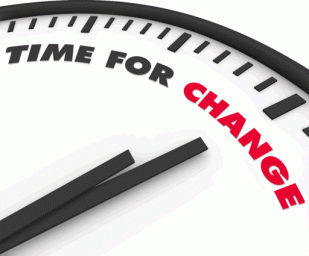
An image of a clock with the phrase "Time for Change" written on it, in reference to the author's call for museum restructuring.

My early years of museum leadership also affirmed that any reorganization would be counterproductive if its draft rationale was not substantially strengthened by one-on-one consultations with those potentially most affected and all-staff feedback opportunities. At both Liberty Science Center and the North Carolina Museum of Natural Sciences, I added a preceding major step. I circulated several drafts of a comprehensive situation analysis after the first 100 days at each CEO appointment to calibrate the state of the institution and to introduce the likelihood of structural adjustments to improve its efficiency and effectiveness—doing things right and doing the right things, respectively. This approach elicited many supportive reactions, such as “If we’d all walk a mile in each other’s shoes, maybe we wouldn’t be so quick to devalue the contributions of coworkers”.

When I read a Harvard Business Review (HBR) article about the Chief Operating Officer (COO) as the CEO’s second-in-command, I became aware of difficulties surrounding a COO appointment at a new science center. A board member who had been an executive at a nearby corporation was appointed CEO and soon hired a COO, necessarily from the private sector because this function was almost unheard of in the museum sector. The other executives reacted negatively to this new player who soon left, having evidently thought that he had a level of seniority between them and the CEO. In addition, his for-profit values seemed incongruent with their mission-advancing values. The conclusions of this HBR article included a need for COOs “to check their egos at the door” and to realize that such positions are “not necessarily in line to receive the kudos for a job well done”.

Recently, as the museum sector has been obliged to think and act in innovative ways, a new genre of restructuring—additional to the rippling effects of downsizing—shows signs of becoming common. In what could be perceived as an approach to transform organizational culture and capabilities, a variety of non-traditional functions are being inserted into the senior management of museums. Compounded by less-than-ideal recruitment approaches due to limitations of online interviews, this step—partly emulating the private sector and partly originating in the museum sector—involves new Chief Fill-in-the-Blank Officer positions which, in alphabetical order, include Commercial, Digital, Diversity, Excellence, Experience, Innovation, People, Strategy, and Technology. Makeba Clay and Cecile Shellman recently remarked on preparing a Chief Diversity Officer (CDO) for success that “… each institution must do extensive diagnostic work to identify and analyze their own challenges” and “institutions that believe they are ready for organizational cultural change [may be] unwilling to face the truth about where they are on their journey”. Concerning her former position of Deputy Director of Digital Initiatives and Chief Experience Officer, Shelley Bernstein clarified that such a position is “in charge of an idea”.

Two museum leaders who have shared their views on the applicability, or not, of private sector practices are Robert Janes, formerly of Canada’s Glenbow Museum who spoke at the Smithsonian’s 150thanniversary symposium (see “Don’t lose your nerve: museums and organizational change), and John Wetenhall of The George Washington University Museum and Textile Museum. How the newly-styled Chief Fill-in-the-Blank Officer positions are optimally spliced into the structure of traditional senior functions is an uneasy task for CEOs to coordinate. As museums rethink their management and try to improve morale, what was a prescient recommendation of Dr. Janes may now be the right gearshift: “…a group of people at the top of an organization, with shared responsibilities and clear accountabilities, are developing strategies together, reaching decisions by consensus, and coordinating implementation of these decisions”. He introduced the leadership team concept of primus inter pares, meaning first among equals. Considering the weighty implications of this approach for the conventional reporting protocol between a museum CEO and her/his governing board, I am reminded of what transpired at the above-noted Harvard Business School course. Experimenting with its CEO-only tradition, board chairs were invited to join their CEOs midweek. What had been a collegially productive atmosphere instantly switched into an awkwardly formal atmosphere and the School soon abandoned its new approach.       

Professional Development

With instability around the traditional lone-CEO approach on the rise, the museum sector needs conference sessions focused on restructuring of leadership with insightful, humanly approaches. Meanwhile, it would be valuable for museums to follow trends of thought and practice about leading change across all sectors (some examples of these trends here, here, here, and here). In its 2016 report on human capital trends, Deloitte noted: “92 percent of participants saw a need to redesign their organization to improve employee engagement and retention and build a meaningful culture. This same survey found that 82 percent of respondents see culture as a competitive advantage, driving innovation, customer service, and employee behavior”. Its 2021 report, titled ‘The New Organization: Different by Design’, notes: “The “new organization … is built around highly empowered teams, driven by a new model of management, and led by a breed of younger, more globally diverse leaders”. Clearly, the design of structures and systems for how results are achieved is ripe for optimization.

About the Author

Emlyn Koster, PhD has been the CEO of Canada’s Royal Tyrrell Museum of Paleontology and Ontario Science Centre, Liberty Science Center in NJ, and the NC Museum of Natural Sciences. With the nature and purpose of leadership an ongoing focus, his recognition has also included Humanitarian of the Year by the American Conference on Diversity and founding chair of ICOM’s Anthropocene Working Group.  Current affiliations include the ambassadors circle for the International Coalition of Sites of Conscience, adjunct professor in Marine, Earth and Atmospheric Sciences at NC State University, and the board of the International Big History Association. He is writing monthly op-ed styles pieces as a guest blogger for RK&A in 2021; find his other posts here.

The post The Chief Fill-in-the-Blank Officer: A Trend in Museum Restructuring appeared first on RK&A.

Written by cplysy · Categorized: rka

  • « Go to Previous Page
  • Go to page 1
  • Interim pages omitted …
  • Go to page 4
  • Go to page 5
  • Go to page 6
  • Go to page 7
  • Go to page 8
  • Interim pages omitted …
  • Go to page 15
  • Go to Next Page »

Footer

Follow our Work

The easiest way to stay connected to our work is to join our newsletter. You’ll get updates on projects, learn about new events, and hear stories from those evaluators whom the field continues to actively exclude and erase.

Get Updates

Want to take further action or join a pod? Click here to learn more.

Copyright © 2026 · The May 13 Group · Log in

en English
af Afrikaanssq Shqipam አማርኛar العربيةhy Հայերենaz Azərbaycan dilieu Euskarabe Беларуская моваbn বাংলাbs Bosanskibg Българскиca Catalàceb Cebuanony Chichewazh-CN 简体中文zh-TW 繁體中文co Corsuhr Hrvatskics Čeština‎da Dansknl Nederlandsen Englisheo Esperantoet Eestitl Filipinofi Suomifr Françaisfy Fryskgl Galegoka ქართულიde Deutschel Ελληνικάgu ગુજરાતીht Kreyol ayisyenha Harshen Hausahaw Ōlelo Hawaiʻiiw עִבְרִיתhi हिन्दीhmn Hmonghu Magyaris Íslenskaig Igboid Bahasa Indonesiaga Gaeilgeit Italianoja 日本語jw Basa Jawakn ಕನ್ನಡkk Қазақ тіліkm ភាសាខ្មែរko 한국어ku كوردی‎ky Кыргызчаlo ພາສາລາວla Latinlv Latviešu valodalt Lietuvių kalbalb Lëtzebuergeschmk Македонски јазикmg Malagasyms Bahasa Melayuml മലയാളംmt Maltesemi Te Reo Māorimr मराठीmn Монголmy ဗမာစာne नेपालीno Norsk bokmålps پښتوfa فارسیpl Polskipt Portuguêspa ਪੰਜਾਬੀro Românăru Русскийsm Samoangd Gàidhligsr Српски језикst Sesothosn Shonasd سنڌيsi සිංහලsk Slovenčinasl Slovenščinaso Afsoomaalies Españolsu Basa Sundasw Kiswahilisv Svenskatg Тоҷикӣta தமிழ்te తెలుగుth ไทยtr Türkçeuk Українськаur اردوuz O‘zbekchavi Tiếng Việtcy Cymraegxh isiXhosayi יידישyo Yorùbázu Zulu