• Skip to main content
  • Skip to footer
  • Home

The May 13 Group

the next day for evaluation

  • Get Involved
  • Our Work
  • About Us
You are here: Home / Archives for cplysy

cplysy

Jun 15 2022

Making Visions Work For You

A good vision statement should do many things for your organization. Too often, a vision statement is created that goes into PR and marketing materials, gets framed on the wall, and then left alone. When we have a good vision, we have so much more than that.

Vision statements can indicate your ‘North Star’. A vision statement can also be your Southwest star, too; it’s about indicating direction. But, it’s more than that.

A good vision statement should:

  1. Provide strategic direction.
  2. Help you make decisions about your strategic activities.
  3. Inspire you and your organization.
  4. Focus on the direction of your efforts.
  5. Align your resources with your goals.

Using Your Vision

It’s worth putting in the work to create a strong vision. A vision will allow you to weather the complexity of your market or circumstances. If you’re getting pushed to do new things, a vision can help you to determine what things are most appropriate. A vision might not tell you exactly what to do, but it will reduce the number of options available. By reducing the volume of information and number of decisions, a vision reduces complexity.

That reduction in complexity reduces the amount of effort you need to put into decisions.

When we have fewer decisions, we can focus more on the quality of those decisions.

Creating Your Vision

Vision statements and the like do not need to require days of meetings and processes. We suggest the following steps:

  1. Research what the pressing needs are of the organization.
  2. Ask what the priorities are of the organization based on these needs.
  3. Inquire about what actions are needed to be achieved within a certain time frame (e.g., year, 3-years, etc..).
  4. Determine the values that guide the work.
  5. Bring together the key leaders and stakeholders to frame what kind of feelings and sensations represent success in achieving the goals.
  6. Put these words (descriptors) together.

Yes, it can be that simple. The aim is to create a good enough phrase that can be used in practice. The focus must be on those who will use the vision, not external audiences. Why? Unless you’re looking to create a PR exercise, the vision is meant to inspire and focus your team.

That means designing it for the humans in your organization, not anonymous external individuals. With a vision ready, you can allow it to serve as your compass as you navigate complexity in the years ahead.

Ready to develop your vision? Want help? Let’s talk – we do this with human services organizations working in complex settings, high-pressure environments, and with a need to innovate.

Image Credit: Erlend Ekseth on Unsplash

The post Making Visions Work For You appeared first on Cense Ltd. .
Written by cplysy · Categorized: cameronnorman

Jun 15 2022

Try This: The SOAR Analysis

This this activity and let me know how it goes. You’ve probably heard of the SWOT analysis. Strengths, Weakness, Opportunities, and Threats. It’s considered a traditional component of the strategic planning process. It’s useful, for the most part. What I mean by this is that, a glaring issue with the SWOT analysis is that the […]

The post Try This: The SOAR Analysis appeared first on Nicole Clark Consulting.

Written by cplysy · Categorized: nicoleclark

Jun 14 2022

Join our private community of evaluators and researchers.

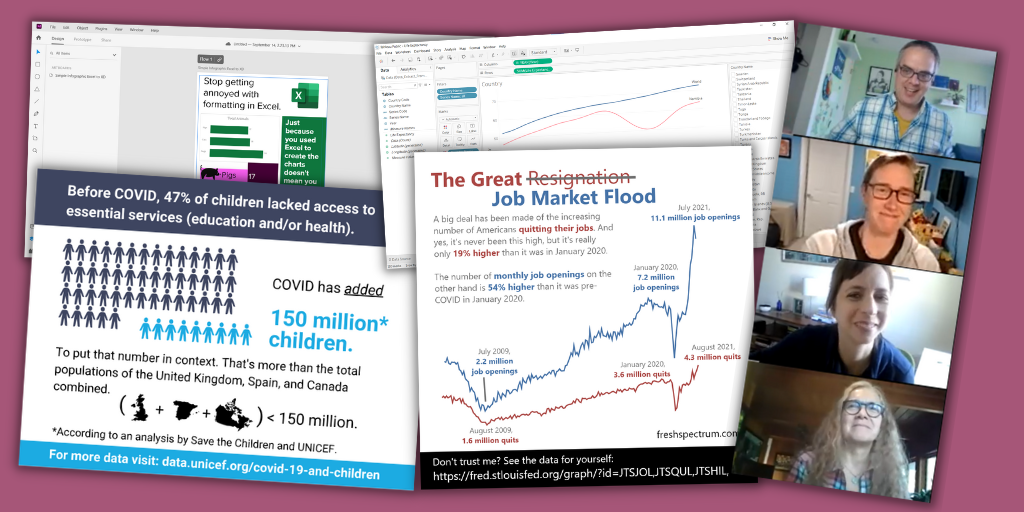
Inside DiY Data Design, evaluators and researchers like you come together to meet and support one another, discover new tech, learn new tricks, get answers to burning questions, participate in data design challenges, and more.

Let's Create Together - DiY Data Design Learning Community with Chris Lysy

Could you become a data design champion?

Behind every well designed report there is a data design champion.

They only sometimes recognize their own talent. And even then, they tend to give far more credit to technology than it deserves. But the reality is, without that person behind the scenes, the cool looking infographic would never exist. Neither would that sleek visual presentation or easy to read slidedoc.

The technology used to create cool things doesn’t work without a person. And if nobody on your team takes the initiative, the status quo remains.

And that’s the secret. It’s not just talent or skill, but initiative. Anyone with the desire to learn could develop the skills to become a data design champion. There are tons of tricks and tools that a person can use to create better infographics and reports.

You could become THE person who makes better design happen in your organization or with your clients. It just involves commitment to building your own skill set, trying new things, and lots of practice.

DiY Data Design Community

Introducing DiY Data Design.

DiY Data Design is a private learning community designed to support aspiring data design champions. The people who join are motivated to go beyond the status quo, committed to self-discovery, willing to do the work, and eager to create.

All data design journeys are unique, but they can all benefit from things like:

  • Direct support from a data design mentor.
  • Introductions to new technology.
  • Cutting edge education.
  • Networking with data design peers.
  • Access to tutorials and templates.

Delivered from within a safe space, free from Cre-Haters and serial Nit Pickers.

Our DiY Data Design Circle Space

What I mean by safe space.

A privacy first attitude. Your work will never be shared outside of the group without your permission. I often stop recording a coaching session so that participants can feel free to privately share their work.

There are no stupid questions. Ask any question without fear of judgment or rejection. We all start somewhere and it’s always okay to ask even the most basic of questions.

A welcoming community. This is a community that welcomes members from diverse backgrounds including race, ethnicity, gender, orientation, neurodiversity, and physical ableness. 

Participate as much or as little as you would like. Want to lurk in the background, take the included courses, watch replays, and not participate in discussions. Feel Free.  The format is open, participate when you have time, take breaks when you don’t.  There is no judgment for lack of participation.

Inside DiY Data Design

Inside DiY Data Design Laughing

So what does being a part of a modern learning community actually look like?  I would say there are 6 fundamental components that make up DiY Data Design.

1. Weekly whiteboard coaching sessions with Chris.

We get together just about every Wednesday except for the occasional holiday or vacation.

Every session opens with either a tour of a specific piece of software, a lesson on a specific data design process, or a case study review of an actual modern report, infographic or dashboard. This part is always recorded.

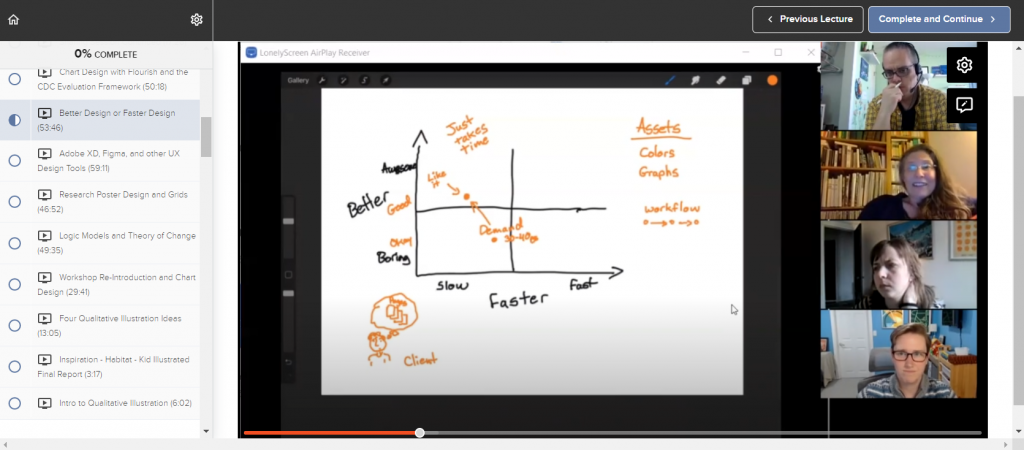
Then we dive into a whiteboard coaching session and group discussion.  In the second half of sessions members are encouraged to share their work, processes, and experiences.

DiY Data Design Whiteboarding Session

2. A coaching session recording archive.

I always believed that a successful workshop or course always left you with something.  A takeaway that you could apply to your own work. Every coaching session is designed to deliver at least one practical takeaway, if not a bunch.

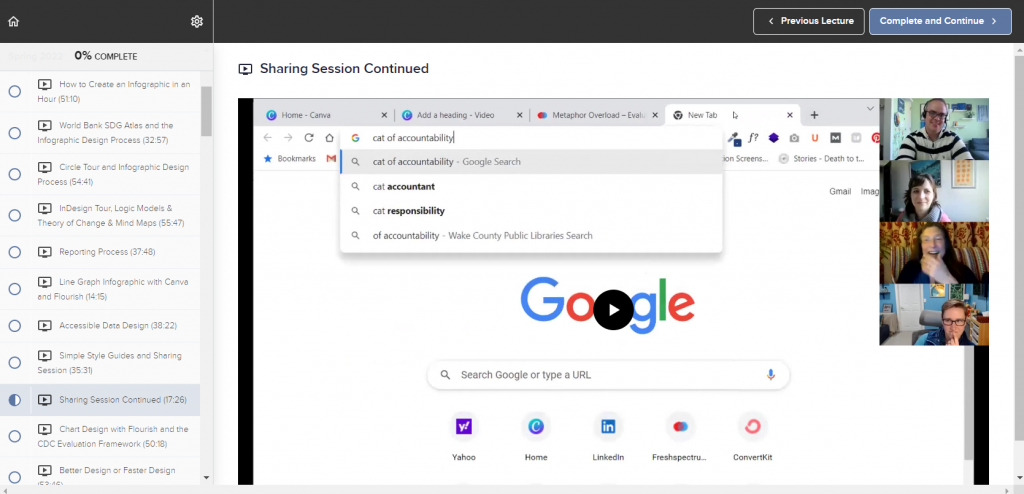
As such, our recording archive is filled with valuable takeaways. We’ve already been operating as a community for 9 months, meeting weekly. And as a bonus, I’ve also included short courses and lessons from my original diy data design workshop.  This gives you hours and hours of content you’ll have access to the minute you register.

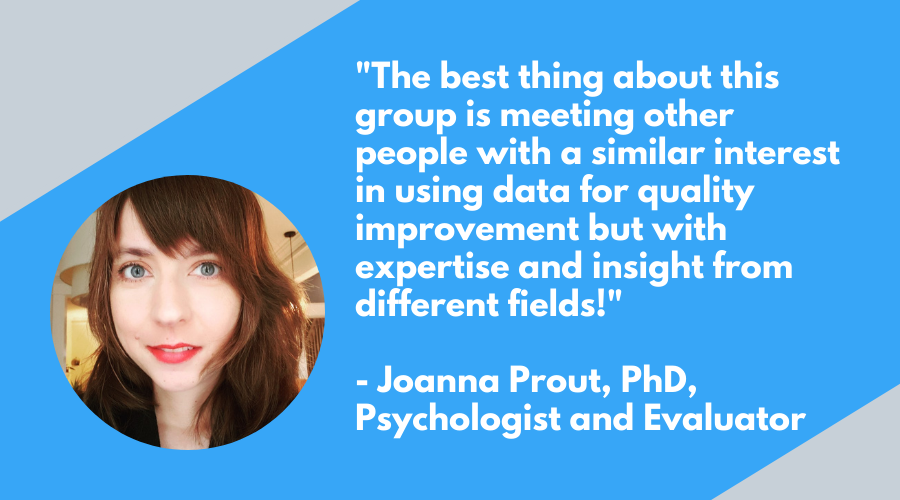
The best thing about this group is meeting other people with a similar interest in using data for quality improvement but with expertise and insight from different fields!

Joanna Prout, PhD, Psychologist and Evaluator

3. An online circle community hub.

In a lot of ways DiY Data Design is a learning community for people who don’t always have the time to be active in a community.  

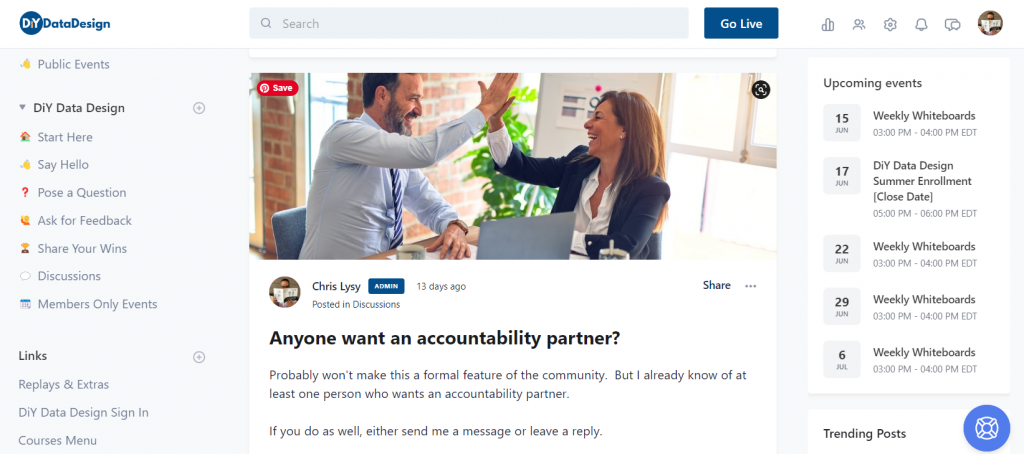
We are built on a Circle community site. There you’ll find a space where you can learn about upcoming events, freely share your work, get feedback, and ask questions.  You can also build out your profile to introduce yourself and your learning goals to me and your fellow community members.  

You are not required to visit often, or ever, if an online community is not your style.  It’s a site that is there if and when you need it. I will also personally read every post that goes onto the site and will usually reply within the next day or two.

4. Self paced courses.

As a DiY Data Design member you will also gain access to a set of self-paced courses.  There are a few existing courses right now, with another handful slated for release this summer and fall.

Currently included:

  • Lunch Break Sessions – Series 1 (diydatadesign exclusive)
  • 1.2.3. Report! (soon to be unpublished and archived)
  • DataViz for Anti-Racism (currently unpublished and archived)

Upcoming course release schedule:

  • Effortless Infographics (Summer 2022)
  • Canva Jumpstart (Summer 2022)
  • Flourish Jumpstart (Summer 2022)
  • Logic Models and Theory of Change (Fall 2022)
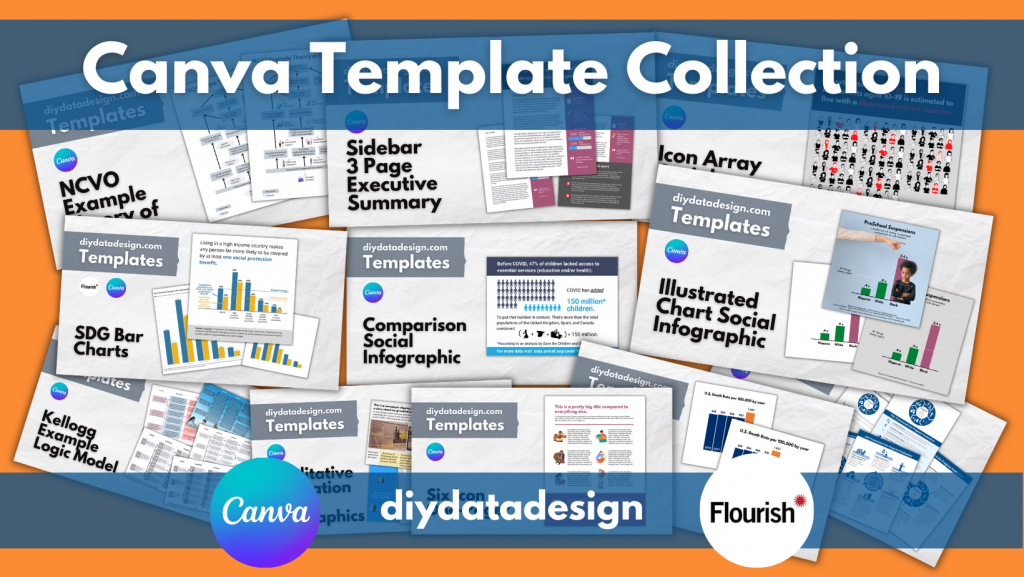
DiY Data Design Canva and Flourish Template Collection

5. Data Design Template Collection

You will gain access to a growing collection of specially designed Canva and Flourish design templates. These designs are available to copy and use in your own work.

In the future this collection will also include PowerPoint infographic templates, Excel chart templates, and Data Design Worksheets.

6. Hands on support and coaching from Chris Lysy

As a consultant my minimum project size is in the thousands of dollars. Through this learning community model I get to offer direct hands-on support at a fraction of the cost. I love to teach and will go out of my way to support our community members.

Very much enjoying our creative reporting workshop with Chris.

He has gone the extra length to help me with an annual report and gave feedback on an article I wrote. Our weekly sessions are informative and practical and helping me moving forward in my data and design journey!"

Mareli Claassens, PhD, Professor and Evaluator

Right now is the perfect time to join the community, here is why!

The summer registration period is only open through the end of this week (June 17, 2022).  It won’t open again until early September.

Here is why you should sign up today!

  1. Prices are going up in the fall (considerably). This is the last quarter to lock in your membership at the original subscription rate.
  2. Last chance to get all of the upcoming self-paced courses included in the subscription.  Starting in the fall only a subset of the upcoming DiY Data Design self-paced courses will be included with the subscription.
  3. Last chance to get a free 30 day trial.  The trial period is going to drop from 30 to 7 days.
Deadline is Coming Cat GIF

Feel like it’s a match?

Outstanding! Here is the current pricing information.

Just keep in mind that enrollment is only open through June 17, 2022.

  • Monthly – $50
  • Annual – $500 (two months free)

Right now you can use this link to apply a 15% off coupon.

15% Off Discount (15OFF)

Need a Scholarship?

Intended for students, non-profits, unemployed, BIPOC, developing countries, and anyone who would like to join the workshop but cannot afford full registration costs.

No application necessary, choose one if you need one, just use the following coupon codes:

25% Off Scholarship (25SCHOLARSHIP)

50% Off Scholarship (50SCHOLARSHIP)

Join US!!!

There is nothing to LOSE!

Join us today and you'll get a 30 day free trial.

If it is not right for you, cancel anytime before the 30 days are up and you will NOT be charged.

Written by cplysy · Categorized: freshspectrum

Jun 13 2022

Three Metrics for Design Evaluation

Design is about the creation of products, services, policies, and systems for use and benefit. It’s a structured, creative process that shapes what we do, how we do it, and what impact we create. Design is fundamentally about innovation: doing something different or new for benefit within a context.

Inspiration, Utility, and Values

How should we measure design and its impact on our organization? We suggest three core evaluation metrics above all to consider.

  1. Inspiration. A design has to inspire you. If you’re not excited about what you’re producing, why would it inspire your clients, customers, or users? By inspiration, we mean that it must capture or focus attention, delight, or attract energy. It does not mean a design has to be glamorous, just that it’s noticed for its purpose or appropriately invisible. For example, creating a negative opt-in to organ donation on driver’s license renewal forms vastly increases the donor pool (and reflects the desire of the population to be donors in the process) because it means people have to choose not to donate, rather than the opposite. Even with something benign like a form adjustment, Inspiration is an outcome.
  2. Utility. Use is the second key metric. Design is about being fit for purpose and if there is a poor fit then the benefits will also be poor. A great design fits the purpose for what it was designed for and is useful. It doesn’t have to be the best, just useful and better than the available alternatives. If your design is not used, then no matter how functional, attractive, or conceptually sound it is, it is a failure.
  3. Values. The alignment of your design with the values of your organization is critical to ensuring that the benefits that you accrue are the ones you want. If you value sustainability and responsibility, then your design has to reflect that. To illustrate, if you’re a company or organization that stands for human rights and ethical practices, what you produce (your designs) needs to reflect that. We see a lot of problems with organizations that say one thing and then design for something else.

From Perfection to Fit

There are no ‘perfect’ designs. A design is made within a time and context and the value and benefit of that design will change over time as the context changes. Even if we want things to stay the same and stable, the world around our designs is changing and evolving. Designs are also made with constraints posed by resources, time, and circumstances. However, design is designed — your process and procedures need to aspire and be set up to achieve the results you’re looking for.

These changes are why evaluation is such an important part of design: we need to continue to monitor and evaluate our designs in light of changes in context and circumstance.

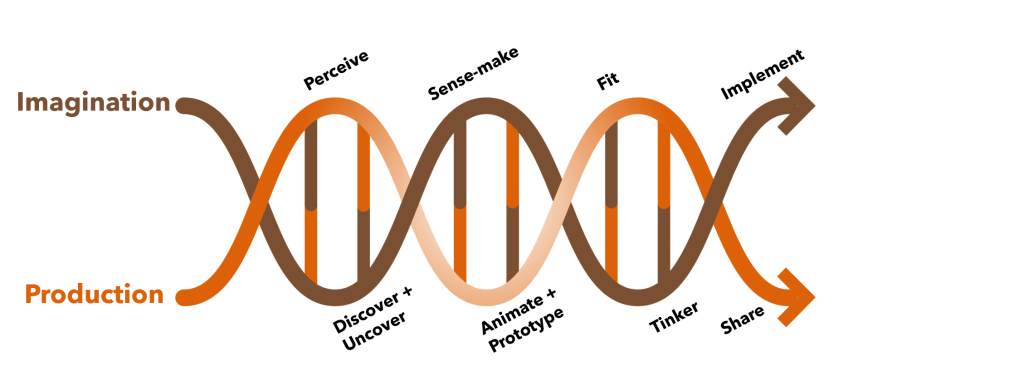
We can’t hope for inspiration, utility, and alignment with values unless we design our designs to match that. Models like the Design Helix (below) can provide some guidance on what can be done to facilitate this.

The process of design and innovation is part art and part science. If you’re looking to design better — whether it’s to improve your products and services, make better policies, or build a culture of innovation we can help. Let’s talk.

Photo by Annie Spratt on Unsplash

The post Three Metrics for Design Evaluation appeared first on Cense Ltd. .

Written by cplysy · Categorized: cameronnorman

Jun 10 2022

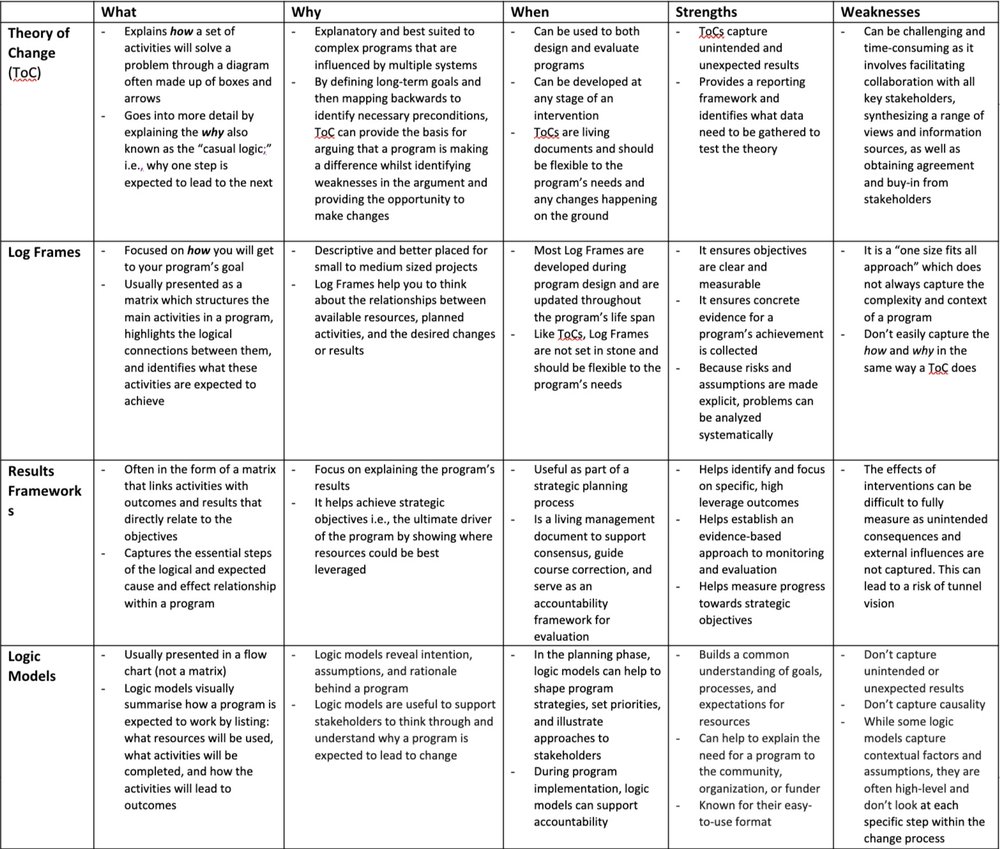
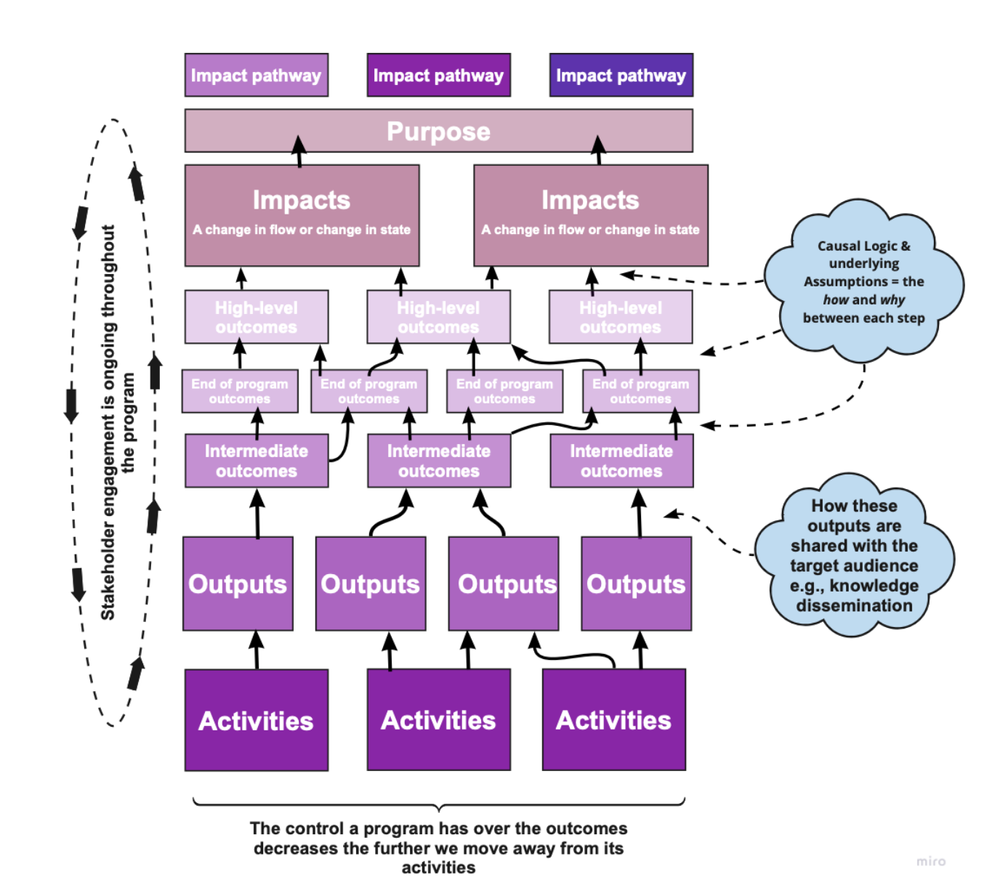
Differences between Theory of Change, Log Frames, Results Frameworks and Logic Models – what are they and when to use them

In some of our previous articles, we’ve introduced and explained how to use different evaluation planning tools for identifying and assessing outcomes. You might have noticed how there seem to be quite a few tools doing very similar things. It’s no surprise that these tools can sometimes be confused, and the lines can be blurred around when and how to use them.

To help you on your way to deciding which tool is best suited to your evaluation, we’ve selected a few of our favourites to compare and contrast. These tools include: 

  • Theory of Change (ToC) 

  • Log Frames 

  • Results Frameworks 

  • Logic Models 

There are some common points across all of the available tools: 

  • All tools provide transparency and a visual explanation for why your program is expected to contribute to change 

  • All tools can help to track progress towards a specific objective 

  • All tools can be used at both the planning and evaluation stages of a program 

  • All tools are living documents and should be reviewed throughout the program lifespan 

  • All tools are time-consuming to develop, but to differing extents; they all require some reflexivity and strategic thinking to develop 


Theory of Change (ToC)

What 

  • Explains how a set of activities will solve a problem through a diagram often made up of boxes and arrows 

  • Goes into more detail by explaining the why also known as the “casual logic;” i.e., why one step is expected to lead to the next

Why 

  • Explanatory and best suited to complex programs that are influenced by multiple systems 

  • By defining long-term goals and then mapping backwards to identify necessary preconditions, ToC can provide the basis for arguing that a program is making a difference whilst identifying weaknesses in the argument and providing the opportunity to make changes 

When 

  • Can be used to both design and evaluate programs 

  • Can be developed at any stage of an intervention 

  • ToCs are living documents and should be flexible to the program’s needs and any changes happening on the ground

Strengths 

  • ToCs capture unintended and unexpected results 

  • Provides a reporting framework and identifies what data need to be gathered to test the theory 

Weaknesses 

  • Can be challenging and time-consuming as it involves facilitating collaboration with all key stakeholders, synthesizing a range of views and information sources, as well as obtaining agreement and buy-in from stakeholders

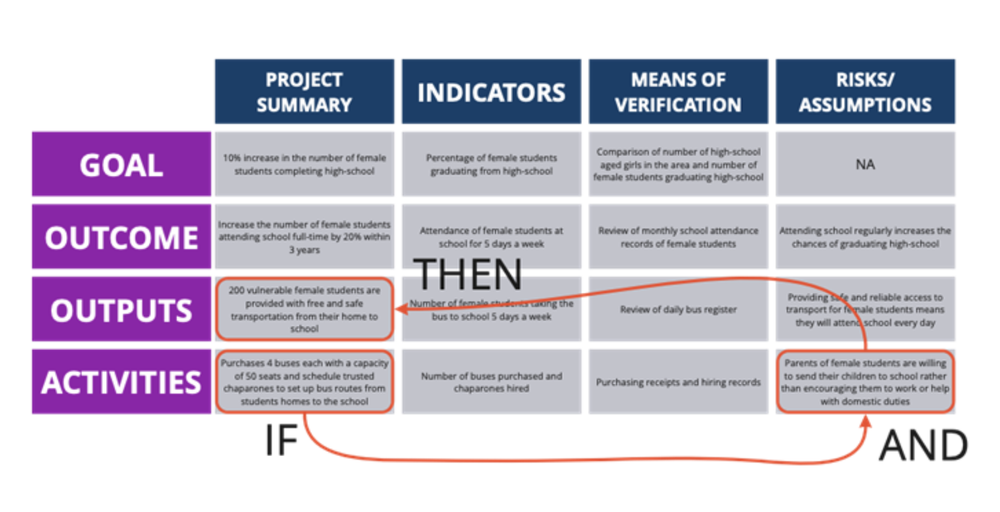
Log Frames

What 

  • Focused on how you will get to your program’s goal 

  • Usually presented as a matrix which structures the main activities in a program, highlights the logical connections between them, and identifies what these activities are expected to achieve 

Why 

  • Descriptive and better placed for small to medium sized projects

  • Log Frames help you to think about the relationships between available resources, planned activities, and the desired changes or results

When 

  • Most Log Frames are developed during program design and are updated throughout the program’s life span 

  • Like ToCs, Log Frames are not set in stone and should be flexible to the program’s needs

Strengths 

  • It ensures objectives are clear and measurable 

  • It ensures concrete evidence for a program’s achievement is collected 

  • Because risks and assumptions are made explicit, problems can be analyzed systematically 

Weaknesses 

  • It is a “one size fits all approach” which does not always capture the complexity and context of a program 

  • Don’t easily capture the how and why in the same way a ToC does

Results Frameworks

What 

  • Often in the form of a matrix that links activities with outcomes and results that directly relate to the objectives

  • Captures the essential steps of the logical and expected cause and effect relationship within a program

Why 

  • Focus on explaining the program’s results

  • It helps achieve strategic objectives i.e., the ultimate driver of the program by showing where resources could be best leveraged

When 

  • Useful as part of a strategic planning process

  • Is a living management document to support consensus, guide course correction, and serve as an accountability framework for evaluation

Strengths 

  • Helps identify and focus on specific, high leverage outcomes

  • Helps establish an evidence-based approach to monitoring and evaluation

  • Helps measure progress towards strategic objectives

Weaknesses 

  • The effects of interventions can be difficult to fully measure as unintended consequences and external influences are not captured. This can lead to a risk of tunnel vision

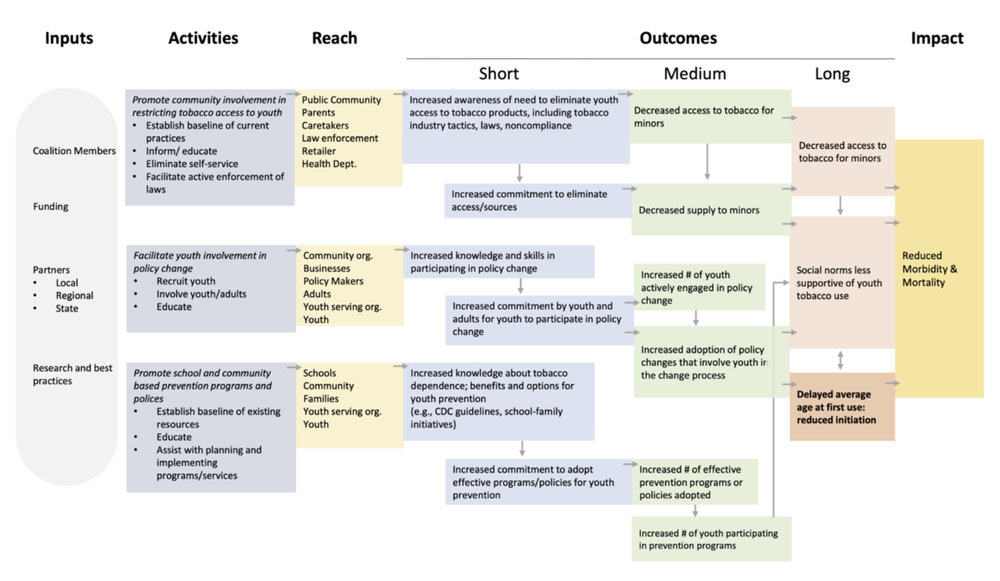
Logic Models

What 

  • Usually presented in a flow chart (not a matrix)

  • Logic models visually summarise how a program is expected to work by listing: what resources will be used, what activities will be completed, and how the activities will lead to outcomes

Why 

  • Logic models reveal intention, assumptions, and rationale behind a program

  • Logic models are useful to support stakeholders to think through and understand why a program is expected to lead to change

When 

  • In the planning phase, logic models can help to shape program strategies, set priorities, and illustrate approaches to stakeholders

  • During program implementation, logic models can support accountability

Strengths 

  • Builds a common understanding of goals, processes, and expectations for resources 

  • Can help to explain the need for a program to the community, organization, or funder 

  • Known for their easy-to-use format 

Weaknesses 

  • Don’t capture unintended or unexpected results

  • Don’t capture causality

  • While some logic models capture contextual factors and assumptions, they are often high-level and don’t look at each specific step within the change process


Theory of Change (ToC)

Main Components:

  • Activities 

  • Outputs 

  • Outcomes 

  • Impacts 

  • Purpose statement 

  • Impact pathways 

  • Description of the causal logic 

  • Description of the key actors 

  • Description of the indicators 

  • Assumptions (the factors outside of the program’s control that are necessary to ensure the program’s success) 

Description of alternative explanations and external factors (i.e., the different ways that may lead to change that are not related to your program) are often included in the narrative. 

Log Frames

Main Components:  

  • Main Goal  

  • Outputs 

  • Outcomes  

  • Activities  

Log Frames may also include indicators of how you will measure change and risks or assumptions underlying the change 

Results Frameworks

Main Components:  

  • Activities 

  • Outcomes (intermediate and longer term) 

  • Impacts (longer term) 

  • Outputs 

  • Indicators 

  • Critical assumptions and risks that must be in place for the intervention to be successful 

Results frameworks are often accompanied by a monitoring plan which includes baseline values and targets for expected outcomes and specifies the measures of achievement 

Logic Models

Main Components:  

  • Goals 

  • Inputs 

  • Activities 

  • Audience 

  • Outputs 

  • Outcomes 


Have you worked with any of these models before, or do you notice one that’s missing from our list? Comment on this article or connect with us on LinkedIn or Twitter! 


Sign up for our newsletter

We’ll let you know about our new content, and curate the best new evaluation resources from around the web!


We respect your privacy.

Thank you!


Sources: 

  • Belcher, B., Davel, R., & Claus, R. (2020) “A refined method for theory-based evaluation of the societal impacts of research”.  MethodsX. 7(1). Available from: https://www.sciencedirect.com/science/article/pii/S221501612030008X  

  • Hearn, S. (2009) “Outcome Mapping: Monitoring and Evaluating Policy Influencing” Presentation for Overseas Development Institute. Available from: https://www.slideshare.net/sihearn/om-for-policy-influencing  

  • Mitroff, I., & Bonoma, T. V. (1978). Psychological assumptions, experimentation, and real-world problems: A critique and an alternate approach to evaluation. Evaluation Quarterly, 2(2), 235–260. Available from: https://doi.org/10.1177/0193841X7800200204  

  • Nkwake, A.M. (2012) Working with Assumptions in International Development Program Evaluation: With a Foreword by Michael Bamberger. Springer Science & Business Media: Berlin, Germany.  

  • Stein, D., & Valters, C. (2012) “Understanding Theory of Change in International Development”. Justice and Security Research Programme at the London School of Economics and Political Science. Available from: http://eprints.lse.ac.uk/56359/1/JSRP_Paper1_Understanding_theory_of_change_in_international_development_Stein_Valters_2012.pdf  

  • Jones, N. D., Azzam, T., Wanzer, D. L., Skousen, D., Knight, C., & Sabarre, N. (2019). Enhancing the Effectiveness of Logic Models. American Journal of Evaluation, 1098214018824417. https://doi.org/10.1177/1098214018824417 


Written by cplysy · Categorized: evalacademy

  • « Go to Previous Page
  • Go to page 1
  • Interim pages omitted …
  • Go to page 124
  • Go to page 125
  • Go to page 126
  • Go to page 127
  • Go to page 128
  • Interim pages omitted …
  • Go to page 304
  • Go to Next Page »

Footer

Follow our Work

The easiest way to stay connected to our work is to join our newsletter. You’ll get updates on projects, learn about new events, and hear stories from those evaluators whom the field continues to actively exclude and erase.

Get Updates

Want to take further action or join a pod? Click here to learn more.

Copyright © 2026 · The May 13 Group · Log in

en English
af Afrikaanssq Shqipam አማርኛar العربيةhy Հայերենaz Azərbaycan dilieu Euskarabe Беларуская моваbn বাংলাbs Bosanskibg Българскиca Catalàceb Cebuanony Chichewazh-CN 简体中文zh-TW 繁體中文co Corsuhr Hrvatskics Čeština‎da Dansknl Nederlandsen Englisheo Esperantoet Eestitl Filipinofi Suomifr Françaisfy Fryskgl Galegoka ქართულიde Deutschel Ελληνικάgu ગુજરાતીht Kreyol ayisyenha Harshen Hausahaw Ōlelo Hawaiʻiiw עִבְרִיתhi हिन्दीhmn Hmonghu Magyaris Íslenskaig Igboid Bahasa Indonesiaga Gaeilgeit Italianoja 日本語jw Basa Jawakn ಕನ್ನಡkk Қазақ тіліkm ភាសាខ្មែរko 한국어ku كوردی‎ky Кыргызчаlo ພາສາລາວla Latinlv Latviešu valodalt Lietuvių kalbalb Lëtzebuergeschmk Македонски јазикmg Malagasyms Bahasa Melayuml മലയാളംmt Maltesemi Te Reo Māorimr मराठीmn Монголmy ဗမာစာne नेपालीno Norsk bokmålps پښتوfa فارسیpl Polskipt Portuguêspa ਪੰਜਾਬੀro Românăru Русскийsm Samoangd Gàidhligsr Српски језикst Sesothosn Shonasd سنڌيsi සිංහලsk Slovenčinasl Slovenščinaso Afsoomaalies Españolsu Basa Sundasw Kiswahilisv Svenskatg Тоҷикӣta தமிழ்te తెలుగుth ไทยtr Türkçeuk Українськаur اردوuz O‘zbekchavi Tiếng Việtcy Cymraegxh isiXhosayi יידישyo Yorùbázu Zulu