[…] the first post of this series, I described how the unique combination of nearly infinite access to information […]
Gen Z are Values-driven: What does this mean for Cultural Institutions?
By: Sadiya Akasha
In the first post of this series, I described how the unique combination of nearly infinite access to information (and a global reach) coupled with a near-constant evaluation of the motives behind consumable content has caused Gen Z to become both global and critical thinkers in a way quite beyond the norm for previous generations. In the second post, I suggested that Gen Z is not only the most racially diverse and multiethnic generation to date but that their identity-building goes beyond clear demarcations of race and ethnicity. Exploration and constant self-examination is a foundational trait to Gen Z and is foundational to their values of freedom, equality, and healthcare for all. In this final post, I posit that Gen Z is values-driven and that cultural institutions will have to put their values at the forefront in order to connect with and engage directly with this generation.
Engagement Through Values
Market research makes it clear that Gen Z consistently chooses to interact with brands whose values align with their own. This values-driven approach is not limited to shopping choices but is expressed by members of Gen Z in their proactive approach to civic engagement as well. Everything we’ve learned about Gen Z indicates that values are central to their engagement.
In this call to action to fellow Gen Z’ers, the author, Cameron Katz, describes her values in action, along with the kind of reception she often receives:
“When I and other members of my generation criticize July 4th, we’re met with disbelief and offense. It’s the ultimate taboo. “Can’t you just have fun?” “Why do you have to make everything political?” However, my criticism isn’t coming from a place of hatred. On the contrary, I’m interested in how we can honor our country by better upholding the promises made during this foundational moment in its history. Liberty, equality, the pursuit of happiness— these ideals were written into the Declaration of Independence in 1776, but they aren’t yet realized for everyone, even in 2021.
I, along with many other Gen Z’ers, want to know why.”
The Weisman Art Museum’s student group, WAM Collective, along with the Student Advisory Council at the Tang Museum, and the Agents for Creative Action (ACA) of the Williams College Museum of Art (WCMA), together convened a virtual roundtable exploring the museum of the future. The student groups described the role of museums “historically, as gatekeepers of knowledge and history.” In this roundtable, the students gave clear guidelines for what the ‘Museum of the Future’ should be, not just look like, for it to engage members of their generation.
At the most foundational level, the Gen Z student groups demanded that cultural institutions should flatten their organizational hierarchies, disengage from the ‘cult of the curator’, refocus their programs to center humans rather than objects, and increase access to be more broadly and holistically inclusive. This missive from the student groups’ to museums is to simply put their values and principles into action. This is a direct message from Gen Z to cultural institutions and they provide ample examples and ideas for immediate action.
Collaborative Cultural Institutions
Made By Us, is a consortium of 100+ history and civics organizations that are collaborating with young adults to reframe historical events in current, politically-aware ways and support civic participation. They’re modeling a whole new approach of collaborative engagement where institutions have an opportunity to engage directly with members of Gen Z. Made by Us recently kicked off an inaugural tradition called ‘Civic Season’ taking place between Juneteenth and the Fourth of July. The season focused on celebration as well as criticism, on learning as well as the sharing of diverse voices. Events and activities were held across the country from regional institutions to digital platforms, creating broad access and a multitude of ways to engage. This new tradition is an amazing example of decentralized, democratized, human-centered, highly accessible, and values-driven programming that seeks to support and partner with Gen Z.
There are cultural institutions working hard to undertake radical shifts on their own as well. After leading community-based workshops, the Walters Art Museum has decided to publish a critical history of their founder, Henry Walters in a full-fledged acknowledgment of his past. This impactful action exemplifies the Walters Art Museum’s values and overarching commitments to its community.
In the academic world, the president of the Massachusetts Institute of Technology, L. Rafael Reif, recently published a letter acknowledging the role that a former MIT president, Francis Amasa Walker, had played in advancing the American reservation system and the complex legacy that this has left behind. To face this history head-on, MIT launched a class for undergraduate students to perform research in this area and based on the students’ findings is continuing the exploration in another new class “The Indigenous History of MIT”. These classes demonstrate how members of Gen Z are driving forward change in every institution that they are deeply engaged in.
University and college museums may be the first to feel the impact of Gen Z’s strongly held values, but the resulting changes will set the standard across the museum world as a whole.
Towards the Museum of the Future
This post abounds with examples of institutions that are doing transformative work and that are likely very happy to share what they’re learning on their journey. Although there is no 1-2-3 formula to follow, as a starting point, take some time to watch the “Student Roundtable: The Future of Museums” to better understand the values that Gen Z wants cultural institutions to exhibit.
For cultural institutions that are keen to engage with members of Gen Z, this is a pivotal moment to listen deeply and act collaboratively. This can start with a simple push to redefine audience segmentation by asking Gen Z how they would identify themselves, and continue by partnering with them to focus on ideas that they say they are interested in exploring. This really does need to be a grassroots effort to engage with Gen Z from ideation to research, then onwards to the development of relevant programs and initiatives, all the way through to implementation. To undertake this journey you have to accept that you will need to question the basis of your institution’s foundation, your mission, your values, and goals. This questioning, when done in collaboration with Gen Z, will drive forward new avenues of growth and transformation across your organization that propel you to become the museum of the future.
About the Author

Sadiya Akasha is the co-founder and Director of Product Development at Sitara Systems, a design and technology laboratory that creates interactive experiences with emerging technologies. Sadiya partners with cultural institutions to help them conceptualize and deliver technology initiatives by leveraging her background in human-centered design, agile thinking, and audience research. In her free time Sadiya enjoys exploring the rugged yet delicate landscapes of the great Southwest.
The post Gen Z are Values-driven: What does this mean for Cultural Institutions? appeared first on RK&A.
Comentario en Evaluador/a no hay camino, se hace camino al andar por Mar Herrera
me siento identificada, la viad del evaluador es dura
Me gustaMe gusta
How to embed Tableau dashboards, without hiding them from Google.
Okay, long story short.
If you are presenting to a public audience, don’t just plop the embed code on your website. And if you don’t feel like reading about why, skip to the bottom of the page for how I would suggest you embed Tableau dashboards (and lots of other embeddable things).
Short story long? Continue reading.
What you see is not what Google sees.
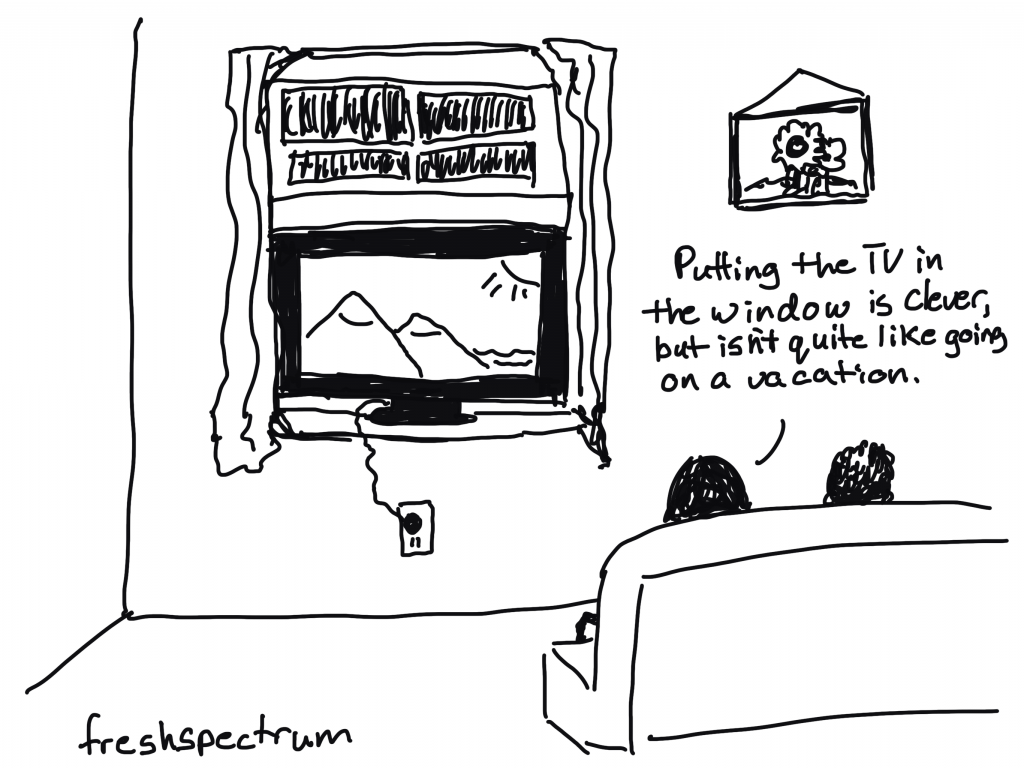
Your web browser translates html and other code into a screen that you can see and read. But just because something looks like it lives on your website, doesn’t mean it does.
Google calls this content rich media. The star of rich media is video. Most video lives on YouTube, we just watch it through our web pages.
But this is something we should really consider when sharing data dashboards. We tend to be really concerned with what goes into a dashboard, but how often do you think about how it will be shared?
So if I embed a dashboard, Google won’t be able to crawl it?
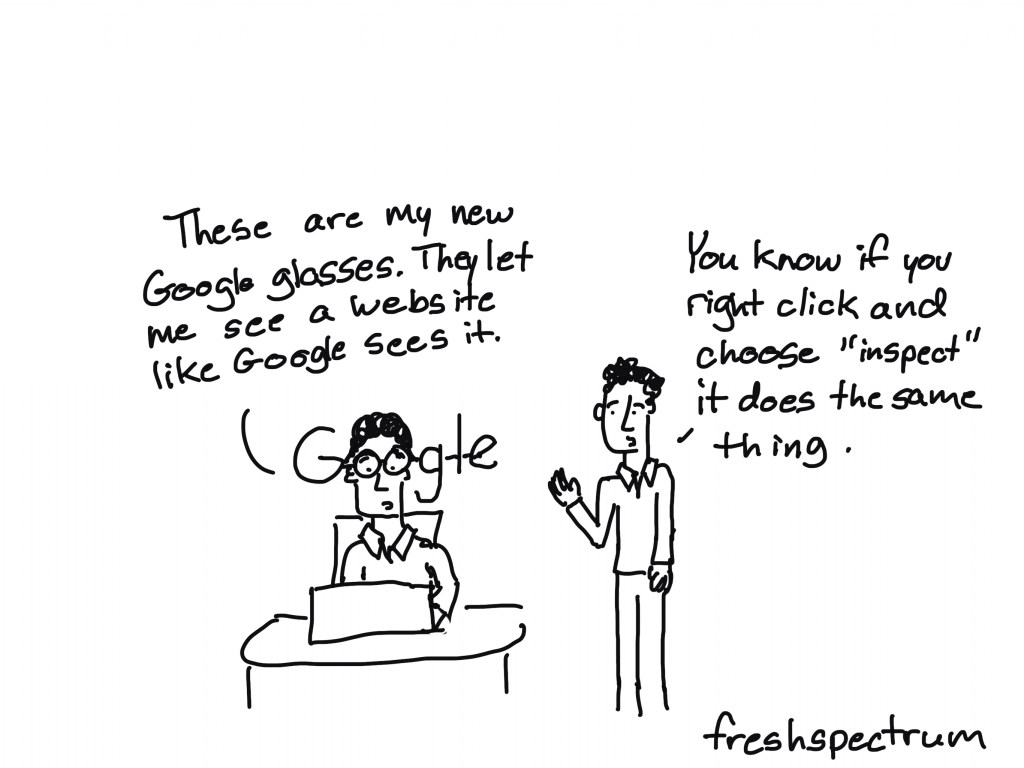
Not exactly. Google has gotten really good at crawling the web and indexing web pages. So it’s pretty likely that they can also parse out the information on the page. But that doesn’t mean it won’t cause problems.
The biggest issue is that if you just plop an embedded dashboard onto your web page, your dashboard content is less likely to show up high in Google search. It’s fine if you don’t care whether people find your dashboard when they Google. But if you want to reach a public audience, you need to compensate.
If you do plan to use rich media on your site, here are some recommendations that can help prevent problems.
Try to use rich media only where it is needed. We recommend that you use HTML for content and navigation.
Provide text versions of pages. If you use a non-HTML splash screen on the home page, make sure to include a regular HTML link on that front page to a text-based page where a user (or Googlebot) can navigate throughout your site without the need for rich media.
In general, search engines are text based. This means that in order to be crawled and indexed, your content needs to be in text format.
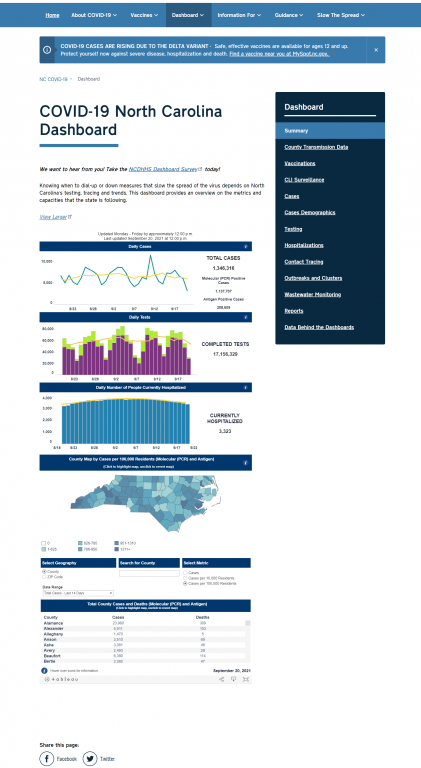
For Example. Let’s look at North Carolina’s COVID-19 dashboard.
When I see the page, this is what I see.
Behind the dashboard I see, in the code, I find an iframe link.
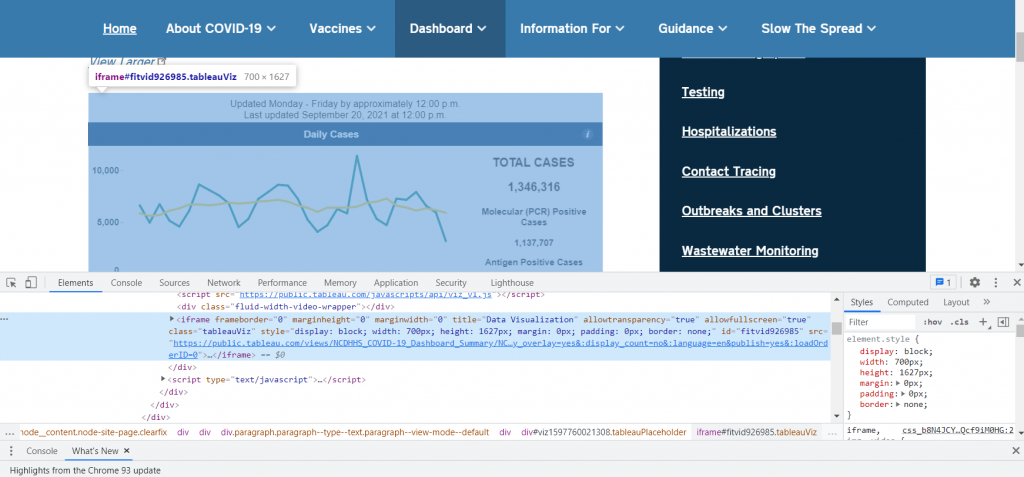
IFrames are sometimes used to display content on web pages. Content displayed via iFrames may not be indexed and available to appear in Google’s search results. We recommend that you avoid the use of iFrames to display content. If you do include iFrames, make sure to provide additional text-based links to the content they display, so that Googlebot can crawl and index this content.
Here, on this page, Google is most likely indexing the lead in paragraph and the header. But not really the data.
But here is the positive with this example, NC’s “COVID dashboard” is an entire subdomain website. It’s not just a page with an embedded Tableau dashboard. So this produces a lot of text for Google to index. Subsequently, the dashboard ranks high in search rankings.
For comparison, you can check out another NC Tableau Dashboard. This one with opioid data. Unlike the previous example, the Opioid Action Plan Data Dashboard has just about all of the text based information embedded within the dashboard.
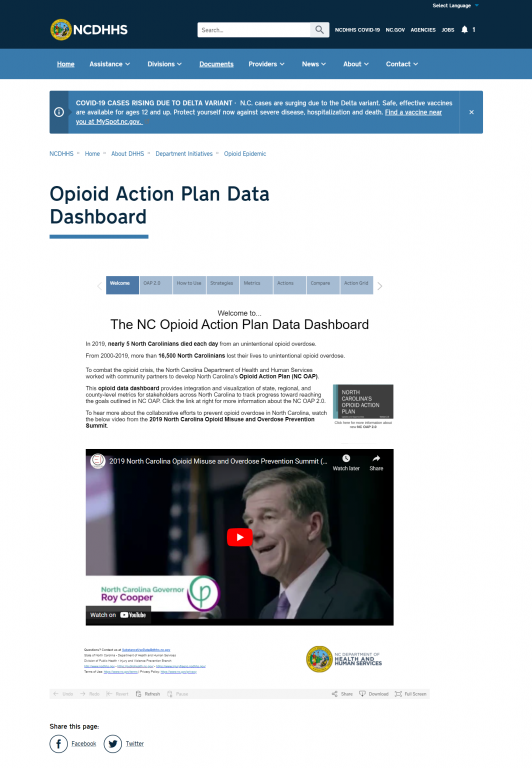
Ultimately, when Google looks at this page. Instead of seeing all that text content, it’s going to just register a few lines of IFrame code.
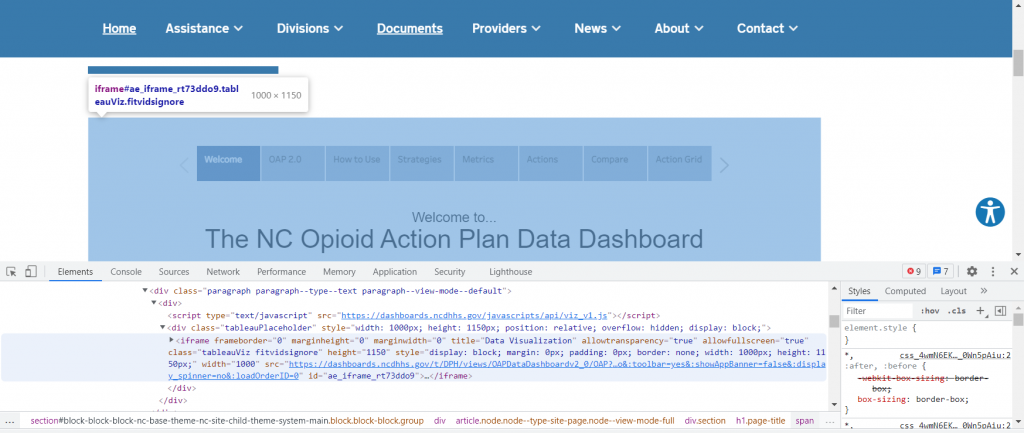
For the sake of being able to Google this information, all of the text based information (and the tabs) should exist within the websites HTML, not the Tableau dashboard.
Counter Example: NY Times?
So here is the North Carolina COVID Coronavirus Map on NY Times.
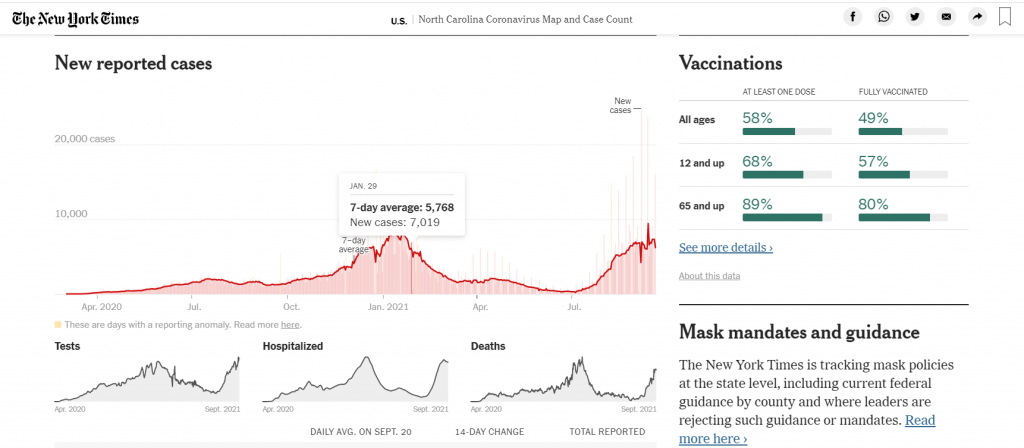
Let’s look at the code underneath the visual.
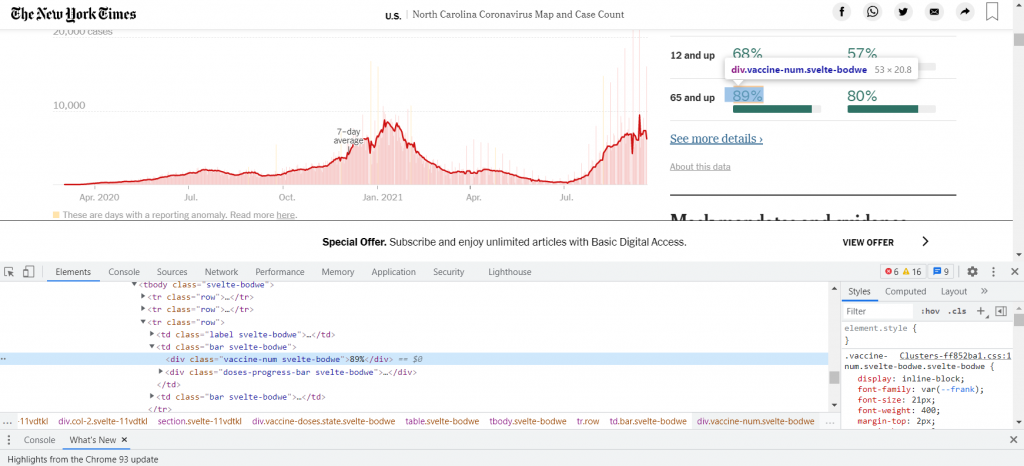
Unlike the last example, everything you see on the page can be found in the code.
If you have ever wondered why Google tends to spotlight data in their search criteria from places like the NY Times and Wikipedia, this is one of the major reasons why. The data crawled, indexed, and visualized on its own terms. This in turn, helps direct people back to places like NY Times and Wikipedia.
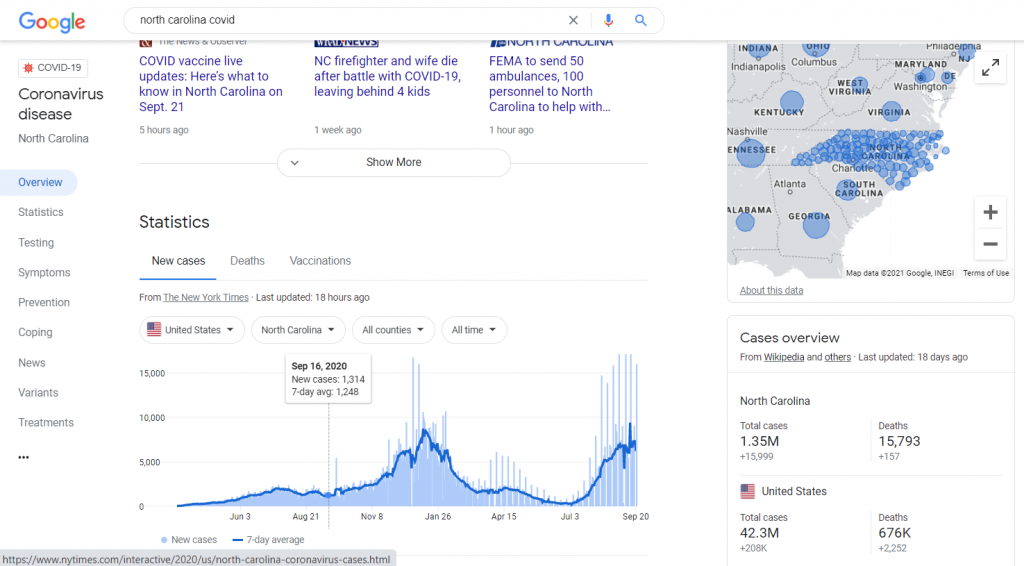
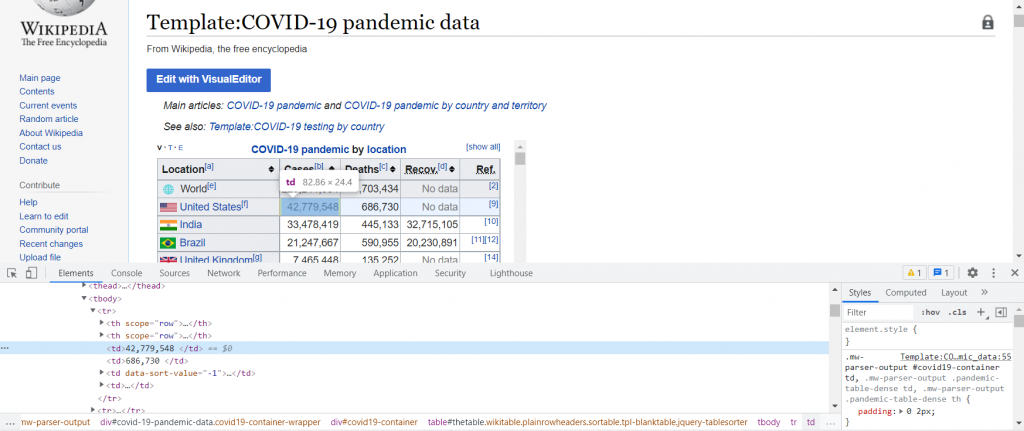
I know, this isn’t Tableau. But this embed thing goes well beyond Tableau.
When sharing information on the web, if we want people to find it, we have to understand what is shared behind what we see.
Bonus Tip: Yes, they are ugly websites, but they are trusted ugly websites

So another question I’ve seen is about domains and dashboards. Should we publish our dashboard under our state or organization domain?
If you work for a state government, federal government, or university you might get annoyed by your website. But even the ugliest of websites fare pretty well in Google, because these sites have a lot of authority.
So when faced with a decision of whether to put your public data dashboard up on an established organization/government public facing website versus sharing on a new domain, generally use the established site. Even if that means a few more bureaucratic hurdles, it’s going to give you the best chance of your content being found.
So, how do we embed Tableau dashboards then?
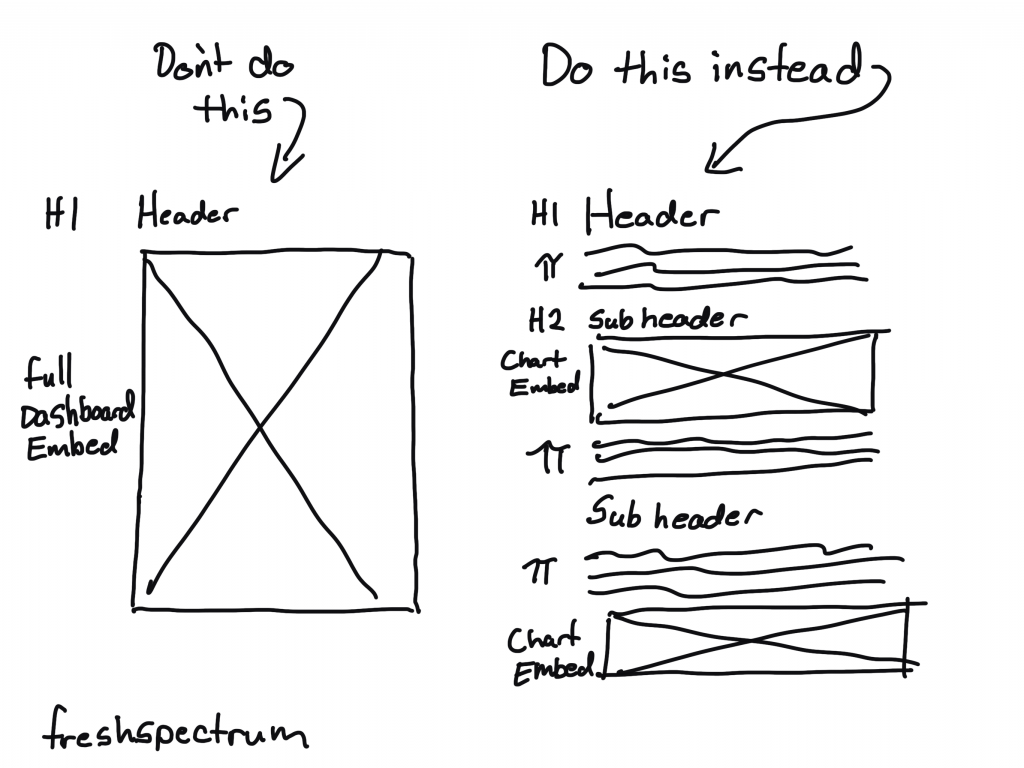
Okay, here is the short answer.
If it is going to be public and on your website, stop thinking about your dashboard as a “Tableau dashboard.” Instead, think of it as a dashboard on your website that you created with the help of Tableau.
Put as much as possible into the HTML on your web page. And if that means creating multiple sub-pages using HTML, do that. Google is going to see it better, and connect it with you if it lives directly on your website.
Then embed the interactive charts/views intermixed with the text based HTML content.
Still Confused?
It can get confusing. That’s why I run a workshop and hold Q&A portions with every session. Click here to join us and get $100 off the annual workshop cost.
Evaluation Roundup – August 2021
Welcome to our monthly roundup of new and noteworthy evaluation news and resources – here is the latest.
Have something you’d like to see here? Tweet us @EvalAcademy!
New and Noteworthy — Reads
The Ultimate Guide to Effective Data Collection
A free 30-page eBook titled, “The Ultimate Guide to Effective Data Collection” can be downloaded from Atlan. The eBook focuses on survey design and administration. The nine chapters in the eBook are intended to help you design a survey that will give you high-quality data.
Evaluation Plan Rubric
EvaluATE recently released an Evaluation Plan Rubric. This rubric was used as part of study EvaluATE was conducting to assess evaluation-related content of its ATE proposals. It lists criteria to consider when assessing evaluation proposals and therefore is a useful resource for those of you involved in selecting an evaluator. However, the rubric is also a helpful reference document when writing evaluation proposals.
Defining and Measuring Diversity, Equity, and Inclusion
EvaluATE has published its survey findings of 210 ATE evaluators. One subsection of the survey examined how evaluators define and measure equity, diversity and inclusion in their projects. The survey found that more participants indicated that they measured diversity than equity and inclusion. Surveys were the most frequently reported data collection tool used across all constructs. Surveys asked diversity questions related to gender most often, then ethnicity, then race.
New and Noteworthy — Events
Organized by: Clear Horizon Academy
Date: September 10, 2021
Instructor: Jess Dart
Program Monitoring: The Key to Successful Implementation
Organized by: EnCompass
Date: September 21 & 23, 2021
Instructor: Kerry Bruce
Organized by: EnCompass
Dates: September 27 & 30, 2021
Instructor: Andy Krackov
 English
 Afrikaans
 Shqip
Shqip አማርኛ
አማርኛ العربية
 Հայերեն
 Azərbaycan dili
 Euskara
 Беларуская мова
 বাংলা
বাংলা Bosanski
 Български
 Català
 Cebuano
 Chichewa
 简体中文
简体中文 繁體中文
繁體中文 Corsu
Corsu Hrvatski
 Čeština
 Dansk
Dansk Nederlands
 Esperanto
 Eesti
Eesti Filipino
 Suomi
Suomi Français
 Frysk
Frysk Galego
 ქართული
 Deutsch
 Ελληνικά
 ગુજરાતી
 Kreyol ayisyen
 Harshen Hausa
 Ōlelo Hawaiʻi
 עִבְרִית
 हिन्दी
 Hmong
Hmong Magyar
 Íslenska
 Igbo
Igbo Bahasa Indonesia
 Gaeilge
 Italiano
 日本語
日本語 Basa Jawa
 ಕನ್ನಡ
ಕನ್ನಡ Қазақ тілі
 ភាសាខ្មែរ
 한국어
한국어 كوردی
كوردی Кыргызча
 ພາສາລາວ
 Latin
Latin Latviešu valoda
 Lietuvių kalba
 Lëtzebuergesch
 Македонски јазик
 Malagasy
 Bahasa Melayu
 മലയാളം
 Maltese
 Te Reo Māori
 मराठी
मराठी Монгол
 ဗမာစာ
ဗမာစာ नेपाली
 Norsk bokmål
 پښتو
پښتو فارسی
فارسی Polski
 Português
 ਪੰਜਾਬੀ
 Română
 Русский
 Samoan
 Gàidhlig
 Српски језик
 Sesotho
 Shona
Shona سنڌي
سنڌي සිංහල
සිංහල Slovenčina
 Slovenščina
 Afsoomaali
 Español
 Basa Sunda
 Kiswahili
 Svenska
 Тоҷикӣ
 தமிழ்
தமிழ் తెలుగు
 ไทย
ไทย Türkçe
 Українська
 اردو
اردو O‘zbekcha
 Tiếng Việt
 Cymraeg
 isiXhosa
 יידיש
יידיש Yorùbá
 Zulu
Zulu