• Skip to main content
  • Skip to footer
  • Home

The May 13 Group

the next day for evaluation

  • Get Involved
  • Our Work
  • About Us
You are here: Home / Archives for allblogs / engagewithdata

engagewithdata

Feb 09 2021

From “Ugh” to “Ooh!” – Reframing Logic Models

From “Ugh” to “Ooh!” – Reframing Logic Models

“Ugh, they’re making us submit a logic model? What is the point of a logic model anyway?

“I don’t understand all that technical jargon. What am I supposed to put in a logic model?”

These are the thoughts I imagine my clients having when a funder or state department of education requires them to create a logic model … and rightfully so.

Logic models are often overly complicated, far too technical, and not connected to ACTUAL practice – so it’s no wonder that they are not intuitive for people doing “the work” in education. 

It doesn’t have to be that way though. Let’s talk about what a logic model actually is and how it can help your organization.

I found the following definition of a logic model on the Community Tool Box (emphasis added):

“A logic model presents a picture of how your effort or initiative is supposed to work… Effective logic models make an explicit, often visual, statement of the activities that will bring about change and the results you expect to see for the community and its people. A logic model keeps participants in the effort moving in the same direction by providing a common language and point of reference.” ​

Here’s what I love about this definition:

1) It clearly conveys that a logic model is a visualization of how your program operates, and

2) It helps teams see that a logic model can actually streamline their work and make sure everyone is on the same page.

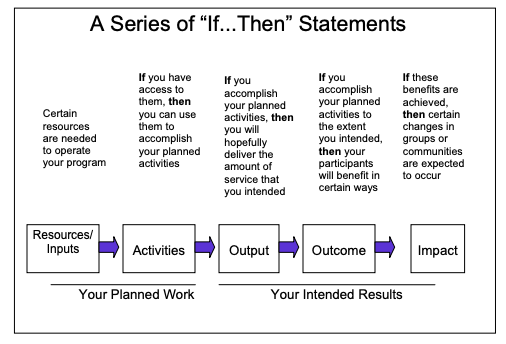
​The image below from the CDC is another great way to think about what a logic model can do.

Picture

So instead of an annoying task you have to complete for grant funding, think of a logic model as a dynamic map of your program and how you will collaboratively work towards achieving your goal. 

Recently, I introduced this new way of thinking to a school district team I’m working with.

I’m designing a data dashboard (learn more here!) for them so that all of their family-serving teams can share data and serve their district’s families more efficiently. (I’m really excited about this.)

When we met with each team individually, they were all saying the same things about how they engage with families and what data they already or want to track. 

Yet, collectively, they couldn’t see the forest for the trees. They didn’t know how similarly each team was operating!

Let me be clear: this wasn’t because they were not communicating or working together. It’s because they didn’t have a framework to guide their collective work and show where there was overlap across project teams.

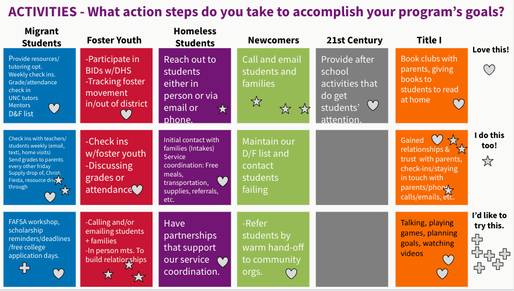
So we got to work. Using Google Slides, we did an interactive work session where the teams brainstormed what they would put in each part of a logic model. Below is a screenshot of their “Activities” brainstorm.​

Picture

Then we did a virtual “gallery walk” so they could see how much overlap there was. See how many “I do this too” stars there are in the image? 

After this, it took no time to put together their ideas into a more traditional logic model format.

If your team is currently struggling with making a logic model, don’t be afraid!

Reframing how we think about logic models can go a long way towards making them purposeful, usable tools to make our family engagement work more effective.
Archives


Select Month May 2021 April 2021 March 2021 February 2021 January 2021 December 2020 November 2020 October 2020 September 2020 August 2020 July 2020 June 2020 May 2020 April 2020 March 2020 February 2020 January 2020 December 2019 November 2019 October 2019

Tags

Attendance
Barriers to Success
Community Schools
Current Events
Data Tracking
Education
ESSA
Evaluation
Family Engagement
Inequality
Microsoft Excel
Professional Learning
Reflections
Surveys
Tools and Resources
Updates

Written by cplysy · Categorized: engagewithdata

Feb 09 2021

From “Ugh” to “Ooh!” – Reframing Logic Models

“Ugh, they’re making us submit a logic model? What is the point of a logic model anyway?” 

“I don’t understand all that technical jargon. What am I supposed to put in a logic model?” 

These are the thoughts I imagine my clients having when a funder or state department of education requires them to create a logic model … and rightfully so. 

Logic models are often overly complicated, far too technical, and not connected to ACTUAL practice – so it’s no wonder that they are not intuitive for people doing “the work” in education. 

It doesn’t have to be that way though. Let’s talk about what a logic model actually is and how it can help your organization.

I found the following definition of a logic model on the Community Tool Box (emphasis added): 

“A logic model presents a picture of how your effort or initiative is supposed to work… Effective logic models make an explicit, often visual, statement of the activities that will bring about change and the results you expect to see for the community and its people. A logic model keeps participants in the effort moving in the same direction by providing a common language and point of reference.” ​

Here’s what I love about this definition:

1) It clearly conveys that a logic model is a visualization of how your program operates, and

2) It helps teams see that a logic model can actually streamline their work and make sure everyone is on the same page. 

​The image below from the CDC is another great way to think about what a logic model can do.

Picture

So instead of an annoying task you have to complete for grant funding, think of a logic model as a dynamic map of your program and how you will collaboratively work towards achieving your goal. 

Recently, I introduced this new way of thinking to a school district team I’m working with. 

I’m designing a data dashboard (learn more here!) for them so that all of their family-serving teams can share data and serve their district’s families more efficiently. (I’m really excited about this.)

When we met with each team individually, they were all saying the same things about how they engage with families and what data they already or want to track. 

Yet, collectively, they couldn’t see the forest for the trees. They didn’t know how similarly each team was operating!

Let me be clear: this wasn’t because they were not communicating or working together. It’s because they didn’t have a framework to guide their collective work and show where there was overlap across project teams.

So we got to work. Using Google Slides, we did an interactive work session where the teams brainstormed what they would put in each part of a logic model. Below is a screenshot of their “Activities” brainstorm.​

Picture

Then we did a virtual “gallery walk” so they could see how much overlap there was. See how many “I do this too” stars there are in the image? 

After this, it took no time to put together their ideas into a more traditional logic model format. 

If your team is currently struggling with making a logic model, don’t be afraid!

Reframing how we think about logic models can go a long way towards making them purposeful, usable tools to make our family engagement work more effective.

Written by cplysy · Categorized: engagewithdata

Jan 26 2021

Use Google Maps to explore your data in a new way

Isn’t it so gratifying to learn a new skill and get to apply it?

One thing I’ve been learning lately is how to use ArcGIS, a super fancy mapping tool that allows you to collect, analyze, and visualize all sorts of data. 

I’ve talked about mapping with clients and at conference presentations for awhile, and I’ve loved using public (read: FREE) mapping tools to learn more about the communities I was serving or studying. 

I’ve used maps in many ways – describing the community for grants or needs assessments, determining which students need home visits, or figuring out which resources are near students’ homes.

Most recently, I’ve gotten to use maps through my part-time work as a researcher at Ohio State.

We were trying to figure out if the students in our college had practicum placements within federally designated “medically underserved communities.”

Using a free public map file from a government agency and uploading a list of addresses where our students were placed, I was able to instantly visualize and (through ArcGIS’s fancy tools) analyze the percentage of our students working within underserved communities. 

Seeing it all come together was magical. 

It painted such a clear picture of the impact of our college and the difference that our students are able to make. 

Given the disproportionate impact of COVID-19 on disadvantaged communities and the rising awareness of systemic racism on, well, every aspect of community life, knowing what children and families need outside of school – and acting on it — is critical.

Using data to pinpoint which students are at the greatest risk of disengaging from online school or whose families struggle to meet basic needs is essential for targeting interventions and outreach.

Here’s a list of free mapping tools to get you started ​(from my May post on the AEA365 blog): 

Demographics

  • U.S. Census Bureau QuickFacts and Data Explorer
  • Income Segregation Maps (Stanford Center on Poverty and Inequality)
  • KIDS COUNT Data Center (Annie E. Casey Foundation)

Education

  • School and Community Factors that Affect Learning (Brookings Institution)
  • School Zones and Segregation (Vox)
  • Education Data Explorer (Urban Institute)
  • NAEP Report Cards – Data Tools

Health

  • U.S. Department of Health and Human Services Datasets
  • USDA Food Access Research Atlas
  • Air Pollution Map (Center for Public Integrity)
  • HRSA Mapping Tool
  • COVID-19 Dashboard (Johns Hopkins University)

City and county agencies also have amazing resources. See if your health or police departments, school districts, or universities have online tools for exploring your area.

Here’s a map I created of the schools, hospitals, and other services where I live, from the city’s mapping tools:

Picture

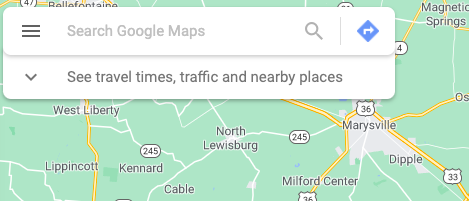
To get started mapping your own data, I always recommend starting with Google Maps!

Beyond being a lifesaver for those with a poor sense of direction like me, Google Maps offers a free tool for creating your own maps. You can map multiple data sources and use colors, symbols, and labels to make sense of your data.

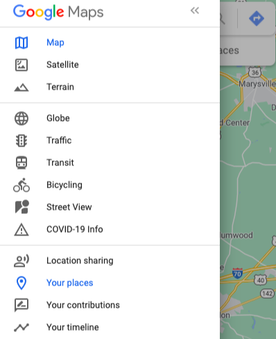
To get there from the Google Maps page, click on the three lines at the top left of your screen (see image below). 
Picture

Then, go to “Your places” (highlighted in blue below).
Picture

Finally, in the “Your places” menu, click the “Maps” tab on the right and then “Create Map” at the bottom. 
Picture

Then go play! See what maps you can create of your community.
​
Now think about each of your students and families as dots on that map. Imagine what they might see every day when they walk down the street. What resources are available to them in their community? In what ways is their community potentially putting them at risk?

You can use what you learn from your mapping explorations to influence survey questions and interview protocols for students and families. For example, if there has been a recent rise in crime rates in a neighborhood, ask families and students if they feel safe and what the school or district could do to make them feel safer.

Certainly, your findings can also help you figure out what services to offer within your program or school. ​

It’s been so enjoyable to build my mapping skillset and explore a whole new way of looking at data. I hope you take some time to play around with these mapping tools and see what you can learn!

Written by cplysy · Categorized: engagewithdata

Jan 07 2021

We need teachers today.

When I was a senior in high school, I thought the coolest job would be to serve as a member of Congress. 

I was lucky to be part of an amazing course (in a public school, might I add!) called Government and Law-Related Experiences, affectionately known as GALRE.

Our teacher, Doug Martin, a hero of mine, is a Vietnam veteran who continued to serve his country by educating thousands of students about their civic rights and duties, in honor of his friend who didn’t make it home from the war.

He taught us to be good citizens, but more importantly, he modeled for us how to be good people and to enjoy life in the process.

We had frequent guest speakers in the course — GALRE alumni, community leaders, and elected officials on all levels — who would come talk to us and answer our questions.

We also had to complete “outside experiences,” where we immersed ourselves in the local community and political scene. I was canvassing and registering voters before I was old enough to vote myself.

The class culminated in a three-day, whirlwind trip to Washington, DC, where we got to see the federal government operate in real life. 

GALRE inspired me to pursue a degree in Political Science and spend my career in service of others and the common good. 

As I watched the horrific news of the insurgence of white supremacist domestic terrorists on the nation’s Capitol yesterday, I found myself thinking back to our trip to DC, sitting on the steps of the Capitol building with my classmates, imagining working there one day.

More importantly, I keep thinking how safe I felt being with a teacher like Mr. Martin during times of national (9-11 occurred when I was a sophomore) and even personal times of crisis.

That level of security — that my teachers could help me process what was happening and reassure me that, by learning from history, we would pull through any challenge — is something I wish for all students. 

Mr. Martin was a huge inspiration for me when I became a Social Studies teacher in Baltimore.

I brought in guest speakers, helped my students participate in a civics education competition, and took them on field trips to see where history happened in their local communities. Following the guidance of a veteran teacher at my school, I tried my best to teach my students the “real” version of early U.S. history and impart the lessons I learned from Mr. Martin.

As I watched yesterday’s events unfold, I kept thinking about today’s generation of students and all the challenges they have faced over the past year.

I worry about the quality of social studies education they are receiving. 

Are they receiving the white-washed, textbook version of history that will only perpetuate the bigoted culture that we’re seeing on display?

Or are they learning about the suffering and triumph of people from all racial and ethnic groups, the truth about how government has perpetuated inequity, and how they can play a role in making things better?

Worse, are they learning about history at all?

Most of all, I find myself wondering if they have a Mr. Martin in their lives to help them feel safe and make sense of what’s tearing our country apart during this scary time. 

I may not be a social studies teacher anymore, but the lessons I learned in G.A.L.R.E. and my time in the classroom have informed my work today.

I truly believe that we can all begin chipping away at the ills of our society through our own actions: how we support others, how we engage and empower children and families, and how we ensure that everyone gets what they need to thrive. 

To all the social studies (or other!) teachers having difficult conversations with their students today and making them feel safe in an increasingly unstable world, thank you. You are making a difference.

Written by cplysy · Categorized: engagewithdata

Dec 23 2020

More than a feeling

It’s the end of the year, when we reflect on the past year and look forward to new beginnings. 

I haven’t done any rigorous data collection about this, but I think it’s fair to assume that most people would rate 2020 as a giant dumpster fire. 

So let’s take it back to 2019. 

Last year was challenging for me in a different way. I had moved to Ohio from Maryland the previous year, and I naively thought that I could transition my business to my new home with relative ease since most of my work was remote. 

WRONG!

As it took time for new connections to materialize into new contracts, I knew that things weren’t headed in the right direction. 

Now, I had a few metrics I used to measure my business: 

  • Income, of course
  • Number of contracts
  • Number of speaking engagements
  • Number of contacts made
  • Some basic analytics regarding email open rates, website visits, and social media engagement

At the time, those weren’t pretty.

However, what was most telling for me was how I FELT. 

I was discouraged, uncertain, and anxious. And in terms of my business, I didn’t know what to do to make it better. 

Certainly, the quantitative data was informing how I was feeling, but the numbers alone did not compel me to act.

I just wanted to feel better! I knew it was time to make a change. 

Around that time, I met a new neighbor who specialized in website design and SEO. I heard about a marketing consultant whose approach resonated with me. I saw that the American Evaluation Association’s (AEA) conference was featuring a lot of workshops and resources for independent consultants. 

I sprang into action. I met with these new specialists, went to the conference, and got to work. And ultimately, I turned my business (and outlook) around. 

While there is always room to grow, the numbers I mentioned earlier do reflect the changes I’ve made to my business. Yet I don’t think they show HOW or WHY those changes happened. 

From my neighbor, I learned something new and gained hope that some simple strategies could make my website work better for me. 

From the marketing consultant, I felt understood and discovered a new way to communicate what I do and why I love it.

From AEA, I gained a large group of new colleagues, friends, and referral partners – but most of all, I felt accepted, validated, and supported. 

To me, those feelings and networks are what helped me turn the page in my business – the fuzzy, not easily measurable, qualitative stuff. 

​Had I not reflected on those things, I might have stayed in my rut. 

Maybe you already track your data, and maybe you don’t, but if you’re getting the feeling that something’s not right, think about the qualitative data you can explore to see what’s up. 

How do your families feel when they interact with you? How do the staff feel? What is the tone of your interactions? How engaged are students in relationships with peers and staff and with their learning?

These things matter.

One thing I’m grateful for from 2020 is that a lot of educators are seeing just how vital family engagement is for student achievement.

So while we’re reflecting on this crazy, crazy year, let’s take a second to examine how our students, families, and staff FELT and how we helped them feel better.  

If that’s what we take with us into 2021, then I think we’re off to a good start.

Missed the other two posts about qualitative data in this series? Check them out here and here.

Written by cplysy · Categorized: engagewithdata

  • « Go to Previous Page
  • Go to page 1
  • Interim pages omitted …
  • Go to page 3
  • Go to page 4
  • Go to page 5
  • Go to page 6
  • Go to page 7
  • Interim pages omitted …
  • Go to page 11
  • Go to Next Page »

Footer

Follow our Work

The easiest way to stay connected to our work is to join our newsletter. You’ll get updates on projects, learn about new events, and hear stories from those evaluators whom the field continues to actively exclude and erase.

Get Updates

Want to take further action or join a pod? Click here to learn more.

Copyright © 2026 · The May 13 Group · Log in

en English
af Afrikaanssq Shqipam አማርኛar العربيةhy Հայերենaz Azərbaycan dilieu Euskarabe Беларуская моваbn বাংলাbs Bosanskibg Българскиca Catalàceb Cebuanony Chichewazh-CN 简体中文zh-TW 繁體中文co Corsuhr Hrvatskics Čeština‎da Dansknl Nederlandsen Englisheo Esperantoet Eestitl Filipinofi Suomifr Françaisfy Fryskgl Galegoka ქართულიde Deutschel Ελληνικάgu ગુજરાતીht Kreyol ayisyenha Harshen Hausahaw Ōlelo Hawaiʻiiw עִבְרִיתhi हिन्दीhmn Hmonghu Magyaris Íslenskaig Igboid Bahasa Indonesiaga Gaeilgeit Italianoja 日本語jw Basa Jawakn ಕನ್ನಡkk Қазақ тіліkm ភាសាខ្មែរko 한국어ku كوردی‎ky Кыргызчаlo ພາສາລາວla Latinlv Latviešu valodalt Lietuvių kalbalb Lëtzebuergeschmk Македонски јазикmg Malagasyms Bahasa Melayuml മലയാളംmt Maltesemi Te Reo Māorimr मराठीmn Монголmy ဗမာစာne नेपालीno Norsk bokmålps پښتوfa فارسیpl Polskipt Portuguêspa ਪੰਜਾਬੀro Românăru Русскийsm Samoangd Gàidhligsr Српски језикst Sesothosn Shonasd سنڌيsi සිංහලsk Slovenčinasl Slovenščinaso Afsoomaalies Españolsu Basa Sundasw Kiswahilisv Svenskatg Тоҷикӣta தமிழ்te తెలుగుth ไทยtr Türkçeuk Українськаur اردوuz O‘zbekchavi Tiếng Việtcy Cymraegxh isiXhosayi יידישyo Yorùbázu Zulu