• Skip to main content
  • Skip to footer
  • Home

The May 13 Group

the next day for evaluation

  • Get Involved
  • Our Work
  • About Us
You are here: Home / Archives for allblogs

allblogs

Feb 27 2022

Seguir  buscando la verdad

Moisés Naím nos contaba en  La guerra contra la verdad, que al mismo tiempo que hoy tenemos más información que en el pasado, la veracidad de esa información es más cuestionable

La información es, al mismo tiempo, más valorada y más despreciada que nunca. La información, potenciada por la revolución digital, será el motor más importante de la economía, la política y la ciencia del siglo XXI. Pero, como ya hemos visto, también será una peligrosa fuente de confusión, fragmentación social y conflictos.

Grandes cantidades de datos que antes no significaban nada, ahora pueden ser convertidos en información que ayuda a gestionar mejor gobiernos y empresas, curar enfermedades, crear nuevas armas o determinar quién gana las elecciones, entre otras muchas cosas. Es el nuevo petróleo: después de procesado y refinado tiene gran valor económico. Y si en el siglo pasado varias guerras fueron provocadas por la búsqueda del control del petróleo, en este siglo «habrá guerras motivadas por el control de la información». Parece que se está cumpliendo…

Pero, al mismo tiempo que hay información que salva vidas y es gloriosa, hay otra que mata y es tóxica. La desinformación, el fraude y la manipulación que fomenta el conflicto están teniendo un auge tan acelerado como la información extraída de las masivas bases de datos digitalizados. Algunos de quienes controlan estas tecnologías saben cómo convencernos de comprar determinados productos. Otros saben cómo entusiasmarnos con ciertas ideas, grupos o lideres —y detestar a sus rivales.

La gran ironía es que, al mismo tiempo que hoy tenemos más información que en el pasado, la veracidad de esa información es más cuestionable. Alan Rusbinger, ex director del diario británico The Guardian, ha dicho que “Estamos descubriendo que la sociedad realmente no puede funcionar si no podemos ponernos de acuerdo sobre la diferencia entre un hecho real y uno falso. No se pueden tener debates o leyes o tribunales o gobernabilidad o ciencia si no hay acuerdo acerca de cuál es un hecho real y cual no”.

El debate acerca de qué es verdad y qué es mentira es tan antiguo como la humanidad. Las discusiones al respecto que se dan entre filósofos, científicos, políticos, periodistas o, simplemente, entre personas con ideas diferentes son frecuentes y feroces. Muchas veces, estos debates en vez de concentrarse en la verificación de los hechos, se centran en la descalificación de quienes los producen. Así, científicos y periodistas son blanco frecuente de quienes, por intereses o creencias, defienden ideas o prácticas basadas en mentiras.

En 1951, Hannah Arendt escribió: “El sujeto ideal de un régimen totalitario no es el nazi convencido o el comunista comprometido, son las personas para quienes la distinción entre los hechos y la ficción, lo verdadero y lo falso ha dejado de existir”.

Más de seis décadas después esta descripción ha adquirido renovada vigencia. ¿Nos posicionaremos frente a los que han declarado la guerra a la verdad?

Written by cplysy · Categorized: TripleAD

Feb 25 2022

Futures and Optimism Bias

Futures (thinking) and strategic foresight can be powerful tools to help us to plan and see opportunities and threats ahead of us. When we can imagine what might happen it’s easier for us to plan for it. Futures work allows us to anticipate what could be so we can adapt better to what is now.

Good strategic foresight involves drawing on trends and patterns to create scenarios, envision possible futures, and assess risks and benefits. It is, however, a product of our present. When we use futures and foresight we begin with stating our assumptions. As we wrote recently on Censemaking, it is the willingness of futurists to see preferred, positive, and optimistic futures that they often neglect things we dislike. Just listen to the assessment on the Globalist of the 2022 Russian invasion of Ukraine and you’ll hear how badly the West got its futures thinking wrong.

Assumption Building

The first step in any futures or strategic foresight project is assumption finding, building, and assessment. We begin by asking ourselves: what do we believe to be true about the situation?

We continue asking: what do we believe about the past, the present, and the future?

Another key tool we use is the Third Position Strategy where we begin asking questions about our beliefs from a ‘third’ position that is not us. Another is the What Went Wrong approach which is a post-hoc review of what we’ve already done. After-action Reviews are other ways to help assess what kind of beliefs we had about something and the effect of that thinking on action.

These two approaches combined with some exploratory design research help us surface assumptions.

Assumption Testing

We also advocate asking these questions and using these techniques ahead of engaging in futures work. There is no ‘correct’ answer to these questions and there may be multiple answers.

  1. Do we see the situation through a lens of optimism or pessimism?
  2. What would someone who is not like me to see in this situation?
  3. What are the fundamental beliefs about human nature that guide our thinking?
  4. How is the situation we are looking at (past, present, future) similar to what’s happened before?
  5. How might we see the situation differently?

By asking these questions and building narratives that can challenge and confirm the answers we can better ensure that our futures thinking is less prone to unhelpful bias.

Futures building is all about beliefs and assumptions. What’s important is that we recognize, acknowledge, and remember the ones we bring.

Futures and strategic foresight work is a means of seeing what might come before it does. It’s a big part of what we do at Cense. For help in bringing this perspective to your organization, contact us and let’s grab a coffee.

Photo by Alex wong on Unsplash

The post Futures and Optimism Bias appeared first on Cense Ltd. .

Written by cplysy · Categorized: cameronnorman

Feb 24 2022

Comment on Adopting Inclusive and Non-Violent Language: Part 1 by Elizabeth

In reply to E Broadbent.

Hello, thanks for your comment! I found this Insider article to be interesting: https://www.businessinsider.com/political-language-rhetoric-framing-messaging-lakoff-luntz-2017-8

Thanks for letting me know about the Rider resource. It looks like it may have been removed from their website.

Written by cplysy · Categorized: elizabethgrim

Feb 24 2022

Modern Reporting – Why you should design before you write.

Seriously, and I don’t mean after you’ve written several drafts. I really mean before you write.

In today’s post.

  • Most creativity happens inside the box.
  • Why waiting till the end to design your report is a bad idea.
  • Why designing first is a better idea.
  • This is something I call reverse design.
  • Introducing my FREE Course – 1. 2. 3. Report!
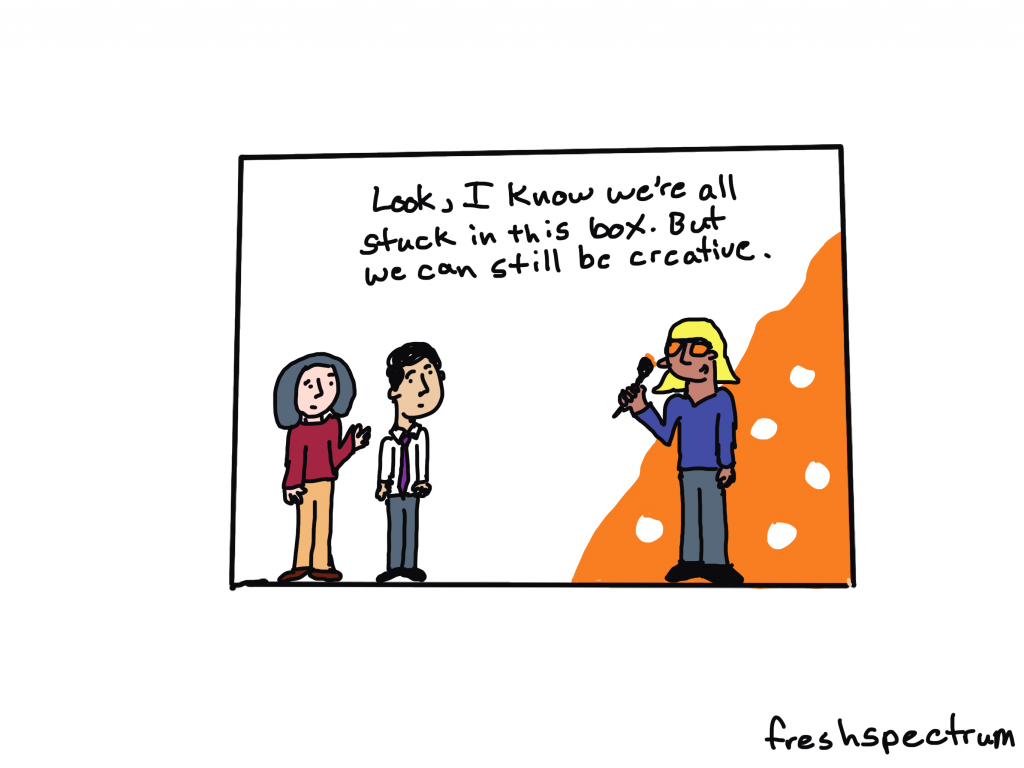
freshspectrum cartoon by Chris Lysy.   Three people in a box, one with a paintbrush and an orange painted wall saying, "Look, I know we're all stuck in this box. But we can still be creative."

Most creativity happens inside the box.

There is this notion out there that to be creative you need to think “outside the box.” Or that you need to draw “outside the lines.”

But I think that’s BS.

Because not only can creativity happen inside the box, the box can help us be creative. Because even though the box limits freedom, it also takes away a bunch of decisions that just get in the way. That clears space to let you focus on the decision points that are most important.

This is why a simple writing prompt is more useful for creative writing than a blank page. It’s why a set of canned WordPress templates can help you create a fresh looking, but functional, web page. It’s why the simple format of a slogan or elevator pitch can help an entrepreneur communicate their business idea.

freshspectrum cartoon by Chris lysy
Person one (holding a report and talking to person two at a desk).  "So we need you to take this 50 page Word doc and turn it into a 25 page visual report.
Oh, and the client's already approved the text, so we can't change anything."

Why waiting till the end to design your report is a bad idea.

I have been on a bunch of evaluation teams where the thought of report design is something that you don’t even entertain until you’ve already written several drafts.

It’s very possible that by the time the designer gets a hold of the report, the wording is completely set in stone. So the designer is stuck with what is written, even if the way something is written makes the report design that much harder.
Here is the deal. A well-designed report, with lots of white space, charts, photos, illustration, and icons, is usually going to have far less space for text than you have written in your Word document. Your 25 pages of Word document narrative might translate better to a 40 page modern report, not a 25 page report.

A good designer can usually still make it look okay. But it’s going to feel heavy. Or it’s going to go way over your desired page count.

freshspectrum cartoon by Chris Lysy.
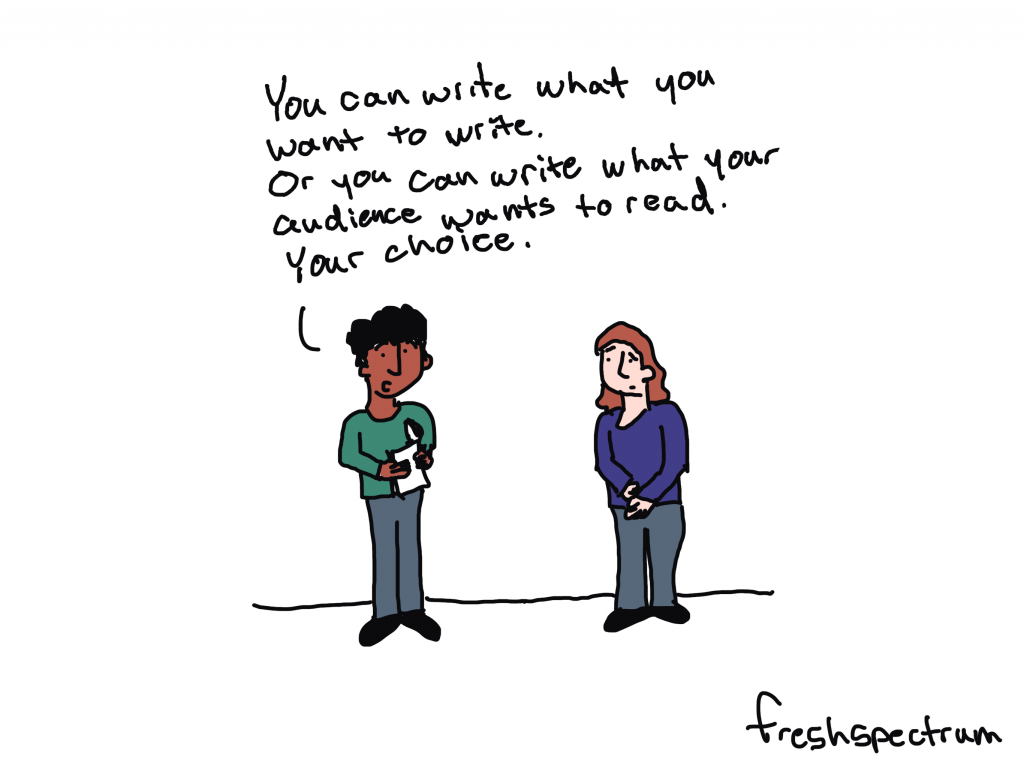
One person to another, "You can write what you want to write.  Or you can write what your audience wants to read.  Your choice."

Why designing first is a better idea.

This is why I like to design the report template first. Even before writing your report you usually know:

  • The target report page length.
  • The must have report sections.
  • Your branding and style guidance.

With that information you can pull together a basic template using dummy text (i.e. lorem ipsum or something a little more narrative like). There is a saying within my wife’s family that I think makes sense here, “start the way you mean to finish.”

By creating a template in the beginning, that has the right overall look and feel, you get to create specific word count goals. You’ll know around how many words you have for every section of your report to keep it clean.

And you’ll also know when you are breaking that style by going over word counts.

This is something I call reverse design.

It’s about starting a report from your ideal final product and working backwards. I talk about it, along with my 3 audience approach in my new free course on simplifying and modernizing your reporting approach.

It’s called 1. 2. 3. Report! and it’s open for enrollment right now.

Two people looking at a computer with 1.2.3. Report! written on the screen.
Take my free course!

My FREE Course – 1. 2. 3. Report!

The full free course is just over 30 minutes and includes:

  • 9 total videos
  • 4 lessons on my simple modern report design approach.
  • 4 reporting activities you can complete using Canva.

This includes activities on creating a 25 page pdf report, 3 page pdf executive summary, 1 page pdf report, and a listicle infographic.

You’ll also get access to a discount code for when my full workshop opens back up for registration on March 1st.

Written by cplysy · Categorized: freshspectrum

Feb 22 2022

“I couldn’t have put it better myself”

“I couldn’t have put it better myself…”

We all know how powerful a startling statistic can be.

Maybe you’ve seen a PowerPoint presentation where there is just a huge number on the slide or a newspaper headline that highlights the stark realities of a situation.

Remember the New York Times’ cover early on in the pandemic that shared the tragedy of reaching 100,000 deaths from COVID?

Numbers are impactful. But words are too. 

I’m sure you’ve remarked to yourself at some point, “I couldn’t have put it better myself!”

Or, maybe when you were writing term papers, you struggled to paraphrase a source because you just didn’t know how something could be expressed better than the authors put it?

To me, those phenomena are the beauty of qualitative data – we don’t have to rephrase anything! We get to let people’s words speak for themselves. 

I’ve written before about a research project I’ve been working on to learn more about the effects of the pandemic on the lives of kinship caregivers (e.g., grandparents raising their grandchildren).

When I was conducting focus groups of caregivers, it was truly emotional to hear them share their experiences and the dedication and love they have for their children.

Now, a few months later, we are analyzing the data we collected, and I am seeing how impactful their words are, even in print.

I’m sure you’ve had the same experience through your family engagement work.

Have you ever had a conversation with a child or family member that just stuck with you? 

I bet their words and experiences began to inform your interactions with the next family you saw or the next time a similar situation came up.

And I bet the services and support you provided were better for it.

So how can we create more opportunities for families to share their brilliant insights and teach us about their lives?

Here are a few ideas to get you started:

– Add open-ended questions to your family surveys to allow families to provide some responses in their own words. 

– Host a listening session or “parent cafe” where the participants, not the educators, are the stars of the show. (TIP: If you get consent to record these conversations, you can use anonymous versions of their quotes to guide your work or highlight needs or impacts for grants or reports.)

– Post questions on social media and invite families to respond in the comments.

– Host your own focus groups or interviews with family leaders in the school community to pick their brains.

The families we work with are the experts on their kids and their lives. Let’s let them tell us what they need, in their own words. 

Over the next few weeks, I’ll be actively working through my mom brain to post more regularly and share more content about qualitative data – how you can collect it, analyze it, and use it to improve your work with kids and families.

Written by cplysy · Categorized: engagewithdata

  • « Go to Previous Page
  • Go to page 1
  • Interim pages omitted …
  • Go to page 138
  • Go to page 139
  • Go to page 140
  • Go to page 141
  • Go to page 142
  • Interim pages omitted …
  • Go to page 310
  • Go to Next Page »

Footer

Follow our Work

The easiest way to stay connected to our work is to join our newsletter. You’ll get updates on projects, learn about new events, and hear stories from those evaluators whom the field continues to actively exclude and erase.

Get Updates

Want to take further action or join a pod? Click here to learn more.

Copyright © 2026 · The May 13 Group · Log in

en English
af Afrikaanssq Shqipam አማርኛar العربيةhy Հայերենaz Azərbaycan dilieu Euskarabe Беларуская моваbn বাংলাbs Bosanskibg Българскиca Catalàceb Cebuanony Chichewazh-CN 简体中文zh-TW 繁體中文co Corsuhr Hrvatskics Čeština‎da Dansknl Nederlandsen Englisheo Esperantoet Eestitl Filipinofi Suomifr Françaisfy Fryskgl Galegoka ქართულიde Deutschel Ελληνικάgu ગુજરાતીht Kreyol ayisyenha Harshen Hausahaw Ōlelo Hawaiʻiiw עִבְרִיתhi हिन्दीhmn Hmonghu Magyaris Íslenskaig Igboid Bahasa Indonesiaga Gaeilgeit Italianoja 日本語jw Basa Jawakn ಕನ್ನಡkk Қазақ тіліkm ភាសាខ្មែរko 한국어ku كوردی‎ky Кыргызчаlo ພາສາລາວla Latinlv Latviešu valodalt Lietuvių kalbalb Lëtzebuergeschmk Македонски јазикmg Malagasyms Bahasa Melayuml മലയാളംmt Maltesemi Te Reo Māorimr मराठीmn Монголmy ဗမာစာne नेपालीno Norsk bokmålps پښتوfa فارسیpl Polskipt Portuguêspa ਪੰਜਾਬੀro Românăru Русскийsm Samoangd Gàidhligsr Српски језикst Sesothosn Shonasd سنڌيsi සිංහලsk Slovenčinasl Slovenščinaso Afsoomaalies Españolsu Basa Sundasw Kiswahilisv Svenskatg Тоҷикӣta தமிழ்te తెలుగుth ไทยtr Türkçeuk Українськаur اردوuz O‘zbekchavi Tiếng Việtcy Cymraegxh isiXhosayi יידישyo Yorùbázu Zulu