Interesting facts. I want to learn more to improve on my report writing. Thank you
allblogs
Awkward Evaluation Networking
So I’m planning a new evaluation networking series. Skip down the page for more info.
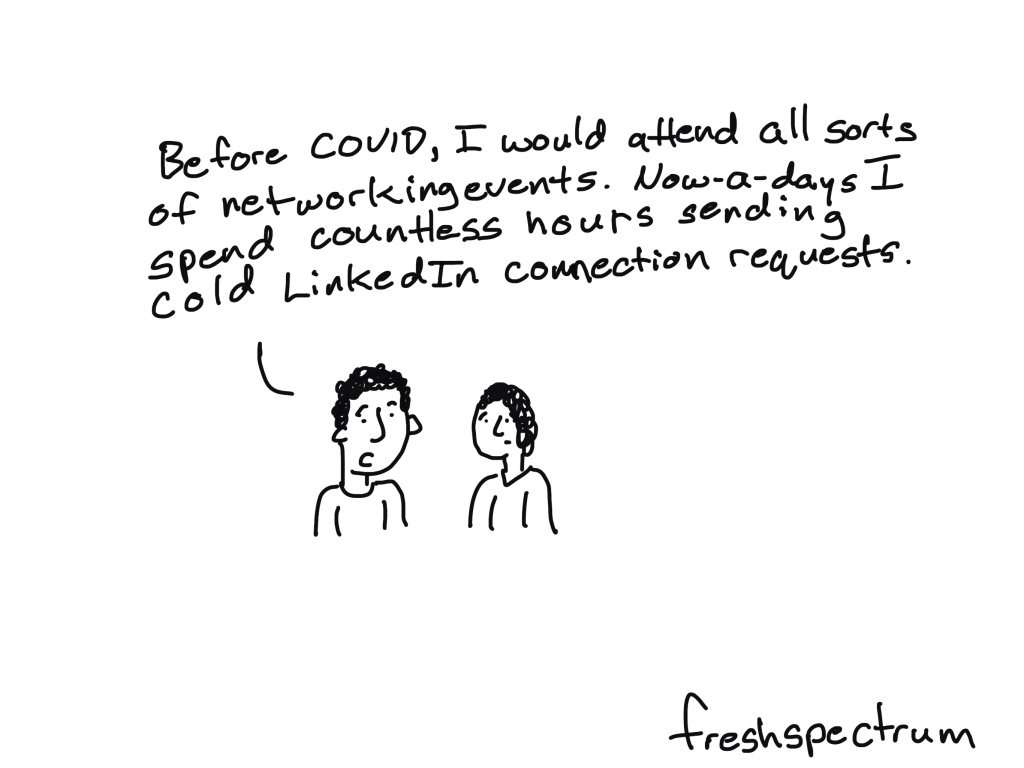
Not sure if you’ve noticed, but COVID has done a number on our networking events.
Yes, we’ve been having virtual replacement events. But many of those are in the form of traditional webinars. There is a speaker who gives a talk, answers a few questions, and then boom, event over.
And sure, those events are valuable. But it’s not really the same thing as the live meeting.
With a virtual event you can get the same speaker to deliver the same talk to the same audience. But it won’t feel the same. And it won’t be the same. Because we almost always take something for granted when we host live in-person events.
That awkward 10 minutes where you are sitting in the room before the talk, and you strike up that conversation with the person in the seat next to you. The long line at the Starbucks filled with fellow conference attendees. That 15 minute chat you have with the professional acquaintance as you walk towards your car after the event. Overhearing the one on one conversation of the two people sitting next to you, one of which is talking way too loud, but then realizing a point of shared interest.
The things that we sometimes gripe about with live events are also incredibly important parts of our social experience. Sure it can be awkward or annoying, but so many of our close relationships are born out of awkward moments or shared somewhat annoying experiences.
Yes, this is my argument, I am making a call for more awkwardness and discomfort in virtual events.
Okay, but is this really all that critical?
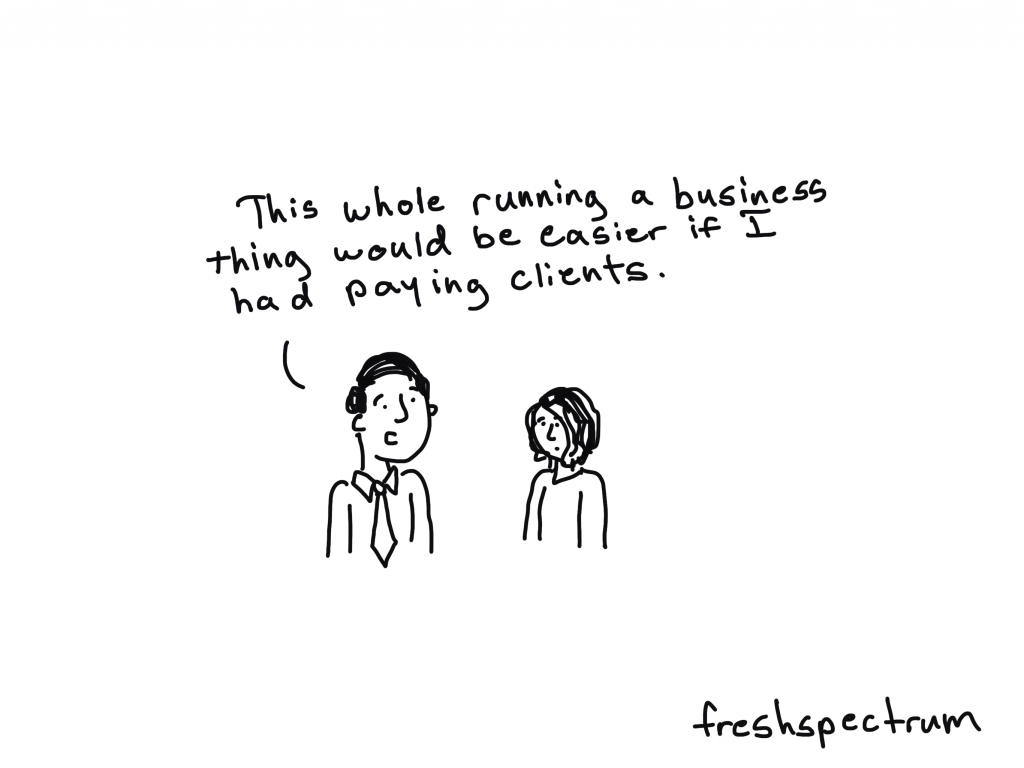
Yes.
Here’s why.
If you already have a solid network, a job, a social circle, and a client base, then the shift to virtual has probably been just fine.
Now if you are an evaluation consultant without enough clients, a graduating evaluator without a job, or just a social creature who feels a little out of touch with the rest of the human world, then the shift to virtual has probably been taking its toll.
And a series of webinar talks is probably not going to make a big difference.
Free Evaluation Networking
Here is the plan.
I’m going to launch a virtual networking series.
Each event will open with a short talk 15-20 minutes followed by 10 minutes of Q&A. Then we’ll have 30 minutes of somewhat awkward breakout group networking.
It won’t be recorded, so if you don’t show up there is nothing to watch later. But that also should let you feel free to talk without worrying about showing up forever on the web.
What kinds of talks?
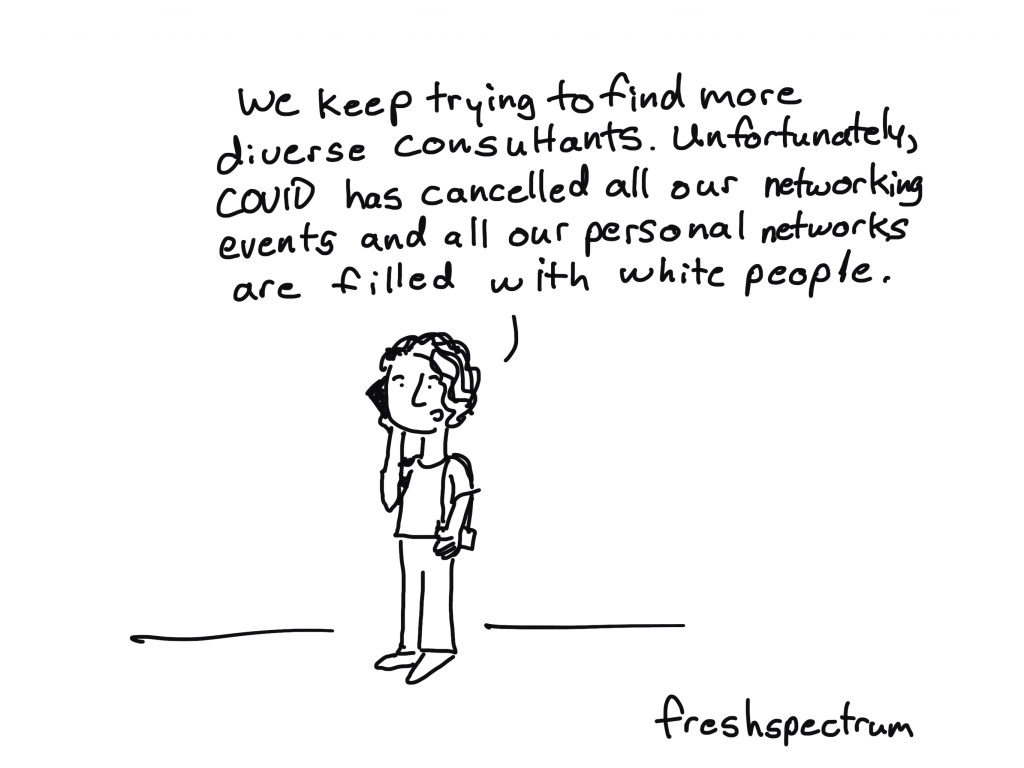
Book/Paper Talks – An evaluation author of some type (defined loosely) will present their work.
Job Talks – A working evaluator will talk about their evaluation job. The idea here is to just give an idea of the many different things self identified evaluators actually do for a living.
Consultant Intros – A consultant will introduce their business, what they do/who they serve.
Interested in giving a talk? Reach out and let me know.
When will it launch?

I’m going to launch it next week with a pretty informal, and probably extra awkward, kickoff on June 2.
Then on June 9 I’ll have my first actual presenter.
Comentario en El poder mágico de las Estructuras Liberadoras (I) por El poder mágico de las Estructuras Liberadoras (II): No estamos sol@s | “TripleAD”: Aprendiendo a Aprender para el Desarrollo
[…] ← El poder mágico de las Estructuras Liberadoras (I) […]
Me gustaMe gusta
El poder mágico de las Estructuras Liberadoras (II): No estamos sol@s

Fuente
Siguiendo con nuestra sección “Estructuras LIberadoras“, aquí la continuación del post “El poder mágico de las Estructuras Liberadoras (I)“, que a su vez se baa en ese post de Nadia von Holzen “El poder mágico de Estructuras Liberadoras: una mirada más allá de la caja de herramientas hacia los principios”, donde nos cuenta sobre los 10 principios de Estructuras Liberadoras (LS).
Estructuras Liberadoras es más que una caja de herramientas. Es un enfoque, una mentalidad, una filosofía, una forma de pensar, colaborar, ser y liderar.
Estos son los 5 siguientes principios de LS:
Se trata de personas:
Una conversación guiada por LS es más que solo contenido hablado. Una y otra vez, se experimenta cómo los intercambios son profundos, rápidos hacia la esencia y se conectan al mismo tiempo. Siempre se trata también de las personas involucradas, sus ideas y perspectivas, sus miedos y preocupaciones, su contribución e imaginación, sus esperanzas y aspiraciones. En un taller de LS, un participante lo expresó de la siguiente manera: “Cuando hables más ‘profundamente’ sobre lo que está pasando contigo, notarás que no estás solo”
Las personas pueden compartir los mismos problemas / pensamientos. Debería haber más espacio para este tipo de conversaciones, pero realmente no creemos que sea ‘normal’ hacerlo en una situación laboral “. LS está orientado a las personas. LS “cree en las personas”, es su credo: Trabajar y activar cualidades y energías humanas como la curiosidad, el humor, la diversión, la creatividad, el coraje, la compasión, el compromiso, la confianza y la vulnerabilidad.
Practiquemos respeto profundo por la gente y las soluciones locales (6)
Creemos confianza en el camino (7)
Seamos “posibilistas”, enfaticemos las posibilidades: intentemos creer antes de ver (8)
Se trata de colaboración, co-facilitación, co-creación:
Las estructuras liberadoras no solo son simples y extremadamente atractivas, sino que también tienen un poder transformador. Cambian el patrón de cómo interactuamos y colaboramos, nuestras reglas de interacción. Al cambiar los patrones de nuestra interacción, cambiamos nuestros hábitos y modelo de colaboración. Para tod@s l@s involucrad@s. Podemos cambiar la colaboración desde dentro. Dar forma a las interacciones de manera diferente es poderoso. Pone en marcha una revolución silenciosa.
Resuelve problemas de diferentes formas. Al mismo tiempo, cambiaremos la forma en que trabajamos juntos para siempre. Esto puede ser radical. Esto requiere coraje.
Invitemos a la destrucción creativa para posibilitar la innovación (9)
Nunca empecemos sin un propósito claro (10)
Los diez principios mencionados destacan lo que se vuelve posible cuando se utilizan estructuras liberadoras para estructurar las interacciones cotidianas.
Encontremos otros centros de gravedad…permanentes (o no).
Dashboard Design and “The Big Picture” in Dataviz: A Conversation with Steve Wexler
I recently had the chance to talk with Steve Wexler, founder of Data Revelations, author of The Big Picture: How to Use Data Visualization to Make Better Decisions- Faster and co-author of The Big Book of Dashboards: Visualizing Your Data Using Real-World Business Scenarios.
Steve joined as a special guest for the Dashboard Design Full Course where participants get hands-on training and access to special guest speakers in real time.
Watch Our Conversation
You can watch Steve’s session here:
What’s Inside
Here are some of the topics we talked about.
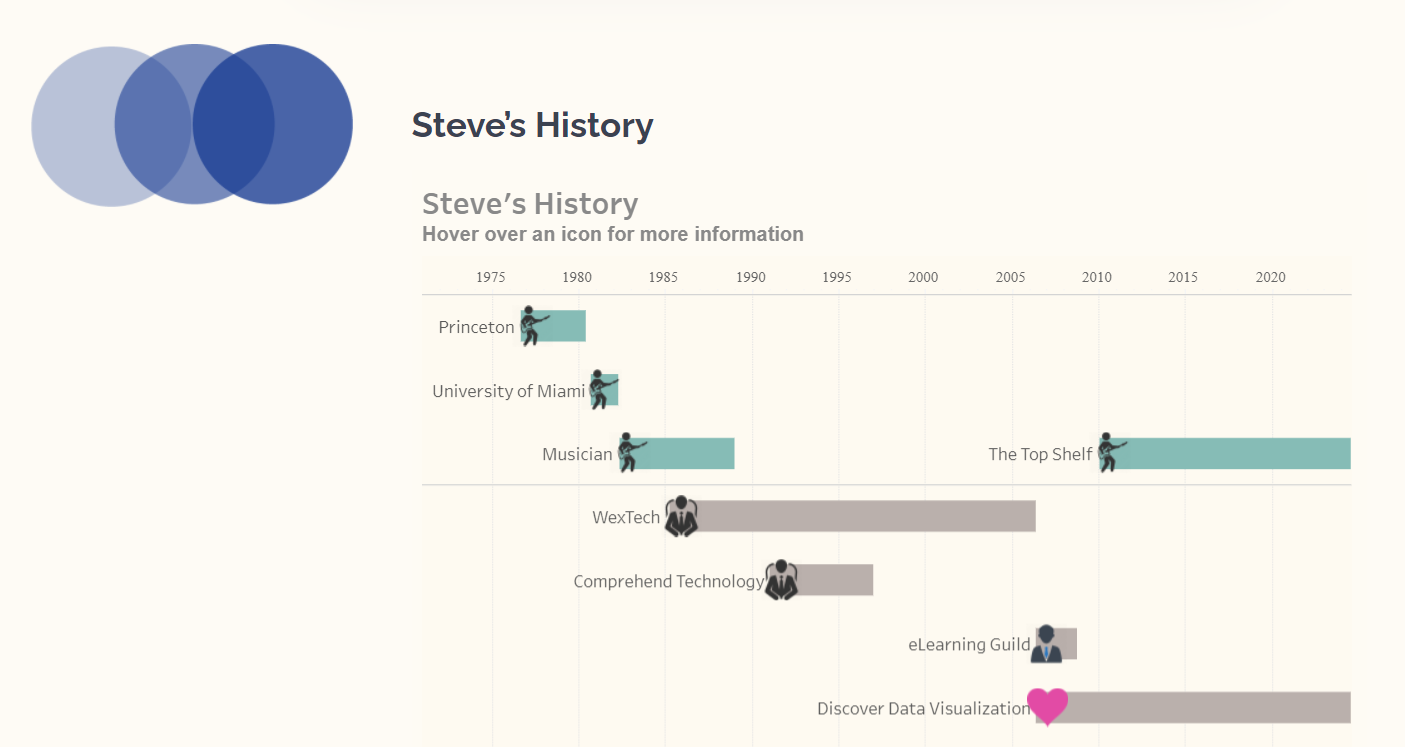
- Steve’s career prior to data viz and book writing. Steve shared that his background was as a musician but, “after plying my trade for a while, I needed to supplement my income and go into personal computers. Ended up doing a lot of consulting on Excel and Word. And did a lot of work with and for Microsoft and then ran my own software company.” About 10 years ago he started his own company as data visualization consultant with a specialty in visualizing survey data. You can visit his website to see an interactive timeline of his career: https://www.datarevelations.com/about-us/.
- How he found Tableau. While working with the Learning Guild, Steve suggested they use interactive dashboards using Spotfire software. They were on board but asked him to research other software which led him to Tableau. “The ace in the hole that Tableau had was undo,” he said.
- The Big Book of Dashboards: Visualizing Your Data Using Real-World Business Scenarios. Steve explained that the book has 28 different business scenarios with ideas of how to present data. It includes examples of what other companies are doing, gives an overview of data visualization as well as includes how to navigate tricky situation (i.e. your client only wants pie charts, only uses red and green). He cautioned though that, “You’re going to fail a lot in trying to get people to adopt [new ways] and don’t feel bad. Think of yourself being like a major league ball player, if you succeed 30% of the time, you’re an all-star.”
- Ann’s favorite part of The Big Book of Dashboards. Ann loved that the book is highly visual, with just 30 pages of best practices, and that the rest is case studies. She often uses the case studies as a resource with clients when they ask for examples.
- The goal of data visualization. Steve said that if you’re in data visualization, your goal should be to “provide the greatest degree of understanding with the least amount of effort for your audience.”
- Why he loves collaboration. Steve coauthored a book with two others and said he often gets asked how three people could write a book together. He shared that they were all aligned on their goal and that he liked having people who challenged him. He invited the idea that his collaborators were coming from a different backgrounds and expertise and, “that this could be someone who’s not looking at it identically to me and that could be great.”
- The Big Picture: How to Use Data Visualization to Make Better Decisions – Faster. Steve shared that book is “for organizations that have not yet embraced how transformative good data visualization can be.” This book came out from workshops from his first book where he realized that a lot of people had no idea what data visualization was or how to interpret it.
- Ann’s favorite part of The Big Picture: How to Use Data Visualization to Make Better Decisions – Faster. Ann’s favorite part is the scaredy-cat icon, which represents caution/what not to do and clearly distinguishes that for the reader.
- Steve’s next book. While Steve hopes to write more books, he’s hoping the next one is text-only, like a novel. “The amount of extra work that needs to go into producing something that is high quality and the angst that’s associated with it… It’s worth it, it’s wonderful, but it’s a fair amount of extra work,” he said.
- Steve’s favorite part of the The Big Picture: How to Use Data Visualization to Make Better Decisions – Faster. Steve’s favorite chapter is the 8th chapter, which covers why knowing your audience is so important. He said he wants to get people thinking about, “how do I best serve my audience?”
- Audience Q&A. At the 45:00 mark, Steve also answered some audience questions about Tableau, offered to help track down a classic data visualization, and shared how he views the connection between data visualization and storytelling.
Connect with Steve Wexler
Download the Introduction to The Big Picture: www.bigpic.me
Twitter: https://twitter.com/DataRevelations
LinkedIn: @swexler
Website: https://www.datarevelations.com/
 English
 Afrikaans
 Shqip
Shqip አማርኛ
አማርኛ العربية
 Հայերեն
 Azərbaycan dili
 Euskara
 Беларуская мова
 বাংলা
বাংলা Bosanski
 Български
 Català
 Cebuano
 Chichewa
 简体中文
简体中文 繁體中文
繁體中文 Corsu
Corsu Hrvatski
 Čeština
 Dansk
Dansk Nederlands
 Esperanto
 Eesti
Eesti Filipino
 Suomi
Suomi Français
 Frysk
Frysk Galego
 ქართული
 Deutsch
 Ελληνικά
 ગુજરાતી
 Kreyol ayisyen
 Harshen Hausa
 Ōlelo Hawaiʻi
 עִבְרִית
 हिन्दी
 Hmong
Hmong Magyar
 Íslenska
 Igbo
Igbo Bahasa Indonesia
 Gaeilge
 Italiano
 日本語
日本語 Basa Jawa
 ಕನ್ನಡ
ಕನ್ನಡ Қазақ тілі
 ភាសាខ្មែរ
 한국어
한국어 كوردی
كوردی Кыргызча
 ພາສາລາວ
 Latin
Latin Latviešu valoda
 Lietuvių kalba
 Lëtzebuergesch
 Македонски јазик
 Malagasy
 Bahasa Melayu
 മലയാളം
 Maltese
 Te Reo Māori
 मराठी
मराठी Монгол
 ဗမာစာ
ဗမာစာ नेपाली
 Norsk bokmål
 پښتو
پښتو فارسی
فارسی Polski
 Português
 ਪੰਜਾਬੀ
 Română
 Русский
 Samoan
 Gàidhlig
 Српски језик
 Sesotho
 Shona
Shona سنڌي
سنڌي සිංහල
සිංහල Slovenčina
 Slovenščina
 Afsoomaali
 Español
 Basa Sunda
 Kiswahili
 Svenska
 Тоҷикӣ
 தமிழ்
தமிழ் తెలుగు
 ไทย
ไทย Türkçe
 Українська
 اردو
اردو O‘zbekcha
 Tiếng Việt
 Cymraeg
 isiXhosa
 יידיש
יידיש Yorùbá
 Zulu
Zulu