• Skip to main content
  • Skip to footer
  • Home

The May 13 Group

the next day for evaluation

  • Get Involved
  • Our Work
  • About Us
You are here: Home / Archives for allblogs

allblogs

May 21 2021

The Chief Fill-in-the-Blank Officer: A Trend in Museum Restructuring

Combining experiences at the helm of nature and science museums with insights from literature and courses on leadership, Emlyn Koster reflects on the corporate roots of this trend and its application to the museum sector.

An unfortunate paradox surrounds the subject of organizational structure. On the one hand, it is the primary tool for configuring the work of employees, any organization’s largest single investment. On the other hand, its absence as a session topic at museum association conferences implies that restructuring is an unimportant focus for shared learning. Perhaps this is because restructuring often conjures up unpleasant memories of surprising changes in position titles and responsibilities, reporting relationships, and office locations. Marilyn Ferguson, a guru in the 1980s movement of social and personal transformation, famously observed: “… Each of us guards a gate of change that can only be opened from the inside. We cannot open the gate of another, either by argument or emotional appeal”.

Successful Restructuring

Here are two insights from courses I attended in the 90s. One for business executives in Toronto likened an organizational structure to a wiring circuit diagram in which any faulty connection will cause a breakdown. A structure should map lines of managerial reporting, decision-making, delegation, and the most favorable pathways for cross-functional teamwork. Then a weeklong immersion for nonprofit executives at the Harvard Business School emphasized that between the boxes and lines of a structure, there may be ‘white spaces’ across which departments also need to often collaborate.
An image of a clock with the phrase "Time for Change" written on it, in reference to the author's call for museum restructuring.

My early years of museum leadership also affirmed that any reorganization would be counterproductive if its draft rationale was not substantially strengthened by one-on-one consultations with those potentially most affected and all-staff feedback opportunities. At both Liberty Science Center and the North Carolina Museum of Natural Sciences, I added a preceding major step. I circulated several drafts of a comprehensive situation analysis after the first 100 days at each CEO appointment to calibrate the state of the institution and to introduce the likelihood of structural adjustments to improve its efficiency and effectiveness—doing things right and doing the right things, respectively. This approach elicited many supportive reactions, such as “If we’d all walk a mile in each other’s shoes, maybe we wouldn’t be so quick to devalue the contributions of coworkers”.

When I read a Harvard Business Review (HBR) article about the Chief Operating Officer (COO) as the CEO’s second-in-command, I became aware of difficulties surrounding a COO appointment at a new science center. A board member who had been an executive at a nearby corporation was appointed CEO and soon hired a COO, necessarily from the private sector because this function was almost unheard of in the museum sector. The other executives reacted negatively to this new player who soon left, having evidently thought that he had a level of seniority between them and the CEO. In addition, his for-profit values seemed incongruent with their mission-advancing values. The conclusions of this HBR article included a need for COOs “to check their egos at the door” and to realize that such positions are “not necessarily in line to receive the kudos for a job well done”.

Recently, as the museum sector has been obliged to think and act in innovative ways, a new genre of restructuring—additional to the rippling effects of downsizing—shows signs of becoming common. In what could be perceived as an approach to transform organizational culture and capabilities, a variety of non-traditional functions are being inserted into the senior management of museums. Compounded by less-than-ideal recruitment approaches due to limitations of online interviews, this step—partly emulating the private sector and partly originating in the museum sector—involves new Chief Fill-in-the-Blank Officer positions which, in alphabetical order, include Commercial, Digital, Diversity, Excellence, Experience, Innovation, People, Strategy, and Technology. Makeba Clay and Cecile Shellman recently remarked on preparing a Chief Diversity Officer (CDO) for success that “… each institution must do extensive diagnostic work to identify and analyze their own challenges” and “institutions that believe they are ready for organizational cultural change [may be] unwilling to face the truth about where they are on their journey”. Concerning her former position of Deputy Director of Digital Initiatives and Chief Experience Officer, Shelley Bernstein clarified that such a position is “in charge of an idea”.

Two museum leaders who have shared their views on the applicability, or not, of private sector practices are Robert Janes, formerly of Canada’s Glenbow Museum who spoke at the Smithsonian’s 150thanniversary symposium (see “Don’t lose your nerve: museums and organizational change), and John Wetenhall of The George Washington University Museum and Textile Museum. How the newly-styled Chief Fill-in-the-Blank Officer positions are optimally spliced into the structure of traditional senior functions is an uneasy task for CEOs to coordinate. As museums rethink their management and try to improve morale, what was a prescient recommendation of Dr. Janes may now be the right gearshift: “…a group of people at the top of an organization, with shared responsibilities and clear accountabilities, are developing strategies together, reaching decisions by consensus, and coordinating implementation of these decisions”. He introduced the leadership team concept of primus inter pares, meaning first among equals. Considering the weighty implications of this approach for the conventional reporting protocol between a museum CEO and her/his governing board, I am reminded of what transpired at the above-noted Harvard Business School course. Experimenting with its CEO-only tradition, board chairs were invited to join their CEOs midweek. What had been a collegially productive atmosphere instantly switched into an awkwardly formal atmosphere and the School soon abandoned its new approach.       

Professional Development

With instability around the traditional lone-CEO approach on the rise, the museum sector needs conference sessions focused on restructuring of leadership with insightful, humanly approaches. Meanwhile, it would be valuable for museums to follow trends of thought and practice about leading change across all sectors (some examples of these trends here, here, here, and here). In its 2016 report on human capital trends, Deloitte noted: “92 percent of participants saw a need to redesign their organization to improve employee engagement and retention and build a meaningful culture. This same survey found that 82 percent of respondents see culture as a competitive advantage, driving innovation, customer service, and employee behavior”. Its 2021 report, titled ‘The New Organization: Different by Design’, notes: “The “new organization … is built around highly empowered teams, driven by a new model of management, and led by a breed of younger, more globally diverse leaders”. Clearly, the design of structures and systems for how results are achieved is ripe for optimization.

About the Author

Emlyn Koster, PhD has been the CEO of Canada’s Royal Tyrrell Museum of Paleontology and Ontario Science Centre, Liberty Science Center in NJ, and the NC Museum of Natural Sciences. With the nature and purpose of leadership an ongoing focus, his recognition has also included Humanitarian of the Year by the American Conference on Diversity and founding chair of ICOM’s Anthropocene Working Group.  Current affiliations include the ambassadors circle for the International Coalition of Sites of Conscience, adjunct professor in Marine, Earth and Atmospheric Sciences at NC State University, and the board of the International Big History Association. He is writing monthly op-ed styles pieces as a guest blogger for RK&A in 2021; find his other posts here.

The post The Chief Fill-in-the-Blank Officer: A Trend in Museum Restructuring appeared first on RK&A.

Written by cplysy · Categorized: rka

May 19 2021

Use Your Data to Celebrate Families

Use your data to celebrate families

Educators: you’ve made it! It’s finally the end of the school year. 

And what a school year it was. 

I’m sure that there are all kinds of celebrations happening as this confusing, exhausting, stressful, and probably scary year comes to a close.

But if you’ve been tracking your student and family engagement data this year, there can be even more celebrations in store as you wrap up SY 2020-2021.

I often talk about using your data to identify needs, uncover gaps in services, and understand exactly who you are reaching and how. 

However, there are lots of other things you can do with all of the rich data you’ve collected, especially now that you have a year’s worth of information. 

One of the benefits of tracking your data is that you also can quickly identify your engagement all-stars and recognize their amazing efforts!

Here are a few examples: 


  • Think of the parents and family members who come to EVERYTHING you’ve planned.

    You know exactly who I’m talking about, right? They’re your biggest supporters!

    Of course, if you have a family engagement data tracker, sorting by the highest total engagements is a great way to identify this list too.

    The end of the year is a great time to show these families that you see them and appreciate how much effort they’ve put into supporting their kids and the school.

    If you have the funds for gift cards or other small gift, that’s great! If not, even printing out a certificate for them or mentioning them in your end-of-year school newsletter shows them how much you care.


  • If your teachers and staff are also tracking their engagement efforts, you can celebrate them too.

    I’ve helped some of my clients build shared tracking sheets for their whole school to document how they’re engaging families.

    With some quick sorting and filtering of their spreadsheet, they can see which teachers have gone above and beyond their minimum monthly outreach.

    These staff members should be celebrated too!

    Not only do they deserve a shout-out in a staff meeting or an award at your end-of-year staff party, but they should also be lifted up as leaders who can inspire and guide other staff who may struggle with engagement.


  • Don’t forget to recognize improvements!

    Those of you on attendance teams know that there is a lot of debate about only recognizing perfect attendance because it’s not always a realistic goal for all of our students and families.

    With family engagement too, we know that not all parents or family members can attend every event, answer every phone call, or work with their kids at home each night.

    That’s why it’s super important to recognize those who have improved over the course of the year.

    In your spreadsheets, you can quickly add columns to add up the number of engagements for each quarter. You can also add one at the end that finds the difference between those quarterly totals.

    Sort by that column to see which families or staff have the greatest positive difference from Quarter 1 to Quarter 4, and give them a shout-out, gift, or certificate, too!

Let’s be honest – celebrating kids, families, and staff is the fun part of the job! 

With a simple data tracking sheet, we’re able to maximize our impact on the tough stuff but also spend even more time on the fun parts. 

End your year on a high note by sharing all of the amazing growth your staff and families have demonstrated (and that you now have the evidence to prove!). 

Written by cplysy · Categorized: engagewithdata

May 18 2021

Systems Mapping Cautions

A systems map is a useful means of visualizing connections between ideas, actors, institutions, and activities. Systems maps can be designed using many different conventions and methods, but the basics are the same. The point of mapping systems is to get a lot of information on a single page.

System maps can help generate insight into patterns that influence behaviour and outcomes. In short: they help us see things better.

A system map is also a potential trap. Maps can lead us into false beliefs about the subject of systems and what the real system is. It’s much like the Buddhist phrase about the finger pointing to the moon: we confuse the system map for the system itself.

Luke Craven, a designer and systems consultant, has remarked on the paradoxes found in system mapping. Among these paradoxes are the tendency toward generating a single, over-arching map. This article reminds us of many conventions we recommend in using system maps.

System Map Suggestions

  1. Diversity in Form. Systems Thinking has many different schools of thought and systems mapping often follows conventions generated from these schools. These forms or conventions are the visual languages of the system. For example, System Dynamics emphasizes causal loops and stocks-and-flows. Social Networks use nodes and links to represent a system.
  2. Awareness of Form. Merging forms together can be useful but must be done mindfully. When we deviate from a convention, we violate certain rules (while creating opportunities). A systems mapper needs to be aware of what is lost and gained when using multiple visual forms. Hybrid maps require coherence to be useful.
  3. Volume. Multiple maps using multiple forms can generate insights that can’t be found when using a singular approach. It’s important to create the time and space to generate multiple maps. Too often we find organizations fail to do this.
  4. Validation. Every map reflects the map-maker. Thus, the more map-makers involved the more the map reflects the diversity of the system and different realities. Show your maps – in any form – to others. Feedback is fuel for system diagrams.
  5. Continuation. A system map’s value changes over time. It’s important to recognize that as the context changes, so does the map’s utility. We recommend updating and revisiting a map over the life of the project.

Map-making can be a powerful way to learn, explore, and illuminate relationships and patterns in a system. It is because maps are so powerful that we must be cautious in making them.

Good map-making requires thoughtful consideration to what a map is and how it is to be used. When you have done this, you have a remarkable pathway for shaping change.

If you want to make system maps and see what they can do for your organization, contact us. We will help you chart a path toward insight and impact.

The post Systems Mapping Cautions appeared first on Cense.

Written by cplysy · Categorized: cameronnorman

May 17 2021

El poder mágico de las Estructuras Liberadoras (I)

Fuente

Fuente

Siguiendo con nuestra sección de “Estructuras LIberadoras“, introducimos este post de Nadia von Holzen “El poder mágico de Estructuras Liberadoras: una mirada más allá de la caja de herramientas hacia los principios”, donde nos cuenta sobre los 10 principios de Estructuras Liberadoras (LS).

Estructuras Liberadoras es más que una caja de herramientas. Es un enfoque, una mentalidad, una filosofía, una forma de pensar, colaborar, ser y liderar.

Keith McCandless es uno de los dos fundadores de Estructuras Liberadoras, de este gran invento colaborativo. El enfoque práctico y pragmático de Keith es refrescante. “¡Solo hazlo!” es su credo”. Su filosofía no es una sorpresa, encaja completamente con los principios de Estructuras Liberadoras.

No compliquemos las cosas, está bien “simplemente” usar las estructuras. La gente podrá vislumbrar lo que es diferente. Se necesita un tiempo hasta que alcanza su máximo potencial.

Estos son los 10 principios de LS:  

Practica el autodescubrimiento dentro de un grupo (1).

Aprende cayendo hacia adelante (2)

Participar en una curiosidad lúdica seria (3)

Puerta de entrada

Con este espíritu, la caja de herramientas es la puerta de entrada al mundo mágico de Estructuras Liberadoras. La mayoría de las estructuras son increíblemente fáciles de aprender y aplicar; esta es la belleza y el poder de Estructuras Liberadoras. Todo el mundo puede convertirse en practicante y empezar de forma rápida e inmediata. Así es también como entré en el mundo de Estructuras Liberadoras hace algunos años.

Una vez que se abre la puerta de una patada, todo tipo de descubrimientos están esperando.

Buceando más profundo. Se trata de estructura pero amplifica libertad y responsabilidad (4)

Combinar “liberado” con “estructurado” es algo desconcertante. ¿Es esto posible al mismo tiempo? Una maravillosa paradoja. Es como el teatro de improvisación, con reglas básicas que nos permiten interpretar bien juntos. Además, en colaboración, cuando queremos trabajar juntos de manera inteligente, hay un delicado equilibrio entre la estructura suficiente y no demasiada estructura. Necesitamos estructura, alguna forma de límite, que cree espacios, oportunidades e invitaciones para encontrar soluciones y dar forma al futuro juntos.

Se trata de interacción. Incluyamos y demos rienda suelta a todos (5)

En los talleres basados ​​en la caja de herramientas de Estructuras Liberadoras, se consigue que las personas interaccionen, en todo tipo de configuraciones cambiantes. Solos, en parejas, en tríos, luego nuevamente solos en parejas y grupos de cuatro, todos juntos, de vuelta en parejas … Todos están comprometidos. Siempre. Piensan, escuchan, desarrollan, cuestionan, exploran, se desafían a sí mismos y entre ellos, se mueven, hacen dibujos, intercambian y deliberan. Son activos como colaboradores, interlocutores, actores y actores.

Continuará la magia…

Written by cplysy · Categorized: TripleAD

May 17 2021

Improving Our Museum Labels Through A Harm Reduction Lens: Part 4

By: Rachel Nicholson

Having drafted new labels, we want to ensure our approach is actually meaningful to our audiences at the Nelson-Atkins before putting them on the walls. We’re currently in the process of evaluating our new labels to better understand their impact on visitors.

Our approach for label evaluations is usually to do random visitor interception. While the museum is open, Covid-19 makes this challenging because of socially distancing and wanting to ensure visitors feel safe and comfortable. We also wanted to focus on speaking to people from groups that may have experienced harm or could potentially experience harm in our galleries. This meant a more targeted approach to visitor evaluation.

Drawing from the strong partnerships that our Community and Public Programs and School and Educator Programs teams have developed, we reached out to community partners who have been involved with the museum in various ways including teachers involved with Race Project KC and artists involved with creating the Black Lives Matters murals throughout Kansas City. Each person we spoke to was a visitor to the Nelson-Atkins, meaning they had visited in the last year, and was over eighteen.

Alyssa Carr, our Evaluator on the team, and Jocelyn Edens developed the protocol for label evaluation. With the help of the museum’s graphic design department, they created new versions of the labels and placed them over the old labels, asking people to read and then reflect on the new version in the gallery. Questions included “What did the label make you think about? What are your reactions to the label? This can be about the objects or the gallery as a whole.” We began with the new label because we were most interested in people’s reactions to the stories shared and language used, apart from whether or not the new just felt like an improvement over the old. Of course, this comparison was important for us to understand if our approach was working to reduce harm and so after discussing the new label, Alyssa and Jocelyn removed the new version to reveal the old one. Here, questions were a bit more specific including “Did any specific words stand out to you in the labels? Do your feelings about the object change from reading one label versus the other?”

What are we learning so far?

For this first round of evaluation, we focused on six objects across the collection areas. Overwhelmingly, visitors reported that they preferred the newer labels (phew!).

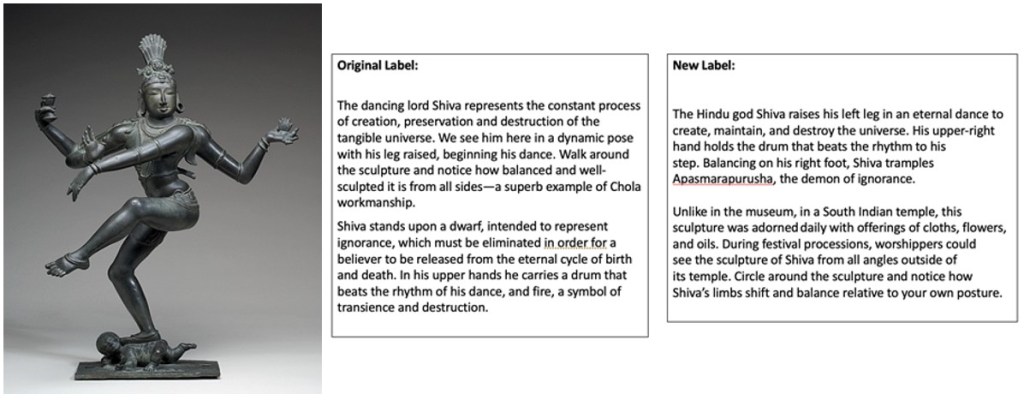
In our last post Ariana Chaivaranon shared how she and curatorial colleagues reimagined the label for Shiva Nataraja, The Lord of Dance. Below are the old and new versions:

Three images are side by side. On the left is a photo of a dark gray, bronze statue against a gray background. The god Shiva raises his right leg and extends his four arms in a dance. At the center and right, two black outlines boxes side by side contain black text on a white background. Box in the center contains the old label. Box on the right contains the new label.
Old label (center) vs. Rewritten label (right) for Shiva Nataraja, Lord of the Dance (left), Indian, early 13th century. Bronze; 34 ¼ x 27 ½ x 13 inches. Purchase: William Rockhill Nelson Trust, 34-7.

After reading the new version, visitors said the label drew them in to examine the object in new ways and that they paid close attention to the sculpture’s posture. The prompt to circle the object and the challenge to think about the object in its original context, in contrast to its display in the museum, both contributed to this reaction. After reading the old label, the majority of visitors also called out the use of the term “dwarf” and mentioned that they appreciated that the new label did not include this term.

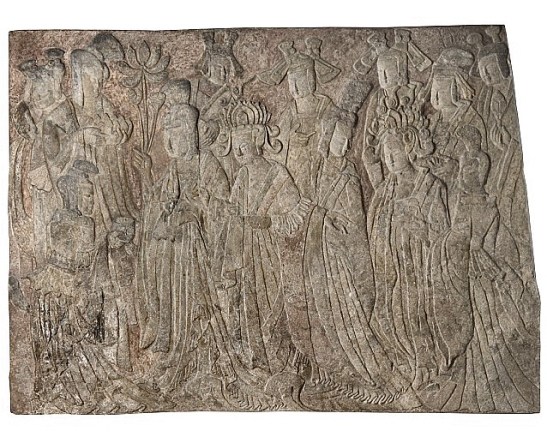
A photo of a dark limestone, shallow carved relief sculpture with traces of color. A group of figures, men and women in ceremonial and royal dress, face right and process across the block of stone.
Offering Procession of the Empress as Donor with Her Court, Chinese, about 522 C.E. Fine, dark-gray limestone; 80 inches x 9 feet 1 ½ inches. Purchase: William Rockhill Nelson Trust. 40-38

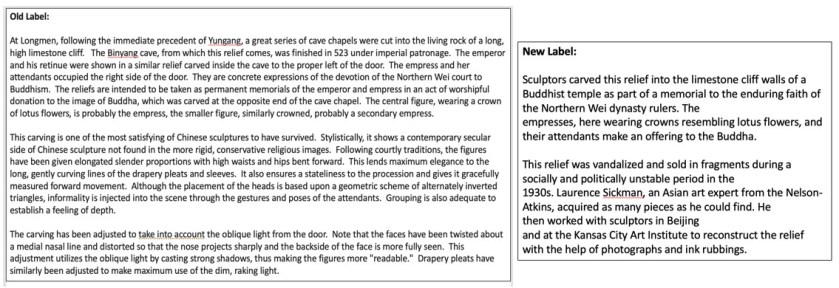
In the case of the Offering Procession of the Empress as Donor with Her Court, from our Chinese Art collection, Jocelyn Edens shared that she and curatorial colleagues wanted to not only shorten the label from over 300 words to 70-90 words but also be transparent about how the work was reconstructed from many fragments, a very different focus than the original label that instead focuses on style and composition.

Old label (on left) vs. Rewritten label (on right) for Offering Procession of the Empress as Donor with Her Court

Once again, all those interviewed preferred the new version to the old, sharing that the old one contained a lot of information that was difficult to take in. One of our motivations with evaluating this particular label was to understand if the new approach would affect how people explored the other objects in the gallery. This, however, did not happen. Instead, people remarked on how the new label made them think about the Buddha as well as the connection to Kansas City Art Institute. While this particular label did not seem to have an effect on the interviewees’ overall experience with other objects, we’d like to continue exploring this question of how individual labels may influence visitors’ understanding of other objects.

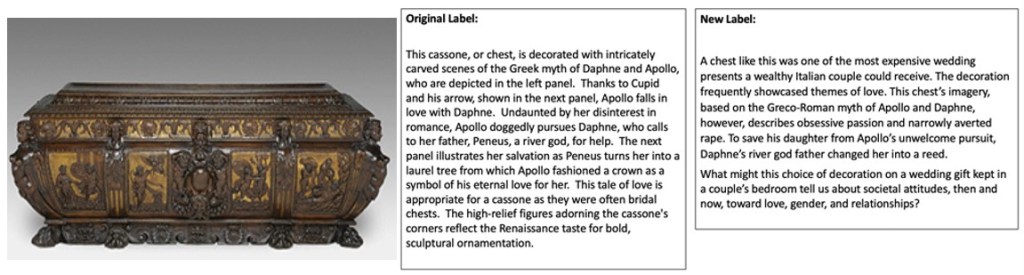
One last example was new interpretation for an object in our European Art collection, Cassone, or Chest, from 1500s Italy, which depicts the myth of Apollo and Daphne. Apollo chases Daphne romantically and, in an effort to help Daphne escape from Apollo’s unwanted pursuits, Daphne’s father, Peneus, turns her into a tree. Much like in the case of Europa and the Bull (a label we are working on but have not yet evaluated), in the original label this myth was described as a romantic story. In the rewrite (both versions below), we explicitly called out the violent nature of this myth as a story of attempted rape.

Image of Cassone (chest) next to its old and new labels. A photo of a large wooden chest shaped like a sarcophagus with a carved, hinged top. Front of the chest has detailed carvings of with stories figures. Two black outlines boxes side by side that contain black text on a white background. Box the on the left contains the old label. Box on the right contains the new label.
Old label (on left) vs. Rewritten label (on right) for Cassone (Chest), Italian, about 1565. Walnut with gilding and traces of paint or gesso. 25 ½ inches x 5 feet ½ inches x 21 ½ inches. Purchase: William Rockhill Nelson Trust. 33-459.

When presented with the new label, interviewees noticed this explicit language of rape as well as how it asked them to think about attitudes towards relationships and gender dynamics both historically and today.  When presented with the old label, interviewees also shared that they were unfamiliar with phrases like “high relief” and “sculpted ornamentation”, reinforcing that we need to avoid art historical jargon. Everyone interviewed preferred the shift away from a traditional art historical approach to the new label that was more explicitly tied to a 21st century understanding of the myth and gendered power dynamics. This one was particularly interesting (and exciting) for me, as it proves that people appreciate, and may actually want, culturally relevant discussions and transparent language in interpretation.

Where do we go from here?

Obviously, we still have a lot of work to do both in replacing current labels and in applying our agreed upon principles to all interpretive text. While this process started with the goal of harm reduction, it has pushed us to reimagine the content of all of our interpretation including the stories we do (and do not) tell and the language we use. Right now, the Interpretation and Curatorial departments are beginning to dig into specific parameters for inclusive language. Here, we are indebted to A Progressive’s Style Guide as a starting point for many conversations. We are gathering resources and sharing as much as possible, all in an effort to build a shared understanding and a common language.

Reflecting on the process, there are a few pieces I would say have been effective. First, this goal of developing a common understanding of harm/shared learning around what creates harm has made the work incredibly collaborative and fruitful. Rather than Interpretation dictating what we say and how we say it, this process has allowed us to build from the bottom up and create principles and values with our curatorial colleagues.

Second, throughout the process we have maintained that we are aiming for progress, not perfection. Those of us working in Interpretation know that once you start asking questions about labels, more questions appear. It’s easy to go down a rabbit hole or get so overwhelmed by the amount of work (don’t even get me started on credit lines and tombstone information!) that these projects die before they get off the ground. Committing to the principle that this is an ongoing process that will likely never be finished has helped us take it one step at a time. At the least, we’ve rewritten some outdated, harmful labels. At the most, we’ve developed new principles and values that will guide our work moving forward. While we still have a lot of work to do, we’ve made progress and tried to not let our perfectionist tendencies get in the way.

While this process has been effective in certain ways, there are, of course, still areas for improvement. I wonder, for instance, if starting with labels was the right place. In each conversation throughout this process, concerns and questions about other forms of interpretation have been raised, not to mention the need for small- and large-scale gallery reinstallations to reframe how we tell stories about objects. This is natural because labels support visitor experience and, as we all know, do not exist in a vacuum. While focusing on labels has enabled us to address some problematic interpretation and start amazing conversations with colleagues, I also worry it has overly focused us too much on one interpretive element. The question now becomes how do we open up the conversation to larger organizing principles that go beyond label text and get to the very root of planning and ideas in our projects. I don’t know the answer, but I think we’re on our way and I’d welcome any thoughts.

Thank you all for reading this series. It has been a pleasure to share our work and I hope it has been inspiring in a small way.

About the Author

Rachel Nicholson is the Director, Interpretation, Evaluation & Visitor Research at the Nelson-Atkins Museum of Art.  You can reach her at rnicholson@nelson-atkins.org. Every two weeks throughout April and May 2021, Rachel has shared her team’s efforts to rewrite the Nelson-Atkins’ permanent collection gallery labels through a harm reduction lens. Read her first three posts here.

Don’t want to miss a post? Subscribe to our mailing list (just fill out the form at the right)! 

The post Improving Our Museum Labels Through A Harm Reduction Lens: Part 4 appeared first on RK&A.

Written by cplysy · Categorized: rka

  • « Go to Previous Page
  • Go to page 1
  • Interim pages omitted …
  • Go to page 184
  • Go to page 185
  • Go to page 186
  • Go to page 187
  • Go to page 188
  • Interim pages omitted …
  • Go to page 310
  • Go to Next Page »

Footer

Follow our Work

The easiest way to stay connected to our work is to join our newsletter. You’ll get updates on projects, learn about new events, and hear stories from those evaluators whom the field continues to actively exclude and erase.

Get Updates

Want to take further action or join a pod? Click here to learn more.

Copyright © 2026 · The May 13 Group · Log in

en English
af Afrikaanssq Shqipam አማርኛar العربيةhy Հայերենaz Azərbaycan dilieu Euskarabe Беларуская моваbn বাংলাbs Bosanskibg Българскиca Catalàceb Cebuanony Chichewazh-CN 简体中文zh-TW 繁體中文co Corsuhr Hrvatskics Čeština‎da Dansknl Nederlandsen Englisheo Esperantoet Eestitl Filipinofi Suomifr Françaisfy Fryskgl Galegoka ქართულიde Deutschel Ελληνικάgu ગુજરાતીht Kreyol ayisyenha Harshen Hausahaw Ōlelo Hawaiʻiiw עִבְרִיתhi हिन्दीhmn Hmonghu Magyaris Íslenskaig Igboid Bahasa Indonesiaga Gaeilgeit Italianoja 日本語jw Basa Jawakn ಕನ್ನಡkk Қазақ тіліkm ភាសាខ្មែរko 한국어ku كوردی‎ky Кыргызчаlo ພາສາລາວla Latinlv Latviešu valodalt Lietuvių kalbalb Lëtzebuergeschmk Македонски јазикmg Malagasyms Bahasa Melayuml മലയാളംmt Maltesemi Te Reo Māorimr मराठीmn Монголmy ဗမာစာne नेपालीno Norsk bokmålps پښتوfa فارسیpl Polskipt Portuguêspa ਪੰਜਾਬੀro Românăru Русскийsm Samoangd Gàidhligsr Српски језикst Sesothosn Shonasd سنڌيsi සිංහලsk Slovenčinasl Slovenščinaso Afsoomaalies Españolsu Basa Sundasw Kiswahilisv Svenskatg Тоҷикӣta தமிழ்te తెలుగుth ไทยtr Türkçeuk Українськаur اردوuz O‘zbekchavi Tiếng Việtcy Cymraegxh isiXhosayi יידישyo Yorùbázu Zulu