• Skip to main content
  • Skip to footer
  • Home

The May 13 Group

the next day for evaluation

  • Get Involved
  • Our Work
  • About Us
You are here: Home / Archives for allblogs

allblogs

May 11 2021

How to Engage Your Audience with “Choose Your Own Adventure” Presentations

Ready for an advanced presentation technique?

Want to make sure your audience is engaged?

No, those 10-minute Q&As at the end of a presentation don’t count as adequate engagement. Let’s notch up our engagement!

In this blog post, you’ll learn about the “Choose Your Own Adventure” method for engaging our audiences during presentations.

In March 2021, I was speaking at the Nonprofit Technology Network’s conference, 21NTC, and I used this technique.

I started to write a blog post with screenshots, but I really want to show you how this works.

In this video, you’ll see:

  1. A brief demo of the Choose Your Own Adventure method
  2. A behind-the-scenes tour of my slides
  3. A discussion of the caveats so you can decide when to use this method

Watch the Video

The Choose Your Own Adventure Method

As you saw in the video, the Choose Your Own Adventure technique puts our audience in the driver’s seat.

Here’s what the presentation looks and feels like for our audience members.

Step 1: Show the Table of Contents Slide

First, we show them a Table of Contents slide, which has an overview of all the topics we might cover.
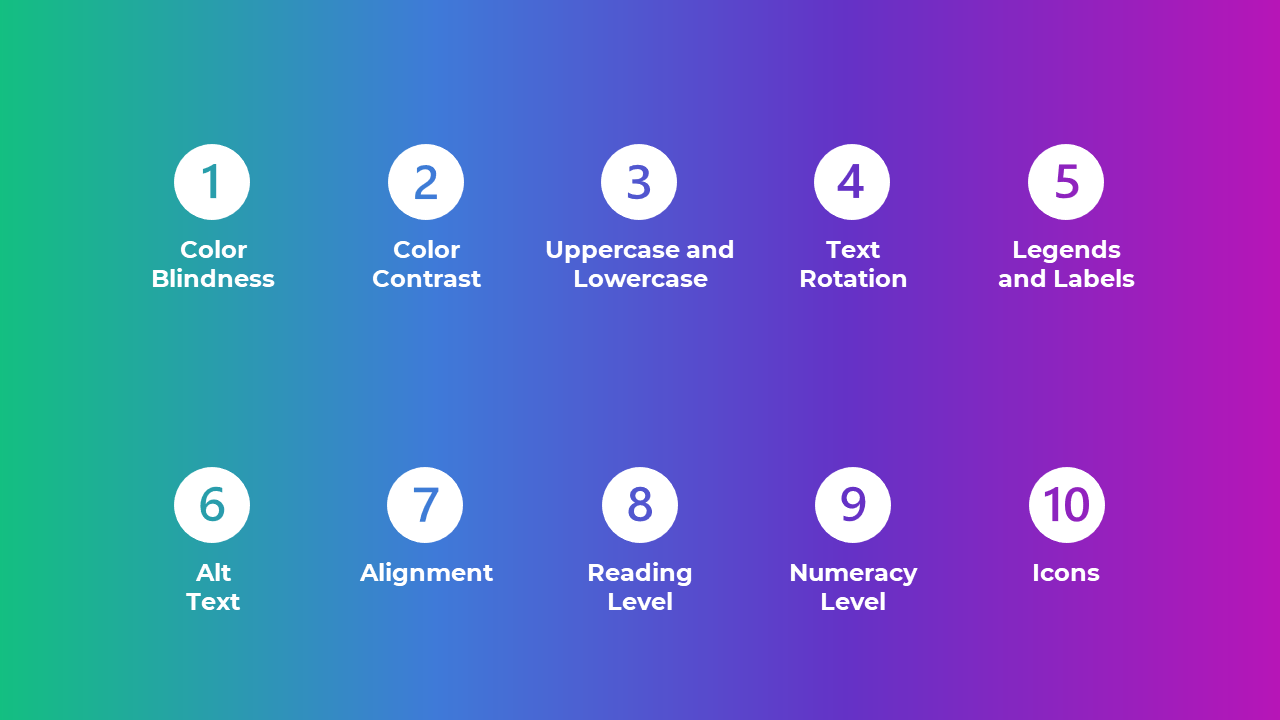
First, we show them a Table of Contents slide, which has an overview of all the topics we might cover in our presentation.

I tell the audience that there’s tons to learn about this topic, but we’ll only have time to cover a few techniques during our short time together.

My 21NTC presentation was 60 minutes long, so we had time for 3 techniques.

Step 2: Ask Attendees to Vote for their Preferred Topics

Then, the audience members vote and help us prioritize which topic(s) we’ll cover.

For example, in my 21NTC presentation in March, I simply asked the attendees to type their votes into the chat window.

You’ll need to make some small talk while audience members are typing in their votes.

Sometimes, there might be a 15- to 30-second delay between us and the audience members. I’ve given virtual talks on a bunch of different conference platforms (Whova, etc.), and most of them have a slight delay. We’ll need to factor that in, too. More small talk.

In the video, you’ll see what I did for my 21NTC presentation. While the audience members were voting, I simply let them know that they could download an ebook to learn all 10 techniques.

Step 3: Click on their Preferred Topics on the Table of Contents Slide

Finally, the links propel us to the correct place in the presentation.

If attendees want to learn about Color Blindness, for instance, then I would click on the Color Blindness section of this slide. The links fast-forward us to that segment of slides.

For example, our Table of Contents slide might be on slide 5, and we can use the links to fast-forward to slide 50.
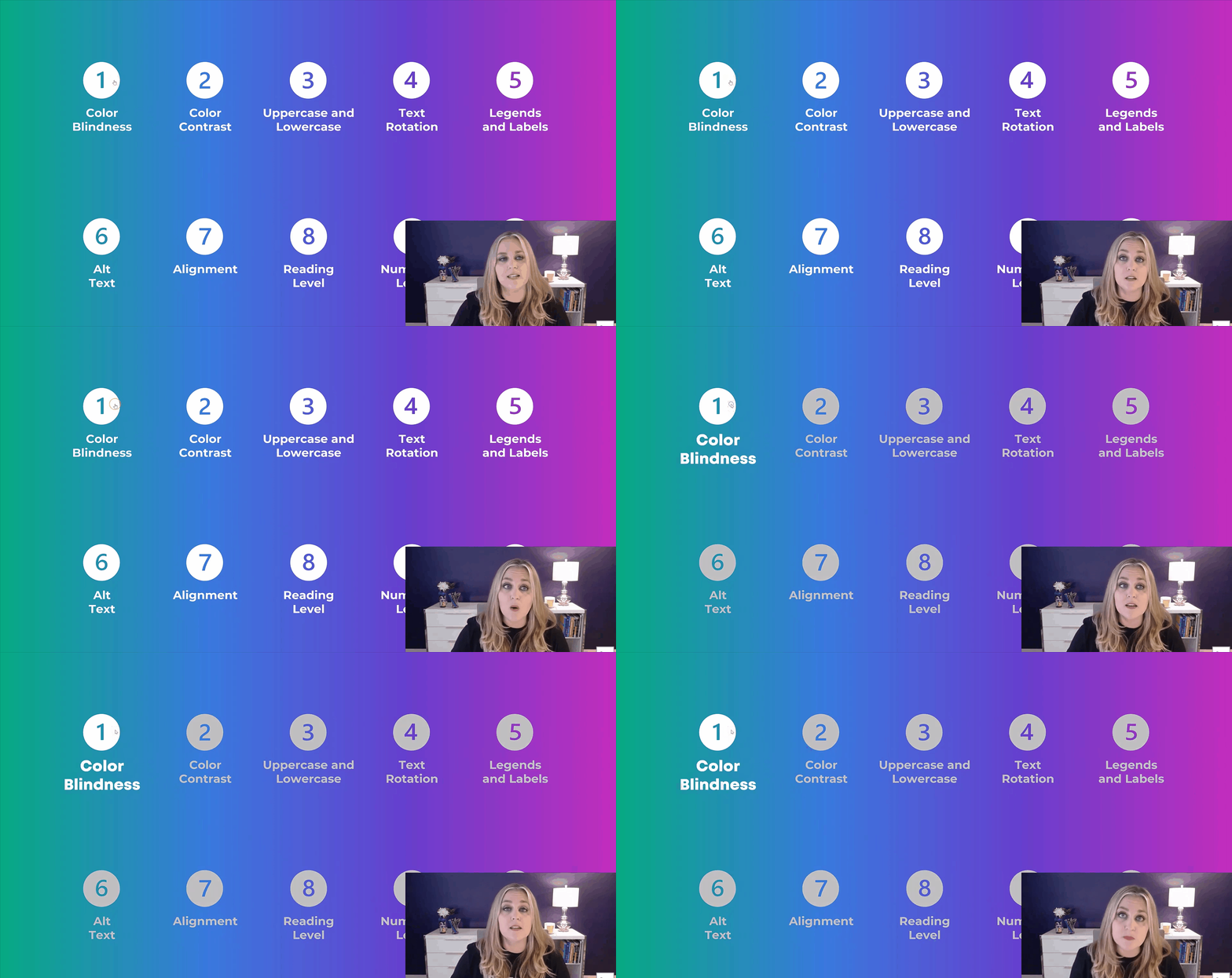
If attendees want to learn about Color Blindness, for instance, then I would click on the Color Blindness section of this slide. The links fast-forward us to that segment of slides.

Step 4: Discuss that Topic & Show the Table of Contents Slide Again

At the end of the Color Blindness section, we see the Table of Contents slide again.

The presenter clicks on the second topic that the audience members wanted to talk about, and the links propel us to that segment of the presentation.

And on and on.

At the end of the Color Blindness section, we see the Table of Contents slide again. The presenter clicks on the second topic that the audience members wanted to talk about, and the links propel us to that segment of the presentation.

I often conclude with a case study. We’ll discuss the case studies and their links in a moment.

A Behind-the-Scenes Tour of My PowerPoint Slides

In the video, you’ll see exactly which buttons to click on to create a Choose Your Own Adventure presentation.

Links on the Table of Contents Slide

Here’s how you can add links to your PowerPoint slides:

  1. Click on the icon or text box where you want to create a link.
  2. Go to the Insert tab at the top of the screen.
  3. Go to the Link button.
  4. Click the down-arrow.
  5. Insert a link.
  6. In the pop-up window, choose Place in this Document.
  7. You can scroll through your list of numbered slides and choose one.
  8. Click ok.

That’s it!

When you click the icon or text box during your live presentation, the links will take you and your audience to the appropriate segment of your presentation.

You can add links to your PowerPoint slides so that when you click the icon or text box during your live presentation, the links will take you and your audience to the appropriate segment of your presentation.

Invisible Links to the Case Studies

Sometimes I end my presentations with case studies. These case studies give the attendees a chance to put their new knowledge into use.

For example, at the 21NTC conference, I prepared three case studies in advance. I had a beginner, intermediate, and advanced case study. I knew we’d only have time to cover one of the case studies.

As shown in the video, I simply added links to the case studies to the Table of Contents slide.

There are invisible rectangles on my Table of Contents slide. The top rectangle is a link to the beginner case study, the middle rectangle is a link to the intermediate case study, and the bottom rectangle is a link to the advanced case study.

Caveats

Wondering whether this technique is right for you?

Should you continue giving a “regular” linear presentation? Or should you try a “Choose Your Own Adventure” non-linear presentation??

Here are two factors to consider:

  • This is an advanced technique. You need to be an expert in your topic area and have tons of presentation experience. You have to be nimble enough to speak about any of your topics in any order, and to adjust the time spent on each topic on the fly.
  • This technique only works when the topics can be presented in any order . In my accessibility presentation, I could discuss topic 1, 2, and 3. Or, I could discuss 1, 3, and 2. The techniques aren’t sequential; they can truly be taught in any order. Make sure your topics can be delivered in any order, too.

Your Turn

After you try this, get in touch! Share tips of your own so we can learn from each other.

Written by cplysy · Categorized: depictdatastudio

May 11 2021

The limitations of using an advocacy frame to understand and evaluate grassroots-led change

This blog post was originally published in AEA365 during the Advocacy and Policy Change week in March 2021

Over the past year, we have all witnessed the power and promise of grassroots-led change as popular movements and organized communities have galvanized widespread support for changing institutions and systems that perpetuate anti-Black violence and racism. These mechanisms for change have a long, important history in advancing systems and structural change grounded in anti-racism, equity, and justice.

However, the evaluation field is short on scholarship, guidance, and spaces for evaluators to learn about the unique histories, cultures, and practices of grassroots-led change, including social movements and community organizing. In that absence, the evaluation field has, perhaps unknowingly, upheld advocacy and policy change evaluation as the framework for these social change mechanisms. In my short evaluation career, I have heard evaluators refer to community organizing as an “advocacy strategy” and policy change as the ultimate end goal of movement building and organizing.

When evaluators subsume community organizing and social movements under the advocacy and policy change umbrella, we obscure and devalue their unique histories, practices, and contributions. Perhaps most troubling, by centering advocacy and policy change in social justice-oriented evaluation, we are indirectly complicit in the continued underinvestment in grassroots-led change by the philanthropic sector. Mitigating these effects and evaluating grassroots-led change responsibly requires a reorientation and expansion in our understanding of the practices, strategies, and outcomes of social change work.

Lesson Learned:

Social movements and community organizing are fundamentally different mechanisms of social change from traditional advocacy — from the individuals and communities that lead them, to the underlying principles that motivate them, to the strategies they employ, to the end goals they seek. Traditionally, the advocacy sector is grounded in technocratic and meritocratic worldviews that center professionalized, “expert” advocates and policymakers as the agents of social change. In contrast, community organizing and social movements democratize social change, putting impacted communities in the driver’s seat. Community organizers and movements builders seek to not just work within existing power structures but to disrupt those structures and build the agency and capacity of communities most impacted by injustice and inequities to advance change.

Key Resources:

How Organizations Develop Activists by Hahrie Han: A thorough primer about the practices of community organizing.

The Purpose of Power by Alicia Garza: Part memoir, part handbook from one of the co-founders of Black Lives Matter that offers reflections and lessons on the unique challenges and opportunities of organizing and movement building in our current moment.

This is an Uprising by Mark and Paul Engler: A clear and compelling guide to movement building, packed with examples from movements around the world.

The American Evaluation Association is hosting APC TIG Week with our colleagues in the Advocacy and Policy Change Topical Interest Group. The contributions all this week to aea365 come from our AP TIG members. Do you have questions, concerns, kudos, or content to extend this aea365 contribution? Please add them in the comments section for this post on the aea365 webpage so that we may enrich our community of practice. Would you like to submit an aea365 Tip? Please send a note of interest to aea365@eval.org. aea365 is sponsored by the American Evaluation Association and provides a Tip-a-Day by and for evaluators. These views and opinions do not necessarily represent those of the American Evaluation Association, and/or any/all contributors to this site.

Originally published at https://aea365.org on March 7, 2021.


The limitations of using an advocacy frame to understand and evaluate grassroots-led change was originally published in InnovationNetwork on Medium, where people are continuing the conversation by highlighting and responding to this story.

Written by cplysy · Categorized: innovationnet

May 10 2021

Teaching like Evaluation

What if we taught like we evaluated? I have been imaging what teaching might look like if we approached it like we did our evaluation work. Just like there are a variety of different approaches and strategies teachers use in their courses (e.g., inclusive pedagogy, team-based learning, problem-based learning, lecture-based instruction) there are a variety of different approaches and strategies evaluators use in their evaluations (e.g., participatory, values-engaged, culturally responsive, democratic, developmental, utilization-focused, mixed methods, theory-driven).

Despite the variety of approaches to both teaching and evaluation, there is a general logic that underlies both teaching[1] and evaluation (Fournier, 1995; Scriven, 1980). At the heart of evaluation is a basic four step process:

  1. Establish criteria of merit
  2. Develop standards of performance along each criterion
  3. Measure performance and compare with standards
  4. Synthesize results into an evaluative judgment

As I critically rethink my teaching philosophy, I am increasingly considering how I can bring the general logic of evaluation—and the working logics of the approaches to evaluation I tend to use—to my teaching practice. I am starting to believe that if I evaluated the way we tend to teach that I would not retain clients for very long, and so I believe it is important I change how I approach my teaching.

The Typical Teaching Approach

From my experience teaching, reading about teaching, and discussing teaching with other instructors, this is a little like what most teaching seems to look like, aligned with the general logic of evaluation four-step process above:

  1. Instructors set the learning objectives prior to meeting with students, which often need to get approval at the department, college, and university level.
  2. Instructors determine what constitutes the grading rubric or expectations for each assignment (note: not usually per learning objective).
  3. Instructors measure performance of students, although there may be some peer assessment or outside assessment components (e.g., client feedback in the case of a service learning course).
  4. Instructors determine the overall grade of the student.

Note how instructors determine pretty much all of it, and often without consultation of the primary ‘stakeholder’ involved in the education process: students. If we were to apply this approach to our program evaluations, it would look something like this:

  1. Evaluators set the criteria for evaluating the program before meeting with the program itself but will require approval by governing bodies and funders first.
  2. Evaluators will develop standards of performance along those criteria, but again without any program input.
  3. Evaluators will measure the performance of the program, often not including programs in that performance measurement. However, a small piece of it may include other programs measuring your program’s performance, or getting feedback from some outside stakeholders.
  4. Evaluators determine the final evaluative judgment of the program. Again, no input given by stakeholders.

Realizing this made me cringe. This is not how I would ever approach my evaluations. Although I know some folks do their evaluations like this, most folks tend to take a more collaborative or participatory approach, align their evaluations with their program’s needs, being culturally responsive in their approach, adjust the evaluation according to the situation, and focus on promoting use.

Applying the logic of evaluation to teaching

So what if we were to instead apply how we typically approach our evaluation work to our teaching? This is what Fournier (1995) calls the working logics of evaluation. At the heart of any evaluation approach is the general logic of evaluation, but that general logic can look different depending on our approaches. Let’s see what teaching might look like if we apply my typical evaluation approach (e.g., utilization-focused, culturally responsive, contingency-based, theory-driven, etc.).

  1. Instructors collaborate with students to determine the learning objectives prior to the course. This is done based on a variety of factors, including what background knowledge and experience the student brings to the course, what they are hoping to get out of the course, and feedback and requirements from external sources (e.g., accreditation requirements, degree requirements, professional association recommendations, career expectations, research on the field of study, research on the pedagogy in the field of study). Although there may be set criteria across all students in the classroom, there is some individuality in the criteria per each student given individual needs.
  2.  Instructors collaborate with students to develop standards of performance. There are a variety of ways this could be done, including setting the standards of performance ahead of time together, the instructor providing standards and giving students an opportunity to reflect and revise, or letting students determine what their standard of performance is for an assignment. Again, external sources may have some sway here to help students get their degree and career they are aiming for.
  3. Instructors and students jointly measure performance. Peer evaluations and outside evaluations can continue to be used, but at least students are brought into the process through practices like asking students to grade themselves on their pre-determined standards of performance.
  4. Instructors and students jointly determine the overall grade and final evaluative judgment of the student. Again, the extent of control of this process by students may vary, but they can provide at least some input into the process and final judgment.

Moving forward

This reflection has led me to pursue changing how I approach my courses for the upcoming semesters. In particular, I have begun revising my courses to promote Ungrading (Blum, 2020), which at the heart of it promotes feedback and learning as opposed to instructor-led student evaluation. Some of the authors in the edited volume go so far as to say that evaluation should not be done at all, although I’m not sure I am willing to go so far as that. However, giving students some autonomy over their learning, meeting students where they are at, matching the course to their needs, and promoting the incorporation of feedback and learning are all things that I agree with and want to promote in my teaching. Just like program evaluation can both evaluate and promote learning, so too can our teaching, if we are thoughtful in how we approach it.


[1] I have not thought much about what the general logic of teaching is, but I would be curious if anyone knows of any references pointing to the topic.  The Fournier (1995) article points to references on the general logic of law, medicine, and science, but not education.

Written by Dana Wanzer · Categorized: danawanzer

May 08 2021

Principios metodológicos para diseñar evaluaciones de alta calidad

En el reciente informe “Evaluación de las intervenciones de desarrollo internacional: una descripción general de los enfoques y métodos“, se discute acerca de algunos de los principios metodológicos clave del diseño de la evaluación que proporcionan las bases para la selección, adaptación y uso de enfoques y métodos de evaluación en el contexto de evaluación del desarrollo. El informe se centra solo en cuestiones metodológicas y no discute otros aspectos clave del diseño, como el uso previsto de la evaluación por parte de las partes interesadas.

Los principios discutidos también se refieren a la evaluación en general, pero son especialmente pertinentes para diseñar evaluaciones independientes en un contexto de desarrollo internacional. Consideran que los siguientes principios metodológicos son importantes para diseñar y desarrollar evaluaciones de alta calidad:

1. Dar la debida consideración a los aspectos metodológicos de la calidad de la evaluación en el diseño: enfoque, consistencia, confiabilidad y validez

2. Adaptación del diseño de la evaluación a las preguntas de la evaluación

3. Utilización de herramientas eficaces para el diseño de evaluaciones

4. Equilibrio del alcance y la profundidad en evaluaciones multinivel y multi lugar

5. Métodos para integrar la profundidad y amplitud analíticas

6. Hacer frente a las oportunidades institucionales y las limitaciones de presupuesto, datos y tiempo

7. Utilizar enfoques basados en la teoría

Referencia:

Vaessen, Jos, Sebastian Lemire, and Barbara Befani. 2020. Evaluation of International Development Interventions: An Overview of Approaches and Methods. Independent Evaluation Group. Washington, DC: World Bank.

Written by cplysy · Categorized: TripleAD

May 07 2021

“You only get as much justice as you have the power to compel.”

This post first appeared in the Luminaire Group monthly newsletter, Be Lumin-Us in August 2019.

Twelve years ago, when I began training as a community organizer in New England, I heard the following saying:

“You only get as much justice as you have the power to compel.”

While my community organizing career was short-lived, during those years, power was a constant reality of my day-to-day work. As I knocked on doors, recruited volunteers, and lobbied legislators, I found my conversations frequently revolving around power — who has it, who doesn’t, and how we can get more of it.

It was at that time I learned that proactively building long-term power in communities and movements is critical to achieving and maintaining structural change. It usually wasn’t enough to just pass good policy and get supportive people elected. We needed to sustain a base of power that could take us past legislative sessions and elections to ensure that policies were implemented, elected officials were held accountable, and an affirmative narrative about equity and justice was cultivated and maintained.

But as I’ve transitioned from organizer to funder to evaluator, I’ve found that in the philanthropic and evaluation sectors, power building is too often missing from discussions about structural and systemic change. As a result, there is a fundamental disconnect between our aspirations for social change and what we fund and measure.

Momentum, a social movement incubator and training organization, teaches a theory of power that helps clarify this disconnect. They explain that most of us have been taught to believe a monolithic view of power — “that power lies in the hands of the appointed few.”

It’s a view that leads people to believe they are powerless or that the path to change necessarily runs through powerful decision-makers. Traditional approaches to power mapping embrace this view of monolithic power by centering decision-makers and their interests. As a result, campaigns and movements are frequently organized around theories of change that make influencing traditional power holders their ultimate goal.

In recent years, there has been an uptick in funders who are shifting from a monolithic view of power to a social view of power that has long been embraced by grassroots organizers and movement builders. Our sector is beginning to understand that durable structural change requires building the power of communities most impacted by inequities and injustice. As a result, knowing how power shows up in change ecosystems, how it is built and wielded, and how to appropriately measure it will become an increasingly important competency for evaluators who assess structural change efforts.

Get Lit with Katie Fox: A Q&A with this month’s guest editor

This month, we chatted with Katie about what’s sparking joy for her, an idea she loves right now, and where she’s turning for inspiration.

Spoiler: This Q&A involves a cute dog photo.

READ THE BLOG →

Originally published at https://mailchi.mp.


“You only get as much justice as you have the power to compel.” was originally published in InnovationNetwork on Medium, where people are continuing the conversation by highlighting and responding to this story.

Written by cplysy · Categorized: innovationnet

  • « Go to Previous Page
  • Go to page 1
  • Interim pages omitted …
  • Go to page 187
  • Go to page 188
  • Go to page 189
  • Go to page 190
  • Go to page 191
  • Interim pages omitted …
  • Go to page 310
  • Go to Next Page »

Footer

Follow our Work

The easiest way to stay connected to our work is to join our newsletter. You’ll get updates on projects, learn about new events, and hear stories from those evaluators whom the field continues to actively exclude and erase.

Get Updates

Want to take further action or join a pod? Click here to learn more.

Copyright © 2026 · The May 13 Group · Log in

en English
af Afrikaanssq Shqipam አማርኛar العربيةhy Հայերենaz Azərbaycan dilieu Euskarabe Беларуская моваbn বাংলাbs Bosanskibg Българскиca Catalàceb Cebuanony Chichewazh-CN 简体中文zh-TW 繁體中文co Corsuhr Hrvatskics Čeština‎da Dansknl Nederlandsen Englisheo Esperantoet Eestitl Filipinofi Suomifr Françaisfy Fryskgl Galegoka ქართულიde Deutschel Ελληνικάgu ગુજરાતીht Kreyol ayisyenha Harshen Hausahaw Ōlelo Hawaiʻiiw עִבְרִיתhi हिन्दीhmn Hmonghu Magyaris Íslenskaig Igboid Bahasa Indonesiaga Gaeilgeit Italianoja 日本語jw Basa Jawakn ಕನ್ನಡkk Қазақ тіліkm ភាសាខ្មែរko 한국어ku كوردی‎ky Кыргызчаlo ພາສາລາວla Latinlv Latviešu valodalt Lietuvių kalbalb Lëtzebuergeschmk Македонски јазикmg Malagasyms Bahasa Melayuml മലയാളംmt Maltesemi Te Reo Māorimr मराठीmn Монголmy ဗမာစာne नेपालीno Norsk bokmålps پښتوfa فارسیpl Polskipt Portuguêspa ਪੰਜਾਬੀro Românăru Русскийsm Samoangd Gàidhligsr Српски језикst Sesothosn Shonasd سنڌيsi සිංහලsk Slovenčinasl Slovenščinaso Afsoomaalies Españolsu Basa Sundasw Kiswahilisv Svenskatg Тоҷикӣta தமிழ்te తెలుగుth ไทยtr Türkçeuk Українськаur اردوuz O‘zbekchavi Tiếng Việtcy Cymraegxh isiXhosayi יידישyo Yorùbázu Zulu