• Skip to main content
  • Skip to footer
  • Home

The May 13 Group

the next day for evaluation

  • Get Involved
  • Our Work
  • About Us
You are here: Home / Archives for allblogs

allblogs

Nov 04 2020

La evaluación no está siendo una prioridad durante la pandemia: desafíos pasados

Retomamos el post Evaluando en tiempos de pandemia: Estos últimos 8 meses en la gestión y ejecución de evaluaciones hemos tenido desafíos (a) éticos, (b) conceptuales y (c) metodológicos que han afectado/están afectado a nuestra capacidad para realizar evaluaciones:

1.Desafíos éticos:

Desde un punto de vista ético, los planes de trabajo de evaluación inevitablemente han necesitado/están necesitando ajustes y plazos más largos/dilatados. En primer lugar, donde la evaluación es un componente clave para comprender si las intervenciones de salud pública y otras intervenciones prioritarias (por ejemplo, protección social y redes de seguridad social para ciudadan@s (vulnerables)) están funcionando y cómo funcionan, l@s evaluador@s deberían haber estar integrad@s (aunque por desgracia no ha sido integrada en demasiados casos, debido a que la evaluación no ha sido una prioridad):  (1) no solo para poder recopilar los mejores datos posibles y realizar las mejores evaluaciones posibles para informar a los responsables de la toma de decisiones durante la crisis, (2) sino también para corroborar debates críticos que tendrán lugar una vez que la crisis esté terminando.

La evaluación ha tratado/está tratado de no ejercer presión innecesaria sobre un sistema público demasiado sobrecargado, el enfoque ha sido reducir (y priorizar) las interacciones directas con colegas operativos que trabajan en sectores relacionados con la crisis, mientras se han intensificado los esfuerzos para llevar a cabo el trabajo evaluativo de manera diferente dadas las limitaciones.

Una consideración ética más sutil ha sido/está siendo cumplir las condiciones necesarias para que las evaluaciones sean útiles y se utilicen. ¿Podemos esperar que nuestra audiencia escuche? L@s evaluador@s están tratando de ser proactiv@s y no depender de mecanismos institucionales no tan bien engrasados ​​para regular la producción de evaluaciones para preservar. Sin embargo, de nuevo, en general la evaluación no está siendo una prioridad durante la respuesta al C-19.

2.Desafíos conceptuales

Avanzando con los planes de trabajo de evaluación y el diseño de la evaluación, se necesita un cambio conceptual. En una pandemia global de las proporciones que estamos experimentando actualmente, los efectos repercuten mucho más allá del sector de la salud pública y los efectos (in) directos sobre la salud de COVID-19 en l@s ciudadan@s. La pandemia global, las medidas de contención impuestas por el gobierno y los cambios de comportamiento durante la crisis del sector privado y la ciudadanía,  pueden tener efectos significativos y duraderos en una amplia gama de temas de importancia social.

3.Desafíos metodológicos:

Desde una perspectiva metodológica, ha habido/está habiendo cuatro desafíos principales para l@s evaluador@s.

El primer desafío se refiere a las restricciones sobre la recopilación de datos empíricos a nivel institucional: algunas de las partes interesadas clave no han estado/están disponibles para entrevistas. Como resultado, los evaluadores han recurrido/están recurriendo al muestreo de conveniencia / propositivo / intencional, aun siendo conscientes de la propensión al sesgo de selección.

En segundo lugar, la mayoría de los ejercicios de evaluación se han visto significativamente limitados debido a la incapacidad de realizar la recopilación de datos en el terreno. Los evaluadores han tenido dificultades para desarrollar (1) una perspectiva rica y contextualizada del evaluando, (2) las estrategias de recopilación de datos, como (a) la observación directa, (b) la construcción de una buena relación con las partes interesadas (observando las costumbres locales y las normas culturales), así como (c) todo tipo de indagación inductiva (incluida la muestra in situ, con el enfoque de bola de nieve de los entrevistados). Las entrevistas remotas (por teléfono, teleconferencias) constituyen solo una solución parcial a este desafío. Se ha mitigado sólo en parte el problema de acceso y es propenso a sesgos (especialmente cuando las entrevistas cubren temas complejos o delicados).

El tercer desafío está estrechamente relacionado con los dos anteriores: es justo decir que incluso antes de COVD-19, algunas evaluaciones programáticas pueden haber estado sujetas a algún tipo de “sesgo del gobierno central” en cuanto a su recopilación de datos. Dependiendo de la naturaleza de la evaluación,  muchas entrevistas ha involucrado a las partes interesadas de gobiernos federales directamente involucradas en la planificación, financiación e ejecución de intervenciones (garantes de derechos). Las entrevistas con las partes interesadas en los niveles descentralizados del gobierno federal  (por ejemplo, subnacionales, provinciales…) y los sujetos de derecho/beneficiarios, y especialmente en las zonas rurales, han sido más difíciles de planificar en las circunstancias actuales, lo que ha reforrzado el sesgo mencionado anteriormente.

Finalmente, un cuarto desafío se refiere a aprovechar el potencial de la revisión y análisis documental durante la fase ​​de gabinete.  Estos meses se han difundido revisiones y sistematizaciones de los conocimientos y datos existentes (aunque otra historia es si los hemos podido internalizar e institucionalizar). Podrían haber tenido mayor importancia/relevancia práctica: Las revisiones de evaluaciones existentes, las revisiones de estrategia, las revisiones estructuradas académicas y de literatura institucional (y así sucesivamente) y el análisis de datos existentes, tanto convencionales (por ejemplo, datos corporativos, datos de encuestas).
Written by cplysy · Categorized: TripleAD

Nov 04 2020

I’m back to blogging

Over on my personal blog, I’ve decided to try blogging every day in the spirit of November as National Blog Posting Month (NaBloPoMo) – that was a thing years ago when blogs were more popular. The idea is to blog every single day during the month of November. That got me thinking that it had been a while since I blogged here… and it turns out that has been more than a year!

I remembered that I had been doing a series on evaluator competencies where I wrote one blog posting a week on each of the Canadian Evaluation Society (CES) evaluator competencies and that I had decided to take a “short break” when stuff was getting busy with the courses I was teaching. So “short” may have not been the right word there. In my defence, the world was turned rather upside down for most of that time, what with a global pandemic and reckoning on racism.

My other issue with actually getting things up on here is my battle with perfectionism. During these pandemic-y times I’ve been doing a fair bit of professional development 1As presentations and workshops have had to move online in response to the pandemic, it’s resulted in a lot of events that otherwise might have been just held locally being available anywhere in the world. And with a reckoning on racism bringing more attention to the work of BIPOC (Black, Indigenous, and people of colour) activists, scholars, and organizations, webinars on anti-racism and reconciliation have been amplified. and from the various webinars and online workshops I’ve attended, I’ve started many, many blog postings as a way to capture notes from these events. But then I think “Oh, I need to summarize this better/come up with a good conclusion/figure out what actions I should take from what I’ve learned/find a good Creative Commons licenced photo to go with this/provide links to the webinar recording/etc./etc.” and then it sits in my drafts folder for ever and ever.

So here’s my new plan. I’m going to re-start on my evaluator competency series – I’ll post once a week on that. And I’m going work through my drafts folder and actually get my notes from each of these events in a reasonable, but not perfect, shape, and post those too. Or I’ll decide that I didn’t get enough value from a given webinar or workshop and hit the “delete” button. I won’t blog every day – but I’m going to aim for two blog postings per week in addition to my evaluator competency one, for the month of November.

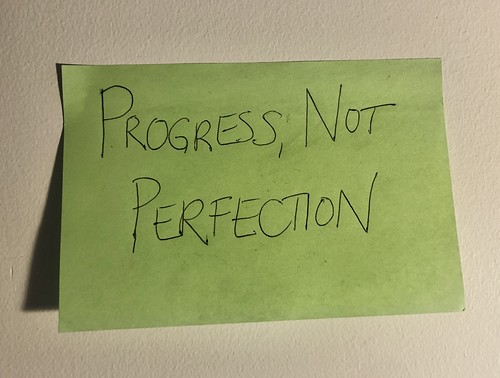
Progress, not perfection
Sticky note I have above my desk in my home office. Though in these the pandemic-y times, some days it’s more survival than progress that I hope to achieve.

Footnotes   [ + ]

1. ↑ As presentations and workshops have had to move online in response to the pandemic, it’s resulted in a lot of events that otherwise might have been just held locally being available anywhere in the world. And with a reckoning on racism bringing more attention to the work of BIPOC (Black, Indigenous, and people of colour) activists, scholars, and organizations, webinars on anti-racism and reconciliation have been amplified.

Written by cplysy · Categorized: drbethsnow

Nov 04 2020

Ask Nicole: The Best Time to Look for a Consultant

Have a question you’d like featured? Let me know. The best time to look for a consultant is before you need a consultant. An observation I’ve made in the past few years is that nonprofits and organizations look for a consultant when they come across an opportunity to fund a project, and that’s not the […]

The post Ask Nicole: The Best Time to Look for a Consultant appeared first on Nicole Clark Consulting.

Written by cplysy · Categorized: nicoleclark

Nov 03 2020

Evaluation Roundup – October 2020


Welcome to our October roundup of new and noteworthy evaluation news and resources – here is the latest.

Have something you’d like to see here? Tweet us @EvalAcademy or connect on LinkedIn!


New and Noteworthy — Resources


Evaluation issues and recommendations for change

The tables have turned and now evaluators need to examine how we can do better. The Funder & Evaluator Affinity Network (FEAN) developed a Call to Action series: five briefs, decision tools, open letters, discussion guides, and more that address urgent issues and recommendations for change. The five briefs propose tangible steps to make changes in the field: 1) Strategy and Practice; 2) Evaluators of Color; 3) Knowledge Sharing; 4) Global Transformation, and; 5) Collaboration and Partnership. We have a lot of work to do. The first step is reading these.

Engaging community in evaluation through empowerment evaluation

The Tamarack Institute and Fetterman & Associates co-facilitated an online session that explored how we ensure evaluation is inclusive, equitable and community-driven. The first part of the session focuses on criteria central to relationship building in participant-driven community-based evaluation. The second half focuses on empowerment evaluation as an evaluation approach to foster community engagement, improvement and self-determination.

Principles Focused Evaluation: A quick overview

CoLab Dudley has pulled together a quick case study guide for anyone interested in Principles Focused Evaluation (PFE). If you don’t have the time to read Michael Quinn Patton’s 435 page book on PFE then check out this resource. The guide contains links to insights from CoLab Dudley team members telling you why and how PFE works for them in their role. It also outlines the steps they took to implement PFE and tips if you are thinking of using it.

How to incorporate gender in your evaluation

Khulisa Management Services breaks down how they incorporate gender into their work through six best practices. Incorporating gender means incorporating analyses of institutions and structures that limit the realization of gender equity. One best practice that Khulisa implements is developing gender-related evaluation questions like, “have stigma and discrimination against people who do not follow traditional gender norms and behaviours been reduced?” Check out the blog and the accompanying slide deck here. 

EvaluATE’s tips for better communication

One-pagers are a necessity when it comes to quickly conveying findings. However, creating a one-pager is often more difficult than a 25-page report! EvaluATE has put together a number of resources to help you create knockout one-page reports. The resources include fillable planning sheets, examples to inspire you, template grids to use in your one-pager and even a couple videos.

EvaluATE also recently posted a blog that outlines strategies for communicating in virtual settings. It outlines some really easy, practical tips for how we can improve our communication in virtual settings. A tip I never thought about – “if you have books in the background turn the spines of the books away. The titles of the books can be distracting and can communicate unintended messages.”

Planning and conducting virtual workshops

Jan Noga (@jannoga) recently contributed to AEA’s A Tip-a-day by publishing a three-part series of articles focused on helping us plan and conduct virtual workshops. In the posts she talks about how online workshops are not the same as in person and gives some helpful tips, tricks and tools that can be used to make sure they are just as effective. The third articles lists “rad resources” like books, training materials, and software to reference when planning your next workshop.


New and Noteworthy — Courses, Events and Webinars


November 2020

Using data analysis and visualization to drive social impact

Sponsor: Clear Horizon Academy 
Date: November 9, 2020
Venue: Online course


MEL Project

Sponsor: Clear Horizon Academy 
Date: November 30, 2020
Venue: Online course

Evaluation and the Challenge of Our Time – AEA Panel Follow-up Conversation

Sponsor: Blue Marble Evaluation
Date: November 13, 2020
Venue: Online

Gender Transformative Program Design and Evaluation

Sponsor: Encompass – Tessie Catsambas
Date: November 3 – 12
Venue: Online Course 

December 2020

Evaluation Planning – Setting the Stage for Successful Evaluations

Sponsor: EnCompass  – Ayesha Boyce
Date: December 7 – 10
Venue: Online Course

Data Storytelling

Sponsor: EnCompass  – Andy Krackov
Date: December 15 -17
Venue: Online Course


Keep the roundups coming? Sign up for our monthly roundup here:

Subscribe to Our Newsletter

Sign up with your email address to receive news and updates from Eval Academy every month.


We respect your privacy.

Thank you!


Written by cplysy · Categorized: evalacademy

Nov 03 2020

Liderar eficazmente organizaciones interdisciplinarias y transdisciplinarias

Fuente: https://miro.medium.com

Continuando con nuestra línea/temática sobre Liderazgo, en el post “Liderar eficazmente organizaciones de investigación interdisciplinarias y transdisciplinarias” (3 de noviembre de 2020) se preguntan ¿Qué cualidades y habilidades necesitan los líderes de las organizaciones de investigación interdisciplinarias y transdisciplinarias?

Los líderes de las organizaciones de investigación interdisciplinarias y transdisciplinarias necesitan las cualidades que hacen que cualquier líder sea exitoso: creatividad, humildad, mentalidad abierta, visión a largo plazo y trabajo en equipo. Además, identifican ocho atributos de liderazgo que son específicos de las interacciones interdisciplinarias y transdisciplinarias y que ayudan a l@s líderes/as a ser transformador@s con impactos en el mundo real. L@s líderes/s necesitan cultivar:

  1. visión más allá del status quo
  2. liderazgo colaborativo
  3. asociaciones
  4. cultura compartida
  5. comunicaciones con múltiples audiencias
  6. seguimiento y evaluación adecuados
  7. perseverancia
  8. recursos para el éxito.

Bueno pues algo de luz en el por qué nos faltan líderes/as: dominar esos atributos, liderar, no es fácil, aunque lo parezca…


Written by cplysy · Categorized: TripleAD

  • « Go to Previous Page
  • Go to page 1
  • Interim pages omitted …
  • Go to page 224
  • Go to page 225
  • Go to page 226
  • Go to page 227
  • Go to page 228
  • Interim pages omitted …
  • Go to page 310
  • Go to Next Page »

Footer

Follow our Work

The easiest way to stay connected to our work is to join our newsletter. You’ll get updates on projects, learn about new events, and hear stories from those evaluators whom the field continues to actively exclude and erase.

Get Updates

Want to take further action or join a pod? Click here to learn more.

Copyright © 2026 · The May 13 Group · Log in

en English
af Afrikaanssq Shqipam አማርኛar العربيةhy Հայերենaz Azərbaycan dilieu Euskarabe Беларуская моваbn বাংলাbs Bosanskibg Българскиca Catalàceb Cebuanony Chichewazh-CN 简体中文zh-TW 繁體中文co Corsuhr Hrvatskics Čeština‎da Dansknl Nederlandsen Englisheo Esperantoet Eestitl Filipinofi Suomifr Françaisfy Fryskgl Galegoka ქართულიde Deutschel Ελληνικάgu ગુજરાતીht Kreyol ayisyenha Harshen Hausahaw Ōlelo Hawaiʻiiw עִבְרִיתhi हिन्दीhmn Hmonghu Magyaris Íslenskaig Igboid Bahasa Indonesiaga Gaeilgeit Italianoja 日本語jw Basa Jawakn ಕನ್ನಡkk Қазақ тіліkm ភាសាខ្មែរko 한국어ku كوردی‎ky Кыргызчаlo ພາສາລາວla Latinlv Latviešu valodalt Lietuvių kalbalb Lëtzebuergeschmk Македонски јазикmg Malagasyms Bahasa Melayuml മലയാളംmt Maltesemi Te Reo Māorimr मराठीmn Монголmy ဗမာစာne नेपालीno Norsk bokmålps پښتوfa فارسیpl Polskipt Portuguêspa ਪੰਜਾਬੀro Românăru Русскийsm Samoangd Gàidhligsr Српски језикst Sesothosn Shonasd سنڌيsi සිංහලsk Slovenčinasl Slovenščinaso Afsoomaalies Españolsu Basa Sundasw Kiswahilisv Svenskatg Тоҷикӣta தமிழ்te తెలుగుth ไทยtr Türkçeuk Українськаur اردوuz O‘zbekchavi Tiếng Việtcy Cymraegxh isiXhosayi יידישyo Yorùbázu Zulu