• Skip to main content
  • Skip to footer
  • Home

The May 13 Group

the next day for evaluation

  • Get Involved
  • Our Work
  • About Us
You are here: Home / Archives for allblogs

allblogs

Nov 10 2020

Conocimiento: de aprendices a enseñantes

Fuente: https://www.sundaynews.co.zw/

Nick Milton nos cuenta en “Nunca dejas de aprender, pero debes empezar a enseñar” que en una organización del aprendizaje, todos somos aprendices, pero con el tiempo cada individuo pasa a ser también un “enseñante”.

Cuando un empleado es muy nuevo en una organización o en un tema, suele ser bastante tranquilo en las actividades de Gestión del Conocimiento; en reuniones de captura de lecciones, por ejemplo, o en foros comunitarios. Todavía están aprendiendo los conceptos básicos, que obtienen de la capacitación, de la base de conocimientos de la comunidad, y pasan el 100% de su tiempo de GC viendo, escuchando y leyendo debates comunitarios. No suelen hacer preguntas; sus preguntas siguen siendo bastante básicas y, si las hacen, la respuesta suele ser una versión de “leer el manual”.

Después de un tiempo, y quizás con bastante rapidez en algunos casos, el empleado comienza a enfrentar problemas y cuestiones que no están en la base de conocimientos. Ahí es cuando comienzan a hacer preguntas a los demás y comienzan a utilizar personal más experimentado como recurso de conocimiento. Pasan del 100% al acecho y la lectura a (con el tiempo) al 100% preguntando.

Después de un poco más de tiempo, los empleados comienzan a darse cuenta de que ellos mismos pueden responder las preguntas de los demás. Esto también puede suceder con relativa rapidez

Los miembros más experimentados pueden asumir un papel de liderazgo para su tema, quizás convirtiéndose en expertos en la materia, con la responsabilidad de enseñar y de poseer algunos de los Activos de Conocimiento de la Comunidad.

Sin embargo, incluso el mejor experto nunca deja de aprender.  Incluso el experto más avanzado debería dedicar algún tiempo a preguntar, algo de tiempo a responder y algo de tiempo a enseñar. Y cuando enseñas, también aprendes. La mejor manera de aprender realmente un tema es enseñar a otros.

Una vez que salgamos de la fase de acecho, nuestra responsabilidad de aprender comenzará a convertirse en una responsabilidad de enseñar también.
Written by cplysy · Categorized: TripleAD

Nov 10 2020

Designing Visual Appendices for Your Next Report—In Under an Hour

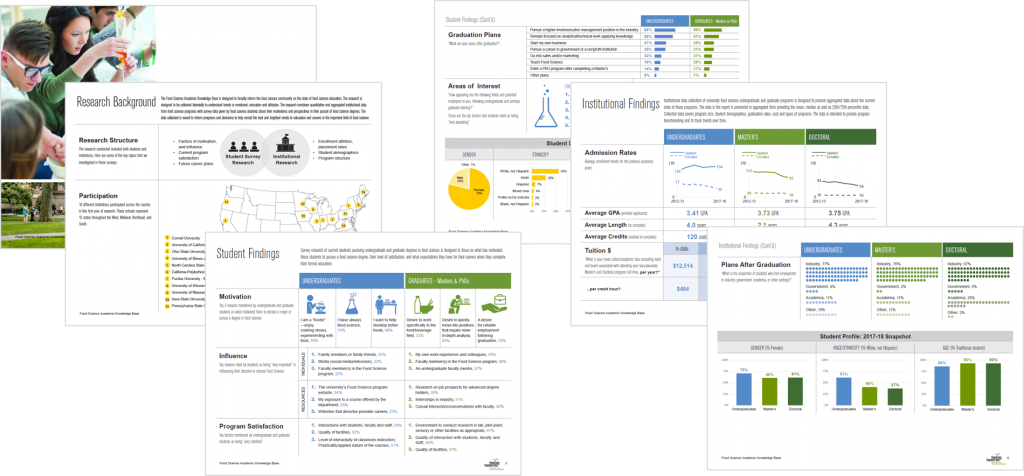
A couple years ago, I worked on this report:

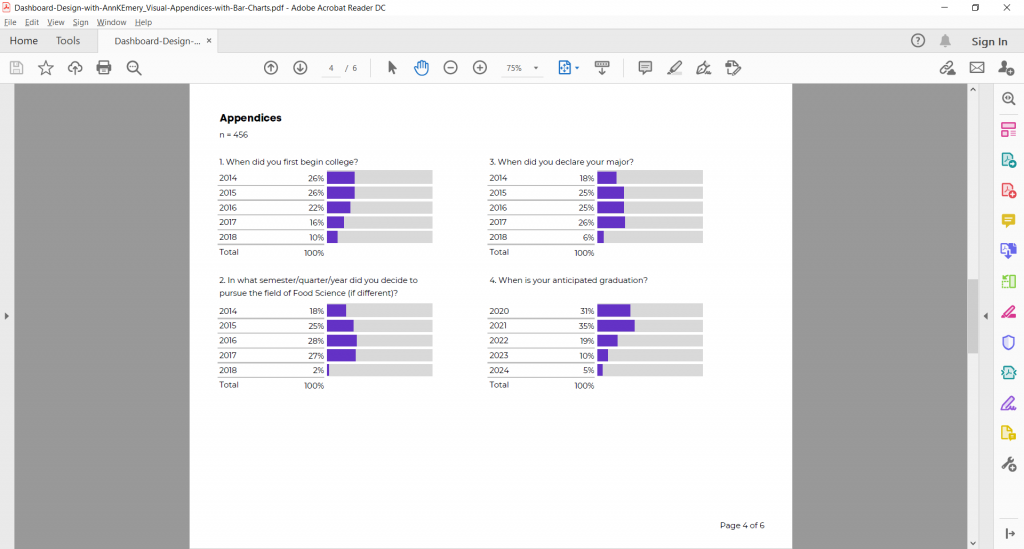
This report summarized survey responses from both universities and their students. Even with hundreds of survey responses and dozens of survey questions, we kept the report’s body to just six pages!

How’d we choose which findings to include in the report’s main body?!

That can be a daunting task. But it doesn’t have to be.

It’s much easier to pare down our report’s content when we’ve got appendices to back us up.

We don’t have to worry about forgetting any important details, since readers can simply flip to the back to learn more.

We get to be transparent by showing all the data (in the appendices) without overwhelming our busy readers (by trying to shove everything into the body of the report).

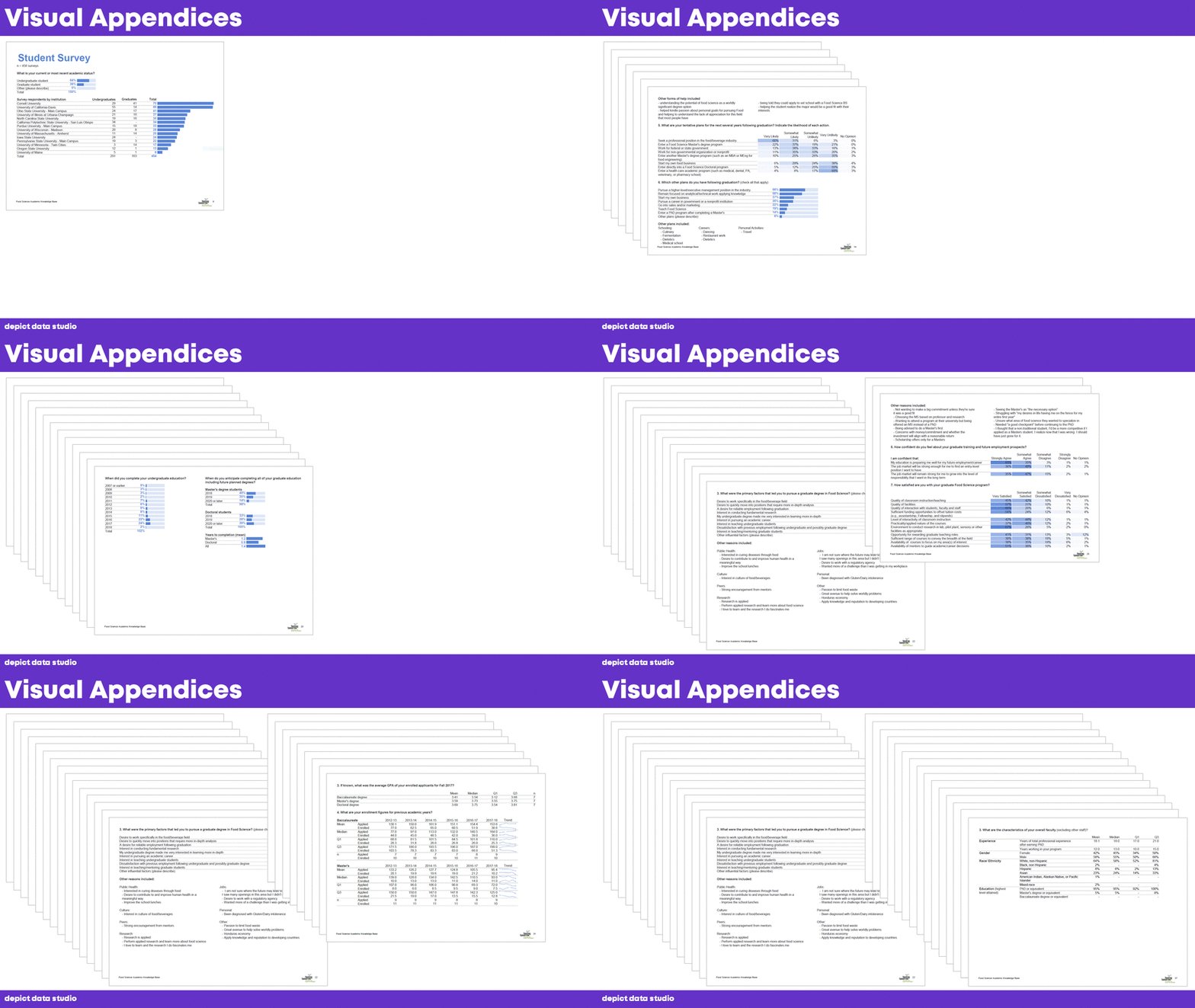
This particular report was six pages long plus 33 pages of appendices!

What Can—and Should—Be Included in Appendices

Here’s everything that can be removed from the report’s main body and pushed to the appendix:

  • Question-by-question survey responses (i.e., tables and tables of closed-ended and open-ended survey data)
  • Data collection instruments (e.g., an empty copy of the questions from the survey)
  • Transcripts from qualitative data collection (like focus groups or interviews)
  • Meeting minutes or other official documents we might’ve referenced quickly within the body of the report
  • Anything that would put our non-technical audiences to sleep
  • Anything that’s not central to the key takeaway message from the report
  • Anything we feel like we should include just in case
  • Anything that one person who asks lots of questions might need to know about
  • Patterns over time (e.g., our report’s main body could focus on this year’s data, but we might include tables that compare this year’s data to last year’s data in the appendix)

What Appendices Typically Look Like

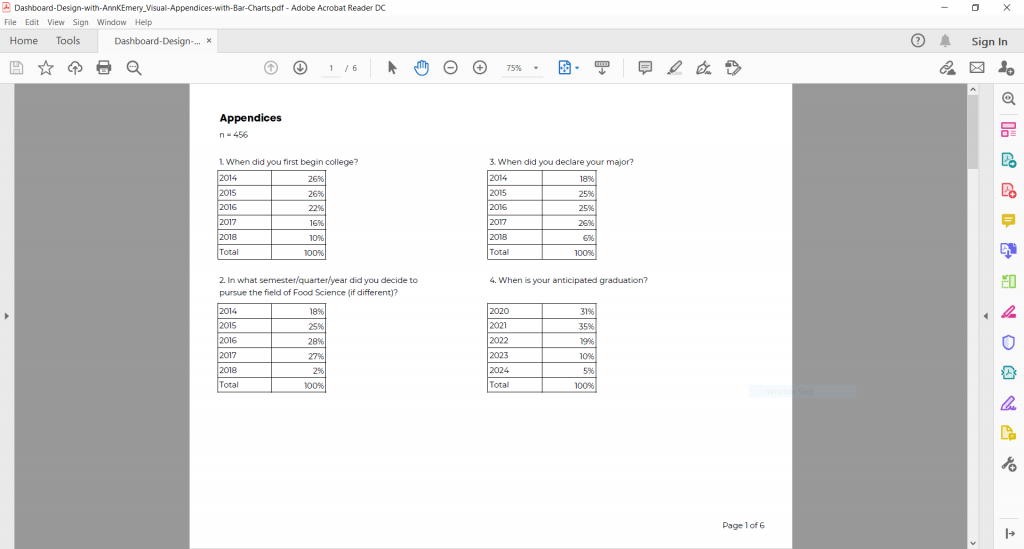
Here’s what tables in the back of reports typically look like: Tiny font sizes, cluttered tables, and no visuals to help readers spot the key patterns.

But what if I told you our appendices could get even better than that—in under an hour??

Introducing… Visual Appendices!

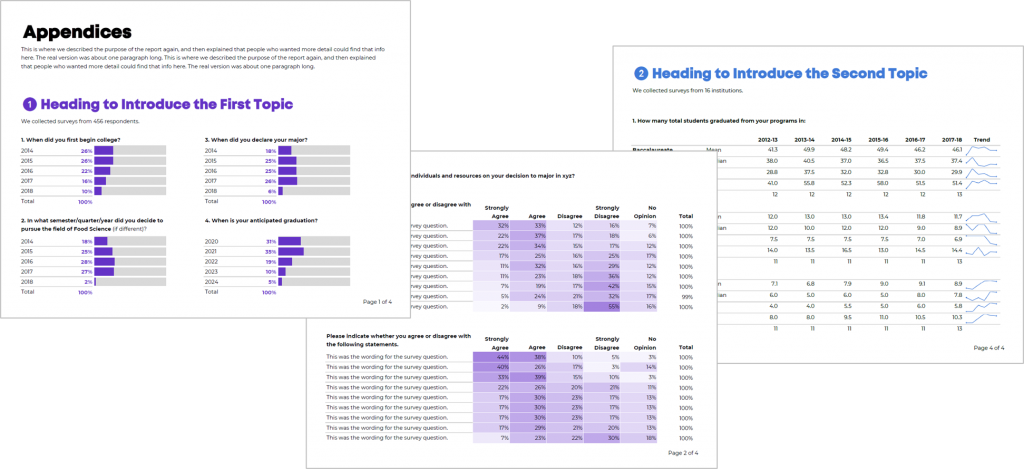
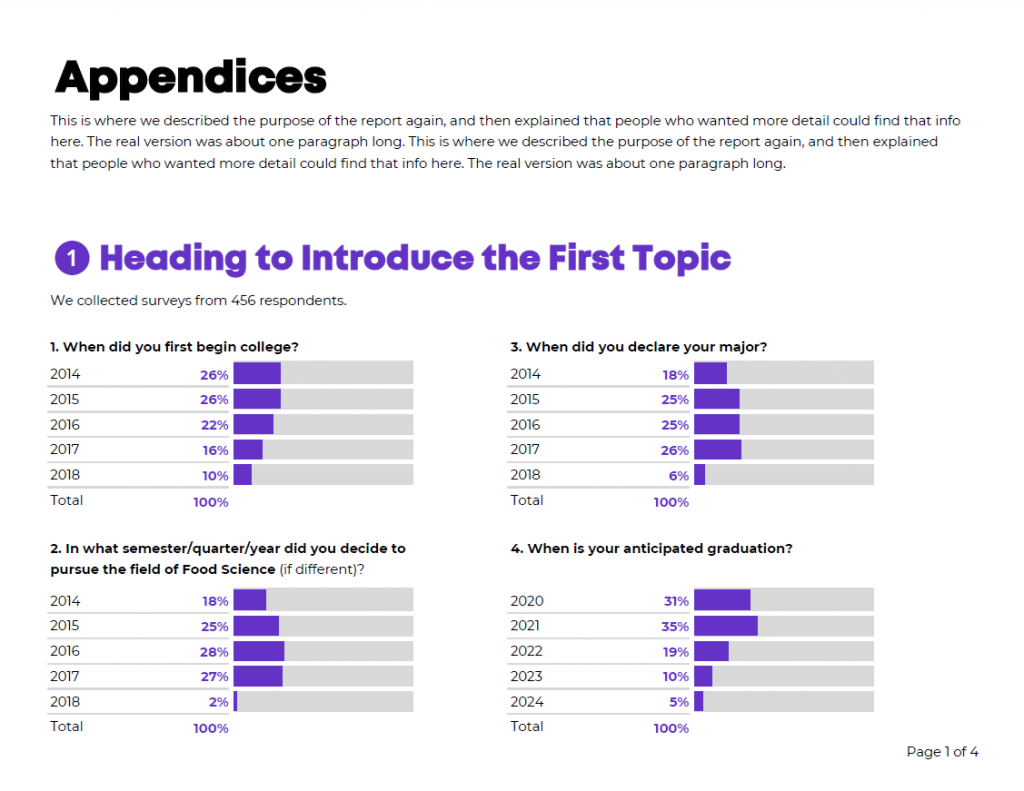
Here’s my wish for your next report: Visual appendices!

5 Easy Edits to Appendices

Let’s start with those original appendices that I showed you a moment ago…

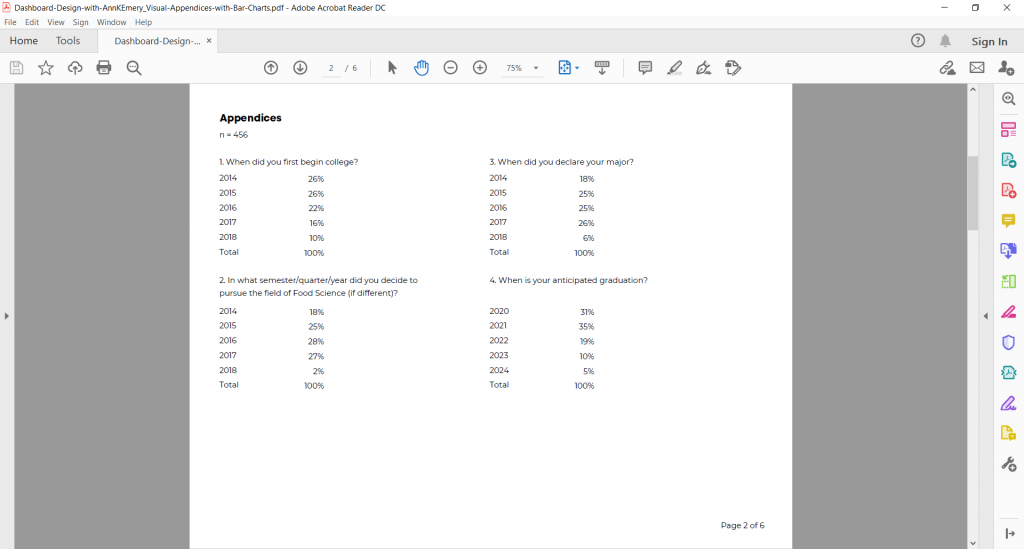
First, declutter the existing tables. Remove all the unnecessary borders and lines.

Oops! Too bare. Don’t worry, we’ll continue editing in the next step.

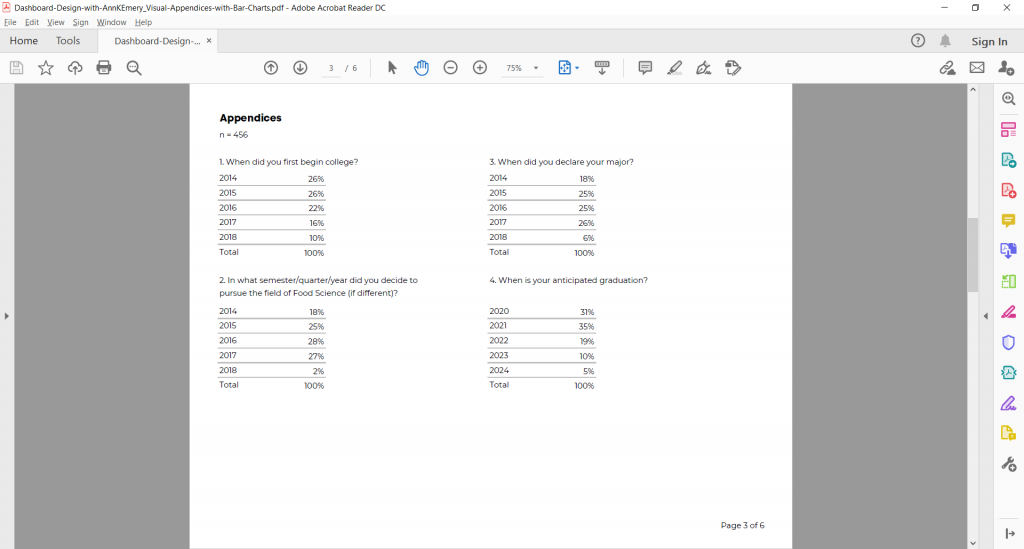
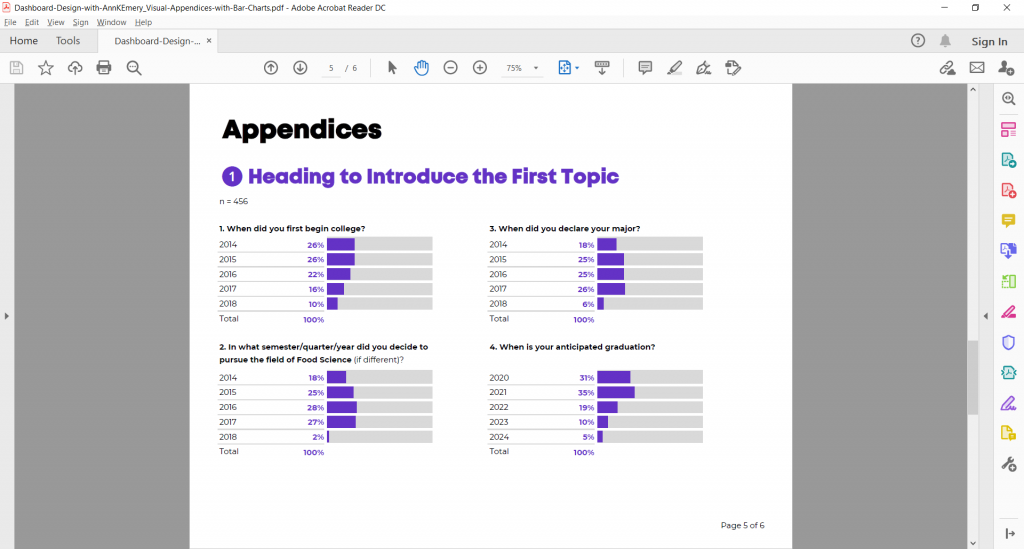
Second, I re-add the horizontal lines in gray rather than in black. Light gray horizontal lines ensure that our viewers can still read across the rows without distracting from the data by adding lots of dark ink.

Third, add visuals! This is the most fun part.

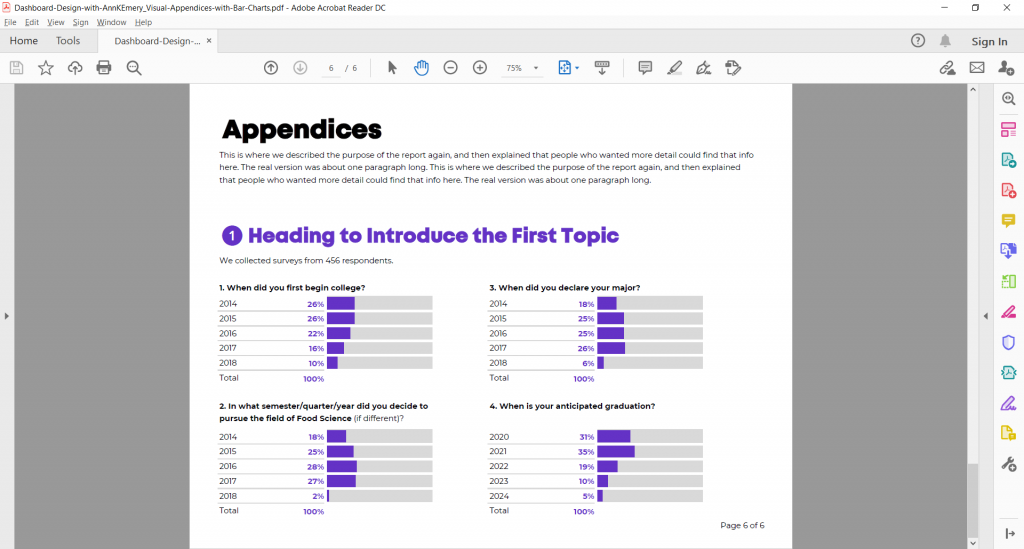
Fourth, apply a text hierarchy. A text hierarchy means our title is going to be the largest, boldest, darkest text on the page (followed by Heading 1s, 2s, and 3s).  

Fifth, add some plain-language text. In this fictional example, I’ve added a short introductory section. I’ve also changed the n=456 jargon into a friendly sentence: “We collected data from 456 respondents.”

3 Quick Visuals to Include in Appendices

There are plenty of quick visuals that we can include in our appendices. Here are a few of my favorite styles.

Bar Charts (or Stacked Bar Charts)

I showed you this approach already. We can build bar charts or stacked bars to visualize how many (“frequencies”).

Heat Tables (or Any Type of Color-Coded Cells)

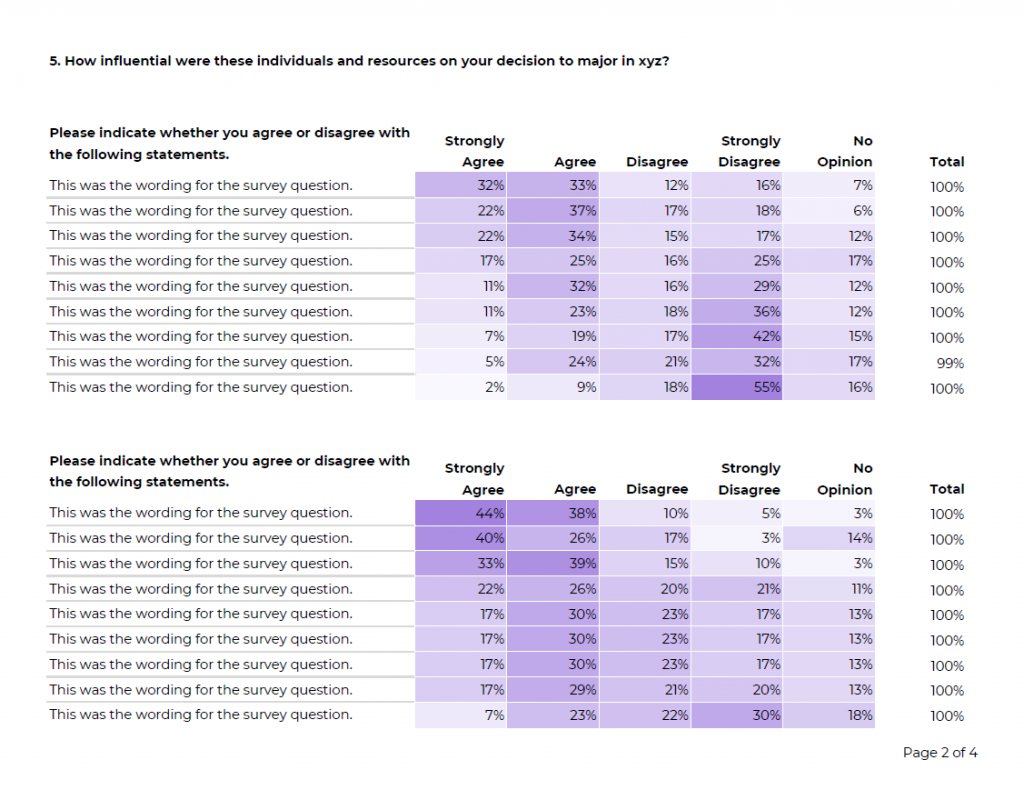
I love creating heat tables to help readers spot the highs and lows in the dataset. Heat tables are more helpful than bar charts when our tables have several rows and columns (like these fictional tables below, which have seven columns each).

Trend Lines (or Vertical Columns)

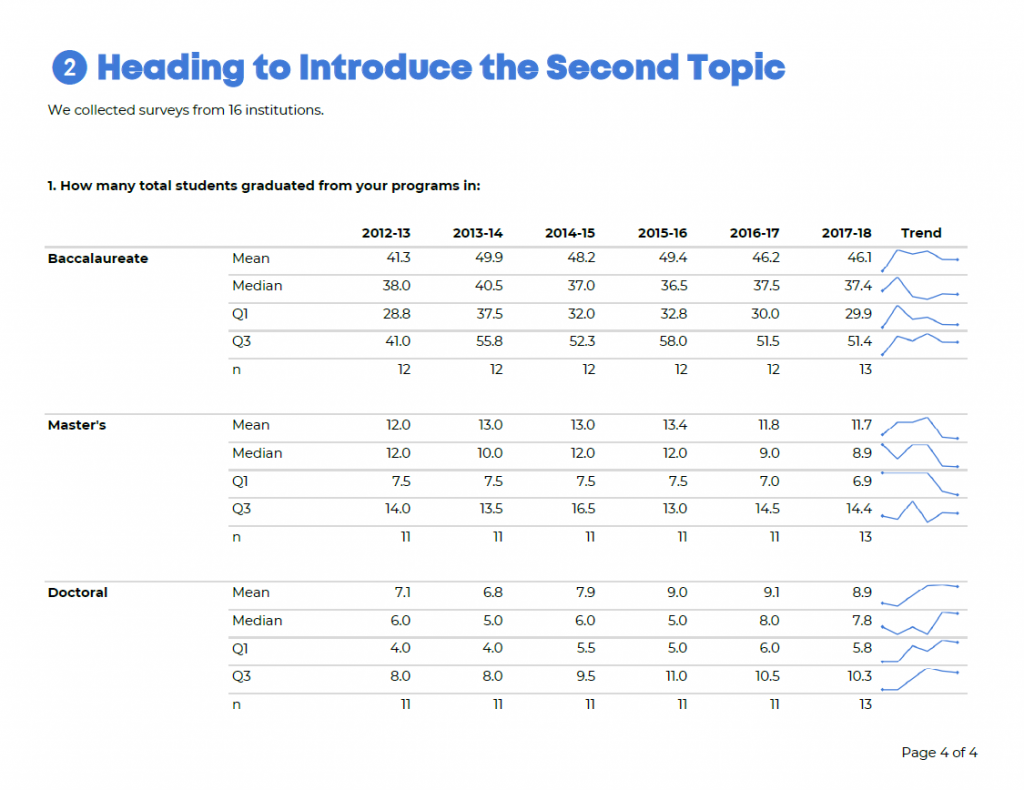
Finally, I love creating trend lines (or, vertical columns) to show patterns over time. In this fictional example, we’re comparing how the patterns shifted between the 2012-13 academic year and the 2017-18 academic year.

The next time you’re adding appendices to your report, add visual appendices!

Bonus: Learn How to Make Visual Appendices

I’m leading a live 60-minute training on visual appendices as part of the Dashboard Design Full Course, which opens for once-a-year enrollment the week of November 16-20, 2020. Learn more.

Written by cplysy · Categorized: depictdatastudio

Nov 10 2020

RK&A’s anti-racism pledge

Over the last month, we have actively been drafting an anti-racism pledge as we study and reflect on equity in our work.  We are hopeful that under the leadership of President Elect Joe Biden and Vice President Elect Kamala Harris, who both addressed systemic racism in their acceptance speeches, our government will begin the hard work of addressing racism in earnest.  Our pledge demonstrates our own earnestness in pursuing anti-racist actions.

We at RK&A, individually and collectively, pledge our commitment to being anti-racist—which we recognize as an ongoing pursuit through our everyday actions.

We consider anti-racist practices a part of Diversity, Equity, Access, and Inclusion (DEAI) efforts that we already pursue.  However, we want to make a specific pledge to anti-racist practices to acknowledge the monumental challenge of combatting racism in our world. Being anti-racist is important to us because:

  • We want to contribute to a more equitable world for individuals facing racial injustices: Black, Indigeneous, and People of Color (BIPOC).
  • We want our research and evaluation work with museums and cultural institutions to confront and challenge systemic racism.
  • We believe in the educational missions of museums and cultural organizations, but we are concerned they will become irrelevant to the public if they do not address their entrenchment in racist systems.

We will take the following actions to embed equity and anti-racist actions into our research and evaluation practices:

  • Apply We All Count’s Data Equity Framework to systematically examine our work for bias, assumptions, unfairness, and prejudice at seven project stages:
    • Funding: We will always be explicit about a project’s funder and transparent about any implications of the funding source.
    • Motivation: As evaluators, we always seek to understand why our clients are motivated to do evaluation and use this as a guidepost for our work.  In our work, we remind clients of their motivations to keep projects on task.  We are committed to going one step further and challenging clients to reveal unconscious biases that may have racist undertones.
    • Project Design: We have long valued collaboration with our clients, and we have come to realize that we cannot pursue anti-racist work without collaborating authentically with our clients.  We must understand the audiences from which we are collecting data and the institution’s relationships with these audiences to design responsive studies.  
    • Data Collection: One guiding principle of evaluation is to collect only  actionable data (i.e., data you will use).  We will avoid optical allyship (i.e., recognizing the individual in a data collection instrument but not representing the individual in reporting) as we collect data about personal characteristics (e.g., race, ethnicity, gender, etc). 
    • Data Analysis: We will challenge ourselves to rethink how we approach data analysis and question the norms of what rigor looks like (e.g., should statistical significance be standard, random versus purposeful sample, considerations for intersectionality, etc.)
    • Interpreting Data: We will be more transparent in our reports that we are data interpreters (data does not speak for itself) by intentionally using terms and phrases like “We interpret this to be…”; “We infer from this data…”; etc.  
    • Communicating & Distributing Results: We have always customized our reports per the needs of a project or client, but we can take this further.  We will rethink report design and communication strategies to ensure the way we share evaluation results is anti-racist.  
  • Ask questions to challenge white supremacy thinking and encounters with interpersonal racism (i.e., don’t fall into white silence).
  • Continue personal and professional development in how to be anti-racist through various avenues (e.g., participate in VSA’s Bridging Communities FIG, attend sessions on CRE through VSA, AEA, Equitable Evaluation, and other evaluation organizations, etc.)
  • Listen to and elevate BIPOC voices on our social media and in conversations with clients and colleagues.
  • Remain open to criticism and critique in our endeavors to pursue anti-racist work (i.e., be vulnerable) 

We recognize equity and anti-racist practices to be ongoing work.  These are the first steps we will be taking, and we plan to reflect and expand upon these actions over time.

The post RK&A’s anti-racism pledge appeared first on RK&A.

Written by cplysy · Categorized: rka

Nov 08 2020

El fracaso de la gestión del conocimiento durante la pandemia

Fuente https://www.apqc.org/


En el post El fracaso de la gestión del conocimiento, nos basamos en el el artículo “Una síntesis de los factores de falla en la gestión del conocimiento” (Frost, 2014), que refería a los factores por los que han fracasado algunas iniciativas para la gestión del conocimiento.

Si retomamos aquel post referido a nuestra gestión del conocimiento en torno a la respuesta al COVID: pensemos en la gestión del conocimiento y el aprendizaje entre la primera y segunda ola del COVID-19, lo que fue y lo que pudo haber sido: Las causas o factores causales se refieren a las cuestiones organizativas y administrativas generales que se requerían/requieren para implementar la gestión del conocimiento con éxito (o no).

Causas del fracaso de la gestión del conocimiento durante la respuesta a la pandemia:

  1. Falta de indicadores de desempeño y beneficios medibles
  2. Insuficientes incentivos o apoyos desde el equipo de dirección / gestión senior
  3. Planificación, diseño, coordinación y evaluación inadecuados
  4. Capacidad inadecuada de los gestores del conocimiento y de los que trabajan ese conocimiento
  5. Problemas con la cultura organizacional
  6. Estructura organizativa inadecuada

Efectos del fracaso de la gestión del conocimiento durante la respuesta a la pandemia:

  • Falta de contribución generalizada del conocimiento
  • Falta de relevancia, calidad y utilidad
  • Exceso de énfasis en el aprendizaje y la sistematización formales 
  • Implementación inadecuada de la tecnología
  • Presupuestación inadecuada o costos excesivos
  • Falta de rendición de cuentas, responsabilidad y apropiación
  • Pérdida de conocimiento por la rotación y la salida del personal

¿Conseguiremos gestionar el conocimiento de la primera y segunda ola para cuando llegue la tercera? Dependerá de las mejoras en el sistema de información y gestión del conocimiento:  planificación, seguimiento y evaluación, capacidad, cultura y organizativa, indicadores e incentivos.

Written by cplysy · Categorized: TripleAD

Nov 05 2020

Not Politics

I didn’t want to send a regular email today. If you are feeling anything like I am feeling, you probably have enough on your mind.

So I decided to just do something completely and totally random. I created some stream of conscience cartoons and a little cartoon story. Not my usual, but not politics either.

Insert Cartoon Here
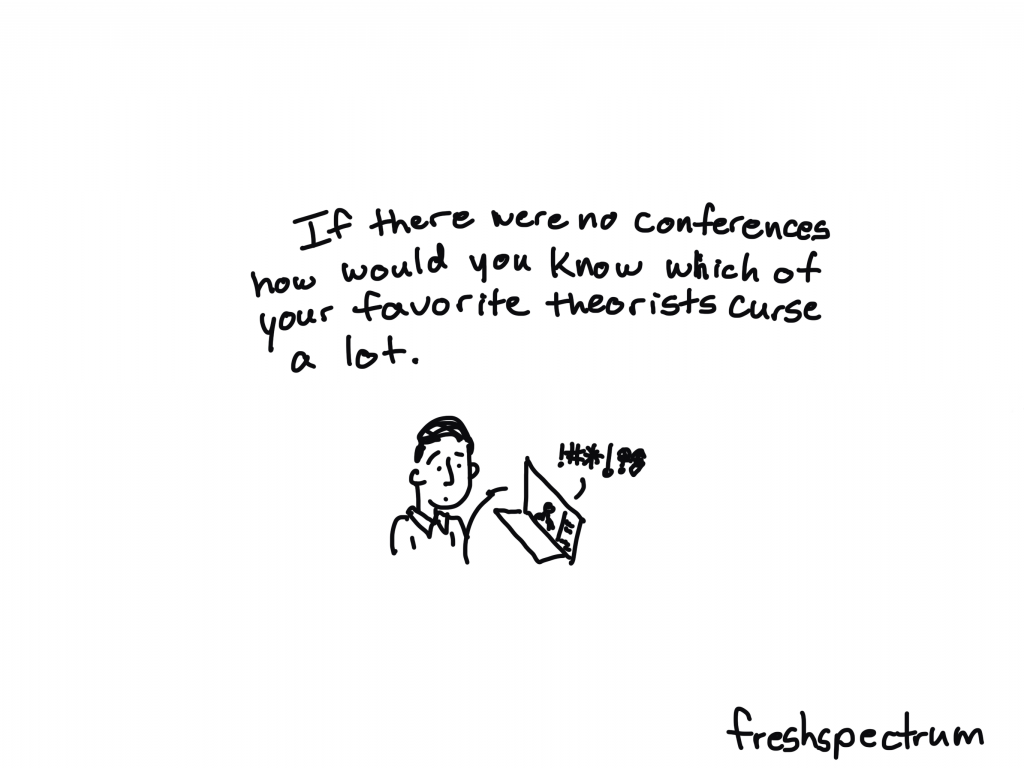
If there were no conferences how would you know which of your favorite theorists curse a lot?
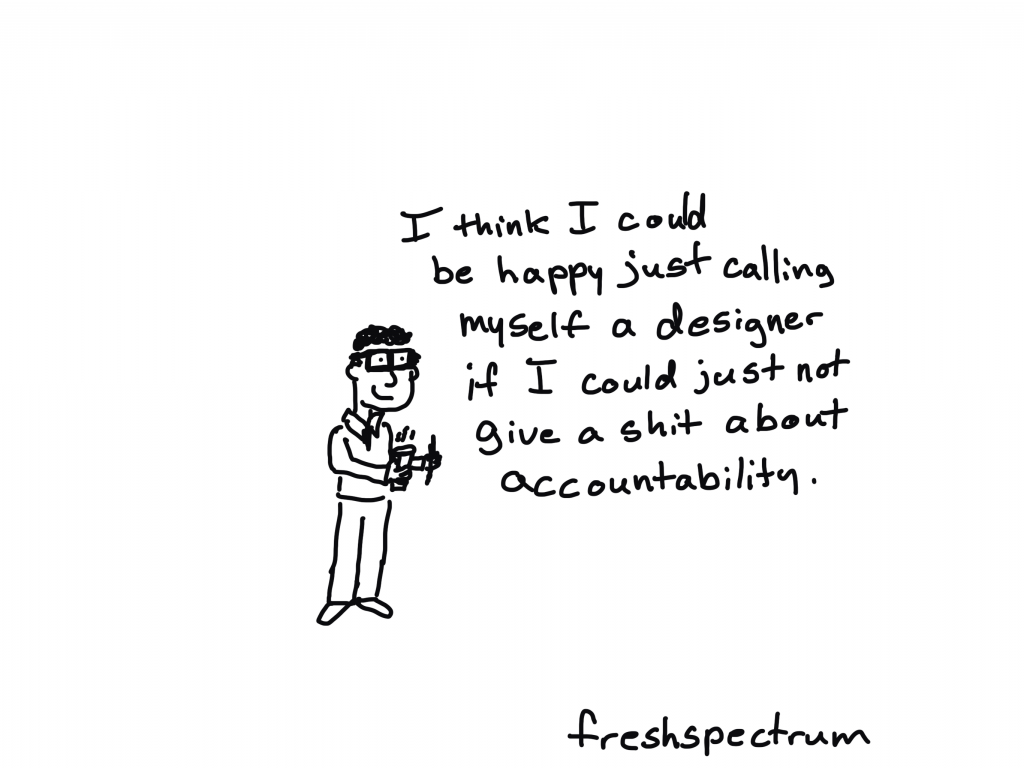
I think I could be happy just calling myself a designer if I could just not give a shit about accountability.
My first job was in fast food. You quickly learn, if you do a good job cleaning the bathroom, you will keep getting asked to clean it. Better to not do a good job.  

I always did a good job.
I read a lot of Mad Magazine as a kid.
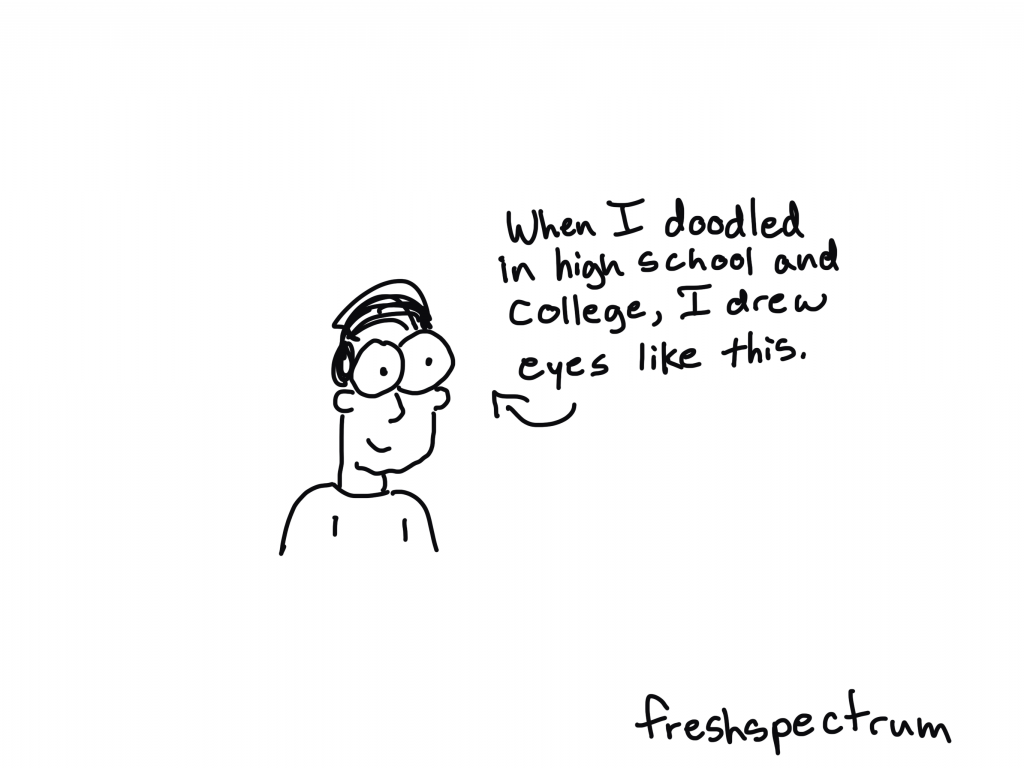
When I doodled in high school and college, I drew eyes like this (surrounded in big circles)
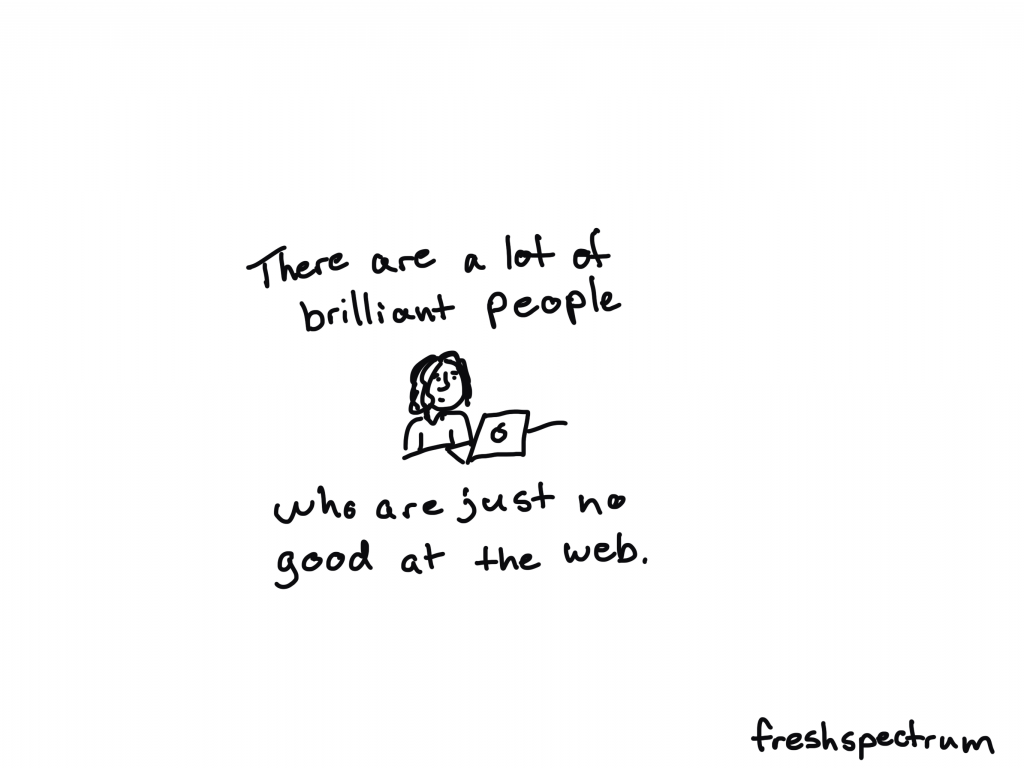
There are a lot of brilliant people who are just no good at the web
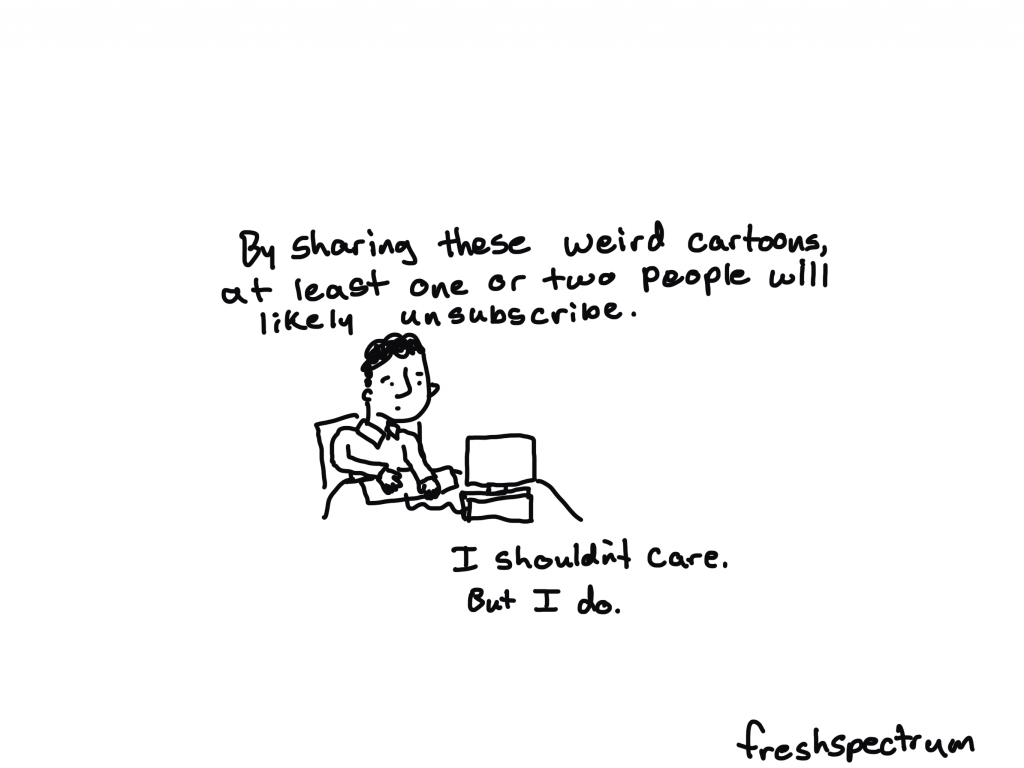
By sharing these weird cartoons, at least one or two people will likely unsubscribe. I shouldn't care. But I do.
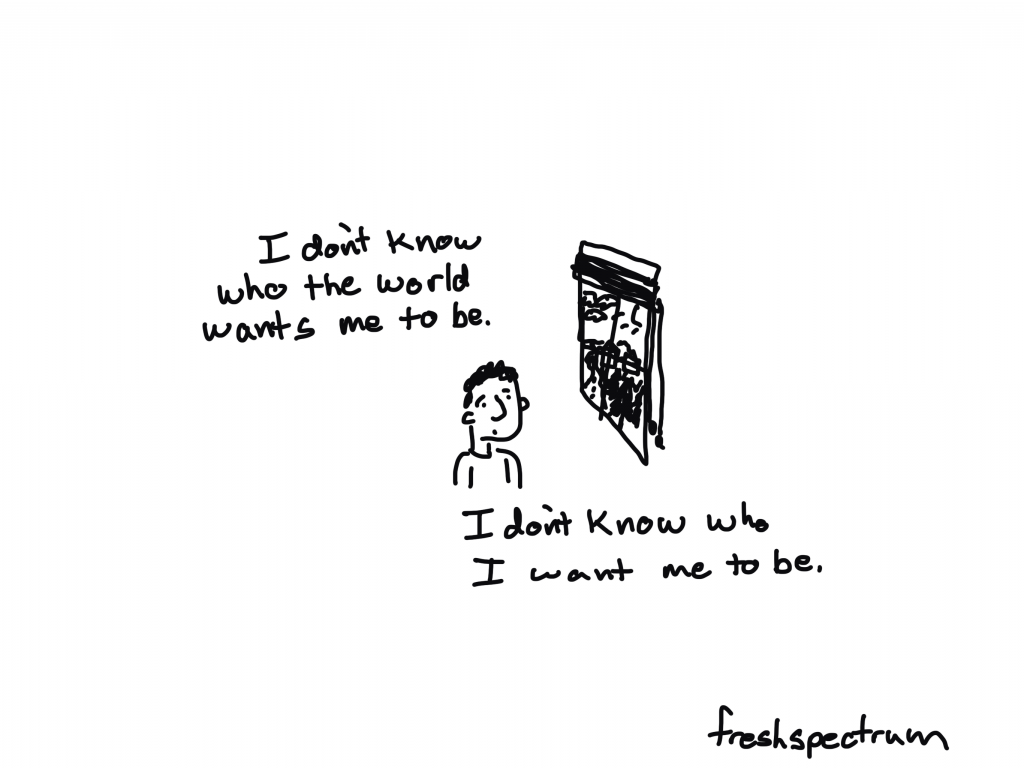
I don't know who the world wants me to be. I don't know who I want me to be.
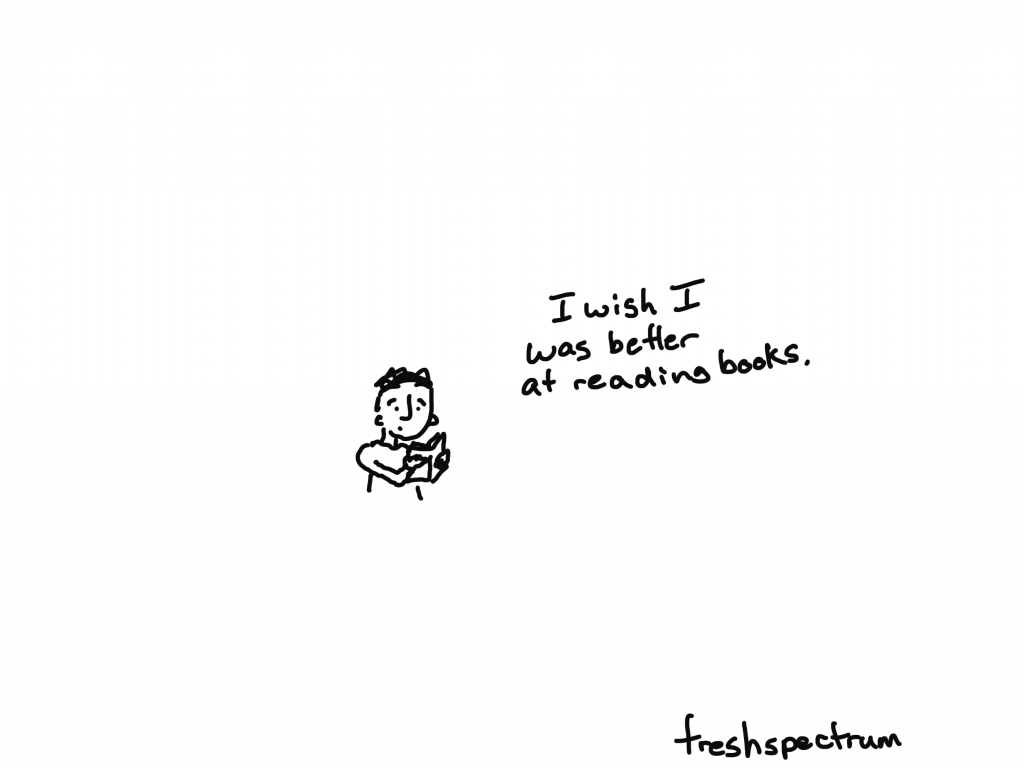
I wish I was better at reading books.
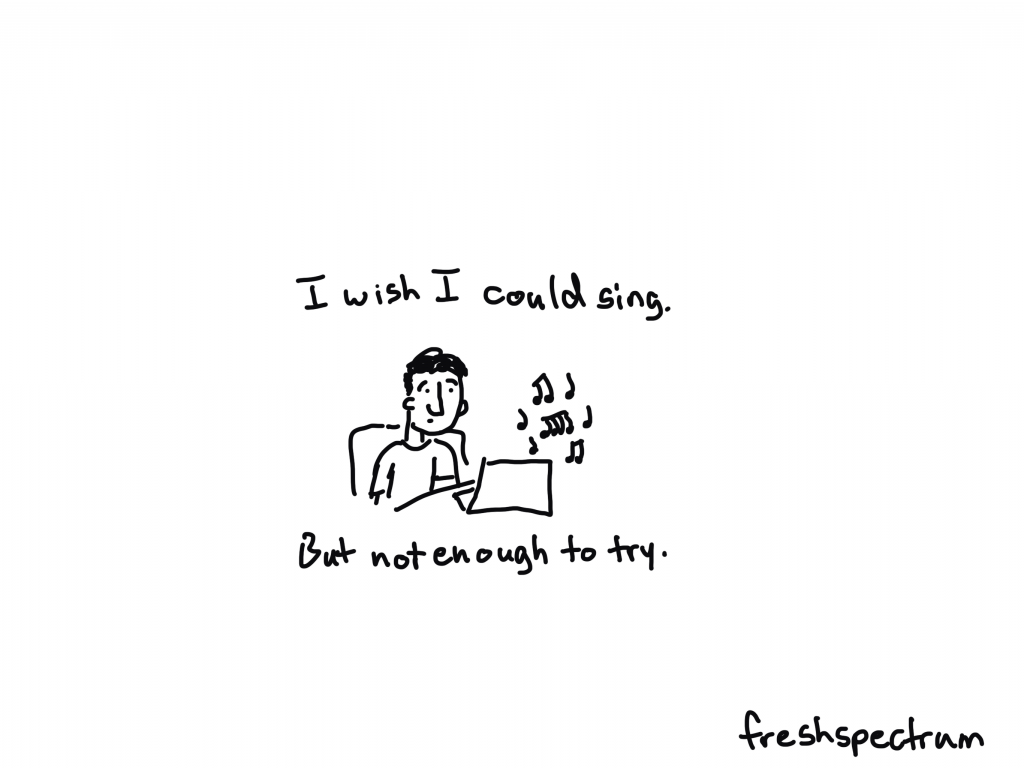
I wish I could sing. But not enough to try.
Sometimes I draw a character just to look into her eyes.

Throwing Stones

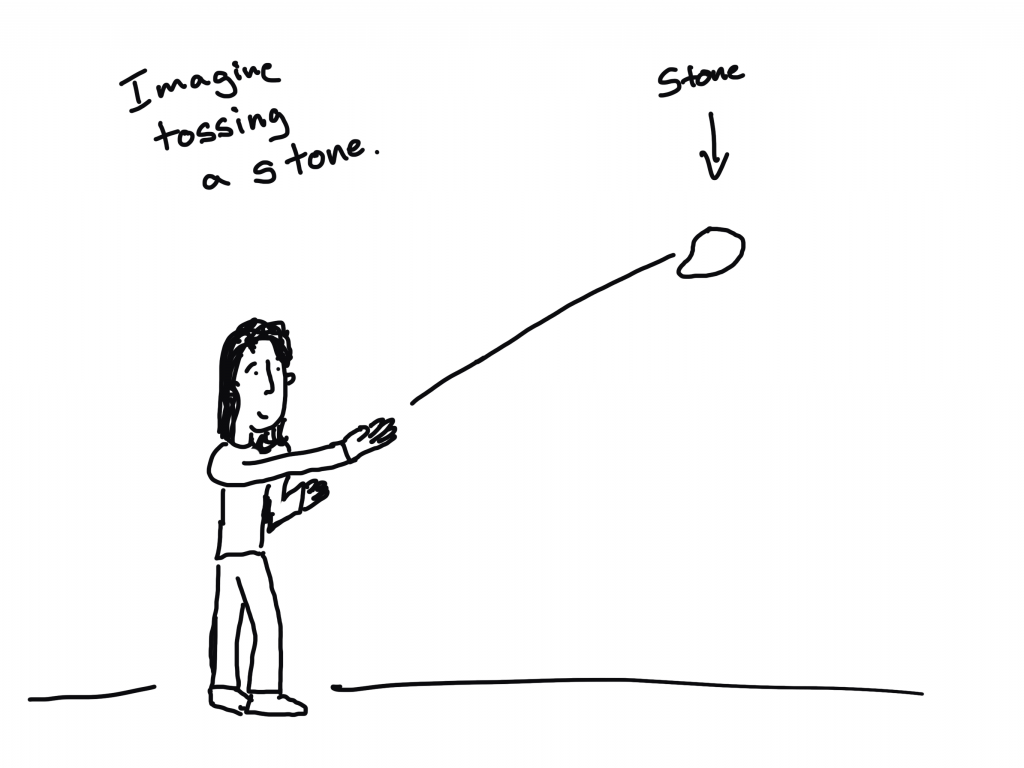
Imagine tossing a stone.
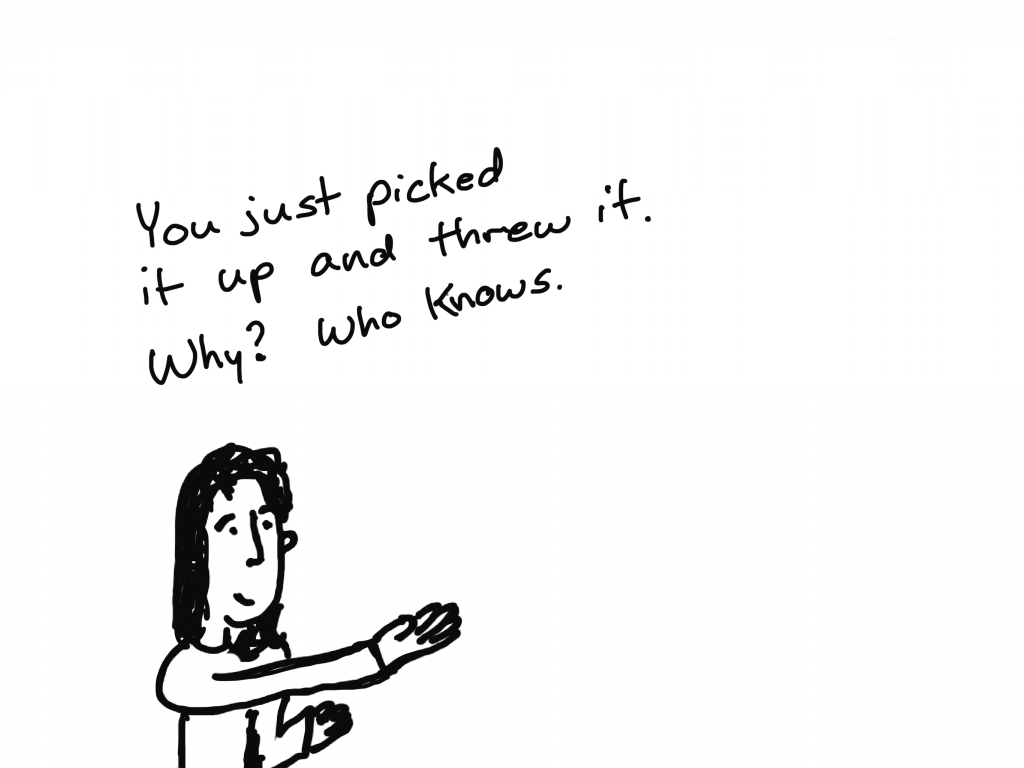
You just picked it up and threw it. Why? Who knows.
And then you turned and left.
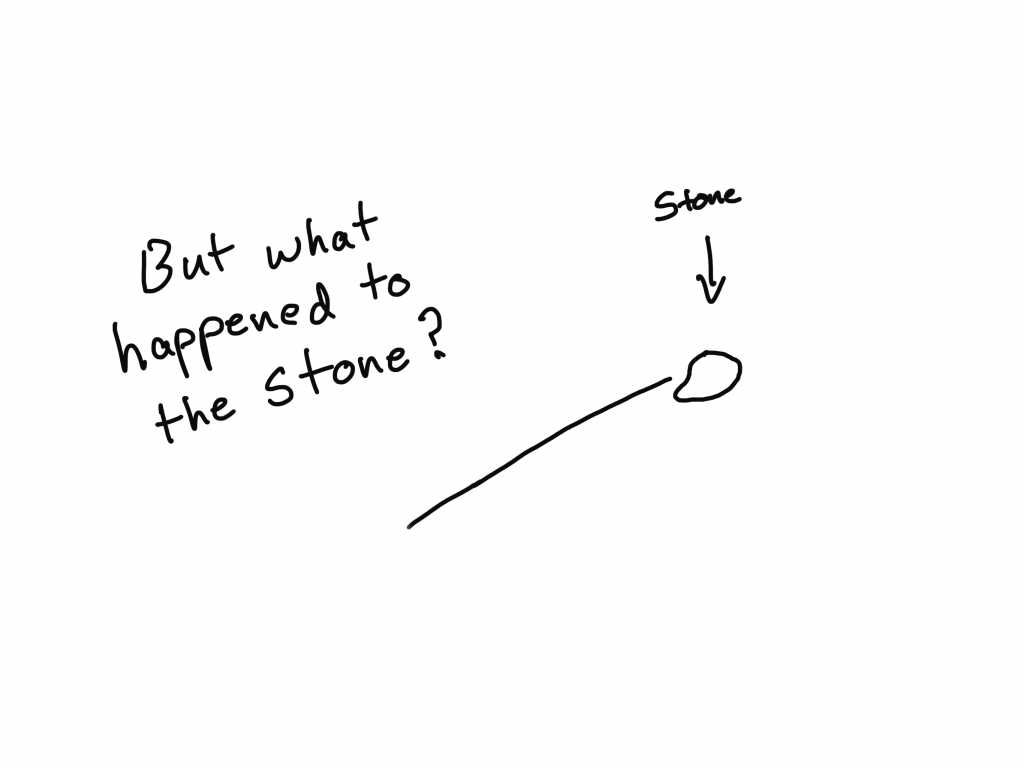
But what happened to the stone?
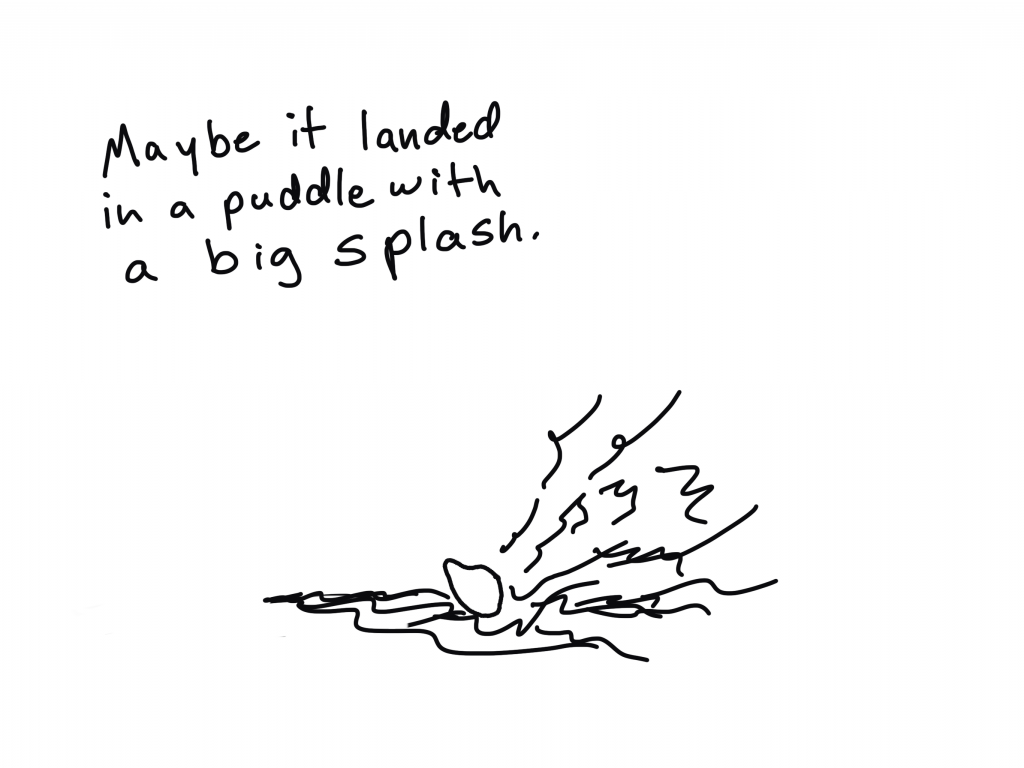
Maybe it landed in a puddle with a big splash.
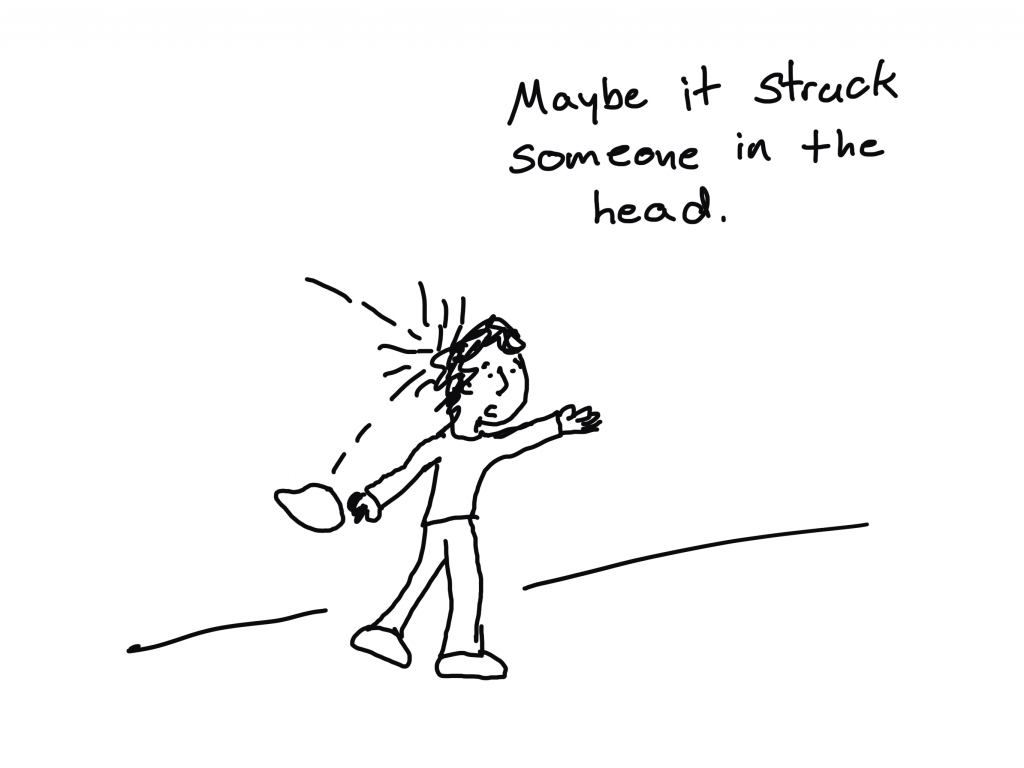
Maybe it struck someone in the head.
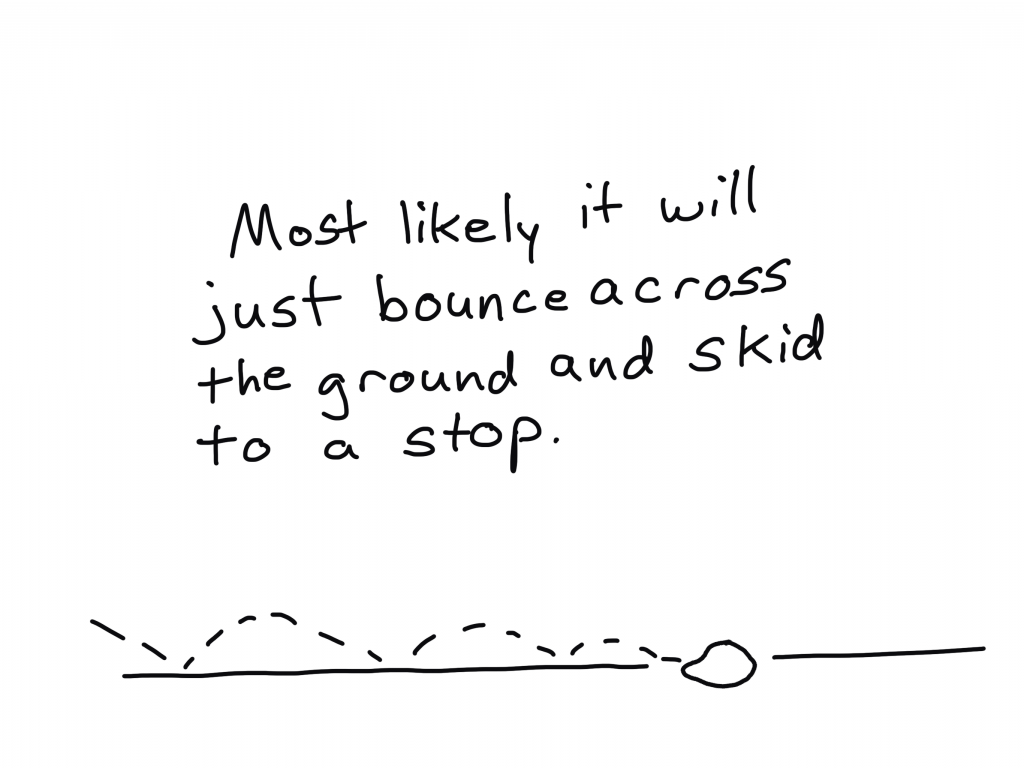
Most likely it will just bounce across the ground and skid to a stop.
But you didn't look. So you'll never know.

Written by cplysy · Categorized: freshspectrum

  • « Go to Previous Page
  • Go to page 1
  • Interim pages omitted …
  • Go to page 223
  • Go to page 224
  • Go to page 225
  • Go to page 226
  • Go to page 227
  • Interim pages omitted …
  • Go to page 310
  • Go to Next Page »

Footer

Follow our Work

The easiest way to stay connected to our work is to join our newsletter. You’ll get updates on projects, learn about new events, and hear stories from those evaluators whom the field continues to actively exclude and erase.

Get Updates

Want to take further action or join a pod? Click here to learn more.

Copyright © 2026 · The May 13 Group · Log in

en English
af Afrikaanssq Shqipam አማርኛar العربيةhy Հայերենaz Azərbaycan dilieu Euskarabe Беларуская моваbn বাংলাbs Bosanskibg Българскиca Catalàceb Cebuanony Chichewazh-CN 简体中文zh-TW 繁體中文co Corsuhr Hrvatskics Čeština‎da Dansknl Nederlandsen Englisheo Esperantoet Eestitl Filipinofi Suomifr Françaisfy Fryskgl Galegoka ქართულიde Deutschel Ελληνικάgu ગુજરાતીht Kreyol ayisyenha Harshen Hausahaw Ōlelo Hawaiʻiiw עִבְרִיתhi हिन्दीhmn Hmonghu Magyaris Íslenskaig Igboid Bahasa Indonesiaga Gaeilgeit Italianoja 日本語jw Basa Jawakn ಕನ್ನಡkk Қазақ тіліkm ភាសាខ្មែរko 한국어ku كوردی‎ky Кыргызчаlo ພາສາລາວla Latinlv Latviešu valodalt Lietuvių kalbalb Lëtzebuergeschmk Македонски јазикmg Malagasyms Bahasa Melayuml മലയാളംmt Maltesemi Te Reo Māorimr मराठीmn Монголmy ဗမာစာne नेपालीno Norsk bokmålps پښتوfa فارسیpl Polskipt Portuguêspa ਪੰਜਾਬੀro Românăru Русскийsm Samoangd Gàidhligsr Српски језикst Sesothosn Shonasd سنڌيsi සිංහලsk Slovenčinasl Slovenščinaso Afsoomaalies Españolsu Basa Sundasw Kiswahilisv Svenskatg Тоҷикӣta தமிழ்te తెలుగుth ไทยtr Türkçeuk Українськаur اردوuz O‘zbekchavi Tiếng Việtcy Cymraegxh isiXhosayi יידישyo Yorùbázu Zulu